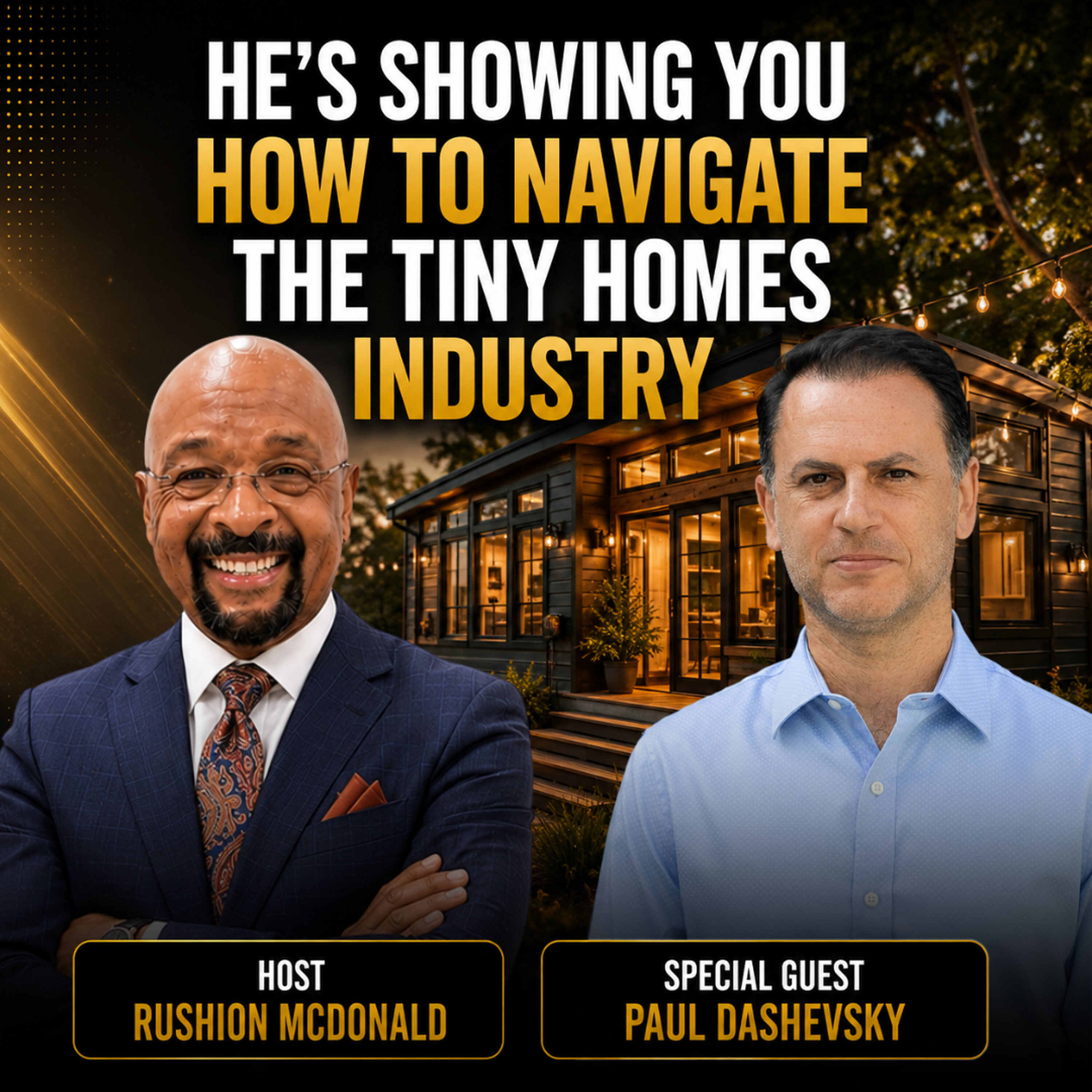
Home Ownership: Paul's conversation about Amazon selling tiny homes for under $50,000 and home affordability.
About this episode
Listen and subscribe to Money Making Conversations on iHeartRadio, Apple Podcasts, Spotify, www.moneymakingconversations.com/subscribe/ or wherever you listen to podcasts. New Money Making Conversations episodes drop daily. I want to alert you, so you don’t miss out on expert analysis and insider perspectives from my guests who provide tips that can help you uplift the community, improve your financial planning, motivation, or advice on how to be a successful entrepreneur. Keep winning!
Two-time Emmy and Three-time NAACP Image Award-winning, television Executive Producer Rushion McDonald interviewed Paul Dashevsky.
A serial entrepreneur, real estate investor, and founder of Maxable. The discussion centers on the growing popularity of Accessory Dwelling Units (ADUs), commonly known as tiny homes, granny flats, or backyard homes.
What begins as a conversation about Amazon selling tiny homes for under $50,000 develops into a broader discussion about housing affordability, rental income opportunities, caring for aging parents, property value enhancement, and the importance of properly planning and permitting ADU projects.
Purpose of the Interview
The interview aims to:
- Educate homeowners about ADUs and their benefits.
- Explain the realities behind purchasing and building tiny homes.
- Highlight how ADUs can generate income and increase property value.
- Provide guidance on avoiding costly mistakes when building an ADU.
- Explore the role ADUs may play in addressing housing shortages and affordability challenges.
Key Takeaways 1. ADUs Are Not Necessarily Tiny
Dashevsky explains that ADUs can range from very small structures around 150 square feet to homes as large as 1,200 square feet.
Many modern ADUs are between 600 and 800 square feet, making them practical living spaces for singles, couples, retirees, and small families.
2. Housing Costs Are Driving Demand
One of the main reasons ADUs are becoming popular is the rising cost of traditional housing.
Many cities and states have updated regulations to allow homeowners to build secondary housing units on their property as a way to increase affordable housing options.
3. ADUs Offer Multiple Uses
Dashevsky emphasizes the flexibility of ADUs, which can serve as:
- Rental properties
- Housing for aging parents
- Caregiver or nanny quarters
- Home offices
- Music studios
- Yoga studios
- Guest houses
- Retirement living spaces
4. ADUs Can Produce Rental Income
Many homeowners build ADUs specifically to generate revenue.
By renting out a backyard unit, owners can:
- Offset mortgage payments
- Create passive income
- Build long-term wealth through real estate
5. Buying an Amazon Tiny Home Is Not as Simple as It Seems
One of the biggest misconceptions discussed in the interview is that a tiny home purchased online is move-in ready.
Dashevsky points out that homeowners still need:
- Site preparation
- Foundations
- Utility connections
- Building permits
- Contractor assistance
- Inspections
The advertised purchase price often excludes many of these costs.
6. Contractor Selection Is Critical
After renovating and building more than 350 homes, Dashevsky warns listeners that hiring the wrong contractor can be financially devastating.
He stresses the importance of:
- Researching contractors
- Checking references
- Verifying licenses
- Avoiding high-pressure sales tactics
- Getting multiple bids
7. Permits Matter
Dashevsky strongly advises homeowners not to build ADUs without proper approvals.
Legal construction provides:
- Better resale value
- Occupancy certification
- Rental eligibility
- Safety compliance
- Protection from future legal issues
8. ADUs Can Increase Property Value
According to Dashevsky, adding a second rentable dwelling generally increases a property's value because it creates an additional income-producing asset.
For many homeowners, an ADU becomes both a lifestyle improvement and an investment vehicle.
9. ADUs May Help Address Housing Challenges
The interview concludes with a discussion about homelessness and affordable housing.
Dashevsky highlights examples where local governments encourage ADU construction as a way to increase housing supply and create more affordable living options.
Memorable Quotes On Housing Affordability
"Housing's too expensive. We want options for all sorts of folks."
On the Appeal of ADUs
"The use cases are really significant and interesting."
On Rental Income
"I want to build a home in my backyard because I want some rental income."
On Contractor Selection
"You better do your homework."
On Avoiding Contractor Scams
"Don't trust that guy that just comes in your door and sweet talks you."
On Amazon Tiny Homes
"What you're buying is just a bunch of parts."
On Permitting
"Go down to your city's building department and ask them what they need from you so you can get it permitted correctly."
On Real Estate Wealth
"If you invest in real estate, if you have one rental unit, two rental units, that's a great way to build wealth."
On Property Value
"I think you add a tiny home or accessory dwelling unit to your property, you're only enhancing the value of that property."
Executive Summary
Paul Dashevsky's core message is that ADUs are far more than a housing trend. They are a versatile real estate tool that can generate income, provide housing for family members, increase property value, and expand affordable housing options. However, homeowners should approach ADU projects thoughtfully by researching regulations, working with qualified contractors, obtaining proper permits, and understanding the true costs involved before making a purchase.
#BEST
#STRAW
#SHMS
Money Making Conversations Master Class with Rushion McDonald is America's premier entrepreneurship, business leadership, financial literacy, and wealth-building podcast featuring successful entrepreneurs, executives, founders, celebrities, and industry experts sharing actionable insights for professional and financial success.
Business Podcast
Entrepreneurship
Small Business
Business Growth
Financial Literacy
Wealth Building
Black Entrepreneurs
Minority Business
Leadership
Executive Leadership
Business Funding
Marketing Strategies
Personal Development
Startup Advice
Sales Training
CEO Interviews
Founder Stories
Professional Development
Economic Empowerment
Business Success
Networking
Brand Building
Innovation
How to start a business
Small business funding
Entrepreneur success stories
Business leadership podcast
Wealth building strategies
Black entrepreneur podcast
Minority business development
Marketing for small businesses
Business growth strategies
Startup funding opportunities
Executive leadership training
Financial literacy education
Success mindset podcast
Support the show: https://www.steveharveyfm.com/
See omnystudio.com/listener for privacy information.
Get every episode summarized
Each time The Steve Harvey Morning Show publishes, we email you a written briefing from the transcript — the topics, who appeared, and any specific claims, with the ad reads skipped.
Email me new episodesFree for 3 shows. No card needed.
Hosts & guests
Transcript ready
869 searchable segments. Every word is indexed and playable.
Full transcript
The Steve Harvey Morning Show — Home Ownership: Paul's conversation about Amazon selling tiny homes for under $50,000 and home affordability.. Machine-transcribed; use the interactive transcript above to jump the player to any line.
This is an I Heart Podcast. Guaranteed Human Guaranteed Work on Your Most Ambitious Ideas and Projects. Guest started at chatgpt.com by selecting Work Mode, available on Plus and Pro Plans. This message is brought to you by Apple Car. All the Summer Road Trip. It's a tradition as old as time. With some stops, meals, and even road trip songs pass down through the generations. But even some traditions can use a little updating. That's why there's Apple Car. Apple Car users earn daily cash back on everyday purchases.
You can even earn 2% daily cash back when you use Apple Car with Apple Pay. So, ever stop for fuel. Late night snack. And even a set of ear plugs. It's now an opportunity to earn daily cash back making Apple Car a road trip must have. Apply for Apple Car now and use a minute with Apple Pay. Subject to Credit Approval. Apple Car is issued by Goldman Sachs Bank USA Salt Lake City Branch. Terms and more at Apple Car.com. If car shopping feels like a whole thing, buying your car online on auto trader makes it way easier. Really. Shop tons of cars online. Compare prices. Check financing and trading options. From wherever you are. Start online. Test drive at the dealer and finish wherever it works for you. Your info stays with you. So there's no starting over. Plus, you're working with local dealers with real people there to help.
Buy your car online on auto trader. Really. In these sponsor jobs, get you the quality candidates when you need them the most. Spin less time searching and more time actually interviewing candidates who check all of your boxes. Let's stress. Less time. More results. When you need the right person to cut through the chaos, this is a job for indeed sponsor jobs. And listens of this show will get a $75 sponsor job credit to help you get your job. The premium stats it deserves at indeed.com slash podcast. Terms and conditions apply. Need to hire? This is a job for indeed sponsor jobs. If you're part of a political campaign, you know media plans are under serious pressure right now. TV alone is not reaching everyone. Digital is crowded. And every dollar has to work harder. That's why political advertisers are adding iHeart. With broadcast radio, podcasts, and streaming, iHeart helps get your message in front of voters with trusted voices, efficient frequency,
and scale across local markets. If you need to reach more voters before election day, let's talk. Partner with iHeart today. Call 1-844-844-iHeart. Welcome to my show. I'm Richa McDonnell, the host of Money Making Conversations Masterclass. When we encourage people to stop reading other people's success stories and start planning your own. Now you don't want to miss an episode. So please take a moment right now to follow or subscribe to Money Making Conversations Masterclass. It's free. You can follow me on iHeart Radio App, Spotify, Apple Podcast, or wherever you listen to your podcast. New Money Making Conversations Masterclass episodes drop daily. I want to keep you on alert, because my guests provide tips on how you can uplift your community, improve your financial planning, motivation, or advice, or how to be a successful entrepreneur. Now let's get this podcast started. My guests are serial entrepreneur and authority on taming homes. They are officially called accessory dwelling units now.
Well, Amazon is now selling a two-story tiny home for under $50,000. Complete with balconies and picture windows. Can you believe that? My guests is personally built and renovated over 350 homes and encountered the frustrations that arise when contractors fail to meet expectations. Buckle up. It's taming home time. Please welcome to Money Making Conversations Masterclass, Paul D'Sheffsky. How you doing, Paul? Thank you. Thank you for having me, Roshan. Great to be with you. Okay, Paul, I got to get this question out. Accessory dwelling units. When it stop being taming homes, man. Taming homes works for me, brother. Yeah, well, you and I were talking about that. I like tiny homes. I like granny flats. That was good marketing. Now they're accessory dwelling units, which is a mouthful. So let's call them ADUs. We call them ADUs out here in California. Okay, cool. Now I'm based in Atlanta, Georgia. And I've been aware of tiny homes for years. I remember I was in Houston, where I'm also living in Houston in 2017. There was creating tiny home communities.
You know, really creating modern communities. Tell me the history if you can. Of tiny homes and why, you know, we can look at the price tag. But why are they what people are like finding it? I'm comfortable with living in a tiny home space now. I mean, here on the west coast. And really this is this is happening all over the country. The governments really want to find housing alternatives. Right? We want to densify housing. We want to bring housings to expensive. We want options for all sorts of folks. And so they said really anyone in the state here. Can build a second home on their property. That never used to be the case. You were never allowed to build a second home on your property. Because that, you know, that densifies everything that creates a duplex in a sense. Now everybody can do it. And that's a big deal because that provides all sorts of folks. A great place to live because they are small, right? They are tiny homes. A lot of what we see being built are 600, 700, 800 square foot homes.
Great for singles. Great for couples. Great for retirees that don't need their large home anymore. All the home builders, they're building these big homes. Two, 2500, 3000 square foot homes. Which is great. Great for families. But lots of people need other options. Smaller type homes. And so that's why I think this is becoming trend. Okay. I would tell you, my very first apartment was 700 square feet. It was one of those split. It was a studio where it had a wall in it. And I was very, very comfortable living in 700 square feet when I think about it. So for you, you're saying that a tiny home is 600 square feet. That sounds doable in my mind. It doesn't seem like, because I think that the word tiny kind of makes it seem like it really is a small space. But it really is a livable space because I was very comfortable living in 700 square feet. What are your thoughts? Yeah, for sure. I mean, that's a good size apartment. We're seeing them anywhere from 150 square feet. Real small, right?
All the way up. The state here allows up to 1200 square feet. So when you say tiny, you know, 1200 square feet is not tiny. That's a house. Yeah. My first home was 1400 square feet. That was a two bedroom, one bath. I'm just giving people context. What you start using the word tiny homes are 80 use at the call. Now is that when you talk about 700 square feet, I live that. My very first apartment. You're talking about, would you say 1100 homes are what? 12, 12, 12, my very first house. And I was with one bear with one car garage. That was my first house. So have you ever, my friends, lived in a tiny home? Please don't go anywhere. We'll be right back with more money making conversations. Masterclass, not need for you to do me a favor. Right now, you'll follow or subscribe to money making conversation. It's free. And you can find it on the iHartRadio app. Spotify, Apple Podcasts or wherever you get your podcasts. Please do me that favor. Follow or subscribe.
Money making conversations. Welcome back to money making conversation. Masterclass hosted by me, Richard McDonald. Let's get back into it. I have never lived in the tiny home. Okay. So you're an authority. What excites you about talking about tiny homes? And we're going to get to the fact that Amazon is now selling them for under $50,000. And we're going to get to the fact that Amazon is now selling them for under $50,000. But I really want to get into the whole live aspect and then also the design. And plus you've renovated over 350 homes in your career. Talk to us about tiny homes. So we started this company five, six years ago called Maxable. And this company is online and it's a resource for anything and everything accessory dwelling units tiny homes, granny flats. Right. If you're someone's thinking about it, I know you were talking about your daughter thinking about it. Someone's thinking about it. The first thing they need to do is research because it's still a house. Right. It's still a home, whether you buy it for Amazon or you build it yourself. It's no joke. You're not building a Lego kid here. So you need to know what you're doing. How to design it. What it costs. How to finance it. So that's what my company might.
I'm going to tell you about that. What it costs. You know, what it costs. It's a lot of money. I'm going to get it. I'm going to get it. I'm going to get it. I'm going to get it. I'm going to get it. I'm going to get it. I'm going to get it. So that's what my company. Maxible does. Now, what gets me. So excited about it is the use cases. So a second home in your yard, a tiny home in your yard can be used for so many things. We have lots of clients coming to us. Some of them about 50. 50% will say. I want to build a home in my backyard. An ADU to rent. Because I want some rental income. help me pay my mortgage with that rental income. So rental income. But lots of people want to start a music studio back there. They want to have their own yoga studio back there. Maybe there were tirees and they need to go and they want to live in the backyard because they don't need their large home anymore. The use cases are really significant and interesting. And so when people build these things, they're building themselves, for themselves. But once they sell that home,
maybe the next buyer is going to use that accessory dwell unit for something else. Maybe a nanny. Maybe when you have a baby, you could put your nanny back there. Maybe you can move mom back there. You don't want her living in a senior facility. So I love the use cases. Well, first of all, education is a powerful thing because you took me from humor to reality. By mentioning parents, we have a really issue with housing for parents, because we never plan for our parents to get know. Where do they go? And being in a tiny home facility, 700 square feet, that's a lot. That you can put on your property. Then you mentioned nurse, which is another situation. Then I loved the other thought that you brought up extra income. You took this from, because a lot of people want to know. Back in the day, it was always building a garage over your apartment, over your garage. But you don't have to do that. But I want to slow this down for a minute, Paul. In my mind, I thought a tiny home
was just already manufactured. Just bring it in, just flop it down. But I keep hearing you use the word build. Tiny homes aren't like mobile homes. You can just go pick them out and just put them on a lot. You got a few options. But mostly out here, people are building their own units. They're designing them to fit their backyard. They're designing them to be permanent structures. That's what we think of ADUs. But there are. You're talking about the Amazon product. There are what we call the other side of the spectrum. Prefab, prefabricated. Prefabricated. Right. Built in a factory, cramed in on your lot. But those aren't custom. So you got to pick one. I'll take this one or I'll take that one. That's another option too. But just remember, you got to get those big boys delivered. That costs something. And you got to get them cramed in. Right? That costs something. And then I'll bring up what people usually forget when they
think about buying one of those or a home on Amazon is somebody's kind of got to put the thing together. And even if it comes kind of constructed, someone's got to build a footing, a foundation on your property. People kind of forget that you don't just plop it down on dirt usually. Someone's got to build a foundation. And then most importantly, someone's kind of connected to the utilities because they don't come with their own water source or power source or gas source. So you really do need a local contractor to kind of help you put it all together. It makes it sound easy when it comes to Amazon. But there's some complications. When the complications are you and help us get through that with your experience. Tell us about your background. Renovating homes, dealing with nightmarish contractors. I think that that's the nightmare that every homeowner or person who rents a home deals with. Talk about your experience. And how did you get into home building business? Over-innovation business, Paul. Yeah, yeah. Thank you. Yeah, my background's real estate, right?
And about 15 years ago, I started flipping and building homes here in Southern California. And we just did that for a while. And we ended up building and flipping 350 homes. So we did quite a few. And nowadays I'm helping with this company Maxwell. I'm building my own accessory dwelling units here on my own properties. So I'm doing a lot of that. And you're right. When I was flipping and building homes, we would either have a really good experience with a contractor or a really bad experience with a contractor. And I kind of wondered about that. Why? Why is this industry so challenging? And I found a statistics from a few years back, Rashan. They interviewed people after they remodeled and they asked them if they had a good experience. 50% said they had a negative experience with their contractor or their remodel. 50%. I thought, that's pretty high. I have a one in two chance. That's worse than Las Vegas. I have a one in two chance of having a really bad experience. And I thought, what if we could help people? What if we could help people find the right contractor? And so we provide resources to make sure that when you're looking for a contractor for your ADU or whatever,
your kitchen remodel, whatever it is you're doing around your house, you better do your homework. Don't trust that guy that just comes in your door and sweet talks you and smells nice and tells you that to help you back tomorrow. If you just give him a check today, you got to be real, real careful. There's too many horror stories out there where you pay somebody and you never see him again. Wow. Stay with us, more money making conversation, masterclass, comment up next. Chad GPT can do more than answer questions. It can help you get real work done. Chad GPT work is built for bigger projects with multiple steps. You bring the goal along with the information that needs, like notes, files, customer feedback, calendars, project plans, or data. Then Chad GPT can help turn that into a useful work. A marketing grief, a sales tracker, an investment update, a deck outline, and analysis, even a workflow your team can use. It can also work with approved apps and connected tools to help new the project forward.
And you stay in control the whole time. You give directions, review the work, approve any access and decide what the final result should be. So instead of spending all your time figuring out where to start, you can start making progress. Put Chad GPT to work on your most ambitious ideas and projects. Get started at ChadGPT.com by selecting Work Mode, available on plus and pro plans. When you need a hire and hero, and these sponsor jobs is a boost whenever you need to find quality talent for your business. You see, when I needed a hard additional employees for my company, 30, 15 media ink, and these sponsor jobs gave me several qualified candidates to choose from at each position. So spend less time searching, and more time actually interviewing candidates who check all your boxes. Let's stress, less time, more results. When you need the right person to cut through the chaos, this is a job for indeed sponsor job. And listens of this show will get a $75 sponsor job credit.
They help you get your job, the premium status, it deserves an indeed.com slash podcast. Just go to indeed.com slash podcast right now. And support I'll show by saying, you heard about indeed on this podcast. Indeed.com slash podcast terms and conditions apply. Need to hire? This is a job for indeed sponsor jobs. Look, I'm sure we all know someone who could use some real talk about their finances. That's where time comes in. Time is changing the way people bank. They're not like traditional old banks who charge fees and gatekeep perks and rewards. Time offers the most rewarding fee-free banking all with no overdraft fees, no monthly fees, no minimum balance fees. You get 5% cash back on a time card and a category of choice, like gas or groceries. All while building credit through regular everyday spending with no credit check, you can also grow your money faster with a savings rate that's nine times the national average. And if you're ever in a pinch,
spot me, let's you overdraft up to $200 fee-free. Listen up, my younger self would have benefited from what time offers. And today, I am benefiting right now. Join the millions who are already banking fee-free with America's number one choice for banking. Head to chime.com slash money. That is chime.com slash money. Sign up now. It only takes a few minutes. Shine is a fintech, not a bank, banking services and chime card provided by Shine's bank partners. Qualifying direct deposits required, terms and limits apply. Go to chime.com slash disclosures for details. All right, if you've been putting up a car shopping because it sounds like a whole thing, buying your car online on auto trader makes it way easier. Like almost easier than ordering your coffee easier. Really, you can search through tons of cars online, compare prices, check out financing and trading options, all from your couch, your office, wherever. And if you want to start online,
but still hit the dealership for a test drive, you can do that too, really. That's what's great about it. It's flexible. Start online. Finish that to dealer. Start at the dealer. Finish your online. Your info stays with you so you're not starting the process from scratch. And unlike those other sites, you're working with local dealers. So you've got real people helping behind the scenes. And when you're ready, you can pick your car up. I have it delivered, really. So whether you know exactly what you want, or you're scrolling, trying to figure out if you want heated cup holders or more horsepower, auto traders got options to fit how you want to buy. Buy your car online on auto trader. Really. McDonald's is putting value back on the menu. Whether you're craving a big Mac, McNuggets are sausage, egg and cheese, McGrittles make it a meal and save. Your favorite is now your wallet's favorite too. Extra value meals are back. Get a big something extra with a big Mac
or 10 piece McNuggets, fries and a medium Coke, all for just $9. Limited time only, promotion pricing may be lower than meal pricing. Ba da ba ba ba. Welcome back to Money Making Conversation Masterclass, hosted by me, Rishan McDollar. Money Making Conversation Masterclass continues online at Money Making Conversations.com and follow Money Making Conversation Masterclass on Facebook, X and Instagram. Now when you talk about, let's go to Amazon a little bit about that's what attracted my daughter. She saw your name, she looked up there, she said, hey, they got houses in there, 29,000, and under 50,000, and backerness and two stories. So the evolution of the Taney Home or the ADU, when I first saw MoTV, there was just, basically I laughed at them, I'm not going to be honest with you, Paul, I never lived there, I never lived there because they were talking about 150 square feet, 200 square, I was like, how does anybody live in there?
But when you start throwing out numbers like 600 square feet or 12 square feet, is that what you involved in custom building out, or you will also do the smaller versions as well? Look, there's a, we're a resource for everything that folks are looking at, they should do their homework right and then come to our site and take a look around. But there's a couple of different options, right? So you talked about the big ones, the 600, 700 square feet. Those are generally built by a contractor in your backyard. You're going to hire a legitimate general contractor, get an architect to design the plans and build it right there in your backyard. So that's option one, usually probably the most expensive because you're getting a real house, right? Option two is the little tiny 150 square foot ones you talk about, they're usually mobile, right? They almost they can almost drive them in, drive them onto your property, real small, real tiny little kitchen and whatnot. That's almost like living in a motor home, in a sense. And then there's stuff in the middle, like these Amazon homes or these prefabricated homes.
You know, maybe there's a site called a website called Boxable that's really interesting. They kind of come, the house kind of comes folded up if you can believe it, almost like origami. And they fold it up, put it on a truck, bring it to your site and unfold it and you have a house. That's probably about 200 square feet, something like that 150 square feet. Hold on, follow local friends there, that, I got a foldable house. I swear. And you just, and they do it, but you do tell everybody, make sure you get contractors. Don't you try to do it. That's the number one message I'm hearing from this interview. Well, look, on the Amazon home, you got to be careful, right? You know, what your buying is, is just a bunch of parts. Right. You got to really be careful. Unless you're really, really handy. You know how to work that nail gun. You need some help. You're going to need a local contractor to help you out. No question. OK, cool. You mentioned Maxable. That's the platform that they can go to. What is the experience that you're offering to anybody
who's listening to the show and just make sure we get the correct website so we drive them there? What is the experience and what do they get and do they register to get additional information? Do they do, is it virtual tours? Are there's dimensional drawings on your website? Talk to us about that. Yeah, we kind of have it all. We have a pretty good YouTube channel with, you know, I don't know, 100 or so videos that people can search through. They can look at this kind of tiny home that you and I talked about or something different. They can look at designs. We're a research site. We want people to do their homework. OK, it could be us, Maxable or other sites. Just check out, learn about them. Don't go to Amazon and click, you know, buy now on one of these things until you kind of do your homework. It's because like I said earlier, when this interview was about, you know, I was at the start of it in a very humorous state. And then you start breaking down the reality when you start talking about how you can make extra income,
how this can be in a major asset if you have an issue with your parents who are aging. What do you put them? You can put them in a tiny home on your property. Retires can look at this as a facility that you can go and live in. And like I said, $1,200 square feet is a lot. My very first apartment was $700 square feet. I was absolutely very comfortable with that. But you did remind me of this, is that Rishan, you still gotta have a foundation to put this on top of. You still gotta have utilities tied into it. You still gotta have permits. Run that through my audience again because I don't want to, they're handing from me, you are the expert, you've renovated 350 homes in your lifetime and more. And you constantly building custom ADUs. Talk to my audience about the mistakes people make and how they should move forward when they come talk to you. Yeah, I mean, folks do these things. I'll say, we used the word illegally. They add something to their home illegally,
they add a patio cover illegally, they'll put a tiny home in their backyard illegally. It's not ideal. Well, it's just not ideal. You can do it without your city permissions, but it's not ideal, right? Because you're never gonna get the value out of it when you sell your home. You really aren't allowed to rent it out. You want to do it legally. So that means, if you, whatever tiny home you're looking at, or you're thinking about, whether it's Amazon or somewhere else, go down to your city's building department. Tell them what you're thinking about doing and ask them what they need from you so you can get it permitted correctly, done correctly. So at the end of it, you can get what's called a certificate of occupancy. So someone's allowed to live in there. Do it right. You're gonna spend lots of money. This is not a couple grand. You're gonna spend lots of money, whether it's 50K or 100K, you're gonna spend lots of money. Do it right. This is gonna be somebody's home, somebody's gonna live in there. You wanna make sure it's safe. You don't wanna put mom into something that's not safe, that isn't done correctly on the right foundation, isn't hooked up to the electrical correctly. Go, that's my biggest advice. Go down to your building department at your city
and ask them what guidelines, what requirements they have for you to put this thing in your backyard. You know, some Paul, just being serious about what's happening in our world today with the homeless situation. I live in Atlanta, and when every time I fly to Los Angeles, it's like stunning the amount of homeless people that you see just like, I mean, if you've never seen a homeless situation in a major city, if you go to Los Angeles, it really will stun you. And even in the city of Atlanta, there's certain areas on the freeway, you can just drive and just a homeless village. And during the election, and I always hear people talk about affordable housing, affordable housing, when you start talking about homes under $50,000, and you're talking about with balconies and picture windows. Am I crazy when I say that this is a possible remedy for the homeless crisis that we're dealing with in America today?
I love that idea. And not only do I love that idea, but I can tell you, for example, in San Diego, because we work throughout California. In San Diego, they have a new program in that city that allows a property owner, let's say a property owner has a larger size property. Throughout the state, mostly you can add one accessory dwelling unit, maybe two accessory dwelling units. San Diego said, if you make them affordable, if you restrict their affordability for folks that to keep those rents low, you can build as many accessory dwelling units on your property as you want, no limit. So, right, like you said, build eight of those, make them affordable, make the rents something somebody can reasonably pay, and yeah, you take people off the street potentially. That's great. Now, when it comes to ADUs, property value, that's always a big statement. You know, putting a tany home, does it decrease your value of your property? What does that do? And particularly, I live in Atlanta. Do you look like you've lost your mind if you put a tany home on an acre of property,
or five acres of property? What I know you live in the California where property space is smaller, and it makes sense sometimes just slide a tany home in there. Now, we're talking to the real world, which is outside of California. Talk to us about the tany home value to properties and what type of property size works for a tany home. Look, I mean, to me, it's pretty simple. You're putting a whole second home, a living structure onto your property. Have your main house, let's say you could rent that for whatever amount you could rent it, but now you have a second property, and somebody could live there. And if somebody's gonna live there, they're not gonna live there for free, they're gonna pay you rent. And so I think you've just enhanced the value of your property. You're making money. Your audience knows that, you know, if you invest in real estate, if you have one rental unit, two rental units, that's a great way to build well. So I think you add a tany home or accessory dwelling unit, your property you're only enhancing the value of that property. And in terms of size, I think it's a matter of what fits on your property.
Like you said, whether you're in California with smaller lots, whether in Atlanta with larger lots, whatever fits and fits, you know, nicely and generously and makes sense for you, there are, here are regulations don't require a minimum lot size. So I think whatever works for you, it's great. Now enthusiasm, they always say marketing is how people find out about certain things. Now Amazon selling a two-story tiny home for under $50,000, I was like complete with balconies and picture windows. And that's that giant window you love on your home, okay? When you hear that and you being a guy of ADU, talk to us about where Amazon may be taking its brand and how it may become a mass appeal throughout the entire country. Look, I love it. It's great marketing, Amazon's right, a big name. So if they're doing something that's really interesting, I remember, before my time to be honest with you, Rashana and I'm not that young, I remember that I would heard that the serious catalog
used to sell a house, okay? So I remember that, right? You remember hearing about that? So this, maybe this is the next version of the serious catalog selling a house. I think it's really interesting, but I also think whether it's Amazon or somebody else, there needs to be an educational component here. Because again, I don't think the average person that hits click now today to buy that house is gonna be happy with the way things turn out. I think they need to understand what they get and what they don't get. And like we talked about, it's really hard to do to build something like that, unless you're really, really handy. And I think you need a local contractor to help you out. And I think you need your local city to be on board. So I don't wanna call it a gimmick, like you said, you'll call it marketing, right? It's marketing, it's been marketing. But I'd love to hear from the people that bought those and find out what kind of experience they had and how they ended up doing it. You know, I've been closed this out, mobile home parks, you know, now you have tiny homes,
and now they call it ADUs. And somehow ADUs sound a little bit more sexier than mobile home parks. How did that happen? How did the ADUs, because I guess, again, marketing, but it seems like I would tell you just, I'm much more receptive to buy ADU than buyin' a mobile home. And that is marketing and that is the business you're in. I wish you good luck, my friend. And I'm pretty sure my daughter, once she hears interviews, she's gonna be even more motivated to buy ADU, but you gave me such tremendous tips on how to look at this whole community that's growing out there. And I hope I'm just a guy on a show. And I wish America wouldn't look at the possibilities of seeing what ADUs can do for the homeless community. Cause we have to do something, and we have to get these people off the street. Any closing thoughts, Paul? I love it, Rashon. Thank you for having me on, appreciate it. Thank you for coming on Monday Making Compensation and Masterclass, you are awesome.
Thank you for listening to this episode. Not need for you to do me a favor. Right now, you'll follow or subscribe to Monday Making Conversations. It's free. And you can find it on the iHeart Radio app, Spotify, Apple podcast, or wherever you get your podcast. Please do me that favor. Follow or subscribe, Monday Making Conversations. Keep winning. Chad GPT can do more than answer questions. It can help you get real work done. With Chad GPT work, you bring the goal and the details, like notes, files, feedback, calendars, project plans, or data. Data can help create things like a brief, tracker, analysis, deck outline, or workflow. You stay in control by giving direction, reviewing the work, and choosing the final result. Put Chad GPT to work on your most ambitious ideas and projects. Get started at ChadGPT.com by selecting Work Mode, Available in Plus and Pro Plans. Indeed, sponsor jobs get you the quality candidates
when you need them the most. Spin less time searching and more time actually interviewing candidates who check all of your boxes. Let's stress less time more results. When you need the right person to cut through the chaos, this is a job for indeed, sponsor jobs. And listens of this show will get a $75 sponsor job credit to help you get your job. The premium stats it deserves at indeed.com slash park cash, terms and conditions apply. Need to hire? This is a job for indeed, sponsor jobs. McDonald's is putting value back on the menu. Whether you're craving a Big Mac, McNuggets, or sausage egg and cheese McGrittle's, make it a meal and save. Your favorite is now your wallet's favorite, too. Extra value meals are back. Get a big something extra. With a Big Mac or 10 piece McNuggets, fries and a medium coke all for just $9. Limited time only, promotion pricing may be lower than meal pricing. Ba-da-ba-ba-ba.
If you run a business, you've probably heard plenty of AI promises. But here's one thing we know for sure. When consumers here and add for your business, 90% want to know it's a real person talking. And that's what you'll get when you advertise with I Heart. We are guaranteed human. That means real voices, real connection, and trusted audio that helps businesses drive results. Learn how easy it is to tell your story through our voices. Call 844-844-I Heart today. That's 844-844-I Heart. Until now, the data your AI depends on has been trapped behind ever-increasing cloud fees. Wasabi created a Cloud Storage and is redefining cloud storage for the AI era, delivering simple, predictable cloud storage for AI, analytics, media, and more. Your data is free to move. Fast to access. And ready will your AI needs it. Hidden fees add up fast as AI workloads grow. Wasabi's flat pricing eliminates all of it. One rate, no surprises. Learn more and try now for free at wasabi.com. Wasabi, the AI Storage Cloud. Proud partner of the I Heart Podcast Network.
More episodes
More from The Steve Harvey Morning Show

Follow Your Dreams: Loni shares lessons about perseverance, mentorship, and over...
The Steve Harvey Morning Show

Follow Your Dreams: Montee served in the U.S. Marine Corps, worked in pharmaceut...
The Steve Harvey Morning Show

Follow Your Dreams: Jasmine's journey from a small rural town in Alabama to beco...
The Steve Harvey Morning Show

Mental Help: Charelle is a business strategist known as the “business therapist....
The Steve Harvey Morning Show