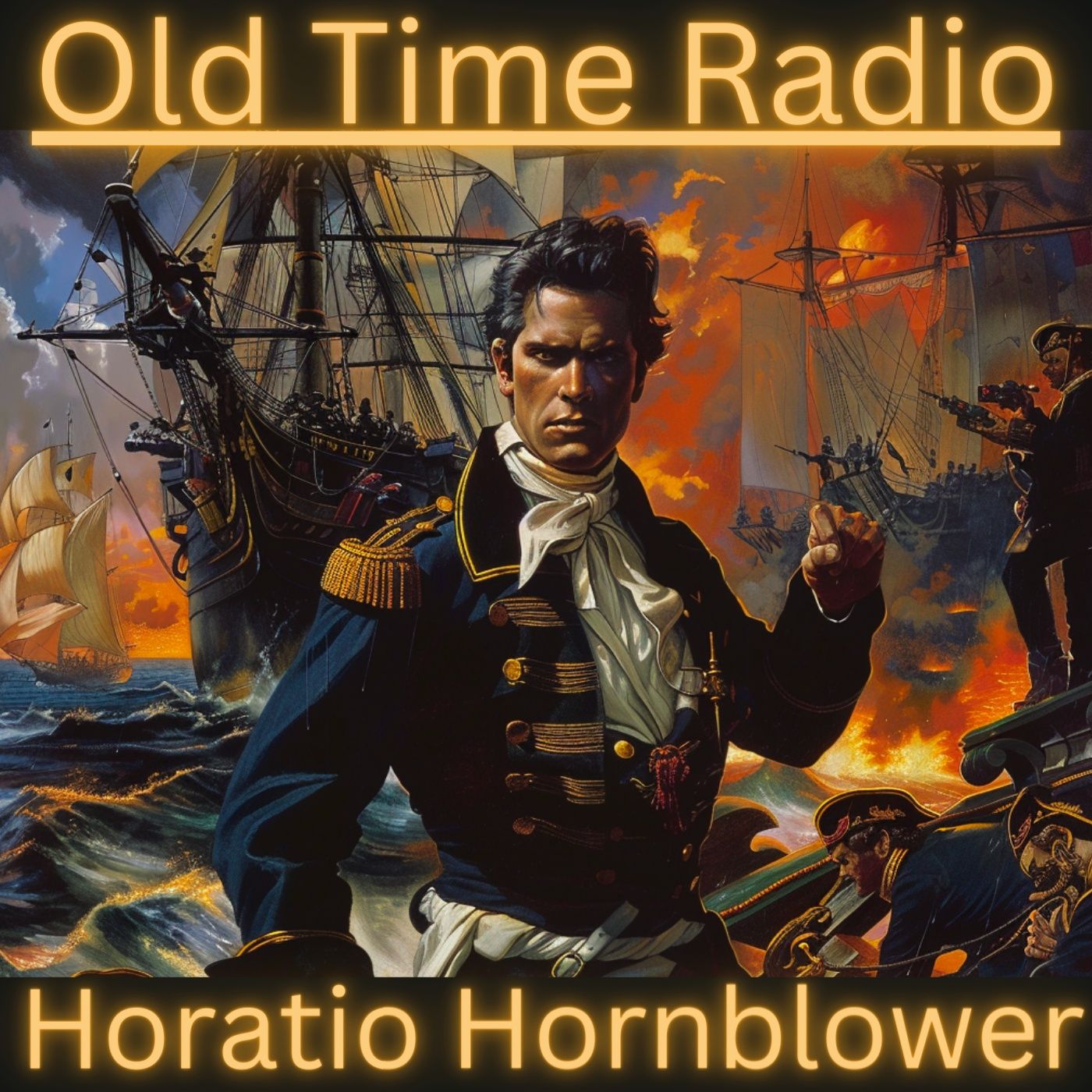
Horatio Hornblower - Horatio Captures The Natividad
About this episode
Get every episode summarized
Each time Old Time Radio Horatio Hornblower publishes, we email you a written briefing from the transcript — the topics, who appeared, and any specific claims, with the ad reads skipped.
Email me new episodesFree for 3 shows. No card needed.
Hosts & guests

Transcript ready
647 searchable segments. Every word is indexed and playable.
Full transcript
Old Time Radio Horatio Hornblower — Horatio Hornblower - Horatio Captures The Natividad. Machine-transcribed; use the interactive transcript above to jump the player to any line.
We present Nigel Anthony in The Hornblower Story, adapted from four of the CS forester novels by Val Gilgut. Part 2 from Mr. Mitchipman Hornblower, The Cargo of Rice. You will hear some people talk as if all life in the Navy afloat is much the same thing. You can take it from me that they don't know what they're talking about. Service in a ship of the line, like the Justinian, in which I started my career as Mitchipman and service in a frigate, like the Indefatigable, Captain Sir Edward Pelliew, was as different as chalk from cheese.
In a ship of the line, no Mitchipman could hope to be more than an unconsidered trifle. In a frigate there was usually the chance of taking prizes, and a prize might mean an independent command, if one only had the luck, an independent command. I thought of it all day and dreamt of it all night. Indefatigable was pounding through biscuit in a heavy sea and under a strong breeze. The waters of the bay were dotted with white sails. The sails of the stragglers from a French convoy, trying to make their home ports. While out in the Atlantic, their escorting fleet was at grips with our own. Ship-pathed ship was overhauled, a subtle two. Their newfangled trickle-f-lag came down, and a prize crew was sent on board. Captain Pelliew was not a man who wasted time, as I soon discovered.
An experienced captain and a young mid-Shipman can go well together. The brig we were chasing was slowed as a render. On that heaving sea it was hard to bring our nine pounders accurately to bear. I was beside Sir Edward on the quarter deck. No, didn't know our hull damage! I want a cripple not sunk! That's better! Got the sleaze of a four-top storyard. Now she must come up into the wind. My speaking trumpet Mr. Hornblower, if you please. Hi, I sir. What? Big sir! What does the fellow say? Mary Galombs of Bordeaux, 24 days out from New Orleans with rice. A revolutionary france, eh?
Let us sell for a pretty penny when we get our home. 200 tons, I say. Crew, twelve at most, and if you need a prize crew of four, a mid-Shipman's command. See what you can do, Mr. Hornblower. Me, sir. Take four men of the cutters crew and board that rig. Mr. Sones will give you our position. Take her into any English port you can make and report there for orders. Hi, I sir. It was no joke jumping from the Misson James into the cutter with that sea running, but it was no time to hesitate under Sir Edward's eye. I had my jerk in a pistol, and the master gave me a paper with our latitude and longitude hastily scrolled. By nature, I was always ungainly and awkward, but I met a make an exhibition of myself and delay indefatable any longer. I jumped, and cannon clumsily into the lieutenant in the stand sheets. What the do you steal, one hornblower?
Sorry, sir. Orders, would you take me to the briggs, sir? You're taking charge of her? Yes, sir. The captain requests I should take four of your men. They're better me topman. That topsel yard of theirs is all adrift. Shall I pick them for you? I'd be obliged, sir. Jones? Baker? I'd go. Grant and Matthews. Keep them away from drink, and they'll be all right. And watch the French crew, or they'll retake the ship and land you in a French jail. Aye, sir. They too, their Matthews. They too. They need a stick together. The first thing that struck my eyes as I boarded the French Brig was the profusion of bottles. There was a pile of them around the hatch cover. There's were rolling about the scuppers. Matthews, evidently the accepted leader of the men from the Qatar, regarded bottles and Frenchmen alike, with the contempt he did not try to conceal. Why, the hurly, they made the best of their time, sir.
Wish we were as happy. That'll do, Matthews. Jones, Grant, brace the afteryard, Salabad. I'll take the wheel myself. Your aided petty officer, Matthews. Get to work at once and clear away that raffle for it. Aye, aye, sir. Get that gibbon before it floods itself to pieces. We'll need more hands than we have, sir. Can I put some of the French's to work? If you think you can, and they're sober enough. I'll work them all right. Drunk or sober, sir. Very good, carry on. We're square away. What's your call, sir? For England, nor East by North. Oh, Matthews. Sir? When are those shots we fired? Looked as if it'd hold her. What's the damage? Don't rightly know, sir. We must take a closer look as soon as we can. Better sound the well now. Aye, aye, sir. I'll need a sounding line in the light. I'll get them, sir.
All right, then I can say, sir. Not a drop. Joy is yesterday, this panicking. You're certain. Sure as I'm alive, sir. Very good, Matthews. Call that rope again. Aye, aye, sir. You'll pardon me, Mr. Hornblow. But we can't keep that course as you set much longer with the wind coming up gusty light. Thank you, Matthews. Some at all hands, and where should I I couldn't wear the Russian on this tack with things as they are. I was to get no sleep that night. Short-handed, I did not dare to continue in the hope that the wind might back. I remembered my reading and instructions warning me of the terrors of a Lee Shore. The thought of taking help from my French prisoners stuck in my gut, but I could see no help for it. I sent below for their captain. I did not care for the look of him when he appeared. I'm shabin'. Very eyed. Bots renom, Monsieur.
I speak English five years. I spent it one of your thoughts, my thoughts, during the last war. My name is Julie Blanc, Lieutenant. I'm Horatio Hornblow, midshipman. Hm. Monsieur Hornblow, my men are angry. No doubt. Myner, I am. I have a cook aboard. Fortunate. Then we can come to terms. Terms? Simple enough. Your cook will provide food for everyone on board the Marie-Galant. You undertake that you and your men will make no attempt to recapture the ship. When you set file for England, Monsieur. That fact has not entirely escaped me. And we ride a little heavily. Is it not so? Maybe. A leak, perhaps. Her well has been sounded. Not a drop of water in. One shot from your figure. It stuck our eye. You know that you carry a cargo of rice, Monsieur. I do. You won't also. Should there be a leak? Every drop of water, taken into our dish, would be absorbed by the rice.
Sonny of the well will tell you nothing. Where do you think the shot hit her? On the port side, follow. You are close, hauled, and healing over when we hit you. If there is a leak, it must be below the water line. I'll go and see. You do not send one of your men. I prefer to see for myself. Our terms. They are agreed, Monsieur Leblanc. You have my hand on it. Good enough. Matthews. Ah! Guess a line, Ried. I'm going over the side. You'll take charge, Mr Matthews. Aye, aye, sir. If I find as a whole, you must bother us, ale, and get it over somehow to plug the leak. Monsieur Leblanc here has promised that his cook will feed us, better take advantage of his offer. The wave closed over my head like a momentary death. And there it was. Two feet below the water line, a splintered jagged hole, square rather than round, and at least a foot across.
At that moment, I fence it. I can hear the sea bubbling into the ship. Are you all right, sir? The Frenchman was right, Matthews. That leak must be plugged, and we've little time to spare. I doubt it, we've tied it all, sir. What do you mean? Look, sir. That deck seam and the pitch bulging out of it. Monge, dear, the cargo, it increases itself. What the devil do you mean? It's the riser. The water's got into it, and it's swelling. It'll burst the ship's seams open, sir. And the sooner we get a sail over the leak, the better, Matthews. If it's possible, sir. Of course it's possible. As Edgy was riding heavily, Monsieur, now you can see, she's already much lower in the water. You keep an eye on your own people, Monsieur Leblanc. We cannot afford any panic. Hurry with that sail, Matthews. Hi, I'm Jack. And have a late on the starboard tack. But on this present tack, we can easily make fordol. Surely you will not risk all our lives. That'd be damned for a tale.
You're a big abardance, sir. Don't light the feel of her. She's settling down. We'll see about that. I have jettison the cargo. Get all the Frenchman for it. Tail onto those tackles and sway up the hatch. We'll circle the fight. He will win the game, man. Yes, this is madness. Of course we'll do our best, sir. But it seems to me she's set in for us. And don't have to tell you twice to obey orders, Matthews. Are we going to be beaten by some rats and a few tons of rice? And you, Monsieur Leblanc. If your men don't want to drown, let me see them start working. Matthews drove the French seamen to work with a ropes end. He and my other three strained and heaved like heroes. But not at least 50 tons of cargo had been hoisted out and flung over side. The brig was a full six inches lower in the water. Now she was leaking like a basket.
The water pouring in through the gaping seams only to be sucked up immediately by the thirsty rice. There was only one thing to do. Matthews, prepare to abandon ship. Hi, Iser. Pass up to you. Best find yourself some warm clothes, Mr. Allblaser. I've been once in an open boat for ten days. Thank you. Think of yourself. And Matthews, see what you can find. Navigating instruments, charts, a compass. Hi, Iser. Monsieur Leblanc. What can I do? We shall be 17 in all. Heavy manning for your men. I'll be back. I'll be back. I'll be back. 17 in all. Heavy manning for your wretched little boat. See that your men lay hands on all the food and water they can manage. That's your service, Monsieur. Yeah? Go. You'll take the tele-mantues. You'll handle an overloaded boat better than I can. I shall leave the ship last, of course. Too bad we couldn't save her, sir. Just so. Now get along.
Hi, Iser. The brig was now so waterlogged that it was almost easy to step down from her deck into the boat. I looked back as we pulled away. The Marie-Galant had acquired a sudden list. Then she'd write it herself, her deck nearly level with the sea and sank almost on an even keel. Her masts slowly disappearing. For instance, her sails gleamed under the green water. She's gone, Mr. Ornblower. Yes, she's gone. And I'm thinking. Yes, sir. My first independent command. It's the Luxor. You're right, Matthews. It's the Luck. What's the use of thinking about it? She's gone. At any rate, we're still alive. That's about it, sir. We're alive. There's usually a funny side to things. Funny, Mr. Ornblower. Begging pardon, but what's so funny about this lot? I'm going to be sick.
Shift out of my way, Matthews, will you? It was a bad time in that open boat. As a bad a time as I can remember in all my years at sea. The Frenchman huddled in the bars, the seal of blanc and midships spainseuf. My foreman with me in the stern. Two nights without sleep. Wet, cold, and that damned sea sickness of mine. Not to speak of the thoughts which nagged me of how I'd lost my first command. At 70, you let these things get under your skin. A biscuit of hard bread and half a panicking of water didn't offer much in the shape of a consolation. Last steps, sir. Luxor bent and ready to hoist. Winds backing west to little Matthews. We'll make sail.
You'll keep the tiller. Baker, take the sheet. Close hold on the port, tack. Close all, it'll be, sir. Where do we go, Mr? North. But the wind is fair for Bordeaux. At tomorrow, we could be there. Why should we go north? Because we're bound for England. England? It'll be a week, a whole week, even if the wind stays fair. This old crowded boat. It is madness. Should there be a storm? Then we shall drown together. Let me tell you once again, Missyula Blanc, that I do not intend to rot for years in a French prison. But I insist that you head for Bordeaux. It would be hard to miss you at about five feet. There is a second pistol in my belt over my left hip. Take it, Matthews. Got it, sir. Began your pardon. But end your better cocky-hawed. You will please point that pistol another way. I only want to make it quite plain that if you, or any of your men, makes a threatening move, my petty officer, I will shoot.
Miss your own lover. I beg you, to listen to me. As I told you, I was in prison in England during the last war. It is not an experience I wish to repeat. Let us come to an agreement and sail to France. We will land anywhere you choose, then you can continue your journey freely. Or I will use all my influence to have you and your men sent back to England without stipulation for exchange or ransom. This I swear. No. Is it not a fair offer? Your government would never part with train seamen like mine on representation from you. They're too valuable. I assure you. It is also my duty to see that your train seamen do not return to France. That is your final word? Yes. Shall I, Cloudy's drawn, shut him up. That'll not be necessary, I think, Mr. Matthews. At least, put your pistol away. It's dangerous. You give me your word that you will do nothing to interfere with my command of this boat. I swear it. And your man? I undertake for them. Very well.
It was after breakfast the next morning that we sighted the sail. Naturally we rejoiced. But, in Matthews suggested she might be French. She was flush-stepped with the look of speed about her in the line of gun ports. And as Matthews pointed out, she had no possible sail set. As a ship traveling on peaceful business would normally have had in such a breeze. Matthews was right. She was a French privateer. She came tearing down on us, past her at half a cable's length, hurled to and cut off our escape. We could only curse and submit. When we stepped onto her deck, I was greeted by a young man in a plum-colored coat with a lace stock. I am Captain Newville of the privateer, Pete. May I inquire? Mitch Schiff and Homeblower of his Britannic Majesty's Navy. I do not distress yourself. The fortunes of war until we make what you will be our commentators in the peak, with all comfort possible.
But those pistils in your belt, they must surely discommodule. Let me relieve you of the weight. Here. And that duck you wear, in Petriot's youth of her lead to some rationalness, there would be a pity. Take it. A thousand thanks. Matta, show you to the bird that is prepared for you below. I should appreciate the company of my Petri office. As you wish. If you will follow me. I am a captain, Senator Mingo has been forged by recent events. I converted the peak into a poverty, so that I am a student of my dividends. Also under our Nobel Committee of Public Safety, I found Paris and unhealthy spot for a gentleman. So I choose to command myself. I expect you know your own business. Nothing, sir.
Here are your cuts. Should the ship go into action, the hatches above will be battled on. Otherwise you are free to move about as you will. I would only add that any attempt by prisoners to interfere with the working or welfare of the peak might be deeply resented by a crew. They serve with me on the shells you understand. Anyone seeking to entangle their freedom or their dividends, might easily find himself overboard. You are very frank, sir. It is where we understand one another. No. Is there anything further I can provide for your comfort? I'll part from the society to your excellent Petri office here. Where is the stepping side? Thank you. Something to read? If you can't read fresh. I can. I have some professional books. I'll comment to you Le Roon's handbook on seamanship. That will do very well, Monsieur. I may rely on your care for the welfare of my three other men.
Why? If it's much, I guess. Diggs, I turn a pumping out of the ship. I protest, sir. That sort of mean-y-al-work. We will not discuss you here if you please. Damned, mincing fellow. I'll get my hands on him, by and by, sir. You will keep your hands to yourself, Matthews, and as I tell you to the contrary. Aye, aye, sir. Begging your pardon, Mr. Ormblur, but being in here with you like this, sir. I like company. Don't you? You an officer, sir. It is perfectly fitting, Matthews. And it is my responsibility. Very good, sir. This is the soft of the two cops, sir. And I'll take the other. Damn it, Matthews. If only I had the sense to get that shot hole in the merry going on plugged a bit earlier. We shouldn't be in this pickle. Oddly your fault, Mr. Ormblur. Incompetent is always a fault. And it looks as if I shall pay for it by celebrating my 18th birthday in a French prison. It was a damnable situation, with little to do, but brewed on my failure, which had brought me to this fix.
For days we cruised in the channel approaches, and saw nothing but a tossing waste of water. Then one morning, Matthews and I were both on deck. They came a hail from the masthead of a ship visible to Windward. She altered course towards us, and the peak stood towards her all-sale set for pursuit. Or flight. I wonder, Matthews. But, God, sir, it's the old indefatigable no less. We are on the edge of her cruising ground. Oh, the same. It's long odds again. I'm not mistaken, sir. I swear to it. You may be right, Matthews. There. She's losing her royals. We'll be back aboard in time for grog. She must first catch us. Did I hear your petty officer or I must hear your own blood? That is your headship. She may be. In her case, you can tell me, what is her best point of sealing? I think not. Such nobility or attitude is out of place.
I could induce you to give me the information. But, fortunately, for you, it is not necessary. There is not one of his Britannic majesty's clumsy fridges that cannot sell the peak running before the wind. However, in the circumstances, I fancy you and your companion would be more comfortable below. I prefer fresh air. Yet, you will obey my orders. Below, miss. You, please, go below. Matthews. Hi, I said. That door in the after bulkhead. Did you see it when it was unlocked? It gives onto the boast and storm. Paint Matthews, paint. That door's two solid slabs of wood, sir. Don't make difficulties, Matthews. Take off your jersey. My jersey, sir. And don't ask damn-fool questions. What? Now, unravel it.
Then, slash open that cot's mattress and scoop out the ticking. And here's a use at last for Monsieur Le Bruns treat us on team and ship. The grease from the lamp. Spread it abroad. Will we grow like herrings, Rithal, though? We got to risk that. Get up on deck again. Get on deck. Argue. Do what you like or what you can, but stay there. What about you, sir? Do as you're told. I'll join you in a minute or two. Don't do it, Matthews. I was committed. I grabbed the lamp and smashed it onto the torn paper and scattered store. The flame caught, spread and fled.
I followed Matthews. On deck, no view was watching the Helmsman with occasional glances aloft to see that every sail was doing its work. The men were at the guns, two hands heaving the log. How much longer would I have? As it turned out, it was long enough. Nothing was so feared in our wooden ships as fire. A rush of flame shot through a cabin skyline. No view brought the peak about and head to wind. It kept the fire from the magazine. The other sails did not catch. For all that, the peak was helpless. She could neither fight nor run. Captain Pillow had seen the smoke and drawn his conclusions. The indefatigable tore down the white wave firming underneath her bicepret and hoisted out her boats a cable's length to windward. The trickle of flag fluttered down.
It remained for me to face Captain Zedward Pillow. And as I went aboard indefatigable, I could have wished myself elsewhere. Glad to see you aboard again, Mr. Hornblower. Thank you, sir. At that private year, I know something of the self-styled Captain Newveel and of his record. A private menace under public danger, Mr. Hornblower. Yes, sir. You agree with me? I was his prisoner, sir. How did he treat you? I have no complaints for myself. You're men? You might have treated them better. Quite so. I should have expected as much. Well, with a little hard work, the peak can be repaired, sent to England and then to see again. What is more important, she's no longer available in French hands to pray on English commas. Yes, for your self, Mr. Hornblower. I cannot excuse myself, sir. The Mary Galant had been holed below the waterline when I boarded her. I should have missed her. The Hornblower prayed to not make a great fuss
about very little. I beg your pardon, sir. The Mary Galant was damaged by gunfire before she surrendered. No one could establish now whether that damage was small or great. I sent you aboard with a prize crew of four. They were all I could spare. You did what you could to save her. You failed. The responsibility was mine, sir. It was all so mine. Furthermore, Mr. Hornblower, it was more important that France should be deprived of that cargo of rice than England should benefit by it. You are indulgent, too, sir. How am I indeed? That is a matter for my lords of the admiralty. In reporting the matter, I shall of course bring to their Lordship's attention the circumstances of the taking of the peak. In that case, also her capture is of considerable benefit to our country. If you say so, sir. I do say so. Fortunately, she caught fire like that.
She was running away from us and would have been out of sight in an hour. Providence, Mr. Hornblower, or have you any idea how it happened? Well, speak up. I think it must have been a case of spontaneous combustion in the paint locker. I can't account for it otherwise. Really, Mr. Hornblower. How very fortunate. Tell me, are you sure that you did not, let us say, nudge fortune's over? I should be glad to include in my report to my lords anything which might serve to favor your future career. It was the time and my opportunity to answer truthfully and with proper modesty. I might reasonably have expected a monochrome of praise, a mention in the gazettes, even perhaps my appointment is acting attendant. I could not do it. Say Edward Pellu did not know the full details of the loss
of the malice and her cargo of rice. I alone knew how and when I had failed. I alone could decide and had decided on the punishment my failure deserved. Well, then anything else, I had to reestablish myself in my own eyes. I can't account for itself. I can't account for it. I repeated it too, Sir Edward. And when I had spoken the words, I was conscious of a sudden and enormous relief. I've not a single twin of regret. In part two of the Hornblower story, you heard Nigel Anthony
as Lord Hornblower, the narrator, with Nicholas Fry in the role of Horatio as a youth. Captain Sir Edward Pellu was played by Ronald Hirdman, Able Seaman Matthews, David Miller, Captain LeBlanc, Ron Davis, Captain Nerville Peter Bell, and a Lieutenant Joe Cook. Location recordings were made by Christopher Hayton Webb and David Fleming Williams aboard the catch IP torso. The Hornblower story is directed by Trevor Hill. The Hornblower story is directed by Trevor Hill.
More episodes
More from Old Time Radio Horatio Hornblower

Horatio Hornblower - Horatio Is Court Martialed
Old Time Radio Horatio Hornblower
Horatio Hornblower - Attack On Haiti Fort
Old Time Radio Horatio Hornblower
Horatio Hornblower - Rejoining The Fleet
Old Time Radio Horatio Hornblower
Horatio Hornblower - First Meeting With Bush
Old Time Radio Horatio Hornblower