newsSep 14, 20261:54:54queued
How Finite Capacity Scheduling Actually Works in Manufacturing
About this episode
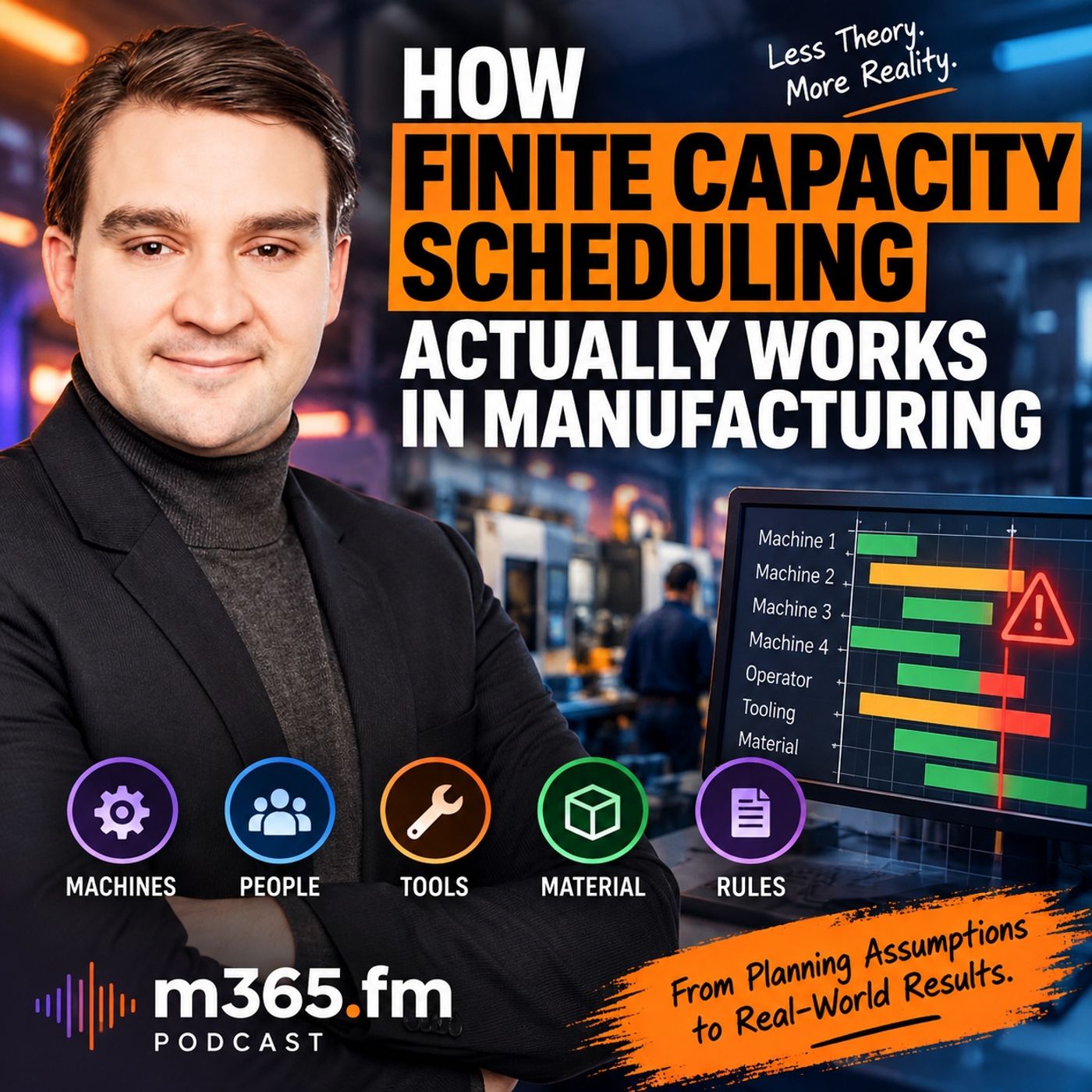
Your ERP says the production order should finish next Thursday. The routing looks correct. Material is planned. Everything appears under control. Then you walk onto the shop floor and discover the machine is already overloaded, the required operator is booked elsewhere, the fixture is in use, or the material exists in ERP but has not actually been inspected and released. That is the gap between planning demand and scheduling reality. In this deep dive, we break down how finite capacity scheduling actually works in manufacturing — from ERP and MRP planning to a schedule that accounts for the physical constraints of machines, people, tools, materials, quality gates, maintenance and time.
INFINITE VS. FINITE CAPACITY PLANNING
Infinite capacity planning has an important purpose. ERP and MRP systems can quickly calculate demand, material requirements, planned orders and dates across thousands of products and long planning horizons. But a planned date does not prove that the factory has enough usable capacity to execute the work. Finite scheduling asks the harder question: Can this operation actually run at this time, on this resource, with everything required to execute it? That means looking beyond calendar hours to usable capacity and considering machines, qualified people, tooling, fixtures, released material and process conditions.
FROM PRODUCTION ORDER TO SCHEDULED OPERATIONS
A production order cannot simply be treated as one block between a start and finish date. A finite scheduler breaks the order into individual operations and calculates setup time, runtime, waiting and transfer time before searching for eligible resources and available slots. Once an operation occupies a slot, that capacity is no longer available to another order. Delays can therefore propagate through subsequent operations and expose a late order before it reaches the shop floor.
FORWARD VS. BACKWARD SCHEDULING
We examine the two fundamental scheduling perspectives. Forward scheduling asks: Given what is ready now and the capacity we actually have, when can this order realistically finish? Backward scheduling starts with the requested delivery date and asks: When must every preceding operation happen for us to keep this promise? Comparing the two can expose the critical decision gap between the customer promise and what current production conditions can actually deliver.
SEQUENCING, BOTTLENECKS AND CHANGEOVERS
Having enough capacity somewhere in the calendar does not automatically tell you which order should run next. We explore competing sequencing strategies including due-date priority, customer priority, shortest processing time, critical ratio and campaign-based sequencing. Changeovers are especially important. Switching fixtures, tools, programs, materials or product families consumes real bottleneck capacity. A schedule that ignores sequence-dependent setup time can look feasible while being impossible to execute.
MATERIAL, PEOPLE, TOOLS AND QUALITY ARE CAPACITY TOO
A free machine does not necessarily mean an operation can start. Material may still be awaiting inspection. The qualified operator may work another shift. A fixture may be installed on another machine. A gauge may require calibration. Quality may need to approve the first piece. Finite scheduling therefore becomes a model of relationships between products, operations, resources, skills, tooling, materials and process rules, rather than simply a machine calendar.
WHAT HAPPENS WHEN THE PLAN BREAKS?
Machines fail. Materials arrive late. Operators become unavailable. Quality holds appear. Priorities change. A useful finite schedule should respond without constantly reshuffling the entire factory. We discuss rescheduling, protected or “freeze” zones, schedule nervousness and how planners can evaluate alternative scenarios instead of blindly accepting a completely regenerated schedule. The objective is not to eliminate human decisions. It is to give planners better information about what each decision will displace.
ERP, MES, APS AND THE MICROSOFT DATA LAYER
The episode also examines where the different technology layers belong. ERP owns much of the commercial and transactional context. MES provides execution status from the shop floor. Maintenance and quality systems contribute additional constraints. The scheduling or APS layer combines those inputs with production rules to determine feasible options. Microsoft technologies can support the surrounding integration, analytics and decision architecture, but they do not automatically become the finite scheduling engine. The production logic still needs explicit constraints, ownership and scheduling rules.
WHERE AI ACTUALLY HELPS
AI can help planners retrieve information, summarize disruptions, explain scheduling outcomes and surface risks. Predictive models can estimate potential machine failures, material delays or changing cycle times. But AI should not invent production feasibility. The scheduling or optimization engine evaluates explicit constraints; AI supports the surrounding decision process; and the planner remains accountable for choices involving customers, quality, labor and production priorities.
THE KEY TAKEAWAY
Finite capacity scheduling does not create capacity. If a resource has 70 usable hours and demand requires 100, an algorithm cannot manufacture the missing 30 hours. What a good schedule can do is expose that conflict early enough to decide whether to change the sequence, add capacity, use an approved alternative, subcontract work or renegotiate the customer commitment. The goal is not a factory where every machine looks busy. The goal is a plan that can actually run.
Become a supporter of this podcast: https://www.spreaker.com/podcast/m365-fm-a-microsoft-mvp-podcast-by-mirko-peters--6704921/support.
INFINITE VS. FINITE CAPACITY PLANNING
Infinite capacity planning has an important purpose. ERP and MRP systems can quickly calculate demand, material requirements, planned orders and dates across thousands of products and long planning horizons. But a planned date does not prove that the factory has enough usable capacity to execute the work. Finite scheduling asks the harder question: Can this operation actually run at this time, on this resource, with everything required to execute it? That means looking beyond calendar hours to usable capacity and considering machines, qualified people, tooling, fixtures, released material and process conditions.
FROM PRODUCTION ORDER TO SCHEDULED OPERATIONS
A production order cannot simply be treated as one block between a start and finish date. A finite scheduler breaks the order into individual operations and calculates setup time, runtime, waiting and transfer time before searching for eligible resources and available slots. Once an operation occupies a slot, that capacity is no longer available to another order. Delays can therefore propagate through subsequent operations and expose a late order before it reaches the shop floor.
FORWARD VS. BACKWARD SCHEDULING
We examine the two fundamental scheduling perspectives. Forward scheduling asks: Given what is ready now and the capacity we actually have, when can this order realistically finish? Backward scheduling starts with the requested delivery date and asks: When must every preceding operation happen for us to keep this promise? Comparing the two can expose the critical decision gap between the customer promise and what current production conditions can actually deliver.
SEQUENCING, BOTTLENECKS AND CHANGEOVERS
Having enough capacity somewhere in the calendar does not automatically tell you which order should run next. We explore competing sequencing strategies including due-date priority, customer priority, shortest processing time, critical ratio and campaign-based sequencing. Changeovers are especially important. Switching fixtures, tools, programs, materials or product families consumes real bottleneck capacity. A schedule that ignores sequence-dependent setup time can look feasible while being impossible to execute.
MATERIAL, PEOPLE, TOOLS AND QUALITY ARE CAPACITY TOO
A free machine does not necessarily mean an operation can start. Material may still be awaiting inspection. The qualified operator may work another shift. A fixture may be installed on another machine. A gauge may require calibration. Quality may need to approve the first piece. Finite scheduling therefore becomes a model of relationships between products, operations, resources, skills, tooling, materials and process rules, rather than simply a machine calendar.
WHAT HAPPENS WHEN THE PLAN BREAKS?
Machines fail. Materials arrive late. Operators become unavailable. Quality holds appear. Priorities change. A useful finite schedule should respond without constantly reshuffling the entire factory. We discuss rescheduling, protected or “freeze” zones, schedule nervousness and how planners can evaluate alternative scenarios instead of blindly accepting a completely regenerated schedule. The objective is not to eliminate human decisions. It is to give planners better information about what each decision will displace.
ERP, MES, APS AND THE MICROSOFT DATA LAYER
The episode also examines where the different technology layers belong. ERP owns much of the commercial and transactional context. MES provides execution status from the shop floor. Maintenance and quality systems contribute additional constraints. The scheduling or APS layer combines those inputs with production rules to determine feasible options. Microsoft technologies can support the surrounding integration, analytics and decision architecture, but they do not automatically become the finite scheduling engine. The production logic still needs explicit constraints, ownership and scheduling rules.
WHERE AI ACTUALLY HELPS
AI can help planners retrieve information, summarize disruptions, explain scheduling outcomes and surface risks. Predictive models can estimate potential machine failures, material delays or changing cycle times. But AI should not invent production feasibility. The scheduling or optimization engine evaluates explicit constraints; AI supports the surrounding decision process; and the planner remains accountable for choices involving customers, quality, labor and production priorities.
THE KEY TAKEAWAY
Finite capacity scheduling does not create capacity. If a resource has 70 usable hours and demand requires 100, an algorithm cannot manufacture the missing 30 hours. What a good schedule can do is expose that conflict early enough to decide whether to change the sequence, add capacity, use an approved alternative, subcontract work or renegotiate the customer commitment. The goal is not a factory where every machine looks busy. The goal is a plan that can actually run.
Become a supporter of this podcast: https://www.spreaker.com/podcast/m365-fm-a-microsoft-mvp-podcast-by-mirko-peters--6704921/support.
Get every episode summarized
Each time M365.FM - Modern work, security, and productivity with Microsoft 365 publishes, we email you a written briefing from the transcript — the topics, who appeared, and any specific claims, with the ad reads skipped.
Email me new episodesFree for 3 shows. No card needed.
Hosts & guests
No transcript yet
This episode has not been transcribed. Request it and it moves to the front of the queue.
Queued for transcription...
More episodes
More from M365.FM - Modern work, security, and productivity with Microsoft 365

Why Your Critical Path Changes When Production Changes
M365.FM - Modern work, security, and productivity with Microsoft 365
Sep 14, 20261:51:17pending

How AI Changed Software Development Forever — Building the Agentic Future with A...
M365.FM - Modern work, security, and productivity with Microsoft 365
Sep 3, 20261:11:37completed

Architecting Power Platform for Complex Enterprise Solutions with Ian Tweedie [M...
M365.FM - Modern work, security, and productivity with Microsoft 365
Sep 2, 20261:01:31completed

Copilot Inherits Your Mess: Modernizing Microsoft 365 for AI with Richard Harbri...
M365.FM - Modern work, security, and productivity with Microsoft 365
Sep 1, 20261:05:32pending