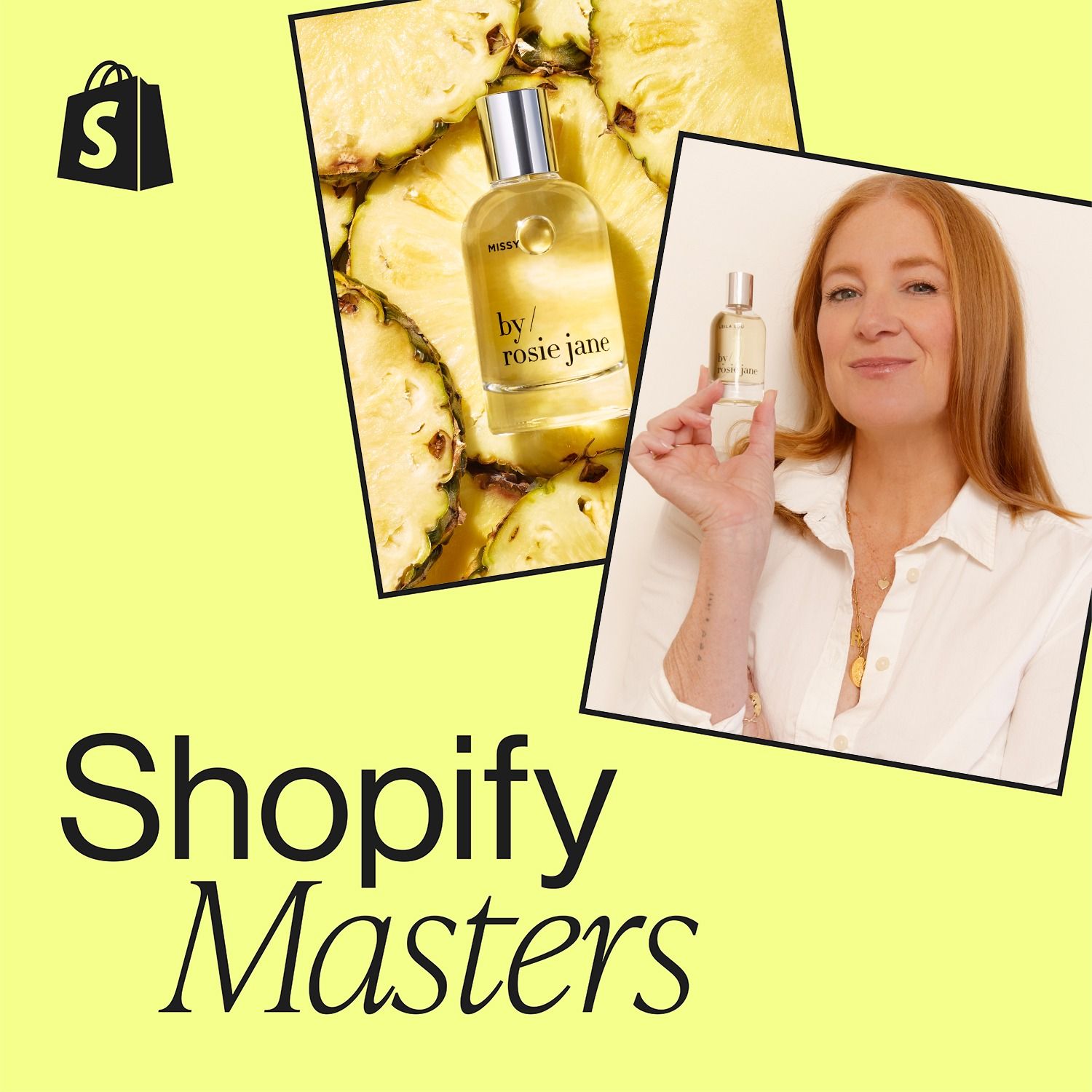
About this episode
A makeup artist started blending perfume at her kitchen table. Twenty years later, By Rosie Jane is set to hit $15 million in sales—bootstrapped, profitable, and still in control.
For more on By Rosie Jane and show notes click here.
Get every episode summarized
Each time Shopify Masters publishes, we email you a written briefing from the transcript — the topics, who appeared, and any specific claims, with the ad reads skipped.
Email me new episodesFree for 3 shows. No card needed.
Hosts & guests
Transcript ready
752 searchable segments. Every word is indexed and playable.
Full transcript
Shopify Masters — How I Scaled My Side Hustle to $15 Million. Machine-transcribed; use the interactive transcript above to jump the player to any line.
You can mark it the f**k out of something, but you're only gonna get one purchase if it's not a great product. They say an overnight success takes at least 10 years to build and by Rosie Jane is living proof of that. Founder Rosie Johnson, a celebrity makeup artist, first started blending her own signature fragrance back in 2005. If you don't make the call or turn up at the store, you're never gonna get the sale. What began as a personal side hustle officially became a business in 2010. For nearly a decade, Rosie was juggling her makeup career and raising a family all while growing the brand. There is no work life balance. You have to know that that's the sacrifice. But everything changed in 2019 when by Rosie Jane became one of the first ever clean fragrance brands carried by Sephora, a milestone that allowed Rosie to become a full-time entrepreneur. Today Rosie is still scaling without outside funding. It is built an authentic community forecasting up to 15 million in sales this year. Rosie's here to share her journey of bootstrapping building strong customer loyalty
and breaking into established retail partners. Rosie, thank you so much for being here. Thank you for having me. Let's rewind back to 2005. You are designing this fragrance for her. For me, for me, I love the word designing is very fancy. I was sitting at a table with a girlfriend. We were sharing a bottle of wine or two and I was like, how am I gonna kind of cut through? What's gonna be my signature calling card? That is when I was like, I'm gonna create something that is uniquely me. I want people to say, can you book me that makeup artist that smells so good? That was the goal from the get-go. I didn't think much further forward than how can I create something that smells amazing that I wanna wear and that my clients won't be overly bothered by. I think that that was probably the key ingredient which made the fragrance the way that it smelled particularly different because you're so close to people. What were you bothered by in terms of fragrances back then?
What was going on in the industry? For me, I just never wanted to be in somebody's fragrance backdrop is the way that I would describe it. When someone walks in front of you and I'm behind them and I'm like, oh my God, I'm so taken and overwhelmed by it. I never wanted to do that to somebody else. As a makeup artist, my hands are in people's faces. I'm inches away from them. So I wanted something that smelled amazing, that smelled clean, that smelled fresh, that smelled casual and didn't overtake the room. Also fragrance at that time still was very formal. Every commercial for it, every advertisement was all about this fantasy, very formal life, beautiful gold gowns, dripping in sort of extraordinary situations. I was busy, I was tired. I had just had my first daughter. I wanted something that felt uplifting in a second, but also felt casual and still like me.
So creating for your own personal experience has been a theme throughout the course of the brand build. How important is it for you to continue to develop product with your own personal experience in mind and can you highlight any examples of that? For me, I create from such a personal space and I've used this sort of reference before which is I think of it like a musician. Songwriters always write and create music from a personal place and fragrance is very much like that for me and beauty. It adds a realness into it and I have this line on our website which is if I don't use it and I wouldn't use it on my kids, it's not going out into the market, right? Like it's just not happening. And I don't always want it to be super subjective though where it's like, oh well, I love Gardenia and everyone else is like, I don't love Gardenia but it always starts. That's what the seed of inspiration is and then it evolves into something bigger or more broad but my body care line, so I am 49 years old.
I have already gone through menopause. I wanted to create something that felt relieving of those symptoms. That was the biggest sort of driver. I started researching within essential oils, natural remedies, holistic remedies and that is where that inspiration came from for this new product that we will launch at the end of 2026. People can tell or our customers can tell in our fragrances that there's a real love in there. Fragrance is such an emotional product that you can't just be like, I want to create vanilla and then you just put vanilla and you can but then you just get some very generic watered down version of what vanilla is with emotion and personal experience. It's layered and complicated and difficult and wonderful and you get all of the challenges and ultimately fragrance is such a layered experience. What goes into actually designing a fragrance? So you're a makeup artist, you have this idea. You see a gap in the market, let's assume
but do you have any experience with, so how does this happen? I don't even think I saw a gap in the market. I was so personal. I think we've all been to farmer's markets. They all have the oil stands and you can see all of the different oils and it says Egyptian musk and strawberry and pear or what have you. I basically order online, get delivered a few different notes of something that I think might smell great. I knew fragrances that I already loved and I was like, okay, maybe I could take that as an inspiration. I really started blending individual notes. So in this case, it was pear, jasmine, fresh cup grass, a little skin musk and I sort of made this concoction which ended up becoming Laila Lou fragrance which is still on the market today. That was my science class. I didn't really think about the ingredients at that point. It was just for personal use. Are you testing this on anybody besides yourself at the time? No, I now look at how come like the danger zone
that I could have been in with just, because you assume that, oh, okay, I didn't know what strength I had to use it out. I didn't know everything that I was mixing together. Could they go together? And I think that that sort of led me into this clean journey. As I was wearing it, people were asking me for it. I had had my daughter. I was, you know, I was breastfeeding and my nearest and dearest people. I was like, sure, here's a bottle of fragrance. I'm just mixing away. Let me hand it out. Go front of my own store in LA. She asked if I would hand-fill her some bottles for Christmas. And I was like, okay, I hand-fill these bottles. I type a label on it from a, you know, a typewriter that I literally got from a garage sale. And at that moment, I had this light bulb where I was like, I have no idea what is in this bottle of beautiful fragrance. And I think probably because of my makeup artist background, you're very aware of ingredients, you're constantly thinking what's going on people's skin, how is it affecting them, that it even became like a realization for me.
I started digging, I started doing research, finding out what really goes into fragrance, what could potentially be in this little bottle that smells amazing, but am I just handing out bottle of toxins to everybody? That's, I think, when I really had that moment of like, wow, could I create something that smells like this without all of this mystery and without certain ingredients that maybe don't even need to be there? And there's a five-year gap right between ideation to official launch of a brand. Yeah, I think it's just because I was busy, I was working, I didn't have the means, or I think probably the true education on what it meant to build a brand. I had dipped my toe in a product development in like 2003 with a cheek and lip part, which felt very easy and natural for me because I was a makeup artist. But this never felt like something that I was like, I don't know fragrance, I'm not an expert, I'm not a nose.
This just felt so personal that I never had that real moment of like, wow, I could actually sell this product and make it a reality until my girlfriend asked me to put it into her store. And that was probably 2008. When do you put the brand online? Oh, 2000, I'm gonna say 2015. We launched like 2010 and I say launch loosely. I didn't have money for packaging, I didn't have money for anything. We were printing stickers at like a local printing place. We had no boxing, it was just one little roll on bottle. We were hand tying at my kitchen table, the swing tag, which had ingredients on it and a little description of what it was. In 2010, we were also still in this, we weren't by Rosie Jane, the fragrance and the brand name was Layla Lou, right? Like that was the whole idea around it. That was the name of the fragrance. It was named after my daughter.
So yeah, it was a slow process for me to kind of see the full picture. Okay, so that brand transition to by Rosie Jane, why does that take place? I think because as I wanted to do another fragrance, we had had this success of Layla Lou. And I mean, in little boutiques, we had expanded into 50 boutiques. It was starting to kind of get a little momentum. We'd, I think we got to write up in like people magazine as like Jennifer Aniston's favorite fragrance, not even knowing if that was real, but that sort of changed everything for us. And I was like, I wanna do another fragrance. How could I bring another fragrance out when my entire brand name is the name of one fragrance? So that's when I sort of decided to make that shift to by Rosie Jane. So the Jennifer Aniston moment, do you look back on that moment as like a real catalyst? I think it just sort of made me think, okay, this is bigger than what I'm doing right now.
Unexpectedly, we were, I think we must have been online at that time as well. Gosh, it's all such a blur now. But I just remember this influx of orders and we were hand printing all of these FedEx labels or UPS labels. And I couldn't pay the UPS bill at the end of it. Like that's what I remember. Like I was doing net 30 with them and we got this massive bill and I was like, I can't pay it. I just remember it being so significant. I think it just showed that there was something real there. So zero to 50 boutiques. Yep. And then at some point you get into bigger and bigger retailers. Yes. This major moment in 2019 where you get into the first Sephora door. Correct. Are you contacting Sephora and pitching them? No. Are they coming to you? You know, I had actually emailed them and pitched them probably a few years before they reached out to us. And they were always like, thank you so much. You know, this isn't a good fit.
Da-da-da. Great. I was like, okay, Sephora is clearly not for us. They don't, it's not, you know, where we're going to be. We had launched into anthropology at that point. We had launched into Mecca in Australia and we were just starting to kind of get momentum. The idea and education piece around what, cleanment was starting to shift before we were always considered natural. That was this big definition. And we were like, no, we're not a natural fragrance. We're a clean fragrance. We don't use certain toxins, but we still use synthetics, you know, and a blend of essential oils and synthetics. I remember getting the email from Sephora saying, hi. You know, my name's Emily. We would be very interested to review virusy Jane as a clean fragrance. And I was like, oh my God. I was like, there's no way they're going to take it, but we'll do it. I think we're at four fragrances at the time. I send in everything we had just repackaged
into our full-size EDPs. Perfect timing. Send everything to them. We were still wrapping our bottles in paper, right? We didn't have like full tubing or boxing or anything. Send it in. I was like, let's see what happens. We didn't really hear from them. I was like, crickets, a couple. Thank you so much for the samples. We're reviewing, didn't hear anything. And then I remember pulling up to a makeup job at like five o'clock in the morning, doing a press junket. And I opened my email and I saw, hey, we would love to offer your position at Sephora. We love the brand. And just being like, like, this is real. What does this mean from a casual perspective? So it was different then. I see the way that brands have to do it now. We were bootstrapped. So we were profitable. We also manufactured in-house. That was a massive difference for us. So I was able to handle their orders.
They also nurtured us so heavily in the beginning. They knew that we were niche. I think they knew that all the brands that were coming in in this clean space were niche. So the orders were large. But we had already had the experience of anthropology. Anthropology does large orders. And we had enough scale in our warehouse to be able to manage it. So how many different retailers are you working with today? So we're Sephora, Nordstrom, Anthropology. We still have some of our incredible mom and pop stores. And of course, our own data see. What makes a good retail partner? I think somebody that has vision with you that isn't just seeing you as somebody to grab and stick on their shelves to, OK, great. You know what? This is the trend. Let's just put it in there and then sort of leave the brand to themselves. It's really a partnership. Sephora has been so wonderful at that. They really, as I said, nurtured us,
helped us communicate our story. What do we stand for? Why do we exist? They're brand builders. And I think that's the most important thing in a retail partner, especially if you have your one retail partner. And then, of course, you can satellite off of it. But I would think that that's the important part. So early on when you were knocking on doors of boutiques, you were doing a lot of cold calling. What advice would you share with founders today that want to take their product into those first retail or boutique doors? No one's on phones anymore, right? So I think that changes everything. Well, they are. They're just not talking on them. Well, that's true, texting. You know, it's about getting you have to show up. So even in your local community, I would call people. I would try and find these lists of stores from other brands that I love, not in beauty, but in fashion and be like, OK, where are they? And then I would approach them. If you don't make the call or turn up at the store, you're never going to get the sale. You have to push all, like, fear and embarrassment
and worry of the rejection away. You just have to do it, you know? And then you get the first store and you're like, I did it. And then you get 10 more closed doors. And then you get the next door. It's if you don't get out into the world and push, no one's going to do it for you. I think a lot of people listening or watching are thinking about, how do I take my brand from online into retail? And there's just so much of an unknown there. And for you, you were calling on boutiques early on. And at some point, you get into anthropology. I mean, did you have any idea what you were doing? No. I mean, sometimes you've got to take that leap of faith. I think what I knew was I had a great product. I knew what we stood for. It wasn't even fully flushed out at that point. And I think, honestly, it's like when Sephora came, we were much more defined in who we were. Thankfully, they had said no to us really when I look back.
We weren't ready for that kind of exposure. When you are going into Sephora's altars, right? These really big, robust brick and mortars, you've got to stand out. It's very competitive. You've really got to know why you exist. But even an anthropology from that point and these weird, being able to kind of get our feet wet in little stores, define what we meant. How do we talk about it? What did our, we used to make our own shelf talkers and send it to the store with the product that would be like, we're by Rosie Jane. We're the first clean fragrance brand. What does clean mean? We would answer all these questions. So it was like our university. It was really this incredible learning and education period for us, which is hard now. I think that old school way of building a brand and building it really brick by brick is starting to not be looked at in the same way. Speaking of brand building,
a big part of your brand building process has been the sort of perfect mix of community and customer retention. How intentional are you about those two things? And how do you think about both community retention, which are obviously, I think critically important to business today? I mean, listen, our community and our customer community is the most important thing that we have. That's what we think about all the time. It's very intentional to constantly be in communication with them, touching base with them, checking in, doing stuff and interacting that we know is going to be meaningful to our community. I think that where we have been able to kind of lean into it, because we don't have a huge amount of cash, we're still bootstrap, but it's this authentic story, making sure that when we're showing up, when we're putting a product onto the market, it has meaning, it has purpose, and that our community trusts in that. It's a relationship. We're building, they're building trust with us
as we bring something out, they're like, you know what? I know by Rosie Jane does things x, y, and z, and this is why I'm going to follow them along their journey. So we try not to divert from that too much. Are there specific tactics to getting customers to make that repurchase, to come back to the website or go back to Sephora and buy again? Ultimately, and this is, I'm pretty sure in every industry, it's about good product. I mean, that you can market the out of something, but you're only going to get one purchase if it's not a great product. We have beautiful, luckily, fragrances that resonate with people, not all of them. Of course, there are always missteps, but there's something very true and real about the fragrances that we put out onto the market, and ultimately, it's the likability of that. And then the backup of a great story, we love to give back to our community, we have a lot of intention in what we do. Hopefully, make people feel good about the fact that they're buying a product that they love anyway. I would think that it's not that easy, though,
given how competitive the industry is. Yeah. I mean, there's bazillion fragrances out there. Yeah. You know, the product can stand out, it can smell terrific. But I would think that storytelling becomes an unbelievably important piece. Yes. Like the customer has to understand why by Rosie Jane is different from everything else in the market. And then you're largely responsible for communicating that. 100%. It always comes back to story. But fundamentally, if that product isn't great, they're never going to come back anyway. So you have to have both. They have equal importance. But yeah, and the consistency through story, people don't shop in the way that they used to. People shop where they are, right? Whether it's Amazon, in store, by Rosie Jane.com. You know, it's about convenience, it's about speed. So if that story isn't consistent across every touchpoint, it gets lost. How do you feel about being the face of the brand today,
which we're winding back to 2010, 2005? I don't know that people really wanted to see who the face of the brand was or who the founder CEO was, the way that they do today. I mean, the shop really wants to understand what is the origin story, who is the founder? Yes. Who is this person? Yeah. Rosie Johnston. Yeah. Is this natural for you to sort of step into the spotlight, be more active on social, be front facing with your community, things like that? No. I mean, I was a makeup artist, so I now I... Your body seems... Happily chose to be more behind the scenes. My sister is an actress, she is very in front. But it comes naturally now, I think, for me, because I'm telling my story. I'm not pretending or playing a part, which is different. So I'm just communicating what is my passion? What do I love? And I want people to full in love with that. But it's different. And I give this social media community,
this younger community, the credit for really peeling back the curtain and being like, well, who the hell was running this thing? They are the ones who sparked this. I want to know founder. I want to know ingredients. I want to, you know, I'm going to poke you for everything before that, my generation, sort of, you know, Gen X. We were like, oh, okay, everything's, is say, Lorde or L'Oreal, you know, we didn't know what was behind the brand. We didn't ask that many questions, but this wonderful, inquisitive mind that has come from that social media generation is what has led us to be so strong about why we are here and what's behind the brand and founder led. Let's talk about the bootstrapping thing for a moment. So the business has been on a sort of slow and steady lock step sort of growth trajectory, let's say, over the course of 15 years, like 20 to 100% I think year over year growth, depending on the year. But nice and steady. Do you think about raising around capital
or outside investment? Yeah, I think I always think about it. It just has to feel what's right for you. For me, I think I'm naturally a bit of a control freak. The idea of being buried in board meetings and spreadsheets is just not why I ever got into this business. And I think we've been lucky enough to not have to. I think we're vertically integrated, right? So everything we do we own in under one roof that has helped us not have to raise cash. And from the beginning, if we weren't profitable, we couldn't survive. So we run a profitable business. And so so far, we've been able to continue to bootstrap. And honestly, I think it's more of an old school way of building a brand. But what it does is give you maybe I don't have the customer base of a massive brand, right? But I have strength. So we are maybe not thin and wide,
where we're deep and narrow, which is wonderful because when tough times come, which ultimately they do, we really have nurtured and grown this community along with us. And as we bring more people into the fold, they stay. I think what investors love about fragrance in general is just the margins, right? It's a high margin category. Did you understand the margins when you first started the business? Or that was not part of the conversation? No, no, none of it was. I mean, it's again, it was I started by Rosie Jane in this time where I didn't I was not thinking more than a month out, right? I wasn't thinking, ooh, what are my margins? All I knew is, okay, if I put it on a sheet and I add it all together, okay, it's going to cost me $10 to make it. Well, okay, I know that, you know, generally, there's probably going to be some other things. Okay, this is what I have to sell in order to keep my doors open. It was very basic back of the napkin math,
which honestly is what margins are. Now, of course, when you get into business, it's so complicated and margins and, oh, my God, and what goes here and what's above the line and what's below the line. But ultimately, it doesn't matter. It's like, how much does it cost you to make it? How much do you sell it for? What does it give you in the middle and how much can you spend to market it? Somebody told me once that accountants care about balance sheets in the P&L, but entrepreneurs care about cash flow. That's it. And that's it. You know, it's so crazy. I had this conversation yesterday with our finance team. I was like, great. Yes, we're going through all the P&Ls. We're doing all of that. I was like, you know what? I just need to know cash flow. Tell me if I can afford to do all the things that I want to do right now. Keep my doors open. Pay my team. That's it. That's all I want to know. I think that's an important piece for founders to take away. What is in the operating account at any given moment? So let's talk about marketing, which has changed quite a bit over the years, specifically with the proliferation of digital and social media, your omnichannel, your online, your in-store, how intentional are you with respect to marketing?
Is there anything that you can share with viewers specifically as it relates to marketing that you think would be valuable? The one thing that I have learned is you can never just throw money at something and expect it to be like, this is the silver bullet, right? It's never going to work. So with marketing now, you know, you could spend a million dollars a month in ads if you wanted to, just to get the name and the word out there. But it doesn't build a brand and it doesn't build a business. It's just money out and some money back in. So the way that we look at it marketing and sort of breaking it down is, of course, we have paid. We have UGC. We have our influencer community that we want to be talking about the product. But one of our biggest levers is just getting product into people's hands, sampling, community events, how do we get more product into more people's hands? That is my number one goal when I'm thinking of marketing. Are you doing paid acquisition specifically?
Well, I mean, by paid acquisition, do you mean like paid ads? Yeah. Yeah, of course. I mean, yeah, we have met a budget 100%, but it's not huge. We always make sure our rowers are at least a 2.3. I don't know if that's too much information. We never go below that because we can't. You know, that's the greatest thing about bootstrapping being profitable is you have to measure it by what it's really bringing back in. So everything has to have meaning. It has to work. We kind of balance it. I don't want to give all my budget to just paid, right? And I certainly don't want to give it all to paid UGC is the same thing. It seems like an easy model. It seems like an easy lever to pull. But if there's no substance behind it, you know, the average consumer is smart. They know they're like, I just saw this same influencer talking about the exact competitive fragrance the other day saying, this is the greatest vanilla I've ever smelled in my life. You're like, okay, how many are there, right? So you have to, when we work with the influencer community, they come into us organically.
They already love our brand. They've already had an interaction with it on their own. And then we will work with them or leverage content that they've already created. Are you paying them like you're an influencer? Of course. Yeah. I mean, but we don't tend to go after them and say, can you create a video for a fragrance that we have? They've posted and then we'll either leverage organic content or go to them afterwards and saying, Hey, we love this piece of content. Thank you so much. We would love to work with you. Could you create more pieces of content for us? Just to clarify for viewers and listeners, you mentioned 2.3, Roas, that is return on ad spend. Yes. Meaning that if you invest a dollar, you get $2.3 back. Correct. Right. Yes. What else with respect to marketing? Is there anything that you're excited about, any new channels of marketing that you're going to be exploring this year or next year? So we're doing a little more out of home, which would be, again, like billboards or we're kicking off Smellgood Saturdays, which is really IRL moments out in our community sampling,
interacting. For us, we have, of course, tremendous confidence in the product that we put out there. So it's about how to get more people exposed to Birozijane, maybe not one particular fragrance, just the brand in general. So out of home is something we've never done before. You know, I don't expect everyone to see billboards of Birozijane every, we're very, very conservative, but we're really this year for us is just about pushing out into our community and helping more people discover the brand. How's it been for you, Rosie? struggling, family life, children, business building? Have you ever sort of felt like you've maxed out on capacity or reached that sort of burnout stage? I mean, I say that I reach that max capacity probably weekly, monthly, it's a lot, you know, that's the trade off. I don't, you know, this ultimate work life balance, I don't even know who came up with that term. If you are building a business, there is no work life balance.
You've got to be doing everything all at the same time, right? So I'm typing on my computer and my, you know, son is asking me about his homework and I sit next to him and I'm like, yep, yep, yep, you know, I mean, you have to know that that's the sacrifice, but what you get, at least from being an entrepreneur and owning a business is a tremendous reward, which is you do run your own schedule, you know, with the fact that you just are working all the time, but someone's not telling me when I have to be at work and when I have to go home and all of those wonderful things, I have been able to grow a beautiful business, I have a beautiful life, but yeah, it's tough, it's a lot. And I always think that entrepreneurs are born, not made because it's just got to be in you. That like, you know, pit bull mentality, you just tenacity, don't let go and you love it, right? I really love what I do. I love building my brand, I love interacting with our community. It makes me so happy. I can't imagine my life without it.
When you reflect back, were there any mistakes that you made so many? What were the biggest ones that you look back on and think those were really impactful from a learning perspective? I think, you know, it's probably what I referenced to before, which is, you know, if you can't just throw money at a problem and expect it to go away or be a silver bullet and I learnt that by, oh, well, this isn't working or we're not growing, someone's not loving this fragrance. Let's just, you know, pay influences to do it, right? Or let's just get a bigger and better PR agency. That is never what moves the needle, right? It has to come back to storytelling, it has to come back to quality of product. But that, and I think also how much money it takes to start a business. When I very first started, I printed all this letterhead. I mean, this is why at so old school, right, when I did the first, like, cheek and lip gloss, I asked my dad, hey, can you help me?
I want to print. I'd let ahead. I had envelope, I had business cards. I probably spent $5,000, right? Just printing letterhead. And I was like, what? I don't even know what I was thinking. It's just taking it slow, trying to rush something, trying to, you know, push through. It's sometimes too much money is not the answer. There's a lot of people watching listening today that will start a business in the next week or month. And maybe don't have clarity on what's going to happen beyond, say, the first year. But they really want to nail the first six months of their business. Do you remember what those first six months were like for you? What did you do right? And what advice could you share with those founders? You know, I think to start slow and small is always the best. I think never getting actually too far beyond that six months, really too far beyond your first account, right?
Just build it one day, one account, one product at a time. You know, it's to envision going from zero to being a $10 million brand, you know, even in three years is overwhelming. Also, you don't know how the market's going to respond to anything. So I'm always an absolute advocate of slow and steady, know why you are creating this product. Why are you putting it on to the market? If it's just because I want to be in the beauty business and I've always wanted to start a brand, is there a place for it? Does it need to exist? These are all the big questions that you should be asking yourself, especially in today and in beauty in particular. Really, that's a great place to wrap. It's been great talking to you, Rosie. Thank you. Thanks for having me. Congrats. Thank you. I'm all the success and wishing you luck. Thank you so much. And if you enjoyed today's conversation, don't forget to subscribe so you never miss an episode. I'm Adam Levinter. You're watching Shopify Masters and we'll see you next time.
More episodes
More from Shopify Masters

Why I Left My Hollywood Dream Job To Become an Entrepreneur
Shopify Masters

How Siblings Are Turning Slow Living Into a Thriving Refillable Candle Brand
Shopify Masters

Selling Feeling Over Features: How Coyuchi Converts AI Search Traffic into Premi...
Shopify Masters

Scarcity, Clout, and Michelin-Star Ambition: Inside Last Crumb’s $120 Box Playbo...
Shopify Masters