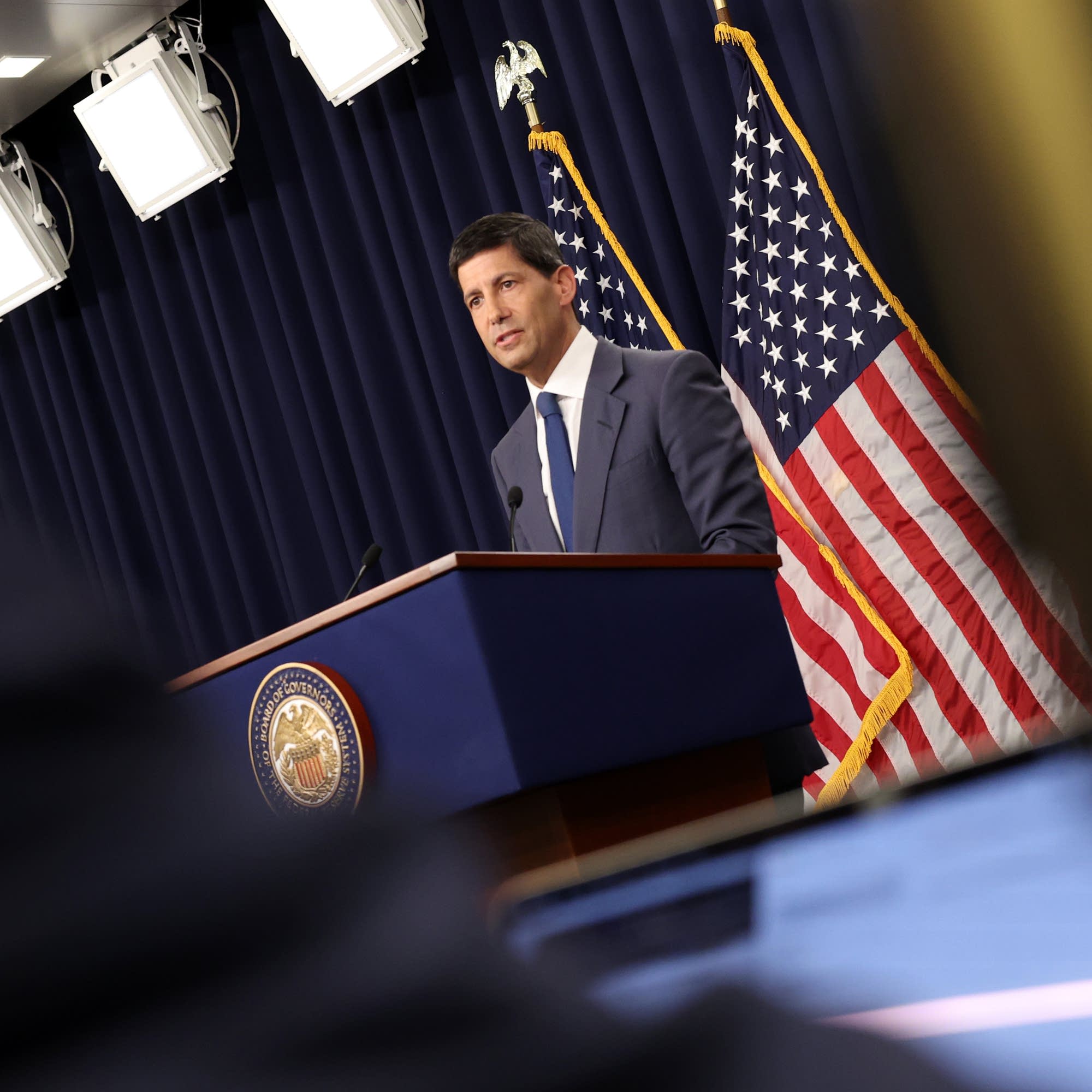
About this episode
Another month, another PCE report that put annual core inflation meaningfully above the Fed’s 2% target. The central bank has been fighting high inflation for more than five years now. At a certain point, you might start to wonder, does the Fed even have the power to fix it? Also in this episode: Consumer confidence falls, transportation durable goods orders tick up, and Arizona’s Great Recession-era bid to save the state budget offers insight into how AI might change our tax structure.
Every story has an economic angle. Want some in your inbox? Subscribe to our daily or weekly newsletter.
Marketplace is more than a radio show. Check out our original reporting and financial literacy content at marketplace.org — and consider making an investment in our future.
Read the stories in today’s episode:
- Inflation is stuck above 2%. Can the Fed really do anything about it?
- Consumers are pessimistic about the next six months
- How Arizona's "Capitol-ism" points to a potential tax fix for the AI age
- What's driving an increase in orders for transportation equipment?
- Running a historic motel off Route 66 is no easy pursuit
- The Gila River Indian Community "walks the walk" on water conservation
Get every episode summarized
Each time Marketplace publishes, we email you a written briefing from the transcript — the topics, who appeared, and any specific claims, with the ad reads skipped.
Email me new episodesFree for 3 shows. No card needed.
Hosts & guests


Transcript ready
338 searchable segments. Every word is indexed and playable.
Full transcript
Marketplace — How much power does the Fed really have?. Machine-transcribed; use the interactive transcript above to jump the player to any line.
We're going to take a little road trip through the Southwest today with pit stops in New Mexico and Arizona. But first, let's fill the tank with some data, shall we? From American Public Media, this is Marketplace. In Denver, I made me Scott in Forkye, Ristall. Wednesday, August 26th, good to have you with us. Inflation, as measured by the PCE or Personal Consumption Expenditures price index, is still two-dang high. That's the latest from the Commerce Department. Well, not in so many words, but the headline is that prices were 3.7% higher in July from the year before. As you hear us say all the time, the PCE is the one the Fed is really paying attention to. And it's been well above the central bank's 2% target for more than five years now.
Marketplace's Nancy Marshall-Genzard takes a look at why the inflation we're seeing now is proving so hard to contain. We found out today that core PCE, which strips out volatile food and energy prices, it hit an annual rate of 3.3% in July. And the thing about the inflation plaguing us right now, it's caused by things that are out of the Fed's control. Danielle DiMartino-Buth is CEO and founder of QI Research. They cannot influence the war in Iran. They cannot influence what's happening in the street of Hormuz. They cannot influence commodity prices. And they cannot influence prices that are driven upwards by tariffs. DiMartino-Buth says it's not like the Fed can pump more oil or do away with the tariffs. It's a supply chain driven situation that the Fed cannot influence. Fed officials' tools only work when demand is the problem, and they can raise interest rates to make borrowing more expensive, dampened demand, and cool off the economy. That would not be so effective now.
Still, Fed Chair Kevin Wars keeps insisting inflation will get back to the Fed's target of 2%. Olu Sanola, head of U.S. economics at Fitch Rating, says at this point. The Fed can only hope that they can talk this inflation down. They can signal this inflation down, but they also recognize that the tool they have is quite blunt. And the worst part is, Fed officials don't know how long they'll be in this pickle. I see the Fed is being in a really tough spot right now. Gary Hoover teaches economics at Tulane University. He says the Fed works best when it knows what to expect next. The on and off again nature of some of the issues that the Fed is facing leaves them really conflicted and not certain on how to proceed. Hoover says the last thing Fed officials want to do is change interest rates and then realize that oops, they need to hit reverse.
I'm Nancy Marshall-Gencer for Marketplace. Wall Street today barely budged actually. We'll have the details when we do the numbers. Those higher prices are one reason consumer confidence slipped again this month. We learned yesterday that conference boards consumer confidence index slid to its lowest level since January. People were especially gloomy looking six months ahead. We'll get another take from the University of Michigan's Consumer Sentiment Survey on Friday. But as we know how we feel about the economy doesn't always show up in how we spend.
This is Kayleigh Wells looked at how the general mood is shaping behavior. It makes sense that consumers keep feeling worse and worse as Eric Hurst. He teaches economics at the University of Chicago. We see this link between high inflation declining real wages and declining consumer confidence. Hurst says like most workers he studied his salary has increased slower than the rate of inflation, which means he can buy less today than he could a year ago or two years ago. As we saw for the last few years, when real wages are rooted, consumer confidence tends to erode with it. Which also helps explain why consumers are more worried about the future than right now. And even though they feel okay that their their job secure and their paychecks are coming in, it's buying them less and that's the concern. Steve Odland is CEO of the conference board, which puts out the monthly survey. Consumers also said they're planning to spend less on almost all the major service categories, dining, internet, personal care, health, the only one going up, utilities.
Your money is buying less than of course you hold back on anything discretionary. Because you know you have to put fuel on the car. You know you have to put food on the table. Remember like with any survey, these results represent the average respondent. But Paul Shea who teaches economics at Bates College says not everybody is average. This is the case shape economy people have been writing a lot about. I think there's some truth in it. If you're middle or upper income you tend to be doing very well. If you're lower middle class, you're struggling much more. Even as confidence wanes, consumer spending has stayed pretty resilient. Bates says that's because high income houses keep on spending and keep on masking the harsher reality for everyone else. I'm Keeley Wells for Marketplace.
The leagard billionaire Bill Gates is warning that the AI era will usher in quote one of the most turbulent times in human history. In an essay on his website and in the New York Times today, Gates says AI could trigger mass unemployment among other threats. As we've been reporting this week, fewer jobs also means fewer people paying taxes. Which is a problem in a country where two thirds of all federal revenue comes from taxing human labor. For the next installment in our series, Robots 8 My Taxes, Marketplace's David Brancaccio looks at a previous shock to the tax system, one that set the stage for a tactic some are suggesting in the age of AI. In the aftermath of the global mortgage meltdown of 2008 and 2009, Arizona was bleeding construction jobs. The state can't tax wages that never happened. This was the greatest financial challenge that the state had faced certainly in about
50 years. Eileen Klein was the Republican governor's chief of staff at the time. She says Arizona needed money fast with so many jobs and so much tax money gone. So officials got creative. They thought why not sell off a long list of state-owned buildings like a big old yard sale among the building sold to investors for $735 million was a big, bow's art style edifice with a copper dome, the Arizona State Capitol building. Nobody felt that it was the perfect solution to be able to generate cash. For the next 10 years, the state paid the buyers for the privilege of using the capital for governing capitalism. You might call it weird, but better than defaulting on payments that we're going to go out to schools or laying off prison guards or closing prisons. But are you kidding me, move of selling a crown jewel did by time for the slower process of raising money another way?
A temporary increase in the sales tax for the following three years. That's a form of what economists call a consumption tax, just one of the revenue-raising ideas now being floated for a time when untaxed AI does more of the work of tax-paying humans. Here's economist Lee Lockwood at the University of Virginia. The consumption tax will be taking in revenue, whereas the labor tax in a really transformative scenario where labor earnings go way down is going to fall much, much larger in proportion. But with the consumption tax, everybody rich and poor can end up paying the same. Taxes on products are, if implemented in isolation, are almost always regressive. As Trevor Tum at the University of Calgary School of Public Policy, he knows all about consumption taxes after studying how Canada tried a carbon tax to discourage the use of fossil fuels, Canada's antidote to regressiveness was cashback from the government. They lump some amount.
Rural Canadians or those with more kids got bigger rebates. Now while many countries have a national consumption tax, they call them value added taxes, to do it on a national level in the United States would be revolutionary. But with AI, we may be entering economically revolutionary times. Tum says it took the last industrial revolution moving people from fields to factories for us to get the modern income tax in 1913. In the same way that dramatic technological changes in the past have led to big changes in the way that we raised revenue. And so we might really need to think harder about the underlying structure itself and how we raised revenue. As for Arizona's state capital, ten years later the state was able to buy it back. The temporary sales tax came for three years and went as the great recession faded. I'm David Brancacho for Marketplace. All this week David is diving into solutions. You can also watch his reporting at Marketplace APM on YouTube and Instagram.
That's not just talking the talk that's actually walking in the walk, right? We'll talk about it. But first let's do the numbers. The Dow Jones Industrial Average fell 113 points, 2.10% to finish at 53,463. The Nasdaq shed 21 points, just one tenth of a percent, it was at 26,130. The S&P 500 lost a point, basically flat, ending at 76.75. Caley Wells reported on withering consumer confidence, with one big concern being the price of food. Budget-conscious consumers helped James Smucker forecast a smaller than expected sales decline in an earnings report today. Better known for jams and snacks, the company also makes ready to eat meals and people are dining out less. James Smucker rose 4 and 3.10% food giant general mills, added 3.4% of a percent. Bonds fell, the yield on the 10-year T-note rose to 4.64%, you're listening to Marketplace.
This is Marketplace, I'm Amy Scott. Plains, trains, and semi-trucks are among the big machinery businesses are buying more of. The Census Bureau said today, overall orders for durable goods rose by more than 1% in July, leading the way was transportation equipment. 2.3% from June, that follows two previous monthly declines. Marketplace's Caitlin Tan made some calls today about what's going on behind the volatility. Tim Quinlan, with Wells Fargo, doesn't give a lot of weight to the month-to-month transportation equipment order data. He says it's kind of like a scary elevator. If you came up on an elevator and the instead of up and down the button said sore and plunge, no one would get on it, right? He says transportation order numbers sore and plunge unpredictably because of big ticket items, like literal airplanes. If Boeing gets a big order at the Paris air show, it'll surge one month and plummet the next. It wasn't Paris, but actually England, where Boeing secured 173 plane orders in July.
But there is a little more to the transportation order numbers lately, says Ken Veef, a senior analyst with ACT Research. Just an old saying in the industry that if you bought it, a truck brought it. Because of all the data center construction this year, truckers have had a lot of hauling to do. When truckers make money, they end turn by trucks and trailers. Especially recently, because there's an impending federal emission regulation that could drive costs up. So on January 1st, up next year, a truck is still going to cost a lot more than a truck that you can order this year. Pre-buying like that is something big trucking companies can afford, says Jim Zantaris. He manages Peter built dealerships in the Detroit Metro, but he says smaller operations aren't thinking about new trucks, but rather, planning out payroll and equipment orders takes predictability. Zantaris says he used a plan for nine to 18 months out.
But now, this cycle has gone now to monthly. There next month, you do not know what is going to happen. There's the ongoing war with Iran on and off again, tariffs. Michael Belzer with Wayne State University says transportation folks might have seen a window to buy equipment in July. With all that volatility, they may have been suppressing their orders and now they're catching up. It's likely a short window impending US Canada tariffs could raise costs on engines and parts. I'm Keaton Tan from Marketplace. This year marks a major milestone for one of America's most iconic roads. Route 66 turns 100 and along the nearly 2500 miles of highway are hundreds of businesses
that make the mother road into the landmark that it is today. So we thought we'd take a road trip over the next few days to visit some of those places. Here's the first installment of that series. This is Don Federico. I am the owner of the blue swallow Motel and Tukum Kiri, New Mexico. And we are 1167 miles from the start of the easternmost point of Route 66 in Chicago. We passed our Tukum Kiri in the winter of 2019. We wanted to stay at the blue swallow Motel, however it was seasonally closed. It was a beautiful sight to see it in the evening with its neon and so we just admired it. Q in COVID in the beginning of that and that made us start to reevaluate what we were doing and what our careers looked like in the future. And our next chapter might be. We reached out to the owners and had a wonderful conversation with them and came down to New Mexico from the Chicago land suburbs. We sold no one what we were doing.
It was kind of a secret mission. Within a matter of probably eight to ten weeks we were here as owners of the blue swallow Motel. We do live on sight. It is the old fashioned mom and pop version. We do sometimes feel as if we might be living in a fish bowl. People are so enamored when they come in. Sometimes they might look through our residence windows not realizing that it might be a residence instead of an office. So it's been a fun adventure. Owning the blue swallow Motel is a huge responsibility. Because it is so well loved throughout Route 66 and because it's also on the National Register of Historic Places. We had a hail storm in May of 2023 that the hail damaged or destroyed about 85% of our neon around the entire place. In 2024 and 2025 we did a massive preservation.
It was a long labor of love but I can say it's done now and it's wonderful and it looks amazing and it will take decades to come. That's what we're extremely proud of. Our season begins March to December and we opened a little early this year because of the centennial and it has been absolutely gangbusters since we've opened. Having a few years of experience under our belt certainly has helped us keep saying this year and keep a good pace with everything so we're handling it and it's dry. That was Don Federico of the Blue Swallow Motel in Tukumkari, New Mexico. Have a favorite pit stop along Route 66? We can write to us about it at Marketplace.org.
The Colorado River provides water to more than 40 million people in seven U.S. states, 30 tribal nations and Mexico. We talked on the show yesterday about a new federal plan to shore up the system in the face of a 26 year drought. The three states in the lower basin, Arizona, California and Nevada will share mandatory and voluntary cuts totaling nearly 2 million acre feet of water over the next two years. One acre foot is enough for about 2 to 3 households a year. The plan also leaves the door open for further cuts in the coming decade. Steven Row Lewis is governor of the Heela River Indian community near Phoenix. The tribal nation fought for decades to secure rights from the Colorado River after its namesake river, the Heela was diverted by colonization. For this last installment of our water series this week, we reached out to Governor Lewis to see how these changes might affect his community. Welcome to the program. Thank you for having me on.
I appreciate it. So as you look ahead to the future of this river system that is over subscribed and deeply threatened, what are you asking for on behalf of the Heela River Indian community? What's kind of a hard line for you or a line in the sand for you about what you're willing to give up? Well, we don't want a second taking of our water. We don't want our water settlement to be undermined in any way. As governor, I've been deeply involved in critical negotiations along the Colorado River for the last 10 years. This is Heela River working with the lower basin states to come up with 700,000 acre feet of water that we can store in the system, to bolster and to protect the system from these falling elevation levels. Over the past 10 years, the community has contributed more than 1 million acre feet in conservation
water to Lake Mead. Now, that is not just words. That's not just talking the talk. That's actually walking the walk. That's really over 15 feet of elevation, which is the difference today between crisis and disaster. So, we're continuing that this time with a further commitment of another 125,000 acre feet over the next three years. And perhaps more if necessary, because we see this as critical to our survival and our collective survival in this region as well. And just to be clear, that's water that you could use. You have the right to, but you're leaving in Lake Mead to shore up the system. To shore up the system, to make an important example to others through the region. Because we see that water connects us all. One region, one state is affected.
We all are affected. I think that shows that there is a collective responsibility that we all need to live up to. That we all need to share a burden in. We've already invested millions of dollars in conservation efforts. When I visited, you were preparing to cover some canals with solar panels to prevent evaporation, but also produce clean energy. How are some of those efforts paying off today? So, we're proud of the fact that we're leading in conservation efforts, both with those solar panels over our canals. We were the first to do this in the Western hemisphere, not just to tribe. We were the first entity to do that. So far, we're generating more solar energy and protecting more acre feet of water than we thought. This potentially, as we scale this up, this could keep us both sustainable and a very constant energy supply moving forward.
Also, we're conserving water as well in such a critical time. This is a win-win for us. This is something that we're looking at ramping up to scale. This just shows that this can work on the ground. This can work at a practical situation. It's a sovereign Native American tribe that's doing it. We're leveraging our sovereignty and our self-determination to make us energy water responsible within our practices. Hopefully, these type of examples that were successful, hopefully, they spread and they motivate and they inspire others to do their part as well. So long-term, with climate change making drought, much more likely and much more severe, how confident are you that when push comes to shove, the federal government will honor
its trust obligations and the water rights your community fought so hard to win back. Exactly, because we don't intend to let this happen again. This has been a journey that the Heeler-Rinning community and other tribes as well that we've been engaged in this for now over almost 200 years. This has been an historical fight and this will continue, especially because of climate change, because of overallocation along the Colorado River as well. The fight continues and the community we have to remain vigilant. But at the same time, we're not standing still. We're doing everything we can to model responsible water management conservation practice. Steven Roe Lewis is governor of the Heeler River Indian community. Governor Lewis, thank you so much for your time. Thank you for having me on.
As always, for more reporting on the messy business of climate solutions, including the story of how the Heeler River Indian community fought for its water rights and won, check out our podcast, How We Survive. This final note on the way out today, there are any winners in the ongoing U.S. trade war against almost everyone. One of them is Vietnam. The Wall Street Journal reports that Vietnam's trade surplus with the United States, in the first half of this year, was $114 billion, meaning the country exported that much more to the U.S. than it imported. That's a bigger surplus than China, Mexico, and Chip Giant Taiwan. With higher tariffs on Chinese-made goods, many manufacturers have shifted production to its neighbor.
Our media production team includes Brian Allison, John Fokey, Montana Johnson, Drew Jostad, Gary O'Keef, and Charlton Thorpe. Alex Simpson is the manager of media production. I'm Amy Scott. We'll be back tomorrow. This is APN. I'm Lee Hawkins, host of Must Be the Money, a podcast for Marketplace. Each week I speak with inspiring entrepreneurs and business leaders about their lived experiences, and they share tangible insights to help guide your path to success. Here from icons like Angelica Nwandu, Van Lathan, Angelie, Matt Barnes, and more about how to seize opportunity, manage money, and meet challenges with resilience.
Listen to Must Be the Money, wherever you get your podcasts.
More episodes


