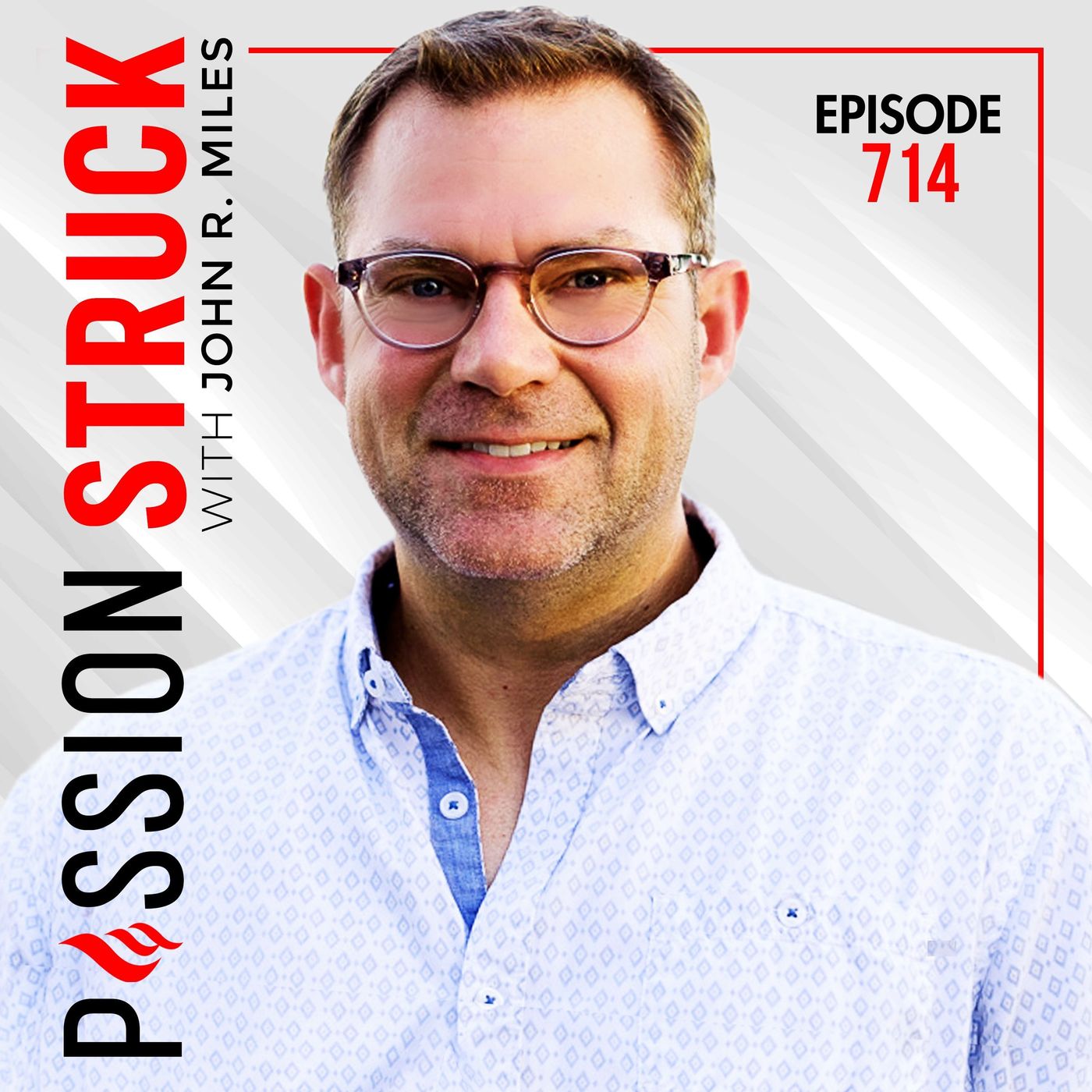
What if the quiet emptiness after achieving "success"—the promotion, the house, the milestone—isn't failure, but a signal to build deeper meaning?In this solo episode of Passion Struck, host John R. Miles introduces the architecture of significance: a blueprint for shifting from a life that's a monument to yourself to one that becomes a shelter for others.Building on insights from Dr. Stephen G. Post and Mark Nepo, John explores the hidden foundation of inherent worth, the pillars of circulation that turn contribution into connection, the windows of mature perception that move from facade to true presence, and the roof of shelter that protects what matters most.This episode explains why success often feels hollow, how significance creates flow rather than extraction, and why your quiet, real presence may be the greatest gift you offer in 2026. It's an invitation to inhabit your worth, circulate meaning, and become the shelter others need.Passion Struck with John R. Miles was recently ranked #1 on FeedSpot’s list of the Top Passion Podcasts on the Web, recognizing the show’s ongoing commitment to thoughtful, human-centered conversations like this one.Check the full show notes here: https://passionstruck.com/build-an-architecture-of-significance/All links gathered here, including books, Substack, YouTube, and Start Mattering apparelhttps://linktr.ee/John_R_MilesFor more about John R. Miles - https://johnrmiles.com/Pre-order You Matter, Luma - https://youmatterluma.com/The Architecture of Significance Companion ResourcesPractical reflections and contemplative prompts to map your shift from success to significance, including exercises on recognizing your foundation, identifying circulation pillars, and reframing perception.Explore the companion guide: https://www.theignitedlife.net/p/becoming-an-architect-of-significanceIn this episode, you will learn
Why the "hollow quiet" after success has a structure, and how to recognize it
How reclaiming inherent worth forms the unshakeable foundation of significance
The difference between extraction (success) and circulation (meaning) in daily life
Why mature attention shifts from facade (impressing others) to windows (truly seeing)
How immersion in the ordinary creates deeper resonance than chasing intensity
Why building a "shelter" for others is the ultimate evolution of a meaningful life
Support the MovementEvery human deserves to feel seen, valued, and like they matter. Wear it. Live it. Show it.https://StartMattering.comDisclaimerThe Passion Struck podcast is for educational and entertainment purposes only. The views and opinions expressed by guests are their own and do not necessarily reflect those of Passion Struck or its affiliates. This podcast is not a substitute for professional advice, diagnosis, or treatment from a licensed physician, therapist, or other qualified professional.
Support the Movement: https://startmattering.com/. Every human deserves to feel seen, valued, and like they matter. Wear it. Live it. Show it.
Disclaimer
The Passion Struck podcast is for educational and entertainment purposes only. The views and opinions
Transcript
Coming up next on Passion Struck. There's a specific kind of silence that happens right after you get exactly what you wanted.
Maybe it was the promotion, maybe it was the house, or the moment the last kid moved out.
And the hard work parenting was technically done. You expected a surge of relief, or at least a sense of arrival.
But instead, you felt a strange hollow quiet. If you've ever looked at your life and found yourself asking, why doesn't this feel like enough?
I want you to know there's nothing wrong with you. You aren't ungrateful, and you aren't burned out.
You've simply reached the top of a ladder that wasn't designed to carry you any further.
What you're experiencing has a structure, and today we're going to name it.
Welcome to Passion Struck. I'm your host John Miles. This is the show where we explore the art of human flourishing.
And what it truly means to live like it matters.
Each week I sit down with change makers, creators, scientists, and everyday heroes to decode the human experience,
and uncover the tools that help us lead with meaning, heal what hurts, and pursue the fullest expression
of who we're capable of becoming. Whether you're designing your future, developing as a leader, or seeking deeper alignment in your life,
this show is your invitation to grow with purpose and act with intention.
Because the secret to a life of deep purpose, connection, and impact is choosing to live like you matter.
Welcome back to episode 714 of Passion Struck. If you've been walking with me through the past month,
and ended the start of 2026, you know that we just came through what I call the season to be coming.
Before the resolutions can step, we need revelations.
We reclaimed worth, we practiced micro choices of courage, and just last week we explored the Dumbar Reset,
the idea of shrinking our world to the size our biology can actually sustain.
Many of you have written to me about the relief of letting go, the global noise, and returning to your true 150.
But as we begin this new series, the Meaning Makers, a different question arises.
Once the noise clears, what do we actually build in the space that remains?
On Tuesday, Dr. Stephen Post helped us decode the biology of pure unlimited love,
showing us that we're not just social animals, but altruistic ones wired for contribution.
On Thursday, Mark Nipo invited us into the second half of life, where the geography shifts, and perception matters more than performance.
What I've realized is this, meaning isn't just a feeling.
It's a structure, and for years, many of you have been master architects of success.
You've built resumes, reputations, and facades that the world admires.
But success is often a scaffolding.
It's great for the construction phase of life, but it was never meant to be the load-bearing wall of your soul.
When the weather of life changes, we realize we need a blueprint that goes deeper than more.
So today, in this silo episode, I want to pull up a chair and walk you through a structure you may already be standing inside.
I call it the architecture of significance.
We're moving from identity based on what you do to presence rooted in who you are, from extraction to circulation,
and from a life that becomes a monument to yourself to a life that becomes a shelter for others.
Before we dive in, a quick note on a project that mirrors these themes of significance.
We often spend our adult lives trying to rediscover the value we should have been anchored in as children.
My new children's book, You Matter and Luma, is a bridge to that truth.
A reminder that your significance isn't earned by your performance.
It is a fact of your existence.
You can pre-order it now at Barnes & Noble or you matterluma.com.
If today's episode resonates, please share it with someone navigating a similar season of life.
And if you haven't yet, a five-star rating review on Apple Podcasts or Spotify helps these conversations reach the people who need them most.
And lastly, I am grateful and honestly humbled that passion struck was ranked number one on feed spots list of the 30 best passion podcasts to inspire what you love.
What makes that recognition so meaningful is that they rank not just on downloads, but on engagement, freshness, reviews, and most importantly, real impact in the passion and purpose space.
Thank you so much feed spot for giving us that recognition.
And thank you for choosing passion struck and choosing me to be your hosting guide on your journey to creating an intentional life.
Now, let that journey begin.
If you look at any architectural blueprint, the foundation is the part you never see once the building is finished.
But it's the only part that determines how high the structure can actually go.
In the season of becoming, we talked about reclaiming worth.
We talked about small, courageous choices.
We talked about clearing noise so that you could hear yourself again.
But as we step into the Meaning Maker series, the foundation isn't something you go out and acquire.
It's not a new degree. It's not a new title.
It's not a smarter set of goals for 2026.
The foundation is what's already there.
It's what becomes visible when the success that you've been spending years building finally stops answering back.
That quiet disorientation we talked about earlier.
That's not a character flaw or a failure of ambition.
It's structural feedback.
That's what makes us are taught to define ourselves by our scaffolding.
The jobs, roles and external validation that prop us up while we're building and scaffolding is useful.
It's necessary for what I call the construction phase of life.
But it's temporary.
The quiet arrives when you reach a stage where scaffolding isn't enough anymore.
When the weight of your life has changed and what you need now is some load bearing.
I talk about doing a mosquito audit clearing the invisible suffocators blood suckers and pain in the asses so that you can breathe again.
The foundational work is the internal spiritual version of that.
It's clearing away the clutter of who you were supposed to be so that you can recognize who you actually are.
And that's why I want to challenge the idea that this moment requires definition.
We're constantly told to quote unquote define your mission statement, but that usually just sounds like more work.
Another task for an already full inbox.
What actually helps here is recognition foundations aren't chosen in moments of high octane ambition.
They're revealed when the noise dropped.
They're the values that remain true when no one is watching, even when there's no reward attached and there's no wind.
We know that this isn't just philosophical.
It's biological humans are wired for connection and contribution that doesn't demand a return.
That's not something you manufacture. It's something you recognize as Mark Nipo reminded us yesterday.
The geography of the second half of life requires a different way of seeing you don't find your foundation by looking further ahead.
You find it by looking deeper down into the soil of what has already survived your hardest seasons.
So let me pause here on a simple reflection.
When you strip away the title on the door, the number in the bank and the noise of everyone else's expectation.
What still feel solid under your feet? That's your foundation.
And once you recognize it, something powerful happens.
You stop trying to prove your worth and start inhabiting it.
So we have just looked at the hidden foundation beneath the scaffolding of success.
That internal shift from proving your worth to finally inhabiting it.
But once that foundation is revealed, the question becomes, how do we build upon it without burning out?
We're going to dive into the second element of the architecture.
But before we do, I want to pause on something important.
Listening to me describe the difference between your scaffolding and your foundation is one thing.
Actually standing on that foundation, especially when the world is trying to hand you more scaffolding, is another.
That tension is exactly what we design the ignited life to hold.
This architecture isn't built overnight. It's built through the quiet, consistent choice of alignment over achievement.
That's why each episode in the Meaningmakers series is paired with specific reflection tools inside the community.
We help you to map your own architecture of significance by asking questions that the noise usually drowns out.
Questions like what parts of my scaffolding and my finally to let go of is this weight I'm carrying today designed to support others or just to sustain my own image inside the ignited life.
You'll find weekly props tied to my interviews along with identity and agency practices to help you move from extraction into true circulation.
You can join us at the ignited life.net now a quick break for our sponsors. Thank you for supporting those who support the show.
Hey friends, there's something about March that makes you want to reset your space for me that started in the kitchen clearing out what I didn't need and upgrading what I use every single day.
That's when I brought in caraway. What I love is how simple caraway makes everything the ceramic coating means food just lifts right off.
So I'm using less oil clean up take seconds and cooking actually feels enjoyable again.
But it's not just performance. It's the intentional design the storage system keeps everything organized and I've become a lot more mindful about what I bring into my home.
And that's why it's so important that caraway is third party tested and made with high standards, which just gives me more confidence and what I'm using every day.
It's one of those upgrades you feel immediately.
Caraway's cookware set is a favorite for a reason. It can save you up to $230 versus buying the items individually plus if you visit carawayhome.com slash passion struck.
You can take an additional 10% off your next purchase. The steel is exclusive for our listeners. So visit carawayhome.com slash passion struck or use code passion struck at checkout caraway non toxic kitchenware made modern.
You're listening to passion struck on the passion struck network. Welcome back before the break.
We were looking at the foundation the quiet internal recognition of what still feel solid under your feet when the titles and the noise are stripped away.
But as any architect will tell you a foundation isn't a destination. It's beginning if we stay only in the foundation.
We are safe, but we aren't yet significant for the structure of our lives to actually hold weight for it to matter to the world around us.
That energy has to move. It has to rise and that brings us to the second element of a life belt for meaning once a foundation is revealed.
The next question is inevitable. What does this foundation actually support? An architecture foundations don't exist for their own sake. They exist so weight can move.
So force can travel safely through a structure without a collapsing under its own gravity. That's where the pillars come in pillars aren't decorative. They aren't symbolic.
They exist to carry a load and to transfer the weight outward. The same is true in a life that feels significant for most of our early adulthood were trained explicitly or not to live extractively.
We ask what can I get from this job from this relationship from this effort extraction makes sense when you're building stability. You need resources.
You need momentum. You need proof that your effort leads somewhere, but extraction has a ceiling. At some point it stops feeding you and it starts hollowing you out. That's when something shifts.
Not because you've suddenly become more virtuous or outgrown your ambition, but because your nervous system begins to ask a different question.
Not what can I get, but what can move through me? We are wired for circulation. As I discussed on Tuesday with Stephen Post, research into altruism shows that humans regulate stress and restore resilience not through accumulation, but through contribution that doesn't demand a return.
Giving isn't something we do after we're fulfilled. It's one of the ways fulfillment is generated in the first place. That's why service that feels forced drains us.
But service that feels aligned restores us. The difference isn't the effort. It's the direction. Most people discover this before they ever even name it. They begin giving in one of three ways.
Through presence, showing up fully without trying to fix or perform through ability using what they're good at in service of something beyond themselves and through resources, time, access or energy that creates ease for someone else.
Long before we call these time, talent or treasure, we feel them. And when they circulate freely, when they're not transactional or performative, they begin to hold weight.
To understand the true power of the shift, you have to look at the great cathedrals of Europe, cartons, Notre Dame, Salisbury. If you study the history of these structures, you'll notice something unusual about the people who built them, the master mason's, the glass cutters, the laborers hauling stone, almost none of them lived to see the buildings finished.
They spent their entire lives contributing to a structure. They knew would only be completed by their grandchildren. In our modern world, we've been taught to be the master mason's of our own lives.
We want to design the building, lay the stone and cut the ribbons ourselves. We want success on the timeline that we can personally enjoy.
But here's the counterintuitive insight. The most significant structures in human history were built by people who never expected to stand under the finished roof.
They weren't motivated by achievement. They were motivated by atmosphere. They weren't building monuments to themselves. They were building spaces where others would eventually feel at home.
This is the shift from extraction to circulation. Success tends to be terminal. It's a project with a clear end, but significance is transgenerational.
It's a structure that carries forward because it was never meant to stop with you. So the quiet disorientation you feel after a big win isn't a signal that you haven't achieved enough.
It's a signal that your life is asking to be lived in a different direction from accumulation to contribution from proven to participating.
These are the pillars of a significant life. They don't drain you. They stabilize you because when meaning circulates, it doesn't leave you empty. It leaves you connected.
So if the foundation is the integrity of your character and the pillars are the ways you circulate your contribution, then we have to talk about the windows.
Once circulation begins, once your energy is no longer collapsing inward but moving outward, something subtle changes. It isn't necessarily what you do, but how you see.
In architecture, windows are not about decoration. They're about orientation. They determine what light enters a space. What views are framed and what the inhabitants learn to notice.
For much of our lives, our attention is drained outward. We focus on the facade. We learn to scan for approval, opportunity and threat.
We obsess over how the building looks from the street, managing perception and performing for an audience.
This is the adaptive phase. It helps us survive and succeed. But eventually, the question of how am I being seen begins to hollow us out.
The maps that once worked begin to fail. And the question quietly turns from, is the world looking at me to, am I actually seeing the world?
This is the moment from facade to window. A facade is about presentation. A window is about perception. A facade manages impressions. A window invites presence.
And here is the shift that surprises people. This change doesn't come from inside alone. It comes from a place of grief.
It comes from realizing that the ways that you once engaged the world, the performance, the hustle, the polishing of the image, no longer work. You may notice it as strange restlessness.
Or a quiet sadness that arrives without explanation. What's actually happening is that your nervous system is no longer satisfied with surface contact.
You don't want louder experiences. You want true ones. You don't want more stimulation. You want more meaning per moment. I call this attentional maturity.
It's the ability to let fewer things matter so that what does matter can register more deeply. Windows narrow the field of view, but they deepen it. You stop chasing intensity and start valuing resonance.
You begin to notice texture instead of volume and death instead of scale. You listen longer before responding. You feel less urgency to comment. The shift isn't a withdrawal from life.
It's a more honest engagement with it. That is why significance often grows quieter with age. It's not because your life is shrinking, but because your attention is becoming more precise.
You stop needing the whole world to see you and you start caring whether you are truly seeing what's in front of you. A child, a friend, a moment of beauty that would have gone unnoticed in the facade phase of your life.
This is the reglasing of the windows. Same structure, but a different clarity. And when your perception changes like this, your presence changes too.
You begin to inhabit your life rather than to perform it. You become less impressive and more real. And that sets the stage for the final element.
Because once a life is grounded, once energy circulates and attention matures, the question becomes, what kind of shelter does this life now provide?
Once a life is grounded in a foundation that doesn't move, once your energy circulates rather than collapses and once your attention matures so that you are truly seeing the world, one final question remains.
What kind of shelter does this life now provide? In architecture, the roof is the most vulnerable part of the structure, but it's the only part that makes the building habitable.
Without it, the walls are just an enclosure with it they become a home. For much of our lives, we are led to believe that the goal of life is to build a monument.
A monument is designed to be looked at from a distance. It's built to say, I was here. I achieved this. Look at the scale of my reach. But monuments are cold.
You can't live inside the monument and you certainly can't find shelter there when the storms of life arrive. In the architecture of significance, the goal is to build a shelter.
When you move from performance to presence, you aren't just improving your own outlook. You're creating a space where other people finally feel safe.
You become the person who can hold space for a friend and crisis without needing to be the hero of their story. You become the leader who provides the load bearing support that allows a team to take risks.
You become the parent or partner who is very present says you are covered. You are safe here. That is the ultimate evolution of the meaning makers.
A life of significance is a building or others feel at home in your presence. So as you head into this weekend, I want to leave you with that one reflective question we opened with.
If you stop trying to build a monument to your success today, what part of your life is already providing shelter for someone else?
Don't look for a grand gesture. Look for the atmosphere you create. Look for the people who lean on you. Not because of your title, but because of your soul.
Success is when you add value to yourself. Significance is when you add value to others. As Stephen Post showed us, this is your biological destiny.
As Mark Nippo reminded us, this is the true geography of your second half of life. And as we've seen today, this is the very architecture that holds when everything else falls away.
Taking that step, moving from building a monument for yourself to becoming a shelter for others is the hardest and most rewarding work we will ever do.
But as we discussed today, you don't have to do it all at once and you certainly don't have to do it all alone.
Before you move on with your day, I'd encourage you to pause.
Look at the one thing or one person right in front of you. Can you offer them 60 seconds of your shelter without trying to fix manage or impress them?
That's the small moment of containment in the first stone in the shelter you're building. It's how we repair the structure of our own lives.
If you want support applying these ideas, join me inside the ignitedlife.net. And remember to check out you matter, Luma, for a reminder that your significance isn't something you have to build.
It's something you already possess. Looking ahead to next Tuesday, I'm joined by Stephen Sloeman, a cognitive scientist and author of the new book, The Knowledge Illusion.
We're going to deconstruct the boundary of the mind, exploring why we think we know more than we do and how the illusion of knowledge can actually prevent us from finding true meaning.
In that conversation, Steve and I explore why our minds are designed for collaboration rather than solo storage.
And why I don't know might be the most important foundation for your growth in 2026. It's a powerful follow up to our work today on the community of the self.
If you really want to make good decisions, you need people with contrasting views to yours.
You don't necessarily need them to generate ideas to generate hypotheses, but you need them to test those ideas.
Like the best way to perfect your own thinking is to describe it to someone who disagrees with you vehemently.
And that way you'll construct really good arguments.
Thank you for walking this first week of the Meaningmakers with me.
Remember, choose gentleness over force, choose space overweight, and live like the life you're becoming is to be the shelter for others.