Loading...
About this Episode
Leaders in Washington and Tehran are on the clock, with about a month to wrap up the Iran war before it does greater damage to the global economy and their own political fates, according to retired Admiral James Stavridis.
On today’s Big Take podcast with David Gura, Adm. Stavridis, the former head of US Southern Command and Supreme Allied Commander of NATO, outlines how the US troops heading to the region could help bring about a diplomatic resolution – or raise the risk of a longer conflict.
Read more:
- Taking Kharg Island May Be a Big Risk for Little Reward
- Three Targets for US Boots on the Ground in Iran
- Iran Can Turn the Persian Gulf Into a Minefield
Hosted by David Gura; Produced by David Fox; Edited by Jeffrey Grocott.
Fact-checking by Eleanor Harrison-Dengate, Tracey Samuelson and Julia Press; Engineering by Katie McMurran.
Senior Producer: Naomi Shavin; Deputy Executive Producer: Julia Weaver. Executive Producer: Nicole Beemsterboer.
See omnystudio.com/listener for privacy information.
Hosts & Guests
Transcript
So there's a lot of noise about AI, but times too tight for more promises.
So let's talk about results. At IBM, we work with our employees to integrate technology right into the systems they need.
Now, a global workforce of 300,000 can use AI to fill their HR questions, resolving 94% of common questions.
Not noise, proof of how we can help companies get smarter by putting AI where it actually pays off.
Deep in the work that moves the business.
Let's create smart to business. IBM.
Everyone has been there. Your team's feedback is scattered across emails, chats, and sticky notes.
It's a mess, but PDF spaces in Adobe Acrobat gives you one collaborative workspace to streamline every file and comment.
So if you need six departments to finally agree on a proposal, do that with Acrobat.
Need to turn a mountain of feedback into one plan of action? Do that with Acrobat.
Want to stop searching for files and finally get everyone on the same page? Do that, do that, do that with Acrobat.
Learn more at adobe.com slash do that with Acrobat.
With Bolly from iShares, you get access to both monthly income and growth potential in one simple ETF.
It's the best of both worlds. Discover Bolly, iShares large-cap premium income active ETF.
iShares, the market is yours. Visit www.iShares.com to view perspectives for investment objectives, risks, fees, expenses, and other information that you should read and consider carefully before investing.
Risks include principal loss in the use of derivatives, which could increase risk and volatility.
Monthly income is not guaranteed, prepared by BlackRock Investments LLC.
Bloomberg Audio Studios.
Podcasts, radio, news.
The war in Iran is four weeks old.
The US has deployed tens of billions of dollars of munitions in thousands of strikes and more than 4,500 people have been killed in the conflict.
That's according to governments and non-government agencies.
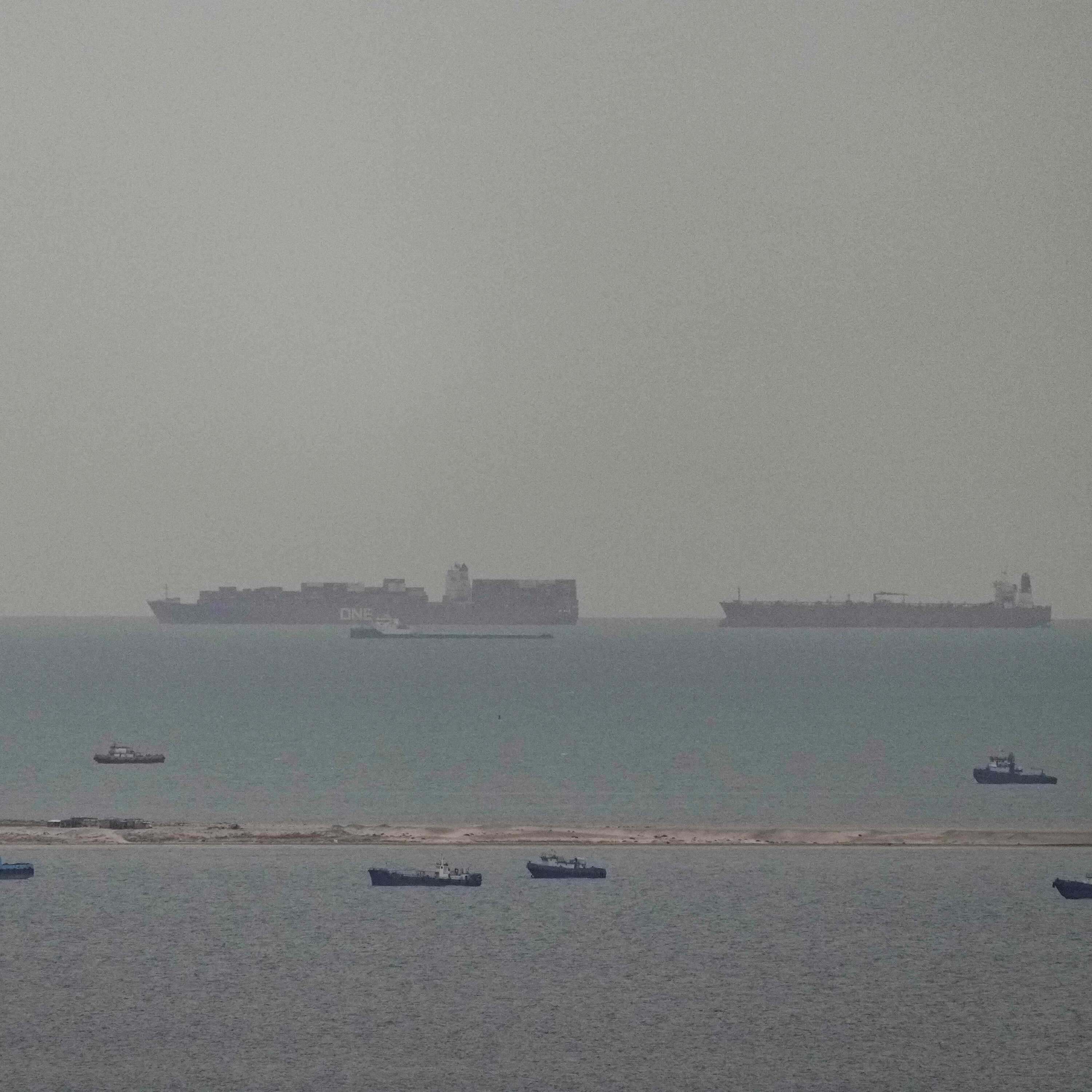
And despite 10 ships passing through the Strait of Hormuz on Thursday, in what President Trump has described as a gesture of goodwill,
the Strait remains effectively shut, choking off roughly 20% of the world's oil and gas, which has sent energy prices soaring.
President Trump has threatened to strike Iranian energy sites, if the country doesn't come to terms and reopen the Strait of Hormuz,
and he's issued a deadline that he's now pushed back twice.
The game out, how the conflict could unfold from here, I reached out to someone who is no stranger to high-stakes military decisions,
retired Admiral James Stavridis, who's also a columnist for Bloomberg opinion.
He is, among other things, the longest-serving combatant commander in recent US history, and the co-author of a series of novels,
the latest 2084, will be published in May.
And Admiral Stavridis sees the pressure rising on both sides to make a deal.
There are two clocks ticking right now.
One clock that's ticking is in Washington, and it's for the Trump administration, it's the gas prices, it's the cost of doing this,
it's the public support, and it's November. It's the election in November.
So that clock is ticking, and certainly it strikes midnight pretty soon.
And for Iran, the clock here is their infrastructure.
How much of their military do we destroy? How much of their defense industrial base? How much of their oil?
How much of their electric grid? That clock strikes midnight.
In probably three to four weeks?
He says both countries have good reason to come to the table, but that's far from a guarantee.
I think there's a two and three chance we get to a negotiated conclusion, call it 65%.
But the bad news is, and this is uncomfortably high, one in three chance, therefore a 35% chance,
that the Iranians do not follow the logic of this situation.
Decide they want to keep fighting, we keep bombing, we then go after their critical infrastructure,
they go after Gulf-era critical infrastructure, then we have a much more serious global economic challenge ahead.
I'm David Garret, and this is The Big Take from Bloomberg News.
Today in the show, retired admiral James Turetis,
on how sending thousands more US troops to the Middle East,
changes the chances of a diplomatic resolution to the Iran War, and raises the risks.
Admiral Sturetis, you were the head of US Southern Command, US European Command,
and from 2009 to 2013, you were a Supreme Allied Commander of NATO.
But before all of that, back in the 1980s, you spent some time as a young sailor,
helping ships make their way through the Persian Gulf.
So before we get into the details of US strategy and options in this particular war,
I'm curious how that time in your life shapes the way that you're thinking about this conflict.
It does immensely, and that's a smart question.
This was in the late 1980s, and we were escorting Kuwaiti tankers,
which were flagged to the United States through the strait.
This is during the Iran-Iraq War, when the Iranians again closed the strait of war moves.
Two takeaways that continue to rattle around in this grizzled, old admiral's brain.
One is, it's hard.
It's navigationally challenging, and to do it under Iranian fire,
as we did in the 1980s, is doubly challenging.
But a key thing to remember is, they did not have drones then.
Number two, you have to open the strait.
You cannot seed control of it to this rotten theocracy in Tehran.
So how we get there, I hope we can do it diplomatically,
but if necessary, see paragraph one, we will open that strait.
In recent weeks, the US has ordered some 7,000 more troops to the Middle East,
around 1,000 soldiers from the 82nd Airborne.
5,000 troops from two marine expeditionary units.
The 31st, which deployed from Okinawa, should arrive in the coming days.
The 11th MEU will be in the region in three to four weeks.
What is the decision to send those troops, indicate to you about the broader objective here
that the US has at this point?
My supposition is that President Trump wants those troops
to kind of hold them like a hammer over the head of the Iranians
and threaten actually seizing Carg Island,
which is, you know David is 90% of the Iranian oil flows through it.
You really put a stake in the heart of the Iranian oil-based economy.
So President Trump is signaling to the Iranians not only am I bombing broadly
across the entire vast nation of Iran, but I also have precise boots on the ground to options.
7,000 troops is not a huge force, they're not going to conquer Iran,
but you could use them in precise ways to try and move on negotiation along.
Could you walk us through what the stages of a mission to take Carg Island would look like
and maybe give us your sense of what the US could stand to gain or lose
by undertaking a mission like that?
Sure, let's go back to those Marines that see the first tranche of them,
the 31st Marine Expeditionary Unit, have arrived just outside of the Strait of Fort Moose.
They got to get through the Strait, which the Iranians will oppose deeply.
They got to get through mines, ballistic missiles, small boats, above all the drones.
Once they get through that, now they still, David, have 350 miles to go
to get up to Carg Island.
In that stretch of water, Iran will continue to attack them.
I could see terrorist attacks against them from small Iranians, supposedly civilian craft, more drone attacks.
Now you're off the coast of Carg Island, so here you depend on central command air cover
to make sure there's a bubble over you in effect and the sea, the fifth fleet is protecting you.
Now those Marines will get on osprey aircraft.
They're kind of in between a plane and a helicopter.
They'll start going ashore by air.
There'll be some seaborn component of them.
You bring them ashore at a relatively undefended corner of this island.
Carg is about a third of the size of Manhattan.
You pick a couple of points, bring in the Marines, seize the base.
Now they're locked down in a well-known place and it's within artillery range of the Iranian coast itself.
And there are 20,000, maybe 30,000 Iranians on the island that you have to control.
Most of them are civilian oil workers who just want to stay out of the line of fire.
They have no interest in getting in the crossfire between US Marines and the Iranian Revolutionary Guard.
If I'm Tehran right now, I'm increasing my forces on the island.
I'm putting booby traps in place, putting land mines at the places where I think you might land.
I'm putting drones overhead, very small ones so I can maintain surveillance.
So they're preparing for this.
It's a very challenging mission.
It's kind of easy for me to sit here and say it.
But to execute that mission will be costly in terms of lives and equipment.
Final point, if I were advising the administration, I would say maybe a better idea blockade the island.
Have the fifth fleet, just shut it down.
Tell the world, don't bother going to Carg islands.
No longer open for business.
Tell the Iranians, you can do all you want with the oil that's stored there, but it's not leaving Carg Island.
I think that might make more sense.
What else might be on the table for the US is they think about where they might deploy troops in this region.
I'll give you three other options that kind of pop into my head.
One is the island of La Rock, right at the very northern tip of the straight of four moves.
And La Rock is very important because it controls the top of the straight.
It's heavily defended, but seizing that I think would have some military utility.
A second one is there are a pair of islands that are claimed by both Iran and the UAE.
This is Abu Musa Island and Tum also in that vicinity.
If you took those islands, you'd have land right at the top of the straight that would help you defend it and keep it open.
But if you really want to lock down the straight, you've got to control both sides of it, both the Arab side and the Persian side.
And then third, and actually more dangerous than anything we've talked about, would be going into Iran deeply into Iran and going after the nuclear material that they have.
They have 900 pounds, maybe a thousand pounds of enriched uranium.
It's not quite weapons grade, but it's very close to it.
Where is it? It's at the bottom of, supposedly, of Isfahan under concrete.
You'd have to have a thousand plus troops to defend the area, put up all the air cover, and then have the seals and the green berets with, wait for it.
Wait for it, civilian technicians who know how to manage all this. It is a very difficult mission.
It would be literally the largest special forces operation in history.
I want to say I'm not advocating those missions. I firmly believe we need to get to a diplomatic resolution here.
But, you know, soft power without the ability to apply hard power is no power.
So move the forces, set the table, and then go to the Iranians and say, look, we really want to settle this at a negotiating table, not on Karg Island.
I want to shift to opening up the straight, and you've laid out ways in which the U.S. could take over Karg Island, other islands.
Do those military options do much to hasten the process of getting oil flowing once again?
Just draw the line for me from doing that to effectively opening up this straight once again.
The theory of the case is that by holding hostage this 90% of the Iranian oil, we could then go to the Iranians and say, Karg Island.
Nice little operation you got going here. Boy, it'd be a shame if we had to blow it all up.
How about if we go ahead and open the straights, and then we can have a conversation?
Let's get to a very simple deal at this point. We stop bombing, you open the straight.
And what would that take?
Let's start by observing that what Iran has done is they have not hard closed the straight.
They have virtually closed the straight, and they've done that by blowing up a handful of tankers saying,
any other tankers we don't like, we're going to blow up with drones.
They put some smart minds in the water that they have control over, but they haven't really hard closed it.
I think it's worth noting they haven't done that, which means there's still room to maneuver here.
And I would say that if we were to fail diplomatically and have to militarily open the straight,
you need more minesweepers to be on station prepared.
You need more guided missile, frigates, destroyers, cruisers to protect shipping going in and out.
You need special forces on small boats to counter the Iranian small boats.
You need to destroy more of the Iranian attack capability along the littoral of the straight itself.
But again, it'll be costly. It would be far better that we got to a negotiation here.
Is it possible to do that kind of clearing that you just described militarily while fighting is still underway?
Or does the fighting have to cease?
Effectively, fighting has to cease as follows.
You have to bring complete air superiority over that particular area, meaning you've got to be able to stop the drones.
You have to go after the longer range of Iranian capabilities.
By the way, there happens to be an admiral in overall command of the mission.
Admiral Brad Cooper, the commander of central command.
That's what Admiral Cooper is doing right now.
And I think the Iranians are cognizant of that as well.
Retired Admiral James DeVritis was the Supreme Allied Commander of NATO.
After the break, his thoughts on what role the alliance could play in helping to reopen the straight.
The thing about AI for business, it may not automatically fit the way your business works.
At IBM, we've seen this firsthand.
But by embedding AI across HR, IT, and procurement processes, we've reduced costs by millions,
slash repetitive tasks, and freed thousands of hours for strategic work.
Now we're helping companies get smarter by putting AI where it actually pays off.
Deep in the work that moves the business.
Let's create smart to business, IBM.
You need to make a huge presentation in an hour.
Adobe Acrobat uses AI to take all your documents and generate a presentation with a single click.
Build slides quickly and streamline the process.
Need a last minute pitch deck? Do that with Acrobat.
Need to level up your presentation design? Do that with Acrobat.
You have 30 plus documents that need to be simplified into a proposal.
Do that. Do that. Do that with Acrobat. Learn more at Adobe.com slash Do That with Acrobat.
Support for the show comes from public.
Lately, it feels like there are two types of investing platforms.
Some are traditional brokerages that haven't changed much in decades.
And others feel less like investing and more like a game.
Public is positioned differently.
It's an investing platform for people who are serious about building their wealth.
On public, you can build a portfolio of stocks, options, bonds, crypto,
without all the bugs or the confetti. Retirement accounts.
Yep, high yield cash. Yes, again, they even have direct indexing.
Public has modern design, powerful tools, and customer support that actually helps.
Go to public.com slash market and earn an uncapped 1% bonus when you transfer your portfolio.
That's public.com slash market.
Add paid for by public holdings,
brokerage services by public investing member Fenra SIPC,
advisory services by public advisors, SEC registered advisor, crypto services by zero hash.
All investing involves risk of loss.
See complete disclosures at public.com slash disclosures.
You've had a lot of big jobs.
You served as NATO Supreme Allied commander.
You've spoken passionately about the importance of that NATO alliance.
This is what the press and posted on social media on Thursday morning.
NATO nations have done absolutely nothing to help with the lunatic nation.
Now militarily decimated of Iran.
The USA needs nothing from NATO, but never forget this very important point in time.
Over the last few weeks, you've heard the president disparage longstanding US allies,
then call for their help and criticize them once again.
How do you see this conflict?
The Iran war impacting relationships between the US and its allies,
many of which were already under strain.
We've been under kind of a rollercoaster with NATO since Trump came back into office.
The good news is NATO has been gradually increasing defense spending from, you know, kind of sub two percent.
Now NATO's pushing up to three and a half percent, maybe four percent depending on how you score it.
So that's a positive event.
On the other hand, the Greenland episode where the United States appeared to really lean in,
talk about the 82nd airborne.
I saw actual tweets from people saying, yeah, the 82nds on their way to Nook, Greenland.
That really rattled Europe's confidence in the United States.
And by the way, I think the Danes would have fought.
They would have blown up those runways.
They would have put special forces there.
That was a pretty dangerous moment for the Alliance.
That was kind of a trough.
Now we're kind of, we've come back out of that,
but now we have the current crisis in the Gulf.
And so for the Europeans, as you assess their behavior,
you need to kind of put it through the filter of how they've been treated in Trump one and in Trump two.
We tend to not remember this in the United States somehow,
but I commanded a mission in Afghanistan for four years.
We were fighting in Afghanistan because we were attacked in New York and in Washington, D.C.
Thousands of Americans were killed.
We went to war.
And who came with us?
The Europeans.
And they fought and died in great numbers.
So don't tell me NATO hasn't stood with us in combat.
Now we come to the current moment.
By the way, President Trump tends to use the word NATO.
He really means the European Union more than anything else,
but he means the nations of Europe.
I think President Trump would be wise to say to the Europeans,
look, we've got the offensive part of this.
We're going to do the bombing.
We will put the troops on the ground if necessary.
The Israelis are going to do the bombing Europe.
Here's what we need.
We need mine sweepers.
We need guided missile frigates.
We need guided missile destroyers.
We need you to help open the straight-of-form moose.
I think Europe would take that mission gladly.
And Mark Ruta, the Secretary General of NATO,
former Prime Minister of the Netherlands, known well,
he's kind of nudging the European allies in that direction.
I'm genuinely curious if there's been a moment in history
where we've seen this much military might
brought to an area and not used.
I think of the conversation that was happening around Venezuela
ahead of the capture of Nicholas Maduro,
but there's an awful lot of equipment and personnel
being brought to the Middle East now.
I think of Chekhov's gun.
If you see the gun, it has to be fired.
As you think about history, have there been moments
when there has been this much, again,
military might marshaled and not used in the end?
Not that immediately leaps to mind.
You should ask Claude that question.
But I think that what is germane is about 25 years ago,
we marshaled this level of forces off of Iraq,
and we did invade.
And we were at war for 20 years.
To me, that's the cautionary tale here.
It's the forever wars.
That's what we desperately must avoid.
I think we will, again, I think we will either negotiate
or if we have to have boots on the ground,
they'll be used in a precise, direct and military way.
But let's remember 25 years ago,
we attacked Iraq 23 years ago, I suppose.
And that experience was not the best for the United States.
This is The Big Take from Bloomberg News.
I'm David Gura.
The show is hosted by me, Sarah Holder, and Juan Ha.
The show is made by Aaron Edwards,
David Fox, Jeff Grootcott, Eleanor Harrison Dengate,
Patty Hirsch, Rachel Lewis Criskey, Katie McMurrin,
Naomi Unn, Julia Press, Tracy Samuelson, Naomi Shavin,
Alex Gura, Julia Weaver, Young Young, and Tata Yasuzawa.
There's much more on Bloomberg.com.
Get unlimited access to all of our coverage
at a special rate for listeners at Bloomberg.com slash podcast offer.
Thanks for listening.
We'll be back on Monday.
For many men, mental health challenges aren't recognized
until they've already taken a toll,
work pressure, financial stress, changing relationships,
and traditional expectations around masculinity
can quietly wear men down.
Often without clear warning signs,
in season three of the visibility gap,
Dr. Guy Winch and his guests explore how these pressures show up,
how to spot them earlier,
and how men can access meaningful support.
Listen to the new season of the visibility gap,
a podcast presented by Signal Healthcare.
With Bolly from Eyeshares,
you get access to both monthly income
and growth potential in one simple ETF.
It's the best of both worlds.
Discover Bolly, Eyeshares large-cap premium income active ETF.
Eyeshares, the market is yours.
Visit www. Eyeshares.com to view
a prospectus for investment objectives, risks, fees, expenses,
and other information that you should read and consider carefully
before investing.
Risks include principal loss in the use of derivatives,
which could increase risk and volatility.
Monthly income is not guaranteed,
prepared by BlackRock Investments LLC.
Deadline shift, plans change,
and sometimes you just need promo products fast.
Turn to forimprint.
Forimprint has hundreds of promotional items available
with 24-hour turnaround.
From custom apparel and drinkware to trade show gear,
writing tools, and more.
And their 360-degree guarantee promises
your logo will be printed with care,
your order ships fast, and it'll show up right and on time.
That's the certainty of forimprint.
Check out the full 24-hour selection at forimprint.com.
Forimprint, for certain.


