About this episode
Dan_Simmons_s_2006_warning_from_the_future
Get every episode summarized
Each time ÆON imminent 🧬 🌀 publishes, we email you a written briefing from the transcript — the topics, who appeared, and any specific claims, with the ad reads skipped.
Email me new episodesFree for 3 shows. No card needed.
Hosts & guests
Transcript ready
209 searchable segments. Every word is indexed and playable.
Full transcript
ÆON imminent 🧬 🌀 — https://youtu.be/Uaorjd03cds?si=OccjGCuS8AT1UAKq. Machine-transcribed; use the interactive transcript above to jump the player to any line.
Welcome to today's custom-tailored deep dive, crafted entirely for you. We have our hands on a truly fascinating, highly controversial, and intensely politically charged archival piece today. Yeah, we really do. We're looking at a specific essay. It was published in April 2006 on the official website of the acclaimed science fiction author, Dan Simmons. You might know him from his award-winning novel, Song of Kali. Right. And our mission today is to crack open this text and look at it as a raw historical artifact. We want to see exactly how an author takes the traditional familiar tropes of science fiction, you know, the things we're used to, and uses them as a vessel to express some deeply intense, real-world political anxieties from the post-911 era. It really is a remarkable time capsule, a very specific cultural moment. But just to set the framework for our discussion right up front, we are approaching this material as an objective exploration of Simmons rhetorical choices. We're looking at the specific post-911 fears he chose to highlight, examining this
purely as a piece of allegorical fiction. We are maintaining an entirely neutral, impartial stance here. Completely neutral. Unpacking these intense geopolitical ideas is not an endorsement of the viewpoint expressed in the source material. It's really just a way to understand how literature is utilized to process and manifest widespread societal fear. Right. We have to look at it objectively. Okay. Let's unpack this. I want you to paint a vivid picture in your mind. Imagine you are sitting alone in your quiet bookline study. Classic writer setting. Exactly. It's near Zeeve 2004. The house is totally silent. And suddenly standing right there in the shadows of your room is a solid grizzled man wearing a gray tunic. Wow. He has livid scars across his face, a strict military buzz cut, and a black eye patch. Very dramatic. Oh, very. And before you can even finish dialing 911 on your phone, he announces in this raspy, exhausted voice that he is a time traveler. And he says he's come back from the future simply to have a conversation. Just a conversation. Right. Now, if a guy shows up in your study
claiming to be from the future, how does he actually prove it without sounding like a complete lunatic? I mean, how do you even start? Well, what's fascinating here is how Simmons tackles that exact problem. He establishes this time-travelish credibility by leveraging a very specific literary reference, one that a sci-fi author would immediately respect. The traveler looks at the skeptical, terrified author and brings up Ken Grimmwood's 1987 novel Replay. Oh, okay. Yeah. In that book, the protagonist keeps waking up to relive his life. And he actually takes out personal ads and newspapers listing specific historical events like Watergate or The Challenger Disaster, just to find other time travelers who would recognize those specific temporal markers. So he uses the author's own genre against him. He does. The traveler rapid fires a list of names and events that had not yet happened on New Year's Eve 2004. Okay. What kind of events? He drops cultural touchstones like the Teresiavo case, the devastation of Hurricane Katrina. Well, the election of Pope Benedict XVI, and the highly specific prediction
that the White Sox would sweep the World Series in four games. That's a lot. It is. It's an overwhelming barrage of proof designed to short-circuit the author's skepticism. And then the traveler tells the author to pay close attention over the next year, promising to return in exactly 12 months for their real conversation before just vanishing into thin air. The author's immediate reaction to this is so incredibly human and grounded, too. He literally has his finger hovering over the 911 buttons on his phone, debating if he has just been visited by a psychotic home invader, or I don't know, an overly dedicated albeit terrifying fan. Right. What would you do? Exactly. But he ultimately keeps quiet. He doesn't call the police. Instead, he just watches the year 2005 unfold exactly as the man in the tunic predicted. He even makes a $50 bet on the White Sox winning the World Series just to capitalize on his bizarre insider knowledge. I mean, you kind of have to, right? Yeah. But knowing the future usually comes with a cash in these stories. When the traveler comes back on New Year's Eve 2005, how do they handle the classic
sci-fi trope of time travel paradoxes? Like, does knowing the future alter it? Well, the traveler completely dismisses the idea of paradoxes, which is a crucial piece of the world building here. He argues that paradoxes simply do not exist in this context. Interesting. He uses a very grounded analogy. He tells the author that knowing the Mississippi River flows south does not change the river's course. Oh, that's a good way to put it. Yeah, your knowledge of the water doesn't change its flow, or whether it floods or where it empties. He claims he is not there to recruit the author to change history, because he believes history cannot be changed. He is just there to talk. That makes the whole setup feel surprisingly intimate. It really strips away the grand save the world action movie narrative and boils it down to two men in a study. Just talking. Yeah. And as they sit down together on New Year's Eve 2005, the traveler finally announces his true purpose. He says he wants to discuss the century war. The century war. Right. And in the context of 2005, the author naturally assumes he means the war on terrorism, which was dominating every single
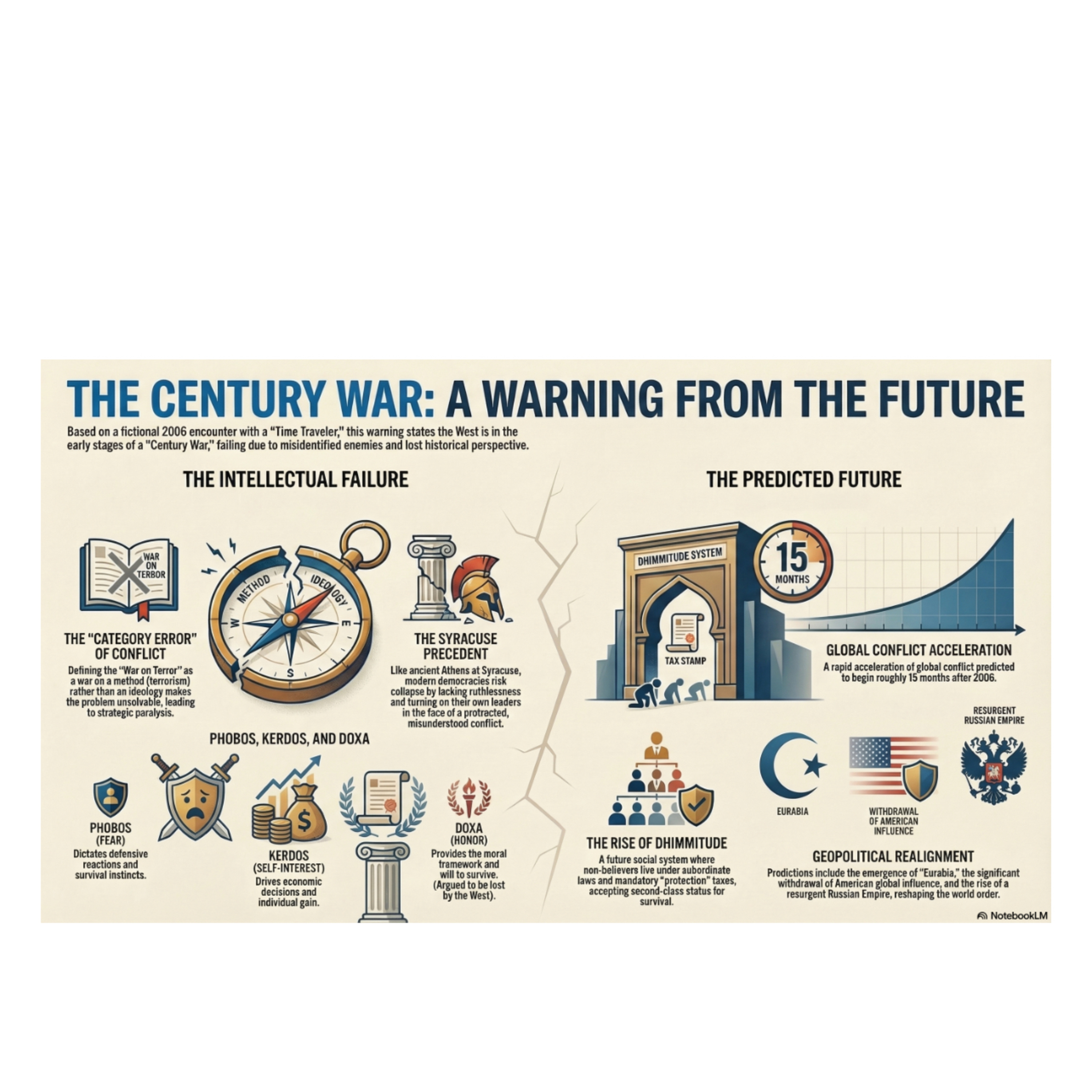
new cycle at the time. But the traveler sharply corrects him. He calls it the long war with Islam. That is a massive, highly controversial pivot. How does the traveler justify redefining the entire global conflict? To justify this distinction, the traveler introduces a philosophical concept known as a category error. Simmons leans heavily into this idea in the text, essentially arguing that if a society defines a problem poorly, it becomes mathematically and practically impossible to solve. No matter what resources you throw at it. Exactly. The traveler argues that the West is committing a massive category error by labeling the conflict a war on terrorism. The core argument presented in the text, and again, we're just looking at this and partially as an element of the story, is that terrorism is merely a method. It's a tactic. Right. It's a tactic. Yeah. The true conflict in the traveler's dystopian view is ideological and civilizational. I love a good historical analogy. And the traveler gives a deeply provocative one to really hammer this category error concept Oh, the Pearl Harbor one. Yes. He asks the author to imagine December 8, 1941, the day after
the Japanese attack on Pearl Harbor. Imagine if President Franklin Delano Roosevelt had gone before Congress. And instead of asking to declare war on the empire, Japan, he had asked Congress to declare war on aviation. It is an extreme analogy. Extremely. But it's designed to shock the listener into a new perspective by comparing the planes at Pearl Harbor to terrorism. The traveler argues that focusing your entire national effort on the means of an attack rather than the source or the ideology behind it is a fatal flaw. Right. In the worldview of this essay declaring war on a tactic guarantees defeat because you haven't actually named your enemy. And if we connect this to the bigger picture Simmons is really channeling the dense geopolitical theories that were highly prevalent in the mid 2000s. The text draws heavily on works like Samuel P. Huntington's The Clash of Civilizations, which argued that future wars would not be thought between countries over borders or economics, but between cultures over fundamental religious and civilizational identities.
Again, a highly debated theory, but central to this story. Exactly. And the author is absorbing all of this in real time. Here's where it gets really interesting though. You think you're settling in for a sci-fi debate about modern 21st century politics. And suddenly the time traveler pivots and turns the conversation into a surprisingly deep history lesson about ancient Greece. Yeah, that's roomy. He brings up the Peloponnesian war, specifically the Athenian invasion of Syracuse around 415 BC. Why jump back over to millennia to make a point about the modern era? Well, this is a critical pivot in the text. And it relies heavily on the historical analysis found in Donald Kagan's multi-volume history of the Peloponnesian war, which Simmons actually cites in his bibliography. To provide the historical context woven into the essay, Athens and Sparta had been fighting for years over hegemony of the known world. Athens, driven by its past successes and a significant amount of democratic hubris, decided to launch a massive, unprecedented expedition
against Syracuse in Sicily. It's Sicily, right? They sent 136 triremes, the absolute best fighting ships of the era, along with 5,000 soldiers. That sounds like a massive overreach, were there any dissenting voices warning them against this kind of huge deployment? General Nicae has strongly warned the Athenian democracy against it. He cautioned that they were marching into hostile unfamiliar territory and would need to become absolute masters of the land immediately or face total destruction. He didn't listen. No. The democratic assembly ignored his warnings, driven by political momentum and pushed forward anyway. The result was a catastrophic two-year debacle. Wow. The Athenian forces were completely destroyed. Nisi's was executed and the massive loss of resources ultimately led to the total collapse of the Athenian Empire at the hands of Sparta. You can really feel the author's frustration building in the narrative here. I mean, it's New Year's Eve 2005. The American public is exhausted by the ongoing war in Iraq. The author groans, assuming this time traveler came all the way back just to give him a heavy
handed allegorical lecture about America invading the wrong country and repeating the mistakes of Athens. But the traveler corrects the author yet again. It's a rhetorical trap. The point he actually makes is chilling within the context of the narrative. The traveler claims that Athens didn't fail because they invaded the wrong place or fought at the wrong time. And why did they fail? He asserts they fail because they weren't ruthless enough. That is a very harsh cynical read on history. It is. The traveler's argument is that the democratic Athenians wanted the victory, but they were not willing to commit to the absolute merciless ruthlessness required to achieve it against an enemy fighting for its survival. When the war in Syracuse started going poorly, the Athenian public back home turned against their own leaders in generals consumed by political infighting and a desire for moral purity. And he's comparing this to. Yes. The traveler looks at the author and claims that America in 2006 is doing the exact same thing. Wow. He accuses the
nation of being so preoccupied with criticizing itself, seeking short term political advantage, and maintaining a façade of decency that it is completely ignoring a war for its civilizational survival. He describes the country as ripping itself apart from the inside like a sun-madden dog. Sun-madden dog. That visceral aggressive language really sets the stage for the terrifying future the traveler lays out next. The author naturally starts getting defensive about civil liberties, bringing up the Patriot Act, and wiretapping things people were actively protesting in 2005. But the traveler literally laughs until he wipes a tear from his eye. He mocks the author for fearing his own democratically elected government. The loss of freedom the traveler has experienced doesn't come from Washington, DC. It comes from a new dominant global power. This raises an important question about the specific highly charged terminology Simmons introduces to flesh out this dystopian vision. He leans into the anxieties detailed in books like Bruce Bauer's while Europe slept, which dealt with European demographic changes. The traveler's speech of a future
region he calls Eurebia. And he instructs the bewildered author to look up a word dimitude. A term the author had never encountered before. What exactly does this look like in the traveler's timeline? Again, keeping in mind we're simply explaining the fictional world Simmons built here. Right. The traveler describes a future where Europe has fallen under a global caliphate governed entirely by Sharia law. Under this tricked religious legal system, non-Muslims are referred to as dimmies. Dimitude is the permanent subordinate societal status they are forced to live under. Okay. According to the traveler's description of this future, dimmies are forced to pay specific punitive taxes, a poll tax called the Jizia, and a land tax called the Karaz simply for exifting his infidels. And the punishment for paying those taxes late in this dystopian future is severe too. I think he mentions death by stoning or beheading. Yes. Furthermore, the traveler explains that in this legal framework, the literal value of an infidels life is codified as a fraction of a Muslims.
He claims that dimmies life is legally valued at one half. Jews and Christians at one third. One third. If a dimmy is murdered, the perpetrator does not face capital punishment. They merely pay a minor blood money fine. And that fine has waved entirely if the murder was deemed part of a sanctioned jihad. Simmons is taking these historical theological concepts and weaponizing them as imminent futuristic threats. It's a bleak, horrifying picture. The traveler doesn't just stop at legal definitions either. He starts dropping names of visceral devastating targets to completely shock the author out of his complacency. The landmarks? Right. He lists Iranian nuclear sites like Natanz and Iraq. He mentions she have missiles. Then he starts naming beloved iconic global landmarks that he claims will be destroyed over the next 15 years. He lists the space needle and Seattle. The Golden Gate Bridge in San Francisco, the new Reichstag in Berlin, St. Paul's Cathedral. Simmons grounds his abstract geopolitical fears in recognizable monuments to elicit a primal reaction. You hear Golden Gate Bridge and it hits you. Absolutely.
But he also elevates the discussion by connecting these geopolitical predictions back to classical philosophy. The traveler invokes Plato and Thucydides stating that human behavior is essentially a chariot pulled by three distinct horses. Phobos, which translates to fear. Curtis, which is self-interest, and Doxo, which is honor. Fear, self-interest, and honor. How does he apply those to the modern west? The traveler asks the author which of those three horses is guiding Western civilization right now. He accuses the west of being entirely too decent, too timid, and too concerned with its own moral superiority to match the sheer ruthlessness of its enemies. Being too decent is a weakness. That's his argument. He argues that this prized western decency is merely a temporary luxury. It is a luxury that vanishes the absolute moment you are forced to bury your children or watch them suffer in subjugation. That accusation that decency is a weakness pushes the author to his absolute breaking point. The tension in that small quiet study finally snaps. The author reaches
into his desk door, pulls out a .38 revolver, cocks the hammer, and aims it directly at the chest of the time traveler, demanding that he get out of his house. It is the physical and emotional climax of the essay. Yet, the traveler shows absolutely no reaction to the loaded gun pointed at him. Instead of flinching, he delivers a devastating personal twist. He gives the author two names, Thomas and Daniel. He reveals that these are the author's own young grandsons, and that they were recently sentenced to death by a sharia tribunal in London. The details he shares are incredibly tragic. The traveler explains that Thomas and Daniel were executed simply for dating Muslim women without converting to Islam first. They didn't even know the women were Muslim because they were wearing modern western clothes. But this action violated a strict part of Islamic law the traveler refers to as Houdud. And Simmons makes sure to note the horrific fate of the women as well, stating they were killed by their own families in honor killings. This further underscores the brutal, uncompromising reality of the world the traveler comes from, contrasting sharply
with the comfortable study they're standing in. The real gut punch arrives when the traveler explains why he knows all of this so intimately. He reveals that he is the author's sole surviving grandson sent back from this horrific war-torn future. He looks at the man holding the trembling gun on him and just calls him grandfather. It completely reframs the entire interaction. It goes from a philosophical debate into a transmission of profound generational trauma. If we look at the dense bibliography, Simmons included at the end of his post, Huntington, Bauer, Kagan, we see exactly how we engineered this narrative. He took sweeping macro-level academic arguments about demographics, civilizational clash, and ancient military history, and synthesized them into an agonizingly personal scenario. So what does this all mean? When you look at the architecture of the story, you realize that Simmons took these massive geopolitical treatises and turned them into an emotionally visceral piece of sci-fi. Regardless of the controversy surrounding the subject matter,
or the specific political stance is taken, the essay is a masterclass in demonstrating how literature serves as a vehicle to process immense societal fear and uncertainty. He took abstract global theories about the collapse of civilization and placed them right inside a grandfather's study staring down the barrel of a gun. That synthesis is what makes the text so potent as a historical document of 2006. There's a final, highly provocative thought that Simmons leaves us with, built perfectly on the foundation of this source material. At the very end of the essay, right before the time traveler vanishes for good, he whispers three last words to his grandfather. But the author refuses to write them down in the essay, though. He deliberately omits them. The author states that those three unspoken words are markers of our future that carry the exact same weight and horror that words like Auschwitz or Hiroshima carry for the 20th century. Wow. They are words that would instantly identify a time traveler because of the sheer scale
of the tragedy they represent. It makes you wonder about our media diet today and how we process our own contemporary anxieties. If literature is the primary way we process societal fear, are the dystopian stories we are obsessively consuming right now actually preparing us for the future? Or are they just blinding us to the actual category errors we are making today? Next time you read a piece of science fiction or watch a dystopian thriller, ask yourself, is this author genuinely predicting the future? Or are they just terrified of the present? We are all living our day-to-day lives entirely unaware of the vocabulary that will define the tragedies of the next century. What future events are we currently living in the shadow of? Completely oblivious to the words the history will remember us by. It is something to think about the next time you consume a story about the end of the world.
More episodes


