Loading...
scienceastronomynatural
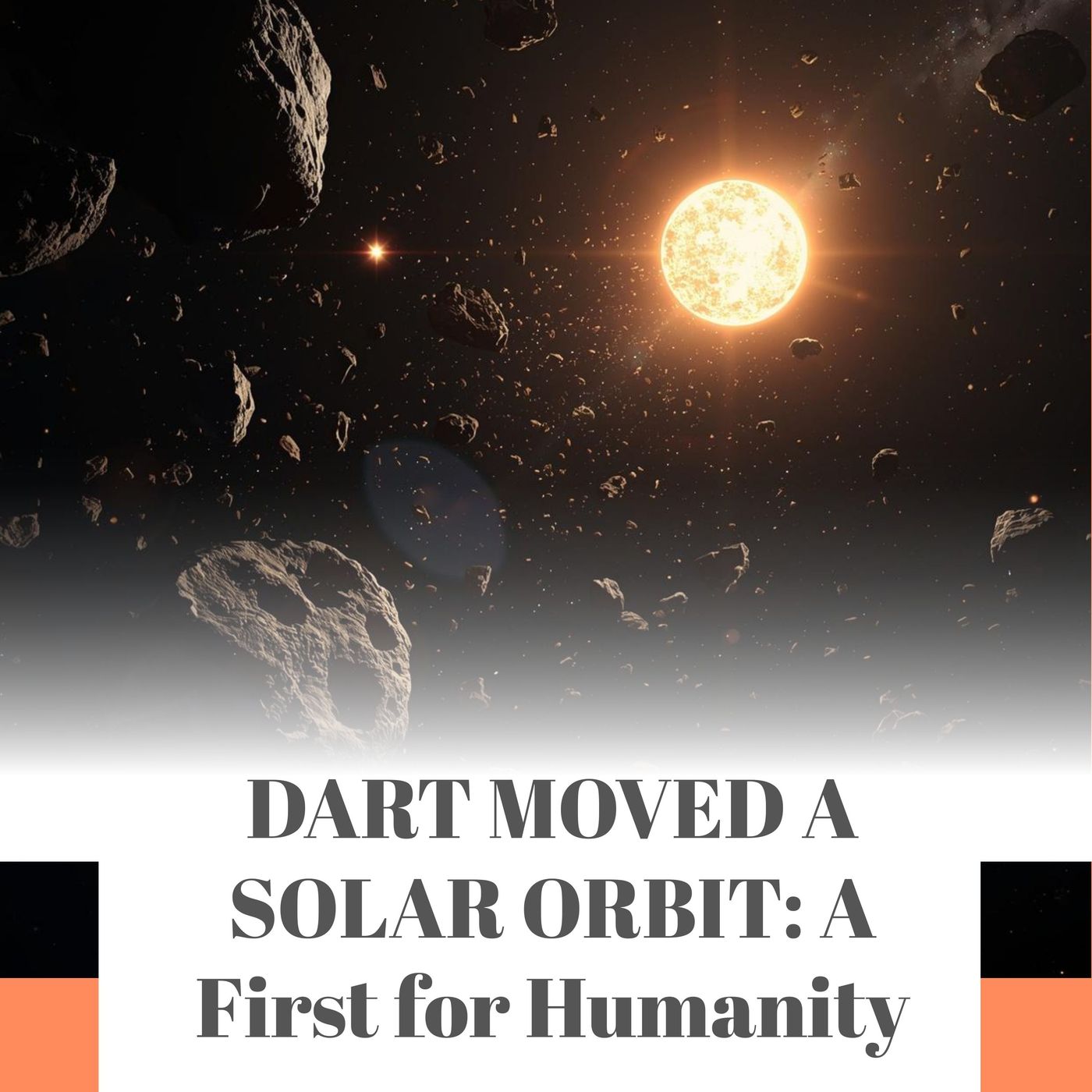
Humanity Just Moved an Asteroid's Orbit Around the Sun
About this Episode
ASTRONOMY DAILY — S05E57 | Saturday 7 March 2026
A landmark week for planetary defence — scientists confirm that NASA's DART impact didn't just move an asteroid's orbit around its companion, it shifted the entire binary system's path around the Sun. Plus: gravitational waves double, a European spacecraft goes silent, a 45-year theory bites the dust, a young Sun caught in the act — and a double planet show in tonight's sky. In This Episode • [00:00] Cold Open — Humanity moved a solar orbit • [02:00] Story 1: DART changed Didymos's orbit around the Sun (Science Advances, March 2026) • [06:00] Story 2: LIGO-Virgo-KAGRA doubles the gravitational wave catalog with GWTC-4 • [10:00] Story 3: ESA's Proba-3 Coronagraph spacecraft goes dark — recovery underway • [13:00] Story 4: Stars keep their rotation pattern for life — 45-year theory overturned (Nature Astronomy) • [16:30] Story 5: Chandra captures first astrosphere around a Sun-like star • [19:30] Story 6: Venus and Saturn pair up in tonight's sky — skywatching guide Connect With Us • Website & Blog: astronomydaily.io • Social: @AstroDailyPod • Network: Bitesz.com Podcast Network
Become a supporter of this podcast: https://www.spreaker.com/podcast/astronomy-daily-space-news-updates--5648921/support.
Sponsor Details:
Ensure your online privacy by using NordVPN. To get our special listener deal and save a lot of money, visit www.bitesz.com/nordvpn. You'll be glad you did!
Become a supporter of Astronomy Daily by joining our Supporters Club. Commercial free episodes daily are only a click way... Click Here
This episode includes AI-generated content.
A landmark week for planetary defence — scientists confirm that NASA's DART impact didn't just move an asteroid's orbit around its companion, it shifted the entire binary system's path around the Sun. Plus: gravitational waves double, a European spacecraft goes silent, a 45-year theory bites the dust, a young Sun caught in the act — and a double planet show in tonight's sky. In This Episode • [00:00] Cold Open — Humanity moved a solar orbit • [02:00] Story 1: DART changed Didymos's orbit around the Sun (Science Advances, March 2026) • [06:00] Story 2: LIGO-Virgo-KAGRA doubles the gravitational wave catalog with GWTC-4 • [10:00] Story 3: ESA's Proba-3 Coronagraph spacecraft goes dark — recovery underway • [13:00] Story 4: Stars keep their rotation pattern for life — 45-year theory overturned (Nature Astronomy) • [16:30] Story 5: Chandra captures first astrosphere around a Sun-like star • [19:30] Story 6: Venus and Saturn pair up in tonight's sky — skywatching guide Connect With Us • Website & Blog: astronomydaily.io • Social: @AstroDailyPod • Network: Bitesz.com Podcast Network
Become a supporter of this podcast: https://www.spreaker.com/podcast/astronomy-daily-space-news-updates--5648921/support.
Sponsor Details:
Ensure your online privacy by using NordVPN. To get our special listener deal and save a lot of money, visit www.bitesz.com/nordvpn. You'll be glad you did!
Become a supporter of Astronomy Daily by joining our Supporters Club. Commercial free episodes daily are only a click way... Click Here
This episode includes AI-generated content.
Hosts & Guests
Transcript
Warning, the following Zippercruder radio spot you are about to hear is going to be filled with F words.
When you're hiring, we at Zippercruder know you can feel frustrated.
For Lauren even, like your efforts are futile, and you can spend a fortune trying to find fabulous people,
only to get flooded with candidates who are just fine.
Fortunately, Zippercruder figured out how to fix all that.
And right now, you can try Zippercruder for free at zippercruder.com slash zip.
With Zippercruder, you can forget your frustrations because we find the right people for your roles
fast, which is our absolute favorite F word. In fact, four out of five employers who post on Zippercruder
get a quality candidate within the first day. Fantastic! So, whether you need to hire four,
40, or 400 people, get ready to meet first rate talent.
Just go to zippercruder.com slash zip to try Zippercruder for free.
Don't forget that zippercruder.com slash zip. Finally, that zippercruder.com slash zip.
Finding great candidates to hire can be like, well, trying to find a needle in a haystack.
Sure, you can post your job to some job board, but then all you can do is hope the right person
comes along, which is why you should try Zippercruder for free. At zippercruder.com slash zip.
Zippercruder doesn't depend on candidates finding you. It finds them for you.
It's powerful technology identifies people with the right experience,
and actively invites them to apply to your job. You get qualified candidates fast,
so while other companies might deliver a lot of, hey, Zippercruder, find you what you're looking for.
The needle in the haystack. See why four out of five employers who post a job on Zippercruder
get a quality candidate within the first day. Zippercruder, the smartest way to hire,
and right now you can try Zippercruder for free. That's right, free at zippercruder.com slash zip.
That zippercruder.com slash zip zippercruder.com slash zip.
You're listening to Astronomy Daily. I'm Anna. And I'm Avery. It is Saturday
the 7th of March, 2026, and as usual, we have a packed show for you today.
We absolutely do. Here's the question to get you thinking. Back in September 2022,
NASA slammed a spacecraft into an asteroid. You probably remember that. But did you know that we
only just confirmed something remarkable? That impact didn't just nudge the asteroid.
It actually changed the orbit of an entire asteroid system around the Sun.
For the first time in human history, we moved the celestial body's solar orbit.
And that's just story one. We've also got gravitational waves,
a spacecraft emergency in orbit, a 45-year-old theory biting the dust,
our young sun blowing its very first cosmic bubble, and a gorgeous double planet show in tonight's
sky. Let's go. So let's kick off with the Dart story. And I think it deserves a moment to
really sink in. We already knew that Dart was a success. We knew it shortened the orbit of
dimorphous around its partner asteroid, Didamose, by about 33 minutes. That was confirmed back in
2022. But a new study published yesterday in the journal Science Advances has revealed something
even bigger. Right, because Didamose and dimorphous are gravitationally linked. They moved together.
And researchers have now confirmed that the debris blasted off dimorphous during that impact
was so enormous, we're talking over a million kilograms of rock and dust that it gave the whole
binary system an extra kick. And that extra kick was measurable. The orbital period of the
entire Didamose system around the Sun shortened by 0.15 seconds. Now, I know that sounds tiny,
but this is the first time a human-made object has measurably changed the path of a celestial body
around our star. To even measure that, the team had to get incredibly creative. They tracked
what are called stellar occultations. Moments when the asteroid passes in front of a background star
and briefly blocks its light. Volunteers around the world contributed 22 of these observations
between October 2022 and March 2025. 22 pinpoint moments of a star blinking out. And from those,
they derived the change of 0.15 seconds in a 770-day solar orbit. The momentum enhancement factor
turned out to be about two, meaning the debris ejected by the impact roughly doubled the total push
given to the asteroid. Dark didn't just hit dimorphous. It turned a dimorphous into a rocket.
And Thomas Statler lead scientists for solar system small bodies at NASA headquarters
framed it perfectly. He said a tiny change can, given enough time,
grow into a significant deflection. This result validates kinetic impact as a genuine planetary
defense technique, not just for nudging a moon, but for altering the path of an entire binary
system around the Sun. He says Harris spacecraft, which launched in 2024,
is expected to arrive at the Didamose system later this year to study the aftermath of close.
Though the science from this impact is very much still unfolding.
Story 2, and it is a landmark one. The LIGO Virgo Cogra collaboration, the LVK,
has just published the fourth edition of the Gravitational Wave Transient Catalog,
known as GWTC4. And the headline? They've more than doubled the total number of gravitational
wave detections ever made. Before this release, the entire catalogue contained 90 candidates
from three previous observing runs, stretching back to 2015. This new catalogue adds 128 new events,
all detected during just the first nine months of the fourth observing run between May 2023 and
January 2024. So we've gone from 90 to 218 in one update. And it's not just the quantity
that's exciting. It's the variety. The catalogue includes the heaviest black hole binary merger
ever detected, with each black hole weighing in at around 130 times the mass of our Sun.
There's also a binary where both black holes are spinning at roughly 40% the speed of light.
And there are two new mixed mergers, a black hole colliding with a neutron star.
Each one of those is a treasure trove for astrophysics.
Daniel Williams, a researcher at the University of Glasgow and LVK member, put it well.
He said they're pushing into new parts of parameter space, seeing things that are more massive,
spinning faster, and more astrophysically unusual than anything detected before.
What I love about this is what it means for testing Einstein.
The catalogue includes an event with one of the loudest gravitational wave signals ever recorded.
DW230814, and the team used it to run precision tests of general relativity.
It passed with flying colors, but the fact that we're now running those tests on events
this extreme is remarkable. Liger and its partners are currently in a maintenance break,
but a new six-month observing run is expected to begin in late 2026. Given how rapidly the catalogue
is growing, that run could double it again.
All right, story three, and this one has a genuine element of suspense.
Europe's Proba 3 mission is in trouble.
Esa confirmed yesterday that they have lost contact with one of the two spacecraft that make up
the Proba 3 mission. Let me explain what Proba 3 actually is, because it's a fascinating concept.
It launched from India back in December 2024, and it consists of two separate spacecraft
designed to fly in extraordinarily precise formation, about 150 meters apart, to create artificial
solar eclipses in space. One spacecraft, the occultor, physically blocks the bright face of the
sun. The other, the coronagraph, uses that shadow to image the sun's faint outer atmosphere,
the corona, without being blinded by the solar disk. And to make this work, the two spacecraft
must maintain alignment to within millimeter accuracy.
It's an almost absurdly precise operation, and it was working. In May of last year,
the spacecraft achieved their landmark formation flying test. In June, they captured the first
ever images of an artificial solar eclipse in space. It was a genuine technological first.
And then, on the weekend of February 14th, something went wrong.
The coronagraph spacecraft, the one doing the imaging, experienced an anomaly that prevented it
from entering safe mode. ESA describes it as a progressive loss of attitude. In other words,
the spacecraft slowly lost its orientation. As it drifted, its solar panels moved away from
the sun. The batteries drained, the spacecraft dropped into survival mode, and contact was lost.
ESA says root cause is under investigation, and they're exploring whether the companion
a culture spacecraft can be maneuvered closer to assist in recovery.
Losing either spacecraft would effectively end the probe with remission. ESA says
teams are working hard, and they will provide updates as new information becomes available.
This is very much a developing story. We'll keep following it.
Story 4 is a classic example of a long-held scientific belief getting overturned.
For 45 years, astronomers thought they understood how stars like our sun
change as they age, specifically how their rotation pattern evolved.
The idea was this. Our sun rotates differentially.
The equator takes about 25 days to complete one full rotation, while the poles take about 35 days.
Equator faster, poles slower. That's called solar-type differential rotation.
And scientists believed that as stars slow down over billions of years,
they would eventually flip. The poles would start spinning faster than the equator, instead.
That flip state was called anti-solar differential rotation.
Theoretical simulations predicted it. No one had ever observed it, but the model said it should happen.
And for decades, the lack of observations was attributed to limitations in our telescope technology.
But now, researchers at Nagoya University in Japan have used Fugaku.
The country's most powerful supercomputer to run the most detailed simulations
ever of stellar interiors. And the result is clear, the flip doesn't happen.
The key was resolution. Previous simulations were low resolution,
and magnetic fields faded out of the models entirely. At high resolution,
we're talking 5.4 billion grid points per simulated star.
The magnetic fields stayed strong, and those magnetic fields, it turns out,
are what prevent the rotation from flipping.
Professor Heidi Yukihata, one of the co-authors, said it simply.
Turbulence and magnetism keep the equator spinning faster than the poles throughout the stars' life.
The switch doesn't happen because magnetic fields, which previous simulations missed, prevent it.
And there's a bonus finding.
Magnetic fields in solar type stars weaken continuously throughout their lifetime,
with no revival in old age.
Previous models had predicted a magnetic comeback, that doesn't happen either.
This matters practically too. A corrected model of stellar rotation
helps us better understand the sun's 11-year sunspot cycle,
and could improve our predictions of how magnetic activity affects the habitability of planets
orbiting sun-like stars over billions of years.
Dory 5, and it's a lovely one, a real window into our own sun's distant past.
NASA's Chandra X-ray Observatory has captured the very first image of what's called
an astrosphere around the sun-like star.
Our sun has a protective bubble around it, called the heliosphere,
created by the solar wind streaming outward and carving out a cavity in interstellar space.
It's enormous. It extends far beyond the outer planets,
and shields the solar system from harmful galactic cosmic rays.
But we've never been able to photograph it from the outside.
The star Chandra observed is called HD-61-005, and it sits about 120 light years away
in the constellation Pupus. It has roughly the same mass and temperature as our sun,
but it's only about 100 million years old.
Our sun is around 5 billion years old, so HD-61005 is cosmically speaking a baby.
And because it's so young,
its stellar wind is dramatically more powerful.
It blows about three times faster, and it's 25 times denser than the wind from our sun today.
That's why its astrosphere is bright enough to detect an X-rays.
The powerful wind collides with the surrounding interstellar dust and gas,
and that collision produces X-ray emission that Chandra can detect.
The astrosphere has a diameter roughly 200 times the distance between earth and the sun.
Carry lists of Johns Hopkins University, who led the study, put it beautifully.
We've been studying our sun's heliosphere for decades,
but we can never see it from the outside.
This is the closest thing we have to a photograph of what our own sun's bubble look like
several billion years ago.
The star is also nicknamed the moth, because a surrounding disc of dust forms a moth-like structure
around it. And interestingly, the dense, dusty environment is actually part of why the
astrosphere is so visible here, making HD-61005 a uniquely ideal subject for this kind of observation.
And we'll finish with some sky-watching news, because tonight and tomorrow night offer
something quite special. Venus and Saturn are meeting up in the evening sky,
and it's a treat for anyone who can get outside shortly after sunset.
Venus is already impossible to miss right now. It's shining at magnitude minus 3.9,
which makes it by far the brightest object in the sky after the sun and moon.
Tonight and tomorrow, Saturn sits close alongside it,
though considerably fainter at magnitude 1.0.
The best time to look is about 30 minutes after sunset. When Venus will be roughly 7 degrees
above the western horizon, binoculars will help a lot. Saturn should pop into view easily
near brilliant Venus. You'll have about 70 minutes before both planets set.
And if you're pointing at telescope at Venus tonight, you're in for an extra treat.
The planet is currently showing a 97% lit disc, almost fully illuminated from our perspective.
It's a gorgeous sight. Neptune is also lurking nearby, just over a degree from Saturn,
though you'll need a telescope to catch that one.
So get outside this evening, if skies are clear.
Venus is your guide. Find that brilliant white beacon low in the west,
and Saturn will be right there waiting for you.
And that's our show for today. Six stories from an asteroid nudged around the sun
to a planet pairing up into night sky. It's a great time to be paying attention to the universe.
If you enjoyed today's episode, please subscribe wherever you're listening,
and leave us a rating or review. It genuinely helps the show reach more people.
You can find us at astronomydaily.io for the blog and show notes,
and follow us at AstroDailyPod on all the major social platforms.
Warning, the following Zippercruder radio spot you are about to hear is going to be filled with F words.
When you're hiring, we at Zippercruder know you can feel frustrated.
For Lauren, even, like your efforts are futile, and you can spend a fortune trying to find fabulous
people, only to get flooded with candidates who are just fine.
Fortunately, Zippercruder figured out how to fix all that, and right now you can try Zippercruder
for free at zippercruder.com slash zip. With Zippercruder, you can forget your frustrations,
because we find the right people for your roles fast, which is our absolute favorite F word.
In fact, four out of five employers who post on Zippercruder get a quality candidate within the
first day. Fantastic! So, whether you need to hire four, 40, or 400 people, get ready to meet
first straight talent. Just go to zippercruder.com slash zip to try Zippercruder for free.
Don't forget that zippercruder.com slash zip. Finally, that zippercruder.com slash zip.
Finding great candidates to hire can be like, well, trying to find a needle in a haystack. Sure,
you can post your job to some job board, but then all you can do is hope the right person comes along,
which is why you should try Zippercruder for free at zippercruder.com slash zip.
Zippercruder doesn't depend on candidates finding you. It finds them for you.
It's powerful technology identifies people with the right experience and actively invites
them to apply to your job. You get qualified candidates fast. So, while other companies might
deliver a lot of, hey, Zippercruder, find you what you're looking for. The needle in the haystack.
See why four out of five employers who post a job on Zippercruder get a quality candidate within
the first day. Zippercruder, the smartest way to hire. And right now, you can try Zippercruder for
free. That's right. Free at zippercruder.com slash zip. That zippercruder.com slash zip zippercruder.com slash zip.
More from Astronomy Daily: Space News Updates
View all episodes →
Artemis II Is Go — Humanity's Return to the Moon
Astronomy Daily: Space News Updates
Apr 2, 2026·13:09·failed

'Hey, Let's Go to the Moon' — Artemis II Launch Day
Astronomy Daily: Space News Updates
Apr 1, 2026·16:24·failed

