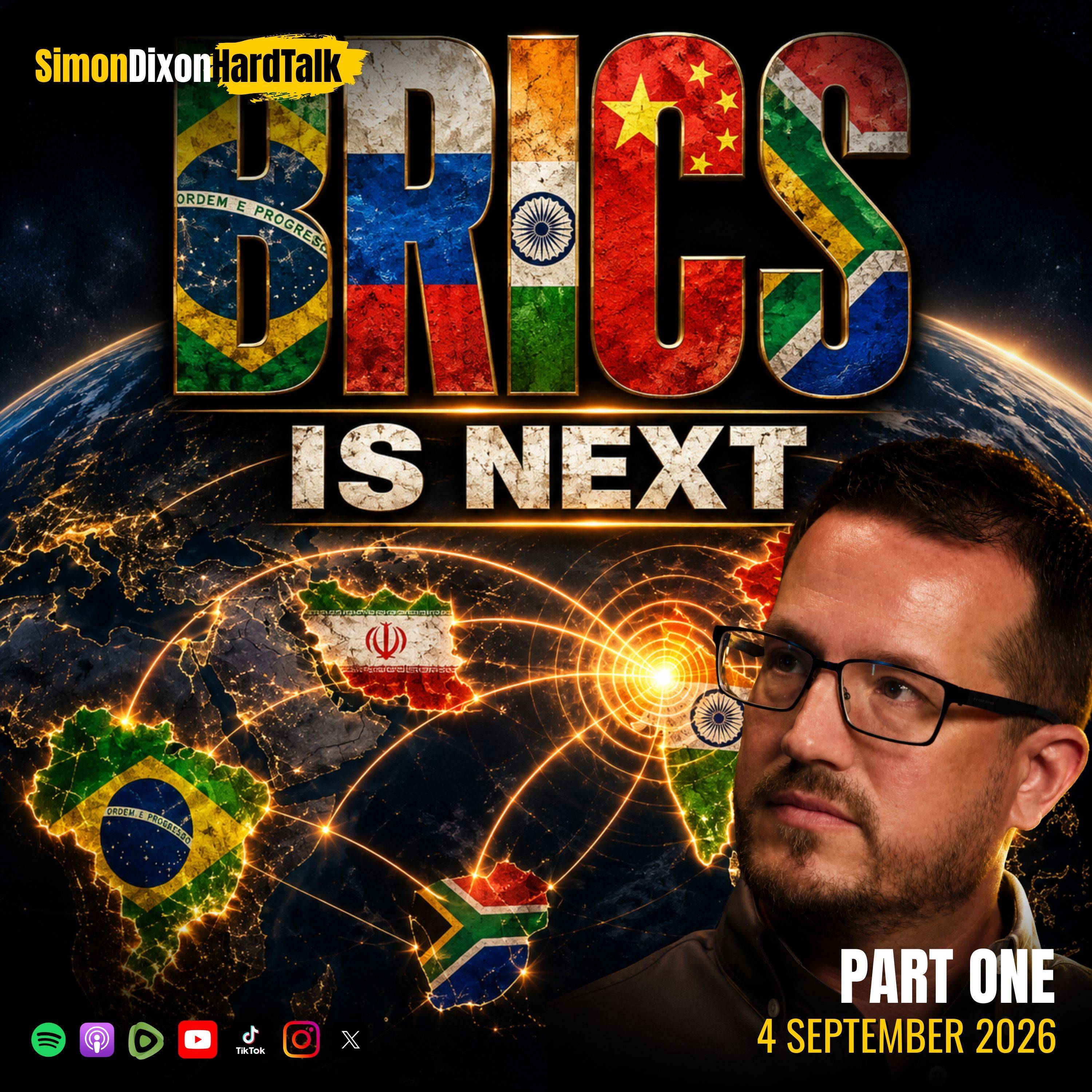
India, China & Iran Just Sent a Major Signal — BRICS Is Next | Simon Dixon Hard Talk LIVE - 4 September 2026 (Part One)
About this episode
Hey hey sovereign wealth builders,
We are witnessing history, and most people are completely missing the signal for the noise.
In the markets, we are seeing a major structural stress test. While the S&P 500 pushes toward its all-time high of ~7,748 under fiscal dominance, the bond market is flashing serious warning signs. The US 10-year Treasury yield is hovering around ~4.76% and the 30-year is at ~5.24%.
In my view, this is driving 7% mortgages back into play and putting severe stress on bank collateral. Meanwhile, Japan’s 10-year yield has risen above 3% for the first time since 1996, signaling a massive decoupling of the Japan carry trade.
The real relief valves are showing their strength. Gold is pushing above ~$4,500 as central banks continue to accumulate physical reserves. In a telling move, the Netherlands has quietly relocated 86 tonnes of its gold reserves ($12 billion) out of the US and over to London, with officials citing "increasing geopolitical unrest".
Bitcoin is also demonstrating its strength as hard money, posting its biggest weekly gain since March 2023 and surging 23% to ~$81,000 after wiping out billions in short positions. This comes as the US Strategic Petroleum Reserve (SPR) falls to ~287 million barrels—four-decade lows not seen since 1982.
In my view, we are watching the transition from a US-dominated dollar hegemony to a multi-node world order.
To unpack this transition, we are going live today for another episode of Simon Dixon Hard Talk LIVE.
You Think You’re Watching a War. You’re Watching a New World Being Built | Simon Dixon Hard Talk LIVE
PART ONE: India, China & Iran Just Sent a Major Signal — BRICS Is Next
Part One of today's broadcast is our live show. It begins with a live macro update from me, followed by an in-depth pre-recorded interview, with me as the guest, on Wally Rashid’s YouTube channel.
In this section, we break down the major geopolitical signals sent at the recent Shanghai Cooperation Organisation (SCO) meeting. India is increasingly cooperating with China, Russia, and Iran through both the SCO and BRICS, with Iranian President Pezeshkian invited to the BRICS summit in New Delhi next week (12–13 September). Meanwhile, at the G20, 19 countries backed freedom of navigation through the Strait of Hormuz, but China blocked a unified consensus.
Why does this matter now? In my view, this is the arrival of the multipolar—or what I call the "multi-node"—world order. Multipolarity does not mean India or the Gulf states are choosing China over America. Instead, they are refusing to choose. They are building regional security nodes connected by competing financial and technological rails. The old hegemonic node is fracturing, and regional powers are stepping up to secure their own corridors while the Financial Industrial Complex (FIC) and Technical Industrial Complex (TIC) jockey for dominance over payment and settlement rails.
Watch Full Episode on YouTube.
Get every episode summarized
Each time Simon Dixon Hard Talk publishes, we email you a written briefing from the transcript — the topics, who appeared, and any specific claims, with the ad reads skipped.
Email me new episodesFree for 3 shows. No card needed.
Hosts & guests
Transcript ready
1,318 searchable segments. Every word is indexed and playable.
Full transcript
Simon Dixon Hard Talk — India, China & Iran Just Sent a Major Signal — BRICS Is Next | Simon Dixon Hard Talk LIVE - 4 September 2026 (Part One). Machine-transcribed; use the interactive transcript above to jump the player to any line.
Did you see what happened between India, Iran, Russia and China at the Shanghai Cooperation Organization meeting S.C.O. at the exact same time as the announcements the opposite way in G20? I think that sets the framework for what's coming next in the bricks of it. But also did you see the Venezuelan deal? It was so different to the reality and how it impacts you. So Netherlands is moving their gold over to London. What do you need to do to protect yourself? Let's break it all down this week in Simon Dixon Hard Talk Live. Hey, hey, sovereign wealth builder, Simon Dixon here and welcome to another episode of Simon Dixon Hard Talk Live. We're on the move so we haven't got the perfect sound but the content is what matters because the title of today's episode is that you think you're watching a war but you're
watching a new world being built. We're going to check in on everything that happened this week and we're also going to go over to one of my live interviews that I gave just yesterday. So part one, what are we going to be covering? Well, there was massive news in the S.C.O meeting and India, China and Iran just sent a major signal that we got to interpret and then we have the bricks on it next as well. So we're going to be going through all of that as well as the Venezuela updates and latest in the Iran side and everything that's happening in the markets. In part two, I'm going to be answering some questions from a podcast that I was recently invited to and the topic was Israel's being privatized. We were discussing what's going to happen to Israel in this new order that's being built and I was also sharing what I think is happening, what deals are happening and how Niten Yahu is likely being left behind but it depends upon the sequencing with the Iran War outcome. That was my interview with Wally Rashid on his YouTube channel and we're going to be
premiering that right after part one where we cover everything that happened this week. So let's dive right in with the market check in. The bond market, as I've always been warning over the last couple of years and particularly since the breakout of the Iran War, is to watch the bond market. The bond vigilantes are telling us the story. While the Federal Reserve can control the short term rates, the long term rates are determined by bondholders in guess what? The Federal Reserve is owned by the financial industrial complex and the largest bondholders are the financial industrial complex. So they own the market and they can dictate policy. Well what are they saying? They are saying if we are to land to the US government for 10 years, we now need 4.76%. I was saying whenever it's about 4.5%, you need to look for signs of serious stress. And that stress in this fiscal dominance environment where the government prints money to stimulate the stock market but bondholders are pricing in higher risk is exactly what we're seeing
right now and the outlet is in gold, Bitcoin and other fixed supply assets that we're starting to see early signs of right now. The stress behind the 10 year bond is oil prices and oil prices are determined by the shape of the world order which is bounded escalation which is why we need to look into the geopolitics. The 30 year to lend to the US government for 30 years, they need 5.24%, 5 and a quarter percent. But what is really happening is everyone connected to America, the network connected to the bank for international settlements, whether it be the bank of England, the bank of Japan, they're bonds in France, Germany, across Europe, across the allies of the United States, they're all blowing out as well. And Japan, significantly we've been covering over the long term, the 10 year yield in order to lend to the Japanese government, it's up to 3%.
Now that has a very different implication because Japan has had that lost couple of decades and that is as a result of the bank of Japan using the Japanese economy as a note for cheap credit for hedge funds, it's called the Japan carry trade. When you push it up to 3%, that decouples the bank of Japan policy from the Federal Reserve policy or it's coordinated by the bank for international settlements in order to manage capital outflows. So rather than Japanese investors and while we talk about Japanese debt being like 250% to GDP, remember who Japan is, who's the largest holder of Japan's debt? It's Japan, it's the bank of Japan, it's the Japanese financial industrial complex, it's the pensions. So it's a very different position to the foreign debt held by US. So now when they're moving the rates to 3%, which is the highest since 1996, that is
a change of policy. That is saying to Japanese investors no longer borrow 0% from us to invest in US treasuries, the basis trade, which is why came in Ireland as the largest lender to the US government via the Japan carry trade, instead lend to us. So this is decoupling of the Japan carry trade. At the same time we got the stress and the petro dollar as a result of the war and the divvying up of financial centers around the world through what's known as the euro dollar, which has nothing to do with euros. But what is the relief valve for all these foreign countries in central banks? Well it's gold. And so gold is pushed above approximately 4,500 again and Bitcoin is starting to push up above 81,000 from a low of approximately 60, 62,000. Where is the stress that we're seeing? So DXY, which is US dollar relative to Western aligned currencies or strategic trade partners
of the dollar, that's hovering around that 99 dollar mark. So it's still below the 100 mark of this recent lows of about 96 dollars prior to the war. But below its peak of about 103 dollars that was a peak dollar strength. So slow burn in terms of the DXY side. But of course the S&P 500 in fiscal dominance is sacrifice world reserve currency. You roll over the debt and dump the debt upon everyone through accelerated inflation. When you invest it into the stock market and the S&P 500 is pushing closer to those all time highs of 7,748. If it breaks the $8,7,850 level, we're back up to new all time highs. And where is the vast majority of that money going? Well of course it's going into the AI and robotics trade, which then leads to significant
unemployment, productivity gains for the largest companies and a significant acceleration of that K-shaped economy that eventually leads to my long term thesis of a universal basic income for those that are priced out of the assets and severe K-shaped wealth inequality for those that only assets in your job, which I actually shared in part two of how you can protect yourself from that in the interview. Meanwhile, where's it coming from? Well it's Brent Crude Oil as a result of the bounded escalation for the negotiation that we're going to be discussing a bit more on what happened this week. We had Brent Crude reach a peak of about $97. It's now around about $95 to $96. So a slight correction of that. And the US strategic petroleum reserve, because in order to control the price of oil, US was releasing its reserves onto the market, as well as China being the most significant by
determining how much it's importing. Now they just got the largest oil reserves in the world that went to approximately 287 barrels, which is the lowest since 1982 significant date, because that's after the fall out of the oil embargo that happened in the late 70s that led to the creation of the petro dollar and the order that is slowly being tested right now through the pegs in the currency from dollars to the Middle East and Gulf countries, which are having to defend the peg as the currency gets weaker, which means selling off gold or selling off treasuries in and at some stage when those pegs get removed, if the dollar continues to weaken, that's how you fully put a death to the end remnants of the petro dollar relationship.
But most importantly, while all this is happening, Bitcoin and gold were showing strength as well. But what is happening? Long term yields are having the blowout. That's where I said all the stress would be in the bond market, and we're really starting to see that acceleration now until eventually you can only control those yields by treasury intervening. And we had some treasury intervention and Scott percent go in round like a headless chicken leaving comments out there. But Scott percent and Warsh are just simply conduits of the financial industrial complex, as well as Trump setting the destabilization of America, shrinking it into a regional power and deconstructing everything that propped up the petro dollar with his destabilization of America while pumping all the value into the stock market and basically phasing out world reserve currency, both Warsh, Besson and Trump all nodes for the financial industrial
complex, as well as Howard Lotnik as well. So bond market keeps pushing yields back up even despite what's percent is saying and the treasury intervention. So we either get higher treasury intervention, which is if you remember last week we covered it, it's taking those longer term yields and refinancing in the short term. But when the Fed starts buying that's quantitative easing, that's new money creation. The banks get to purchase those bonds, the Fed balance she increases and the shareholders of the Fed are the financial industrial complex and the banks that clear into the federal reserve system. So governments can intervene but the bond market is deciding and it's the bond vigilante that decides whether they accept what's happening. And so the bond market right now is saying we don't believe you've been sent, roll over more on the short term. We want some of those short term rates, we don't want to lend too long and that's having
big impact on the markets which are connected to the 10 year and 30 year, which is mortgages. And so mortgages are up to 7% for anyone refinancing now, which causes stress in the banks collateral, which is also connected to commercial real estate and private credit to a lesser extent. But these are markets that we continually follow. Now the most important thing, by long term thesis has been that emerging market currencies when they have metals, when they have resources, they're outperforming the dollar and we're starting to see more strengthening as the dollar weakens and vice versa. Those currencies that don't have metals, don't have sovereign wealth on players, they're weakening relative to the dollar as well. So we'll continue to watch the bond market, gold, oil, the dollar, we can ignore narrative, that's telling us. And again, stress in the bond market, acceleration of gold and oil is indication that
of the escalation that happened in Iran. But until we get major blowouts of oil above 115 again and gold continues to rise in sync, then we can start to think about whether this is actually a war that is going off rails or on plan. Right now, I think it's bounded escalation into a negotiated outcome that resets the world order. So, the narrative, ignore the day to day, watch the money, it's the people that really control the markets that know what the military industrial complex, financial industrial complex and technical industrial complex and negotiating. So that's the markets. Now, let's look at what's causing those issues, which obviously is what's happening in the Middle East, which is, are we leading to other missiles, are they genuine escalations of war or are they negotiation? I still believe that this is negotiation. And remember what my long term thesis has been is that this is the mick swiping up the
last profits it can while using its leverage to get a better deal for thick financial industrial complex, military industrial complex and also get those technical industrial complex tick contracts. Then who rebuilds determines the shape of the world order, who invests in Iran, who invests in Lebanon, who invests in what's happening in Palestine, Israel, all of these regions, Syria. And we started to see significant movement in Syria and Iraq while this was happening. So let's have a look at it. So, you know, and for those of you new to the show, this has been my long term thesis since China normalized between Saudi and Iran, which was back in 2023, before the escalation of October the 7th and many of the lies and BS has happened that has led to where we are right now. But the Middle Eastern forever war model is coming to an end while most people think this
is either an escalation to World War III or the forever war just being business as usual. But this is not that type of escalation because the markets are telling me. And whenever I look at it, take a zoom out. I see a change which I've never seen in my lifetime. And this is simply bounded escalation towards settlement. So we had this week significant retaliations against the US from Iran. There were Saudi assets that were targeted in terms of oil tankers. None of them was sunk in order to create some kind of disaster in the region. But they were targeted. And the region is still in my eye settling rather than, you know, there's lots of territorial posturing into this new world order, but nothing that's leading to an all out regional war. So the Gulf states have been hosting US bases.
And we've been watching the outsourcing of the destruction of US bases to Iran. And Iran has been doing an incredible job. So we got more retaliation from Iran. So the sequence of events is US comes in and they attack. Then Iran retaliates by destroying US bases. And then the Gulf countries get to renegotiate their terms. And the Mick Fick and Tick get additional revenue from meeting some of those short term needs and you get to drain the US of all of its Mick reserves. And then you get to Lockheed Martin, General Dynamic Rathion, they get new contracts. While the Fick negotiates, rebuild contracts and gets as much leverage as it can, knowing that it can't penetrate China and China is at the other side of the trade. And the Mick needs China for its weapons. The Fick tries to integrate with China in a multipolar world order.
And the Tick needs refinement and resources for its big data center build out from China as well. So essentially the Gulf in this normalization covertly in my opinion has been outsourcing the destruction of US bases in cooperation with Iran. And now we're starting to see some of those security umbrellas be announced. It's very sequential what we've been watching. It's actually really stunning to watch. For those of you who have been long term followers, let me know in the comments what you think, whether we think we're on track, how we've been saying this over the years. And it's really stunning to watch. But you have to kind of ignore the day-to-day short term headline distractions. So Iran says that the Gulf states are basically reaching out in order to add Iran to a new security arrangement. Now there was back and forth, there was posturing.
But the important thing is that the Gulf governments haven't all publicly committed to this yet. But what have they done? Well they signed the Mecca Agreement. We'll go to that in a little bit deeper. But first we need to see what's happening around the region. So in order to replace Mick from the Middle East and Forever War, you need a regional power because there's no one country in the Middle East that is able to provide a replacement for what was forced on the Gulf countries through the Petro dollar. So if you remember just a quick recap, the Petro dollar after King Fizer was assassinated as Israel escalated, there was a retaliation, there was an oil embargo, that created a real crisis because America was very, and the West were very independent upon that oil. So we asked to the degree that we are today. Then you had Safari Club with George Bush, which was covert operations to groom Osama Bin Laden and turn them into a CIA asset.
Then you had the assassination of King Fizer, oil embargo, petro dollar, and the petro dollar relationship was that we will price oil. Now price is different to pricing and settling. So they will price and settle oil in dollars. You can price in dollars and settle in another currency, but price and settle in dollars. And then those dollars will stay within the Federal Reserve system. They'll peg their currencies to the dollar. They'll agree to defend it, which is fine in a rising market, but these defense in the falling market. And then those dollars will obviously purchase US government debt. And then the yield on the debt will purchase military equipment from the MIC. And then the MIC will build bases. And then those bases are used in order to enforce destabilization across the region and strategic tension through things like Operation Gladio.
Now that's what I believe we're witnessing the end of. So what did the Gulf countries do? They started by inequities, AI companies, all of the different stocks and various other things. And they started settling in pricing in dollars, but settling in some alternative currencies as well. And started hedging and building alternative rails like a network of CBDCs. Now all couple that with what's happened in the war struck regions. So in the forever war, you had Syria, you had Lebanon, you had Libya, you had Iraq, now you have Iran, you have Sudan, you have other areas which are part of this war death destruction, rebuild, MIC, Fictic, surveillance state. But as we're starting to see Iraq right now, you can see that there was a proposal. So we had an agreement between Saudis, military, financial might, Turkey's military and manufacturing
might and Pakistan's nuclear and military substance and battle testing. They signed an agreement and then there was a proposal between Iran and Saudi and in Iraq security, coordinated coordination council. So it was not quite MEC or agreement, but it's a coordination between Iraq, Iran and Saudi. And in exchange for that, US forces scheduled that they're going to be withdrawing from Iraq by the 30th of September. So we're getting more and more retreats from the US military side and then more and more agreements that are being signed up. Iraq basically describes this transition as military to economic. What I would say and translate that in my terms is MIC exit and Fict remains. So this is the bounded escalation on the regional stability phase where Fict tries to get as
much leverage as it can. And so we started to see big shifts in Iraqi currency policy. Firstly, there was a re-denomination adding three zeros. That's irrelevant, but there was also a movement towards digital currencies. And so digital rails, which in translation is central bank digital currencies. So the Fict took over the Iraqi central bank and Iraq needs to apply for permission after the war in order to access their funds. While the military were guarding oil resources and in China started coming in and rebuilding and ending up about 30% of the equity of much of the oil infrastructure in Iraq. So this is basically the region taking responsibility for the security in a post-US dominated mid-least. And China wants stability because America is now an energy exporter, whereas before it
was an importer, with the exception of the diesel crisis that we're seeing right now, and its dependency upon Canada and Mexico. But what is Mexico? Mexico basically is Chinese factories. So Chinese factories and refinement capabilities in Mexico and that relationship between Canada and China and Europe is also being tested. We started to see some of those tariffs policies kick up again, but this is just again, how do you make America into a regional power? You destroy everything that propped up the petro dollar and made it a global hegemon, and you build an alternative after 1991 when the Soviet Union fell, which is the new BRICS-GCC regional corridors in a multi-polar world that we're seeing right now. But especially energy security is what's being negotiated here. And with the closure of the straight-offermuse, Iraq was severely impacted more than any
other country in the mid-least. And so that gives maximum subordination, basalization in these negotiations, and Iran seems to be retreating, but there were additional border tensions. But to me, it feels like Iran is allowing the different militia groups to integrate into their own security models and political integration models as we make this transition that we're witnessing right in front of us. The Gulf wants stability in the region. Iran eventually will get its sanctioned relief and therefore wants to maximize its position. The make wants to make as much profits. The thick wants as much leverage. And China is the one where make-fictic Gulf Iran and everyone is completely dependent upon. Now when China wants stability, it wants to hedge its bets across the region.
It doesn't want to be dependant of one dominant player. And so what happens in the straight-offermuse is very important for Iraq, for the Gulf countries, for the Levant, for China, for make-fictic, for the world. And whatever comes out of that is going to set the world order. I do believe it will be a toll in my opinion. And I think it will be divvyed up across different regional powers. There was a lot of posturing between Iran and Iran. That implies to me, heavy negotiations. So when you see public narrative around, oh, we're not doing this deal, we are doing this deal. And that's just the type of posturing that are happening in my opinion behind the scenes. So things are moving on those stuff. Iran wants sanction relief and regional reintegration, which is the reformist part of the government. And the military side is represented by IRGC. In part two's interview, I answered a lot of questions in terms of the implication that
I think this has on Israel. Now Iraq wants that US military exit, but the price it has to pay is financial isolation. So the FIC, with all that leverage and with all that subordination, China has massive access to energy resources. And the FIC is getting as much of those deals, knowing that Levant, Iraq, the Middle East, regional stability will produce one of the biggest growth investment areas when you follow the money. So the outstanding settlement issues are that we need to get to a resolution on, is what does the toll booth look like on the straight of the me's? Iran sanction relief at the moment is temporary in order to control the price of oil. But once you release that oil and you have that sanction released, how much is cleared in the Chinese yuan, you know, you want your petrol yuan system versus how much is forced
onto FIC rails? Then you've got obviously the Gulf security architecture where we've had massive announcements and progress. Then the US military withdrawal and then the reconstruction contracts. Those are really important. Once we see if there is a $300 billion reconstruction contract in Iran or not, who pays it, what happens in Syria, in Lebanon, in Gaza, that shapes what these negotiated outcomes look like based upon the boundary of escalation we're seeing. And then economic integration, which is a multi-decade process. And of course, the most important thing, Palestine and Israel, what does that dynamic look like? I've speculated and we cover more on that in part two. But don't mistake negotiations by missiles for the forever war, US dominance and the business as usual.
You've got to stop analyzing from the perspective of the previous world order. This is a transition to a new world order. And the rules of the past are not the rules of the future. And many people in our entire lifetime will just be used to US dominance forever war. Israel and this changes all of those games. The missiles are part of the negotiation, part of what needs to be destroyed, part of what needs to be rebuilt, and part of what gives the leverage into the regional settlements and the price that I think we're moving towards of a post-US, at least that becomes West Asia again, post-colonial era. In line with that, we also saw that there was announcement from President Xi visiting Egypt. This is the first visit to Egypt in a decade. So Egypt is incredibly interesting. Obviously, the historical importance of Egypt dominating North Africa and our corridor,
the Silk Road corridor between Middle East, the West and the East, the African resources. And Egypt is incredibly important. It's very militarized right now, deep in debt, very subordinated to the IMF, but it's been refinancing with Gulf sovereign wealth funds and China's Belt and Road Initiative. And so when Egypt, during and after October the 7th, would not ethnically cleanse the Palestinians because the IMF said, well pardon your $18 billion debt, and they held the fort, that implied that Egypt was pointing more eastwards. And who joined Brics, Egypt, UAE, Saudi as an observer, Saudi holds the key, both in Brics and the Palestinian Israel saying we won't normalize with Israel until there is a Palestinian state. So it's the hold out in importance in the region. But Egypt joined Iran, joined UAE, joined these are all the key notes and we also had Ethiopia
in Africa as well, very, very important strategic points here to join Brics. Now we've got the Brics meeting next week, so we'll see what comes from that. Most people think it's a currency, it's not a currency. A currency was a Goldman Sachs sign up that would have led to a blocked currency that could be controlled like the European Union. It's a political realignment into regional, economic and security measures that are coming into place, combined with the SEO meeting Shanghai Corporation Organization, I'm sorry, I get confused, SEO anyway, you'll put in the comments what it is, the Shanghai Corporation Organization, there we go. Hopefully I got that right. But Egypt controls the Suiz Canal, one of the most important things, it marked the fall of the British Empire, when the British Empire could no longer defend it. We had a nationalist uprising, Egypt got to keep its resources and then it went through
a massive, thick currency war. When it recently floated its currency, they were able to destroy the value of its currency and purchase much of its assets and vassalize it. Some of that went into Belt and Road, but IMF implemented massive takeover proposals. We also had the 2011 Arab Spring, which led to the changing leadership, somewhere over Weston Puppet, but now changing in that stance based upon the new world order that we're seeing. So, Egypt controls the Suiz Canal, Iran controls for Mouss, and then the Yemen and the African regions are the Red Sea. These are the key strategic choke points, whatever happens in the straight of for Mouss, I expect to have big implications, which is why there was a lot of, you know, into group, more escalation between Saudi, Houthis, Yemenis army, and order, again, bounded escalation to reach settlement
and based upon the power dynamics of the being that side. So China's been very strategic here in terms of trade routes and it needs to make sure it's stable and it needs to make sure that it is distributed. While it's also building a lot of its AI and robotic infrastructure that requires vast LNG and energy and is building all of its renewables every form of energy as well as having the largest reserves as well. It needs steady pricing and it was really controlling the price of oil throughout this whole bounded escalation with Iran. So the China basically Egypt, there was a defense relationship that hasn't been announced as formalized but is deepening and they were putting out press releases and this was including basically a joint air force exercise between China and Egypt was the announcement.
And more importantly, the Chinese tick, the technical industrial complex which is subordinate to the Chinese government in the case of China, in the case of America, the government is subordinate to tick, make and fit. But Huawei is basically proposing a major AI data center infrastructure built in Egypt. Now this is really important. Egypt is not just saying you provide the infrastructure, it's actually building out its own data center. So Huawei is going around its regional partners, building them up and also investing in the degree of autonomy while releasing open source code. I know it sounds like I'm some kind of China propagandist. I'm just talking about how China is resisting. Once China becomes, we'll cover, I'm trying to be geopolitically neutral here. But China is the major resistance of why this is actually happening.
America is the current order and the changes what's happening as a result of these things. So Egypt is diversifying is economically, technologically and militarily. Basically while remaining connected to the US through its legacy IMF predatory currency war, FIC-MIC and relationships, but leaning into the FIC-MIC tick in the east on the Chinese side. But here's what's important. China has been so far in terms of Belt and Road building countries up so that they can purchase their exports. Whereas the IMF European American model was destroy countries through covert operations, take their resources, install puppet corrupt governments and then make sure that you can get all of the resources and force three military action people onto a dollar dependency and IMF and World Bank debt dependency.
China will probably do that, but I think the countries that have been colonized are better in their negotiations. And so if you ask China for something that supports your infrastructure, we're seeing so far that the countries that have leverage in terms of the resources that they have are able to get their data sensors and factories built in their countries which makes them more sovereign, more autonomy and say rather than us just giving you the resources, build up the factories. And that's what all sovereign countries need to do and access to those resources is what's determining the power dynamics of those relationships. But China doesn't need to replace America's Middle East military empire because it is going more for a partnership model than a destroy and rebuild contracts type of model that the West has traditionally followed across the Middle East, Africa, the global
South, and Asia. And stable region is what they want rather than the forever war model because it doesn't look like it's monetizing military at the moment. It looks like it's monetizing building. Now look, China's a very authoritarian government, no doubt, I'm not saying live there, but I'm saying what is the relationship between the countries, China, the FIC, MIC and TIC that's happening right now. But it's all about energy flows moving as we transition to this TIC global control grid with AI and robotics. So Egypt is now seriously considering joining the MACCA joint defense agreement. This is major. So Saudi has, as I've already said, significant financial results. And by the way, there was a lot of news about the headline said Saudi is taking $8 billion alone in distress.
That was negotiated as a $58 billion loan in January prior to the Iran War. They've got $497 billion of dollar reserves and dollar assets. It's got $1.2 trillion within its sovereign well fund of assets, including much of the AI and infrastructure and data centers across America. As well as partnerships with China who's purchasing their energy, now is the closure of the straight-of-form news, impacting them. Yes, it requires significant investment in alternative rail, which is what we're seeing right now. And it requires normalization with Iran, which is what the agreement that I think is going to be happening in this post-US dominated world order. But to have Saudi Arabia's financial might, as I said, so that $8 billion was just part of a $58 billion. Imagine you're an asset manager.
You're managing your portfolio. You have assets. America doesn't want you to sell your bonds. So you could either get like UAE got an FX swap line where you deposit your own currency as collateral and they give you dollar loans. We've also seen FEMA agreements, which is where the US in order to not sell your treasuries, they're basically giving you dollars in exchange for your treasuries so that you don't have to sell them. They're also looking, and so you've got those, or you just don't sell down your assets and you take out a loan restructuring instead. That's what Saudi's done. That's what it agreed to in January. Now obviously, economically, these higher oil prices are helping, but the amount that they're able to export has been reduced, which have been factored into the equation. So that's the Saudi financial might situation. There's a big bill of rebuild after this, whether it be investments in Levant, Iran, Palestine,
its vision 2030, that's a lot of cash that's coming. This is the fixed leverage. The danger in these negotiations is that the sovereign world fund is providing the autonomy, the co-opting of FIC. The CEO of Saudi Aramco, which is the Saudi state run oil private company that floated, is on the board of BlackRock. You can see the leverage being pulled. Their new centers are being built in Riyadh. This is the negotiation to get the make out of the region and you can see it happening in real time. So you need the next, well, a partnership with Turkey. So Turkey is building significant technology, drones, manufacturing, base, strategic importance in terms of its historical route with the Ottoman Empire and a significant military, you know, member of NATO. That's a bridge. Now Pakistan has historically, it is currently run out of dollars during COVID it famously
ran out of dollars in terms of its dollar loans. And that got refinanced by the Gulf countries. Now by the Gulf countries refinancing it, they were able to play China's Belt and Road Initiative, but they are stuck between IMF historical debt. It's need for dollars. It's refinancing with the Gulf countries and also the China's Belt and Road Initiative. So Pakistan is very subordinate. So what has it is it leveraging? It's military, it's battle tested, it's nuclear powered. It's a militarized country. You know, we had the arrest of Imran Khan and we had, you know, a, the military kind of Pakistan becoming more and more militarized as its strategic asset. So it's utilizing that strategic asset. Through, it became a proxy for China for the negotiations with Iran. Now what is very important here is that they call it the Mecca Agreement.
And that implies a Muslim alliance. Bangladesh started to apply to join. I'm sure Syria will apply to join, but if Egypt also joins and there was an invite from Turkey. Now look at these historical relationships. Turkey, Saudi Arabia, Pakistan, Egypt. You've got, you've got Africa, you've got Asia, you've got West Asia, North Africa, you've got the Middle East coming West Asia, you've got the financial might of the sovereign wealth funds, you've got the resources, you've got the manufacturing base, you've got the nuclear capacity, you've got the seasoned army, no one has all the pieces. And so this is the new regional model and the historical importance of the problems that have been between the Ottomans, the Persians, the Arabs, the Indians, Pakistanis, Bangladesh. All of it is being one by one resolved via these bricks, alternative rails.
So to see Pakistan and India sat down together in the SEO meeting, that is a major, major shift. It doesn't mean you don't have all the historical hate and all those problems. But to be able to coordinate via economic integration and regional dependency to create a collective sovereignty, that's what we're witnessing in the region right now and Fick is trying to get as much of that as it can as well. And manage the regionalization of America, pump assets, strip it, pump all the value in the stocks, burden the country with debt, inflate away the case, you know, inflate into the UK shaped economy. And then you're seeing all those currencies and ETF flows go into emerging markets based upon access to resources, which is a trend that we're seeing right now. So the macro agreement, the macro agreement is explicitly being around regional ownership and it has a Muslim feel to it, which is why I think eventually this is when we enter
into the next phase of this Iran agreement and we have the resolution with Palestine and Israel. Eventually, I'd expect to see this is what Iran, the reformist, the government side and the IRGC are leveraging in order to, you know, accelerate these types of agreement in a very sequential order. So we're seeing, you know, again, escalation, de-escalation, bounded escalation, escalate to de-escalate and collective security agreements and joint defense production agreements as well with these manufacturing and China is providing the infrastructure, but the data centers are built upon owning the data. So these are the important parts that we're seeing. Obviously, both China and the TIC will try and be leveraging those data and so the devil's in the detail. But if Egypt ends up joining this macro agreement and you have Egypt plus Saudi plus Turkey plus
Pakistan and eventually you then have Syria and then you also have Iran, then effectively, you know, you could say that the neo version of the Ottoman Empire is back and that is a major change. That is what the Europeans and the Americans always tried to prevent with these forever wars. You can't have Africa's resources, Middle East and energy, China's manufacturing base, Russia's military mine and them having collective agreements without boxing America and Europe into just regional powers only. And this is a new regional security architecture, which means global hegemony can no longer be pushed. This is the end of US global dominance, but member US is not a sovereign country, Fick
and TICs are the bovut and they're global in nature so they're engaging in these global negotiations and escalating and accelerating this movement towards multi polarity as well. Egypt's also joining a contract towards a Sui security and this emerging Gulf West security architecture. So this is potentially another major piece of the post US dollar dominated. And so I'll keep watching Egypt. Again, these were announcements, these were PR, this was posturing at the moment, but we'll watch what happens from she's visit, what we've already seen, the macro agreement and this could be the two states of the same transition, but keep watching how sequentially it's being done. It's starting to watch as I said, China provides the capital and the tech, the technology is what we're seeing in the Egypt case where regional powers are increasing their own security
and that's a good combination. Right. So what happened this week anyway? We also had a G20 summit, so those are the two sides of the polar's. And next week we've got a brick summit. So it's all happening all together right now. Very, very important, corridor blocks at some point you have Asyn as well and it's been constant GCC ones. So these are the key blocks that you're witnessing as well. This really does represent the arrival of this multipolar thesis. I've heard somebody, I don't know who to credit to, I heard it somewhere on X, which I think is a much better in line with my understanding of the world, rather than multipolar, I think is multi-node. So you have nodes in a network, just like Bitcoin, you have nodes in a network and miners that have the gain access to those resources. I think a multi-node structure might be a much better way of describing what's emerging. And you can connect your node to these different regional blocks, GCC, SEO, Asyn, Bricks.
And so we saw this week the announcements that came from the Shanghai cooperation organization. Now, really important, most important thing that we saw there was India, which most people frame as China and India enemies. And of course, there's historically, that's how it's been and there is competition with the two biggest populations in the world, like half the world's population across India and China. But India through the SEO anyway, and India has always been as neutral as it can be with its leverage of the Scots, is increasingly putting out signals that there is cooperation with China, Russia and Iran. And obviously a member of Bricks as well. But now using the SEO corridor and we'll see what happens in Bricks as well. So Modi basically met with the Iranian leadership at the SEO meeting.
And so it was meeting with the different factions of Iran. And India once basically announced a deeper cooperation with Iran through the SEO and Bricks. Now, historically, India and Iran have always had that type of relationship, just as India and Russia, just as India and China. But we talked about in previous episodes, when India Gold price, you can go back to a previous episode where I was talking about when India came out and it wanted its people to sell its gold and buy its local currency to defend it. But the architecture of the Iranian financial structure has always been done by a UAE Hong Kong, India and China. And so these Bricks corridors. So Proseskyan, which represents the reformist element of Iran, was invited to the Bricks summit in India next week after the announcements that happened at the SEO.
And Iran is a member of Bricks plus as well. So at the same time, we had the beneficiaries of the legacy order, G20, which is the 19 largest countries that met. And really the main thing that was being talked about was Iran, the straight-of-form news, the navigating, what's these different relationships. And China significantly blocked the consensus. And so there was meant to be a shared statement around the straight-of-form news. China didn't block that consensus. At the G20 meeting, while announcements were happening between India, China, Russia and Iran at the SEO meeting leading into what's going to be happening at the Bricks meeting next week. So India basically backed freedom of navigation through the straight-of-form news at the G20
summit. And India also was basically having discussions with China on the straight-of-form news, while cooperating with China and Iran at the SEO meeting into Bricks. That's the typical India role. Trying to be neutral, this is what you see in UAE. While people focus on one half of UAE, they forget the other half of UAE. Left OPEC, which is half to the petro-dollar. The emberage central bank digital currency, which is circumventing Swift. The relationships with Iran in terms of what the latest percent operation targeted Egyptian banks in Iran. Sorry, Egyptian banks in UAE that were facilitating trade for Iran. And Iran and UAE, second largest trade importer. So you can see that one half tends to get discussed in Western media, but they're a neutral.
You've got India and you've got UAE. And what are they doing? This lies into part two. There actually India has been acquiring the strategic assets of Israel, the ports. UAE in Abraham Accords has been investing in the privatization of Israeli companies. This is the asset stripping and asset sell of Israel into that regional corridor, while the alternative rail with Iran are being built, which is the normalization with China. When you really follow the money, you can see that what we see and the theatrics is not exactly what's happening. And India is playing that role as well. Look, again, this is not me saying I'm an advocate for what's happening here in terms of India's role, what should happen to Palestine, the crimes against humanity. As I said, I always have to do this. And I have to say this in every episode. My analyst hat is following the money and telling you what I believe is happening based
upon the monetary flows and ignoring all the media and politicians' BS. My humanitarian hat is often not getting what it wants. You know, what I want to happen is irrelevant to what will happen. And so people confuse advocacy for analysis. And I have to say it in every episode because I got new viewers that are listening as well. What I'm analyzing is not what I'm advocating for. If I put my humanitarian hat and I go to the advocacy, I do that work as well. It's a separate part of me as Simon the human versus Simon the analyst. Anyway, and that's the point with India right now. It is countries acting in their own interest. People getting angry at them acting in their own interest because it's not aligned with their ideological beliefs or their human analysis of what they think should happen. But what we think is not relevant. You know, unless you are a big allocator of capital, which is why I say you vote with your money, not with your vote, then you don't get to say.
And that's why I've always tried to help people understand that the illusion of votes is a distraction from real power. Anyway, multi-polarity. It doesn't mean India chooses between China instead of America. It means it tries to bridge both. And that's why FIC targets, UAE, India, and tries to do as much privatization in those regions. And now privatizing Israel as well into this new multi-polarity. So India is increasingly refusing to choose. And America, you know, in the public facing BS Trump rhetoric, you know, there was a trade war and the farmers in America and the different swirly being and so all that type of stuff. But you know, this is trying to get as much leverage for these FIC trades into multi-polarity as well. But anyway, India and Russia, that's why the pressure campaign, you know, you had to get
the relief of sanctions. And so Russia is now selling its oil, not at the discounted rate because it's called sanction relief as a result of the price of oil going up. So India has to pay full prices now. So you can see these different posturing that's happening. And then you started to see progress in India and Iran and India and China as well resolving historical issues. And while India is managing its relationship with the US and is almighty, remitted industry whereas exporting its labor across the world and they're sending back those, you know, they're earning in dollars, in pounds, in euros, in golf countries, peg two dollars in deniers and in various other things. And then millions is flowing back in order to through the remittance markets into the Indian economy while they build out their technological industrial complex and some of
their own independent military industrial complex. And then that gets into the historical challenges with Pakistan. But at the SEO meeting, you had India, you had Pakistan, you had China, you had Russia. So you know, this is real politiquity or this is regional integration knowing that the world is changing. So anyway, multiple nodes negotiating with each other, I think it's right. I think I'm going to change this from multipolar to multi-node world order. I think it's more reflective of how it is. I don't know who I stole that from. Maybe you could research and put in the comments who was the first to coin that phrase. But I heard it on X through somebody anyway. So what's next? Brick Summit 12th to 13th of September. That's going to be in New Delhi. And so Iran will be there and we'll see what happens as well. So what I'll be watching for is I'll be watching Iran, India, China, Russia discussions,
what they announced. I expect more continuations of what we've already seen. And I'll be watching the straighter for moose. Whenever we get to the next phase, however long it takes, as I said, I believe the orders changing all the financial markets are telling me that and eventually we'll see. I got the timing completely wrong as I said in part two. I thought this would have been done by now. But hey, you know what? You ever been involved in a business deal? Every single deal I'd been involved with in my life takes longer than I thought it would actually take. And that is a human condition, I think. We think we radically underestimate what we can achieve in 10 years and overestimate what we can do in one year, right? Do you relate to that? But things take time. And every deal I've ever been involved with, M&A companies go in public, any type of transaction, any type of big deal, it's always taken longer than previously imagine. Can you imagine how much needs to be negotiated in changing the world order?
So I'll forgive myself for getting the timing wrong. But directionally this is where I think we're headed. So I'll keep watching the security arrangements and cover it each week. Sanctions, temporary relief, full relief. The sanction money from when the Shah was spending in the MIC and then we had the Iranian Revolution and a lot of those funds were confiscated. The release of those funds has billions of dollars. And most importantly watch the payment rails. These are so important. The settlement rails, the payment rails, it doesn't matter whether you're pricing things in dollars. What you're settling, what your alternatives are and what infrastructure is being built, both on the Chinese side and the Fick side. This isn't the east replacing the west. It's the end of one hegemony node and the rise of many other nodes as well. So speaking of which, now let's look at the west and hemisphere. I've always said that the MIC won't exit the forever war until it has a new war zone.
I identified three possibilities. One is Central and South America. The other is continuing escalation with Russia into Europe. And the third is domestic terrorism and the police and surveillance state across Europe, UK, America, the west and hemisphere, Canada, Australia and looking at those allegiances. So a deal was signed with Venezuela. We had one of those covert operations. The narrative was that this is about drugs, but it was about oil obviously. And it was about separating the world based upon China, Russia and Iran's penetration of Venezuela and agreements in my opinion, massive coordination where they were trading settlement in Syria, settlement in Ukraine, settlement in Taiwan, settlement in Venezuela, as an alternative to World War III because everyone was dependent upon China's manufacturing base and Russia's resources as well.
Okay, let's discuss Venezuela. We've covered Venezuela many times leading up to the different operations and historically. Let's jump straight in and we had some announcements from Trump and the deal. Let's look at what the deal was. What's real? What's not real? What it means for this transition. So by way of background, Venezuela is incredibly important because in a west and hemisphere with America dominating its local region, the question of Central and South America, Europe, Canada and those regions become incredibly important. So historically, if you look at what was happening with Venezuela, it was receiving drones produced in Iran. It was a military rare earth type of relationship with Russia and an energy relationship with China
as America was losing its dominance across the region. Now this operation was, I believe, coincided with the settlement of Syria, a covert fake operation in Venezuela saying it was about drugs and drug trafficking. Really it was regime change based upon compliance with Mcfick-Tit, China, Russia and various factions of Iran and their agreements in the region. And so while we had the settlement of Syria, which involved both Russian interests, Chinese interests and Iranian interests, and then we had the Gulf-funded revolution funded by Turkey and the GCC, and then we had the expansion of territory by Israel. We also had the Venezuelan operation. So you see how these things work. You get a fake narrative. You realize this for Mcfick and Tick is told to the voters that it's for the American people
and the lowest IQ voter kind of buys into that narrative. Now Venezuela, I expect to be, it was already financially oppressed through currency wars from Fick. Then we had Trump escalating the military regime change through Mick. Now I expect Tick to take over in the region through stablecoin adoption and the historical role of the forever war in the Middle East where you use war zones and territories in central and South America in order to dollarize them like happened in El Salvador. Then you put it on digital rails and you have Tick control grids providing much of the technology and infrastructure. That was the sequence that we saw in El Salvador and then we had the building up of a Bitcoin strategic reserves as a sovereign strategy for a resistance against IMF.
But IMF ultimately uses leverage but the Bitcoin strategic reserve strategy still exists. Now in Venezuela there was the conversation of the crypto which hasn't entered the Bitcoin strategic reserves of America yet. We don't know what's happening with the gold and we don't know what happened with the stablecoins. But apparently those were confiscated and then we'll find out what actually happens with them. So you've got what's happening, the announcement was all around what's happening with the oil. Now Venezuela I expect to become similar to the Palestinian laboratory across different regions of central and South America because I believe that that's the negotiated settled outcome for the police and surveillance state that's being built across the Tick dominated and Fick dominated West. And so MIC I think makes up for lost profits in central and South America as well as through escalating with Russia across Europe to increase the revenue that is lost from the Middle
East and forever war as well as the police and surveillance state prison, privatized prison sector, domestic terrorism, immigration policy, open borders, close borders, algorithmically radicalizing the rise of militia groups. That all leads to the technocratic control grid across America. So an important part of that is what Trump's narrative, this being fed to the people leading into the midterm election and is Trump still useful to power. Because remember power in the world of democracies or fake democracies is that you need to be useful to your lobby, MIC Fick Tick, the most important ones. But you need to pretend that you're useful to the people. So if you still have a cult following, then you're useful in terms of the narrative side. And if you're still providing all of what powers needed, so Trump does very well in terms
of providing Fick what it needs. He's been awesome for Fick through all policies and Tick as well. Now less useful to make even though we've seen war escalation but as part of a, you know, as part of this managed transition that we've talked about, very useful to his private interests, golf funded affinity, capital partners, UAE, stable coins, various other things. So his private wealth into regional stability in the Middle East. But he's losing on his cult following a narrative. He's still got a bit of a cult following but he's shrinking. And so midterm elections is where you demonstrate to real power whether you still have the ability to service Mick Fick and Tick and pretend as a distraction that you work for the American people. So his job is now to ratchet up the narratives. So he's been handing over to JD Vance in terms of the settlement, a Tick note.
JD Vance came from the Palantir Peter Till funding. Trump came from Elon Musk Tick funding, Peter Till, those types of crews as well. But he also had Bank of New York, Melon, you know, Melon Banking, dynasty funding. And he also had Mary Maid or Sin Israel, which is Mick funding. But he also had the goal funding for regional stability in the region. So if you look across his money, he's trying to balance those different servicing. But that's causing a lot of tension with his voter base because he promised America first. And obviously his Mick, you know, Mick, particularly Fick, Tick first. Fick and Tick first, Mick kind of lost and golf in between because that's a Fick mission with the golf sovereign, well funds. And so that's what's managing this transition and the voter base are getting increasingly pissed off that there's no America first. So he needs a lead into the midterms.
And so you start to get a transition to JD Vance being, oh, I'm going to be responsible for the Iran agreement, but Sen has been pushing the economic side without Trump having to do it. And then Trump is now going to have to lean into, oh, shit, I've got a pretend I'm serving Americans again. So expect an opt-ip in BS narratives. One of those is Venezuela. Trump framed this as the biggest oil deal in world history. Well, there have been many oil deals done. And this is probably 10% of what's being reported. But we're used to that now. So anyway, leading into midterm elections, we have a diesel fuel crisis, we have an aviation crisis, there is shortage in diesel. And of course, oil companies will always favor higher prices over anything that is needed for domestic needs. And so people will frame that as different things. Like some people will say, oh, they're sending their oil over. No, this is a company that is selling
their oil at the highest price. And when you export it, you may be able to make money from exporting it, then you can for domestic needs. And so people keep confusing the needs of the country with the fact that it's not a sovereign country. It is companies that are maximizing for their shareholders that decide. That's the construct here. Mick Fick tick is a bunch of companies that all require Fick capital. And they have to maximize their revenue. It's not the national debt is only of concern to the Fick in that they receive their yield. And they get money back. It's not paying down the debt. They need to roll over the debt because national debt is a subordination vehicle for bondholders. But anyway, same with big oil. You know, big oil wants to sell oil. So as the prices are higher, they do better. It doesn't matter what the price is for the average American. It doesn't matter as long as you're still able to continue business as usual. And that's what
is being negotiated as we've been covering throughout this whole war cycle. And so the claim is that the US as an entity regains majority control over 65 billion barrels. Well, firstly, the 65 billion claim is complete BS because there is oil that there is a potential to achieve in decades ahead. If you spend significant money extracting it, then there is the type of oil that it is. It doesn't start immediately impacting the price and filling the strategic reserves. And it who makes money from extracting it. And what is the price of the oil as you do that? So US will purchase oil for its strategic petroleum reserves. But it won't be Venezuela and oil. It will be companies that get that contract while the national debt is the bill for everybody else
through the hidden tax of inflation. And so it's all around what private corporate interest gets the contracts. And who ends up buying? Well, America gets to buy it. It doesn't get it for free. It's not how I think the transaction happens. And it requires an investment from whoever's going to control it. And so whoever ends up investing will get the beneficiary from it and the shareholdings from it. And there's a private organization that's set up in the middle. And the organization had significant change in shareholders prior to the Venezuelan action and the deal being announced. Plus, the 65 billion barrels is just the total amount that could be available under the ground. But what it makes it sound like is like America has just doubled its oil reserves. No, it has to purchase it. The oil reserves are not the right type of oil. And it requires significant investment
until the maximum potential of 65 billion barrels can actually be done, which is not the biggest deal in time. It's been done many types of deals. So we used to this anyway. But the idea is that the bill is socialized onto the people through inflation by the Pentagon budget, which boosts the share price of the military that conducts these actions. Then the military gets access to the resources and regime change that has geopolitical significance. And then you take, then you get the resources that is not for the American people because there's no sovereign well fund in America that has access to these resources. That is purchased using the debt. And so the FIC get the interest and yield on the debt. Everybody else get socialized losses through the bond market. The equity valuations increase depending on who gets the contract. And that increases the value
of the dollar, which makes exports more expensive. And so is only in weakening the currency in giving up world reserve currency that that transition between fiscal dominance is here. So this is the asset stripping phase of an end of empire where you're using and renting the US military as a militia in order to acquire those resources for private global interest, as I've always said. So America does not suddenly own another 65 billion barrels of oil. However, to leading into midterm elections to the lowest IQ person that just reads Trump's truth social post, that sounds like a political win. So expect more and more of that. Doesn't matter whether it's true, doesn't matter whether it's reality is just the gain of hiding true power. And leading into the midterm elections, what happens? You need to demonstrate to real power, Mick Fickentic, the lobbies, the most
important lobbies that you're still serving their interests, but you still have a following. And as long as the American people still believe Trump works for them, then he's useful while he's still serving Mick Fickentic and lobby power. And Trump is doing very well at serving Fick lobby power and tick lobby power. And profiting from it personally, managing the transition at Fick once, which is into multi polarity, providing the narrative for Mick lost profits from ending the Middle East and forever war and having the Central and South America and European war zones, as well as domestic terrorism and civil unrest, domestically to monetize. But he's getting quite unpopular into a certain degree of his voter base. The ones that are making bank that own the shares are loving it because their stock market valuations are all time high. The ones that don't own the assets, which is an ever increasing number of people, having the
worst time ever. And so that then leads to the tension, then you have the midterm elections, and you've demonstrate to real power that you still have the call following that distracts people from knowing how the world actually works or how the system actually works. But more and more people are starting to discover it because of this information agent we're in. And so they're profiteering from algorithms and tick control grids. So anyway, oil in place, which is the 65 billion dollars, is not the same, the same as recoverable oil. Recoverable oil from the oil experts at Ice Boatkin to like Annis, he was saying estimating about 10 to 15%. So recoverable oil is not economically productive oil too. It's not producible oil that you can actually go out and get out of the ground because that requires significant investment. So Venezuela and oil is not US proven reserves.
Because it doesn't belong to US, it needs to be purchased. And it needs the significant investment and those contracts are divvied up and there's not 65 billion barrels. So you can see through the BS there, but whoever gets the rebuild contracts and the refinement contracts and ends up purchasing that oil will tell us a lot. So we'll keep following that as we do. But remember, heavy Venezuela is not oil that you can simply put into a strategic petroleum reserve. And the strategic petroleum reserve have been drained so that oil companies can get more contracts, sell at higher prices. And it can cost the strategic petroleum reserves. Higher prices in order to purchase that, which then rolls over the debt, helps the fake yield and pumps the markets that benefit from that. So meanwhile, the actual US strategic petroleum reserve, as I said, is down to 287 million barrels, which is not a surprise for those people that have been following because relief of sanctions from
Iran and Russia, the draining of Japan's strategic petroleum reserves, the deals that would be negotiated as a result of the closure of the straight up for me and US strategic petroleum reserves would keep in the price down, while announcements were being used as insider information to profiteer personally from those in the inner circles, including the Trump administration. So the strategic petroleum reserves are at four decade lows, and they need to be purchased at higher prices in order to fill those again. So that's how you know that there is bounded escalation, and this is a managed transition, because the strategic petroleum reserves are not the consideration of FIC, they don't care, other than selling them. And if you can sell to exporters more expensively, then you prioritize that revenue as you'll fiduciary duty to your shareholders. Anyway, so what did America actually gain as a nation state? Well, it gained certainly influence
over Venezuela and oil, but that is for the lobbies as well. So it can direct that into pumping up the K-shaped economy. It also has a degree of veto over the investment in the infrastructure, as opposed to China, but China would have asked for things in because it was exiting prior to the covert operation that led to the regime change in Maduro, it would have asked for things in return, which is Syria and Taiwan, and the different types of negotiations that happen there, as well as Russia, which would have been the resolution of what's going to happen in a Russia-Ukrain situation, which I think will be an extended war that will lead to divvying up those different routes. And China's now purchasing more oil than Russia than ever before, while we're in this transition refaz right now. That's because there was sanction relief, so India is now paying the higher price rather than
the discounted price. Iran and Russia got their temporary sanction relief, but now we're entering into the economic operation in Iran, which Russia then benefits from in terms of purchases from China. And they get to use some of these negotiations for FIC, not for the American economy. So if you own the shares, then you may benefit from it, but also whether what happens with the frozen assets and gold, and there was some confiscated Bitcoin, there was gold reserves, there was stable coins, we'll find out what's happening with those, and we don't fully know right now. I haven't seen those added to the Bitcoin strategic reserve, which is only filling its reserves through confiscation, which is banned, being the Trump strategy, confiscation of Bitcoin, rather than purchase of Bitcoin in relation to the strategic reserves, which is where stable coins and that whole control grid comes in. So I do believe that Venezuela will be part of the
the beta test of tick technology for the global control grid, and it will most likely be dollarized through stable coins, similar to what happened in El Salvador. And Venezuela this time maybe their Bitcoin confiscated or their gold confiscated, which would be the resistance for the Venezuelan state sovereign interest. So whether that is now, but where is that gold? Well that gold is reportedly being transferred to US, but that never all got confirmed. So it's in the Bank of England. And so the Bank of England has that leverage in these FIC level negotiations as well. So, Bloss, there was rumors this week about Venezuela leaving OPEC. Now I don't think they will, because I think they need the quota, because the numbers are smaller in Venezuela than, you know, the meets the eye. And so I don't think they will leave OPEC, but it was, you know, I think this
is posturing into negotiations. So I don't expect this to be like UAE where they've already got their own quotas and a degree of sovereignty from the sovereign welfare. Venezuela is fully vassalized at this stage. And in America's sphere of influence, which means they become a TIC, FIC and MIC node, MIC, loss profits in the MIC, control grid by the TIC, and financialization of stable coins and securitiesization into this programmable money, programmable tokens. So I don't expect them to leave OPEC, which is another half of the petro dollar. The most important part of the petro dollar to watch is the peg of the Gulf countries currencies, which still remains. And so yeah, I won't expect that to happen, but if they do happen, if they do leave OPEC, then that would be significant. But Venezuela is still trying to recover from basically the 31 tons of gold that is now at the Bank of England. And so what's going to happen
to that? Well, that's leverage in this negotiation as well. At the same time as the UK and Europe selling down bonds. At the same time as Japan selling down some of their bonds, at the same time as China selling down some of their bonds. So you've got them trying to balance this stable coin adoption in Central South America while Europe is moving over to CBDCs, which is non-swift-related settlement as well, depending on how that technology works as well. So anyway, there's been no evidence yet that the gold has been transferred from London or the Bank of England over to the Federal Reserve or Fort Knox. That hasn't been established, it's been rumors about that. But I'll definitely be watching what happens to that gold. And I still want to know what happens to the Bitcoin. Does it enter the Bitcoin strategic reserve? Has it gone into some type of corruption? What happens to the stable coins? So I'll be watching what happens with OPEC with gold, with the Bitcoin and the control grid stable coins as well. So we need to see how Venezuelan oil
is settled as well. I think it's going to be dollarized. I think that's the severe of influence. And I think that's what world leaders in Iran, Iran, I think, would have settled around the no longer supporting the proxies. I know that's an offensive word for some. Resistance, whatever you want to call it, genuine resistance, sometimes weaponized as proxies. But I don't want to weaponize that as a word. I'm just trying to be accurate in terms of the description of how they are utilized. And so if you are integrating those into a political process and a military process in each of the regions, then Iran's exit from Venezuela would have been part of that. I think with Russia it would have been an agreement to continue the war for longer so that Europe can be vassalized deeper into the US stock market and the sphere of influence can be determined
for Russia. And on the Chinese side, obviously the McFick and Tick need access to their resources, cheap labor and their refinement and everything. And China wants Taiwan. So I think that's all been divvied up and settled. And we're just in the strategic coordination at the highest level of powers into these transitions. And as part of that, dollarization of Venezuela would be what I'd expect to happen. So the West and hemisphere, I believe, is being this is part of a consolidation strategy. The US doesn't need to own Venezuela in terms of a physicality. All it needs is basically Venezuela inside the node. And the best way to achieve that is through the Fick node, the McNode and the Tick nodes. And so Mick is basically changing the political alignment. That was the regime change operation with Maduro. Fick is negotiating oil, capital, sanctions and then access to
probably the dollar stablecoin rails. And Tick provides the digital control grid and the digital rails in order to continue the tests that the Mick used to do through co-operations in the mid-least. But now they can do it in central and south America again. And they go to test their technology and they can do it across Europe and then the domestic crime technologies as well. So if Venezuela leaves OPEC, which I don't expect them to do, but oil stays on the dollar stablecoin rails, then this kind of supports the thesis. I expect it to stay and I expect it to dollarize further. If Venezuela moves oil settlement away from dollar architecture, then the analysis is wrong. And in fact, the American dominated Fick Mick Tick is going more aggressive on America
into a multi-polarity. But I think it was negotiating having the Western hemisphere under its digital control rails. But that's what Venezuela is really about. It's definitely not about drugs and, as I said, CIA, MI6, Mossad, they support the drug trafficking routes in order to fund their black oil corporations. So what else can we look at? What's happening? So that's on the Venezuelan side and we'll keep following Europe Central South America, Canada, Mexico, and these different regions to see more and more of that. But what's happening in terms of the Mick and Fick across the Middle East, I talked about different changes that we're seeing. We covered Iraq earlier and we're seeing the same thing happening in Syria, but a different flavor. So in Syria, Iraq, Iran, let's put that in one block. We've got three different models that are being progressed, as the
Mick exit and the Fick gets what it negotiated. So in Syria, they removed the classification on Syria as a state-sponsored terrorism designation has been removed. Let me re-translate that. Basically, Assad that was supporting the corridor between Iran and Hezbollah in terms of the resistance after the Israeli invasion of Lebanon. That corridor has been closed since the removal of Assad and that required the cooperation of Russia, Iran, and China when the GCC Saudi and Turkey funded the revolution and Assad's debt to Assad and got asylum within Russia. Now, once that node goes, the strategic tension between Israel and Iran is weakened. So the justification for Israel as a Mick node and also the reformation of Iran into regional integration
normalized by a China. That is accelerated, which also means that in order for Mick to leave, Fick would have had to be compensated. So how did Fick get its relief? Well, it stops Mick, stops sponsoring ISIS and al-Qaeda and you get a rebrand of al-Qaeda members into presidents. And they represent the Gulf and Turkey interests into regional stability. And America steps aside, and America in order for Mick to enter, Fick needs access to payment rails. And so what did you get? You got World Bank loans announced and you got the removal of state-sponsored terrorists, proxy removed from the Assad leadership. What that means is that America stopped funding terrorism and now the Fick have negotiated that they got their deals, remember when the Syrian President
went to visit Trump and they sprayed him with perfume. And then immediately Trump met City Bank and all the banks and BlackRock and Larry Fink. It means they got their front-run deals. Syria is going to regional integration. The classification has been removed, which bumps the insider training that was happening. Then you get access to visa rails in order to keep it into the swift system while it integrates and builds out eventually, if it gets a sovereign well fund, into the alternative rails that the Gulf corridors have built integrated into China. So that's the transition that I think we're witnessing right now. And obviously Israel has held on to some Mick leverage power by taking over-golomheids and getting access to additional territory and trying to destabilize the region so that Mick can maximize profits before Fick gets their financial rails. And so this is a financial reintegration or a financial integration, which would have been
the settlement for Fick to allow Mick to leave. And so it's integrated into swift payments, investment rails, but with a goal flavor. So golf is providing the capital, fixed providing the payment rails. And then suddenly, US takes off the state, you know, they get the sanction relief and they take off the state's sponsor terrorism because America stops sponsoring the terrorism via Israel and the Mick proxies as well. Now, what did we get in rock? In rocks are slightly different models. We covered it slightly deeper. So we're getting US troops are now leaving America, Iraq, which was guarding the oil fields, but they installed Fick Federal Reserve rails, where their reserves are held at the Federal Reserve within the swift banking clearing system. And so they're holding on to those rails, but there was an announcement firstly, they were going to be redenominating the Iraqi currency and adding three zeros, which is just
central banks, you know, exerting monetary policy. It doesn't increase the wealth. It's just, you know, redenominating the currency, but it came with banking reform announcements into digital rails. Now, what are those digital rails? If they're CBDCs, then that's an alternative to Swiss, sorry, to Swiss, to the swift system. If it is dollarization through stablecoins, which I don't expect, then this is Fick getting its leverage negotiation in terms of the oil settlement with Iran cooperation as part of the agreement for Iran to get the sanction relief into these negotiations. So what happens with the financial system in Iraq is an indication what Iran will do next as what happened in Syria was in it. Excuse me. As what happened in Syria was an indication
around Gulf regional stability, Turkey, Mecca agreement and China normalization. So these are two different models based upon Iran agreeing, I believe, with Russia and China to allow Assad to be regime changed. Gulf installing their leadership. And then now we're getting the exit of US from Iraq while Iran agrees to stop supporting militia groups there. Similar things happening in Yemen, similar things happening across other parts of the region as well. So anyway, they announced they're going to be doing digital payments, but we haven't got the details. Is this a swift circumvention rail? Is it a Fick integrated swift rail? And how does that impact what happens with the oil? Now the Kurds that were there guarding the oil for American Fick control and big oil. Now they were redeployed and they were going to be involved in the Iran operation, but that never
moved forward because there would have been some kind of agreement and settlement most likely. Or it was understood that it would be a suicide mission for Mick anyway. So financial integration into Iraq is really important one to watch. And of course the big one which is Iran. We are seeing additional military pressure happen this week. We saw the secondary sanctions that have been applied. And I do believe genuinely that they are weakening the currency for the creating more inflation and starting to squeeze on some of the UAE Egyptian banking rails that allow for the flow, but that just draws Iran deeper into China vasalization via the Petri one. And so by being a member of OPEC and by leaning into China, which is why they were at the SEO meeting and will be at the BRICS meeting, it's kind of pushing Iran deeper into the sphere of influence of China while the 300 billion the sanction relief
and what comes from an agreement there, which will eventually I believe leave to the Mecca agreement where Iran joins the security back. And what happened this week in retaliation? Well, there was a threat from Scott Bessenn on the banks that were facilitating the Iranian trade. We've already had conversation of the stablecoins, but the Bitcoin remained. So I think Iran is continuing to mine Bitcoin into his nuclear energy program. Bessenn is threatening sanctions against any major bank or financial institution that is facilitating trade. So that's thick leverage for Mick Exit and tick negotiating his contracts with the Gulf countries. So the real test here is China. Are they being pushed further into China? And China basically is remaining the
critical buyer of the oil and these higher prices. It started to suppress some of the oil during the war, but this basically has turned Iran fully dependent upon those rails, which go via UAE and Hong Kong as well. And so the Hong Kong rails via the gold trade oil trade that goes into the Petrae yuan and integration into the Sip system. Now here's the key thing. Scott Bessenn sanctioned one of the Egyptian banks located in UAE, but it didn't sanction the Chinese banks. And what did Scott Bessenn say? He said, I don't want to destroy and blow up the financial system. He probably wasn't meant to say that part. That's him admitting that sanctioning the Chinese banks blows up the system, which blows up the bond markets, which pushes out the yield to its sense US into the doom loop, and then Fick me, can take, can manage that transition. So what happens with the Iranian oil is very, very important. And so US and so at the same time, you know, all of the different rails are being built to create
less dependency upon the straight-offermuse while we had the different announcements from both in Iran and Iran in terms of the toll. So US, they can sanction the tankers and the middlemen, but eventually Washington has no choice but to, you know, enter into a deal at some point. And, you know, so we had some of the Saudi oil tankers being targeted, but nothing that led to complete destruction of the tankers where it was an oil disaster into the sea and various other things you might expect in a real war. And by real war, I mean, you know, one that's not operating within the bounded escalation negotiations. So the real question that we answer next and that we'll keep following on Symedics and Hardtalk is
how far is America prepared to sanction Chinese financial institutions? That's the real game. Because if they do that, then that is way more of an escalation. And I expect that not to be triggered in a bounded escalation model. So China said it's going to protect its interests. And it invites, you know, it hosted Iran at the SEO meeting next week. And India will be hosting Iran at the BRICS meeting next week. So the military battlefield, I think, in the least is changing to a financial battlefield. That's the phase that we're at, which involves the sanction relief, the toll passes on strategic routes, and the rebuild contracts. Those are the key things that we keep watching. But the Mike footprint is shrinking and the footprint is still getting access to, you know, gaining access through some of those dollar rails. But the pressure is moving towards bounded escalation and resolution on both the Iranian side, the Chinese side,
the Gulf, and others that are going to be towards these different types of either alternative rails, CVDCs, or, you know, the the swift rails as well. So the FIC sanctions can only protect the dollar system. It can't protect the non-dollar system. And the incentives, you know, the more you push there, the more we move to multi-polarity and alternative financial rails, which obviously in a multi-polar world, the FIC is trying to get a transaction fee from settlement between all these alternative rails as well. That's basically how the multi-polar, now I call multi-node, financial architecture is being built through this bounded escalation. So what do we see in all of that? Well, we saw another boost in the price of gold and another price in the price of Bitcoin. So, you know, those times are changing. There was a very
interesting announcement that came from Netherlands. Now, we watch Netherlands because what have they what's been going on in Netherlands? In previous episodes, we talked about how tax reform is strategically weakening the key assets and private equity are sweeping in based upon wealth tax and exit tax, similar things that are happening in the UK or the direction it's headed. But Netherlands has a key node for the tick because it has ASMR, one of the key components of the semiconductor AI robotics trade. You know, the key nodes are Japan, South Korea, Netherlands, Taiwan, and then the purchases are China and America that are building their independence from those nodes and infrastructures. But Netherlands is really interesting because it also decided to take this opportunity to take control through a cova operation unannounced. 86 tons of its gold reserves away from North America and over towards London. And my answer was
wise move. Taking your gold away from custody in America while they're trying to simultaneously, you know, the thickest trying to simultaneously gain access to these private equity assets through through sponsoring policies of wealth that's an exit taxes. That's a great move because your sovereign assets is how you build power. But what do we know from Venezuela and what do we know from Argentina? Argentina also moved its gold over to Rothschild Bank in London. Why is that happening? Well, a lot of the gold seems to be moving over towards London and the state of London seems to be negotiating into these China rails as well. And so more of the gold is ending up in Singapore and Shanghai. And yeah, more of it's going over to Switzerland, but why is these transfers happening over to London? If Netherlands was a sovereign country, they would take self custody of their gold.
Every country should take self custody of their gold. You know, they should build the infrastructure in order to protect their gold in self custody so they can use it if they were a sovereign state to build a sovereign wealth fund, which would allow them to negotiate away from Mcfick and Tick in trying to remain a sovereign country. But because it's fully vassalized, the Dutch empire, the British empire, the American empire, the previous world orders for the last 500 years, you're starting to see it move over to London while what are they doing with that? They're using it as collateral in order to issue more leverage gold contracts. And so paper gold is increasing, just like we're seeing with Bitcoin. Strategy and micro strategy and BlackRock and various other nodes are centralizing as much Bitcoin and then issuing paper contracts against it. In fact, even Trump mentioned these trying to bring hyper ledger into America and set up a regulatory regime
for many of these different highly leveraged products within the Bitcoin and crypto sphere. So that helps the digital control grid through crypto. It helps centralize as much Bitcoin so you can issue more paper Bitcoin. Meanwhile, who's got the real Bitcoin? Well, it runs mining it, UAE is mining it, Russia's mining it, and China's banning it, but 20% of the mining is happening within China still while it's publicly facing banning it and is building its massive gold reserves. So gold is going eastwards, Bitcoin is going central and America's confiscating more of it, but the Department of Justice is transferring some of that Bitcoin back, for example, Bitfinex. Bitfinex is meant to be received the settlement while it integrated its stablecoin USDT into the Genius Act complying grid control
rails while setting up in El Salvador, which is the tick node while the IMF is trying to leverage to make sure that El Salvador is more dollarized rather than having its Bitcoin strategic reserve. So you can see this power play that's happening around the sovereign assets. But Shanghai is ending up with more gold and more and more nodes like Netherlands are transferring them over to London where they issue more paper contracts and then with those paper contracts, it's a central bank lending that leads to the transfer of gold for the physical settlements by the Hong Kong rails, the Shanghai rails, the Singapore rails, and obviously via Switzerland through the Bank for International Settlement rails. This is the asset stripping of that gold. So away from America good, but over to London bad in terms of Netherlands, but that just shows the FitTiknik subordination that that's no longer a sovereign country, which you'd expect after
inventing the central banking model from Amsterdam, as well as the Dutch East India Company, and the socialization and privatization model that was expected exported to UK and then exported to America. So the official reasoning that was announced by the Dutch government was that geopolitical unrest within America and the need for liquidity and diversification of custodians over to London. But if that were real, then you would self-custody the gold in your own country. Because the story of Venezuela and the story of Argentina is that your gold held in somebody else's custody is not your gold. And that was the story of the American people when the gold was confiscated between World War I and World War II during the last Great Depression. And that law has been repurposed for Bitcoin conversation, but via the Department of Justice rails. So the Mick
and is being used in order to confiscate Bitcoin, put it in the Bitcoin strategic reserve, and then distributed by a Mick-Fick node at the moment, and building the tick-control grid of stablecoins and programmable money while Europe moves deeper into the central bank digital currencies. So Venezuela is still fighting for their gold in London while Netherlands transfers its gold to London. Central banks are increasingly really thinking about where the gold sits, who controls it, and whether it can be monetized, financialized, securitized, and even whether it can be mobilized, whether it can be frozen, whether it can't be frozen, it isn't enough to own an asset right now in paper. Who holds it is the key. And when we're in this transition, this further and further into this transition, those that have the highest gold in their own control relative
to their GDP and debt, and the least number of paper contracts held against it is the one that gets a seat at the table, just like those that hold their Bitcoin and self-custody get a seat in the sovereign table to resist against the digital tick-control grids and the centralizing forces here that are being happening. So anyway, in summary, let's close this up for now before the internet crashes again. Don't watch the individual missiles buy into the narrative, the state propaganda from all sides, watch the architecture that's being built and how it's being built and follow the money. We'll keep doing that at Simonix and the hardtop. And of course, subscribe here, hit the subscribe button, hit the notifications and you'll be notified. We are severely, many people that are subscribed to me are saying that they don't receive those notifications. So like, comment, do what we can to support the algorithm. Let me know what you'd like to see in future episodes,
but don't necessarily watch Opec alone, watch exactly what happens to the Venezuelan oil, the Venezuelan gold, and also the sanction relief that we'll see, as well as the different financial settlement rails. That tells you the complete story. Don't just watch Bricks next week as an anti-America. You've got to watch it in terms of regional notes, thick leverage, mid-leveraged tick leverage, and what can possibly happen into thick wanting multi-polarity and tick wanting digital control grids as well. Don't just interpret every Iran escalation as something that's taking us to World War Three or anything like that. Think of it in terms of the regional rails and what comes next. Longer term thinking is how you get ahead of this. They want you just reacting to the headlines. And reacting to the headlines is the content that they're rewarding. The content that actually thinks long term and is rational
and gives you a longer term vision to protect yourself from, that's the content they don't want you having. So that's what you should be doing. So watch what gets negotiated after all of these escalations. Straight-off on-muse is the most important event to this transition that we'll ever see. The new security architectures that have been set up, the Mecca Agreement, radically changes the world as we know it. Sanctions are becoming less powerful as the alternative rails are being built, but they still provide negotiation power in these transition. Any US military withdrawal really tells you this isn't about wanting peace. This is about not being able to exert influence in exchange for thick power. Regional security agreements, reconstruction agreements, I'm looking forward to all the details we'll keep covering the different payment rails, what they integrate into. And also what happens to Palestine? What happens to Palestine sets the shape
for everything that comes next in the other war zones? What level of sovereign well-funded might be allowed to have? Who makes the investment in a rebuild contract? All of that determines what happens to Israel, which will only be resolved once the Iranian situation has been settled and understood. And then we enter into a major, major change, a shift of, you know, we'll never see. So the next major checkpoints that we need to check in and Simon Dixon Harddoor live, we got the bricks, summit next week. That's on, sorry, 12th and 13th September, that's coming up then. So it'll probably be a couple of episodes until we'll be able to cover that. The old order was the American military dominance plus the dollar financial dominance. The emerging order is effectively regional security nodes connected by competing financial settlement rails and technological rails based upon who hosts the data centers.
That transition is not for America, is for Mick Fick and Tick. And Trump is the conduit that gives a public facing narrative in order to make people think something else is happening. So that's everything I've got for you this week. The episode we called it, you think you're watching a war, you're actually watching a new world being built. And I hope this delivered upon that promise based upon everything that happened this week. In part one, I covered India, I covered China, I covered Iran, and they how they sent a major signal via the SEO meeting and that the bricks meeting is next. Now we're going to head over to part two. In part two, I was invited onto a podcast. And the question was very much focused on Israel and where we are in the war, but it was me sharing further details on how Israel is being privatized and how watching Netanyahu, what working in his own individual capacity, because whatever replaces Netanyahu
will be radically different. And I don't mean from the Zionists, war-mongering, anti-Palestinian rhetoric has to ratchet up into this election cycle that's happening in October. But I believe the Iranian side needs to be settled. Then we get the settlement of happening with Netanyahu into October. We'll keep covering. I'm expecting regime change. He may have more work to do for Mick Fick and Tick. We'll see for that. But how Netanyahu, I think, is being left behind, will be covering that. And that was me appearing yesterday on Wally Rishidh's podcast. So I'm going to ask you for a few things and then we'll go over straight over to Part Two, where we'll play that interview. First thing is please do, if you're watching this on YouTube, like, share, add a comment below. I read the comments in determining what bits I'm not explaining clearly, what could be
explained more clearer. This is where I give all the details. This is more for me every week, making sure I'm keeping up to date with everything. So it joins into my analysis. I've now completed the complete first draft of Game of Money, my new book. And I'm now going through the edit phase. So we're going through the different edits. We're drawing out all the diagrams. I'm really, really happy with the book. It's broken into three parts. Part One is on understanding the game of money. Part Two is on mastering the rules, broken down by each market. And the third part is on winning the game of money. It's about 280,000 words. So it's a big book. It may have to be broken into a couple of volumes. But I've literally filled in all the gaps to empower you to have a plan for yourself in order to build your sovereign longer term strategy and move from these subordination
subordinate to sovereign. Classify where you are in each area of your life. And really it's been my lifetime work, answering the question from my father who asked me when he lost all his money, what happened to his money? It took me 25 years. Sadly, he passed away before I was able to give him the answer. So I'm giving the answer to you. And we'll be looking at how we can deliver that book in combination with you having all the tools you need to deliver your plan. So I'm really looking forward to that. I've even started on the next one where I'm applying the methodology to different markets. And the next one's going to be on applying it to the history of Bitcoin. I really want to document the whole history of Bitcoin because I was there from 2011, like two years in. And I think so many people get the history wrong. And so I really want to apply the methodology and explain what's happening to Bitcoin now as a separate book. So if you are interested in getting notifications and joining the open source community, you can join at SimonDixon.com
and there's a free membership. I don't charge for anything. There's no sponsorship, there's no adverts, there's no monetization, there's no upsell business model. The only thing I've got is I'm going to be releasing my book and I'll probably be figuring out a way to do that in an open source way and anyone wants to buy the audio book or something. It makes no difference to me. Trust me. But that's the only thing we got at the moment. But if you'd like priority notification around that book, make sure you've got a membership on SimonDixon.com. Also, make sure that in that membership, you can leave some feedback. Let me know what you'd like in the book. I'm also going to be leaving all the open source stuff and the commands, AI commands to build your own plans. Everything is going to be hosted in there. And that's where I back up everything. In case YouTube takes our content, I back it up over there in our own hosted environment. In case YouTube takes me down, please follow me over on Rumble. I've only got like 2000 followers on Rumble. I think until YouTube gets very aggressive, no one's doing that. But please help me build that because we
may need to transition to Rumble at some stage. We're approaching I think 180,000 subscribers on YouTube. Last time we checked about 26% of you that watch these videos regularly on subscribe. So please subscribe. That's all I ask for so that we can get this content out to more people so more people can protect themselves. Help the algorithms like. Follow me over on X. I'm starting to ease back in after writing my book. I'm giving more analysis over there at Simon Dixon Twitter. And also, I'm looking to make the transition to more decentralized social media and NOSTA. I'll make sure I'm promoting, I need to add the NOSTA link to the website. I think I'll make sure that that gets updated and it is on there. Because we need to start preparing for more decentralized social media platforms, more decentralized identity now that we're decentralizing money. So please do that's all I ask. And I'll keep covering this content each and every week. And all the content will be backed up with content
that you can't get anywhere else on the Simon Dixon hard talk membership portal. So always remember, you are alive and one of the most interesting exciting and scary times in financial history. Some moving it around. Most are going to get wrecked. Others are going to do very well. I want to make sure you're on the right side of that change. I want to see how we can do this within our own sovereign community with a bit more peace, love and unity. And I want to enjoy the part two where we will be covering the privatization of Israel. I'll see you this time next week. And let me know what you think about part two. Peace.
More episodes
More from Simon Dixon Hard Talk

You Think You’re Watching a War. You’re Watching a New World Being Built | Simon...
Simon Dixon Hard Talk

Israel Is Being Privatized — And Netanyahu Is Being Left Behind | Simon Dixon x...
Simon Dixon Hard Talk

Bond Yields Blow Out — Bitcoin & Gold Break Higher | Simon Dixon Hard Talk LIVE...
Simon Dixon Hard Talk

The Bond Market Is Screaming — America Is Sacrificing the Reserve Currency | Sim...
Simon Dixon Hard Talk