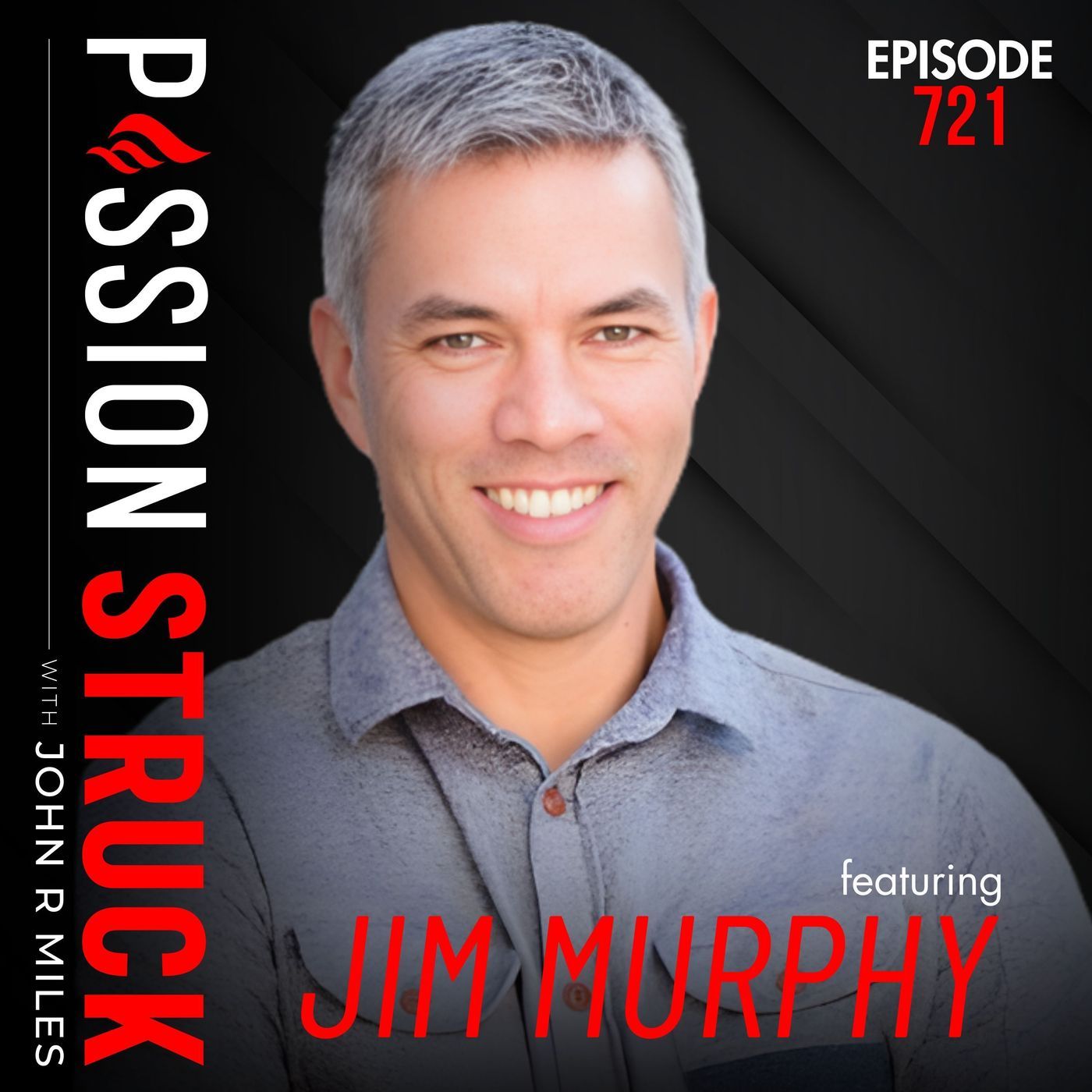
Inner Excellence: How to Build Inner Stability Under Pressure | Jim Murphy – EP 721
About this episode
What if peak performance isn’t created by intensity, control, or relentless self-pressure, but by inner stability?In this powerful episode of Passion Struck, Jim Murphy, performance coach to elite athletes and the #1 New York Times bestselling author of Inner Excellence, joins the show to explore what truly sustains excellence under pressure.Many listeners first encountered Inner Excellence when A.J. Brown was shown reading it on the NFL sideline during a playoff game. That moment sparked a national conversation—but Jim’s work has been shaping elite performers quietly for years.In this conversation, John and Jim examine the inner architecture that allows people to remain grounded when the stakes are high. Jim explains how fear, ego, and self-centered thinking destabilize performance, and how cultivating love, wisdom, and courage creates inner freedom that carries across athletics, leadership, parenting, and everyday life.Rather than focusing on tactics or motivation, this episode centers on the internal conditions that allow clarity, presence, and sustained performance to emerge. It offers a framework for anyone seeking excellence that endures—without burnout, anxiety, or collapse under pressure.If you’ve ever wondered why success alone doesn’t steady the inner world—or how to remain anchored when everything is on the line—this conversation offers a path inward.Check the full show notes here: https://passionstruck.com/inner-excellence-jim-murphy/Download a Free Companion Workbook: https://www.theignitedlife.net/p/jim-murphy-inner-excellence-pressureConnect with JohnKeynote speaking, books, and podcast: https://linktr.ee/John_R_MilesPre-order the Children’s BookYou Matter, Luma: https://youmatterluma.com/Learn More About Jim MurphyWebsite & newsletter: https://innerexcellence.com/Book: Inner Excellence: Train Your Mind for Extraordinary Performance and the Best Possible LifeAvailable wherever books are sold.In This Episode, You Will Learn
- What Inner Excellence really means and why inner stability precedes peak performance
- Why fear escalates under pressure and how “fear of fear” disrupts clarity and presence
- How ego destabilizes performance by creating self-centered thinking and internal noise
- The three pillars of Inner Excellence: love, wisdom, and courage
- Why the heart plays a central role in sustained performance and fulfillment
- How elite athletes remain grounded when expectations, scrutiny, and stakes rise
- How to apply Inner Excellence beyond sports—in leadership, relationships, and daily life
- What creates excellence that endures rather than collapses under pressure
Connect with John
- Pre-Order The Mattering Effect: https://matteringeffect.com/
- Book John to Speak: https://johnrmiles.com/speaking/
- Keynotes, books, podcast, and resources: https://linktr.ee/John_R_Miles
- Children’s Book — You Matter, Luma: https://youmatterluma.com/
- Substack: https://www.theignitedlife.net/
Support the Movement: https://startmattering.com/. Every human deserves to feel seen, valued, and like they matter. Wear it. Live it. Show it.
Disclaimer
The Passion Struck podcast is for educational and entertainment purposes only. The views and opinions expressed do not necessarily reflect those of Passion Struck or its affiliates. This podcast is not a substitute for professional medical or psychological advice.
Pre-Order The Mattering Effect: https://matteringeffect.com/. Take the 90-second diagnostic to see if you're disappearing.
Explore the Show: https://passionstruck.com/starter-packs/. New to Passion Struck? Start with the best episodes curated for you.
Connect with John
- Website: https://johnrmiles.com
- Book John to Speak: https://johnrmiles.com/speaking/
- Substack: https://www.theignitedlife.net/
- Children’s Book — You Matter, Luma: https://youmatterluma.com/
Support the Movement: https://startmattering.com/. Every human deserves to feel seen, valued, and like they matter. Wear it. Live it. Show it.
Passion Struck — #1 Alternative Health Podcast. 85M+ downloads.
Disclaimer
The Passion Struck podcast is for educational and entertainment purposes only. The views and opinions expressed do not necessarily reflect those of Passion Struck or its affiliates. This podcast is not a substitute for professional medical or psychological advice.
Hosted by Simplecast, an AdsWizz company. See pcm.adswizz.com for information about our collection and use of personal data for advertising.
Get every episode summarized
Each time Passion Struck with John R. Miles publishes, we email you a written briefing from the transcript — the topics, who appeared, and any specific claims, with the ad reads skipped.
Email me new episodesFree for 3 shows. No card needed.
Transcript ready
512 searchable segments. Every word is indexed and playable.
Full transcript
Passion Struck with John R. Miles — Inner Excellence: How to Build Inner Stability Under Pressure | Jim Murphy – EP 721. Machine-transcribed; use the interactive transcript above to jump the player to any line.
coming up next on passion struck. Fear is where you're in self-protection. You're concerned what other people are thinking and will I fail. And so that lifetime in this is saying, look, the default is if you don't do anything, you're going to go towards fear. That's human nature. You're going to start thinking about yourself. You're going to think about everything you want, but can't control. You're going to start comparing yourself to others. Your subconscious mind is going to remind you of all your failures and weaknesses. And you're going to move towards anxiety in fear. So you need a clear, intentional plan and path to live an extraordinary life. And that path is based on the three most powerful resources, I believe, in the universe's love wisdom and courage. Welcome to passion struck. I'm your host John Miles. This is the show where we explore the art of human flourishing and what it truly means to live like it matters. Each week, I sit down with change makers, creators, scientists and everyday heroes to decode the human experience. And uncover the tools that help us lead with meaning, heal what hurts and pursue the fullest
expression of who we're capable of becoming. Whether you're designing your future, developing as a leader or seeking deeper alignment in your life, this show is your invitation to grow with purpose and act with intention. Because the secret to a life of deep purpose, connection and impact is choosing to live like you matter. Hey, friends, and welcome back to episode 721. We're continuing our series, The Meaningmakers, an exploration of how meaning is formed, tested and sustained under pressure. In recent episodes, we've been tracing how performance environments shape the inner life. With Alex Emis, we examined the winner's curse, how success under competitive conditions and quietly distort judgment and long-term decision making. Last week, with Shannon Pearson, we explored invisible ADHD and how unseen cognitive strain erode self-trust identity and emotional
regulation over time. And then last Thursday, with Robin Kazelowitz, we returned to the family system for regulation safety and belonging first take route. Today, we move into a different, but essential structure, the interdiscipline of excellence. Now, if you've been following me for a while, you know I'm a diehard Philadelphia Eagles fan. And like many of you, I was watching that playoff game last year when AJ Brown, one of the best wide receivers in the leagues, was shown sitting on the sidelines reading a book. That book, inner excellence, crane your mind, extraordinary performance, the best possible life by Jim Murphy. I was fascinated. What kind of book captures an athlete's attention to the middle of a playoff game? So I picked it up. And what I found wasn't just a book about sports performance. It was a guide to living with courage, wisdom, and love framework for aligning who you are on the inside with how you show up when the pressure is on. That's why I want to Jim Murphy on the show. Jim is a performance coach to professional athletes, Olympians, and top executives.
In this conversation, we explore why the greatest battle you face isn't out there. It's inside. How fear, the critic, and the monkey mind sabotage performance. Why the heart, not the mind, is the true source of extraordinary results. And how to align your life with the three pillars of inner excellence. Love, wisdom, and courage. If you've ever felt stuck, anxious, or you like the ball in the game of pinball, today's episode is for you. Before we begin, a brief note. If you're interested in this broader work around visibility, worth, and mattering, including how these ideas translate across generation, you can learn more about my upcoming children's book, YouMatterLuma at YouMatterLuma.com. And if this episode resonates, please consider sharing it or leaving a five star review. Your support helps these conversations reach the people they're meant for. Now, let's continue the meaning makers with Jim Murphy. Thank you for choosing PassionStruck and choosing me to be your hosting guide on your journey to creating an intentional life. Now, let that journey begin.
Hey friends, there's something about March that makes you want to reset your space. For me, that started in the kitchen, clearing out what I didn't need and upgrading what I use every single day. That's when I brought in Caraway. What I love is how simple Caraway makes everything. The ceramic coating means food just lifts right off, so I'm using less oil, clean up, take seconds, and cooking actually feels enjoyable again. But it's not just performance, it's the intentional design. The storage system keeps everything organized, and I've become a lot more mindful about what I bring into my home. And that's why it's so important that Caraway is third-party tested and made with high standards, which just gives me more confidence in what I'm using every day. It's one of those upgrades you feel immediately. Caraway's cookware set is a favorite for a reason. It can save you up to $230 versus buying the items individually. Plus, if you visit CarawayHome.com slash PassionStruck, you can take an additional 10% off your next purchase.
The steel is exclusive for our listeners, so visit CarawayHome.com slash PassionStruck or use code PassionStruck at checkout. Caraway, nontoxic kitchenware made modern. I'm absolutely thrilled today to have Jim Murphy on PassionStruck. Welcome, Jim. How are you today? Thanks, John. Great. Thanks for having me. For those of you who aren't watching this on YouTube, Jim immediately hit a bond with me when I saw that Jersey he was wearing. And at first, I thought it was a Cub Jersey. Turns out it's a Philly's Jersey and being from around that area and loving the Philly's immediate bond. But you're wearing it because you just had the opportunity to do something I could only dream of. You just got to do what for the Philly's. Throughout the first pitch last week, it was quite an honor. Man, that is awesome. Who were they playing? The Mets. Yeah, big game,
big series. Big series. I'm hoping the Philly's go a whole way. They are not well-liked here where I'm in Tampa because the raised fans feel like they cost us our best opportunity of winning a world series a while back when the Philly's beat us. But not only do I love the Philly's and spring training and everything else, but I live right by their spring training facility. So it's such a treat to get to have that part of the year with them. Well, being a huge Philadelphia sports fan, I like every single Eagles sports fan was completely blown away by the whole AJ Brown sideline. A fact that happened. How was your life changed from that moment? John, it's changed a lot. A lot of travel. So it's funny because I traveled before January 12th of this year, when it all started. The last two years, I went to 23 different countries, I think. So that's a fair amount of international travel. And so this year, I've only
been to a couple of countries, but I've been to a different city every four or five days or so since January 12th, except one of in Spain. Yeah, a lot more travel speaking and workshops and retreats. But it's just an honor to be able to share the message that selfless is fearless. That's awesome. And for those of you who have not been watching TV or following the news or sports, I think for the past couple of years, Jim is the number one bestselling author of inner excellence. Train your mind for extraordinary performance and the best possible life. And I'm holding a copy of it here. But man, I clouded through this book and I'm telling you about four hours, four and a half hours. It just was such a fantastic read. And I had heard about it even before seeing it with AJ Brown, because we share another common person between us. And that's Sean Foley, who had told me about this book a while back. And then it was one that I should eventually read. How do you know, Sean? Oh, well, I've known Sean for, let's see. He's got
actually a big part of my life. Well, Sean's Canadian as am I. And Sean was coaching and golf for a few years ago that was quite talented Tiger Woods. And Sean read inner excellence, contacts me when he's coaching Tiger and said that he had a, he read inner excellence and wanted to see if I could work with one of his clients. And so that's when I met Sean. This was 2011, I believe. Yeah, not only was Sean working with Tiger, but he happened to be working with Tiger right after all those terrible things happen in Tiger's life. So not only was he trying to help him become a better golfer, he was trying to get him to take back his life again. So what a challenging time to be any superstars coach. One of the things that I really liked about the book right from the beginning is how you bring in your own story. And you said this quote, those destined for
greatness must first walk alone in the desert. You literally sold most of your possessions and lived in solitude for years. What did that season of your life teach you about yourself and also about life? Well, I don't think you can live an extraordinary life without solitude. I just don't think it's possible. At least I don't know how to do it. Now you don't have to go to the desert like I did and you don't have to go for two and a half years. I wasn't in complete solitude. I had a couple of friends there and actually my parents and sister ended up moving in with me, although I rarely saw them because I would leave early in the morning and come back at night when they're asleep. But being in the desert was in front who I was, what I really wanted in life. And I went there to figure out what I can do to devote my life to find something that I can devote my life to and do willing to live and die for. And that's what I found in the desert. And I know you're a faith-based person like myself, but when I was reading this and when I thought about my own life and periods of time where I've really done deep self-awareness, I think
back to even Jesus' journey of how he spent 40 days alone and would look for solitude when he was contemplating big events in his life as well. So I really do think there's something about this need for solitude and for rewiring ourselves and coming back to ourselves. Did that sort of play into it for you? Well, I think he's the wisest, most confident, joyful, passionate, compassionate person that's ever lived and the best model. Yeah. Yeah, well, this whole podcast is all about human flourishing and I am a huge fan of Abraham Maslow. And again, early in the book, before we get into the Maslow chapter, you write what any of us really want is to feel truly alive. And it's interesting because if you look at the work of palliative care people like Brony Ware or even scientists who've studied tons of lives,
what they all come back to is that most people end up living the life that they feel they should and they end up settling instead of living the life that they could, which is one where they flourish in all aspects of it. Why do you think it is that so few people find that fullness? Fear is the biggest issue. And fear, inter excellence comes from self-centeredness in general, comes from we get in our own way, that's the biggest challenge that we face and through three main areas, overthinking negative thinking or judgmental thinking and self-consciousness. And it all comes from a self-referential self-centeredness that's inherent in human life. We need to think about ourselves in order to get through the day in order to do something great. We have to think about ourselves, but that comes with a self-consciousness and a subconscious mind that's always in protection mode. And so it creates this unease and that leads to fear when we think about ourselves. And that's why selfless is fearless. I think it's a really important aspect that you cover throughout the book
and really uses the foundation. I remember I was an executive at Lowe's Home Improvement, I was a VP at the time and I was on the staff of the CIO and I had four fantastic peers, all of them extremely talented themselves, but we had a lot of infighting amongst us. And I remember one day our boss Steve Stone comes into this conference room where we would have our weekly meetings. He was not a person who would really get aggravated, he was person he used intellect, but I remember him just slamming his fist on the table and said that we have the opportunity to do so much, but there are three letters that are getting in the way of us achieving greatness and he said it was ego. And at the time I was in my early 30s and I didn't really understand the enormity of what he was talking about, but you really do a good job of connecting ego with self-setterness. Could you talk a little bit more about it? Sure, I think of ego as the part of our mind that's
always threatened, always comparing and never satisfied. It may not be how anyone else defines it, but in order to make a difference in someone's life, you got to be clear in your communication and so I try to define all the terms that I use. And so we all have a mind that has this concern, this threat, and it leverages our deepest need, which is for love and acceptance. And so it says, it's that voice in your head that says, hey, if you screw this up, if you fail, not only you're not going to be loved and accepted, but you're going to get the exact opposite, which is your greatest fear, in general, the greatest fear of humans is for rejection. And when I think of interactions, I think of self-mastery, and when I think of self-mastery, I think of mastering the ego. When I think of mastering the ego, I think of three things, actually, being unembarrassable, unaffendable, and unirritatable. And out of those three things, which one do you think is the hardest for most people to undertake in their lives? Well, they're all really hard. I think it depends on the person.
So I define humility as an accurate view of self, not over-inflated or under-inflated. And if you're truly humble, then you can never be humiliated or truly embarrassed. Because embarrassment and humiliation is concerned for self. My status just went down. Now I feel bad about myself because I think other people feel less of me. But if you're completely selfless, there's no self to defend. There's nothing to be afraid of because you're not defending anything. You're not protecting anything. And that's, you can look at when the best performances in the history of the world happen. There's no concern for self, there's no thoughts of self whatsoever. And so the ego is the part of the mind that's constantly threatening, threatened. And when it's threatened, it's got to work over time. It's got to, oh, what about this? What about that? And that's where anxiety comes in. And anxiety's in mind with too many thoughts and too many concerns. One other thing that I really liked, as you opened the book, was you made the statement that the quality of your life is based on three elements. Your inner world of thoughts and feelings,
your frame of reference, a mindset, and your relationships. And I think those three things are fantastic. I wanted to ask you about a fourth one that I would probably include that you didn't. And I feel that you can have that frame of reference of mindset, but really you need to be intentional with your behaviors and how you're using that mindset set to drive your actions. And if I were going to do my own version of this, I would add behaviors to it or intentionality. What's your thoughts on that? Yeah, thanks for sharing that. So yesterday I was walking into a grocery store as I drove from New York City here to Central Pennsylvania to work on this next book. And I was thinking I actually shared on an Instagram story that my life has been incredibly blessed and very busy the last eight months. And just so much logistics, so many things to track. And that can create anxiety. And I'm walking into the store and thinking about all the things that
are happening coming up. We've got a book signing in Philly on Saturday, which is amazing. I'm not a book signing. Some sort of a we're doing something with a book giveaway in Philly. And I thought, you know what? The number one thing in my life that's the most important thing is not my circumstances and not even my actions. It's my heart because my actions come from my heart. And because it's easy to anxiety is so easy to have and so many people have it now because they're trying to track so many things in life is so complex and there's so many scary things in the world right now. And so, but if your heart is connected to the source of all goodness in the world and the universe and you have inner peace, then you're going to go out into the world in strength no matter what your circumstances are. But you could have a million followers and millions of dollars. But if you have inner turmoil, you're going out into the world in weakness. It's so true because without that you're not going to have authenticity in how you're bringing
yourself and presenting yourself to the world is the way I think about it. One of the things that you and I both talk about and it's a core foundation of this whole podcast is the power of choices. And I like to talk about our micro choices or our micro decisions are the ones that really shape the life that we want to have. You also talk about choices and one of the things that love in the book were that through the beginning chapters, you create two pyramids and then bring them together into kind of the life diamond. And I was hoping you might be able to talk about that path because it's all really rooted in our choices. Yeah, thank you. So the way I look at life is that we're walking either love or fear. Every moment you're in either love or fear. Some form of love, which is this selfless creative connectedness where you see possibilities and
fear is where you're in self-protection, you're concerned with other people thinking and will I fail. And that life diamond is just saying, look, the default is if you don't do anything, you're going to go towards fear. That's human nature. You're going to start thinking about yourself. You're going to think about everything you want, but can't control. You're going to start comparing yourself to others. Your subconscious mind is going to remind you of all your failures and you're going to move towards anxiety in fear. So you need a clear intentional plan and path to live an extraordinary life. And that path is based on the three most powerful resources, I believe, in the universe's love wisdom and courage, whereas love. And when I say love, there's something that really needs to be clarified because in America and Western culture, English only has one word for love. And I love four games. I love sushi, Korean barbecue and Thai curry and many things I love. But those are like things that are pleasurable. And the love that I'm talking about is sacrificial
love, the kind that brings joy. Because pleasure brings happiness. And there's a very big difference between the two. Happiness to me, I define as a positive, temporary feeling based on what's happening. Good circumstances, good feelings, bad circumstances, you're not getting good feelings. Joy, in other hand, I define as a deep sense of well-being, freedom and gratitude and inner buoyancy and delight that comes from love. And we need a clear path and plan to simplify our lives, reduce all the thoughts. And that involves having a purpose for your life and with interactions, we think about how you want to feel, how you want to live, who you want to become most important to you. And start to clarify those things so you can be true to yourself. And when I say true to yourself, half of it's your own personal preference and half of it's understanding how you're created and what you're created for. Because there's a lot of misunderstandings. In the interactions we talk about your heart and following your heart, but we have to make sure
we're clear that the heart has an inherent self-centeredness. On the one hand, we're created in God's image. On the other hand, we have human nature. And if you don't do anything, the human nature is going to take over and you're going to move towards fear. And so if you think following my heart means doing what I feel the most strongly about, then you might be taking crystal meth and you might be eating chocolate as great as that is to get sick and maxing out the credit cards and leading you to a horrible life or death. If you follow your feelings, which people translate, following your heart is following my feelings. So you're going to be very careful about following your feelings. I have a mantra that's I live by purpose, not by feelings. And oftentimes that's what I say to myself to get out of bed. Because a lot of times don't want to get out of bed. That's how the pyramid works. Do nothing. You're going to go down towards self-centeredness and fear. We need to have an intentional plan based on love wisdom, encourage sacrifice, doing hard things,
having doing some discipline, some of the interactions, disciplines, there's nine of them. And then moving towards that selfless and therefore fearless life. Before we continue, I want to pause for a moment. Conversations like this one with Jim offer insight. Integration requires intention. Inside my sub stack, the ignited life, each episode in the Meaning Maker series is paired with guided reflection prompts designed to help you apply what you're hearing steadily, honestly and without pressure. This week's prompts focus on identifying fear driven patterns and performance, reconnecting with inner stability under pressure, clarifying what excellence means beyond outcomes. You can explore them all at theignitedlife.net. Now a quick break for our sponsors. Thank you for supporting those who support the show. You're listening to PassionStruck on the PassionStruck Network. Now back to my conversation with Jim Murphy. By the way, you described it. I really loved. You say, every day we wake up with a choice. Do we let our natural self-centeredness and ego lead us towards
doubts and fears? Or do we choose to focus on what you were just talking about? Love, wisdom, and courage. If we don't make a conscious decision, we inevitably follow our natural inclination down the pyramid, which is right below where I'm reading that. And I wanted to just talk about a couple of words that you bring up there. And one of the most important ones I think is the word conscious. Because in my own book, I talk about the fact that I think so many people today are not living on autopilot, where if you put the plan on autopilot, you're typically going in the direction you want your life to take. I think more of us are living it like we're a pinball in the game of pinball. And we just subconsciously allow our lives to unfold without being deliberate about how we're trying to live them. And I think in many ways, that's what you're trying to say here. You've very deliberate about our lives. And seeking wisdom above all else, wisdom is the greatest
thing anyone could ever seek. And it's far different than knowledge. To me, knowledge is understanding how these transactional temporary things in life work. How does a lawnmower work? Great things that can create great companies. And how do you build a computer or a light or a table or a business? Knowledge is super helpful and important. It's just like logic. Super important and awful. But logic also can be very limiting and so can knowledge. And logic doesn't send a man to the moon. Wisdom to me is to have unobstructed views of beauty and connections and possibilities unhindered by our own self-reliance. And on another level, it's also how I think about wisdom is to know who God is and therefore who you are, what he's doing in the world and how you can join in. I think that's absolutely essential and agree with you for heartedly. One of the things you do throughout the book is you've got some great examples of people in the book. I'm going to use a person, but then I'm going to use a story you didn't talk about in the book.
You talk about Michael Jordan and his coach in multiple places. And one of the things you talked about, Michael is one of the things that led him to greatness was his focus on practice, which is something a lot of us don't want to do, but he thrived on it. But I want to take Michael in a different setting that you know a lot about. So Michael comes out of winning three championships and makes the decision he wants to become a professional baseball player. And I remember when he first came out, he was just tearing it up. And then the teams and the pitchers figured out his weakness and all of a sudden he couldn't hit a ball to save his life. But in typical Michael Jordan fashion, what did he do differently that a lot of people wouldn't have done when he faced that situation? Michael was in the minor leagues playing for one of the Chicago teams around the same time that I was in the minor leagues playing for one of the Chicago
teams. And he's probably the such an inspiring athlete in that the documentary on him said his greatness was his ability to be fully present. And I think that's so true. And I think courage is the greatest thing that most successful people have in common. And then that Michael also had. And what's great about that is that we can all have it. I absolutely think that's one aspect. The other thing that I thought was remarkable is that he would sit there and reportedly hit 1,500 pitches a day until he figured out how to master the curve ball, which was really impacting his ability. And watching that same thing, it was pretty interesting how many professional players thought if he would have had more time, he would have definitely made it to the big leagues because of his work ethic. Yeah, cut from his high school team, the ability to be resilient and not get down that's such a trait of the best. Yeah, so in the book you used a Greek word to describe the life we're meant to live.
How did you come upon that word? And why did you find it so powerful? That's a great story, actually. So I'm in the desert. I go there to figure out what to do with my life. I had no plans, just went to go live a life of solitude and except for help my friend Ricky with his batting baseball academy part-time. And I started to put together this little manual. I decided to become a personal coach to pro baseball players, teach them how to have peace and confidence under pressure. My first two or three clients do amazing. And so I thought, okay, let's give them a little manual. And so I start to put that together. And I call up a sports psychologist and ask him, how can a Olympic athlete train for four years for an event that may last less than 60 seconds and have peace and confidence under that situation? And it brought more questions and answers, so I call another and another. And I spent five years full-time writing and researching that question. And that became the book inter excellence. Along the way, I found out that the heart is the key to your life, your spirit, your will. We're far more than thinking machines. We've got to get deeper. And I'm working on the book and I asked this friend of mine from church, Jennifer,
and I said, Jennifer, can you take a look at this manuscript? I want to make sure it lines up with the Bible, make sure it's filled with wisdom and has no errors. She reads inter excellence. She said, I read your book. Have you ever heard of the word Zoe? I said no. She said, that's a word in the Bible. A Greek word used a lot. It's the word for life, but it's not just any life. It's not the BIOS life, which is biologically alive. It's the absolute fullness of life. And the Bible, Jesus talks about it. John 10 and 10, I came to bring you life and life abundantly. And so that's the kind of life that she said, I think you're talking about. And I said, yes, my whole life I've obsessed about being some sort of a superstar. When I realized now, I've always wanted to feel fully alive. So I started to revolve my book around the pursuit of fullness of life and let everything else be added to you. So I'm doing this, running this book. And then the book comes out and I have a near mental breakdown five years of full-time writing and research. I spent my life savings $90,000 in debt. And I go to I'm having this near mental breakdown. I call my friend
Ricky, who was there and I said, tell me what to do. He said, find the homeless person and help him. So I go find this homeless harvest right on the corner in Denver, the thing that King David used to play. You don't see these too often. And so I gave him some money and I left and went to go run on the treadmill back where I was staying and just to try and breathe and get through the day. I come back to that same area a couple hours later. I'm so filled with anxiety at the time. I can't function just staring off into the vest. That homeless guy walks in, walks past me, stops in his tracks and said to you, the guy that gave me that money. And I said, yes. And he said, thank you so much for caring for me. No one's cared for me like that before. He leaves. He comes back with a box of chocolates and a bracelet that he made and a card. He gives all three to me. And the card says, thank you so much for caring for me. No one's cared for me like that. Love Zoe. Oh my lord. And so I'm like, your name is Zoe. And he said, yeah. And I said, do you know what your name means? He said, no. And I said, it means absolute fullness of life. I've studied that for five years. I just wrote a book about it. And I gave him a book and a never saw him again. But that's
where my life really dramatically changed after that moment in the next few weeks. Man. So how did AJ Brown come about reading the book? Was it referred to him from someone? Yeah, I'll tell you what happened. About 10, 12 years ago, I started building houses with youth with a mission, homes of hope in Mexico for a family. We're going to do one in November. Actually, it's sold out, but we haven't every year. And they told me, you got to meet this guy named Guy East. He's a former professional cyclist who brings pro athletes to come build houses for the poor in Mexico. And so I met Guy and Guy and I become good friends. And then he says, hey, there's a retreat coming up. This was like two, three years ago. And there's an Anglican priest preaching. And I was like, is Anglican even Christian? It was very secretive. And there's no website. And there's like, I don't know. It's in the Appalachian foothills. But I go and I meet this director for athletes in action in Austin named DJ Jair. And I was like,
man, this guy's amazing. It's like, oh, there's, you've got to talk to one of my friends. Carson Foster is a Olympic hopeful. And I mean, Carson, we start to work together and amazing story. But DJ gives the book to Morrow a Jomo football player at University of Texas. He gets drafted by the Philadelphia Eagles. He reads the book. He sees his teammate and says, hey, I think you might like this book. AJ, and you did. And there are some history. Well, I think when we think about the history, I want to make sure people don't get it confused. When you say the rest of history, what I think is lives are changing all over the world. And they're going to really change in Philadelphia because we're going to do some amazing things there. There's, well, there's already amazing things going on with Shane Claiborne, my hero and Kensington. And I met some amazing people there doing great work in inner city Philly. I'm so excited for what we're going to do. That's what I'm saying is this was the inflection point that
brought this whole movement to awareness. And sometimes I think that's what it takes is you just have this divine intervention. And then all of a sudden, it gives you that lightning rod to impact so many people, which your book is now doing. So throughout the book, something I liked is you have all these different stories. And one of them is you write about Joe Irman's shift from a win-it-all cost mentality to building a life, built on relationships and purpose. And it was interesting because you use Joe's story as the entry point, but then you talk about coaches like Wooden and Steve Golden State Warriors, Coach and others who you bring up that it's not Lou Holtz was another one. It's not about at all about win at all cost mentality. The wins will come, but that shouldn't be the focus yet. For so many of us, we have a win-it-all cost mentality. We
want success in life more than anything. I had this happen to me myself. I felt the most invisible in my life. I've ever felt because I was chasing all the wrong things and neglecting the things in life that count the most. Why do you think so many of us today get stuck in the performance trap? It's super, super common. Well, it's because our greatest need is for love and acceptance. And the ego says the trickster says, if you are successful, you're going to get the love and acceptance that you want. And if you're not though, then you're not. You're going to get rejected. The obsession with winning isn't a obsession with acceptance. And ironically, that obsession with winning and acceptance creates the opposite effect. It creates tension and fear. It's hard to love someone who's a little tension and fear. Well, amen to that. One of the other stories I really liked in the book is I must have been sleeping under a rock or something when this happened because I was not aware of it. But you tell the story of
Lewis Gordon Pugh. And this to me was an amazing story in part because I have a good friend, John Doolittle, who's been a guest on this show. John retired as a06 Navy Seal, but he was the first Navy Seal to swim the English Channel. And John was telling me this story that, and I'll let you tell the story of Lewis, but he went during some of the warmest months possible to swim the English Channel. And he still said it was freezing beyond belief. It was like 4850 degrees. So he said that at no time when he was doing this 12 hour crossing, could you stop where you would immediately go into hypothermia? And he said that there was this period of time. He's about a third of the way through. He wants to throw in the towel. And then he sees his dad on the bow of the boat. And that's pushing him forward. And he starts raising names of seals who have died in combat that John is swimming for. And John says that moment. And then seeing kind of the American flag
relit his determination. And as he would swim further and further, the father kept putting up a different name and then a different name. And it's so related to Lewis's story and what you write about. So I was hoping you could share that using do stories of backdrop. Sure. I am running the book. And I'm in living in Canada working with the University of British Columbia men's golf team. And I see on the National newspaper, the Globe and Mail, a front page, this guy diving off an iceberg in his speedo. And I'm like, what is this crazy person doing? And this is before I'd ever heard of Wim Hof. And he swam one kilometer at the geographic North pole to raise awareness for global warming because normally it's covered in meters of ice, but because of global warming, it's thawing. And so I interviewed him and his coach because writing this book about inter excellence and how do you achieve great things and have that peace and confidence under pressure. And that was life-threatening. Most people said it was impossible, physically impossible. The water was below freezing. If you can believe that, you might think,
well, he'd be swimming in ice. Well, there was ice all around him. But because of salt water, the water temperature was below 32. And yeah, so what he had to do or his coach said, there's no way you're going to make it if you think if you're thinking about one kilometer. We've got to break it down into smaller chunks. And this is so crucial when we want to make changes in our life or want to attempt anything, so often the first step is too big. And so we just got to make the first step smaller and smaller until we can do it. And so he had similar to your story, or was they put up a flag every 100 meters of people on his team from different countries. And he said, just focus on this 100 meters. You can't think of past it. And that got him to the end. But also he had a purpose beyond himself that he was willing to die for. What I thought was so remarkable about it is he did two trials prior to doing the swim and and actually warm or water and failed miserably both times. And yeah, he was actually
extremely fearful. And as you write as was the doctor who had to make the decision, could he do this or not? And what I thought was just so amazing is when they would put out the different flags for him. It was like he was swimming for Sweden. He was swimming for Norway. And eventually he was swimming for Britain, where he's from. But it gave him that sense that he's trying to bring awareness to climate change. But in each one of those segments, he was swimming for all the people in that country. So he used that greater pull to mentally get him his way through it. And I thought it was a great example of inner excellence coming to life. For sure. And so I think it's really it is significant. Like you said, that he failed twice greatly just before he went. And he was filled with fear the day he was going. And so fear is not the problem. Fear is not the enemy. Fear has power. The problem is when you're afraid of fear. Great things happen when you're filled with nervous energy and fear. What stops people
is they're afraid of fear. When I think of fear in my own life, I think about how many times I end up arsoning the very things because I start doing self-sabotaging actions, the very things that I want to accomplish. And sometimes that fear takes root because we allow our mind to leap as Lewis was to like the end where he wants to go instead of thinking, I just have to take the first step. And I often think the reason most people never change their life is they get so fearful of what they think it's going to take to get to where they eventually want that they never take the first step to begin with. And that is the hardest choice of them all to make is to choose to take that step to start going down the path of making
your life different. As your coaching athletes and executives, etc. Do you find the same to be true? That's why we got to make it smaller and smaller until you can take that step. But I actually call it the being the turtle effect and I got this act actually from Elon Musk. And the way I think about it is you have to have that vision of where you want to take things, kind of a slow moving sea turtle, but you have to execute your life like the bee who is constantly in action taking small steps to serve the hive. And it's that combination of balance and both. If you can perfect it, that really gets you into the flow of life. Yeah, I think the greatest challenge that we face in life today other than self-centeredness is the anxiety that comes from too many thoughts, from too many concerns and being too busy with too many things. That comes from not having a clear purpose for your life and being too busy
and therefore too distracted. One of the things speaking of being too distracted that you focus on multiple times in the book is the life of a samurai. Why did you choose to use that such an important to element of the book? Yeah, because if I was born 100 years earlier or 200 and then I would have been a samurai, at least if my mom would have married another Japanese guy. Yeah, my mom from samurai descendants. So it's got a very personal connection. What's amazing that I found really amazing is as I was researching the book, I realized in my mind that love wisdom encouraged with the three most powerful resources. And then once I decided on that, then I found out that's what the Bouchito code was of the samurai. It's based on love wisdom encouraged and that was amazing. I also liked how you in the book talk about the samurai and this focus on the three
qualities that you bring up in the book, but also their their inherent mindfulness and focus on being present at all times because they never knew when their life might end. And so they were always having to live in the moment. And it's so different than how most of us live today. The way I think about it is I want to be prepared to fully live or fully give up that life to die and in moments notice. And what I mean by that is I want to capture beauty. I think most of my life, I've missed it. It's certainly missed more than I've seen and want to miss less. And so I want to capture it when I see not just the easy ones, beautiful sunset or leaf falling from a tree. I saw my first leaf fall, first sign of fall a few days ago, but I want to capture it from a homeless person or a kid or someone in a nursing home. And I want to be ready to give up my life and a moment's notice as well if it comes down between my life and someone else's I want to be able to have a heart that's ready to give up my life. One other story I was hoping you might be able to
talk about because he I'm here in Florida and he came from Florida is the story of Rick Ankeel who came from Port St. Lucia High School in Florida. His name high school player the year of a USA today drafted by the Cardinals receives $2.5 million signing bonus. What ended up happening direct? Well, it's quite a story. Rick had a mental block of being on the pitcher's mound and couldn't throw a strike. And he ended up going gets it down to the he's signed a big contract. And what happened was the head coach Tony LaRusa put this rookie in a big playoff game when he wasn't ready and he got a mental block and threw the ball into the dirt and then and then he stressed out about it and so your subconscious mind doesn't care if you make a mistake it only cares how you feel about mistakes or anything really. You could lose your job and if if it doesn't have any meaning to you and you'd be like oh subconscious gives it a pass but if it was traumatic to you or if someone if you feel really embarrassed then that subconscious is going to lock it in. And so he felt really
bad for throwing the ball in the dirt or whatever and so then that became the mental block and he had retire from baseball as a pitcher. But then amazingly one day as the agent said hey let's go back and play as a position player then he came back and that interesting about that how the mind works the home plate is 60 feet six inches from pitcher's rubber and he couldn't sometimes it couldn't throw it where the catcher could even touch it. But from from the outfield he can throw it to third base and the third baseman not have to move his glove more than a footer to and that's because from the outfield there's no pressure to throw it to hit it throw a strike it's just like putting in golf there's no pressure to sink a 50 foot putt but there is pressure to sink a three footer. Yeah isn't that so funny how that is the layup becomes harder than the half court shot than so many cases in our lives. Yeah it's all based on the same thing if it's the fear of rejection.
Rejection in this case by the fans by your teammates. But the way it plays out is if I miss a 50 foot putt nobody's going to say oh I can't believe you missed that oh how terrible boo that doesn't happen. You miss a three foot putt people are going to be whispering and you're going to feel you could feel wow I'm a pro golfer and I missed a three foot putt pro golfer shouldn't miss three foot putts and especially if someone in the crowd says my grandma kind of made that then you feel really bad because our greatest need is for love and acceptance and a greatest fears of rejection and the subconscious mind feels if I screw something up that I shouldn't screw up I'm going to get rejected and so fear becomes a big issue for things that we feel like we shouldn't screw up on and that's where the ego comes into play if you the better you get a master in the ego the more fearless you are because you're not afraid of screwing up and that's what the greatest are able to do they're able to master the ego enough so that they're not filled with fear every time they have something that they really want to do but don't know if they can do it. So you end the book
talking about pursuing the path of interactions with all your heart and if you do you'll find the secret to everything you've ever wanted. For those who are listening to our conversation today what is maybe the biggest thing that you want them to remember from our discussion and the purpose for you writing the book to begin with? Well self-centeredness leads to fear and what you really want most is to understand what your heart deeply wants is so important to feel fully alive and fullness of life comes from relationships. Well Jim if people want to learn more about you what you're doing in Philadelphia and other parts of the country where's the best place for them to go? You can go to InterExynz.com my website we've got a newsletter the VIP newsletter which will be on sub-stack here very soon and you can go on social media, InterExynz, Jim Murphy and follow me there as well. Awesome well it was such an honor to have you on the show Jim thank you for writing this book and bringing your wisdom to our audience. Thanks so much Don I really appreciate it.
That brings us to a close today's conversation with Jim Murphy. I hope it left you reflecting on what it means to live fully alive and to perform at your best when it matters most. Here are the three biggest takeaways that stood out for me. First fear is the number one barrier to greatness. For any of your heart to quiet the critic and choose courage is the first step toward freedom. Second performance and fulfillment are the same path you don't have to trade meaning for achievement the two can work together and third extraordinary results start on the inside. Your routines thoughts and small choices are shaping your destiny every day. This episode reminding me that legacy is about what we build choice by choice. Jim's work is a powerful guide to aligning those choices with who we want to become. Next we turn our attention outward towards truth power and consequence. On Thursday I'm joined by Charles Pillar an investigative journalist for Science Magazine and the author the new book doctor. We discuss fraud arrogance and tragedy in the quest to cure Alzheimer's disease
and what happens when systems prioritize prestige over truth and certainty over integrity. I think people of good intentions can make mistakes they can be drawn into actions that are counter productive that are even counter to what their expressed views and wishes would be and my job is to try to tell the bigger story to tell the human story behind some of these concerns so that I don't want to leave readers with a sense of cynicism. I think it's important to view the world as it is but also to try to generate a sense of hopefulness about what it can be by exposing bad actions and trying to correct them and also pointing out where things in the future might benefit from some of the work that's being done. Today's episode resonated. Please share it with someone who might benefit or leave a five star view on Apple Podcasts or Spotify. If you'd like to continue the work visit the ignitedlife.net for episode reflections. Watch the full conversations on YouTube
and genre miles or passion struck clips or explore intention driven apparel at startmattering.com as we continue the meaning makers remember excellence begins inside truth demands courage and significance grows for integrity holds. I'm Sean Miles and you've been passion struck.
More episodes
More from Passion Struck with John R. Miles

How to Believe in Yourself When Everyone Tells You “You Can’t” | Cole Brauer - E...
Passion Struck with John R. Miles

The Agency Paradox: Why Real Adaptability Starts Inside the Box | John R. Miles...
Passion Struck with John R. Miles

You Don't Need More Freedom. You Need Better Constraints | David Epstein - EP 81...
Passion Struck with John R. Miles

World’s Most Influential Psychologist: The Hidden Force That Drives Human Progre...
Passion Struck with John R. Miles