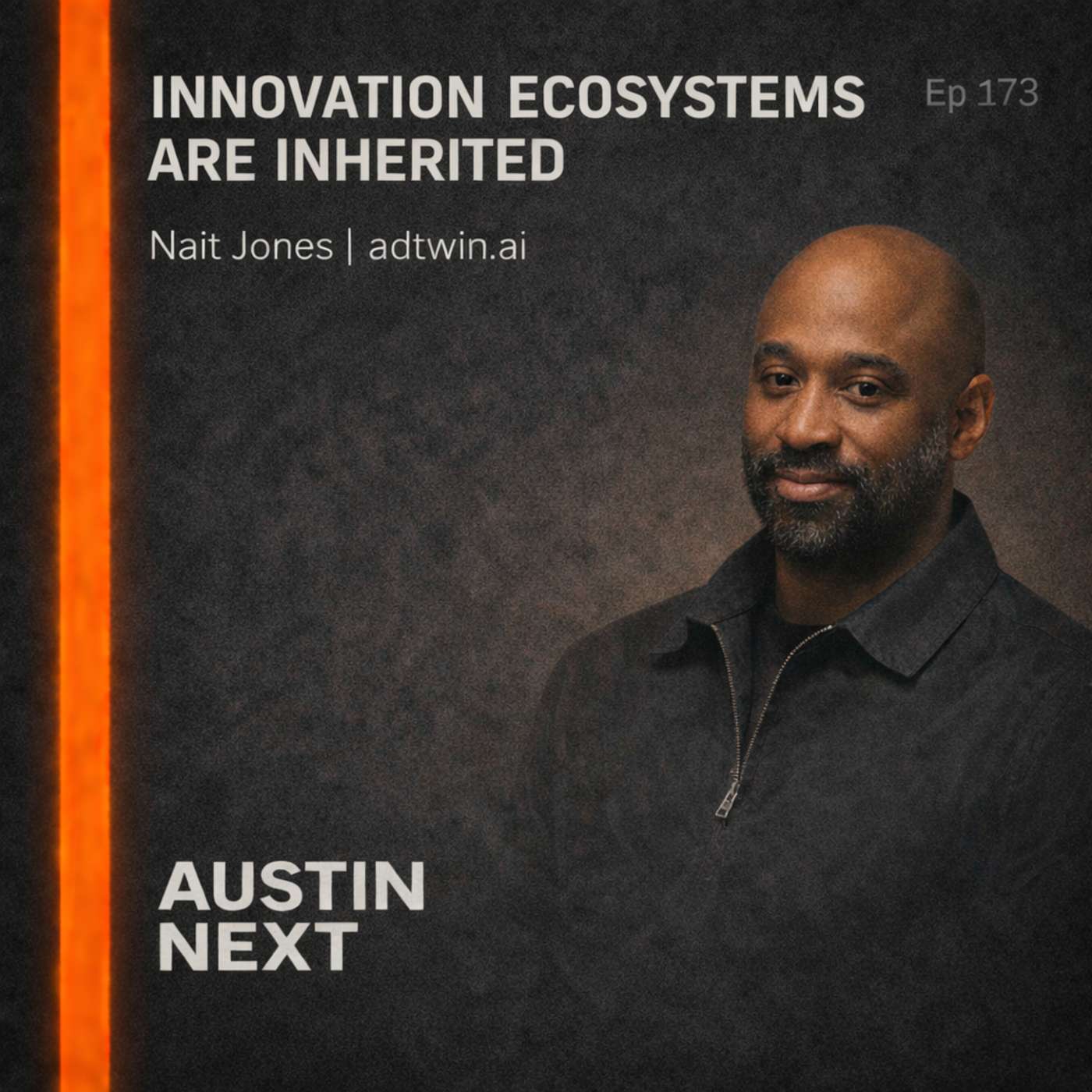
About this episode
The hype that landed on Austin in 2021 was correct and at the same time ahead of the curve. Nait Jones, serial founder and former a16z partner who arrived in Silicon Valley in 2011 at the Web 2 moment and moved to Austin during the pandemic, argues that the fundamentals have now caught up
Jones traces what he calls a spiritual succession. A direct genealogy from Arthur Rock's invention of venture capital through Fairchild, Intel, Dell, and UT research into the current generation of robotics, defense, and energy infrastructure concentrated within a 200-mile radius. The city's defensible moat is where intelligence meets the physical world, the hardware and the software built as one.
The result will look nothing like what came before it.
Agenda
- 0:00 Intro + Silicon Valley 2011 and the Web 2 Gold Rush
- 9:17 How The Social Network Changed the Talent Pipeline
- 11:16 Inside the a16z Partner Meeting
- 14:48 Spiritual Succession from Arthur Rock to Austin
- 18:06 The 2021 Hype Was Real, Just Early
- 20:26 California and Delaware's Self-Inflicted Wounds
- 23:43 The 200-Mile Radius
- 26:26 Permission to Build and the Sunlight Metaphor
- 30:20 Foundational Models Belong to SF
- 34:48 Third Places and Connective Tissue
- 42:29 The Storytelling Gap
- 45:44 Six-Month Vesting in the AI Era
- 49:04 Seedance, Suno, and the Creation-Consumption Collapse
- 54:59 The Barbell of Synthetic Media and Analog Craft
- 59:27 Copyright, IP, and the Entertainment Layer Cake
Guest Links
Nait Jones: X, LinkedIn
Adtwin: Website, LinkedIn
-------------------
Austin Next Links: Website, X/Twitter, YouTube, LinkedIn
Ecosystem Metacognition Substack
Get every episode summarized
Each time Austin Next publishes, we email you a written briefing from the transcript — the topics, who appeared, and any specific claims, with the ad reads skipped.
Email me new episodesFree for 3 shows. No card needed.
Hosts & guests
Transcript ready
1,619 searchable segments. Every word is indexed and playable.
Full transcript
Austin Next — Innovation Ecosystems Are Inherited | Nait Jones. Machine-transcribed; use the interactive transcript above to jump the player to any line.
Parasins are, they're not necessary. And history doesn't repeat it right. I think that's kind of what's going on here in Austin. Organism can grow without sunlight, right? Like, you need sunlight. You have to. That's what permission is for builders. It has to be a permissive environment. If people feel that the environment's permissive, they're just going to go there and build. You can clearly see that the brain of this thing is, it's emerged. Robotics. AI. Data centers are being built on natural gas fields. Intel computers in Austin, Texas, scales right off the back of Intel as they're being. So we have, it was the early star of the distributed internet for personal computer. So you have a direct line from Intel computing, a direct line from the beginning of Silicon Valley with Arthur Rock, Venture Capital, and Intel computers. Do you have a direct spiritual succession line from Silicon Valley to Austin? Austin will go through kind of a rebirth.
Most advanced technology in the world, and if you can't actually build it or ship it, then what's the point? You need storytellers who are able to paint the picture of what's happening at the frontiers of technology. The U.S. needs to get back more to that in less like lawyer-ish and more, we're building stuff. The frontier isn't just a place. It's forged in the fire. Welcome to Austin Next. Nate, welcome to Austin Next. And thanks for having me. This is going to be fun. I think we're going to end up going all over the place, just like we do whenever we have to. Yes. We tend to go all over the place. Yeah, last time was what? We had AI, orbital data centers, and everything else in between, so. Yeah, exactly. I want to start off like how we met. So it was, you posted on X, just like how hard it is
to connect into Austin. I think you'd been here a couple of years at this point, as it I, and of course I, as I said tonight, I raised my hand, it's like, hey, how's it going? Like we should meet. I kind of want to just get into like what you were feeling at that moment, was it, you know, when I'm not finding the right people, it's just very fragment. I just wanted to sense of like your impression of Austin in that first couple of years. I was a really unfair comment, honestly, in hindsight. We were just coming out of the pandemic. My experience of when I first got into Silicon Valley was a very unique experience that I've now learned. It was very unique to Silicon Valley at that specific time in San Francisco, kind of a peninsula, the timeframe that I got there. And so I was making a comparison. And I don't know, I went on pack. I'm going to want to unpack that time frame, too, yeah. We definitely will. And I was an unfair comparison. For sure, it was an unfair comparison. In the years since I've kind of gotten to know kind of the ins, a few more of the ins and outs of Austin and kind of how to get ingratiated more into it,
I at that point in time had a very nice welcoming committee that had really opened up their arms to me. So I feel like that comment got blown out of proportion. And it never happens on social media ever, you know? And it sounded like I was like talking down on Austin, and I really was not. It was more of wanting to kind of bring the sinew and the tissue and the connectivity that I'd kind of felt pulsating in Silicon Valley around the time that I'd gotten there. Wanted to feel that here. And it is here, and we'll get into it. It's different. And I'm really excited about actually where Austin is right now at this particular point in time. And I'm happy to be on the show here and kind of get into that. So I do want to go back. So when did you move to Silicon Valley and like talk to me about that moment and what it was and how you kind of then what it was you were comparing Austin to? It was a very, it was a really riveting experience
landing in Silicon Valley in 2011. You're at the beginning of the Web2 cycle. Think Slack, Airbnb, Uber, Lyft, et cetera. You're at the beginning of that cycle. There were a lot of like really cool kind of third spaces where builders, investors, innovators, engineers, product people were all hanging out, building, partying, doing all kinds of stuff. And so it was like at the CalTrain stop you had a coffee shop called the Creamery. Also on the other end of the CalTrain stop in Palo Alto you had the Pete's Coffee in Palo Alto. And then you had Rocket Space and... What's Rocket Space? Is that a coffee shop or something else? No, it was like a coworker space. Cool, okay. Yeah, yeah, yeah. So you had all these spaces that, I mean, Uber was started there. Yeah, okay. That's what Travis was at a table with like five people. I met him actually in the end of 2010 there. And it was just a very electric environment.
I would say coming from the Midwest, coming from Kansas City, which is a very... Oh, no, I'm in Midwestern. In Kansas City? Yeah, yeah, you understand. People think I'm a bandwagon, but I've literally been a cheese fan in the worst times. Very old school Midwestern city, very parochial, very industry driven, being meaning that unless you're an insider inside of like, you know, there are a lot of big architectural firms for instance, in Kansas City. And unless you were like inside of that industrial complex and grew up in it, you weren't going to be able to break into it. There were no outsiders coming into that, right? And that's just one industry, for example, in Kansas City. So, which is very typical of Midwestern cities and somewhat East Coast cities as well. If you go, you know, try to break into finance in New York, it's very parochial, right? There are paths to get in. There are pathways to get in. It's very relationship driven, family driven, all of these things. Who did you go to school with? All of these things, right? And the reason why I was jarring coming to Silicon Valley in 2011 is because none of that existed, right?
It was like, I show up as a literal nobody. Like, nobody knows who I am. I'm just this guy from Kansas City trying to build some things or do some things. And I could get a meeting with almost anybody at the time. So we talk about that Pete's coffee in Palo Alto. I was able to meet with Guy Kawasaki right there at that Pete's. I met with everybody who I'd been reading about in Tech Crunch, who I was interested in. Either I was able to meet them or be connected to them on email and have an exchange with them. And this was a completely foreign concept to me at the time. Being a young professional, it seemed like, and being a bit of a hustler too, it was like, I've got a, I've got a move here. I have to move here because my superpowers and this place are just going to be a perfect fit. And so I did everything to move myself and my family to Silicon Valley at the time. And it worked for exactly those reasons. And so, I'm going to have a dumb question here. We have coffee shops. We have, so I mean, is it just simply like, you said like Travis and Guy?
They were just the people who were at those places or was something different in the way that these third places are happening. It just felt like a revolution. There were, this is, you got to realize, at this point in time, the prestige careers were finance, big finance. I'm not talking about venture. Big finance, consulting, like KPMG, all the others. The big banks, big banking, Goldman, et cetera. These were the prestige careers. This is where if you graduated from HBS, GSB, whatever, these were the careers. And then the movie dropped. The social network. Then the big valuation announcements started rolling in. And there's like huge light bulb went off at all of these schools. All these top 20 US news and world report schools. And there was an influx of people who said, I'm gonna sleep on the floor with five other people to an apartment and code every day and go out and sell every day and hope to do the same thing.
Like virtually a gold rush started from 2011. All the way to 2016, it felt like a gold rush. So that was the energy of it. I had a conversation on the podcast with Tyler, he was at the time, the head of antler. And we talked about how true innovation entrepreneurship is countercultural. You can say whether it's contraint, and the kind of things that you want to build something, you have to be thinking different than everybody else. And the moment that social network made it cool, like did that, is it the same people who felt it became cool because of the movie? Did they end up becoming actual builders? Like the real builders or the people who we look back to that era who built these things weren't as influenced by the movie. Do you know what I'm saying? So you're talking about revolutions and cycles. You know, I, you're talking about being counterculture that innovation has to come from outside ideas that break through ideas or not on consensus. This is actually the core tenant that, I think, in Dries and Horowitz actually, was able to break through Inventoron, which is to find people building non-consensus ideas
that sound ridiculous, but actually are the new way of doing things, particularly around a way that consumer behavior works. And so they kind of built there. The early days, they built an incredible media operation around this idea that outsiders, particularly founders, with ideas that were non-consensus and were the ideas to back. And so some of the most contentious partner meetings at Inventoron, Horowitz produced some of the biggest returns. And I've often heard it said in the halls of Inventoron, Horowitz, when I worked there that the more contentious and the more passionate the disagreement about a company, the better the sign is that that company is probably one of those types of companies. How do you balance in those types, especially the kind of people who are there and the headbutting, I mean, in the best way possible, right? The, you can have that contention and be wrong, right? So how do you, so, if this thing is more contentious in a yes versus a no, like, what is the group dynamics? Well, I don't know. I mean, it's just the question that often gets asked
is like, you can find thousands of reasons why something won't work. Sure. But if the one reason that it can work produces potentially a huge gigantic outcome, then you have to ask yourself and explore that question, what if it works? And that's the interesting question. And I think that's where you get to the power, that's where you actually begin to scale the power law. Because if you, if you, back a bunch of founders who have a really elite superpower, you don't look at their weaknesses anymore, you say, okay, what if no one can outcompete this founder at doing this? And if this particular skill and way of doing things becomes the key insight into a new market, this is going to be an elite world-class founder in three, four years, we want to invest now. We don't want to invest when we don't have a premium once everybody knows because then it becomes consensus. Then it's obvious. So the way that you bring back alpha to LPs is you invest in things that are non-obvious. But I mean, everybody says this now on hindsight, everybody talks this way,
but in 2011, people were not talking this way. And in some ways, that's a credit to the power and the output of A16Z's media operation in that they've changed the entire way that we talk about founding companies and markets. What happens now in something where it's flipped, right? A lot of the narrative sense is set by A16Z and now they're going to this whole new, it's the next level of media, right? Bringing on Eric and everything that they're kind of building out. Eric's one of the first person I met when I got to Silicon Valley in 2011. Great him being awesome person. I look, if I can put anything out there, I want him to do live players, again, with Sam, like I was like my favorite shows and since the A16Z seemed to be done and I would really like that to come back. It was one of the most, most, most fascinating things that's out there. But so like by now at your point, they were being the pirates versus being like the Navy, right? Like the kind of, there are many ways setting the agenda right now.
I mean, there was all recently on Ex that chart that they put out about, they were showing like, oh yeah, I mean, it's all you tweet that. Well, and look, I will say, so the chart in particular, if anyone see it was like new funds or new venture companies created over the last few years and it was like everybody was down and then like SF was up and this is not A16Z fault because they pulled it straight from a Silicon Valley bank report. It's like, I saw that report and the question is like, why wasn't Austin on this list? Like what's the, you know, they have the, I mean, at Miami, you had Chicago, you had Denver, you had DC, you had Atlanta, like, there was this kind of thing like, because did it show some, did it show data that would look the opposite and you know, could not. You want to pull me into something? No, I'm just, I'm not saying they, that's what I said, they didn't make the, I mean, they made this slide prettier, but like they took it from somebody. So they had, I don't know, I don't know why it matters. I, I get why, sometimes they go, we have to, you know, they get very, we get, they get very touchy about how they're compared.
I don't think there needs to be a comparison. These things form over a 60 or 80 year old, 80 year period. Yeah. I'm a big studio of spiritual succession. I think all great things have a spiritual successor. So let's, you know, if you go back to the origins of Silicon Valley, let's go back to Arthur Rock, Davis and Rock Company. Basically, Invent Adventure Capital is a category. A few different things around that was allowing employees to move around without handcuffing them. And so this allowed people to take some of their knowledge and take it and start new things. The other thing being they invented kind of equity investing and structured financing's over stages. The whole idea around that, but not to get too deep into weeds on that. But there's a, there's a spiritual succession, which is basically Arthur Rock Invest in Fairchild Summit and Doggers. Two guys leave Fairchild. It becomes Intel, right? Intel. No effect whatsoever there, you know? Yeah, Dell computers in Austin, Texas, scales right off the back of Intel as their biggest OEM.
It allows basically Dell is the, you know, it was the early star of the distributed internet for personal computing. So you have a direct line from Intel computing, a direct line from the beginning of Silicon Valley with Arthur Rock, venture capital and Intel computers, which the internet doesn't happen really without Intel computers, right? And you have intellectual property rights. This is like the environment of which innovation began. Of course you had, you know, you had DARPA, right? You had Xerox Park, so you had the research element to that. But you have a direct spiritual succession line from Silicon Valley to Austin. That's what I look at, really. So then you got Dell computers. Now today, look at all the money Dell put into UT, research, equivalent to DARPA, Xerox Park, type of activity going on. And now we have the next generation, which is we have a big robotics company, Abtronic, here in Austin. It's a tiny, tiny little race they had recently. Yeah, well, a nine hundred million dollar series A's
is we're looking at some massive numbers now here for Austin. I think it's important though to look at that as spiritual succession. Sometimes when we talk about competing ecosystems, right? We talk about them in terms of like a half a decade or a decade. But when you look at Silicon Valley, it took 50 years of research and development for Silicon Valley to actually appear, right? As what it is now. And also when you go back, same thing with when you look at like industrial Manchester, Renaissance floor, like these things that created, it's the only thing that drives me a little crazy is like innovation ecosystems existed before Silicon Valley. Because through the history of time, they look different computers, technology, and all of that kind of stuff. Just like, and we think that the, which is also why I think that to think it, I think a spiritual succession is probably a good way to put it because it's not going to be the same. Whatever comes next, what I'm saying, like these comparisons are, they're not necessary, it's not.
But I mean, you know, you look at, they say history doesn't repeat it right. You've heard that saying, right? I think that's kind of what's going on here in Austin. I think it's very true. And I think when I go back to the unfairness of my comment that I made that we started the show off with, and I actually made this comment to a friend of mine the other day, which is, all the hype that was being heaped on Austin in 2020-2021, I think is actually true now. I think it was just the comments were a little bit early. Because we had the end of work from home, everybody loved, you know, not everybody. A few people left, a few people said, I like the lifestyle here, I like the pace here, a lot of family people stayed. So we ended up retaining a ton, a ton of knowledge here. And then it kind of evened out and smoothed out. And then you started seeing people really dig deep. And talent now is starting to be net migration here. That's actually happening, right? And so I don't think it needs to be comparative. I mean, look, we've got a very, very cool ecosystem here. It's interesting that you said that the stories was a head of reality, which I actually think that becomes the power. The difference between it and it's interesting
because I don't know if you see about Palantir this morning. Yeah, so like, yeah, Palantir would Miami, because it's interesting because it's obviously Miami in the last couple of weeks, it's been having another moment. But it's interesting because I agree with you that when that hype was happening in Austin in 21, 22, that it was two or three years ahead of reality, right? And I think the problem that happened in Miami, so we interesting to see what happens right now, is when Suarez did that tweet, you know, yeah, how can I help you move to Silicon Valley to Miami, they were like 10 years ahead of reality. Yeah, and so that gap ends up having that kind of, and you're like, well, you're not getting it. And then it's like, it's not real, and all of this kind of subverses, my number's probably like, you know, using VC funding, they were like in the mid teens, you know, in 2020, and they're like 9th or 10th now. Like, that's actually a pretty significant jump, and then it takes time to compound on that. And so, yeah, I think that the, you have that high of people kind of come, and it's interesting because both, obviously both Austin and Miami, you're kind of having another moment, where I was like, oh, yeah, we're gonna,
we're gonna dig it and grow, and then like, oh, no, no, everyone's coming again. Yeah, it's interesting. I think this time is actually real, and I think it's, I think it's more real this time, based upon two specific things as the headlines, and there's a bunch of kind of subtext to it as well, on being this kind of almost antagonistic environment towards wealth that seems to be happening in California. So they have this really, really dysfunctional, a state government seems to have this very dysfunctional relationship with their biggest tax payers. And I don't understand that strategy. I just simply cannot understand that strategy. You know, California has been a miracle story, based upon kind of the unique environment that it has. And so why would you experiment or take a risk with that, right? But that's what they're doing. So that's one, zero some thinking. It's like, well, zero some thinking. There's not, it can't grow anymore. So let me get, let me get my peace. Right, yeah. And then the second one is what's happening in Delaware, which is the court of chanceery, and how that's been politicized in some ways,
which has really put a chill on formation through Delaware. And at the same time, Texas has upgraded its business court system, its business formation system that makes it very, very viable. And of course, the personal tax benefits to building a company, the incentive models, to build a company become extremely wealthy, all those things. I am a capitalist, like I believe in the incentives to become wealthy, cause some people to work extremely hard, to press themselves, to go beyond their limits, to build things that we all end up benefiting from. So you're seeing some, I don't think in the past, it was very kind of, it was like symbolic change. Whereas now I think you're seeing some material changes that I think actually do kind of provide you with some questions to say, is there gonna be some kind of sub-competing ecosystems? Not to say it's gonna rival Silicon Valley, cause again, I don't believe in like, let's create a rivalry chart. But I do think when you look at the key ingredients that are around Austin, it's interesting right now. Yeah, very interesting.
And how much of, I think like Cal, and then I think you would add New York to this list too, just like shooting themselves in the foot, my numbers may be wrong, it's like one place I'd ever like, fully one after it. But it's like one third of Delaware's tax base is the business formation. If all that leaves and goes to Texas, Nevada, Wyoming, like it's a bit of a hole you just created for the entire, you know. Oh, it's a bit of a hole. And then like, there's a, like when you look at these things like Silicon Valley, they had the big bang moment, you know, with Xerox Park and with DARPA and some of the funding and venture capital as an innovation and all those things, it's sort of a big bang moment. And then you fast forward about, you know, two generations and then you start seeing the heartbeat of the innovation environment appear, the brain of the innovation environment appear. Austin kinda has that going on right now, which is you can clearly see that the brain of this thing is, it's emerged, right? Robotics, AI, data centers are being built
on natural gas fields, which is a huge innovation with the turbines and all those other things. We are an hour away from one of the biggest military installations in the world, joint-based San Antonio, which is by the way, where the KNSA, all of their crypto stuff is, all their cryptographic stuff is. So huge defense budgets are right over there. Also, the cyber defense department is based, the joint-based San Antonio. So all of this nat-deaf stuff is an hour away. You've got all of this energy on-prem energy within an hour and a half, two hours outside of Houston and with the nat gas fields where data centers are being built. You've got the university, which is a ton of research being commercialized. You've got state government as a headquarters right here. So you've got all this esoteric knowledge around how to procure through the state, how to sell to the government and how to build for the government. And you've got anchor companies now. So you've got Teslas here. You've got all that going on. So the ingredients, the Petri dish
for an innovation zone are here. And there aren't too many innovation zones that have this many ingredients within a 200-ish square mile radius. So it's here, I think it's materially happening. Yeah, and it's, I think Carter put out some data that was like, this is awesome with a few places that's grown and it's kind of like, it's positioned. It was like 8, 9, 10th in like 2020 consistently. And then it's solid fifth now. There was a Wall Street Journal article that came out recently that, you know, while the pie of venture capital funding has grown like for everybody, the share, it was just SF and Austin. Are the only ones that kind of grew their share. They're very different share, like I'm not, you know, I talk about Austin, like, oh yeah, well, you know, they still come back to like 10X. I'm like, I understand that, like, like, but it is this when you think about like robotics defend, like these are the kinds of things. You have the space, I remember having on, you know, as from Valor in the Gundo, and John Cougan was on that episode as well. And there was an interesting discussion we had, which was, okay, when all of the guys in the Gundo
have to build their gigafactories, it's not happening in L.A., right? You're gonna do it in Texas, Ohio, Georgia, whatever like this. And so it's gonna be interesting to see what happens at that phase, is there, do you have something like Tesla, like the energy starts to move, like where the headquarters is. We very interested to see what happens with like Arsenal 1 and Anderol, is like, does Ohio become more of a central point for it? I don't know. Organism can grow without sunlight, right? Like you need sunlight, you have to have it. That's what permission is for builders. There has to be a permissive environment, and if people feel that the environment's permissive, they're just gonna go there and build, right? That's one thing I saw in 2012, 2011, and Silicon Valley, it felt extremely permissive, if not, if not almost like encouraging you and pushing you to try more experiments. And what I feel right now, that I'm not sure I felt two, three years ago, I thought it might begin to start being that way, but what I feel now is an extremely permissive environment. Extremely permissive environment, that's attractive. That's extremely attractive. So I am, I am very, very bullish
on what I see happening right now, but again, I still think we're about five years out, seven years out, from it being obvious. So what does obvious look like then? I feel like it's obvious now, and in that. I mean, we're in the middle of it. Sure. It looks obvious to us. It does look obvious to me. I'm saying to the broader world, of course, that happened, you know, that kind of thing. I do feel like it's been interesting there's been a shift in the last six months, because like, there was like a Wall Street Journal where I caught back in like May of last year. There was like the Austin Tech Boom's over, and I was like, okay, it was like two anecdotal stories from like one like a guy who's like been in five places in three years, and they used the signifier data that I laughed, they didn't put up the chart, he's the actual chart says, Miami and San Diego, the only one's the buck, the trend of like everybody being down and like employment. I love Miami by the way, I just got back from there. I've got so many friends there. I think that's gonna be an awesome ecosystem. I'm going there like next week. They'll have us on weather, no, like there's nothing. There's two have us. Yeah, we moved to California. I was like, okay, like this is, it's some, it's different here in terms of the weather.
It's becomes a little more of a filter in that kind of sign. Um, but it was interesting because like, look, there was a Washington Journal article on Zactel and like what he's building a base. There was a GQ article about all the defense here. There's like, so in some ways, if you like the narrative is starting to change, be like, I think Ashley Vance did a whole, I haven't seen it come out yet, but I know he was like touring around Texas for a little bit. And so I feel like it's starting to be more of, I don't know if it's five to seven years from being obvious from the narrative perspective now. At what size, you know, do we pass LA or Boston? Okay, that's like, that's a step function, right? Yeah, you just start to see all this like crazy institutional capture type energy happening when things are obvious. It becomes, well, it's first, the gold rush starts first and then it becomes territory battles and entrenchments and tribal warfare. And those are like institutions that are come in to do a bunch of tribal warfare. I think that's what you start to see when it becomes super obvious. Right now, I think the builders who are building things
are important right now. The ones that I've met, the ones who I know are trying to purposely keep it as quiet as possible. Somewhat because they're building for defense and they're building for all these other things where being flashy is not a net positive anyway, but like, but yeah, this is a very like quiet builder. I already know I'm wealthy or I'm going to be, I don't need to prove it to anyone. I'm heads down, building type of place and not saying Silicon Valley is not that place. I do think there's a ton of stuff going on in San Francisco and in Peninsula that's that way as well. If like if you're building a foundational model, you probably should only do it there. Like that's just point blank. And like, unless you're building something that is specifically different than the way the LMS are being built there and you want to be out of that bubble. But generally I, 100% agree with it. Like if you think about like Web AI here, which is a, you know, a model company and that like it's very, very different the way they're doing it. So it makes sense to me that they would be here, not there. I'd get that. That is an edge case, right? It's definitely an edge case.
I still think that like it's hard not to have some, at least emissary contact with that ecosystem. The pace that the foundational model ecosystem is moving out in San Francisco is so fast. It's unreal. Like you have to be there somewhat at least I think. That's, I mean, that's the future of software. I mean, it's the now of software. It's what the entire world is going to be built upon. It's what the entire world is being built upon. And so it's an incredibly important place and that's never going to stop. No, this is where I get into like the first principles of ecosystems. I mean, you can think about it from sector perspectives the easiest way. Like if you're building a standard like drug therapeutic, go to Boston, right? That makes, that makes a lot of sense, right? And so you have those kind of, those nature now, if you're building something that's a little bit different, you know, the way they think about it, then you start having those kind of like the cowboy attitude, where does that work, where does that fit, right? Yeah, components, anything that is component reliant, componentized technology, I think, you could say that Austin is probably the number one player
there, space tech robotics. Where AI and all this stuff hits the real world. Yeah, energy infrastructure, all of those things, where you're going to have to create very specialized software to help these components run efficiently, there is going to be still a moat. I think that's going to be the last barrier left that can't be vibed coated, which is the very specialized, you know, frameworks that are built to run these components on our eyes, innovations. And so in that aspect, I think Austin has a very, very unique place that is very defensible from a moat standpoint. And I think that that's why you're starting to see more LP dollars come this way. Yeah, yeah, and having the specialized, and then just, you're back to the permission to build here, I think, goes from, always that they've been in the culture, and then literally the regular, like, oh, I mean, like the famous line that, like Elon said, was like, he would, he built the gigafactory fast, and it would have taken him to get the paperwork done. Yeah, 100% the environmental studies. That's, that's a, that's a famous kind of stalling technique with California governments is all the environmental studies
that have to be done. It's, it's just been crazy to watch California shoot itself in the foot in that way. But it's kind of, I think it's somewhat good overall in that you really do have to be on the ground in person with these teams building. You can't, I don't, I believe remote works somewhat, but it breaks down. And so having several ecosystems that are specialists in different areas, I think, is good. So not everybody can afford to live in San Francisco. It's like a eight square mile radius. But I mean, it's probably just from that standpoint alone. It's good for us to have several ecosystems operating. Yeah, we almost moved. I was, I was interviewing at a Genentech and almost moved in from San Diego up there. And like, it is just crazy. This was like, oh, God, it must have been 2013, 2013, 2014. And it was in the craziest things just in terms of this because it was like, I was working at a BD at the time. It was the first conversation. Like, here's our relocation package.
Wait, I just talked to you for five seconds. I guess the first in the HR person you can tell me the relocation package. And then we're gonna take you out the whole day. And I remember going like, so for the price of your house, you can have the two bedroom thing that's 20 minutes. What I was like, I have like small kids. That's not gonna work. Or you could do the like East Bay hour and a half. Here's the shuttle kind of situation. I was like, we didn't do the move because that crazy is for a lateral, but crazy. But it just, that was then I can only imagine now it's 10 times as bad. I had a really nice house in Kansas City. Two small children got to Silicon Valley. It was in an apartment, you know, but opportunity costs. So say, to your point, it's probably 10 times worse now. I didn't get into Stanford. That was the one school I didn't, and doing the math on it. The number of people who I would have been there at the same time with, I was like, oh, that's just great. It's okay. I'm not still bitter all these years later. Yeah, you can't. There's a few universities you can't really replace.
And UT's actually emerging in this way, which Stanford, I mean, what happens on campus, it's just the natural ingress he grasps with people. Yeah. You know, who you bump into. Now, I mean, that happens at the battery a lot. What's the battery? It's like so-house, but in San Francisco. Okay. It's where half the ecosystem hangs out. A lot of investors, LPs, hunters, et cetera. It's basically like so-house. So deep, I have heard the great thing that like so-house here is not doing that well. I don't know for sure. Well, they just went back private. Okay, yeah, and I know, and like, I've been a couple times, like people invited and it's always like empty. So I don't quite under. It's an understanding of like, when you have these third places, these kind of connective tissues, like the one that's, I think it's a natural element that has to happen, right? You can't be like- I have an organic one. Yeah, this is the place. This is the place, it's not gonna be the place, right? That's a hundred percent, right? Yeah, and I think that that's, that is one of the things that I think is indicative of Austin in the negative sense,
is that it is still very fragmented, especially as it's getting bigger. And I think a couple of different, one is that I think just a lot of people are heads down, right? And I've gotten into debates about like, there needs, you do need to yell and be about kind of what's going on with some of the people like just know what's going on. And what's also interesting is that there were a lot of people here who have since came out that they're here, but they were just like kind of moved in silence, right? I'm gonna tell you, this is a big phenomenon on being here, which is, I've been here for five years now. I run across people all the time. I'm like, you visiting? No, I live here. You live here. How long have you been here? I've been here for two, three. This happens all of the time. Like, and I'm like, there are so many people I know in my network who have moved here quietly and live here. And I have no idea until I run across them. Tell them to stop being quiet. Or what's the thought? Okay, it's still mad at me. Like why, like, there's a lot of people I find out a second and third hand, I'm like, they're here, you know? I think it's real estate. Like, I can get to LA, I can get to New York,
and I can have the house, and I can have somewhat of a network here, and there's a lot of that drive. So there's an interesting, that's obviously the debate obviously with Miami and this, and that, you know, if you're like, well, they're just going there for the tax rate, and obviously with the, you know, the wealth destruction tax, that's obviously why they're kind of moving in that. The yacht parties. Yeah, the person, oh, like, I get seasick. Like, you see, you know, like I've had, if I own the plane, I will never own the boat. That, you know, if things go well. But, but it's interesting because, if someone comes off on their own, it had out, like, I've just come into text for the tax purposes, the middle of these kind of things. When they, then I see, because I know people who have done that, but then as soon as they start engaging, like some magic starts, oh yeah, like, you know, there was a, yeah, I don't want to say, it was like, there was a VC firm, their person moved, you know, here, and it was like, they moved for that, like they wanted to be here for that, for there was like that. No, like the firm has like 10 people here, right? There's ones that started getting involved, they're like, oh, yeah, there's a whole lot here,
and it's amazing and all that kind of stuff. I'm seeing that a lot of venture capital firms are like opening a little satellite offices here too. You had to go, it's interesting. Okay, A16Z, I don't know why they're, you know. They are here. Okay, they're not here loudly, then, enough to know that there's actually, you know. Shout out, Paul Oates. Okay. Shout out. Look. Have you ever seen this? That's what I'm being very intentional now, as well, which is like, I'm going to start doing these dinners and, you know, good vibes, have a little DJ, a good chef, you know, get a nice little spot that we can go to, and I'm going to start doing ecosystem dinners so that we can have these like ingress, egress points of like founders, investors, stuff like that. I think more and more people that do that will get that connective tissue more. I am starting to see it more. I'm getting invited to more, more like founder and builder events, so I'm starting to see that happen. There was a big, huge, clawed, clawed by the event last week. I was out of town, but I wasn't there. I was there. I heard you were there.
I was there for like the very end, yeah. I was like, I heard it was packed. Yes, it was. I love that. Yeah, there was a, this is really the thing, like there was literally like the third event of that night. And then I had, and then like, my wife had two separate events and so like, it was, that was what you, once you go out, you're like, well, I'm out, the kids are gonna say, might as well just say, yes to everything. You know how hard it is to get outside? Once I'm outside, I'm outside. So yeah, yeah, yeah, I heard it was lit. I heard it was lit. That was good. And then I think that's gonna grow a lot. So more of that, more of that. I do think that the difference that I have seen as you say, like, you know, putting on dinners and getting people together is that I was never, I was never in Silicon Valley, so I'm making an assumption. But it feels like you have to work harder here in the connection. Like the people who I feel like haven't succeeded, they're like, well, I moved here and it didn't just appear. Like, why don't you get all the invites? Why don't you get all the things? So like, what are you doing? Like you, you have to get out there, you know. I agree with that. Versus it.
It feels like Silicon Valley, like you, you walk. Look at the street, you're like, I've got 90 people. Yeah, exactly. This is like, you know, box. You just open it up, everything's right there. Right, you're the opposite problem, which is like, is it that one or that one like the opportunity cost problem, right? Yeah, Austin's kind of spread out in a very similar way that LA is. You know, I'm not as big, obviously, but the same kind of thing where it's like, you're in Tarry Town, well, I'm in South Austin or this person's over in ESA. It's like, I'll see you, I guess, when I see you, which is a very LA thing. If you have friends on the other side of LA, you should never see them. So Austin's obviously not that, that's scope, that size of scope, but like, there's a similar kind of people kind of stick to their neighborhoods. Okay, you know what I mean? Well, okay, I'm gonna push on it again from, I've been to it's like, you know, Bay Area a lot. I hear people say that, but like, to the convalescent from like San Jose to ESA, like, it's not, it's not small, it's used a lot. A lot. Okay. Okay. We were talking, I told my friend one day, I was like, I wonder how much, how many world class elite products,
most of their code base was built on the couch a lot. Yeah. So I mean, this is a lot of people like, that ended up being, and then they had the creamery for many years, it was closed now, which is like, once you get to San Francisco, there's a coffee shop right there. Everybody would just meet right there. Okay, just, I got in. I personally, that's probably like cosmic. I like better half, but that's better. That's good too. It was sweet of shale until, and while they're doing all the things, but yeah, there doesn't need to be the, it's starting to have, but it is funny because it does, you know, I go to a better half all the time, and then I'm just sitting there, and like, this person written in that person, like, you know, there was a, there was there before this, and like, late stage, you know, VC that I knew, and that, you know, so you, it does have that kind of connectivity being out, and you just kind of run into people, and then, like, I've seen you in like three, we should totally get the XYZ done, right? And so, there, I think there is that density that's beginning to have, obviously, nowhere near its scale at any of this other stuff, but you're starting to have those kind of random moments.
Yeah, and shout out to Josh Barr too, because what he's doing with Capital Factory has always been at the heart of like, trying to build that community and succeeding in building that community, running a ton of events, doing a ton of things around this, and he's always been the open door, welcome mat, you know, to Austin, so shout out to him, because I do think Capital Factory plays an important role in this ecosystem too, around that. Right, it's someone who, who, and I mean, it's in the best way, who talks a lot, saying what's going on, getting on, you know, getting that kind of narrative versus the, when I've seen, this was my biggest realization when moving here from San Diego, was everybody, like San Diego is an amazing ecosystem, nobody knows that, because nobody says anything. So I was like, oh, it's tiny, it's small, I was like, it was like the fifth largest for like 10 years, like it's gigantic, but because the story tells people who aren't getting out and saying like, here's what's going on, and what I've realized is that the, one of the key elements of storytelling are the VCs.
And so one of San Diego's biggest issues was the lack of a homegrown VC, like most of the money was coming from the Bay. Well, like, okay, I'm going to give you the check and I want this company to do well, I have no reason to talk up, you know, San Diego versus, whether they're talking about, you know, Silicon Valley or not, most of the time when talking about, you know, whether it be A-16Z or whoever, right, Earthquake, they're talking about the Bay Area, right? Like that's what they're talking about in that. So it creates that narrative that says like, you came from Kansas, you're like, well, I want to make, I'm going to go there, right? Yeah. Same thing as a Hollywood, if I like, I want to go be a star, I'm going to go to LA. Yeah, you want to be an actual go to LA, you want to be a politician, you got to go to D.C. Right. You want to be a banker, you got to go to New York, you know. And I think that's what we're starting, it's funny. I thought we were starting to hit. So I kind of put it like, he was the, the last way was like 19 to 24, right? That was the heavy way, that's when a lot of the people, you know, that we're talking about, you know, you know, we moved here, that was the important thing, right? So, um, but, and then I think it was like,
it was certainly to be that narrative wave now, which is, okay, you didn't, does everyone move to Austin for Austin? Like, I was going to say, you know, the same versus, now you're like, I want to go for defense tents, I want to roll for robots, I want to go for these things. And then now, of course, we've kind of had the opposite with, you know, like, you know, David's axe, like, you know, like, I'm moving like this, like, we're always back to the same kind of wave. Yeah, I kind of, you know. It feeds into like the overall vibe shift that happened a year and a half ago, two years ago, whatever, you know, the overall vibe shift of people saying, we don't want to be, you know, politically, there was a vibe shift. Yeah. And unfortunately, there was a vibe shift. And I think Texas aesthetics also played into that, which is, I mean, it's Texas, you know, so that played a big, big part of this as well. So it's just been interesting to watch. I think it's been good. On the ground, I mean, what do you think besides more? Like, more capital, more founders, more. And I totally really think one thing that would really change the game also in Texas is getting rid of non-competes. Like, I don't, it didn't quite realize having been in California my whole life, like, because that was just standing you, that was the thing.
And then now it's like seeing that here. Yeah, I actually think the entire way we think about formation is fundamentally outdated at the point in time. I think Vesting periods are way too long now because the velocity of software building has sped up dramatically. The Vesting periods probably should as well. So if I were to go and build a company right now, I would probably like a six month Vesting period for an engineer and give them the same amount of. Six month total? Six month total, we're renewable. Okay. Right, which is two month cliff and then Vesting into the rest of it over that. Yeah, I think that's the velocity of software. I know it's insane. This sounds insane to say, but I think the opportunity cost for an engineer to be in your company for a year now is too great for them to wait a year to Vest. And for them to cliff. The pace of innovation and things of being shipped, the opportunity cost to them during this period of time
is so great that in order for you to compete, if you got to start up, first of all, everything is coalescing to these four big labs. If you're building anything that's adjacent that starts to become successful, you're at great risk of being completely wiped out by the latest feature. Which I used to think of. It's not open clock going to open out. Well, I just think it was the stupidest question of venture capitalists could ask a founder, which is, what do Google builds that? Like, I used to hate that. Right. But it's actually a real thing now. Like, it actually is a real thing. Like, even if you have, even if you have like the founder insights until why I'm building this company, it used to be, Google's never gonna be able to outcompete me because the product cycles in my head are so far ahead from an, from an IDMA standpoint. I've gone through the IDMAs. I understand why this product works. I understand why the user will behave this way. Whereas these big companies can throw like a piece of their PNL at this, with like 20 engineers or whatever, and they'll never outcompete me, right? That was the kind of the old wisdom.
That wisdom falls flat right now because the product cycles while building with AI are sped up in that way. I can learn that fast. So even if I don't have the original inspiration and intuition around the product, I can catch up to you in enough product cycles because of how the velocity of building products with AI is. And so I actually think for the first time ever, it's not a stupid thing. If a venture capitalist says you would have, would have opened AI's, would have, would have enthropped ships this, right? Because that's real. That's a real thing. And by the way, there's no loyalty to products anymore. You point like Google kind of stumbled out of the, I mean, they wrote the paper, right? And they stumbled out of the gate. And now they've, it was, so I was 85% like ChatGPT in a few other cases. And when Gemini 3 came out, all of a sudden I was like, oh, now, now I just spent too much and he was all in, you're like, this is for this, this is for that. And I'm always like, you know what I'm saying? Yeah, Kenny K25 now is awesome.
It's like, now we're like every Chinese model that ships were like, that's pretty sweet. And a lot cheaper from a token standpoint. So I'm not touching any of those though. I know, I get it. But like, I want like, I mean, so you've seen, you've seen sandboxes. You can't, I'm not good, you know? But it is crazy. I mean, like I obviously have seen like C Dance 2 online. And that, that is insane. No, that's insane. Like, C Dance 2 is unreal. And I'm hearing they're going to ship three, like very soon. Like, I said, same room as you do, yeah. You're not a film, new film studios. I know that are getting started right now. Basically building out inference stacks in their apartment. It's like the new, it's crazy like what's going on. Yeah, and it's like, you know, exactly Levi came on on the podcast. We got into this real deep about, you know, his position on it. And I still leaning towards, which I actually might be interested in when you talk about like, you know, the company you're building, that we are in a moment of an explosion of like pot,
like people can be artists, people can do these things. They can build out. We were talking about like editing podcasts before, I mean, like my, you know, like all of the, not this could be shock, maybe like watches the intro to this, but like all of the like non-clip parts of it were AI made, right? Because I can't, it's going inside a factory. Like, I can't film that. I can't build it out, right? But it allowed me to do things that, and I'm in a push and it says, it didn't take anybody's job. It just wouldn't have been done. Like, I never would have done it anyways. If I had, if this, I just would have been like, here's just like a, you know, random, random intro, but like the music, everything kind of that. And it just like any tool, there's just some random thing. I saw like, you know, the background music, I will listen to, what I'm working, it is all like, sooner-based. I made it, it's background, that's the stuff. Yeah, so my insight around that is that Spotify and other streaming networks are probably cooked unless they buy sooner, because the gap between creation and consumption is closed, which gives an entirely different feedback loop. Because right now, what I'm waiting on
is for major record label playlists to be curated for me. Or as I spoke to one Spotify, because I could have at one point in time, 80% of the listening is passive listening. I like, Spotify is choosing what I listen to. I don't even know, like, the background for me. They're selling ads against that. That's their business. Fundamentally, that business is gonna be disrupted because if, if the point of origination, point of creation is also the point of consumption, and music becomes personalized in that way, like I'm making hyper-personalized art for myself. And I know there's gonna be a bunch of controversy over this thing. This is really art, blah, blah, blah. I get that, and I respect artists. So I just wanna put that out there. Everybody here in this, I respect artists, and this is a whole other debate. I'm not making a moral argument for AI being better than artists. So I just wanna make sure that I'm clear on that. From a business and market standpoint, human behavior, markets behavior, the point of inspiration, point of creation, being the same as the point of consumption,
is a big innovation. In music and in movies. There's an interesting line, right? So I say like the background music, you right, I've created and done this kind of stuff. Like literally, this was like yesterday they did before. I don't know, like, just scrolling through YouTube shorts too much. And there was just, I don't even know how to describe. Like, I think the best way to explain it, it sounded like the guy was playing a sitcom, he's playing the piano. And it was the coolest thing I'd ever heard. It like, that was like an amazing, like I think I've watched that video now, at least like a hundred and found other stuff. Like, the true talent of inspiration and like, that could create, like, there's gonna be stuff that, like the crap techno music that I, and it's not me knocking techno, it's I liked it. But like, the level of like that, when I put in to sooner to be like, I just want something energetic that I can write to, right? Yeah. It's very different. And it's also just as sensitive to how good you are writing prompts as NLM is. Yeah. So you get good at writing audio prompts or sooner prompts. Like, you can make some really cool stuff, man. I've learned how to kind of work with both of those systems and their shipping incredible products.
And what's funny is the public discourse disconnect to private use, which is I know so many artists that are using AI in their production flow, publicly disavow the user. And I don't know how long that's gonna go on for. I understand why it exists, but it is kind of funny because there are world class artists who, I've spent time in their studio setups and watched them implement AI. And then I've seen them on, you know, on Instagram with, oh, you know, we can't have AI and, you know, all this other stuff. So it's just interesting from a cultural standpoint to watch that, but fundamentally from a market standpoint, from consumer behavior standpoint, the point of consumption and the point of creation being one in the same hyper-personalized in that way. Social feedback loops in that way is an incredible shift in media that I don't think we fully understand how powerful that shift is yet. I mean, I saw Suno's published kind of numbers that they put out after their last round, that they were talking about their growth numbers.
It's a lot of people are, I think Spotify and Apple Music and they've got to really look at that. They've got to really look at that. But it doesn't like, I mean, it just created with the creation of synthetic media, whatever it really may be, video to, I guess. But, yeah, so, I mean, I've heard that, right? I don't know, I'm trying to figure out I don't mean it negatively, I'm just trying to... It's not negative. I think then we're gonna crave the other side more in terms of like tours are going huge. You want to think real life, there's this stuff, and so you end up like everything else at barbells. Yes, here's what I think, here's what I think happens. In a log equipment, we're gonna explode again. Look at some of your analog makers like Moog, or I don't know, let's just think through some of your, analog synthesizers and drum machines and stuff like that, where I have to have a skill in, I have to actually make that music in person. There's no, there's no like sequencer, software based sequencer,
making the beat, quantizing it for me. People are going to start to value someone being in front of them making this music. Again, like the craftsmanship of it, right? Venues, I believe live venues are going to be a big thing, but there's gonna come a privatized live venue company, which is we're gonna build the full stack, the tech, the building, you get access to these residencies of these artists, things like that. Those kind of experiences are going to be highly revalued right in this new world. On the other side of the equation, I don't necessarily think the creation of hyper personalized music is a net negative for art, like some people do. I do think that the economics around it are going to change and your live performances are gonna become a big thing, but I don't think the production of AI music or AI movies is a net negative to art. I think consumption demands it at this point in time.
Yeah, no, I think that it gives us a lot more, I think that the, at your point, it seems to figure out the economics on it, but because one I think you enable other people, it becomes a different skill set, just like photography and painting, completely different skills. Well, my dad, my dad was a world-class musician. He played tour guitar for the Ho, a studio... Tiny little word. Yeah. Studio for Nat King Cole and the Beach Boys. He played rhythm guitar for those guys in the studio and he went on tour with the Ho, and then when John Edwistle left the Ho to form his new band, Rigger Mortis, he left and was the lead guitarist for Rigger Mortis. So if you go on YouTube and you look up, old-grade whistle test, which was a BBC show and put in Rigger Mortis or put that in there, you'll see my dad up there. So long story short, my dad built the schematics for an electric guitar that was, the IP of that guitar was stolen by a big guitar manufacturer because he was a musician.
He just wasn't good at business. And so I have a very strong relationship with like creation, taking things that belonged to other artists and things like that. So I don't want to trample on that because that's core to my ethic. But one thing the reason why I bring this up is nobody complained when the drum machine dropped. Studio drummers were out of work because now you have Roger Lynn drops the Lindrum which then Roland Corporation comes in and makes the 808 machine and the 707 machine and suddenly like half of all music, especially pop music in the 80s and 90s, ran on eights and 707s and 606s and Lindrums and then NPCs later which then the advent of hip hop music and sampling. And then the doll came along, the digital audio workstation which was software that replicated the entire recording process from tracking to mastering, mixing all of those things that you could do very, very cheaply using software like Fudeloop's Pro Tools, et cetera. Nobody really made a big deal out of that that the only studio workers are gonna be.
And so I've found it, what's been difficult to me is we've always celebrated these automations in music but suddenly this one is a step too far. This one is the automation where it's like hold on. This is too far. How do you think about the business? Because I'm torn, I get the, okay. I get both arguments. You're training off of my music, my writing, whatever, right, both in the LMS and that's in the industry. And by the way, by the way, I'm heavily for, if we can show that you've been training on copyrighted material, those artists should be paid for that. Okay, but heavy on that. How do you balance the other side? Because you and I listen to and read copyrighted material and are trained as human beings on that. I see, I see both sides and I understand the point of like you have this copyright, you know, what do you, I mean, obviously all this stuff we're talking about, we start with like proceed dance. Clearly all that violates copyright when I've got Batman fighting dead pool. It's murky. I spent, I've probably spent over the last three years.
Yeah, I've probably spent over the last three years, hundreds of hours with some of the top IP counsel in the world talking through the murky environment of copyrights, performance rights, likeness rights, and understanding each. What's performance rights? So if you, in the music business, if you play somebody's work in a commercial situation, that's a performance considered a performance, they need to be paid for that, right? In this case, the venue is, you know, this website that is essentially you can reproduce. And so there was this, I don't know if you saw part of the UMG, why UMG was able to strike a deal with these companies is they had forensic experts prompt, almost exact replicas of copyrighted songs using the right prompts. They were able to kind of prove that mathematically, it's in there. Mathematically speaking, it's almost impossible you didn't train on this song. I wouldn't have been able to do this. So neither you nor there. And when I spent time with them, the one thing I've learned is that like,
first of all, for starters, this is gonna take years to fully get settled in case law. It's so murky, there's so many interpretations of old laws like Bat Middler versus Ford Company, Tom Waits versus Frito Lay, which are old cases where their voices were replicated and used and blah, blah, blah. Those have been used as precedents. Those precedents have been used to help litigate in this new era, but there's all types of edge cases now that are being litigated as well. Everybody benefits, I think, from settling all of this litigation, which is why you see somebody's partnership agreements between the big record labels and I think the movie studios are probably gonna strike similar deals. Everybody wants to see new episodes of Seinfeld, right? So why not just if Elaine owns syndication rights to Seinfeld, why don't we just pay Elaine and just give everybody new episodes, right? I think we'll eventually get to this place where there'll be standards. We're not there right now. We're not there right now. Yeah, the Wild West is a painful and valuable, because sometimes as soon as you set down
the boundary points to the sandbox, right? That's it. This is the way what if we weren't there yet? And that's always the kind of regulatory pro. And it's like, it's UMG, it's always the big guys who are then setting the boundary test. You're like, well, what if we wanna, you know? You really have to understand the entertainment industry as a layer cake of interdependencies and like there's a bunch of incentives in those interdependencies, meaning like for 50, 60 years, managers, agents, unions that represent the studio workers, film crews, whatever. This entanglement of people who got paid whenever work was produced and the entrenched kind of institutions around it, run deep. And also it's very, very personal. These are personal relationships that this thing runs on it and a very small amount of personal relationships. And so to some extent, there's no way to innovate around that. Like many of a startup has gone to LA
and it's not a technology issue. It's not a technology, it's a people issue. Right. If you can, if you use the technology or use the innovation to change the incentives, then things start to move. But you know what? People don't know if the incentives are real yet. They need to know that these businesses work. They need to know that they can produce real cash flow and they need to know what their representation is inside of that cash flow. Until they know that, they're just going to operate the way they've always operated, which is okay. Just pay me up front, cover my downside today. So I never have to worry about it. And so if you, you know, for startups that want to build in that ecosystem, you just have to spend tens of millions of dollars of venture capital up front on securing people's consensus. Yep. Easy. Yeah, very easy. All right. So we're, we're hitting up a time and I knew we'd end up going down some random rabbit holes to always do. I want to end it with the same question. I was going to ask everybody, but it's the new question of this year. So looking ahead to kind of what's next on your radar?
What's the next trend technology experiment that you think really represents a possible hinge point coming up? I'm going to say the most boring thing ever because it's the most obvious thing ever. And this is going to be kind of cringe and how boring and obvious it is. In that, I mean, a gentick is here if you're not building agentically. And I think people, because we're so close to it, we think that it's already over with. I think we're very early, extremely early. I think there are hyper-nitch cases that are very lucrative markets for all of this type of work to be built. It's exciting in that you don't need a team of five engineers, 10 engineers, 20 engineers. And this goes back to my six month investing, which is if you get the amount of work done for five engineers, then why not give five engineers worth of equity to one person over a shorter period of time, then you can realign the incentives again and potentially get the kind of talent you need. There's your 100x engineer. There's your 100x engineer, but you can run, you're obviously going to run more experiments as well, right? So in a two-year period where you might have ran
three experiments, now you're going to run 20, right? And so I think that is what is extremely exciting to me. Obviously, media entertainment is core and central to me, but look, anything in sales, biz dev, user acquisition, anything that needs an engine like that, I think it's an exciting time to build those businesses, science and research. So you're Bailey Wic, UT here, the Dell Medical Center, and all of the research and investment that's going into medical devices right now, again, componentize tech, amazing what's going to be happening there, especially when you add the intelligence of, 10,000 years of human history inside of a bit of ice. I think these are very, very interesting times, being in Austin, while all its componentized tech is taking off as well. So robotics and space tech and all these things, so I could just go down the line, but extremely exciting time, scary time. Obviously, we've got some scary grams on the internet. Big things are happening, if you read that, and then Ray Dalio obviously sent us scary grams.
You guys saw both of those, yeah. The world's over, all these other things. I'm slightly more optimistic. I'm slightly more optimistic because you have to be, right? I mean, if you actually read that and believe that you just have to give up, and we can't give up, we can't give up, so. No, look, we're building the future, things are happening. Like the future we were probably, we're starting to see in our streets and in space, like, I mean, you get back to like the idea like, or whatever we had coffee the other day, and we had that long conversation about like, orbital data centers, like the things you read about sci-fi are being like, talked about now, like, you know, Elon was on cheeky pint time, like, mass drivers on the moon, like, this is stuff we're gonna, we can see soon. Yeah, he was like, yeah, Mars might take so long, so we're just gonna do the moon instead. Okay. That sounds good. But it's a fun time. Thanks so much for joining the show. Thanks for having me, man.
More episodes
More from Austin Next

The Army Is Adapting to the New Speed of War | Matt Willis, Army FUZE
Austin Next

What This Unlikely Deal Shows About New Austin | Max Cunningham (Sesh) & Jake Me...
Austin Next

Live from Hack Club Stasis: The Teenage Hardware Frontier Lands in Austin
Austin Next

Love Conquers Fear: The Last Barrier to Abundance Is Our Own Fear | Brett Hurt
Austin Next