About this episode
Get every episode summarized
Each time Bright Side Universe publishes, we email you a written briefing from the transcript — the topics, who appeared, and any specific claims, with the ad reads skipped.
Email me new episodesFree for 3 shows. No card needed.
Hosts & guests

Transcript ready
128 searchable segments. Every word is indexed and playable.
Full transcript
Bright Side Universe — Insane Space Events You'd Be Lucky to Miss. Machine-transcribed; use the interactive transcript above to jump the player to any line.
Security program on spreadsheets, new regulations piling up, and audit dread, it's time for Vanta. Vanta automates security and compliance, brings evidence into one place, and cuts audit prep by 82%. Less manual work, clear visibility, faster deals, zero chaos. Call it compliance, or call it, calm compliance. Get it? Join the 15,000 companies using Vanta to prove trust. Go to vant.com slash calm. It's not just something you made, it's the privilege that you get to work with your hands. It's building something that serves a purpose, proof that you have the grit to keep going. At Simplent, we understand you take your craft seriously, and we do too. Which is why our products are built to the highest quality. We put in the work so you can perfect yours, with purpose in every detail, and crafted with intention. Simplent, built on craft, visit Simplent.com to shop.
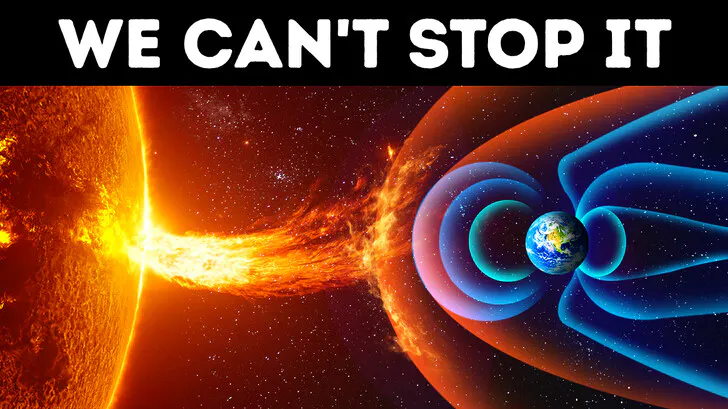
Earth's magnetic field hides a fascinating story. It turns out that it's getting weaker day by day. In fact, it's been doing so for the last 3,000 years, and if this trend continues, we could be in for some trouble within a millennium. What's the big deal? Well, picture this, magnetic north becomes south, and vice versa. Pretty wild, right? When this happens, our planet's protective magnetic shield might weaken, allowing more cosmic rays to hit us. These high energy particles from the universe can cause electronic malfunctions in our satellites and produce elements that could be harmful to us. The last time a polarity reversal occurred was between 772,774,000 years ago. Thankfully, humanity has some pretty smart people on the case, who are investigating the history of Earth's magnetic field.
They take cores of sediments from the seafloor, and study the magnetization of fossils to figure out when these reversals occurred in the past, and when they might happen again. Another group of researchers is studying the South Atlantic anomaly, SAA, a vast region of Earth's magnetic field that is about 3 times weaker than the field at the poles. Using data from multiple satellites, they are trying to figure out what's causing the SAA and how it might change in the future. This could give us a glimpse into how a weakened magnetic field can affect our satellites and our planet. Sure, our generation won't be here to witness these changes, but it does make you wonder what that planet might look like upside down. Magnetically, that is. NASA's astronomers have also announced that in 4 billion years, the Milky Way galaxy is going to get a major glow up. After a cosmic collision that will shake things up, I'm not talking about a small fender bender here.
I'm talking about a titanic collision with our neighboring Andromeda galaxy. Humanity will have to hold on to its space helmet for this one, because the Sun might get flung into a new region of the galaxy. However, Exfinity tech support? I can't get Jurassic Park back on line without, but no worries. Our Wi-Fi boosted mobile keeps you connected in all kinds of places. Cut your mobile bill in half with two lines of unlimited. Learn more at xfinitymobile.com Xfinity. Imagine that. Watch Jurassic Park with Xfinity. Restrictions apply, Xfinity Internet required, savings comparison based on promotional rate for two lines of Xfinity mobile unlimited versus two lines of T-Mobile experience more, Verizon unlimited plus an AT&T starter as of February 10th, 2026. You've been there, settling in for an evening of TV only to waste half the night scrolling. Enter Fire TV. Entertainment with zero effort required. Fire TV serves up personalized recommendations from across all your apps.
Not sure what to watch? Just tell Alexa Plus what you're in the mood for and she'll pull up the perfect recommendation. Problem solved. Stop the scroll. Start the show. Find what you're looking for with Fire TV. Subscriptions may be required. Our Earth and Solar System probably won't be seriously affected. Sounds difficult to believe. So how come? NASA's Hubble Space Telescope did some hardcore measurements of Andromeda's motion. Although the galaxies will plow into each other, the stars inside each galaxy are so far apart that they won't collide with other stars during the encounter. However, the stars will be thrown into different orbits around their new galactic centers. According to simulations, our solar system will probably be tossed much farther from the galactic core than it is today. Set your telescopes aside. You don't need to start counting down the years. This event is likely scheduled in about 4 billion years, so chances for us to witness it are zero.
Saturn is losing its rings. Thankfully, we won't be here to witness this sad event either. Apparently, the rings are being pulled into Saturn as a dusty rain of ice particles all under the influence of Saturn's magnetic field. According to NASA's research, the ring rain is draining an amount of water products that could fill an Olympic-sized swimming pool from Saturn's rings every half an hour. The entire ring system will likely be gone in 300 million years. Scientists believe we should consider ourselves lucky to witness Saturn's ring system at all, as it seems to be in the middle of its lifetime. But if you think about it that way, that rings around planets are all temporary, there's a chance we've just missed out on the giant ring system of Jupiter, or those of Uranus, and Neptune. These planets have only thin ringlets around them these days. Scientists have long debated whether Saturn was formed together with its rings, or if the planet acquired them later in life.
The new research favors the second scenario, indicating that they are unlikely to be older than 100 million years. While Saturn itself is around 4.5 billion years old. What caused the rings to appear in the first place? Well, there are a few theories. One of them suggests the rings could have formed when small, icy moons in orbit around Saturn collided. Perhaps their own orbits were messed up by a gravitational tug from a passing asteroid or comet. Who knows what humans might end up looking like in the future. It's unlikely we'll see any major changes in our lifetime, but let's take a journey to the future and ponder what we might evolve into. Will we become cyborgs with all sorts of cool machine implants? Or maybe we'll become a hybrid species of biological and artificial beings. To understand our future evolution, we got to take a peek at our past.
A million years ago, homo sapiens didn't even exist. There were a few other similar species though, like the Neanderthal. Fast forward to today, and humans have become taller and sturdier. Maybe in the future we'll become smaller to conserve energy. As it's predicted that our planet will get more crowded. Speaking of crowded planets, living in these new conditions means we have to adapt and fast. We're constantly interacting with lots of people, and remembering names is becoming a crucial skill. With Grubhub, there's no fees on restaurant orders over $50. You eat the food, Grubhub will eat the fees. Wait, wait. Grubhub is going to eat the fees? Wait, like the receipts? It's a metaphor for how Grubhub is doing away with fees. No delivery fees, no service fees, no rainy day fees. Well, what if it rains? Can I still order delivery? Please! You can still get any type of food delivered without getting off the couch. That case, what about the new pants fee? Well, I've never heard of that one, but I guess we'll eat that too. No fees on restaurant orders over $50, only on Grubhub.
Grubhub will eat the fees! Details at Grubhub.com Luckily, technology might help us out with brain implants that will improve our memory. In the future, we might also have more noticeable technologies as part of our appearance. Imagine having an artificial eye with a camera that can read different frequencies of light. While predicting a million years into the future is pure speculation, we can use bioinformatics to make some predictions about the immediate future. Demographic trends suggest that urban areas will become more genetically diverse, while rural areas will become less diverse. And what about space? If we end up colonizing Mars, our bodies could change due to lower gravity. Maybe we'll have longer arms and legs, or even insulating body hair like our Neanderthal cousins. In the future, our moon is also going to witness some dramatic changes. We'll miss these ones too.
In about 5 billion years, things are going to get really interesting in this corner of the universe. For now, the sun is chilling in its main sequence phase, just burn in hydrogen like nobody's business. In the future, during the red giant phase, the sun is going to puff up like a balloon until its atmosphere reaches out and engulfs our beloved Earth and moon. Our natural satellite, which is already moving away from Earth, is going to get warped around the Sun's influence. Its orbit will get all wonky, and it'll end up closer to Earth during the new moon phase than during the full moon. And that's not even the worst part. If left alone, the moon would keep on moving away from Earth until it'll need almost 50 days to orbit us. As the sun continues with its own journey, its atmosphere will drag on the moon and cause its orbit to decay. Eventually, the moon will get torn apart into a stunning ring of debris circling Earth.
We're talking about all its mountains, craters, and even the footprints and flags we left there. All scattered throughout the debris field. There's a chance the sun will shed enough mass to spare Earth and the moon from total annihilation. Or if we're really lucky, the sun will lose 20% of its mass and will be safe and sound. It's all just theory right now, we haven't seen a red giant star during this phase. The universe itself might go completely dark one day too. Scientists can't predict it with absolute certainty, but they can make some educated guesses. Right now, our universe is 13.77 billion years old, and it's still turning out new stars left and right. It said that eventually, after about 1 trillion years, the last star will be born. That final star will be a little guy, a red dwarf, just a fraction the size of our sun.
These stars are champs at living long lives, slowly sipping on hydrogen to keep their fusion reactions going. But even they can't last forever. Fast forward about 100 trillion years, and the last light will go out. The universe will be dark and lonely. But thankfully, we won't be here to watch it all fade away. This episode is brought to you by Athletic Brewing Company. No matter how you do game day, on the couch, in the crowd, or manning the snack table, Athletic Brewing fits right in. With a full lineup of non-alcoholic beer styles, you can enjoy bold flavors all game long. No hangovers, no buzz, no subbing out for water in the second half. Stuck the fridge for tip-off, with a variety of non-alcoholic craft styles available at your local grocery store or online at AthleticBrewing.com. Near beer, fit for all times.
Free road hazard protection and convenient installation options. Go to tire rack.com to see tire test results, tire ratings, and consumer reviews. And be sure to check out all the special offers, tire rack.com, the way tire buying should be.
More episodes
More from Bright Side Universe

Solar Eclipses That Changed Human History Forever
Bright Side Universe
Our Solar System Is Doomed Because of This Star
Bright Side Universe
7 Ancient Sites Some People Believe Were Built by ALIENS
Bright Side Universe
What Changed the Moon Forever? The Incredible Event That Shaped It
Bright Side Universe