Loading...
About this Episode
Data examined by the BBC shows the devastating impact of the attacks on Iran's capital, Tehran, since the start of the US-Israel war. According to the findings, Israel has dropped 3,600 munitions on the city in the last four weeks. Almost 40 police stations and bases for the paramilitary Basij force have been hit, many in residential areas. BBC Eye has gathered eyewitness testimony, filmed the aftermath of strikes and analysed footage from social media and satellite imagery. In other news, scientists have managed to film a group of sperm whales supporting a female from their pod giving birth. A former rapper is sworn in as the prime minister of Nepal. And a mother tells us of her struggle to limit the screen time of her young son.
The Global News Podcast brings you the breaking news you need to hear, as it happens. Listen for the latest headlines and current affairs from around the world. Politics, economics, climate, business, technology, health – we cover it all with expert analysis and insight. Get the news that matters, delivered twice a day on weekdays and daily at weekends, plus special bonus episodes reacting to urgent breaking stories. Follow or subscribe now and never miss a moment. Get in touch: [email protected]
Hosts & Guests

Transcript
This BBC podcast is supported by ads outside the UK.
To start planning your next vacation, that's visit usvi.com, usvi naturally in rhythm.
Tax season has arrived and doing taxes without the right help can feel overwhelming.
Into it, TurboTax is here now to guide you through it with confidence.
Match with a TurboTax full service expert who handles everything for you from start
to finish.
Your dedicated expert checks every single deduction and credit to help you get the best possible
outcome so you can feel confident you're getting every dollar you deserve.
In the best part, you'll see real-time updates on your expert's progress right on your
phone while you live your life.
Plus, you get unlimited expert help at no extra cost, even on nights and weekends during
tax season.
Visit TurboTax.com.
Only available with TurboTax full service experts, real-time updates only on iOS mobile app.
This is the Global News Podcast from the BBC World Service.
I'm Celia Hatton and at 16 hours GMT on Friday, the 27th of March, these are our main stories.
With the war in Iran continuing, a BBC investigation tracks the effects of airstrikes on Tehran.
We'll hear from our Jerusalem correspondent on Israel's military strategy and Ukraine signs
a deal to share expertise with Saudi Arabia on combating drones and missiles gained over
four years of war with Russia.
Also in this podcast, a moment rarely witnessed.
The whales were thrashing about and then there was a gush of blood that came up in the middle,
but amongst these 11 female whales each about 40 feet and the small whale emerges.
Spurm whales helping one of their pod give birth.
We start with a BBC investigation into how the war is being waged inside Iran and who
is being hit in those attacks.
For the last month, Iran's capital Tehran has been under assault.
Data examined by the BBC shows that Israel has dropped 3,600 munitions on the city in
the last four weeks and has hit 38 police stations in bases of the Basiege, which is a large
voluntary militia connected to the Islamic Revolutionary Guards.
Many of those strikes have hit into the heart of residential areas.
The U.S. is involved in this war, too, and it says it's carried out more than 9,000
attacks across Iran.
Both the United States and Israel say they do not deliberately target civilians.
With rare access inside Tehran and using satellite imagery, social media content and interviews,
our Senior International Investigations correspondent, Nawal Al-Maghafi reports.
In Resalat, East in Tehran, a mother in agony.
Her daughter has been trapped under the rubble for three days.
My daughter's scared of the dark, she cries.
She calls out for her child.
Mariam, she wails.
But help has come too late.
It's been three days since this neighborhood was attacked by Israeli forces.
They told us they were targeting a military compound of the Iranian Basiege, part of
the Revolutionary Guard.
We confirmed the building they targeted was used by the Basiege militia.
The bomb hit so suddenly, it flew me, then there was another strike.
But that day, three other residential buildings were also struck in quick succession.
I hit the wall and then fell.
I tried to stand up three times, but I was knocked into the wall.
This man, who we're calling Ali, has lived in the neighborhood for 50 years.
His building was badly damaged in the attack.
I stood up again and I don't know what happened.
Rubble fell on my head.
My hands, my back, my legs and my ears were bleeding.
I don't have anything now.
We gathered as much evidence as we could on the ground and examined satellite imagery
from after the strike.
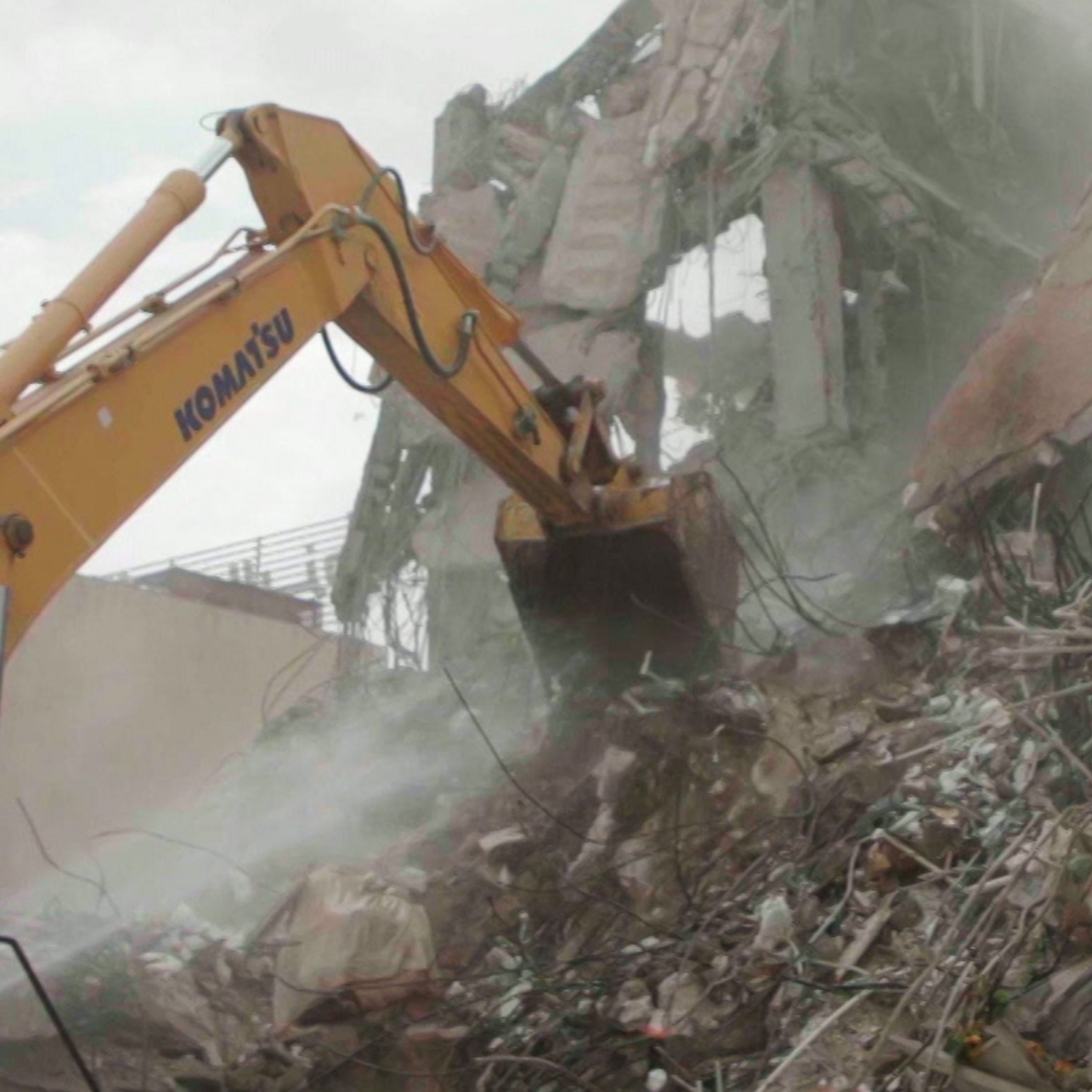
Our investigation showed that four buildings were completely obliterated and the blast
damaged homes and businesses in a 65 meters radius.
Hours after the attack, the local mayor spoke to the media.
Unfortunately, they destroyed 30 residences.
This was no pinpoint attack.
They have caused a lot of damage.
Rescuers worked through the night to try and find survivors.
Local authorities and residents said at least 40 people were killed, but they said the
besiege building had been evacuated.
Military experts told us that the scale and spread of the damage in this attack is consistent
with the use of one of the largest bombs, the mark 80, which weighs 2,000 pounds.
Ras Alat is one of the 38 police stations and besiege bases we've identified as being
hit in Tehran alone.
Most of them, in densely populated areas.
Finally to the great proud people of Iran, I say tonight that the hour of your freedom
is at hand.
The U.S. and Israel say by targeting police and besiege installations, they're preparing
the ground for the Iranian people to overthrow the government.
Stay sheltered.
Don't leave your home.
It's very dangerous outside.
Bombs will be dropping everywhere.
When we are finished, take over your government.
It will be yours to take.
This will be probably your only chance for generations.
But it's the Iranian people that are getting caught in the crossfire.
I don't know who's okay or not.
I just know my friends at the end of the alley are all dead.
And we have more on this story with Nawal Al-Magafi on our YouTube channel.
Search for BBC News on YouTube and you'll find global news podcast in the podcast section.
That report from Nawal, as Israel says it will step up strikes against Iran as a result
of its continued missile fire.
Our Middle East correspondent Yulal Nell is in Jerusalem.
The Defence Minister Israel Kance was quoted from a briefing with military officials.
He said the Prime Minister and I warned the Iranian regime to stop the missile fire towards
civilians in Israel.
And he says, despite the warnings the fire continues, therefore, IDF strikes in Iran
will intensify and expand to additional targets.
This after the Israeli military said it carried out another wide-scale wave of attacks in Iran
overnight.
It said specifically that it bombed Iran's central naval arms production site and ballistic
missile factories this morning.
And after a lengthy lull overnight, Syrians went off this morning also in southern Israel.
In settlements and parts of the West Bank, there was a missile that was down with no injuries
or property damage reported.
A short time ago, there were Syrians here in Jerusalem sending people into shelters and
now just had another alert for a new attack on the southern Israel.
Another friend, though, Israel has been attacking targets in Lebanon.
That's right.
In Israeli air strike targeted the southern suburbs of Beirut this morning.
That's an area that's really known as a Hezbollah stronghold.
There have been a real uptick in attacks by Hezbollah in the past day or so.
And they seem to be escalating at the same time as Israel is expanding its occupation
of southern Lebanon.
The Israeli military has said that it needs more troops to carry out that big deployment.
That's where it says it's trying to set up what it calls a buffer zone to protect
its own citizens.
On that note, though, Israel's main opposition leader, Yehra Lapida, accused the government
of steering the country towards a security disaster because of a shortage of combat soldiers.
That's right.
He's really worried after having security briefings about the issue of strains on Israel's
military manpower.
And he said that the government is sending the army into a multi-front war without
a strategy without the necessary means and with far too few soldiers.
And that is important because up to now the political opposition has largely been aligned
with the government on the war efforts in both Iran and Lebanon.
You'll end now.
Ukraine's president, Vladimir Zelensky, says he signed a defense cooperation agreement
with Saudi Arabia.
He said his country was ready to share its expertise in combating drones and ballistic
missiles, the kind of weapons that Saudi Arabia has been facing from Iran over recent weeks.
In return, Ukraine could get help in defending itself against Russia, particularly now that
the U.S. is distracted with its own war in Iran.
Mr. Zelensky is currently on a visit to Saudi Arabia.
So what can Ukraine offer the Saudis?
I spoke to Vitaly Shabchenko, BBC Monitoring's chief analyst in Kiev.
First of all, it's the drones.
As you say, Celia, the Gulf states had been facing them over the past weeks and Ukraine has
been facing them over the past four years.
So clearly they know a thing or two about how to deal with those drones, especially given
that many of those drones are of the same type, the Shahed drones that are attacking both
the Gulf states and Ukraine.
So we're talking about actual intercepted drones, such as the P1SUN.
Then also there's the issue of integrating these intercepted drones with raiders because
they don't work on their own, they have to be deployed as part of a system.
And thirdly, Ukraine's expertise, as far as we understand, about 230 Ukrainian experts,
members of the Ukrainian military have experienced in fighting drones.
They are already in the Gulf.
So this is what Ukraine is offering to the Gulf states.
Remarkable though, Vitaly, because we have to remember that Ukraine is still very much
fighting a war with Russia, how much can the Ukrainians realistically offer other countries
right now?
That's a question that we asked here in Kiev in conversations with a number of Ukrainian
drone manufacturers.
And they're all saying that they're confident that they can scale up production, no problem.
It's only a question of money and money is what the Gulf states do not seem to have
a shortage of.
But the government in Kiev is really keen for this to be not just a commercial transaction
of Vladimir Zelensky saying that he wants to put Ukraine on the map as a donor of security.
That's the phrase that he used this morning.
So that's why those drone manufacturers in Ukraine that we've been talking to, they're
saying, look, we've got the kids, we've got the products.
The Gulf states want to buy it, countries like Saudi Arabia and Kuwait have approached
Ukraine and drone manufacturers, but everyone is waiting for the green light from the Ukraine
and President.
How's this all being received inside Ukraine?
There's a feeling that the tables have been turned Ukraine for so many years has been
a recipient of aid and technology and reliant on what others were willing to give to Kiev
right now Ukraine is being asked for help.
That's why there's a sense of national pride attached to all this as well.
Vitaly Shivchenko, well the war in Iran is having an effect far beyond the Middle East.
It's causing problems and economic sectors you might not even have heard of.
In South Korea, there's a shortage of raw material used to make plastic bags and other
packaging.
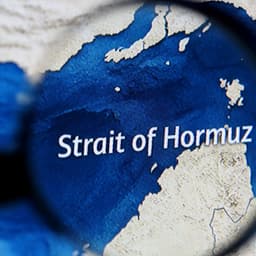
The process needs a chemical called NAFTA, much of which is imported from the Middle East
through the Strait of Hormuz.
There are now fears of a shortage of plastic bags and packaging in South Korea.
Jake Kwon is our correspondent in Seoul.
NAFTA is a crucial ingredient in making plastic products and especially in this case plastic
bags and I think some of our listeners might think so what or a good it will make people
use reusable bags instead, but this isn't a small problem here because South Korea has
a rule that everyone must use plastic bags for their waste and not just any plastic
bag, but everyone must buy these government printed bags to throw out their food and
general trash.
So there was a bit of a panic as people wondered whether they should run to the store and
stock up on them before what they feared would happen next month.
And there are of course plenty of other products that use plastic parts or wrappings we're
talking diapers, the plastic box, South Korea's many take out restaurants rely on to sell
their food.
And that makes us think about the importance of plastic, doesn't it?
I mean, what other measures is the government in Seoul introducing to cope with the fuel crisis?
Every day there has been an emergency meeting by the government to figure out if this really
tough and unsolvable problem, the government is talking about finding a different source
of oil and gas.
They also want to nip the panic at the but before the price of petrol runs away, the government
introduced price cap and promised stern punishment to companies that might try to profit off
with this by hoarding the supply.
And they're also tackling it from the demand side.
The government had urged the public to cut back on electricity use, suggesting all kinds
of measures, including taking shorter showers and turning down the heaters and AC.
Jake, it's not only South Korea that's taking steps over in Japan, the government's acting
there too.
The government there says it's going to allow the increased use of coal-fired power stations
because of fuel shortages.
That seems like a big decision.
It is a big measure for a big problem.
Starting next month, Japan will lift restrictions.
It has been placing on coal power to fight climate change to cut down on the fossil fuel.
This is because Japan depends on the Middle East for most of its energy needs.
One measure shows that around 90 percent of its oil comes through the straight of
poor moves, and they're trying to switch lanes to importing coal, which mainly comes from
Australia.
Jake Kwan in South Korea.
Still to come in this podcast, how much screen time should a two-year-old get?
It's on my mind every day, but at the same time, it's just like you've got other pressures
and most of the time it is to avoid conflicts, meltdowns and to give yourself a bit of a break.
You advise for parents.
When Kohler, the global design leader in luxurious kitchen and bath products, came to me and said,
Martha, we need an ambassador for our timeless, elegant, durable, cast iron products.
I said, I'm in.
Now, let me see the factory.
Weeks later, I was suited up in coveralls and workboots, walking through their Kohler
Wisconsin cast iron foundry.
I stood next to the molten iron furnace, so the hand-applying enamel, and touched the
gorgeous finished products, waiting to be sent out into the world.
Since 1883 Kohler cast iron products have been forged and finished by the incredible crafts
people right in Kohler, Wisconsin.
I'll tell you, I gained a newfound respect and appreciation for Kohler's cast iron
craftsmanship.
So now I'm lending my discerning staff of approval to my most beloved Kohler cast iron
products for their durability, beauty and timelessness.
Shop my Kohler cast iron favorites curated on Kohler.com, bringing the warmth, character,
and enduring style of these timeless products into your kitchens and bathrooms.
As the Kohler cast iron ambassador, I say, long live cast iron.
Doing taxes the old way meant handing everything off and just hoping things were moving.
But now you can feel confident your taxes are being handled right, with Intuit Turbo Tax.
Now you match with a Turbo Tax full service expert.
Just upload your documents right in the app and boom, they take it from there.
Start to finish, you've got a dedicated expert working your return.
They check every deduction and credit to help you get the best possible outcome.
So you can feel confident you're getting every dollar you deserve.
And now you're not guessing what's happening, you're seeing it happen.
Turbo Tax gives you real time updates on your expert's progress while you go about your
day.
Run errands, grab a coffee, live your life, you're always in the loop.
And if a question pops up, you got unlimited expert help at no extra cost, even on nights
and weekends during tax season.
Taxes are finally transparent, easier and handled.
Visit TurboTax.com.
Only available with Turbo Tax full service experts, real time updates only in iOS mobile
app.
It's Carnival season and the U.S. Virgin Islands invite you to experience Carnival in
St. Thomas, this May, a non-stop celebration of music, culture, food, and pure Caribbean
vibes.
Picture this, colorful parade, filling the streets, soka and steel pan in the air, dancing
from day into night and incredible local flavors at every turn.
The energy is contagious.
You don't just watch Carnival, you feel it when you're ready to slow it down.
The beauty of the U.S. Virgin Islands is right here waiting, from the stunning beaches
of St. Thomas, St. Coy and St. John, to the warmest hospitality and vibe like no other.
It's the perfect mix of celebration and relaxation.
Here's the best art.
If you're traveling from the U.S., no passport is required.
Just easy travel and no stress.
If you love good food, great music, beautiful beaches, and unforgettable vibes, especially
during Carnival, this is where you need to be.
Start putting your Carnival getaway at visit usvi.com.
That's visit usvi.com.
USVI, naturally in rhythm.
Hey there, it's Ryan Seacrest for Safeway.
It's stock up savings time.
Now through April 2nd, spraying in for store-wide deals and earn four times of points.
Look for in-store tags to earn on eligible items from Lindor, Chipsahoy, Gatorade, Post,
Ziploc, and Zoah.
Then clip the offer in the app for automatic event-long savings.
Stack up those rewards to save even more.
Enjoy savings on top of savings when you shop in store or online for easy, drive up and
go, pick up or delivery.
Restrictions apply.
See website for full-terms and conditions.
This is the Global News Podcast.
Let's move away from the conflict in the Middle East now and have a look at a couple of
other stories.
Nepal has a new Prime Minister.
New the elected MPs giving their oaths at a ceremony to swear in the new Prime Minister
the rapper-turned politician Belendra Shah.
Earlier this month his party won a landslide victory.
It was the country's first election since protests that were driven by young people toppled
Nepal's government.
From Mumbai the BBC's South Asia Correspondent Yogatalamaya reports.
35-year-old Balindra Shah took oath as Nepal's Prime Minister in a ceremony that included
Hindu and Buddhist rituals in the capital Kathmandu.
His party swept a power riding on public anger against Nepal's political old god.
Deeply entrenched corruption and rising unemployment were among the key reasons why masses of young
people took to the streets in September last year, ousting Nepal's leadership.
Balindra Shah, who's won an unprecedented mandate, has promised that his government will
tackle corruption, deliver social justice, expand the economy and create jobs.
These are daunting challenges for a relatively inexperienced politician.
Trained as an engineer Balindra Shah was a rapper before he turned to politics and was accused
of a high-handed leadership style when he was Kathmandu's mayor.
Scientists have observed a group of sperm whales supporting a mother whale giving birth
and then helping the newborn calf take its first breath out of the water.
The observations took place in the eastern Caribbean off the coast of Dominica.
Professor David Gruber is the founder of Project Ceti and one of the researchers who captured
that moment on film.
He spoke to James Menendez about what they saw.
The crazy thing is that we came across these whales quite early in the morning.
There was 11 members of a unit, known as Unit A, which are lead biologists, nose each
individually as family members, and we just saw this kind of very odd behavior where they
were all kind of facing inward and they were just going up and down and doing these shallow
dives.
And then about two hours in, there was just tremendous amount of thrashing and the whales were
thrashing about and then there was a gush of blood that came up in the middle.
And then amongst these 11 female whales, each about 40 feet, they were some, you know,
the small whale emerges and we see it.
What was going through your mind?
Every now and then, you know, something just truly extraordinary happens and I think
we were all just so grateful to have been there and even more grateful that like our equipment
was working.
Even more than that, we had observers on the boat that were just so intimately familiar
with these whales and their history for several decades.
So all these combined allowed us to do this like really unique type of study.
So when the baby whale was born, what were the others doing then supporting the mother
supporting the baby?
What we saw right after the birth is that the family members, the unit members were
working to lift the baby out of the water.
So the baby was really unable to swim for the first few minutes and they were just
basically, you know, working as a group to kind of uplift the baby out of the water and
almost twirling it around at some point completely out of the water.
I think you use some machine learning software to analyze some of the recordings that you
made.
What did it tell you about the way that they were working together?
What we did is we developed a computer vision software that draws little circles around
each individual whale so you know them by their name.
And then we passed this off to a complex network science team to really show what role
each whale played in this very unique whale birth.
And what?
It was all coordinated.
One of the really interesting parts that I felt was that among the unit A, this group
of whales, there's both kin and non-kin.
But we saw that they took turns among kinship lions, so two kin holding and then two non-kin.
And this went on for several hours until the baby was able to swim away.
And at the end of this kind of, you know, very intensive day, we basically watched just
the mom and the baby kind of swim off into the sunset.
And this is the first time this behavior has been observed in what a species, an animal
rather than primates.
This is one of the most cooperative, empathetic examples of an entry into the world.
Maybe only humans would be the one that we can compare this event to.
And do you think it's replicated across other whale species?
I would think so.
We date this behavior back over 34 million years.
You know, whales are these ocean living ancestors that we had a common ancestor them over
90 million years ago, and we stayed on land and they went into the water.
But to give birth in the water, the baby is actually negatively buoyant.
So like the baby would sink like a rock.
So this type of collaborative lifting among sperm whales in order for them to do the successfully
is something that goes way back.
It's truly unique for these, you know, these ocean dwelling ancestors.
David Gruber.
Many parents around the world find it difficult to deal with the issue of screen time for their
young children.
How much is too much and what's safe?
In Britain, new official advice in England from education experts says that children under
two should not have any time watching a screen on their own, and under fives should
be limited to an hour a day.
Their evidence points to long periods of time spent on screens alone, affecting children's
sleep and physical activity, which are key to their development.
Our reporter, Vanessa Clark, has been following one family in the city of Manchester in their
quest to cut down on time spent in front of all devices, from tablets to televisions to
mobile phones.
So my name's Alexis, and we've got two boys.
Roma here is nearly five, and Marla is nearly two in May, so.
For the busy house.
Yeah, yeah, it's Matt.
Oh, you love to you.
For the Montastille family who live here in Manchester, life is a juggle.
Is it any plane?
From school and nursery pick up to dinner time, their home is filled with technology, and
screen time is something that happens more often than the family would like.
Yeah, I just make me feel guilty for doing it, and I always feel like it's not what we
should be doing.
But what you're going to do, you're not going to be always getting out of bed bouncing
with them at six o'clock and setting up an art and crafts table.
Do you think you do have screens and games on too much?
Are you conscious of it or do you think I'm conscious for sure?
It's on my mind every day, but at the same time, it's just like you've got other pressures
and most of the time it is to avoid conflicts, meltdowns and to give yourself a bit of a
break.
Over the next week, the Montastiers are keen to cut back on screen time, swapping mobile
devices and TV for books, toys and other activities.
All the others in iPod.
And for Romy, it is going to be a big change.
What do you do with your iPad?
I like to do Angry Birds games.
I'm a big pig towerer, I've got a picture on them, there's nothing grabbers for me.
One week later, I check back in to see how they've been getting on.
So yeah, it's been interesting to do the week.
At the start of the week, I was like, yeah, come on, we're going to do this and by the
end of the week, no screen or everything, I'll just swap perfectly.
But it didn't happen.
We've tried our best, but I think, yeah, I've been conscious of it for a while.
This has definitely made me more aware and almost made me start doing things that I've
always said, we need to do that.
For Romy, I'm not sure he's totally convinced, but there were definitely some highlights.
Thanks in a new morning.
Was that better than the iPad?
Yes.
Vanessa Clark.
And last to the United States, where Paramount's mega deal to buy rival film and TV studio
Warner Brothers Discovery rumbles on, with the latter now setting a date in April for
when shareholders will vote on the proposal.
The takeover could significantly reshape Hollywood and the wider media landscape.
It's far from a done deal, Paramount still needs approval from regulators.
One person with concerns is the Hollywood actor turned producer Eva Longoria.
She came to fame for her role in the TV series Desperate Housewives, and she now runs
a production company and is an investor in football clubs in several countries, including
Mexico and the US.
She's been speaking to Will Bain, and she started by reflecting on the mood in Hollywood.
There's a couple of different vibes happening.
One is really AI technology, changing our industry or how it's done.
Not knowing enough about it, knowing too much about it.
There's just a lot of concern about, is it a tool or is it a competitor?
So that conversation is happening at the same time, there's intense consolidation.
And when there's an intense consolidation of buyers, that's never good for any industry.
Right?
I mean, we can see it in automotive industry.
We can see it in...
So it's that side of it, is it, that there would just be fewer players who will stop with
worn a gun, rather than who's giving the car to you?
Players means less, not only fewer people who are buying, but less diversity of thought,
and less diversity of thought leaders.
You know, I think what YouTube and streamers did was disrupt the idea of who is the gatekeeper
to becoming a creator, right?
You had to go through the studio system, you had to go through these proper channels,
and now you can have a show, and you can shoot something on your iPhone, and you can
put it up.
And, oh my gosh, you're a great storyteller.
Like, you don't have to go through these traditional legacy studios, you can do it on your own.
You're a business perspective.
What does that to mean to you, running a product company?
And what would it mean, say, if Paramount does take over Warner Brothers?
Again, the consolidation is the scary part of it, especially when you see it coming
to the consolidation that you see, and a massive amount of job loss of creatives, because
now it's just been a, it comes into this siloed system of intake, and so when I probably
will just pitch one person for five different buyers, but that one person, you know, pitching
to one person, what happens in that process is innovation dies, diversity dies.
So regulators need to look at this closely, don't?
Yeah, I mean, I think we all need to pay attention to what's going to happen.
Supposedly, it's going to operate separately still, but you know, who knows?
Very last one, then.
Well cut.
You must be excited.
Are you ready for all of us coming out from Britain?
We're ready to call it football.
We are ready.
That's a good start.
I mean, that's a start.
I mean, yeah, it's a start.
Look, I live between Mexico and Spain and Los Angeles, and so I just, I was just in
Mexico and, oh, my God, the airport's a mess because of just the amount of people that
they're expecting and trying to really build out the airport so that it is a more streamlined
process.
But look, any country that hosts the World Cup ends up a better off because the infrastructure
is being built to for easier flow.
And so hopefully next year we're all benefit from that.
But we're excited.
We're actually excited.
I've always been excited about the World Cup, no matter where it is in the world.
I just find it fascinating that the global language of the world is football, is soccer.
You can be from anywhere in the world and, and understand and, and speak the language
of football.
And that to me is, is so uniting.
And I think sports is one of the few things that we can look forward to in, in this moment,
in this moment of history that could unite us.
Ending on an optimistic note.
Eva Longoria, actor, producer and football club investor.
And that's all from us for now.
If you want to get in touch, you can email us at globalpodcast at bbc.co.uk.
You can also find us on X at BBC World Service.
Use the hashtag globalnewspod.
And don't forget our sister podcast, The Global Story, which goes in depth and beyond
the headlines on one big story.
This edition of the globalnewspodcast was mixed by Rosenwin Doral.
The editor is Karen Martin.
I'm Celia Hatton.
Until next time, goodbye.
With verbals, last minute deals, you can save over $50 on your spring getaway.
So whether it's a mountain escape with friends, a family week at the beach, or sightseeing
in a new city, there's still time to get great discounts.
Book your next day now.
Average saving $72 select homes only.