About this episode
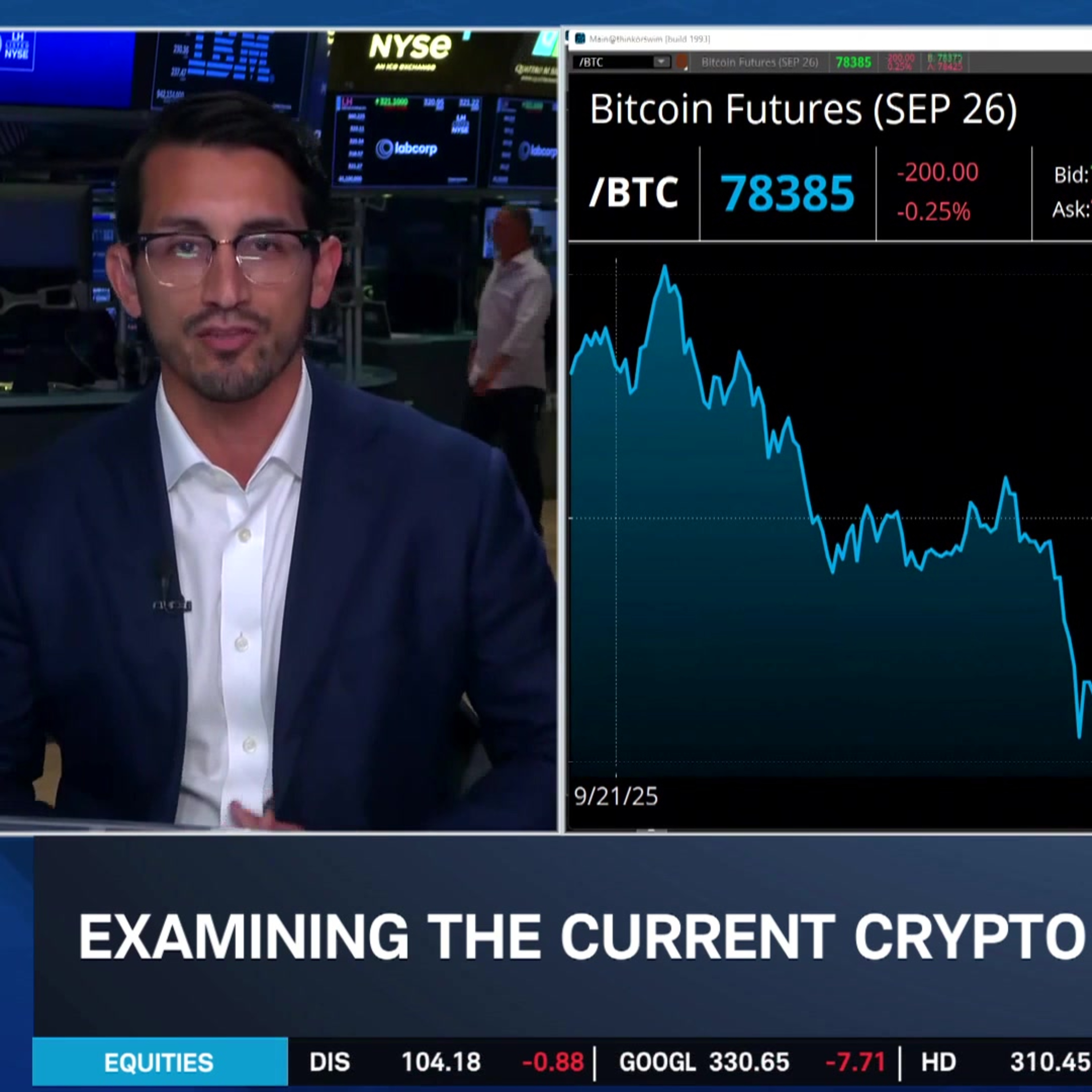
Christian Lopez explains how Bitcoin and other cryptocurrencies are seeing a resurgence as institutional interest grows. He notes that firms like BlackRock, Vanguard, Fidelity, and Morgan Stanley are advising clients to allocate 2% to 5% of their portfolios to digital assets.
======== Schwab Network ========
Empowering every investor and trader, every market day.
Subscribe to the Market Minute newsletter - https://schwabnetwork.com/subscribe
Download the iOS app - https://apps.apple.com/us/app/schwab-network/id1460719185
Download the Amazon Fire Tv App - https://www.amazon.com/TD-Ameritrade-Network/dp/B07KRD76C7
Watch on Sling - https://watch.sling.com/1/asset/191928615bd8d47686f94682aefaa007/watch
Watch on Vizio - https://www.vizio.com/en/watchfreeplus-explore
Watch on DistroTV - https://www.distro.tv/live/schwab-network/
Follow us on X – https://twitter.com/schwabnetwork
Follow us on Facebook – https://www.facebook.com/schwabnetwork
Follow us on LinkedIn - https://www.linkedin.com/company/schwab-network/
About Schwab Network - https://schwabnetwork.com/about
Get every episode summarized
Each time Schwab Network publishes, we email you a written briefing from the transcript — the topics, who appeared, and any specific claims, with the ad reads skipped.
Email me new episodesFree for 3 shows. No card needed.
Transcript ready
81 searchable segments. Every word is indexed and playable.
Full transcript
Schwab Network — Institutional Interest Drives a Crypto Resurgence. Machine-transcribed; use the interactive transcript above to jump the player to any line.
To discuss the latest in the world of crypto, let's welcome in our next guest, Christian Loap has managing director and head of blockchain and digital assets at Cohen and company capital markets. Christian, great to have you on here. I'm looking at Bitcoin right now. We're at about 78,250. We'll call it Ethereum's just under 2500. But both are still down substantially year to date. What's driving the disconnect right now between crypto and the broader equity markets? Well, really nice to be on here. Yeah, I mean, listen, the crypto market kind of fell in October of last year due to a variety of reasons, particularly an issue with one of the larger exchanges and a massive deleveraging event. And I think it's been seen at the bottom and accumulation in kind of the low 50s, sorry, high 50s, low 60s range over the last several months. But recently in the last two, three weeks, we've seen a bid for crypto. You know, obviously hasn't come back to all time highs. But a lot of people in the industry and in the crypto market are believers of the crypto cycle.
And if history has anything to say, you know, we're probably looking at an October, November cycle where we're going to continue to see a nice bid for the crypto asset. And a really interesting thing about one of the reports that you sent over is that capital continues to pour in. Even when we were at those depressed levels, those 50, 60,000 dollars levels, and we've been under pressure, it was nearly 20 billion dollars, I believe, raised across the sector in just the past year. What is that money betting on? That's a great question. Listen, the money is betting on infrastructure right now, right? And so where folks are really focused on stablecoins, global payments, tokenization. The market for the actual digital asset, the underlying cryptocurrency has been a bit softer as we discussed. But there's been accumulation from larger players, institutions, pension funds. You have folks like BlackRock, Vanguard, Fidelity, and other asset managers Morgan Stanley launched their Bitcoin ETF. All of them are telling their clients and consumers you need to hold a portion of your assets in Bitcoin, right?
Your portfolio should have a 2-5% exposure to Bitcoin and other digital assets. So that continues to drive the market. And I think we're going to see that bid. Sellers are running out of steam. And we believe that Ed Cohen, that Bitcoin is kind of headed to the next leg up. And another thing that we're seeing is this wave of public companies reinventing themselves around these crypto treasuries. Is this becoming a legitimate new corporate strategy? Are we seeing a new version of, I guess you call it like a SPAC phenomenon? Yeah, I mean, that's really good analogy, right? These companies, what they did was they're using their vehicle to go by cryptocurrencies in the public markets. But your question is, are we seeing a new phenomenon? I think, you know, reality is, you know, I think that was a brief period of time where people took advantage of a really hot market. Last year, you know, the crypto market was pretty wild from a positive perspective. Bitcoin hit all-time ties of 125, Solana Ethereum, and other alternative digital assets really ran nicely.
So players in the ecosystem took advantage of that. I think right now, because the regulatory lanes are a lot more open, ETFs are available. Other ways to access crypto are open. The digital asset treasuries, I think, probably you're not going to see any new ones, but the ones that do exist and took advantage of the market. They now have the ability to use the capital markets to go do interesting things. You know, financial engineering or go acquire, you know, smaller companies to generate revenues and cash flows in order to accumulate more of that asset. In Christian, we've got some crypto-related stocks up on the screen next to your face right now. So I'm wondering, what can be through the economic rationale? As we're talking about the assets themselves, why you should own a company's stock that comes at a premium to its underlying crypto holding rather than just buying the crypto directly? The main reason is really the financial engineering aspect. I think a really good example of these companies is strive, which is ASST and micro-strategy.
They've accumulated enough digital assets in their capital base that they are very liquid, right? They trade billions of dollars every day in the public markets, and that allows them to take advantage of that liquidity and sell different parts of the capital structure to different types of investors all the way from long-term institutions to our funds and hedge funds all the way down to retail. And as a retail investor, if you're interested in exposure to the digital asset ecosystem, the reason that you go buy these assets is because you get a levered play on the underlying asset. If you're not looking for extra juice on top of the underlying, then yeah, your best bet is to either go buy the digital asset directly or you go buy the ETF. And so at what point does the market start demanding though that these companies demonstrate an actual operating businesses or are yield rather than simply accumulating tokens? I think you're seeing it live, right? Like the micro-strategy fell 50-60% over the last market cycle, same with asset entities and all these other digital asset treasuries.
So the market is brutal, it brutally honest, the supply demand factor exists out there, and I think a lot of retail investors and institutions kind of moved away from the digital asset treasuries. But you're starting to see some of that come back, asset entities itself is up about 67% in the last two weeks, micro-strategy up above 20, 30% in that same time period. So that levered play works both ways on the downside and on the upside. I mean, on the other hand though, you have these actual operating entities that you had on the screen before, bullish, Gemini, Robinhood is obviously crypto adjacent. These are real operating businesses who are setting themselves up from a licensing perspective, volume perspective, and infrastructure to take advantage of what we believe is a next cycle in crypto, which is kind of tokenization of real world assets. But the actual operating business itself, it's very much tied to flows of crypto digital assets.
And Bitcoin used to dominate the conversation, not we just generally when we talked about crypto, but specifically about this corporate treasury conversion. But now we're seeing companies building strategies around Ethereum, Solana, XRP, they're really broadening out here. Why is that happening? Really it was the liquidity that was available last year, right? So markets at all time high, tons of money flowing into the ecosystem and folks saw an opportunity to get exposure to more than just Bitcoin. Bitcoin is the stalwart of the crypto ecosystem. All assets kind of follow what Bitcoin does, but they tend to do it at a higher beta, right? So if Bitcoin is up 20% in the last two weeks, Ethereum is up about 30%. Solana is up above 35%. This is in the last two weeks alone. So these large rents, and by the way, these are billion dollar asset classes that trade daily in terms of total market cap. So these aren't just tiny little assets that are like, hey, let's just add some exposure to this. These are real, on-chain assets that companies are building on.
A ton of DeFi projects, stable coins, and payments companies are all built on Ethereum and Solana. And so the players that built these digital asset treasuries on those different asset classes are really trying to get that exposure out there, market to the world that, hey, this is the future of finance, right? Building on these digital rails at T plus zero settlement and basically instant settlement time across borders at very low costs. Christian, really appreciate you joining us, especially from the nice, seed floor today. We're sadly going to have to leave it there, but really appreciate you taking the time to be with us. Christian Lopez, managing director and head of blockchain and digital assets at Cohen and company capital markets.
More episodes
More from Schwab Network

Stock Market Today: ORCL & ADBE Earnings, AEO Plunges Near 52-Week Low
Schwab Network

Thursday's Final Takeaways: Crude Taps $103 & PPI Hotter than Expected
Schwab Network

Balancing High-Conviction AI With High-Dividend Diversification
Schwab Network

EARNINGS PANEL: ORCL, ADBE
Schwab Network