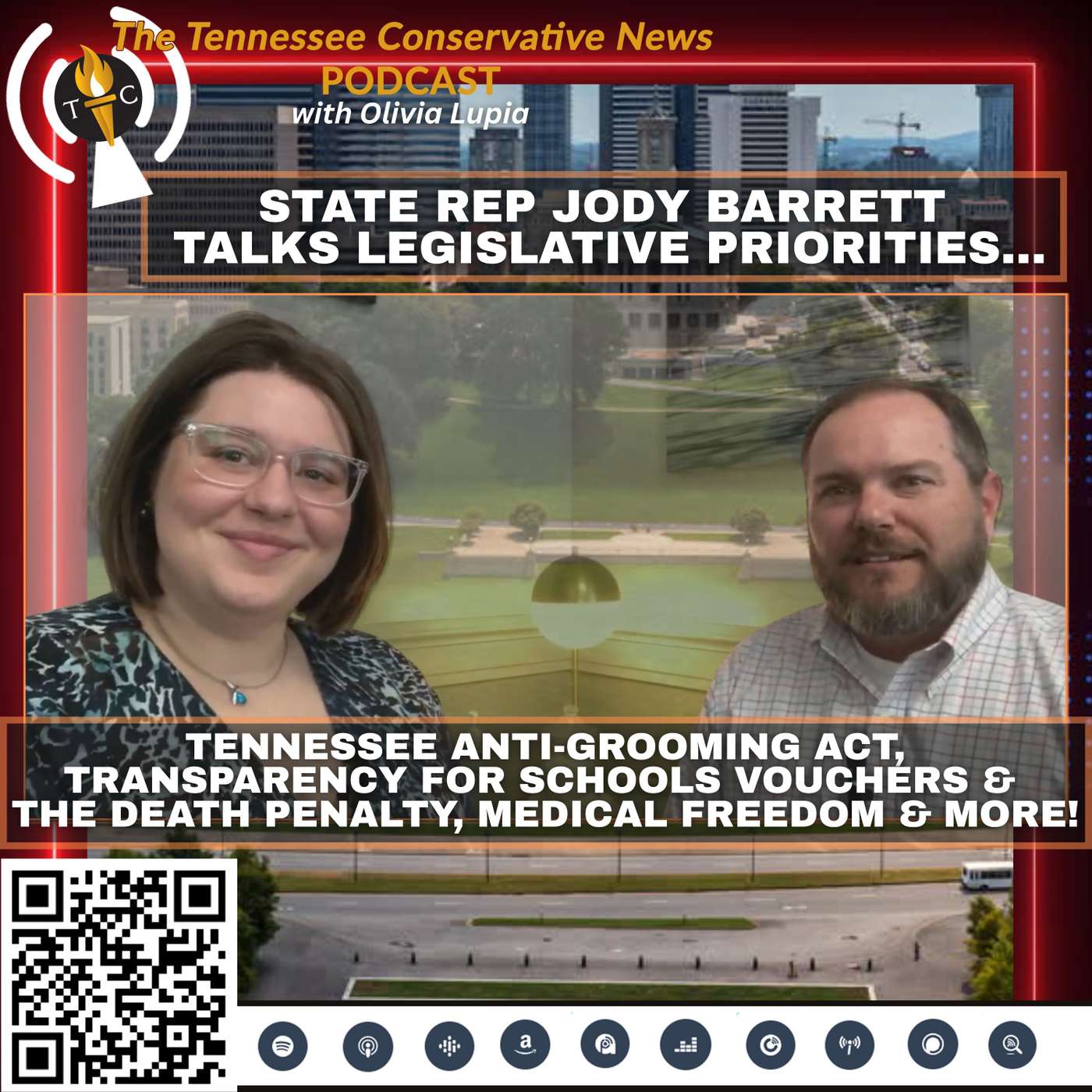
Interview: TN State Rep. Jody Barrett - Anti-Grooming Act, Transparency for Schools Vouchers & More!
About this episode
State Rep Jody Barrett Talks Legislative Priorities…
Tennessee Anti-Grooming Act, Transparency for Schools Vouchers & the Death Penalty, Medical Freedom & More!
Tennessee State Representative Jody Barrett (R-Dickson-District 69) interviewed by The Tennessee Conservative’s Olivia Lupia.
Get every episode summarized
Each time The Tennessee Conservative publishes, we email you a written briefing from the transcript — the topics, who appeared, and any specific claims, with the ad reads skipped.
Email me new episodesFree for 3 shows. No card needed.
Hosts & guests


Transcript ready
186 searchable segments. Every word is indexed and playable.
Full transcript
The Tennessee Conservative — Interview: TN State Rep. Jody Barrett - Anti-Grooming Act, Transparency for Schools Vouchers & More!. Machine-transcribed; use the interactive transcript above to jump the player to any line.
Hey everybody, it's Olivia back here with Brett Barrett, he's ready to dive in. Yeah. I just hit the button. Let's go. So we've talked a little bit about a couple of bills you got going on, but give us kind of an idea of what your legislative priorities are for the season, where you're out, what you got cooking, some things that are important to conservatives that they need to know about that you're working on. Yeah. We've already talked about the Equal Protection Bill. I also have another bill that's very important, it's the Tennessee Anti-Grooming Act I'm working on with Senator Bowling, as many of you know, of course, is just a warrior up here. But the Anti-Grooming Act is trying to cut off some of this sexual abuse and exploitation of children before it actually happens. So currently in Tennessee law, there is not a crime or criminal charge for the act of trying to groom a minor for that purpose. And so if this passes, law enforcement would have another tool in their tool belt to be
able to go after these folks with felony charges, serious charges, and put them behind bars before they actually abuse these children or take advantage of them. So that's a big one. Yeah. And I think we actually covered that one. So again, you guys can find out on the website we did a bill introduction so you guys can get an idea of kind of the language and the specificity. But I mean, I have to say, I think this is a great bill personally, just because there's not a day that goes by, I don't think that we don't publish something about some abuse in schools or teachers, you know, having this kind of room, family members, all sorts of things. So I think this is a really great proactive tool to get ahead of some of that, so. Yeah. And I think it gives, again, we have folks now that are in the law enforcement better specifically online, dealing with online targeting of our children. This is going to give them the ability to go after these folks instead of having to sit back and wait till they actually make contact or communication with a Tennessee child. They're going to be able to go after them for the act of what's everything they've done
leading up to that point. Okay. Great. What else you got, cooking? We've got just a couple of things. Yeah. I got a lot of bills this year. It's kind of maddening. But also have a bill on the transparency for government or surrounding the death penalty. So here in Tennessee, there's a lot of information about the death penalty that is not disclosed and you can't get the information from the government. And we're trying to open those books a little bit, particularly with where we get the drugs that we do the death penalty with, how we're paying for that, what we're paying for, how those drugs are mixed because the main drug that everybody uses is intentionally limited to use for that purpose. So it has to be mixed with something else before it can be administered in an execution. And right now all of that information is kept secret. And so we want to open the books a little bit, shed a little light on that so that the
citizens here can understand exactly how that process is working. And so what I've been saying is if we're going to execute prisoners in Tennessee, which we are because it is state law, then we need to make sure that we're doing it openly, transparently, and that everybody understands exactly how it's working. Excellent. That's again, we're all about more transparency than last and all the way up and there has been a lot of confusion and I know back and forth and then we had the stays and then the this and the studies. So that seems like a good thing. Yeah. Yeah. Can't be mad at more transparency. Before that, I've got another transparency bill dealing with the school vouchers or the scholarship program. Some of the frustration that we've seen in the first year of the application of the program is some of the limited information that we've been able to get from the Department of Ed. And part of that's not their fault. They just haven't been gathering that information because they weren't required to. And so that opened the books for us to kind of take a look at and say, well, what information do we need as legislature to properly analyze the program to make sure that it's doing what
it was intended to do, that the people that really need the help are getting it, and that the money that we're spending is being used properly and efficiently. And so that bill will try to answer some of those questions, force the Department to compile some of that data on a year-to-year basis annually and present that back to the legislature so that each year when we come back to decide how much money we're going to fund for that program, which we're going to expand it, what not, that we have kind of all the data that tells us, hey, here's who's benefiting from this. Here's how it's working. And I think it's important again, if we're going to spend your taxpayer dollars, we should know how we're spending it and who's benefiting from that. Yeah. Well, that kind of makes sense. And it almost kind of seems like this should have been in place before we announced and by we, I mean, a certain governor announced that he wanted to go ahead and push expansion of the program. Well, I mean, even a governor said, I think he said in an interview, that there is no data available. He did say that.
No, I forget the exact term we used, but no data available that is useful. And that proves my point for my bill is why it's necessary, but I agree with the governor. There is no useful data. And so we need to start compiling that. And this is not a relitigation of the voucher plan itself. I'm not making any statements or comments about whether it's good or bad. I'm just saying, let's collect the data. Let's understand how it's actually operating in the state who's benefiting from it. And then we can have that conversation later as to whether or not it's working in the right way. Really what I want to know, too, is from the data that we were asking to be collected, is are the people that are truly stuck in bad public schools or in bad situations? Are they really getting access to the use of this money? And if not, then we may need to make some adjustments in how the program works so that it is getting to the right people. Yeah, definitely. So I'm like a good thing.
I hope so. I hope so. You would think. But we saw how that worked out in this. That's true. You're right. You're right. Any more kind of big things, priorities, things that you really want and serve as be focused on. Yeah. I mean, the other bill I think that's really good. I've got a medical freedom bill that deals with autologous blood donations. You taught me a new word when I learned about that bill. But that one I think is also important as well. So if you've ever had a situation where you had a surgery scheduled and you knew in advance that you're going to be going in and in the process of that surgery, you might have to have a blood transfusion. And this would allow you to direct with the consultation of your physician, direct that surgeon in that medical facility to allow you to provide your own medical or your own blood donation. That's the word autologous. And if you wanted to do that, then you would be permitted to do so. Currently, there's some give and take in some areas with different hospitals and blood
banks that don't allow that. And so it's two things. Autologous blood donation, meaning you donate your own blood or a directed blood donation where you have a friend or a family member that would donate that blood for you. And so again, it's just medical freedom for you to be able to control what is being put in your body. And it's still subject to all the safety protocols and testing and that sort of thing. So we're not creating some opening pandora's box for people to come in and tell the doctors that they must allow you to do dangerous things with your body. But that is something that I never would have even thought of. And I think that's a great idea. Like, yeah, if I have to have a blood transfusion, just put my own blood back in me, or if I know my mom or my dad or whoever, my best friend is a perfect match, who's safe and clean and all those things. That really makes sense. Well, and the more I've gotten into this, the more I've learned that there's all sorts of things that are not tested. I think there are 12 major markers that are tested regularly. But outside of that, there's a whole list of things that are not being detected with
the tests that are being used with standard blood donations. And so it's just a, you know where you've been, you know where your blood's been and where it came from. And so it gives you just a little bit more comfort and security that what you're putting back into your body, you know where it came from. That's very interesting. I think that's a great thing. Again, we'd never have thought of it, but what a great thing that we kind of already should be opted into that and this kind of seems to rectify that. I think it would also, I think it may also help encourage more blood donation because if folks are going and donating their own blood, a lot of times it's not going to be used. Right. And if it's not used and that blood would go into the bank for use for other patients. And so this is just another way for us to encourage folks to, hey, if you think you've got a surgery coming up, go ahead and make your own blood donation and whatever you don't use, we're going to keep in blood bank. Yeah, that's, that's awesome. Sounds like fun. Sounds like it. So I think actually all of the bills that you mentioned, I believe we are tracking. So make sure that you are signed up for our newsletter. If you're not getting that already, we've got the calls to action. We do kind of deep ties and introductions into these bills.
We also give you ways that you can contact the committee members or the bill sponsors. In this case, they're all our one and only rep bear it here. But a lot of great things coming down the pipe. Thank you guys so much for tuning in. Thank you for those wonderful explanations. It's always great to hear directly from our legislators, what you guys are up to, particularly those who are conservative and freedom minded, who we know are fighting for us in all the right way. Thanks for coming to visit. Oh, it's my pleasure. It's been fun.
More episodes
More from The Tennessee Conservative

Are Tennessee Officials Finally Listening To Voters On Unwarranted Surveillance?
The Tennessee Conservative

My favorite Dolly Parton song you've never heard & why. Plus a good playlist rec...
The Tennessee Conservative

Remembering Dolly… Plus Property Tax Outrage, Data Center Progress & TN’s $752M...
The Tennessee Conservative
State Lawmakers Considering Audit Of Metro Nashville Public Schools
The Tennessee Conservative