
IP#509 Dr. Robert D. Enright – Forgiving as Unity with Christ on Inside the Pages with Kris McGregor – Discerning Hearts Podcast
About this episode

Dr. Robert D. Enright – Forgiving as Unity with Christ on Inside the Pages with Kris McGregor
Dr. Robert Enright speaks with Kris McGregor about his book Forgiving as Unity with Christ: A Journey for Healing, Resentment, and Relationships. He shares how an epiphany in 1985 redirected his academic career toward the study of forgiveness, which had previously been neglected in psychological research. Forgiveness, as a moral virtue, can transform the heart by healing the effects of injustice such as anger, resentment, and mistrust. Drawing from Aristotle and Aquinas, forgiveness does not excuse wrongdoing, demand forgetfulness, require reconciliation, or negate the pursuit of justice. Rather, it involves offering goodness to one who has acted unfairly, allowing a person to reclaim peace and dignity while also maintaining boundaries and seeking fairness where needed.
Dr. Enright outlines forgiveness as a deliberate, grace-filled path that must often be walked slowly, with self-awareness and even journaling. He discusses its spiritual dimensions, particularly its unity with Christ’s suffering and love on the cross, which brings healing not only to the individual but potentially to the offender and their relationship. He touches on the need for forgiveness education, especially within Catholic contexts, to help children and adults alike cope with life’s inevitable wounds. Dr. Enright also speaks on self-forgiveness, highlighting its importance in embracing one’s worth before God, especially through confession and sincere restitution. His research in diverse settings—from survivors of incest to prison inmates—demonstrates the transformative power of forgiveness on emotional, relational, and even physical well-being.
Discerning Hearts Reflection Questions:
- How does unhealed resentment affect your relationship with God and others?
- In what areas of your life might God be inviting you to forgive, even if the other person hasn’t repented?
- How can uniting your suffering with Christ on the cross transform your experience of injustice?
- Are there ways you’ve misunderstood forgiveness—as excusing, forgetting, or reconciling—that need to be corrected?
- How might your pursuit of justice be more Christ-like if it flows from a forgiving heart?
- Who in your life do you need to forgive not just for their sake, but for your own healing and freedom?
- How do you see the Sacrament of Reconciliation supporting both seeking and offering forgiveness?
- What role does prayer and grace play in your ability to forgive someone who deeply wounded you?
- How can cultivating forgiveness in your family or community reflect the mercy of Christ more fully?
- In what ways have you struggled with self-forgiveness, and how can God’s mercy reshape your self-understanding?
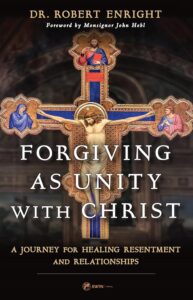 From the book’s description:
Dr. Robert D. Enright, founder of the International Forgiveness Institute, invites you to travel with him down the road from alienation to forgiveness to possible reconciliation. His cathartic exercises will enliven your relationship with Jesus and provide a healing balm that will deepen your empathy and dispose you to forgiving others.
Similar to The Imitation of Christ, this work is divided into three books comprising short chapters with brief points to consider. The first book lays out forgiveness in general and includes biblical stories of forgiveness; the second approaches forgiveness from the Catholic perspective, including loving others through our intimate connection with Christ and seeking forgiveness ourselves; the third discusses skeptical views of forgiveness as well as self-forgiveness, forgiveness within communities, and what legacy you will leave behind.
These powerful exercises will help you understand what forgiveness actually is and why it is beneficial, including scientific studies of those who were suffering physically, psychologically, or emotionally and experienced healing.
You will learn answers to soul-searching questions and discover:
- How to embrace your littleness with the humility of a beloved child of God
- The Process Model of Forgiveness to aid you in becoming “forgivingly fit”
- Seven forgiveness lessons in the Old Testament story of Joseph and his brothers
- The three Rs that help complete the triangle of forgiveness and rebuild trust
- Seven aspects of “forgiveness as redemptive suffering”
- The importance of forgiveness in God’s design for our peace and joy
As you contemplate God’s love for you in these extraordinary pages, you will grow deeper in your faith through journaling prompts and transformative meditations, including penetrating questions to guide you on your path to freedom. The book has been given an imprimatur by Bishop Donald Hying of the Catholic Diocese of Madison, Wisconsin.
About the Author
Dr. Robert Enright is a member of the Catholic Church. He is a licensed psychologist and the founder of the International Forgiveness Institute, a nonprofit organization dedicated to disseminating knowledge about forgiveness and community renewal through forgiveness. In 2020, he was awarded the Aristotelian Professorship in Forgiveness Science in the Department of Educational Psychology at University of Wisconsin-Madison. He is the first to publish a scientific study on the topic of person-to-person forgiving (1989). He is a popular speaker on forgiveness, and his work has appeared in such outlets as Time magazine, the Los Angeles Times, and the Chicago Tribune and on ABC’s 20/20. His International Forgiveness Institute organized the Jerusalem Conference on Forgiveness for the Renewal of Individuals, Families, and Communities at the Notre Dame of Jerusalem Center, 2017; the Rome Conference on Forgiveness at the University of Santa Croce, 2018; and the International Educational Conference on Agape Love and Forgiveness in Madison, Wisconsin, 2022. For his innovative research on forgiveness, he received in 2022 what the American Psychological Association calls “psychology’s highest awards:” the APF Gold Medal Award for Impact in Psychology..
Get every episode summarized
Each time Discerning Hearts - Catholic Podcasts publishes, we email you a written briefing from the transcript — the topics, who appeared, and any specific claims, with the ad reads skipped.
Email me new episodesFree for 3 shows. No card needed.
Hosts & guests
Transcript ready
577 searchable segments. Every word is indexed and playable.
Full transcript
Discerning Hearts - Catholic Podcasts — IP#509 Dr. Robert D. Enright – Forgiving as Unity with Christ on Inside the Pages with Kris McGregor – Discerning Hearts Podcast. Machine-transcribed; use the interactive transcript above to jump the player to any line.
Descerning Hearts provides content dedicated to those on the spiritual journey. To continue production of these podcasts, prayers and more, go to DescerningHarts.com and click the donate link found there, or inside the free Descerning Hearts app to make your donation. Thanks and God Bless! DescerningHarts.com presents Inside the Pages, Insights from Today's Most Compelling Authors. I'm your host, Chris McGregor, and I am delighted to be joined by Dr. Robert N. Wright, who is a member of the Catholic Church, a licensed psychologist, and the founder of the International Forgiveness Institute, the nonprofit organization dedicated to disseminating knowledge about forgiveness and community renewal through forgiveness. With Dr. Robert N. Wright we go inside the pages of, Forgiving as Unity with Christ, a journey for healing resentment and relationships, published by EWTN Publishing. Dr. N. Wright, thank you so much for joining me.
Oh, you're quite welcome, Chris. Thank you for having me. I love this book, Forgiving as Unity with Christ, a journey for healing, resentment and relationships. That's what it's all about, isn't it? I mean, it's healing in the deepest, most profound way to forgive, isn't it? It is actually, and a lot of people don't even realize that. They kind of live with resentment in their heart, and they sometimes think that's just the way it is. I have to live with this. And I have found over years of studying forgiveness that it actually can cure the effects of injustice, such as resentment, discontent, mistrust in ways that nothing else on the planet can actually be as effective. What I found really compelling is that in the very beginning of the book, you described something for you, which was an epiphany.
It happened in 1985. Yeah. From NaviStake, and you were in the car. And could you talk to us about what happened? Well, I was hired at the University of Wisconsin in Madison in the Department of Educational Psychology to study what they call moral development. And I was a very obedient academic studying what academics at the time told me, I can study what was the norm, which was how children in adolescence and adults think about justice, and how they get more complex with that as they grow and as they mature. And it was very good to me. I had grants, and I got 10-year studying that. And I woke up one day and asked myself a very dangerous question. Who am I helping with my research? And the answer was a few of my colleagues, we meet at professional meetings, and then
we pat ourselves on the back of how wonderful our work is, and we go back to our own departments helping nobody. So I used the expression I threw all of my work over a cliff. And I said, I'm not going to do this anymore. Then very soon after that, a good, cast-like student from Brazil, who was my advisor at the time, getting a master's degree, came in and said, look, I'm out of money. I'm going to leave. I have to go back to Brazil without my degree. Just tell me what to study. And I thought to her, well, that's not the way it goes. You're supposed to tell me what you want to study, and I'm supposed to help you. But because she was in such dire straits, riding alone in my car, driving to the university one day, and I prayed specifically to our Heavenly Father for help with the student. See, it wasn't about me. It was about her.
And surprisingly, I got one word back in prayer, forgiveness. I kind of went back in my driver's seat and I said, forgiveness. Because I had never thought of that as a research topic at all. I thought, oh, forgiveness. So the next week, we didn't have Google then, so I had to do something primitive. I had to walk all the way to the library, Chris. Whoa. And I got a computer search in the literature by the librarian. And I said, I want all the published research on the topic of forgiveness that has appeared in print, whether book chapters or journal articles that you can find. But I'd like it published and scientific research, which I figured there'd be a lot, because psychology is supposed to be the pumping professions. And she came back a half-hour later with a blank sheet of paper and said, there are none.
And I had a friend do the same thing at the University of Kansas at the same time. And he came back with a blank sheet of paper. So I thought, well, this is for me. I think I'm going to try this, but there's no published work, Kalinon. So I started talking to graduate students, saying, you want to try a new moral development topic. And I had probably, I can't remember now exactly, probably six to eight graduate students from kind of all over the world, Greece, Taiwan, Korea, the United States. And we all sat around on a Friday morning asking three questions, what is forgiveness? How do you go about it and what happens when you do? And I'm still asking those three questions. I'm a slow learner. I love it. I love it. I just have a morality, justice, and forgiveness. If we're going to talk about forgiveness, Dr. Unright, maybe for a lot of people, we have
to start out with what it isn't. Yes. Well, I agree with you. I hold what's called the Aristotelian professorship in forgiveness science. The long words for studying forgiveness from ancient philosophy. The Aristotel reminds us that whenever you start a conversation about any topic of importance, when you define it, be sure you tell us also what it is not. So I'll give you at least four ideas that forgiveness is not. And they get me in trouble all the time when people misunderstand. Firstly, forgiveness is not, is it's not to excuse what the other person did. A lot of people think, well, you're just saying, oh, let it go. It wasn't a big deal. And it was a big deal to me. And you in right, you're telling me that it's not a big deal. No, no, no. What happened wasn't fair is unfair. It's always going to be unfair.
But we're not going to say, oh, it's okay now that I forgive you. No, when you forgive, it stays that way on fair. It also doesn't mean that you completely forget what happened, less did happen again. We see we remember, but it passes through our heart without harm. Where when we forgive, some people think we develop a certain amnesia about what happened. And so if I keep giving money to a gambler and I forgive, I'm going to forget the person is never paying me back. And so I'm hurt by my forgiveness. No, you've forgiven, remember in new ways, but you don't just blood it out so that you can do something about it. Because people misunderstand it. They equate forgiving, which is a moral virtue of goodness to our others who aren't good to you,
with reconciling. But reconciliation is not a moral virtue. It's a negotiation strategy between two or more people who come together again in mutual trust. So one can forgive and not reconcile with, let's say, a very authoritarian boss where it's really bringing you down so you can go get a new job. And when you're on your desk in a new job, maybe in another state, you can be forgiving that boss, but you're not reconciled. When people are in hugely abusive relationships, they say, you're telling me to go back where I could get killed? What do you in right, you're dangerous? No, no, no. In the extreme cases, you can forgive and not reconcile an apartment relationship. And then a fourth one that gets me in trouble all the time is people think in either or ways where they think,
well, if I forgive, I cannot seek justice. Or if I seek justice, I cannot forgive. So that if a 12-year-old keeps being pushed down on the playground by someone who bullies this child, they think, well, if I asked my child to forgive, then my child can't seek help, can't seek fairness. No, no. Aristotle reminds us so to say, Thomas Aquinas, that the moral virtues grow up together. So you can and should forgive and seek justice. And what's really the beauty about that is if you can cleanse your heart of deep anger or hatred against the other, the justice for which you ask will probably be fairer and more reasonable than if you want a pound of flesh in your supposed justice. Those are so important.
They are. And if people understand that, they wouldn't pick on me so much. Nobody's picking on you. I don't believe it. Because I mean, that's just all wisdom. Everything you're talking about is wisdom. Part of it, I could go through each point and I want to. But part of that, the fuel can be fear and anger. That gets in the way, doesn't it? See, in those aren't the injustice. Those are the effects that tumble into our heart after the injustice has occurred. So someone could be extremely mean to you ten years ago. And that's over. The injustice we can't build a time machine and go back and change that. But what happens is the effects of the injustice get into our heart. And sadly, those effects can stay in the heart, affecting me rather than the one who was unfair to me, who's probably longed forgotten about it.
And so that person's on to other things. And I'm still growling at that person if I've had a bad dream about the person or someone reminds me of the person or I'm watching a film or it kind of reminds me of our interactions. And I'm living with these negative responses that I call effects. That aren't affecting the other person at all anymore. And looking at all the power that person has over my own while being. It is so important, isn't it, that we have to come to a point where we can accept that. Sometimes that in that forgiveness, that's something that I'm grappling with. And in some ways, it has really nothing to do with the other person, how the other person responds, what happens to them ultimately, whatever. What you're dealing with, what you're talking about, is the wrestling we do within ourselves, isn't it? It is the wrestling within ourselves.
But the key is it's not just about me for me. The paradox of forgiveness, a paradox being in a parent contradiction that is not a contradiction, is that when I reach out with care, compassion, even love towards someone who in terms of justice doesn't necessarily deserve it, I am engaging in the moral virtue of forgiveness because I'm focusing goodness on the other. And it is myself who experiences healing. There might be healed from that if I get the person's attention that, oh, yeah, I really did hurt. And right, more than I thought I did. And the person repents, maybe goes to confession. Great. But we're giving the other an opportunity to heal that person takes it or not. I can be set free by engaging in confronting heroically these effects, the mercy of forgiveness, so the other no longer has that kind of power over me.
So interesting when you connect it with justice. I think that is really key because when we have been hurt or harmed or something, something's been taken from us, maybe it's trust. So whatever that is, when we think of justice, we think of there's an arbitration and that person will have to be held into account. Right. And where that justice is obtained in this case, when it in areas of forgiveness, I think that's where people have to almost have to release that. Like if you were to go to court, you would leave it in the hands of the judge. So for the Christian, who's the judge, you know, distributing justice? Right. Yeah, ultimately the justice comes from our Heavenly Father. That's very obvious. At the same time, I can work with the grace of God to affect a certain justice. If someone, for example, keeps beating up other people, it would be good.
If they beat me up, if I forgive, but it would be good if that person was in custody for the sake of other people, you see, I work for justice as I forgive. I'm not doing it for revenge. I'm doing it to protect others as well as myself, because this person refuses to change. And we in society, in our communities, have to do something about this to protect others from the grave woundedness in that other person's heart, who's just in all likelihood, displacing anger and hatred from others now onto unsuspecting victims. Well, this is where we get into chapter three of your book. We talk about, are you talk about that the process? Sometimes we don't even know we need to forgive. Yeah. You got to do a deep dive on your own heart in very many ways, don't we? That's right. Because sometimes we're in denial that we're as wounded as we really are.
We don't want to admit that to ourselves, because it's to admit that someone really is so powerful over me that I can be gravely wounded. And so forgiveness asks us to stand in the truth that I've been treated unjustly. And in all likelihood, I have been wounded to some degree. And in some cases, I'm wounded even more than I realized. That actually becomes a motivator to do something about it. And again, forgiveness offers a person a chance of healing that woundedness in the heart, possibly helping the other with that person's woundedness and then healing the wounded relationship, possibly. When somebody has wounded us, there's a desire to have them ask for that forgiveness. That's right. Yeah, because that takes humility. But oftentimes, just as mine need to forgive, oftentimes is motivated by the discontent
in my heart, as well as wanting to be good to the other person for the other sake. This idea of seeking forgiveness has ways of hiding that from us, where we don't admit as much guilt, where we say, well, the other deserved it. Or what I did wasn't so bad. So it really takes grace to do both either forgive or speak forgiveness. And so eventually, that guilt cannot add us to such a degree that we do want to do something about it. And that's where confession comes in and then going to those we've heard and saying, you know, when I think about it, I think I really did hurt you and I'm sorry and I asked you to forgive me. But see, here's something to keep in mind, Chris, about this. That's because I apologize and ask for forgiveness. The other might not be ready.
And we don't want now to say, well, I've done this. Now you're pressured and have to forgive because I asked you. So we have to give the wounded person a chance to heal to say, yes, the free will to walk the pathway of forgiveness, to grow in it to some degree, and part of seeking forgiveness is waiting for the other person to develop that sense of forgiving and offer it freely. There is a big difference. Isn't there between the blanket? I'm sorry. If I ever did anything to hurt you. And then the sincere, do you forgive me? Because then I'm sorry is like that. You just toss it out there and if it blames, if it hits you great, but the question of, do you forgive me, that elicits a response, doesn't it? Yes, it does. And that's again, where the question or the one who asks that question has to be willing
to humbly wait for an answer. Because the first answer might be, are you kidding me? After what you've done, because the person isn't ready. That doesn't mean the no today will be no tomorrow or the next month. And we have to be patient with that. And that's why both getting together with the forgiving and the seeking forgiveness is hard because they're not always at the same point of their journey. See, one might be much farther along than the other and one is really ready to forgive and the other really is not ready to seek it. And so once we can work with one another and get on similar pathways near the end of it, that's when the beauty of reconciliation is possible. It doesn't always happen, but forgiving and seeking forgiveness in both pathways make that possible. We're talking with Dr. Robert Enright about his book, Forgiving as Unity with Christ
a Journey for Healing, Resetment and Relationships. If I could give a gift to every priest, every Deacon, well, anybody involved in ministry, well, just about anybody, quite honestly, would be this book. Because I think this is at the heart of the Christian message in so many ways. And that's what we go through, Lent. This is what we go through Lent, isn't it? Right. You're right. And the idea of, you know, suffering along with Jesus Christ, which we go through in Lent and of course, the culmination of the suffering is good Friday. And then the resurrected heart is Easter Sunday. It would be amazing if every Catholic in the world would take the notion of forgiving seriously. Also cultivate that in the family and give it to the children so that children grow up
almost naturally with the truth of what forgiveness is and what it's not. The practice of it so that it becomes part of their daily routine. And quite frankly, Chris, I would like to see forgiveness education in every Catholic school in every country in the world. I'm greedy. I want to see this everywhere for the sake of the children. What's the point of education? Isn't it to prepare for adulthood? Why don't we prepare people for the tragedies of injustice that invariably inflict all of us? I was talking with a 35 year old woman recently whose husband abandoned her and she didn't expect it. And she was raising two children and she was going to have to get a job and she said to me, I want to forgive him so he don't have this burden of anger, but I don't know how.
See what if she was taught forgiveness in the family and in her Catholic school, it would become naturally to her just like breathing in and out. And she wouldn't have to say to me, but I don't know how she would have been practiced over about 30 years. And that's why I'm greedy, Chris. I want forgiveness education in every Catholic school in the world. You're not greedy. You have a Christ like heart. I mean, isn't that why he gave us that prayer? He's talking about, forgive us our trespasses as we forgive those. So true. I mean, yeah, this is not greedy. Thank you. Thank you for your therapy. I'm starting to feel better about myself. Hallelujah. Well, I felt better after reading your book. I mean, it just, I talked to you about this forever because I think this is at the core of so much what ails us in our society today because I mean, we can say, well, I forgave
them, but it holds on to it. I mean, you, you had this wonderful moment just a few minutes ago when you were talking about how when there's true forgiveness somehow through God's grace, it passes through your heart, the memory of it, but it doesn't cause you pain. And that's right. I grew up in a dysfunctional home. My father is an alcoholic and there was a lot of trouble and a lot of trauma in our family. It wasn't until I was in my 20s that my dad had a real conversion experience of his own heart, not necessarily religious, but one that truly, I think, God initiate. And he asked for forgiveness. And I had to go through a process of getting to that point where in turning that over to the Lord and Dr. N. Wright, there was that moment where something happened and I can remember all those things that happened, but it doesn't hurt is just what it was.
Yeah. And I love my dad. I forgive him. It doesn't make it right what happened during those years, but it doesn't hurt. And it's all good. And I still love him. You know, God rest his soul. Yeah. And it certainly still is an injustice you wish had not happened. Exactly. Exactly. But it's now passing harmlessly through your heart. That's, that's the beauty of forgiveness right there. I think you've summed it up perfectly, Chris, where we can still think about it. We can think about the people and yet we can reach out to the people as children of God made in the image and likeness of God, rather than defining people by their injustice. When we do that, we stereotype them. We're not giving them much of a chance. And this is the forgiveness, why does our vision where we see more of the person than just what was happening to us.
And we see the person who has built in worth built in value built in love. God is love and we are loved by God. And certainly God didn't want that to happen in your family, but he wants all redeemed. And so we see someone worthy of redemption, and that's the widening the lens that forgiveness allows us to have. Well, return to Inside the Pages in just a moment. Did you know that Deserning Hearts has a free app where you can find all your favorite Deserning Hearts programming, Father Timothy Gallagher, Dr. Anthony Lillus, one senior John As of Deakin James Keating, Father Donald Haggardy, Mike Aqualina, Dr. Matthew Bunson, and so many more, they're all available on the free Deserning Hearts app. Over 3,000 spiritual formation programs and prayers all available to you with no hidden
fees or subscriptions. Did you also know that you can listen to Deserning Hearts programming wherever you download your favorite podcasts like Apple Podcasts, Google Play, I Heart Radio, Spotify, even Unaudible, as well as numerous other, worldwide podcast streaming platforms. And did you know that Deserning Hearts also has a YouTube channel? Be sure to check out all these different places where you can find Deserning Hearts Catholic Podcasts dedicated to those on the spiritual journey. We now return to inside the pages. We're talking with Dr. Robert Enright about his book, Forgiving as Unity with Christ, a journey for healing resentment and relationships. Can't help but go back to that experience of Good Friday and you talk about that in the book, the experience of Jesus being on the cross. And forgiving, or asking the Father to forgive, you know, what was happening in the hearts
of these people, the cruelty that they were inflicting upon him, that right there, that's one of the, it's encapsulated in one of the greatest mysteries of all time. Right. Yeah, one of the Romans used crucifixion as the ultimate torture and there's such love from our Heavenly Father and Jesus Christ toward us that Jesus Christ got on the cross for the perfect acts of both mercy and justice fused together. And there was ultimate forgiveness and ultimate love and the ultimate justice or payment for sin. If we can repent, all blended together and now we are to do what? We are now to take up our cross every day and follow in his steps. So part of this is a learning for us to also bear our burdens, our the injustices against
us in a crucified way with Jesus Christ. I love this book so much because it's also so practical. I mean, it's, it's deep, it's beautiful. I love the fact that you encouraged journaling for people because that's important too. I mean, could you have to allow yourself a chance to process? Don't you? Right. See, it takes time. Sometimes people misunderstand forgiveness and they think as you had said earlier, person says, I forgive you, it's supposed to be all wrapped up, but those words aren't necessarily what's reflected in the heart. And the given is a path that we have to walk that can take time. And it basically is our via dola rosa. We are, we are taking up the cross and we are walking in our pain and in the Catholic way with Jesus Christ for him, for the one who heard us.
And we can't rush that and we can't simply say, okay, I forgive you, it's all wrapped up. Let's just kick back and watch TV or play volleyball and heart is fine. No, the heart takes time to heal. So we have to walk this path of forgiveness, knowing a path that actually is effective so that we can get to the point just like you described with your father where it can pass in a non-harmed way for you as you recall these issues and interact. The hard part is get to a certain point in that forgiveness. You begin to, I was thinking of Teresa Benedict of the Cross that idea of co-passionating. You begin to enter into the passion that via dola rosa you talked about that road that the other might be, the one that wounded you, the one that hurt you, what happened to them?
What do they need to forgive? And will they ever get there? Maybe, maybe not. But it's, you begin to have that empathy that goes even deeper. Yep. See, as we are wounded and as we walk with Jesus Christ on his way to Calvary and we realize he's wounded and I'm wounded together, there's a tendency to ask the question, is the one who is standing there who hurt me also so wounded and that's in part why I was wounded, not to excuse, remember that's not what we're beginning to see someone who is very much in need of Jesus Christ who might not have appropriated grace enough to heal his or her own wounds and now I have become a victim of that person being wounded gravely by others.
Again, not to excuse, but to understand better. And as we do, we realize our heart might be softening toward this person why, because this person's in need of salvation just as I am. And maybe, my walking this past with Jesus and eventually on his cross with him, this redemptive suffering might be efficacious in helping to save this person. And that's when the heart really starts softening because we're supposed to bless those who curse us, it's biblical. And as we do that in our heart's softens, you see that takes away some of that stony, cold hardness of the heart and the heart starts softening. And the more we do this, the more it softens until we realize, you know, I'm being healed of a burden in my heart that literally could have been with me for the rest of my life. Yeah, and what you're talking about is the softening isn't necessarily warm fuzzies.
Right. And this is all connected with the great love your neighbor. How do I love? And that forgiveness is tied into it. But it's not the same thing is that emotional feeling, eros type of love. It's the the amor of the agape where I will it with God's grace. Right. See, they're done with their four different kind of loves in ancient Greece and it was really up to Thomas Aquinas and others who followed him to define the major hard one, which is a copy, a G-A-P-E, which is to reach out to the other for the other sake, even when it's difficult for me or even if it's painful for me. And see, that's the idea of the cross where we can reach out with Jesus Christ on his cross with them and redemptively suffer, there's a copy. For the salvation of the other person, and that is love in its heroic deepest sense that we can't
accomplish it alone. St. Thomas Aquinas referred to agape as charity, and he said it's an infused virtue. We need without the grace of God. Very hard to have agape love toward those who wounded us. But with that grace with Jesus Christ as the one who's our model and with whom we're uniting in with this redemptive suffering, we can accomplish that, but not on our own. Apart from God, we can do what? We can do nothing. Exactly. And well, I think one of the great acts of love and grace is your work. I just love this. I mean, this is like that. I just thought it's to shout it from the the mountain tops. I'm doing the best I can just through this vehicle because it's not only again, we're not just talking about forgiveness. We have to understand the concept of justice.
And so, and sometimes even having to surrender that justice and our need to be able to see it get done on our terms and or even quite honestly understanding what justice is about. Right. Yeah, because justice is to give what is deserved. And if we're if we're fueling with hatred, we think they deserve a lot more than what is fair. And so we can become intemperate and seeking justice that really tumbles into injustice because we keep wanting the pound of flesh as Shakespeare would put it. And so when we forgive, there's a tendency to balance the justice and see what truly is deserved or the other. So it's not overdone. Exactly. But what if you found in this exploration over the the decades that you've focused on this? I mean, what's been the response? Well, we do what we call randomized experimental and control group clinical trials where we
randomized people to the forgiveness path and we then have others in what's called the control group and they have something other than forgiveness. And here's just some examples. In early study published in 1996, a long time ago by Suzanne Friedman and myself worked with six adult female incest survivors and six in the control group who at first didn't have the forgiveness work. And the six who were asked to walk a forgiveness path said, yeah, I'll be part of your program, but I'll never forgive the father or father figure because that's one of the most most evil kind of injustices where a father or father figure who's supposed to protect violates. And they they were kind. They said to her, look, I'm going to be the one who's not going to help your study is I'm not going to forgive. And Suzanne said, come anyway. So she worked one on one
with each of the six female adults once a week for about an hour each until each one of them said, I have forgiven by your definition, which is to get rid of as best you can, not completely excessive emotional anger, thoughts of revenge and behaviors in that direction and add positive feelings like some compassion and thinking seeing this person is more than this and behaviors that are not revengeful. And it took 14 months on the average before each one of them said, I have forgiven. And the control group could seek therapy as they wished. And at the end of that time, those who had forgiveness came to us depressed. They had clinical problems with depression and they
went to non depressed status. The control group was still depressed. They went through the program. They also took about 14 months and they went to non depressed status. And the first group didn't have forgiveness therapy now for 14 months after they finished and they were still non depressed. It was the strongest, published, scientific work and positive outcomes from incest ever published. We worked on a cardiac unit of a hospital with men who had heart compromised and injustices from the past that were unhealed. And in terms of the cardiac world, when people of cardiac compromised and they think of things that riled them up, the arteries to the heart began to narrow and that did happen to them. Interesting. The control group and then we brought the
forgiveness condition people, the experimental group through the forgiveness program. And after four months post intervention, we waited, it took a while for this to kick in so to speak, four months after we finished forgiveness when we asked them to tell their story of deeper and hook them up to the heart monitors. When they told the story of deeper, not the case with the control group. And they had all that the cardiac unit could help them in terms of cardiac health and it didn't help with the keeping the arteries open. And Dr. Douglas Russell, who was the physician overseeing this, said there's a cause and effect here and forgiveness helped the man to avoid chest pains and sudden death. And if you think about it, this showed a cause of improving the heart, which is forgiveness.
And then we just recently finished a study in a maximum security correctional institution of men who are clinically angry, anxious and depressed. And we had the forgiveness program versus the usual hand picked rehabilitation program. They went through six months and only those who had forgiveness ended up going to normal levels of anger, anxiety, and depression. The other state clinically depressed, we put them through forgiveness. They went to normal levels. So what was hand picked by the Department of Corrections did nothing for them in terms of their well-being and it took forgiving those who abused them in the past that helped them. For example, one guy was thrown out of his home before he was a teenager is a dining room table at night was trash cans and his bed for the night was under cars for protection. Friend of mine now,
who's out of corrections who had this program, said I was sexually abused. This was a male. I was sexually abused and physically abused as a child. And my hatred built up to such a degree I could kill. When he saw the connection between his being abused and the hatred that built up his heart and the mayhem he was perpetrating on others, he said the light bulb went on. And he rehabilitated well, he's out of corrections now and his job is helping those coming on of corrections to transition well so they don't go back in. So the forgiveness program helped him get a job where he's helping others reduce their anger so they don't keep repeating it. So we've gotten quite startling effects and there's a lot more than that but I don't want to go on and on but those are three examples of how forgiveness can really change a person's entire world.
I'm so grateful for the time that we've had. I wish we had more but I would not be doing justice to the topic if I didn't talk about self forgiveness. Yes. That's huge, isn't it? Yes it is. Now some people say you can't self forgive because you can't forgive your own sins but again we have to talk about what it is and what it is not. Do you forgive other sins when you forgive other people who hurt you? No. You're not forgiving sins. You're reaching out in goodness toward the person and you're not forgiving your own sins when you self forgive. You are same thing with the others. You are seeing your own humanity. You're seeing your own worth. You're seeing your made in the image and likeness of God. You lighten your perspective of who you are. You are more than what you did. And so you're beginning to welcome yourself back into the human community. But you also, here's where it differs from forgiving others. You go to those you have offended
and you seek forgiveness. Who's the first one you've offended? God. So what do you do as Catholics everybody? You go to confession. Do you see how forgiving and the sacrament of confession fit together perfectly? And so you seek forgiveness for God and you get the grace to go to people you have offended and seek forgiveness knowing they might not forgive you immediately. But then you have accepted yourself back into the human community. You've done your best toward others. And even if others rebuff you and say, forget it. I'm not ready to get out of here. You have done the best you can, especially with God and confession and with yourself. And you can go in peace knowing you've done your best and not let the others criticism of you be the defining characteristic of who you are. Yeah. I just, I've said it so many times. I love this book. I mean, I have to
forgiving as unity with Christ, a journey for healing, resentment and relationships. Because when you heal, then you become that wound. It heals up. That whole is no longer there. You become holier than you're leading towards holiness, right? And so that's the desire, isn't it? That is the desire. That's right. See, we surprise ourselves when we forgive that we find new gifts such as a closer relationship with Jesus Christ. If we can redemptively suffer with him first, on his cross with him with Pope Saint John Paul II recommends that we redemptively suffer because it then transforms suffering into love. Okay. And we do that. And so we're all surprised as I've grown closer to my Lord and Savior, Jesus Christ. And then I'm learning more deeply about loving those who haven't loved me. That's a whole other dimension where forgiveness
is also transformed into love, suffering is transformed into love with Jesus Christ, forgiving is transformed into love with the love of Jesus Christ flowing through us toward the other where we pray for the other salvation. We get good things we didn't even expect. Forgiveness is like that. It resurrects the heart. I want to go to Madison, Wisconsin and just said it, or fear, which I was in your near classes. And just this is so awesome. The book is so good, forgiving as unity with Christ. I wish we had more time. I know you're a busy guy, but do you have any final thoughts? Well, the final thoughts are if you don't want to forgive, it is your free will choice. And people shouldn't put pressure on you because that could turn you off from forgiveness. But if you finally come around to the idea that forgiveness might in a startling way rehabilitate your
own heart, possibly help rehabilitate the other in terms of his or her own actions, and possibly rehabilitate relationships and help children in adolescence prepare for these kind of atrocities, which I hope never happens, but we're in a fallen world, but get them ready to forgive so that their hearts are more protected. I think we need to take forgiving far, far, far more seriously in our world than we have throughout the history of the world, to be honest with you. Yeah, I think seriously and more deeply. Seriously and more deeply and persevere in it and say, well, I've done my due diligence. I practice forgiveness for a week and talk for an hour with the kids. Keep at it. Persevere, walk the pathway of forgiveness until it becomes part of who you are as a person. Beautiful. Dr. Robert Enrich, thank you so very much.
Thank you for all you do, Chris. I really admire your work. Thank you. With Dr. Robert Enrich, we've gone inside the pages of, forgiving as unity with Christ, a journey for healing, resentment, and relationships. To learn more about this book or to obtain a copy, go to SophiaInstitute.com, the website for its publisher, EWTN Publishing, or you can find it at any fine Catholic bookstore. To hear and or to download this conversation along with hundreds of other spiritual formation programs, visit DescerningHearts.com or you can find it within the free Descerning Hearts app or wherever you download your favorite podcasts. This has been a production of Descerning Hearts. I'm your host, Chris McGregor. We hope that if this has been helpful for you that you will first pray for our mission, which is to offer authentic and rock solid spiritual formation freely to souls around the world. And if you feel as worthy, please consider a charitable donation which is fully tax deductible to help support our efforts. But most of all, we hope that you will
tell a friend about DescerningHearts.com and join us next time for Inside the Pages, Insights from Today's Most Compelling Authors.
More episodes
More from Discerning Hearts - Catholic Podcasts

St. Hildegard von Bingen Novena – Day 6
Discerning Hearts - Catholic Podcasts
Sunday of the Twenty-Fourth Week in Ordinary Time – A Time of Lectio Divina for...
Discerning Hearts - Catholic Podcasts
St. Hildegard von Bingen Novena – Day 5
Discerning Hearts - Catholic Podcasts
Saturday of the Twenty-Third Week in Ordinary Time – A Time of Lectio Divina for...
Discerning Hearts - Catholic Podcasts