Loading...

newsdaily
Iran’s top officials keep dying. This is how the regime is surviving.
About this Episode
Iran is cracking down on dissent to prevent an uprising by its citizens. The Wall Street Journal’s Margherita Stancati breaks down the situation Iranians are in.
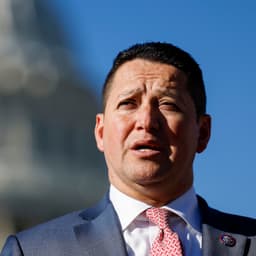
Oklahoma Senator Markwayne Mullin begins the confirmation process today to become the next homeland-security secretary. The Atlantic’s Nick Miroff discusses what Mullin might do with large warehouses the administration purchased to convert into megajails.
Cuba is dealing with a major economic crisis and the failure of its antiquated power grid. Carmen Sesin of NBC News joins to discuss what life is like for some Cubans day to day.
Plus, why teens are suing Elon Musk’s xAI, the House Oversight Committee officially subpoenaed Attorney General Pam Bondi, and how spas and gyms took over traditional retail space.
Today’s episode was hosted by Cecilia Lei.
Hosts & Guests


Transcript
Good morning, Israel kills Iranian officials in a major blow to the country's leadership.
But the Wall Street Journal explains why an uprising remains unlikely, at least for
now.
The government has made it very clear that if anyone takes to the streets during the war,
they will face intense violence.
Trump's pick to run Homeland Security faces the Senate.
The Atlantic looks at a major challenge coming his way.
And what happened when all the lights went out in Cuba?
It's Wednesday, March 18th.
I'm Cecilia Lay.
And I'm Gideon Resnick.
This is Apple News today.
Iran suffered major losses at the top yesterday.
After Israel killed the leader of the country's volunteer paramilitary group, as well as
its security chief, a man described by Reuters as Iran's ultimate backroom power broker.
The country's intelligence minister was also reportedly killed overnight, and Iran retaliated
with strikes that killed at least two people in Israel.
The deaths of these officials raise more questions over who is making the decisions on Iran's
war behind the scenes, as the world waits for its new supreme leader to make his first
public appearance.
Since the start of the war, Israel has strategically targeted the regime's senior decision makers.
Some say their aim is to destabilize the very top, in the hopes of stoking a revolution
from below.
We are ready for this.
In the end, Iran is going to die, and this is not going to happen.
Announcing the strikes yesterday, Israeli Prime Minister Benjamin Netanyahu said that his
military was undermining the regime to give Iranians the chance to take fate into their
own hands.
But despite heavy losses from U.S. and Israeli bombardment, Iran's new rulers are cracking
down on dissent.
That's manifesting itself in a variety of ways, including widespread arrests, but also
threats, making sure that people know that if they do rise up, they will be faced with
lethal force.
Margarita Stankadi is a foreign correspondent with the Wall Street Journal.
She's been reporting on how Iranians have been responding to the conflict.
On the very first day of the war, our people celebrating the killing of the late supreme
leader Ali Haminei, obviously many people were upset that he was killed, but there were
some public shows of celebrations, because some people were definitely happy that this
happened, and there was a lot of hope among opponents of the regime that this could be
the beginning of the end of the Islamic Republic.
We have not seen mass protests in the same way that we saw them in January.
Stankadi said that's partly because of the immense danger facing protesters, as strikes
continue to rain down on Iran.
And even if they could organize in those conditions, severe threats have been issued on mass.
The Islamic Revolutionary Guard, the kind of paramilitary force that is de facto in
charge with much of what's happened in day to day during the war in Iran, they sent messages
to Iranian mobile phone users saying that they will face violence like they did on January
8th.
So drawing a clear link between what may happen to them and what happened in January.
And we've also seen threats in television broadcasts, another revolutionary guard commander
saying that there's a shoot to kill order in place for anyone who rises up.
Internet blackouts in Iran largely remain, and the BBC reports that checkpoints have started
appearing in the capital to deter protests.
All of this undermines what the US and Israel had initially said it wanted to achieve, creating
the conditions inside the country that might fuel a popular uprising, and ultimately regime
change.
But Stankadi reports that the regime's crackdown is perhaps evidence of their stress
under bombardment.
I think the fact that the government is flexing its muscle and cracking down domestically
today doesn't mean that it hasn't weakened.
And I think a possible scenario is that if you week, if you monster even a year from now,
we will see another popular uprising.
So I think it does make a difference in terms of what's happening in the short term, but
in the long term, we may still see large scale popular demonstrations depending on what
happens.
Because the underlining populous content is there, and the regime is weakened.
You can find more coverage in the Apple News app.
Cecilia has more news coming up next.
The man poised to take on one of the most powerful jobs in Washington heads to the Senate
today for confirmation hearings.
McWayne Mullin and Oklahoma Senator is President Trump's pick to replace Christy
Nome as head of the Department of Homeland Security.
It's expected to be a straightforward confirmation process, but what comes next is a different
story.
It's a job with sprawling responsibilities and historically large budget, and as of late,
it's been mired by controversies.
Even some Republicans have characterized DHS as having major problems.
Nick Meroff covers the department for the Atlantic.
He says a lot is writing on Mullin's appointment.
It's really an open question as to if he has some kind of idea to take DHS in a different
direction, or how he might run the department differently from Christy Nome and her team.
Meroff said that Mullin is a strong proponent of the MAGA agenda, so we shouldn't expect
big policy changes at least to begin with.
President Trump, who was looking to replace Christy Nome with someone I think that he believed
he could trust to have been a loyal defender of his, who has been outspoken on some of
the Homeland Security issues, like the border wall, like defending ICE agents for the course
of the last several months, amid various controversies.
Right out of the gates, Mullin will face big questions about the future of immigration
enforcement tactics, the disaster relief agency FEMA, and how he will fill the leadership
void left by Nome's sudden departure.
And of course, DHS hasn't been functioning properly for weeks, it's been shut down
until the two parties can agree on some reforms for immigration enforcement tactics.
Meroff has been looking into the issue of immigration as Mullin prepares to step into
his new role.
In particular, he reports on the administration's plans to spend $38 billion to make over
the nation's detention system by converting warehouses into large-scale immigrant holding
centers.
This moment of transition could also provide a chance for some reflection as to how this
all might work.
There's an expectation that there's going to be a pause now, that things have been kind
of going off the rails, and that the arrival of a new secretary is an opportunity for
a reset, and particularly to try to do some of the groundwork that wasn't done in advance
to get local jurisdictions, get them on board with ISIS re-engineering plan.
Obviously building new detention centers are a key component of the administration's
plan to detain and deport millions of people.
Upon confirmation, Mullin will oversee the largest expansion of U.S. immigrant detention
in generations.
But it's no small task to retrofit warehouses that were built for storing products and
to centers to house people.
The strategy has also run into opposition from some Republican lawmakers who have said
that the rapid build-up would strain resources in their jurisdictions.
Miraf said the warehouses purchases came quickly after the White House pressed DHS on its
promised detention capacity.
ICE has really just went out and bought these 11 warehouses, in some cases, at above
market rates, creating a lot of doubt and uncertainty and raising a lot of questions
in these local jurisdictions.
What is the government doing in my county, right, in my backyard?
And as Miraf notes, the questions over DHS' management and contracts were a key part
of why Nome was fired.
It's worth pointing out that all of this is occurring basically under a cloud of suspicion
around the way DHS contracts have been awarded.
Let's keep in mind that when Kristi Nome really got in trouble with the White House, really
kind of like the last straw for her were these questions from Republican senators about
Nome's media contracts, you know, spending on this glitzy ad campaign with her as the
star in addition to her plans to acquire these jets.
The future of the warehouse contracts will come down in part to how Mullin wants to handle
it.
Miraf said that he might give his fellow senators what is often a safe answer in confirmation
hearings.
I don't know yet.
Cuba was plunged into darkness this week after its entire electric grid collapsed, leaving
10 million people without power.
Cubans were out on the streets Monday night in darkness, hitting pots and pans in protest.
The island nation is facing its biggest crisis in decades after Trump effectively cut its
people off from its main energy source, Venezuelan oil.
Speaking to rotors, one man described a situation of total scarcity.
It's not just a blackout.
There is no water, no electricity, no gas.
There is no water because there is no electricity to run the pumps.
There is no electricity, no food, no oil, no fuel.
All of this is really very bad.
Let's say that Cuba's electricity is coming back gradually, but their crisis remains acute.
This week, Trump has raised the prospect of, quote, taking Cuba in some form without explaining
what that actually means.
Yesterday, Secretary of State Marco Rubio, whose family has roots on the island, said the
country needed a new leader.
The bottom line is, the economy doesn't work.
It's a non-functional economy.
It's an economy that has survived on subsidies.
From the Soviet Union and now from Venezuela, they don't get subsidies anymore, so there
in a lot of trouble.
Kermans has seen rights for NBC News and has been reporting on Cuba's crises in recent
days.
Cuba's electrical system is very old.
It's very outdated, and it needs a lot of work to keep it going.
Because of the embargo, because of the shortages they have and the lack of money, they find
it hard to keep the system going.
On top of that, it requires oil.
They're oil-fired plants.
So with the lack of fuel, that's been going on for years, but even more so now, with
the oil blockade, they just don't have enough oil to fire up their power plants and give
power to people.
Sassin told us her colleague, based in Cuba, spoke to one 33-year-old man who lives in
Havana with his wife and two children.
He's in construction, but told NBC the work is inconsistent.
Sometimes his income is $40 a month, and sometimes it's $0.
That means he's not able to afford groceries.
So he resorts to buying staples like rice and beans from neighbors.
Inconsistent power makes it that much harder to plan.
And yes, sometimes it's at 2 o'clock in the morning when the power comes on, and then
he and his wife have to scramble, get out of bed, charge their phones immediately, start
cooking because they don't know when the power is going to go out again.
And obviously, they can't keep anything in the refrigerator because it'll go bad.
It'll go bad in just a few hours after the power going out.
Here this week, Havana announced some reforms to open up the national economy, allowing
Cubans living abroad to invest and take a stake in private companies on the island.
Rebeo described that change as not dramatic enough.
And finally, a few other stories we're following.
Three families with teenagers are suing Elon Musk's XAI over explicit images generated
by Groc, the company's chatbot.
Police informed the families that a man was arrested for taking photos of minors and
using an unnamed app to remove their clothing and manipulate the images to make them sexually
suggestive.
Lawyers for the family say that if XAI hadn't licensed its technology to app makers, this
harmful content would have never existed.
They also accuse Musk in the company of deliberately designing Groc to make money off of sexually
explicit content.
From late December 2025 to January 2026, a research group estimated Groc generated around 3 million
sexualized images, about 23,000 of them depicted children.
In the past, Musk has defended what is known as Groc's spicy mode, calling it a business
decision.
The family is seeking damages for emotional distress caused by the images.
The House Oversight Committee yesterday officially subpoenaed Attorney General Pam Bondi to testify
on the Epstein files.
Republican Nancy Mace of South Carolina introduces subpoena, saying it's unclear whether the
DOJ has released all documents required by a recently passed law mandating their disclosure.
In a statement, the DOJ called the subpoena unnecessary and that the lawmakers have been
invited to review unredacted files at the Justice Department.
The Hill News site notes congressional subpoenas are compulsory and carry the risk of a criminal
referral if they are ignored.
And finally, are you an online shopper or someone who likes to browse in person?
For the traditionalists out there, you might be in for a little disappointment next time you
head out.
The Wall Street Journal reports the US now has more spas, gyms, and other service-oriented
businesses taking up retail space than actual stores where you buy things.
For the first time ever, service-based tenants leased a little over half of the total retail
square footage in 2025 according to the data firm CoStar.
The owner of One Boxing Gym celebrated the change telling the journal that this is the
new happy hour.
That is, if you don't get knocked out in the ring.
You can find all these stories and more in the Apple News app, and if you're already
listening in the news app right now, we've got a narrated article coming up next.
The Atlantic explores what the human body goes through when it's struck by lightning and
why it can be excruciating for some but metaphysically transformative for others.
If you're listening in the podcast app, follow Apple News Plus narrated to find that
story, and I'll be back with the news tomorrow.