About this episode
Get every episode summarized
Each time News at One publishes, we email you a written briefing from the transcript — the topics, who appeared, and any specific claims, with the ad reads skipped.
Email me new episodesFree for 3 shows. No card needed.
Hosts & guests
Transcript ready
73 searchable segments. Every word is indexed and playable.
Full transcript
News at One — Israeli authorities using access to water against Palestinians. Machine-transcribed; use the interactive transcript above to jump the player to any line.
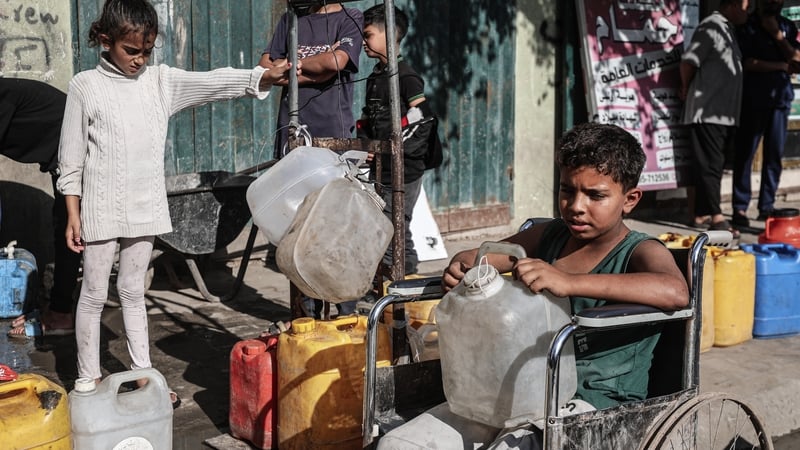
The Israeli authorities have used access to water against Palestinians, systematically depriving people in Gaza of water in a campaign of collective punishment. That's according to a report published today by Med San San Frontier. MSF is asking the Israeli authorities to restore water in Gaza to the required level. Claire San Filippo is emergency manager with MSF and she joins us now on the line. Claire San Filippo, thank you for being with us this afternoon. Will you explain the situation as you see it? Thanks for having me, absolutely, and unfortunately, the situation is very grim. The Israeli authorities know that without water, lifehands, and in Gaza, they have used access to water as a weapon to collectively punish Palestinians. This is happening alongside the killing of civilians, the obliteration of the health
care system, as well as the flattening of infrastructure, including homes and forced displacement of the population. So what we're seeing is that the denial of access to water creates destructive conditions of life. And this is an integral part of the ongoing genocide in Gaza. And when you say the denial of access to water, I mean, is that an inevitable consequence of widespread bombing? Or do you believe that the destruction of water infrastructure that it was more targeted than that? So what we've seen is definitely a systematic destruction and damaging of water infrastructure in Gaza, according to the UN today, nearly 90% of the water and sanitation infrastructure has been either damaged or destroyed. This includes disillination plants, boreholes, pipelines, and sewage systems.
Palestinians have been injured, they've been killed whilst they were trying to get water and it cannot stop thinking about what Hanan, a Palestinian woman in Gaza City, told us she said, getting water is not supposed to be dangerous. It's not supposed to be dangerous. And yet a ten-year-old grandson was killed last July when he was standing in line with other children waiting for water. So we've seen this destruction, but we've also seen that the Israeli authorities have consistently blocked essential water related supplies from entering into the Gaza Strip. They've also blocked and limited access to non-governmental organisations to provide water to the population in need safely. Have you put all of this to Israel? Absolutely. We have done this repeatedly and unfortunately for now, you know, without consequences,
we've obviously called the Israeli authorities, as you said, to immediately restore water to the people to the required level in the Gaza Strip, but also to allow humanitarian access at scale, including allowing material that is related to water and the sanitation. What we see on a daily basis at doctors without borders is the dramatic or the dramatic consequences for Palestinians of this denial of water. We're talking about hygiene and the lack of accessible clean water, soap, diapers, menstrual hygiene products that make the life of people extremely difficult impact their hygiene, but also their dignity. And we're also seeing the health consequences as the lack of water combined with the dire
living conditions, extreme overcrowding, intense and the collapse health system create really a perfect storm for the spread of diseases. So we see in our consultations a lot of patients with skin diseases, with gastrointestinal diseases, including diarrhea, and that's very dangerous for children and pregnant women. And we also see, and that's something people maybe think of less, you know, but the crushing impact on people psychologically are mental health teams here again and again, that the lack of autism, major source of suffering of Palestinians and sometimes for some it drives despair so deep that it leads to societal thoughts. So that's really, you know, the strong message that that we have. And as a Palestinian said, we need water. It does not make sense. It's like we're asking the world for the essential of life. So what we are asking as MSF is to immediately restore water for people and to allow humanitarian
access for international organizations to respond to the catastrophic needs in the Gaza strip. As you mentioned that, I know that MSF has had a strange relationship with Israel. Are you currently able to work inside Gaza? We continue to work inside Gaza under our registration with the Palestinian authorities. Unfortunately, at the end of last year, we have lost our registration with the Israeli authorities. So we continue to work with our Palestinian colleagues only in the occupied territory and with support from international stuff remotely. And it is very difficult to work as the Israeli authorities have blocked systematically. The arrival of supply within the strip in a context again, where the humanitarian situation
is nothing short of catastrophic because everywhere you look, you're overwhelmed by a sheer devastation and need. Claire Saint-Philippo of MSF, thanks for talking to us this afternoon.
More episodes
More from News at One

Roscommon defeated Galway in the Nestor Cup becoming Connacht Champions for the...
News at One
Medical Board at UHL said it needs emergency funding to deal with patient safety...
News at One
Humanitarian assistance to be provided to all affected by the fire at the Tycor...
News at One

Director of the National Ambulance Service on the impact of industrial action on...
News at One