About this episode
Jordan Baker said it best: “Life starts all over again when it gets crisp in the fall.”
In just one short sentence, the character in F. Scott Fitzgerald’s “The Great Gatsby” sums up that wonderful feeling of anticipation that comes with autumn. For bookish people, the season comes with its own set of expectations; some of the year’s biggest books are released in September and October. On this episode of the “Book Review” podcast, Joumana Khatib and MJ Franklin join our host, Gilbert Cruz, to go over some of the titles they’re most looking forward to.
Books discussed on this episode:
- “The Disappearers,” by Marlon James
- “The Radiance,” by Ayad Akhtar
- “American Scoundrel: Roy Cohn’s Dark Journey From Joe McCarthy to Donald Trump,” by Kai Bird and Susan Goldmark
- “Switzy,” by Emma Cline
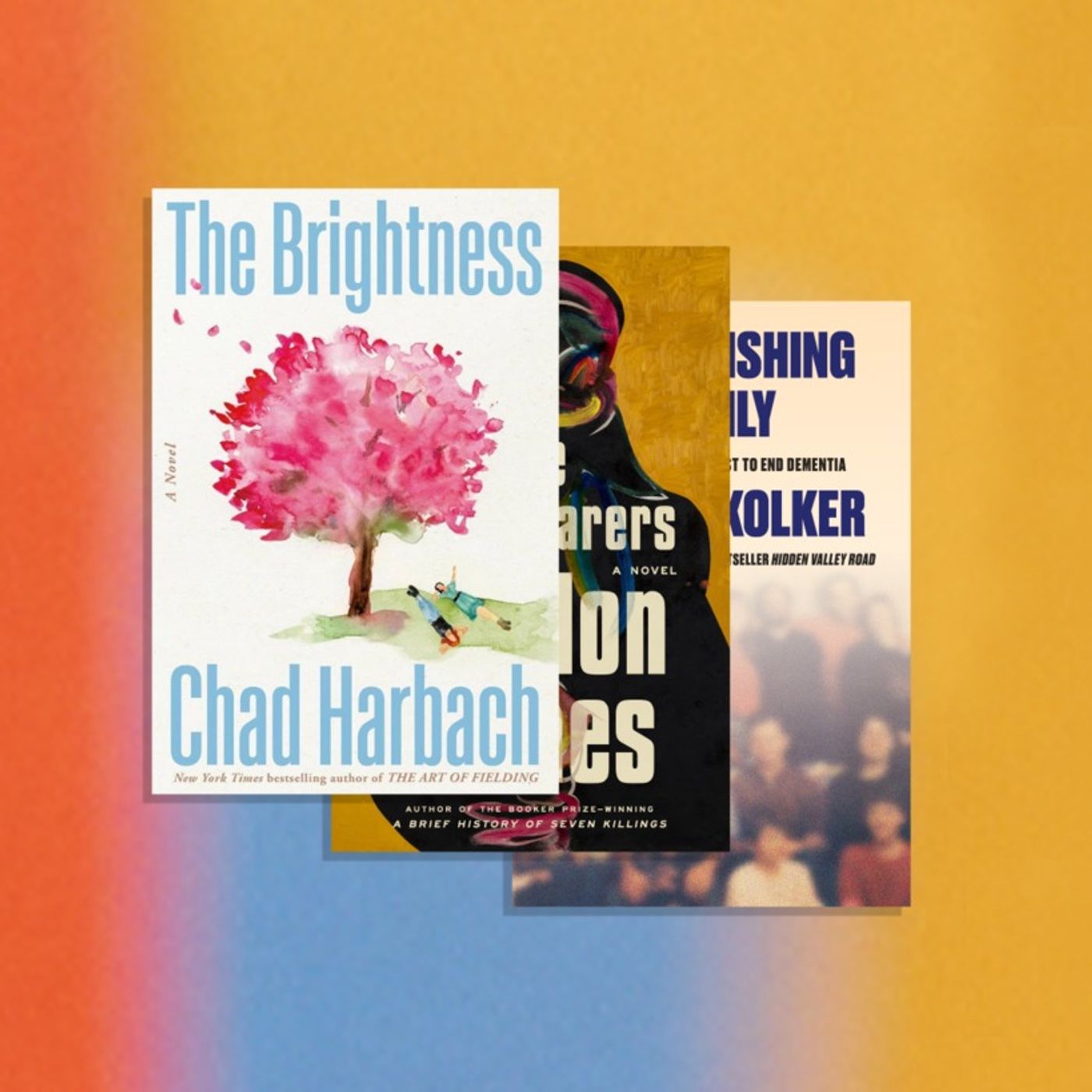
- “The Vanishing Family: Love, Fate, and the Quest to End Dementia,” by Robert Kolker
- “Dead Beat,” by Leigh Bardugo
- “American Hagwon,” by Min Jin Lee
- “Mazywood,” by Tananarive Due
- “Public Access Afterworld,” by Jane Schoenbrun
- “Other Worlds Than These,” by Stephen King and Peter Straub
- “Partita,” by Barbara Kingsolver
- “Music Against the Night,” by Yiyun Li
- “The Rush: California Gold, the Civil War and the Making of the Modern World,” by Nathaniel Philbrick
- “The Occidental Book of the Dead,” by T. Geronimo Johnson
- “The Brightness,” by Chad Harbach
- “Stations,” by Louise Kennedy
- “On the Calculation of Volume (Book V),” by Solvej Balle
- “Dodge City,” by Patrick DeWitt
- “Under Story,” by Chloe Benjamin
- “Our Noble Selves,” by Kate Atkinson
- “Taipei Story,” by R.F. Kuang
- “Exit Party,” by Emily St. John Mandel
- “Ply,” by Hernan Diaz
- “Hollywood, Ending,” by John Green
- “No Land to Stand On: Notes From Detention,” by Mahmoud Khalil
- “Life Out of Order,” by Audrey Niffenegger
- “Every Story Is a Love Story,” by Imbolo Mbue
- “Peck & Peck,” by Bonnie Garmus
- “A Court of Splintered Harmony,” by Sarah J. Maas
- “Take My Word for It,” by LeVar Burton
- “Promise Me, America,” by Joe Biden
Listen to and Follow ‘The Book Review’
Apple Podcasts | Spotify | Amazon Music | YouTube | iHeartRadio
Unlock full access to New York Times podcasts and explore everything from politics to pop culture. Subscribe today at nytimes.com/podcasts or on Apple Podcasts and Spotify.
We Want to Hear From You
We would love to hear your thoughts about this episode, and about the Book Review’s podcast in general. You can send them to [email protected].
Credits
The “Book Review” podcast is hosted by Gilbert Cruz and produced by Amy Pearl, Sarah Diamond and Patricia Sulbarán. The show is mixed by Pedro Rosado.
Special thanks to MJ Franklin, Dahlia Haddad and Brooke Minters.
Subscribe today at nytimes.com/podcasts or on Apple Podcasts and Spotify. You can also subscribe via your favorite podcast app here https://www.nytimes.com/activate-access/audio?source=podcatcher. For more podcasts and narrated articles, download The New York Times app at nytimes.com/app.
Hosted by Simplecast, an AdsWizz company. See pcm.adswizz.com for information about our collection and use of personal data for advertising.
Get every episode summarized
Each time The Book Review publishes, we email you a written briefing from the transcript — the topics, who appeared, and any specific claims, with the ad reads skipped.
Email me new episodesFree for 3 shows. No card needed.
Hosts & guests

Transcript ready
414 searchable segments. Every word is indexed and playable.
Full transcript
The Book Review — It’s Time for a Big Ol’ Fall Book Preview. Machine-transcribed; use the interactive transcript above to jump the player to any line.
If you're a parent of a teen or have teens in your life, it can be hard to figure out the right way to approach social media and technology. Ultimately, if you feel like your teens are ready, there are tools to help. Instagram teen accounts have automatic protections for what your teens see and who can contact them, plus time management tools like daily time limits and sleep mode. An Instagram will continue adding built-in safety features to help create age-appropriate experiences. Learn more about teen accounts and Instagram's ongoing work to protect teens online at Instagram.com slash teen accounts. That's Instagram.com slash teen accounts. I'm Gilbert Cruz and this is the book review. Okay, these are my seasons ranked in reverse order. These are specific to me. I live in the northeast. Please do not write in. Please do not quibble. Please do not argue. Number 4. Summer. The worst. I've said it before on this podcast. Summer is the worst. I like vacations. I hate the heats. This is undeniable.
Number 3. Spring. You get that magical feeling in the air. Oh, the season's going to turn. This is great. You know what else you get? Allergies. The worst. Number 2. Now we're cooking. Winter. You have sweaters. You have the holidays. You have hot cocoa. It's cold. Yes. That is annoying, but sweaters. Refer to my previous statement. Number 1. It's possible that you guessed it. Given where we are in the calendar, fall is the absolute best season. I will quote a book titled The Great Gatsby, which says life starts all over again when it gets crisp in the fall. And crisp air or not, there are fewer bugs. There are apple cider doughnuts and lots of books. Fall book season is here. When many publishers just flood the zone with books, and I'm here with two of my favorite guests to talk about, fall book seasons, Shubana Katee. Welcome back. I, Gilbert, for once, I don't disagree with anything you just said. For once, possibly the only time. MJ Franklin, you know him. He is the host of our monthly book club discussion. MJ, welcome back. Thank you for having me. I do disagree. However, I did love inclusion of a quote. I love a quote.
You do love a quote. Sound back on board. Thank you very much. That was, that was a take. All right. We're going to talk about books that are coming out in September, October, November. We're going to do a lightning round at the end because there are so many which just cannot fit them all in. But first I want to go big picture. MJ and Shubana, as you both know, having worked at the book review for many years, fall book season is always a big deal. However, it feels like this fall is a little bit bigger than falls that we've had over the past few years. It's a lot bigger. Both in terms of the number of huge returning authors and literally bigger. Every book seems giant. Every book seems above 500 pages. It's a lot to read. It's exciting though. It is exciting. And the summer season is always a little slow and to pull back the curtain a little bit working at the book review means you spend a little bit of that time getting ready for the fall reading ahead some of these big books. Oh, yeah. I mean, one of my fondest beach days was spent reading a book coming out in November that I will tell you about towards the end of this podcast.
I also feel just with this job like Billy Pogrum unstuck in time. I'm like living in one season reading for another like it's very confusing where we are at any given point. The wonderful thing is it's not going to be confusing for listeners. We're going to hold your hand. We're going to walk you through the next several months. And we are going to talk about a bunch of books that we are excited for. I will start talk about a big book and an exciting book in September. Marlon James is back with his book The Disappearers. It's his big return to literary fiction. You may remember Marlon James from his book. A brief history of Southern killings, which won the booker prize in 2015. After that, he started this fantasy series. Three books all covering the same story, but told from a different perspective. Now he's back to literary fiction. And this is a literal big book. I think it's around 600 pages. It's an epic. The cover is about 20 years. It's told in eight sections, but at the center there is a horrific gay bashing in Kingston. And then afterward the victims start to disappear.
The question is, why are they disappearing? Where are they disappearing to? What happens to those who remain? The book is brilliant. It's tackling ideas of justice and moving on. And what does revenge look like? This is a revenge novel. Marlon James is also so smart. It's dense with illusions. Other books, plays, movies, a lot of music. This is a tough challenging book, but it's also I think brilliant. It is so good. That is The Disappearers by Marlon James. Okay, I have a weird slim, totally worthwhile book. This is called The Radiance by Iad Aqatar. If you're a reader, you probably know him for Homeland Elegy, which is one of the book reviews 10 best books of the year in 2020. He's also a really decorated playwright. He's a Pulitzer Prize winner. His work deals a lot with American identity draws on his background, his experience growing up with Muslim heritage. And he's just one of the most like cerebral, but like with force behind his writing.
Like he is a brain, but there's real action there. This is a weird book. I love it. It's okay. So it's it's auto fictional. Stay with me here. It follows a character who is a writer named Iad Aqatar, who moves from New York City to the Hudson Valley during the pandemic. He gets a adjunct teaching job at this small college where he has a friend who's a professor and he decides to set up a course called discoveries in auto fiction or something like that. So you can sense right from the jump that he is positioning himself to write a campus novel, something that's waiting into the cultural debates of the time. And then all of a sudden the character Iad Aqatar is writing his bike and he gets clipped by a pickup truck. And it's a really debilitating injury. He's briefly comatose. And when he awakes, he finds that his entire existence and like window onto life is draped in this sort of, I mean, it's the radiance of the title.
It's sort of this ethereal shimmering kind of veil over his perception. And he finds that he's more compassionate. He is sort of moved to tears more easily. His sex drive is almost on existence. Although I would argue that it's sublimated, but that's something for another podcast. And he begins to think like, oh my gosh, I think maybe this was a racially motivated accident by the guy who hit me on the bike. And then there's this like crisis on campus with a student. It's disturbing and it's very quick silver. And I loved it. Great ending also great madming ending. You mentioned several words that I think might be intimidating to readers. Auto fictional. Yeah, weird. Yeah. It sounds abstract. But what I want to stress is that this book has a sense of humor to it. He delivers everything almost like with a wink. It is weird. It is abstraction. It's just a fictional, but like he knows you know he knows like there's something about the the sensibility of this book that feels playful and mischievous and the opposite of intimidating even as it deals with these had his subjects.
I think that's totally right. Like he really is so obviously having fun. And I think that this is a book that's almost prismatic where it's like if you read it in your in one frame of mind, something will stick out at you. If you come back to it again, something else will strike you. That's what I like about it. I mean, it feels very alive and very like fertile in that way. So that was the radiance by I add actor. I am here to talk about American scoundrel by high bird and Susan Goldmark. Oh, that's to do with New York City history. A little bit, a little bit. I'm sorry I could only be me. Actually, I'm not going to apologize for that. Yeah, don't apologize for being you know, but there's no other Gilbert on earth. Say that again. Are you going to say that in the mirror? Every morning now. This is a book about Roy Cone and Roy Cone. Yes. Is a figure of ill repute now in New York City history, but he also is someone who was fairly relevant in mid century America.
He is most well known now, I think for being one of Donald Trump's early mentors. When now present Donald Trump was working with his father in real estate in New York in the early 70s, got to know Roy Cone. And he liked Roy Cone because Roy Cone was someone who got his way and he got his way through often nefarious means. You could trace his lineage back to being a lawyer for Senator McCarthy during the communist witch hunt in the 50s. He helped prosecute the Rosenbergs in the early 50s. If you are an artsy person who loves theater, you might know Roy Cone's name because he is a character in angels in America, the Tony Kushner play. And he is an incredibly dark influence. Some would argue. I think Kybird would argue this on modern American history. Which is why it's important to read about him. Kybird is also interesting because he was the co author of American Prometheus. It was the Pulitzer winning biography that eventually got adapted into the movie Oppenheimer, which won all those awards a couple years ago.
He wrote that book with Martin Sherwin who is since passed away and he has written this book with his wife Susan Goldmark. I'm interested in this. I'm interested because of villains. And I think Roy Cone is someone we can characterize as a villain are interesting to read about. This sounds like the opposite of an MJ book. It sounds like a dense biography. I don't read a ton of biographies. That's for no reason other than. You can only be you. I can only be me. I think someone said that one's that said this sounds so good. I cannot wait to read this. That's American scoundrel Roy Cone's dark journey from Joe McCarthy to Donald Trump by Kybird and Susan Goldmark. I have another one. It's Switzerland by Emma Klein. You may know Emma Klein from books like The Girls That Was Her debut novel or the guest, which was a big summer hit in 2023. That was about a woman who was scamming her way through the Hamptons. Switzerland is a huge pivot. This book follows man at the end of his life. He has what seems to be dementia or some type of Alzheimer's and he is traveling to Switzerland.
Switzerland, Switzerland, to do dignitas that's assisted dying. He wants to end his life on his own terms. As he's traveling, he's thinking about his life. He's thinking about his career. He's thinking about his daughter and his family. And he's thinking about a huge friendship that really haunts him in his life. This book is a farewell tour of sorts. However, it doesn't feel like dour. It doesn't feel unduly depressing. It feels existential and meditative. It's about what do you do when you know that the end is near? How do you look back on your life and make peace with it? There's a fascinating sense of alienation here. This man is almost like a living ghost. He knows that he's ending his life. He may or may not have told other people in his life. And you're just watching him navigate the living with this knowledge of what's about to happen. It's intense. It's great. I think I read it basically in one sitting. I also have aging men with money in my life. I've made choices and not-
I have many questions. They can only beat themselves. There were moments where I had to put the book down where I was like, oh my god, I can just see this happening. I cannot. This is looking into the future in a way that I am perhaps not fully prepared for. It's definitely my favorite book of Emma Clients. I was really taken aback by the emotional residents of it. But there's also some levity. There's a bathtub scene in there that's amazing. I was picturing my favorite hotel at Bar and London where this was happening. It was thought provoking. It was very glad to have read it. Especially after a book like The Gast, the deep earnestness of this book really stands out in a way that I think will connect with readers. And time will tell because the book comes out in September. So soon. But that book is Switzerland by Emma Clients. MJ, you mentioned that the main character in Switzerland might have something that appears to be dementia. The next book that I want to talk about the vanishing family by Robert Kolker is also about dementia. Do you know, do you guys know Robert Kolker, the journalist he finds the most amazing stories. So his last book Hidden Valley Road, which was one of the book reviews, top 10 books of 2020 was about this family. There are 12 kids in the family.
And half of them end up getting diagnosed with schizophrenia. And he follows this family and talked to as many of them as he can here. Another large family. There are nine kids. And they find themselves dealing with what appears to be a genetic predisposition towards dementia. And it's another story about health and family and sickness and the ways in which families can make people the same and also very different. It's just incredible. The stories that he can find very much looking forward to this one despite it's somewhat depressing topic that is the vanishing family by Robert Kolker. I have a radically different type of book. This is Deadbeat by Lee Bardugo. How do you feel about ghosts? I love him. So Deadbeat is the third and final book in Lee Bardugo's Ninth House trilogy. That is a trilogy about a young woman who can see ghosts as she gets inducted into the secret society at Yale where there are all of these like magic houses and all of its stuff. She's in the ninth house.
And I don't know much about this book yet because it is kept under lock and key. I'm so deeply looking forward to this one. I have a story. So during the pandemic, I got sick with COVID and I'm locked down. I'm hibernating. And to keep me company during that time, I am reading Ninth House, the first book in the series. And at one point, my husband comes in and he's like, MJ, you are being very quiet. Is there anything unique? Can I get you anything? And I was like, yes, get me the second book. And then he goes and gets the second book and I marathon read that one. The books are so immersive and there's so much mystery and intrigue and magic. There are trips to hell. There are like demons. It's, it's crazy. And it's been a few years since the second book. And I want to know what happens in the end. I'm so excited for this one. That sounds amazing. I had. We had Lee Bardugo on the podcast a few years ago when she did a one off service standalone that wasn't related to this. And all I wanted to ask her is like, why are you writing that one instead of writing with another one?
A question that I'm sure authors love. I didn't ask that question. I am a professional. I am a nice person. That is deadbeat by Lee Bardugo. Okay, I have another very exciting follow up. I think people are going to be very jazzed about this. This is a big one. It's a big one. I think it is a book from an author that people have been thirsting to hear from. This is American Hague one by none other than Minjin Lee of Pachinko fame. Minjin Lee is back. Minjin Lee is back. It's was when I was sort of preparing for this podcast. I didn't really remember that it has been almost 10 years since Pachinko was published. Wait, really? 2017 is when that book came out, but I feel like it has just never left our consciousness. That book followed a family of ethnic Koreans first in Japanese occupied Korea in the early 20th century. Then in Japan itself, it's a really twisty history and people just love it. People love the way that Minjin Lee writes and this backstory and her immersive tendencies.
And it's just, yeah, I've never seen a book take off quite like that. So this is similar. First of all, it might be helpful to know what a Hague one is. A Hague one is I think a South Korean phenomenon. They're these sort of private cram schools for students to take like supplementary classes in English and Korean and math to prepare for South Korea's college missions exam, which are they sound totally onerous and it's become a sort of runaway phenomenon. Okay, but just have that in mind. So this follows one family, the co family and they go from Seoul to Sydney to Southern California. I don't really want to spoil much more, but I think that all the hallmarks of Pachinko, the sort of sweeping multi generational, the sort of strands that pick up the family betrayal, the love, the existential questions.
Like how can we retain our humanity in the face of history? It's all there. So I think people are going to be really into this one. My spiny sense has been pretty well developed over the last several years. So I don't know. I'll be curious to see what kind of sticking power this story has in the sort of public imagination. This is tricky. When I guess it's tricky for all of these authors that they have beloved books that have come previously, which means anticipation is high. It's always interesting to see how authors follow up giant books. I can't even imagine following up at Chinko. I just can't. There's still a lot of affection for her. I think you're right. There's an Apple TV adaptation of years ago. I think that also sort of brought people back to the book who hadn't thought about it in a while. Yeah. I also would love to see people go back to Minjin Lee's like debut book free food for millionaires, totally different than Pachinko, totally different than American hagwan. And I don't feel like for somebody who is as beloved as she is, people are really looking at her back catalog and there's no excuse because she only has two published books so far.
That's right. The back catalog is a catalog. I love the back catalog. Yeah. Okay. All right, readers, you have your homework. But in the meantime, this is American hagwan by Minjin Lee. Pencils. I can you believe we're still in September? September is a huge month for this is what I'm saying. It is a big fall. It is bigger than most. The book I have is Maze Wood by Tanana Rievedu. If you don't know Tanana Rievedu, no Tanana Rievedu, she is horror royalty. She's been working for years and years and years, but her previous book The Reformatory was particularly like a big breakout. That was like if you get Nicoboy's matched with ghosts, it was inspired by that same school, the Dozer school in Florida, where a bunch of black boys were murdered. This is her latest and it is also a horror story and it's a multi-generational sweeping story. It opens in the 1920s with a black child actress, Mazeel. She and her family are trying to make it in Hollywood, but they are stymied by racism.
They're given these degrading roles, they're pigeon-hold, and then one day Mazeel stumbles on a magical wishing well as every story has, wishes for a friend, and shortly thereafter she stumbles on scouts. The strange dog that seems to be able to read her mind and closely follows her commands and her inner wishes and with scouts they are able to make it in Hollywood. They have this act that just kind of takes off. I don't want to spoil more. Plop, plop, plop, plop, and then scout disappears. Flash forward to Mazeel's grandson. He's visiting Mazeel's mountain estate with his family, and they arrive and they quickly learn that there are some type of monster that is stalking the grounds and it's angry, and I don't want to say more. But this book has everything. It has a historical sweep, a commentary on racism and the Hollywood industry and the movie industry, and it has monsters.
I'm in to state the obvious, MJ. Thank you for talking about this one. Again, that is Mazeel's word by T'Nan'a Reef-Due. MJ, talking about a spooky book is a great transition into October. After the break, we'll have more books. If you're a parent of a teen or have teens in your life, it can be hard to figure out the right way to approach social media and technology. Ultimately, if you feel like your teens are ready, there are tools to help. Instagram teen accounts have automatic protections for what your teens see and who can contact them, plus time management tools like daily time limits and sleep mode. An Instagram will continue adding built-in safety features to help create age-appropriate experiences. Learn more about teen accounts and Instagram's ongoing work to protect teens online at Instagram.com slash teen accounts. This message is brought to you by AppleCard, shave ice by the beach, a trip to the state fair, and a throwback flick at the local drive-in.
There are more than just items to check off the summer bucket list. There are also opportunities to earn 2% daily cash back when you use your AppleCard with Apple Pay. Apply for AppleCard now and use in minutes with Apple Pay. Subject to credit approval. AppleCard is issued by Goldman Sachs Bank USA Salt Lake City Branch. Terms and more at AppleCard.com. This podcast is supported by Britbox streaming a new twist on Agatha Christie's Tommy and Tuppens. These two ex-lovers have a curious knack for solving murders and a romantic history that makes working together rather complicated. As Tommy and Tuppens flirt with danger, follow and clues, chasing suspects, and getting quite good at this detective business. Every clue brings them closer. Agatha Christie's Tommy and Tuppens, streaming September 15th, only on Britbox. Watch with a free trial at Britbox.com. Okay, now we're moving into October. This is Halloween Month. It might very well be my favorite month. Cardigans abound. Do we have at least one other creepy semi-creepy book to talk about?
Yeah. What do you got? Okay, this is called Public Access After World by Jane Shownbrun. The author is a filmmaker and this is their debut. As soon as I read the description of this, I was like, oh, I'm so in. I don't really read a ton of horror. I mean, now that I've read Stephen Graham's, I'm like, okay, maybe I can see this, but really, I'm not reading a lot of horror. Okay, however, the conceit of this is really interesting. So it's this sort of like, kind of David Lynchy. It's basically about this pirate TV station that's broadcasting possibly from another dimension. And the novel follows various characters who encounter this station and then face these devastating and mysterious consequences. So a weatherman kills himself on air, which made me think disclosure day, which is actually possibly my favorite movie of the year. Whoa. Yeah. Twist. I know. I've been a take.
You might be alone on that. Oh, I loved that movie. A girl and her friend are watching and then she disappears. And then there's like a content moderator who their entire job is to flag possibly inflammatory or violent or, you know, unsavory content and they get swept up into this world. It's just weird and creepy and unsettling. And Shone Brown is also a filmmaker who I think generally has a horror bent in their film work. I'm excited. It kind of reminded me of the only horror movie I think I've ever watched in theaters, which was white noise, which weirdly had Michael Keaton in it. I couldn't sleep for weeks. Was that where there's like a ghost in the radio? Yeah. Yeah. Got it. Jumana, you mentioned that Shone Brown is a filmmaker. They have a new movie out now called Teenage Sex and Death at Camp Myesma, which is one of the freaking best titles
that I've heard in ages. I'm very curious about that one. They also directed. I saw the TV low and we're all going to the world's fair. All of them are sort of about pop culture, TV, movies, nostalgia, how the things that you watch when you're young continue to affect you when they're later. Shone Brown is a trans filmmaker. They also, all of them are sort of thematically rife with questions about trans identity and how pop culture sort of plays into how you think about yourself and see yourself in the world. They're, I think they're extremely talented. The fact that they're also putting out a book like a month after they put out this movie is incredible. That in a very roundabout way was public access afterworld by Jane Shone Brown. We're speaking of horror. We're speaking of spooky things. I have to mention Stephen King. He has a new book titled Other Worlds Than These. He wrote it with Peter Straub. Stephen King, someone I've talked about on this podcast before, maybe. Have I ever talked about him?
Who knows? You've never mentioned it. Well, he has a new book. It seems like he has a new book every year. It's incredible that he still can produce essentially a book a year, a genuinely high caliber. This one is a weird mishmash. This is the third book in his Talisman series. That was a series that started in the mid 80s. It's also a book that is linked to an eight book series called The Dark Tower series that Stephen King has written. And those books are the most genre mishmash crossover things that I have ever come across. They're a little bit scary. They take place in sort of like an alternate Wild West. There's fantasy. There's science fiction. They're incredible. Should we just stop this and make this into a Dark Tower podcast right now? I'd be happy to do so. I'll show myself out. But this one is sort like brings those two universes together. The Talisman, the Dark Tower series. And I think anyone who's like been interested in the Stephen
King extended universe over these many decades will definitely be reading this one. That one is Other Worlds Than These by Stephen King and Peter Straub. I have a pivot from horror unless you consider an ex reaching out to you after 28 years. A horror story. That's so scary. I would think that I've ever heard. That inciting incident is the start of partita by Barbara King Solver. You may remember Barbara King Solver from a great number of books. She just publishes hit after hit after hit. But most recently she published Demon Copperhead, which came out in 2022 on the 2023 Pulitzer Prize. And just like it was everywhere. This is a different type of story. This is not a retelling. This is a coming of age story, a love story, a story of ambition and music and art. It opens with that aforementioned ex reaching out to our protagonist, a woman named Livia. She is living on this farm and you don't know much about her.
But you can tell that she's rattled by this call. Then the book flashes back to the past and you see Livia's youth. We go back to our college years. She's a music prodigy who made it out of her small farming community where she grew up. And now she's attending this very prestigious music conservatory. She's a fish out of water. She's struggling to fit in, but she's very, very talented. Then she meets Sigurd, a labor organizer who's visiting campus. She and this guy have this instant spark. That turns into this sweeping life changing career changing affair. The story juggles a lot, but it's Barbara King's solver. It's lush. The characters are rich and full of the scene work is immersive. This is a story to get lost in. If you love books like Heart the Lover by Lily King, I think you will love this one. This is partita by Barbara King's solver.
I actually have a book that is also about music centrally about music. This is a novel that's called Music Against the Night by Yee-enly. Yee-enly's last book was a memoir. Things in nature merely grow and that delved into the suicides of both of her sons, both of her children, and how she really picked herself up afterwards and carried on. It's unlike any other book that delves into grief that I've ever read and I read most of them that come my way. I know that that was a book that really resonated with readers. This is a novel. This is a historical novel. This is Music Against the Night and it picks up the real-life stories of two 18th century musicians who were totally new to me and like a jable. Double in the 18th century. Double musical history. Famously. Yeah, you know. And it's a love story. It's a creative partnership. It's just
ripe for I think novelistic treatment. So our principal characters are John Field who was an Irish prodigy. He's apparently credited with having created the nocturned form before some guy named Chopin just took it ran wild. And then we have Adelaide, Pérsérone, who was born in Pondicherry, which I think was under French colonial rule at the time. And she was mixed race and sort of not totally accepted by her family and she was orphaned. And so there's some like levels of astrangement there. Anyway, both of these children, as children, took real refuge in music. I think John's talent was discovered a little earlier than Adelaide's. Adelaide's took her to Paris and then Moscow, which is where she met John. And they embarked on a tempestuous and loving and complicated
marriage in real life. Anyway, she's a beautiful writer. She's so astute about kind of interior emotional states. And I just I really admire this. I think it's elegant and informative. And I learned something. And these are new to me historical figures that are totally worth your time and attention. I'm excited for this one because I also write things in nature merely grow and was completely gutted by it. And I've been curious, but she's going to do it to follow that up. Well, you will just have to read music against the night by ye and Lee. Lee and Lee is another Pulitzer winner. I think that book won the Pulitzer earlier this year. Heavy hitters and all star season. Heavy hitters. I'm going to come back in with another work of nonfiction. This in my opinion is a real dad book. And I say that with love and actually not to assign it or eliminate to any gender, it's sort of a state of mind rather than anything else is if you're interested in like history,
biographies, presidents, America, the Civil War, boats, you will like this one. I think you would down the dad book checklist. It's all in one book. Well, let me talk to you about it. This is called the rush California goal, the Civil War and the making of the modern world by Nathaniel Philbrick. The reason I brought up boats is because I think if you know Nathaniel Philbrick, you might know him best as the author of in the heart of the sea. This was a book that told the true story of the Essex, which was a real life whale ship that had an unfortunate run in with a whale in that true life story. And that true life story ended up inspiring Movedick, which is supposedly one of the great works of American fiction. I'm stuck on supposedly not Movedick catching strays. How many century? We can we can have a separate pod on that. He's a story and he's written about the Mayflower. He's written about so many books about George Washington, a couple books
about the American Revolution. He wrote about Custer and sitting bull. And now he's ready about the gold rush, the gold rush, which is we all know. And as we all remember happen in the late 1840s, when a bunch of people went to California after someone discovered a little pebble of gold in a town called Stutters Mill, we all learned this at school. Yes? I don't remember that. I was not born then. Really feel like you guys are just pew pew left and right. Well, if it isn't the consequences of my own action. I sewed and now I reap. So this book, The Rush, is about the California gold rush, but it's also about the early days of California, the attempts to sort of move it towards the Confederacy, perhaps as it was in the final stages of becoming a state. And how the gold rush and westward expansion just sort of related
to all the terrible things that happened later during the Civil War. Nathaniel Philbric, if you've read in the heart of the sea, you know, as the best narrative nonfiction historical writers can do, just puts you in a place with incredible detail. So that's The Rush, California gold, the Civil War and the making of the modern world by Nathaniel Philbric. Me next, I have another book. This is the Occidental Book of a Dad by T. Geronimo Johnson. And this one is really tricky to explain, which is why it's great. Okay. On the surface, it is about the fateful collision of two people, a black cop who grew up in a poor housing project in Atlanta. He made it out and now as a cop, he patrols his old neighborhood. And you also follow a white teenager and snared in crime in that same area. So the book juggles their two stories. Their two lives. They are each dealing with trials and tribulations trying to make it. And then they have
this fateful run in that changes everything. The thing that makes this book hard to explain is that it's extremely experimental with form. The novel opens with not what looks like a copyright page, but what looks like film credits. And then you get these two long isolated character portraits. And then the book jumps and then you get a script. At one point, the book resets. It seems like another book has started. The page count at the top of the book starts over. I've not finished this one. It's one though that I'm very, very eager to get back to because I love what I read. And you can tell that metafictional hijinks are a foot, but it's unpacking these really serious ideas about race and trauma and the disparate experiences of America. And that's what the form is trying to emulate. This is like if you took a racer by Proce of War Everett, mashed it with homey abitonus myth, mashed it with transcription by Bryn Learner. It's all over the
place. But those comps almost don't do it credit because T. Drona Mojonson has this sensibility of his own. I'm really, really excited for this one. You love to bring in an experimental work. I feel like I'm bringing very basic stuff here. And then you're like, here is a form-breaking novel about race and class in America. That is the accidental book of the dead by T. Drona Mojonson. Okay. All right. This is another highly anticipated long gestating sequel to a beloved novel, The Brightness by Chad Harbach. Chad Harbach being the author of The Art of Fielding, which was to be Frank everywhere. So this is actually pretty exciting because The Brightness, it's still in the universe that Harbach set up in The Art of Fielding. It's just sort of swiveling to look at a different swath of his characters. Well, the first one was actually kind of an amazing book about
baseball. This focuses more on the female perspective. One of our main characters is Pella, who we met in The Art of Fielding. Her father was the college president, also a Melville scholar. So he probably would like to read that Phil Brick book. But she's 27 now. She's sort of reckoning with her past. She's engaged to another character that we also met in The Art of Fielding, Mike Schwartz. I mean, it's going to be interesting to see how much crossover there is because I think the baseball writing was a huge draw for people in The Art of Fielding because he almost had this zen approach to it. And it's really great to find good athletic writing in fiction. That is less here. This is more in the sort of like big bustling like social coming of age novel, like Claire Masoud, like the Emperor's Children or something like that. I think people are going to
be delighted. So that is The Brightness by Chad Harbach. So somehow we've gotten through September in October. So many books. So many books from us. We said heavy hitters, big authors, award winners. I think we are going to talk about just a couple of November books. November is not infrequently a lighter month in the fall book season. And then we're going to move on to our very fast lightning round. I'm going to start in November by talking about a book that we have sort of talked about on this podcast before in April. Jermani, remember this because you were here. We devoted an entire episode to a series of novels written by the Danish author Solve Balla. Those novels are titled on the calculation of volume in April. Balla had just released the fourth volume. And these books are about a woman who lives the same day over and over again. And that's it. That's the basic story. She thinks a lot. She travels a lot throughout Europe.
She tries to figure out what is happening. Can I solve this problem? It's philosophical. Please listen to that episode. There are eventually going to be seven books. And we're going to see the fifth one coming out this November. It's coming out on November 17th, which is funny. And ironic because the woman lives the same day over and over again. And that is November 18th, but because books come out on Tuesdays, we cannot release this book on the 18th. But readers, you can read it on the 18th. It's close to the titular date. The titular date. By it on the 17th, read it on the 18th. That's on the calculation of volume five by Solvav Balla. I am thrilled to talk about this is genuinely one of my favorite books. I've read in a long time to say nothing of this here. This is Stations by Louise Kennedy. Louise Kennedy is an Irish author. Her debut novel, Trust Passes, also blew me away. It is a beautiful heartbreaking romance. It's sort of an age gap romance. It's much more than that. I don't know when
that became a genre. She's such a perceptive writer. She's quick. She's agile. She's emotionally astute. So this follows a high schooler, Rushing. She's sort of having a hard time adjusting. She's moved to a new town. This is during the Irish troubles. So Rushing, we meet her when she's like at her most malleable. She befriends a classmate named Red. When I started reading this, I was like, oh my god, it's going to be normal people. But there are parallels for sure. But the story blooms into something so rich and satisfying. We meet them. We feel there's this charge. It's a friendship. It's not quite platonic, but it's not romantic. There's just that kind of adolescent love that you're only really capable of when you're like 18 and your hormones are all over the place. One of the things that I love about this novel is how agile it is. There's not over explanation.
Louise Kennedy trusts you to fill in the gaps of what happened off the page. It moves beautifully. There's an evolution to this relationship that is so beautiful. I'm always interested in depictions of addiction and fiction. Wow. That was that was wonderful. Was that like the Tarle Opinski triple axel? That was great. You didn't even know you were doing that. And this is actually a very sensitive portrayal. And it deals with I think very human concerns like forgiveness and redemption and how to make peace with the dead and how to accept that people are going to fall short over and over and over in your life. And what do you do about that? And it doesn't feel over determined or too preachy. It's just a beautiful book. I love this book so much. Highly recommend it. If you just sort of like old-fashioned character-driven narratives, this is a great novel for you. This sounds excellent. I haven't read it yet and I'm so
excited too. I think you're going to like it. So that is stations by Louise Kennedy. After the break, we will come back with a lightning round in which we are going to talk about even more books. If you're a parent of a teen or have teens in your life, it can be hard to figure out the right way to approach social media and technology. Ultimately, if you feel like your teens are ready, there are tools to help. Instagram teen accounts have automatic protections for what your teens see and who can contact them, plus time management tools like daily time limits and sleep mode. An Instagram will continue adding built-in safety features to help create age-appropriate experiences. Learn more about teen accounts and Instagram's ongoing work to protect teens online at Instagram.com slash teen accounts. That's Instagram.com slash teen accounts. This message is brought to you by Apple Card. Shave ice by the beach.
A trip to the state fair. And a throwback flick at the local drive-in. There are more than just items to check off the summer bucket list. There are also opportunities to earn 2% daily cash back when you use your Apple Card with Apple Pay. Apply for Apple Card now and use in minutes with Apple Pay. Subject to credit approval. Apple Card is issued by Goldman Sex Bank USA Salt Lake City branch. Terms and more at Applecard.com. Moongblanc writing instruments like the Meisterstook are crafted for the words that matter. Moongblanc, let's write. Find your perfect writing companion at moongblanc.com.
You have heard MJ Jamana and myself talk about this fall. All the big books coming out. There's so many more. We're going to go around the table here. Imagine a table in your mind. We're going to go around it. Round Robin. Jamana, please start. I'm going to start with Dodge City by Patrick Dawitt. My first thing is that I love Patrick Dawitt because he's really intelligent without being too clever. He totally avoids Wes Anderson syndrome. It's 1967. A young man has been drafted. He takes a job driving cars across country so that he can dodge the draft. And then he makes stops to visit his family in various cities along the way on his way to Canada. So that's Dodge City out in September. I have the understory by Chloe Benjamin. This is a science fiction-inflicted grief novel. Benjamin is the author of The Immortalists, a book that I think deserves more praise. I love that book. Here with the understory we follow a woman who is flat to you and artica. She is grieving something. She has a secret, but she discovers
a potential for a second chance. And that is also out in September. Our noble selves by Kate Atkinson out in September. Kate Atkinson is the beloved English mystery writer. She has written the Jackson Brody series of books. And this is another mystery. This one takes place in post-World War Two London, which I feel like is a period of time that is underwritten about in fiction. So I'm looking forward to that one. Okay. I have Taipei story by RF Kwong, who you might know for yellow face, babble, or catavacist, which I now know how to pronounce. You got it. All right. While RF Kwong is really good with speculative and dark academia and satire and all these kind of outlandish elements, this is kind of a quieter novel. This is about a young woman named Lily, who wants to reconnect with her heritage. And so finds herself in Taiwan, even though none of her family lives in Taiwan. And it's a self-discovery coming of age story. And that is out in September.
I have exit party by Emily St. John Mendoe, who you may remember from station 11. This new one is a dystopian mystery. There are blitz where people disappear. There are doppelgangers. I hope you didn't think we'd get through a podcast recording without doppelgangers. Got my polymarket just went up. And that's what this is. It's a doppelganger dystopian science fiction mystery. That's also out in September. So we talked earlier about Barbara King-selver. She won the bullet-surprise infection. She co won the bullet-surprise infection along with the author of this next book, Fly by Ernan Diaz. That's out at the end of September. And this is the follow up to his book Trust, which I think I've read two or three times at this point. I really love that book. It's a great book. I love that book. I didn't know you're a re-reader. Sometimes I can surprise. Speaking of surprises, we have Hollywood ending by John Green. John Green is the author of the Fault in Our Stars, a ton of YA novels. He seems to be synonymous with YA literature. Here he's making his adult
debut with the story of two young Hollywood actors. They are merging in their careers and it's about their understanding of fame, how they are navigating work, and this relationship that they have developed. That is also out at the end of September. All right. I have a memoir. This is No Land to Stand On. Notes from Detention by Mahmoud Halil. Halil is the Columbia student who I think has become for many people. V-face or A-face of President Trump's campus crackdown and immigration crackdown. This is a memoir that will detail his time and detention, his arrests, and his reflections on being in the states at this pivotal moment out in September. In 2003, a book called The Time Traveler's Wife came out. I read it so long ago. I remember almost nothing about it other than the fact that I really, really loved it. It's about a guy who becomes unstuck in time
and can't help when he moves about falls in love with a woman and how difficult it is to have a relationship when you can't help moving back and forth in time. Audrey Niffinegger, the author of that has written a sequel, I think a long-awaited sequel to The Time Traveler's Wife. That is called Life Out of Order and it is out in early October. Okay. I have a novel that I cannot wait to read called Every Story is a Love Story by Imboleau Mbue. This is about a man who is widowed, his wife died in a car crash and he's really struggled to put his life back together and he seems like he's sort of tentatively got it and he's holding it together and then he gets a letter from the woman who was behind the wheel of the car that killed his wife and everything spirals out of control and that comes out in October. I also have Peck in Peck by Bonnie Garmus who of course is the author of Lessons in Chemistry which was astronomically popular. This is a very, very
different mood and tone. This is a novel about a young man who gets hired by the sort of illustrious and secretive poetry journal called Peck in Peck in New York City and that is out in October. I'm going to close out with three books here. The first one is I would say long-awaited. This is the latest in Sarah J. Moss' A Court of Thorns in Rosa series. This one is called A Court of Splintered Harmony. I think she has another one coming out in early 2027 but A Court of Splintered Harmony comes out at the end of October. Butterfly in the sky. I can fly twice as high. If you know what I've talked about, you know that's from Reading Rainbow. If you know Reading Rainbow, you know Lovar Burton, the patron saint of bookish kids at least in my generation. He has a memoir that's coming out titled Take My Word for It. That is out at the beginning of November. And then finally in the middle of November just after the midterms we have a memoir from a former president.
Former president Joe Biden is releasing a book called Promise Me America and it's a memoir about his presidency. There's so many books that we just could not fit in here. The fall is stacked. We've run out of time. We did not run out of books. We'll never run out of books. I'm so happy that the two of you came on to talk about this as always and helped me to account here and kept beyond track. Your feet to the fire. And lightly poked me. This is really fun. MJ, thank you. Thank you for being on. Thank you. Jumana. Thank you. It was my pleasure. The book review is produced by Sarah Diamond, Amy Pearl and Trisha Su-Badan. It's edited by Tracy Mumford and mixed by Pedro Rosado. Original music by Dan Powell and Alicia Bait-E-Tube. Special thanks to Dalia Hadad. We want to hear what you think about the show. So send us an email at the book review at nytimes.com. I'm Gilbert Cruz. Thanks for listening.
What's the next best thing to reading a great mystery? Watching one on PBS, brilliant detectives and flawed investigators, contemporary cases and period procedures, literary adaptations, and all new originals, there's truly a case for every taste. So cozy up with the Marlow Murder Club on Masterpiece. Exam in the criminal mind with Professor T and dive into a classic case with Agatha Christie's Paro, a library of global titles and new premieres this fall. Your next mystery awaits on the PBS app where mystery loves company.
More episodes
More from The Book Review

The Best Books of the 21st Century: Taffy Brodesser-Akner on ‘The Corrections’
The Book Review

Book Club: Let’s Talk About ‘London Falling’
The Book Review

Why We Can’t Resist a Great Bookstore
The Book Review

This Reporter Can Tell Us What Nuclear Apocalypse Looks Like (Encore)
The Book Review