Loading...
tvfilmhistory
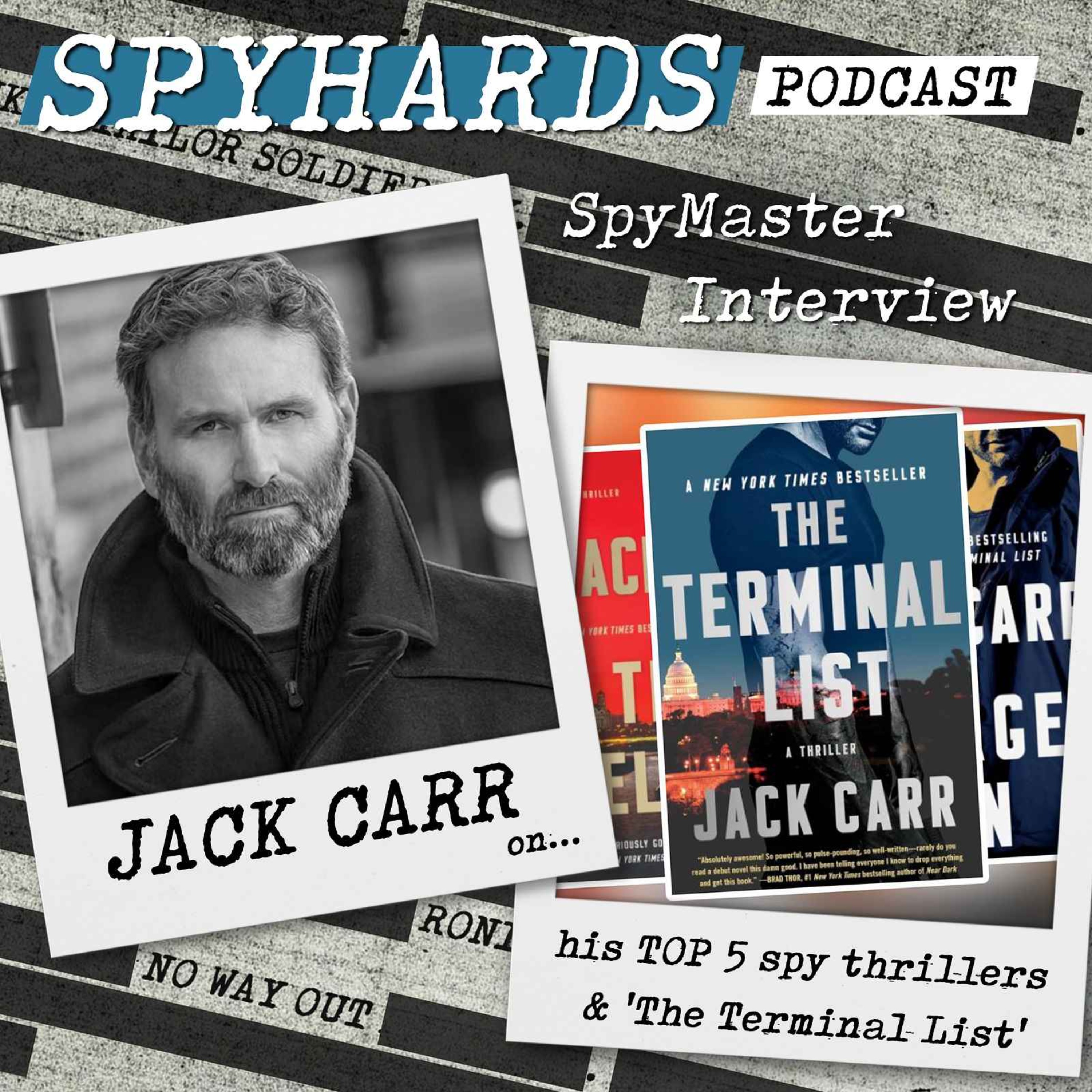
Jack Carr on His Top 5 Spy Thrillers + The Terminal List - SpyMaster Interview #123
About this Episode
Agents Scott and Cam welcome novelist, screenwriter and podcast host Jack Carr to the show to reveal his top 5 greatest spy thrillers. He also shares stories about writing the James Reece book series and the Amazon TV series The Terminal List and The Terminal List: Dark Wolf!
Learn more about Jack Carr's books, TV series and podcasts on his website. Make sure to pre-order his latest novel The Fourth Option. You can also follow him on X and Instagram.
Become a SpyHards Patron and gain access to top secret "Agents in the Field" bonus episodes, movie commentaries and more!
Make your opinions about the NOC List known. Leave us a voicemail on Speakpipe or send us an email now!
Purchase the latest exclusive SpyHards merch at Redbubble.
Social media: @spyhards
View the NOC List and the Disavowed List at Letterboxd.com/spyhards
Podcast artwork by Hannah Hughes.
Theme music by Doug Astley.
Hosted on Acast. See acast.com/privacy for more information.
Hosts & Guests

Transcript
The longer you stay alive, the longer you can enjoy Boost Mobile's unlimited plan with a price that never goes up.
So here are some tips.
Do not parallel park on a cliff if you want to enjoy an unlimited plan with a price that never goes up.
Do not mistake a wasp nest for a piñata.
If you want to enjoy an unlimited plan with a price that never goes up.
Do not microwave a hard boiled egg if you want to enjoy an unlimited plan with a price that never goes up.
Stay alive and enjoy unlimited wireless for $25 a month forever with Boost Mobile.
After 30 gigs, customers may experience lower speeds.
Customers will pay $25 a month as long as they remain active on the Boost Mobile unlimited plan.
Over 90 of the top 100 US accounting firms trust Bill to handle Bill pay processes.
Why?
Because our tools are built on over a trillion dollars of secure payments.
We're not just moving money.
We're powering financial workflows for half a million customers.
That's a level of expertise you just can't fake.
Ready to talk with an expert?
Visit bill.com slash proven to get started.
And grab a $250 gift card as a thank you.
Terms and conditions apply.
See offer page for details.
Boost Mobile is now sending experts nationwide to deliver and set up customers new phones.
Wait, we're going on tour?
We're delivering and setting up customers' phones.
It's not a tour.
Not with that attitude.
Introducing store-in-a-door.
Switch and get a new device with expert setup and delivery.
Delivery available for select devices purchased at BoostMobile.com.
Welcome to spy-hards podcast.
I'm agent Scott.
And I'm Cam the provocateur doing everything he can to avoid winding up on the terminal list.
As you should cam, because frankly, you'd be my first target.
Uh-oh.
Well, I've known that for a long time.
It's been six years.
I'm actually very terrible at taking people out.
I keep doing the serpentine maneuver.
That's why.
Don't take me back to the in-laws.
Instead of talking about something that I don't like.
I talk about something I do like.
And that is this week's guest, Cam.
Who are we talking to?
Yes.
We are talking to novelist and screenwriter Jack Carr, who created the world of the terminal list.
And it started, of course, with the original novel, the terminal list, which I mentioned up top.
And it spun off into several other adventures featuring the character James Reese.
As well, Jack also created the TV series, The Terminal List, on Amazon.
As well as it's been off, The Terminal List, Dark Wolf.
Yeah, for sure.
And this isn't just your standard spymaster interview, folks.
We got some great notes about our Matt Gaulie episode.
We did last year where we focused on a particular subject throughout the interview.
So we've got a fantastic little hook in here as well.
We're going to talk about some political thrillers that we all love.
You're damn right.
We are.
Plus, of course, we're going to talk about his fantastic books.
Getting to turn that into a TV show, one opportunity.
And a little bit about his military career as well.
A fascinating man with many fascinating tales.
So without further ado, let's get to it, folks.
Dad to attention for Mr. Jack Carr.
Cam.
It's time.
Our guest sitting across from us right now is not only a screenwriter,
a novelist, a podcaster, a producer,
but unlike Money Penny in Skyfall,
he never hesitates to take the bloody shot
because he's a former Navy sales sniper.
It is none other than Jack Carr.
Hello, sir. How are you?
Oh, my goodness.
Doing great.
That is the best intro that I've ever had in any podcast
that I've ever done thus far.
So incredible.
But I expect nothing less.
You guys are awesome.
I've been so excited for this interview.
And every more so than I, a conversation, not interview.
But that that I've ever done before,
even prepared for it.
I'm going to show you right here.
This is my desk right now.
So I have the books and, uh, and films.
I went out and made sure I even found this one right here
is by a game in VHS.
I thought I was going to find that one in DVD.
But got a whole bunch of props here to go along with our conversation.
I think you might be more prepared in Austin with the hosts.
That actually is on point.
Knowledge.
Well, some say anyway.
But Jack, it's a pleasure to have you here.
We're glad we can make this happen.
We've been talking offline for a while now anyway.
So that we've made it podcast official video official.
We're doing it.
Let's sort of frame the conversation a little bit.
Because, you know, we're not just going to talk about your books.
We're not going to talk about sort of your stories that were turned into television shows.
But we're going to talk about the influence in which spy thrillers have had on your life.
So much so that you've picked five of your favorite political thrillers throughout the decades.
And we're going to talk about them.
That is right.
And we, uh, we went back and forth a little bit on what to, what to do.
Mm-hmm.
And we narrow it down.
Correct me if I'm wrong, but we went by decades.
So I chose something from 70s, 80s, 90s.
Do we call it the arts?
What do we call the zero, zero?
Anyway, I always say the naughties, but that's, uh, that's just me.
That's very British.
And if you go to the teens, are we going to the teens?
Where do we go to before we get to the 20s?
Is it the 10s or the teens?
I don't know.
Someone's screaming at the screen right now or their headset.
It's clearly this guy.
We'll spend a lot of time going through those comments so we can educate ourselves on.
We will.
So anyway, those three because we're not through the, uh, the roaring 20s here, uh, yet.
So we don't know what my favorite movie of the 20s is going to be.
So we have four more years left.
So, uh, so we went with those, uh, those previous, uh, geez, five decades.
Oh my lord.
And, uh, and those are those are the ones.
Yeah, it's kind of a good way of grounding it and also looking sort of the best of that decade.
And also because it's your take, it may not be the best for everyone.
And we can have that discussion when we're talking about the films.
But I kind of want to rapidly love that discussion in a little bit about you and getting us there.
And I think that first question for me is, what made you sort of fall in love with the spy genre?
Well, jump back to that in a second, but I also want to frame these choices when we get to them.
And I didn't rewatch them.
Um, I mean, I did rewatch them right before this, which was super fun to do.
But when I picked, I was going back to my memory banks from the 80s, essentially,
and 90s for the 70s, 80s, 90s picks.
And then early thousands when I, when I saw Spy game for the first time.
So I went, I did it from memory, not going looking at each decade now after we started talking and looking at all the films.
And then picking like the most popular or the most popular one.
Now it's from my memory.
So that'll come into play when we discuss some of these as we, as we move ahead here.
But I think the level of spy films and, and, and books was just in my DNA.
So I think even if I didn't have the influences that I had, meaning my mom's library and so I grew up surrounded by books and a love of reading.
My dad was a James Bond fan.
They had our, our cabin up in the mountains that we had.
I had, they had all the La Corée and they had loved looms and they had Ken fall and they had all these these paperbacks, essentially, of, of the masters on those shelves.
So even before I could even read them or even before I could tip them from the shelf.
I knew those names and I knew that La Corée was up there and I knew that Fleming was up there and, and, and the love loom.
They were all in those shelves from, essentially, in the seventies from my earliest memories.
And so I think that probably had something to do with it.
And then watching Bond with my dad, probably when I was way too young to be watching those kind of films.
The seventies was a little different.
There weren't as many parental concerns or controls on things.
So whatever dad wanted to watch, that's kind of what you watched as a kid.
And it wasn't even a discussion as if it's appropriate or not.
So I'm watching all those early Bond films.
We had a, I should have grabbed a match.
I didn't grab downstairs because I've started to collect them again in RCA video disc, which is not laser disc.
This is seventies style, like a plastic disc, essentially, that is encased in this square thing that you push into a machine.
You got about 35 minutes, I believe, maybe 40.
And then it would stop and you'd have to go in, pull it out, turn it over, stick it back in and take out this big, it was this big plastic case.
So I had all the Bond movies on, on that.
So we, so anytime I was sick home from school or something like that, I would be watching Dr. No from Russia with love, gold figure, Thunderball.
You only lived twice, like I would watch all of those constantly because there wasn't all these other distractions out there.
So it being in my blood, I think, was part of it.
And then those influences, obviously those early influences visually and watching those films with my dad probably laid this foundation.
Well, do you remember what your first, you know, Bond film was and also the first spy book you read that really grabbed your maybe just the first one period.
Yes, so I, you know, memories a little hazy from the 70s.
Some of my first memories actually are of the 1979 Iranian hostage crisis.
So I remember being pulled out of school.
I was at a Catholic school at the time and they go into church to pray for the Americans that were taking hostage.
And then I remember the, the blindfolds on the news.
I remember watching Walter Cronk out with my parents counting up the days that they had been held.
So that was, that was very formative.
But spy movie, I can't remember if it was Goldfinger on RCA video disc or if it was and we probably go back and find out somehow because to live and let die was like this Sunday night movie.
I think in the late 70s on ABC CBS or NBC, one of those.
And so it was either Goldfinger or to live and let die on television with commercials.
And I don't know exactly which one it is.
I think it was Goldfinger, but I'm not 100% sure.
Can't go wrong either way, either one of them.
I was so young that it's not like, oh, I was 10 years old.
No, I was probably six or six or so somewhere around there.
The perfect age for live and let die.
Or Goldfinger.
I mean, these are very formative films for my life.
I think, you know, whatever you do between, you know, a little later than age six, but I think between let's say eight and 18 or 10 and 20.
Like what you do in that time frame when your brain is developing and it's just such a formative time in all of our lives.
I was very fortunate that I was watching movies about things that I wanted to do later in life.
So military spy type stuff, but then reading and reading fiction and nonfiction during that time frame.
And there wasn't obviously wasn't a TikTok and a Facebook and an Instagram and wasn't 24 hour video games or anything like that.
You had to go to an arcade and put a quarter in and as soon as your three lives were up and you ran out of your five bucks or whatever you were done for the day.
And you'd ride your bike back home and play outside or read a book or watch a movie.
So I feel very fortunate that I grew up in that kind of a in that era because those movies and all those books that I read are really foundational to what I'm doing now.
But to be able to have experienced them when they were contemporary, meaning separate spy thrillers contemporary books, not going back at age 40.
It's in say like, you know, whatever 2015 or something like that going back and then watching them and trying to put myself in the shoes of someone in 1983 85 87.
No, I got to read all those books that clansies when they were contemporary thrillers. Now if you go back and read hunt for a October or read Patriot games or something like that, you it's a time machine back to the time in which that written.
So to do them read them as contemporary thrillers, I feel extremely fortunate and thank my my parents for instilling that love of reading in me at a very young age.
But for spy book, you know, it's probably a young adult type book. So I'm sure there were young adult type books that choose your own adventures.
There was a 007 choose your own adventure. I remember there's there's Indiana Jones to your own adventures. There was the actual choose your own adventures.
There were young adult books that had to do with World War Two, usually kids experiences in World War Two type of a thing. I remember reading reading those.
And then I get into let's say sixth grade fifth grade sixth grade is when I started reading the same type of books that my parents were reading.
So that's when I read hunt for a October. So that was an early one.
JC Pollock Center Fuge, another early one, only by Mark Olden, the Mac Bowling books, all those more pulp kind of action adventure than than spy, but there's crossover for sure.
So all of those books that I started reading back then. And then by sixth grade seventh grade. Now I'm into the David Morales, the brotherhood of the Rose for turning the stone league and fog that trilogy that took the best of UK spy fiction at the time.
And then I got into the parade and combined it essentially with the the Luddlam, the best of US spy fiction combined those together to make something new going forward. So that those were very inspirational as far as an impactful to me as a young reader.
So I don't know exactly what my first one was, but those are all definitely in the mix.
I suppose I was going to follow up with sort of what was it about that particular book that jumped out, but if we can't recall one, I'll reframe the question.
What separates the wheat from chaff? What is it about from you? What creates a great thriller versus a good one?
Yeah, because these things are all subjective, but it's that tangible. It's that heart. It's when something has heart.
And you don't know, you can't really put your finger on it. Yes, you can describe it, but art is subjective. And so whether it's that it's a it's a painting, whether it's a sculpture, whether it's a film, whether it's a book home, whatever it is, it's that heart.
And so you can't really describe it other than you know that whoever it is, that artist, that author, whatever that their heart and soul went into this project.
And for some reason, it's speaking to you. And now we use the term authenticity for that sort of thing, but it's more than that. It's it's it's heart.
And so that really I think is what separates the good from the great.
I want to I do want to get into the list, but I kind of want to frame your story because I find your particular story that led you to writing books in the first place to be quite intriguing.
You know, you said this upbringing, you're exposed to all this by literature, mother, librarian, your around books, naturally you think you would become a writer and of course you do.
But there's a big part of your life that happens before that, which is of course your service.
So why did where did that mindset come from and that urge to go that direction before you perhaps went the other way?
Yeah, once again, in DNA, but my father, my grandfather was a, it was killed in World War II, we flew a course air, which was the plane that had the gold wings like this, it would fold up.
So to get fit on the aircraft carrier. And there was a TV show in the late 70s, and I watched it in the early 80s, my dad and syndication.
And he started out as Bob, Bob Blacksheep, when I went to syndication, they called it Blacksheep Squadron, but it was based on the life of a happy point or his exploits in World War II.
And he actually had a couple cameos in the, in the series, and I'd watch those with my dad, but back before Facebook or anything like that, if you lost a parent in World War II, it was hard to connect, hard to connect with anyone that knew him.
So I think my dad's connection to that generation, because he never knew his father was, he was killed while the before he was born, really.
And, and so popular culture was his connection to that generation. So it became my connection to that generation. So watching all those World War II films.
So that was incredibly impactful. So I grew up with my grandfather's silk maps that they gave aviators back then, because you got a paper map, and you had a ditch in the water, which is just integrate, but the silk map would just get wet.
And so he used it, had his wings, he was a marine aviator, so I had his medals, pictures of him in his squadron, his plane, that make middle models of the F4U corsair.
So I had those like hanging from the ceiling of my room and dogfight type physicians.
So I think it was just ingrained in me from an early age, and it wasn't expected at all from, from my family. It was just, it was in there. I knew I wanted to serve my country in uniform.
And then I found out about seals at age seven through a movie called The Frogman. Once again, power, power of popular culture, old black and white film.
So I asked my dad, like, who are these guys? And, and he said, ask your mother, because that's what dads did back in the seventies.
And so we went down to local library and did some research into Frogman found out about underwater demolition teams and naval combat demolition units and seal teams.
And my takeaway from that research was that seals are some of the best special operators in the world and the training is some of the toughest ever devised by a modern military. So at age seven, I was in and it's about the time that I find out that Magnum was in Vietnam.
And those first couple seasons, you see him running around the jungle and tiger stripe camo and you're like, naval intelligence officer, what's he doing? And I think the writers found out about seals.
I forget what season, but by season three, maybe they find out about about seals. And so now he becomes a seal and they put the, put the tried on his uniform. And now he decides that background going forward.
So, so the power of popular culture was, was strong. And luckily I had those, I think, good, good influences. And so, so service was definitely something that I was going to do. And I knew that after that time in uniform that I'd write thrillers, the same kind that I was enjoying reading between let's sage.
18, 18 timeframe. So I knew my path. I was very fortunate to know my path. And then the reading actually prepared me not just for what I'm doing now, but also prepared me for what I did in the seal teams, because I read so much fiction and nonfiction that I had this base of knowledge, essentially as I stepped into the seal teams. And when I went through hell week, I thought back to all of those guys who did things that were a lot more difficult than I was doing in the beach in sunny Southern California.
I was not storming the beaches at Normandy or Iwojima. I was pursuing my dream. And I was only able to do that because of the sacrifice of those who came before. So I thought about that, which put things in its proper perspective, relative terms, which is always important, I believe.
And you get a lot of that through reading. And that's why I worry today about kids who are just scrolling and getting kind of being manipulated by an algorithm to be infuriated and anything. And it's just I don't think it's very healthy.
But it's also doesn't develop that compassion and empathy that comes from reading, yes, nonfiction, but also fiction, because you put yourself in someone else's shoes. And I think that really helps when it comes to discourse, getting along with others.
And that seems to be completely lost when it comes to the online culture and discourse these days, unfortunately.
Well, also, when I look at your story, there's a lot of direction to it and motivation. And it's like, you knew which step to basically go to.
And I feel like nowadays, it's, I mean, I work with young kids and teenagers in early 20s. It's really hard to have direction now to have that sense of, I know where I could go and what is feasible.
Yeah, I mean, it's tough. And I think a lot of that comes from not having these, these long form inputs, like going to a theater and watching a movie waiting for a TV show to come on that you're excited about. Maybe you don't even know why, but you know you're excited about whether it's a medical procedural that's inspiring you to become a doctor or health care professional somewhere.
And there are to police procedural and that's the inspiring you to join join a police force or the FBI or whatever it might be or a spy story that gets interested in that or a military type thriller where you're interested in special operations or flying or whatever it might be.
So there's just not as many of those more healthy type inputs, I think today. So I think there's probably that's that probably really that plays in significantly, I would say.
Well, it seems like my child's obsession with Star Trek is not paid off yet. Come on, look at the posters behind you look what we're doing now.
It keeps me company, but I definitely haven't gone to space just yet.
Oh, man, I got to see those in the theater in the first Star Trek movies.
I've seen them all, I've seen them all in time since my first, I think one of my first theatrical experiences was Star Trek 6.
Yeah, I'm a lot older than you.
That can't be helped, unfortunately, but it wouldn't be a spy-hards episode without mention of Star Trek at some point.
So it has to be.
I'm a fan of you guys.
So I know how it goes.
Before you jump time, we were talking about the Dorchester, because you were one of your first interview episodes had a Dorchester link to it with a screenwriter that went over there and spent some time.
And so I was going to show you this. They left a couple gifts for me because the concierge was a fan.
And so I got up to the room and there was a really cool coffee table asked in Martin book.
And I was like, it's a little worn. I don't think that's a gift, but it's very cool.
But then this, I'm like, I think this is a gift because they had this out there signed so a bond continuation novel.
But it was this was this was this bond in the Dorchester right here.
So the history of Fleming going from the meetings that took place there and what was written there.
And then how all the bond actors have done something there throughout the history of the franchise.
So that was that was pretty cool to be over there and going to be walking in some of those same those same paths that some of these guys did, especially Fleming there in the beginning.
So, but what a cool thing for the Dorchester to do. Yeah, very nice. Very nice.
It was it was it was a great place to stay. We found our spot. If we go back, it was not a bad not a bad place to spend a few days.
Well, let's let's synthesize a little. Let's start to bring it towards political thrillers.
You you've done your military service. You served your country. Then you chose to take a pivot and do the other thing you had been planning to do, as you said.
It is begin to write thrillers and of course you've gone on to be exceedingly successful travel the world talking about your books. Of course you've had TV shows been often terminal lists on Amazon.
Multiple books multiple best sellers.
Where did you get that sort of inspiration from to make that pivot once you left the service and what was sort of your first step into that world.
Well, I think it was a lot of a lot of it was knowing what I wanted to do early and then not letting anybody talk me out of it, meaning like when you want to do something as a kid.
And in my case, be a seal or or right. You don't really think you don't see the failures. All you see is the are the books that say number one New York Times best seller on them.
So as an 11 year old, you think, Oh, of course, I'm going to be a number one New York Times best thing author. You don't see the other side of it.
Or I watch watching movies or reading books about the seal teams. I'm not watching movies or books about people who failed. I'm seeing movies and books about people who made it through and are now operating.
So in my head, because I think I wanted that so early, it never occurred to me that I would not be a seal and I would not be a number one New York Times best selling author.
And I would not have something made adapted from the books because a lot of the things that I was watching adapted from from books in Fleming's James Bond 007 and all those early early RCA video discs that was always pop up there.
So that was my mindset from a very early age. So when I got back from my last Iraq deployment, I knew that that would be my last time maneuvering guys tactically on the battlefield.
And that's what I was good at from then on. I'd come back. Maybe I go to staff job somewhere and circle background as a commanding officer someday, but that's really, I mean, it sounds impressive, but you're really a manager.
You're not kicking indoors guys and the guys don't want you kicking doors in with them because you've been at a staff job for three, four, five, six, seven years. So you're removed from that tactical type expertise. Now you're at that more operational level.
So so I knew it was I knew it was time to go very clear to me. It's time to go. I listened to that little voice. And and so then I started thinking about, okay, how what how am I going to move into this next chapter in life?
And I know what I want to do when we're right thrillers. So I wrote down six, seven, eight, nine, ten different one page executive summaries.
Kind of like what you read on the back of a book like this kind of thing.
They were back inside the flapjacket kind of like a, like a letter to myself. They become letters to myself. I didn't look at it that way then, but they've since become that and I've done it for every book sense, meaning I write that one page executive summary could be a couple paragraphs, could be over four or something like that.
But then I ask myself, is this worth the next year, year and a half of my life? And if the answer is yes. And I read it again. And I say, if someone were to walk by a Hudson news in the airport and reach something like this on the back of a paperback or the inside flapjacket of a hardcover.
Would they would be interesting enough to them to spend time in these pages time. They're never going to get back. And if the answer is yes, or probably then that's my next project. So that's essentially what I did for that first one, putting all these different things on the dining room table in Coronado, California.
These one page executive summaries reading them all. And then it was very clear to me that the terminal list was the one to start with. So that that was December of 2014. And by the time I got out of the military a couple years later, it was essentially in the in the editing phase. And then I sent it to Simon and Schuster in the fall. And they loved it. Have me out to New York. I think to make sure I wasn't a crazy person. And I'd coffee with Emily Bessler, who's my editor in publisher today, which is an imprint of a Simon and Schuster of Patriot books. And we went to coffee. And then she said.
I want to get this, but you need an agent. And I was like, well, how do I get one of those? And she said, well, I want to buy it. So I'll introduce you to four. And they'll all want to one represent you because they already have a buyer and just pick one and we'll go from there. So picked one Alexander machinist. And she is my agent today. And it's a fantastic team. So after the races, I went and some of those executive summaries have become the next books. And then some of this new series that comes out May 12 called the fourth option.
So I have, I don't think I'll ever run out of ideas, plus the world keeps keeps, keeps serving them up either fortunately or unfortunately.
Well, I was, I'll let you drive back in, but something that I wanted to point out. And I was listening to, I think it was interview with you the other day, just in preparation for this. And I was sort of blown away. I sort of heard sort of about like you sort of saying, setting your approach out, you were going to do this.
You're going to become a Navy seal and you did. You were going to write a best Southern you did. And I really loved that idea of you.
And you may not look at it in this perspective, almost manifesting this world that you now live in. You created that life of becoming a seal.
You then created a new life of becoming a best-selling author. And then looking at how it was adapted, you always saw Chris Pratt in the role.
You always saw Anton Fuqua as directing it. And I just loved that you basically made it happen through sheer force of nature.
And I just think that's a really powerful statement for someone who, if you have an idea and you believe in it, keep going because you will make it.
Yeah, the Chris Pratt and Anton Fuqua thing is a little bit crazier because the other side of it, the seal part and the writing part, that was preparation out of love, essentially.
I was wondering about both these things. I'm doing this reading, preparing myself physically as best I can for seal training, essentially for my whole life.
So I prepared for it. I can still fail, but if I hadn't prepared for it, then, okay, probably not going to happen. But putting in that work, there's an opportunity for it to happen, I guess.
So that part, that's one side. But the Chris Pratt and Anton Fuqua thing is a little odd because I sat down to write and as a child of the 80s, like we kind of touched on, I thought, well, who's going to play after I wrote my first sentence?
I was like, who's going to play my main character here when this is adapted?
So already, I'm thinking, of course, this is going to be adapted. I have one sentence title, and that's about it.
So I thought, well, you know what? I don't want somebody who, like I have a choice at this point. I mean, I'm in my little office on our bedroom, in a rental, in front of California, I'm still in the seal teams.
And I'm thinking about who I'm going to let play my main character when we adapted this thing to a film or a TV show.
And I thought, you know, I don't want someone who's done this sort of thing before. I don't want that action here who's done this.
I want someone who needs to do it, kind of like Tom Hanks in the 80s did all of comedy. And then he does Philadelphia takes that risk with Philadelphia in the early 90s.
And then from now on, he can really do anything that he wants. And I thought, who is that guy for this generation?
I want someone who's inherently likable, who has done comedy and needs to do something else needs to prove that he can do something like that's darker like this and needs to do it.
Type of a thing for his career. And this is before Brad has done Guardians of the Galaxy. This is before Jurassic World. This is just when he's in Parks and Rec.
And he got to my radar because I saw Parks and Rec. And I saw him in zero dark 30 worried about the bin Laden rate where he has a very small role as a seal.
So I was like, OK, I saw this guy here in Parks and Rec, see him transform his body and how he acts here as a seal in zero dark 30.
And I said, Chris Pratt is the guy Chris Pratt will play James Reese in the adaptation. And then I wrote one more sentence. And I thought, well, who should direct this thing? And I thought Antoine Fuqua for sure.
He's the he's the guy love all his work amazing training day tears of the sun. He's just he's just incredible.
So, but that's all I thought I gave to it. I had no connection to Hollywood, no connection to publishing. None of that.
And then when I got closer to publication date, a buddy calls me out of the blue who I talked about in talk to in five years.
And he's from the seal teams. And he said, Hey, man, I heard I always want to call you and say, thank you. And I was like, well, for what? And he said, well, the only person in the seal teams who sat me down when I said I was getting out, talked to me about transitioning out to the private sector, you introduced me to people in the private sector.
Then you followed up with me. No one did any of those things except for you. And so I always wanted to say, thank you. And I was like, no problem. How's it going? And he said, it's going great. But I heard you wrote a book.
And I said, it's coming out in a few months. I have a galley copy that I can send you. And I just found out what a galley copy was probably like two weeks earlier.
And he said, yeah, I'd like to give it to a friend of mine. And I was like, who's that? And he said Chris Pratt.
He gave it to me. And then another buddy, a couple of months later, gave a copy to Antoine Fuqua. He was giving a speech somewhere from another former seal buddy. And he gave a copy to Antoine Fuqua who read it and wanted it also.
And they knew each other from working on Magnificent 7. And so they called and said, let's do this together. So option is to Chris Pratt in early 2018 before it had even hit shelves. And then started working on it a couple of years later.
Wow, that's crazy. I was going to ask though, like in terms of, you know, your first book is a hit.
But leading up to that, like, were you someone who was always writing for yourself because those skills are gained? I would think over time or no?
No, it's the reading. It's all the reading. So all those authors that I was reading from 18, 10 to 20, or really for my whole life, let's say.
Those are my professors in the art of storytelling during a time when there were no other distractions. There was no mortgage I had to pay, no car payment, no job, nothing like that.
My job was just essentially to stay out from underfoot as a kid. And so I got to read and just escape into these pages. And they were just magical to me.
And I knew that one dad write books like this. But I wasn't studying them like that. I was just enjoying them. So it was completely from the fan perspective, maybe similar to how Quentin Tarantino grew up on films.
I didn't go to film, but you know what? He's certainly an expert on the history of film for Sicily and his genres. So I think it comes from just the love for him, the love of film and for me, the love of books and reading and then these adaptations that I'm, that I'm washing.
So, but it's not reading scripts. That's the difference. I'm reading books. And I know that I'm going to write these books someday and then we'll adapt them. So I think that's the, that was the key, I think.
Well, so like when you're writing your first book, did it just feel very natural? Like did you stumble with writer's block or was it just very beginning to end? You had it kind of in your head.
Yeah, no writer's block. And I heard I think it's helped me out early on. I didn't read because now you can study how to do something forever.
And always that way. But, but now you can, you can go, you can spend your whole life online just studying how to do something and coming up with an excuse. Maybe why not to do it because you just have to read this one more thing or study this one more thing or just no.
I read on writing by Stephen King. I read the successful novelist by David Murrow. And then I read whatever I think it was three or four books. Maybe, maybe, maybe, yeah, maybe three at the time. Now there's probably six or seven of them out there by Stephen Pressfield.
And one's called the War of Hearts. And that's the one that was was out the first one in this series of books on creativity. Essentially, Stephen Pressfield wrote Gates of Fire, Legend of Bag of Vance. He's a dear friend now. He also did work on above the law.
The movie from the 80s, the Stephen Seagull movie. He doesn't like to publicize that. It's fantastic. It's actually, it's a great film. And you guys have talked about to the director actually in a previous podcast that I listened to.
Fantastic. But anyway, in that book, it's either in that book or in an interview that I heard from him. But if it's not directly in that book or those series of books on creativity is really inside it.
And that is that there, let's say a dentist doesn't get dentist block. A trucker doesn't get truckers block. You're a professional. You sit down. You write. That's what you do.
So I really, that hearing that from him, I guess, was, I guess it canceled out the possibility of writer's block. Is your people talk about it so much that you actually believe it's true. And it's not just with writer's block. It's other things in life as well.
You hear it repeated so often. You just think it's a thing like imposter syndrome. You hear that people talked about it all the time in the SEAL teams as far as like leadership classes when they started bringing people in to talk about that sort of thing.
And I was already well pass my my leadership time like I was getting out with the time they started doing that. It was all backed by fire for for me, but you'd hear that sort of thing. And I was always like.
I don't feel imposter syndrome. I feel like I've put in the work and made and done everything I can possibly do to make myself the best leader and operator I possibly can. And I wanted to be a better leader and operator.
And I was like, tomorrow, then I am today type of a thing and same thing with writing. I want to be a bit of the next book to be better than this, this one that's coming out in May. I always want the next show to be better than the last show and a learn from the lessons of the past apply them going forward as wisdom always improving.
So, so yeah, I never worried about writers block, especially after I heard that.
The trucker doesn't get truckers blocking just to sit down. It doesn't drive the truck that day. The dentist and say, Oh, I've got dentist block today. I can't do my job. No, you sit down and you write your professional.
So, so yeah, I think that really really played played into it. And also I heard from somebody. I think I wish I knew who said this, but someone said, give yourself permission to write a bad chapter.
And I was like, Oh, that is great advice because you can go back and make it great. Just get it down. Don't get stalled out in a sense because it's not great.
Get it down. Get the story out there. Then go back and reread it and edit and make it as good as you can possibly get it before giving it to your editor. So just get it done.
And so give yourself permission to write a bad chapter, write a bad sentence type of a thing right about paragraph. Don't get stalled out and any of these things. So I think that really helped to.
Well, like the permission to fail the space to fail to learn you only learn through making mistakes or certainly I have. But that I just find I've never heard that that sort of idea you mentioned before about you know truckers don't get truckers block.
I absolutely love that. I might be adopting that. That's a fantastic way of looking at things.
Yeah, do it. If you haven't read the word of art by Stephen Frostfield, you can read it in an afternoon. Like I said, there's multiple. There's ones called turning pro, another one's called do the work.
So he has a bunch of these little thin books, which is his hard learned advice over his lifetime and very readable as well. So I think reading those maybe on writing, successful novelist, bam, get to work.
It's kind of funny. We're spending all this time talking about writing. And I'm about to pivot as into talking about watching. And that is films.
And if there's one thing people take away from the first half hour of this conversation, it's read books, people, they're great.
Read read read read. I mean first. So I just say just pick them up too.
For a yes, for a host of reasons that empathy and compassion we talked about earlier, they developed through reading the ability to sit and deep in thought and not be distracted by the things out there.
So there's so many there's so many advantages to reading. And I think it's attributed to Mark Twain, although I don't know if you actually said it or not, that there's really no difference between the person who can't read in the person who doesn't read.
If it is Mark Twain, I believe it. It sounds like something he would say.
Sounds like Mark Twain, but I think it's just a trip. I'm not sure. And I've seen it attributed to other people, but more contemporary type people. And I was like, no, that's not this person.
He's one of those, he's one of those legacies I'd love to have. Like people just attribute stuff to Mark Twain all the time. And it's just like, he's just sort of grown his legacy over time without ever being around.
Yeah, no, exactly. And if you buy it, that sounds like him. You're so witty.
Yeah. And for me, it's that that sense of curiosity that I get through reading. And also consuming art in most forms is that just wanting to know about people, the world, and things that don't exist fit in the fiction.
But speaking of fiction, speaking of spy fiction, while you're all listening, you want to hear this top five, don't you? You want to hear it? Well, we're going to do it.
So we're going to talk about the five decades we've picked. And then we're going to rank them at the end. That's going to be the hardest one to do because Jack, you're in the hot seat. People going to be judging your choices here.
I know it. I know. But once again, the, and I don't like, well, these were all picked through the lens of the age in which I saw these films for the first time. So that should be taken into account because they're probably our quote unquote subjectively better films perhaps for
this per decade, maybe not for maybe two of them, but, but anyway, these are, these are through that lens of that decade, but I rewatched them with my wife, except for two of them. She, well, she made it through four and a half.
I, you know, we have to figure out by the end, which one is the half?
I think you'll know. I give it up as we go on back. But, but I've watched it again. And then I thought, oh, I can't read. I can't go back and kind of pick another one. I'm going to stick with these choices, specifically because of why I chose them because of how impactful they were at the time in which I saw them.
So, so I think that's a, that's a unique way to go about picking rather than going back and saying, what's the best film of the 80s or the 70s or the 90s? So, so it's through that lens for everyone watching or listening.
Okay. Well, you've, you've teased us with starting with the 1970s. Jack, what's your pick for the best thriller?
Starting 70s. So, right here, and I even picked up the, the VHS right here, three days of the condor. So, Robert Redford. And I chose this one. So it was really between these two that came to mind. Of course, here we go.
Day of the jackal right here. People, a lot of people say, day of the jackal, why not day of the jackal? And it's because of something. Maybe it's because, and I tie this back to something you guys said on a previous podcast, actually, I feel like the day of the jackal could have been, it was came out in 1973, I believe, could have been come out in like 1968.
And be surprised if this movie was 68, 69. And three days of the condor is so quintessentially 70s, which is why I went with this one came at 1975, everything from, from the clothing to the Robert Redford's haircut.
And I think that watch, of course, he has the, he has words that doxa in this one, usually a lot of times he wears a, not inspired game, but another other, he was associated with the Submariner Rolex, but, but he wears the doxa, those, thanks to the shark hunter on that leather strap in, in this.
So it's just so 70s, and then it also comes out at a time where trust in government is at very low conspiracy theories abound the, I forget exactly when this is a pruder film came out, but right around this time, we're about to have the church hearings.
Kennedy, of course, assassinated in 63, but that loss of innocence is really pervasive all the way through here, we have water gates, this becomes one of the most popular books. And first, here's the book, six days of the condor, right?
James Gray, who's amazing, incredible guy, and they changed it to three days here, a little more palatable for, for an audience, which happens in film, you have to condense things down.
But then here we go, here they republish here, there it is three days right here in the movie tie and essentially, and then this is a more modern version right here that's the James Gray, he signed for me a few years back, which was the 2019 he gave me that was great.
I mean, that's a flex on that last bit there, I have to say, you have to, you have to.
I love, I love the green leaf on the books as well, though, on the some of the original once you've got this, that's nice. Yeah, I love that.
Yeah, and I love these covers. I mean, I collect also the movie tie ends, so I have it from the 80s, and it's something it's not really done anymore. I'm trying to bring them back. I really wanted to do one for dark wolf, because that's a prequel to the terminal list.
And then I so deep into the research from my last book cry havoc, because it takes place in 1968. And so doing that research that wasn't contemporary research added months and months and months that I wasn't expecting.
So I didn't get to do the movie tie in, and I really want to do that at some point. So if we get a second season, hopefully I can do first season, second season, movie tie ends, because I want to bring those back, because I have such great memories of reading those reading novelization of Rambo first blood part two by David Morales.
I talked about earlier from from the brother of the rose, create Rambo in 1972 with first blood. So anyway, I love these old paperbacks and have all the bond paperbacks right there, all the Fleming ones multiple, because there's so many different addition of the Fleming novels in both hardcover and in paperback. So I have a lot of those.
But I just love those powers. I mean, so 70s right there. And even the cover of of this right here is so 70s right there. It's just fantastic. And but I chose this once again, yes, because of the 70s, but this when I watched it again.
And I was watching, I won't say how long my wife made it through each one of these so we can go to the, about that a little bit at the end.
But interesting how women are treated back in the 60s and 70s when you watch some of these films. So that stands out, but also a great car in there. I got the old Bronco in there with the way drive. So that's fantastic.
Christmas movie also right here. That's a, that's a plus in this corner. But then the near the end, like the two best scenes, Max Bonsado, when he's, when he's giving that little talk near the end about a car, the car will come, will roll up door will open.
Maybe it's somebody that you know, I mean, that scene is got to be one of the best scenes in a spy movie ever, ever written and ever, ever portrayed on film that. And then also the very ending when Cliff Robertson's like, how do you know that they'll, they'll publish it.
Those two scenes stand out and, and make this because the conspiracy side of it with the, with Cliff Robertson talking at the end where you don't really know if the, if the New York Times is going to publish this, this story. And then the marksman's Max Bonsado found a little monologue that he does there is just so well done.
So for both of those reasons, and, and that it's quintessentially 70s, three days of the condor my 70s pick.
And you read the book before you saw the movie was the movie first.
That is a very good question. I don't think so. I think I would have seen the movie in the 80s.
And probably didn't really get it back then because it wasn't as fast as some of the other things that were more contemporary. It was.
I think when I saw this in the 80s, let's say I saw it in 84, let's say probably thought about 84, I would guess.
I think I was like, I was comparing it to first blood. I'm comparing it to uncommon valor. I'm comparing it to some of the bond films.
And I'm just not quite there. Kind of like when you read like array to early, which I did as well.
Kind of like, wait, why doesn't somebody kill somebody? When something going to blow up.
You know, like, why does he throw this guy off the balcony? Like all of those things if you're reading some of the other books that I mentioned earlier.
So I think I saw this at a time when I was probably too young to really get it.
And even though it was not not going to decade old, let's say decade old when I said it might see it.
It seemed like it could have been 50 years old to me at that time, which is really, which says something for sure.
But yeah, so I probably saw this and then read the book. You probably in high school. So another, you know, five or six, seven years down the line.
It's for me, a very interesting pick that you come up with this one, because if you were going to objectively say what's the best spy movie of the 1970s, this film would probably be in the conversation.
I would be the conversation was going to say, yeah, yeah.
That's exactly. I know I had other hackmen picks also. And so that they didn't make it. I mean, yeah.
The guy, the guy had good spy game. I wasn't in spy game.
But like, what I find interesting about this pick is, I mean, I love the film. And you mentioned those two scenes, the scene that jumps out to me every time.
I think a three days to the condor is the elevator scene.
Oh, we read for the maximums of doubt. And I mean, they would go on to riff on that in Captain America, the Winter Soldier later on and other films have done.
Riffs on that too. But they, they did it best. The sense of tension without saying a single word is probably just.
It's, it's mustful filmmaking on the level that we don't tend to see as much anymore.
And I based that lot on the story, but also Max wants to tell us presence in any scene will intimidate and terrify you.
Yeah, fantastic. I mean, and you, oh, I don't know if you've done this film. If you don't victory, it's not a spy film, really.
But with it's, it's the best soccer World War II POW.
We strangely actually have on our Patreon covered that film.
What you did, yeah, it's, I, I, as a foot, you know, I'm British quite clearly for those who don't know.
I'd never seen it as a football film. You think I'd seen it.
So good. I love that movie. I've got great memories watching it as a kid. Of course, so that stays with you. And then, you know, it kind of gets just missed.
It kind of gets his mystery. I'm Michael Caine and Max von Sido in there and, uh, paylay in there and actual poker players in their football players for those on the other side of the pond.
And it's so good. It's so good. But anyway, that, uh, that's seen in the elevator is classic.
And the kid that goes in there and presses all the, the buttons I've forgotten about that part. And now as a parent, I get it.
And, uh, that, that is pretty cool. And then it gets off at the wrong, let me get off at the wrong floor and then get back on.
Uh, so it's, it's so great.
The reason I find it interesting is because that film has a particular sort of meaning to Americans, I would say, because it is rooted deeply in the sort of pessimism as you mentioned in the 1970s.
It's not something politically that was necessary the same in both of our countries, Canada and the UK.
We were going through different political situations in both those decades too.
But it very much is a vibe in which the, the, the, the zeitgeist was tapping into with this filmmaking.
I think it, it's interesting that you pick it. And I find it interesting that it's still impactful to you now.
And was then in the 80s when you saw it, which is a decade that, you know, where I think that actually looked better in the 1980s.
You're growing up and also you're quite young and pessimistic to the world.
Seeing this film telling this quite dark story, it really grabbed you. I just find that interesting.
Yep. And it also, I also, I think I, I'm more, after writing my last book for I have it, I'm really wanting to write an espionage thriller.
I don't know if you find my first seven is espionage thriller. Certainly they're, they're spy elements in some of them.
Yeah.
But they're more political thrillers type of, type of genre.
But I really wanted to write a spy thriller an espionage thriller, set it in the heart of Saigon in 1968.
So that's what I did with my, my last book. So I think I was kind of more in tune because of that process and really wanting to go back and write it through the lens of 1968, not with 50 plus years of, of hindsight.
And I was really inspired by, but honorable schoolboy and cheers of autumn.
And the quiet American, those were like the three books that, you know, they're on their all slow, slow burns essentially.
So those ones were really impactful and inspirational to my last book cry havoc. So I think that's probably why this is top of mind right now.
But also because it just captures the seventies from that American perspective and also, we're, we're just, just out of Vietnam. So all that's all that's in there as well.
But that distrust in, in government that really comes through here and through the eyes of the every man also, which is kind of also a surprising pick for me, because usually I like somebody to have a background that would explain why.
They can take some of the actions that they do in these books and films, some of the ever man stuff. I'm like, how does he know, like, how does he know this firearm is going to work? How does he know to take the safe.
This thing, how does you know, these other guys would kill him for sure and I know, I'm a heartbeat, you know, these assassins that are after the every man, but Robert Redford pulls it off in this.
And I also love my wife looked over at me at a certain point. She's like, I see why you like this now, because he's a reader and they're talking about books.
And, and so she was like, I, she's like, did you base your entire life off this thing?
Because she'd never seen it before. And so, so she was like, maybe, maybe I don't even realize how impactful this was early on, although I think I was well on my path by the time that I, that I saw this, but the reading part jumped out to her in this one.
I love to in condor is that the violence is very messy. Almost every scene, whether it's the fight with like the assassin in the apartment or throughout the course of the movie, it's not these like clean, highly choreographed sequences of, you know, action or death.
And when you look at a lot of modern spy films or action films, they over choreograph it to a point where you lose the tension that you have of not knowing how it could possibly end because people are scrambling all over the place.
Yeah, beautifully shot as well, the whole thing, but, but you're right in that, in that respect, it's, it's, I remember what one of my takeaways from watching it back in the day was like, I wasn't impressed with the fight scene back in the 80s.
Because even though it wasn't as highly stylized back then, you're still watching, let's say, maybe not at that time, you're not watching Jean-Claude Van Dam movies, but you're Chuck Norris movies, certainly.
Yeah, you're seeing some, maybe some Bond fight scenes, but they're still more like more choreographed, like you said, and not quite as messy or you're watching a rocky boxing film, you know, that stuff up against the ropes and people are taking so much abuse.
But, but I, but watching it again this time, I really liked the fight scene. I loved the fight scene this time that it was messed and he notices the guys shoes, the postman's shoes as he comes down the, the stairs type thing, and you actually believe that the every man, if you can get to this gun, he can use it as an equalizer and, and get this guy if he puts the don't get this close range.
The alley's a little farther away than the scene before that where he takes his other shots.
But then sometimes like the, the 1911 is cocked and locked and sometimes it's not when he's holding it on people type of a thing, you know, little things like that, we try to get right today because now, like in the 70s, if you watch that and you caught that, who are you going to tell?
Yeah, you're spouse and they're just going to roll their eyes at you, but now you can get online and freeze frame it and say, what idiots these guys are, they don't know what they're doing.
It's a hammers down and he's got his finger on the trigger and all this stuff. So you've got to enjoy it for, for what it is.
But at the same time, it's the every man and they even talk about it in the briefing. They say we hasn't had training on this firearm. You got lucky type of a thing.
What does he do? He reads books. So it's, so I thought it was just, it's just masterful all the way all the way.
Well, it's something that is a through life through your writing is, it's accuracy. You go for accuracy.
And I think it seems to be something that maybe you've rubbed you the wrong way in other stories you've read or watched where it is abnormal to perhaps using the wrong hardware as a force or that sort of stuff.
And you do like to keep that detail in your writings and in adaptations as well.
But I think the thing that Cam was getting to with that fight and I think it's what we've rubbed up against quite a lot in the past when we're watching spy movies.
Is if you think of something like North by Northwest, you've got Carrie Grant dashing spy. He isn't a spy. He's a guy that's pulled into this world accidentally.
And so is Robert Refford in this film. He's pulled in. He's, he's not got any training. He reads books. He's an analyst. So when he has a physical fight and I've been in enough fights to know.
You have it all the training in the world. It falls to crap after time when you're actually in that situation.
And so that's a scrap between two people and then one person gets the upper hand and that's the end of it.
And he still looks athletic though. So you still have a red. You're you're bringing that filmography with you to to this, even though he's playing kind of against type in in this with his glasses and on the bike in the beginning and all that stuff.
But it's about you buy it because, okay, I've seen Robert Redford, you know, gun people down and but you're gassing the second kid or whatever else and do downhill racer or whatever. That came up before this.
But you see, he's an athletic guy. You should bring to to this character as the viewer, you're bringing that with you type of a thing.
So you're kind of buying, especially in the 70s, I think that someone who's athletic can fight because you know, as you're not watching UFC yet, you don't really, you don't know about all these things.
Yeah, so you're like, I'm athletic. I could could do this. So I think you buy it and you buy that scene as well.
Over 90 of the top 100 US accounting firms trust Bill to handle bill pay processes. Why? Because our tools are built on over a trillion dollars of secure payments.
We're not just moving money. We're powering financial workflows for half a million customers. That's a level of expertise you just can't fake.
Ready to talk with an expert? Visit bill.com slash proven to get started and grab a $250 gift card as a thank you terms and conditions apply see offer page for details.
Watch all the action and see who wins and advances to the championship match against neo right now at global gaming league dot com that's global gaming league dot com everybody games.
I think that I remember watching in a theater for the first time once again for this one, but still managed to get in there.
And I remember the ending even to this day. I think about this ending even today that we brought it up when we're talking about what to do with dark wolf and some of these other adaptations.
So I reference no way out of a couple other projects in Hollywood as well right now that one couple that I've grabbed back so I can turn them into into books, but in at least one of those I reference no way out specifically for the ending of that project.
So that is why it was no way out. And I know this is going to disappoint you guys. I thought about the package to because I watched this also.
Yeah, yeah, and I watched this in the theater. So I was well aware of Andrew Davis from I think from this and then it ran from from from the cigar movie above the law.
But I get right here for whatever reason when I when I watch this in the theater it hit hard like it was great. And I wanted to watch it again before this podcast and I didn't get a didn't get a chance to do that.
But I loved this movie when it came out in the theater because I'm probably I guess freshman in high school maybe or something like that around that timeframe.
And and I just remember this like the assassin and the tie into like JFK type stuff. And and I just I thought it was fantastic. Of course love Gene Hackman. So I almost went with this, but because of the ending right there.
Oh, no way out interesting because of the based on a book, which I did not know until I looked it up for this podcast. Then at which I'm surprised me.
Usually I know when things are adaptations, but I hadn't seen this in so long. Maybe even since the the 80s when it came out on VHS, you know, year after it hit theaters.
But it's based on this book right here that I picked up and the big clock by Kenneth Fearing. And so I'm going to read this at at some point. So I think it's a loose adaptation from the cover and reading the inside flap jacket, but very cool.
There is actually a film as well of the big clock. You can watch. I think it's actually on yeah on YouTube. I think you can watch it for free actually to the best of my memory. And it's interesting as an adaptation because it is actually the film. The previous film is not a spy thriller, but it is very similar.
Interesting. I'm going to watch it. I'm going to watch this seems like it's I'm very curious now. Yeah, like do it. It's a very entertaining movie.
But that I mean picking no way out, especially looking at the twist ending that people I genuinely did not see coming and I've seen plenty of spy films and that took me by surprise.
Yep. And when it came out, it was a big deal. And this is one of the ones. So there wasn't a spoiler because there weren't all these what people trying to ruin things for you on radio, which seems to be a thing these days, which is not it's rude.
But regardless, this you just walked into it, expecting to see, you know, Kevin Koster. I think I knew him from Silverado, which was a western at the time. So I hadn't been in too many things. I forget if revenge came out before or after this, but I got to see both of those in the in the theater.
And of course, untouchables also in the theater. So you're kind of expecting something, you know, like that, like some action. It looks like there's a little romance obviously from the from the cover, but you didn't really know that much about these films.
Unless you watched Cisco and Eber, maybe on I think it was on Sundays, back in the day, I used to like watching that, or you saw the promo type type interview on an entertainment tonight type of a thing where they show a couple clips from from the movie. And of course, you see the trailer type of a deal, but it looks like it can be a lot of action.
And then, but the ending is not hinted at at all in any of those things. So you got genuinely surprised by this twist ending and it's so good. It's so good.
And so I saw for the ending, I picked this for the 80s and it came out 1987.
Yeah. And it's interesting with the ending. I remember we were very mixed on that ending when we watched it our first time. Yeah, we were. And I think it was because it came out of nowhere. It didn't feel like it was sort of organically happening.
But what it does, I think is something really interesting for the movie, which is the first time through you get the surprise.
And the second time or third time or whatever else, it adopts more of like a Hitchcockian tone, a tone where it's like it puts you in the mind of the bad guy essentially.
And you then are watching a bad guy essentially or someone you are not silly should be on the side of try to get out of trouble and root against perhaps interest you should be on the side of perhaps.
And that's something Hitchcock would often do would put you in the sympathy of Norman Bates or the villain on strangers in a train on a train because it was like, let's see what I can play.
Like, let's see how I can play with an audience and shift their sympathies and kind of go against what they might morally choose.
Yeah, there wasn't. So you're saying that it wasn't the ending wasn't earned. If you watch it now, like back in the day, I don't remember thinking that as a kid. Of course, I'm really young at the time.
I was just like, oh, this is awesome. No way they had Kevin Costner, the guy from the cowboy from Silverado and from the untouched good guy from from the untouchables is a is is a bad guy.
No way you've been rooting for him this whole time. And so I just remember that feeling from back then. But now I think you go back and you watch it now contemporary and you watch it maybe as a student of film.
You can say, oh, and you can get that in books as well. You have to have enough.
There needs to be enough ways for an audience or reader to figure something out throughout that book. So when the ending comes, they go, I can't believe I didn't put that together. Of course.
So there's still surprise, but it's earned and it's in there. And if they've been paying attention. And I can see maybe how you don't get it here.
But watching it now, there was that one scene and I forget which one it is right now. But I remember thinking, oh, they dropped one hint.
And I forgot what scene it was now. But as I watched this couple to go, there is one that like a consulate party or something like that. And he orders a particular drink.
Oh, I won't say because there's almost might be some people watching or listening to this to haven't actually seen the film.
We've spoiled that there is a twist, but we haven't spoiled anything else.
Well, I won't spoil it almost in offense, but like there is a drink order that might give it away. But then it might just be someone's particular taste and drinks.
I wasn't thinking that, but I was there's another scene where they kind of where they where you go back now now watching at this age.
I go back and say out there's a scene in there where there where makes you go, why is that scene in there?
And I remember thinking that as I watched it this time around, but it was interesting seeing TWA in Ireland. It doesn't exist anymore.
Yeah.
I loved his watch in there. I meant to grab mine for the for this podcast. It was down. It's down downstairs.
But if the Chronosport UDT timer, which is also on Stallone's wrist in Rambo 3 where he goes to Afghanistan. So that's what he's wearing in this.
And I didn't notice it. I didn't remember it from back in the day, even though it was in US Cavalry magazines and there's another one called Brigade Quartermaster.
And so they had this watch that was 350 bucks, I think, which might have might as well been $3 million to meet back then.
But now I have a couple of them, but he was wearing that on his wrist. So very of the era.
And of course they bring in Iran Contra and they bring in like Central America going back to watching it now.
The two special forces assassins guys.
And the way they run, and even my wife was like, what if you want like what the worst runners, almost as bad as to go on above the law.
They're really bad. And they seem like, I don't know, could have maybe cast a couple of different guys that are a little more confident as far as it.
And then the car chase thing, all of a sudden, I get this one. I read it. Well, I should have back in 87 or when I watched it on VHS when it came out, you know, the next year or whatever whenever I saw it again.
Like all of a sudden they have this big chase scene and car crashes. And then there's no not really mentioned again. And then they're back in the Pentagon.
And they're just like in the same room together. And it's like, oh, you floiled us. We were going to go and assassinate this poor lady.
And instead we're back in the Pentagon now and watching you again type of a thing. So that part was a little little odd.
So, but you know, hey, I tried to pick things apart. As I watched, I try to enjoy them for what they are and not pick them apart because I think it's a miserable way to go through life if you're looking for the negative and everything.
So just for for what they are. But and a lot of whites. I don't know any maybe person who maybe the Pentagon you do, but usually have like one pair of whites. And he had three changes back in the exact same.
Throughout this thing. And they were all ready to go in his office. And running in those whites, the shoes that go with your whites and uniform. Very difficult. And yet he's running around in those white shoes.
And somehow he has a Navy cross. And I meant to go right before this. I was going to run downstairs and put it on TV and pause it at that point where Gene Hackman is sitting in the restaurant.
And he opens up the newspaper to see the rescue because it says something about a metal. And I don't know if it said something about a life saving metal. They got for that that mission or that that rescue that he does at sea.
Or if it says something about how he got his Navy cross because the Navy cross. That's that's legit. That's one below the Medal of Honor. And he's wearing that on his uniform was a naval intelligence guy, which doesn't really make sense.
But they're telling a story with it. So they're saying that he must have been, he must have done something. He has some physical prowess, some courage, something like that.
But I meant to go back and look at that. He's able to see if it mentioned the Navy cross because it's interesting that he's wearing.
These are my favorite criticisms I've ever heard of no way out. And like I've never thought of any of these, but they're the perfect you comments to have about like the cross and the sneakers or whatever shoes he was wearing.
I'm sure it was sneakers in the end, but but like for me, no way out is, I mean, the twist is great.
But you've also got this great romance with Sean Young in the background there who, you know, it's beautiful now.
But in the 1980s, she was a star that just, you know, she was everywhere. It was great to see.
And then you've also got that sort of like ticking time bomb where he's constantly under threat the entire way through that that image resolving.
And now you watch it the second time knowing what he's actually thinking about. It's, it is quite the thriller.
Yeah, the way they do the ticking clock with that and then with the printer that's printing out all things.
Let's see if both of those kind of going. So it's, I don't really know another movie that's done it like that. I think it comes to mind anyway.
Something that's so kind of on the nose, but works like that. It's great. It's fantastic.
It's also like a purely entertaining star vehicle. And I like that when I look at your picks, almost all of them are movies that really could only happen within their decade.
And you would not get a movie like no way out really moving forward. It could have perhaps happened in like the 90s, perhaps, but there would have been changes to it.
There's something about this movie that feels so specific to the 80s period. And it's the type of movie that, you know, the sign of aging.
It's when you go back and watch movies like this and go, they don't make them like this anymore.
Yeah, which is, yeah, we can talk about that too, but it's.
I've been saying that too much recently, I think.
I mean, but it's a truth. I mean, it's things are changing so fast in both publishing and in Hollywood.
It's probably the worst time you can step into either of those as an author.
In history, probably, or let's say it's not history. Let's say over the last 50 years, 60 years, 70 years, just because these are changing so fast in a way that doesn't benefit the creator essentially.
There's no box office anymore. There's no DVD obviously percentages anymore. There's, I mean, barely, but it's just such a different tie eyes coming in.
You could talk about publishing people reading less and less. Just when you see the 2003 onward reading just falls off a cliff and then 2006 for, I mean, forget it's crazy to look at that graph.
The rise of the iPhone and usage of social media and then reading. It just goes like this. It's so sad. So as an author, probably not the best time, but, you know, it's what I love.
And not to mention media literacy as well. Like that is, that is fooling off of a cliff. Unfortunately, people.
Not quite sure about what they're just all on their phones and just taking it all as gospel and maybe you should take some use your brain up there and think about what you're reading sometimes.
But thinking about your brain a little bit here, you've had two in a row of three days of the condo no way out.
I mean, both perfect picks. I think both so far, not closed films. Yeah, not no way out. That was like a real conversation right up into the end on that one.
Yeah. Controversial. Okay. That was an early film. Yeah. Who's picks? Sorry.
It was, I think it was just me and Cam. We did that. I think we voted no for the knock list for no way out. What was it split cam?
Oh, we had Andy who was actually another spy novelist on that one. And yeah. Yeah. That was one. I do think no way out actually improves with three watches.
I think the first time like there is like the surprise element, but I think when you go back to it, you really appreciate just the mechanics of the storytelling.
And just how it's very in a sense, very glossy Hollywood film. But at the other, it's very intricate in like the planning and the way it just pulls you in.
Yeah. Well, you know, racing into the 1990s. Yeah. Racing correctly. Yes. What do we have?
So once again, I see this with my first seal platoon back in, so it's 98. So I remember going to this with my, my LPO, so leaving petty officer.
So like the enlisted guys, we all went to see this movie when it came out, probably because of the trailers. And we're all going to see movie and then we're going to go out and get some drinks and it's pretty September 11th.
And it's just your new. It's excited. Movies are still a big, big thing that everyone goes to and bam, Ronin right here.
And so I remember how much I loved this movie when it came out, had it on DVD, you know, years later, whatever, and you know, watch it every now and again.
It's been a while. It's been a while since I watched all of these because it's been so busy lately. And first it was like kids in work and then writing and still kids and family and juggling all the rest of it.
So I hadn't seen this in a long time and watched it again the other night. And I still love it. And I really respect the two car chases.
Because now we've done a little bit of that work. And I know how difficult it is. And really how you can only do it. I think these days.
If you're not going to make it look like a kind of cheaper 80s TV show car chase. And some of those were even really good compared to what they do today.
Just budgetary budget wise timeline wise as well. How much time you have to film an episode of television. So budget and time really restrict you from being able to do something like they do in here and they do it twice.
Two amazing car chases in here.
The way the first one starts the plan for the ambush not that great as I'm watching you.
Even though De Niro does that whole thing with the ambush you with a cup of coffee. What colors the boat house and hair for like all that stuff was so good when I watched it back in the day that dialogue that whole thing.
But then you see him do it. And maybe it's because of all the years of experience in Iraq and Afghanistan, maybe having been in an ambush in real life.
Like that sort of a thing and I watched them like all this planning seems to have not worked out very well at all from get go like the cars just take off.
Like they knew exactly where the thing were the packages or that this case is know what cards and all that stuff.
They stopped the other car and it was just drives off another in this car chase and there's somebody very anyway.
So that part, like I said, I try not to pull things apart, but there was there was that.
And then De Niro when he gets the saw out so the squad automatic weapon people is that thing out.
And it's like under his arm like it's just a little bit awkward.
It should be any children should be leaning into it just rocking that thing.
And instead it's just kind of like putting it around a corner and shoot a little bit like missed opportunity there.
But cast amazing, of course, stands out.
Michael Lonstale, of course, we see in in moon raker and in the jackal, of course, he's in there.
So you have an incredible cast.
You get people getting shot and run over.
So it's messy and that's something I bring up for our TV shows.
In the scene, Riva cameo and dark wolf where I get shot in this tunnel sequence.
The way that we had written it the first time there was there were civilians getting killed.
And that didn't make it in didn't even make it into our our filming that got next.
But I think it's important to show that stuff and it's because it stands out in here because you don't usually see that sort of thing.
Yet when you're having a car chase with things blowing up and cars flipping over and driving through
Mark open air markets and cafes and then fullest flying everywhere.
Like bad things can happen and they show that in in Ronin.
So I really appreciate that.
That they do that dialogue, obviously amazing.
And then what's bad about watching it, wherever I watched it, Apple TV or something.
And not having the DVD is you don't get the special features.
And there's an ultimate ending to Ronin on the DVD.
And I think the way they ended in the film is better that the actual end.
But it's interesting to know that they had an option for a different ending with with the with the girl and Danero.
And that hope of a meetup you get the hope in this.
So I think it's better the way they did it.
That's often the case with like directors cuts I find and with alternate endings is that usually they choose the right one.
The one that stands out is being a little different is man on fire, the second one, the Tony Scott one.
That alternate ending because there was too much left unresolved.
I feel I love that whole movie, but I feel like I want the hero to get all the bad guys.
And there's a couple that survive in in that one, but they don't in the alternate ending of a man on fire.
And it's a cool alternative. So I think that was that's the only one that really jumps to mind.
Anyway, Ronin was by pick for the 90s. But once again, through that lens of watching it with my seal platoon in the 90s, but still still gritty and absolutely absolutely love it still.
I just wish they'd have a little better planning on that.
The film itself feels I mean fantastic pick again. I can't get any of your picks.
It feels atypical to the thrillers we were getting in the 1990s. I think it's why it stands out now.
I mean, you take the driving sequences. Fantastic stuff. We can talk about that all day long.
But you've also got this quite labyrinth the implot that you don't even know really what the moguffin is they're trying to get.
You could find out if you read the script, but you don't really need to know that.
It's about the sort of the journey of getting there and the machinations they go through and also about that sort of.
That sort of brother and arm thing you've got going on with Robert De Niro and.
I forget you guys.
John Renault. Thank you. I had John page. It's not Regis on page. Certainly not.
John Renault. And I think actually that might be a little bit why it spoke to you.
And your brother's an arm when you saw it in the 1990s because there is a little bit of that sort of like soldiers for hire together.
United thing going on here.
It certainly has that. And it has a week link in there. It has the portrayals in there.
And it also has a twist ending that I love. Yeah. And I love.
I love. I mean, I think it's right up there with with no way out.
But it is. It's so good. You realize that this whole movie that you've just watched.
It wasn't what you thought it was. And there was another reason behind the protagonist drive to be a part of this.
This this team and to be there. And it wasn't really the money.
And it wasn't really it was the next CIA guy that's competent. And now he's a gun for hire a Ronin.
And and so I love I love that ending that part.
Right. One of the ice skating rig.
What I love to is that it's a movie where it gets chaotic.
But it's highly competent characters figuring it out.
And there's a joy to that when you have something like this like where everything is hitting the wall.
But someone like De Niro is just cool and comment or pressure.
And we get to actually watch him execute on how to solve problem after problem after problem.
It's great to watch.
Yeah, but we're going to get in get shot. So he gets hurt.
You were coverage pretty quickly from from that.
And also the way you get shot. I'm kind of like, why didn't you just shoot this guy before he shot you is pistols.
The opposite direction.
You've just been shooting everybody else type of thing.
So it's kind of those you have to work through.
You've got to just like, okay, you can enjoy it for what it is type of a thing.
But a competent shooter would have just like.
Taken that shot beforehand.
Before John Reno hits the thing out of the way and it ricochets and and hits him and all that stuff.
So so there's that side of it.
And then there's I mean, even the and catarita wit in there, the the ice skater and what happens to her.
I've never been surprised when that happened when I watched it for the first time.
Like that's pretty brutal and you don't really expect that to happen great great tension in there.
With scars guard counting down the the seconds.
So all that stuff is really done really well.
I always think about the I mean, yeah, we mentioned some of the scenes, but the scene with scars guard pointing the gun at the playground.
And it's just like it's tight.
It's a small little scene.
There's two people in the car and some kids in the background.
But the amount of tension you get out of that.
You think about again, I'm not trying to compare it to things these days.
But it is two actors at the peak of their performance, just great stuff.
And you feel that gut wrenching fear.
I'm not even a parent, but I know what I almost feel like I know what that fear is.
And it puts it into you as a viewer.
Yeah, no, certainly.
So I remember that at the time, too.
And that was before I was a was a parent and not Alexander scars guard his dad's telling scars guard.
By the way, obviously.
But yeah, that one that one's in there.
But it's just because it's dirty.
And but it does feel like it takes those elements of the films that that I liked in the past from the 70s and 80s.
And applies them to a film in the late 90s, which does make it stand out, made it stand out at the time and still makes it stand out today.
So it's a great one.
I just love I love that movie.
Well, you think about like the Austin Powers subversion of the Bond tropes talking about the villain pontificating his plan to bond and blah, blah, blah.
Talking all about that.
This is the complete undercut of that.
This is scars guards are like, no, I'm just going to choose kids.
Because I'm a bad guy and I want to achieve my objective.
And it's just like and and also with me to a bit Johnson Price again, a subtle and fantastic performance in that.
He did bond the year before and he's like chewing the scenery off.
And he does this quiet, sadistic performance here.
It's great.
Oh, yeah.
He spent everybody in it is spent.
I think that's a common theme that runs through all of the films that we're talking about is that everyone brings their A game.
And everyone is so good.
I don't think I can point to anybody in any of these picks that's like how they just showed up for the paycheck or something like that.
Or they're dead.
They missed it somehow or they weren't.
Yeah.
They're all at the top of their game.
They're all so good.
It's actually a fruit line so far.
I mean, we haven't seen you in the next two picks.
But they are something like rodents, a big film.
No way out of big film.
So it's three days at the condor, but they're all character stories.
Yeah.
Yep.
Everybody's so good.
So good.
To kill you the minor character.
I mean, everybody's supporting cast.
Everybody's so good.
And just watch it.
If anything else, just watch it to see a bunch of Hollywood actors get whipped around in cars by stop drivers.
Yeah.
And I didn't like.
So the stunt.
When they get the Audi, you know, and we want just a park it to like just get ready for the ambush type thing.
But he's skidding around these corners and like,
taking a little too many risks there before the app even kicks off.
Either getting pulled over or goes off road in the in the Audi and then like skids around like.
Oh, okay.
Maybe just like kind of creep in the position.
Just turn it down a little bit.
Just turn it down.
Funny.
Yeah.
Well, it's also like one of the last films for John Frankenheimer.
So you have like one of the great action directors using all the skills he's accumulated over decades in the industry.
And his final film would be reindeer games, which was less successful.
But like you watch him in Ronin.
It's just like this guy is the old pro.
It's a little bit like George Miller doing bad Max Furry Road, where it's just like.
How is he so good at this?
Well, because he's been doing this for like, you know, 30 or 40 years.
Yeah.
And it's and you realize it's still before.
I mean, I think it's still they're doing it on film still and they're still making it.
It's on film and they're driving through these little streets and it looks like it's a drone in front or it's a.
Obviously, it wasn't or they have like some stick off the front with a GoPro,
but then they take it out in visual effects afterward.
No, that's another car that's driving just as fast as these other cars and has a cameraman in the back.
And it's capturing this through the streets, which is wild to think about that they did all that stuff and they probably.
I mean, today we wouldn't do that sort of thing will be too dangerous to risky to.
I mean, a host of reasons you can now do it visual effects, but it's not the same.
It is not the same you feel it in these car chase scenes.
You know that it's not there's slow motion cars going over in the glass flying out.
And you know that it's not really an actor or a stunt person in that vehicle.
It's all visual effects.
It's all Marvel Universe type of a thing, which is different than having that gritty car going through the streets knowing that this is on film.
And someone is right there filming this thing right in front of this car that's speeding through these alleyways.
That's a different deal and then when it goes off that car goes off at the end of that second car chase.
Yes, second car chase when it goes.
Our goes off and flips over and the construction guys are pulling pulling the bodies out and everything.
And it explodes and you have the narrow and genre no up top.
And they're just the way their bodies move and what they're wearing and how it's shot through the smoke looking up at them.
That is a beautiful shot going back to just how things are shot differently today.
That visual is awesome.
Just awesome.
We interrupt this program to bring you a special report.
Agents, we don't expect you to talk.
We expect you to buy a subscription to our Patreon.
Yeah, that's right.
Over on the Spy Hards Patreon, we're covering all your favorite spy TV shows as well as popular films from the most iconic secret agent actors of all time.
Cam, why don't you share some intel on our latest assignment?
Well, Scott, March is here and you know what time it is.
Oscar time.
So we're going to take a look this month on the Patreon at two of the best picture winners of the days of your first up.
We're going to look at 1996's The English Patient.
Does this literary adaptation starring Ray Finds still hold up or does it crash into the Sahara Sands like an out of control biplane?
Tune in and find out.
So, ta-tune your dial to patreon.com slash spy hards and spice up your podcast feed.
But before Nick Nack runs out of Tabasco, resume the Spy Jinks.
Big news.
Boost Mobile is now sending experts nationwide to deliver and set up customers new phones at home or work.
Wait, we're going on tour?
Not a tour.
We're delivering and setting up customer's phones so it's easier to upgrade.
Let's get in the tour bus and hit the road.
No, not a tour bus.
It's a regular car.
We use to deliver and set up customer's phones at home or work.
Are you a groupie on this tour?
We deliver and set up phones.
It's not a tour.
Oh, you're definitely a groupie.
Switch and get a new device with expert set up and delivery wherever you're at.
Delivery available for select devices purchase at boostmobile.com.
Over 90 of the top 100 US accounting firms trust Bill to handle bill pay processes.
Why?
Because our tools are built on over a trillion dollars of secure payments.
We're not just moving money.
We're powering financial workflows for half a million customers.
That's a level of expertise you just can't fake.
Ready to talk with an expert?
Visit bill.com slash proven to get started and grab a $250 gift card as a thank you.
Terms and conditions apply.
See offer page for details.
Three picks.
Two decades to go.
The naughties.
We were talking about the software.
How you say this decade.
I'm going with the naughties.
Very British sounding.
The 2000s.
Yes.
What do you have?
Yes.
So early on.
Boom.
We got where we were backed by game.
We got Robert Redford here.
And I saw this in Kuwait after September 11th.
A little theater there.
And I think I was like maybe me.
Maybe one other person in that theater.
And we're doing ship boarding operations there.
Meaning we were going up to the northern Arabian Gulf.
And as a rack,
ships would come out.
Big class three tankers.
Other things too like Dow's,
but a lot of times class three tankers.
They come out in really bad weather and take a hard left for raining waters.
So we had to get on board and turn them around and back in international waters before they got to Iranian waters.
So we'd be three days on three days off with another seal platoon.
So we were always out there always hitting these things to enforce the UN oil embargo.
And so I was on this on this space.
And when we weren't operating when we had this three days off,
we were just working out and reading and.
To watch some movies.
A lot of guys played video games back then and Grand Theft Auto was big.
But I never played video game guys.
So I saw this at the theater in Kuwait.
And I remember loving it then.
And watching it again out of all of these picks.
I think this is the one that still like holds up and keeps you engaged the most as a contemporary viewer.
Even though it was 2001.
And so I love this one spy game rubber red for Brad Pitt.
Of course, I heard that he Brad Pitt turned down born the born films to do this.
So it's an interesting choice.
And then we filmed dark wolf primarily in Budapest.
And as I'm watching this now, I'm like,
Oh, I know that this is Budapest.
I know that.
He's on top of that building and throws the chair over after the little East Berlin escape thing when he has to leave the guy behind.
And he's rubber red for talking about it and say,
Oh, it is a game and it's one you don't want to lose.
And I'm like, I know exactly what that building is right exactly where they filmed that.
So it's cool to see that.
And my wife would come over to Budapest.
She knew it as well.
Someone would film in film and dark wolf.
So that was fun.
But fantastic.
Love this.
This film.
And it's also based on these books right here, which I have not read.
And so I have them in my collection.
And I really want to read these.
And I just have not taken the time to do it yet.
So got all three of these.
And I'd love to read these someday.
But it's very cool that.
It's a.
And also that.
That this author Michael Ross Beckner got.
It was a screenwriter on this as well.
So we're creating a credit or something.
But it's a bit spy game right here.
Got the Porsche 912 in there.
Most people, if you don't look, you think it's a 911 or it's an old 911.
Nope.
It is a 912.
Awesome.
So ever since I saw this movie,
I've wanted a 912 in that color.
Like British racing green type of a color,
whatever Porsche called it back then.
And I don't think they called it British racing green,
but that's what it looks like.
And love that vehicle in this movie.
So cool.
It's like a character of himself,
even though it's only in the beginning in the end.
So cool.
So, so yeah, love.
Love is for all those reasons.
The ending part even go.
I even go with it because the movie is so good and so fast pace
and all the actors are so good that even a few Huey's going into China
and landing on a helicopter landing on a roof and then taking back up
and taking off.
I went with it.
There's no clear suppliers.
There's nothing like that part,
but you go with it and you have to.
Because it's much more fun if you do rather than try to pick
all that stuff apart.
So just let how smart this movie is,
how fast-paced it is,
and the performances are fantastic.
Well, I was going to ask you about Redford because you have,
you know, three days of the condor with Robert Redford.
Do you think it's something about him that elevates those movies
in your eyes or is it he just had great taste in material
and worked with the, you know,
the best screenwriters, the best directors?
I'll probably had, he had great taste in directors and scripts
and he had his choice even then back,
you know, all those years later after he was,
I mean, he's still a major Hollywood star.
Most, when you look at it,
a lot of guys have a 10-year run.
Some have a 20-year run.
If you're really lucky.
But if you think about even Arnold Schwarzenegger
or Sylvester Stallone,
like guys who add staying power,
there is a decade, a 15-year run,
a 20-year run where they're height
and they can pick and choose.
And Redford certainly falls into that,
where he, he, his, his, I guess,
stature as a star was an outlier.
And he still was picking and choosing,
well, into his 60s and 70s.
And so, yeah, he,
but he does elevate everything that he's,
and everybody gets to choose as well.
He didn't have to make that movie.
Certainly, I don't think.
And I didn't have to do the,
for a paycheck at that, at that point.
So he's, he's picking and choosing,
I believe, and gets to work with somebody yum coming up
and they actually look like father and son in this,
in this film.
It's quite remarkable.
And then it's a cool that he has,
it's a tie.
I mean, there's a loose link to Condor
and even sneakers.
Sneakers is something I thought about rewatching too.
And I didn't, I've been meaning to do that for years
and I didn't get a chance.
So, so I want to spy a game on this one.
I mean, first of all, make sneakers,
appointment viewing in your household.
Get it on.
Because it's great.
And it still holds up.
Spy game is a film, like historically,
I think Cam and I got a bad call on.
Like, I'm not sure,
our review stands up quite discreetly now looking back on it.
And it's one that's really stayed with us.
And I think we've also been very blessed
to have a lot of people on the show,
not only come on like yourself
and just say how great of a film it is.
But we've been blessed to speak to a lot of people,
including Michael Frost Beckner.
And I know he listens to the show
and he'll be thrilled to hear that you're a fan.
So I, I love that.
That look connection between writers there.
I think for me,
Spy game is,
I always talk about competency porn.
That's how I frame it online when I talk about it.
And Spy game feels a lot like that.
You've got two spies
at the peak of their power,
passing on the torture, you know.
But it is also two actors
on the other side of it,
the peak of their power,
giving you performances you will not forget.
And I always,
I've always wanted,
if I was in any sort of military,
I will one day,
I would love to have made an operation dinner out.
I know.
So good.
You know, after what dinner out, sir?
You know, it's so great.
I just love it.
It's fantastic.
All of it.
And I love the wife part,
like my wife was cracking up about that,
like,
which wife,
how many times has he been married?
And then, you know,
they're all cover wives,
type of a thing like that,
far too masterful.
I thought was so much,
so much fun.
Yeah.
And this is also Tony Scott,
you know, you mentioned John Frank,
and I ever previously,
Tony Scott at a point where
he is like a brand.
And what I liked about Tony Scott
was that he could have easily made
more of his straight ahead action films
if he wanted.
But the fact he chose something
like spy game,
which is narratively,
very twisty.
It really depends on someone
who's not just like someone
who can do the pyrotechnics,
but needs to be able
to carry the audience
over a very,
kind of labyrinthine narrative.
And he does it so well,
he makes it look easy.
Yeah.
No,
it's,
and just thinking about it,
who directed No Way Out?
Because we have some
pretty amazing directors on the other.
Oh, that was Roger Donaldson.
Donald Donald.
What else did he do?
I did a Dante's Peak.
He did species.
He was someone who did like,
he never stuck in kind of one mode.
He did things all over the place,
different types of movies.
Nice.
Yeah.
So we have some amazing
directors that do this too.
So you're pairing up
incredible directors
with stars
and supporting cast
that are all just stellar.
So,
and that's up through line.
I didn't really thought about it
until we started talking about it.
And,
and character.
Again,
this is all character-driven stuff
that the sort of tension
between the two spies
about the girlfriend
and all that stuff.
I,
another perfect choice.
I think most people
would be just like
standing up uploading you
during this section
and just just,
all good,
all killer no filler.
Yeah,
exactly.
You've got one more chance
up at bat now.
The 2010s.
I think that's what we call it.
An interesting decade
for spy movies.
There were some greats
and some massive duds.
And I don't think a lot
of innovation
passed the sort of post-9-11
era which we had in the
naughties.
What do you have for us?
Yeah.
So this one was,
was interesting
because now we're into the,
I don't know when the first
Marvel things came out,
but
things starting to shift
in Hollywood a bit at this point,
I think.
Streaming is starting to come
on a little stronger.
Prestige television is taking
more of a position.
We have smartphones now
that are distracting us.
So,
it's almost a different
audience,
which is why
that they made this.
I think they got this in
just under the wire,
meaning I don't know
if executive today,
unless it was a type
of a project,
like a person
type of a project
that they just wanted
to do,
I don't know if,
it would be difficult
I think to do today,
because it still feels
like it was filmed on film,
and I don't,
I doubt it was,
but I don't know.
You guys probably,
probably know.
So 2011,
so they're filming it
in, let's say,
2009,
2010,
time frame,
depending on how long,
it's stuck,
and when they decided to release it.
So,
so I'm not sure if it was,
it was digital or not,
but regardless,
it feels like it's film.
And it is,
where's my,
where's my stack?
This is a big stack
on this one,
because I found,
where is it?
I found there it is,
because I have all my
movie tie-in stuff.
So,
Tinker Tailor,
right here,
at the CD,
and,
because once again,
it,
it,
it feels,
both of,
2011,
yes,
but it also feels like,
of 1979,
in the way that it slow burns.
So,
I liked that.
And this,
and this is one my wife did not
watch with me.
It's you.
There's another one that she walked,
she didn't make it that far in,
but this,
so she didn't have the opportunity
to sit there,
because I knew that she would be like,
what?
Because I think,
even watching this now,
and I only watched it once
the first time in the theater,
and then,
and then now.
So,
because things were getting,
getting busy,
at the, at the time.
But it's,
it feels like,
you needed to be a fan of
La Corée,
and have read the book,
and have,
and know that there was another one
that was made,
or BBC back in the day
with Allie Guinness,
it feels like it was made
for that audience.
And,
if you didn't come to it
with some sort of knowledge
of like,
what,
what control is,
and all the,
you know,
the different thing.
Oh, here's my,
here's my smiley cup,
by the way,
from,
from when I went to the,
exhibit,
my La Corée cup.
And,
Okay,
now this is,
be a song song,
a song song.
And,
of course,
this is not gonna,
please.
Maybe watching.
Seeing on the picturesing
books,
that redefines the spy thriller essentially back in the day.
And so you're, that's a lot of baggage
that you need to bring to this, I think.
So I don't know because I had that baggage coming in
and I shouldn't call it baggage,
but you need to be a fan, I thought, I feel,
but I better know.
So maybe you guys talk to people who know nothing
about Likerey, nothing about Smiley
and have a different perspective on it.
But as I'm watching it, I'm thinking,
wow, this would be awfully difficult to understand
and really enjoy, unless I have some sort of a foundation
that I'm bringing to it, if that makes sense.
No, that, that was my experience
because I saw the movie in theaters in 2011
and I didn't have, I had not done the deep dive
into the world of spy cinema at that point in my life.
You know, I was obviously big into Bond
and I'd seen the boring films and stuff.
But I remember sitting there through my initial viewing
of Tinker Taylor being completely baffled
as told I was watching and feeling like I had watched
a long book that was condensed into a,
you know, two hour plus movie and I felt lost
and it wasn't until really we did the rewatch on the show
where suddenly I had all this knowledge
that I had accumulated over the, you know,
years we've been doing the show
that it was just like the movie came to life
and I was like, this is amazing.
So I really did turn a corner on this one.
Yeah, well, I feel like it's one of those ones
that like it is a legitimate espionage film
and it does honor the source material character wise most of the,
but so anyway, so but if you're not bringing this to it,
which is, you know, a book here from the,
from the 70s right here.
If you don't know about, about these from,
from BBC back in the day and here's my,
here's my signed, my signed copy right here
for a sedition, right, the man right there
and then here's the movie tie-in right there.
So got the movie tie-in, very old, but of course,
he does an amazing job in this thing
and then I picked this up over in London also.
So this was that available at the spy
who came in from the cold stage play
that I went to last week.
So full, cool addition that I didn't have.
But yeah, so I had to, I chose it just because
I struggled to think of something in that decade
that really is as quintessentially a spy film as this.
A lot of action, but in other films,
but this one, slow, slow burn and,
and I think it's something that Le Correa,
I think was proud of and he has a cameo in this as well.
You probably saw him stand up and clap in the,
in the scene of the good Christmas party.
The made up Christmas party as well,
not to, not quite in the book.
It's an addition, an addition versus subtraction
when it comes to adaptations of books.
You often find they strip things away,
whereas this actually added a little bit
to it which I always find fascinating for me.
It's an interesting one because I,
I do approach it as sort of a spy movie fan spy movie
in a sense like it is really for fans.
But there is also like a way of watching his,
I found the first time I saw it as more like a mood piece.
I don't like using the word vibe
when it comes to films, but you know,
you necessarily don't have to understand control
and color and all this sort of terminology
because you can get the intention through the acting.
And again, I think we've narratively tied
all these films together quite well,
character led drama.
And you've got Gary Oldman at the front
who now, I mean, he should have had sequels as smiley.
Let's all be honest.
Yeah, we should have had, you know,
smiley people and some other Le Correa adaptations.
But he's now kicking, you know,
kicking butt over in slow horses.
So we've got our Gary Oldman spy thriller
just not the way we necessarily thought we would.
But think of Taylor for me,
yeah, quintessential viewing.
Absolutely.
Yeah.
And I was trying to think of other movies
that I could have chosen from that decade.
But I just kept coming back to this
and with everything going on,
I didn't really think much past this.
But what would you guys say that is up there from that decade?
It's not the greatest decade.
Yeah, you've got like, I mean,
who doesn't love this means wool?
No, I'm kidding.
Well, I mean, when I think about that decade,
you're right, like the Marvel stuff
really does take over in starting in 2008.
And so those types of kind of intelligence spy films
really do kind of fall by the wayside
in terms of what's popular.
And a lot of it is more action stuff.
The biggest spy movie of the decade is Skyfall,
which does, I think, a decent job
in injecting some intellectual elements
into the Bond films,
which they've done over the Daniel Craig movies.
But I don't regard that in the same way
I do like a Tinker Tailor Soldier spy.
The only other one that jumps out
just looking at our master list of films
is more of a,
it's not like Mission Impossible Bond,
which we're all over this decade
because it was all about franchiseism.
Unfortunately, still is for many people.
Is Bridge of Spies?
Yo, that's a great one, yeah.
Yeah.
I still think I would have if it was on it.
It was on my radar
because I watched it not too long ago
because there's a touchpoint with my last book, Cry Haddock,
so I watched it.
But yeah, but Tinker Tailor,
I think takes it enough for that decade
as far as we're talking,
that's been a type of films.
So recapping the list.
The 1970s we have three days of the Condor 1980s,
we have no way out 1990s for Ronin,
naughty spy game of 2010s, Tinker Tailor,
so just by,
I think that's a fault list list.
No, thank you.
And there was one,
I know you guys would be disappointed
that I didn't choose Condor, man.
Like I had it not that bad.
I had such a great time watching that
when it came out and like,
what was it?
Did you eat or something like that?
Yeah.
Yeah.
And so it was big.
And so during COVID,
I put it on for our kids.
They made it like three minutes on Earth is this thing.
It wasn't a very good copy either.
It was one that I think I got it.
It must have been from a streaming service,
but it was like not very clear.
It wasn't a great, I don't know.
But anyway, I remember loving it so much.
And I was like,
come on guys, just give it a chance.
So I wanted to make sure that we gave Condor, man,
it's due in this podcast.
And then also when I was talking about how I feel like
they had a jackal could have been filmed in the late 60s.
It reminded me of something you guys said
because I listened to your episode on The Little Jummer Girl.
Right.
Also on the Kare has a cameo in there for those guys.
And how you guys said that this feels like
it could have been filmed in the 70s,
which is 100% true.
I mean, you watch this thing.
You almost can't believe that it was filmed in the 80s.
It just, I don't know why.
It wasn't intentional that they're like trying to do something
more gritty like a Ronin type of a thing.
It just feels a little off like not of the time.
Like they just missed it a bit here for whatever reason.
But I also never loving this poster
and seeing this poster in our home video store
back in the day and thinking like,
oh, that's a really cool movie poster back in the day.
So got this for us.
I had to bring that up to you guys as well.
I know how much you guys love this film.
The marketing department had to do something
to publicize that version of The Little Jummer Girl.
If it is a good poster that will get some butts in seats.
Did you ever see the BBC version in the 2017 or 16?
I think it was.
Yeah, it's on my list of things to do.
But once again, that was like crazy time and work.
So it's on my list to sit down and watch
and really take some time with.
Wow.
It's got a scars god in it.
So you know, it's going to be good.
I know.
Yes, yes.
Night manager.
Night manager, we did that.
Did just watch the second episode of that.
That was interesting to watch that.
It's it's going to be an interesting third season.
From what we've been told.
Yeah, it seems like the second season,
there was a lot in common with the first.
If that's a good way to maybe put it.
I think I think there was a little bit of like,
I don't I don't want you to turn member berries.
That gets thrown around too much loosely.
I think it's more of like a, because it had been 10 years,
it was about refreshing people's memories
as to who this person was and this universe was.
Yeah, I thought they were going to go away from the previews
and make it more like bond or born or whatever,
because I saw some explosions and some motorcycle
and saw this other stuff and it didn't really do that.
But first season was so, so good.
I mean, that's a tough one to anytime you have something
like that that's so good.
It's tough to come back, especially so many years later
when the expectations are so, so high.
And with no source material.
Yeah, which is also very freeing in my experience,
doing the doing dark wolf, having characters,
but not a story.
And because you're not worried about the book
or what, hey, the readership is not going to go with this
because you don't, you're not tied to that source material.
So for me, anyway, I can't speak for anybody else,
but it was quite freeing to just have the characters,
but not have the story and be able to create that.
It was just a different experience.
So I can see how it could be freeing,
but also can see I could be trapped for it by it,
especially when you're dealing with Likere's characters.
You know, that's that's different than mine.
Right, well, we have one final mission for you
when it comes to this list of five.
And this could be a very tough ask,
but we'll do it together.
We'll work through this together.
Like a therapy session.
Yes, yes.
Can you give me those five films in order of preference?
Yeah, so I think I think I can.
And I didn't know going into it.
I think I had other expectations going in.
I thought I would be Ronan, number one.
I thought would be my,
but after watching them all over the last few days,
it's by game.
Did I go back to or of all these that I go sit down
with my kids or something?
It would be this one.
So spy game number one.
I should have probably gone the other order, right?
But anyway, regardless, it's your list.
You do it the way you want to do it.
Yep, yep, so we got this.
I think I'm gonna go, oh man.
I think I'll go Ronan next.
I think I'll go three days of the condor after that.
Three of three.
Tigger Taylor.
And then I think I'll go no way out.
I think too many whites, the changes in the whites got me.
I think that would be, I think that would be the lineup.
And it would be a toss up between Ronan
and three days of the condor for number two,
but they're separated by so many years that it's,
that's, you know, that's tough.
But I think spy game Ronan three days of the condor
Tigger Taylor in no way out.
I think that would be, if I put on the spot,
I hadn't thought about it till just now.
So yeah, just on the spot, that's the lineup.
So I suppose then, what I want to do for the perhaps last bit
of this is talk about how these have influenced you
and influenced your writing.
And you know, we spoke a bit about the impetus
but you going into becoming an author
and the stories that informed you as a child
have gone into war this.
How have these films particularly informed your series,
James Reese, the creation of that character
and also the subsequent other books you've done?
I think it's all indirect.
I think it's all a part of my experience, especially
because I didn't watch them as like, okay,
40, I'm about to get out of the military.
What should I have been reading and watching
for the past 30 years of my life to prepare me
to go in to publishing and write?
It wasn't like that at all, but I'd already done that.
I'd already read those, I'd already seen all these movies
over all these years at a time without those distractions
that we talked about.
So they really became part of my experience
during those formative years of my life
when your brain is still forming
and you're so malleable, I guess, as a young man.
So I think they're all in there.
I mean, Tinker Taylor is obviously not in there yet
because that's 2011 and I'm a lot older by that point.
I'm really close to starting to write.
And my books are going to be more political thrillers
out of the gate, visceral, primal,
lean into my experiences from Iraq and Afghanistan.
So I can bring those feelings and emotions
to an ambush rather than like having to think of,
what would it be like to have been an ambusher?
What would it have been like to be behind a sniper rifle
and press that trigger?
I don't know if to interview someone
that has been in those positions.
I just remember what it was like
and then apply those feelings and emotions
to a completely fictional narrative.
So even if someone doesn't know that's my background,
I think it still rings true
because it's my heart and soul going into each and every word.
So I think having this foundation both film and from reading
and then coupled with my study of warfare reading
and then the practical experience in Iraq and Afghanistan,
all of those things came together at the right time
in place to allow me to write the types of thrillers
that I'm writing today in a way that feels real
to a reader because all of those things come
from a real place.
So that's a very long way of me saying
that they're a part of my experience.
And so all of them in one way or another find their way
into my writing just like all the TV shows,
all the movies in a very other book
that I've ever read become part of that experience.
Well, it's clear that you're bringing authenticity to your writing.
And I suppose I wanted to pitch that back as a question to you
because it's clear that authenticity
in the stories you're consuming is also important.
Is there a particular political thriller,
perhaps not in this five or a spy movie
or just another film could be not in the genre
that got the operate a mindset right
that felt naturalistic to you when you watched that film?
Well, yeah, let's just think about this the other day.
Gosh, and what was it?
Doc, I'm not gonna lose it.
I'm gonna have to call you guys back and text you later.
I'm gonna text on screen right now for the video,
should I?
Yeah, but I know there was, there have been a few out there,
but more than that, you know, I think I also,
like I said earlier, I don't like to pick things apart.
I mean, I do now because I'm in that business
of creating these TV shows as an executive producer.
As a writer, I see every single script.
I make my notes and now I actually write episodes
with the showrunner, I've learned how to make television
and I've spent time with the stunt guys,
hair and makeup, mobility, catering,
all of those different parts of a filmmaking
that need to come together to get something out there.
I'm one of my main takeaways after being on set initially,
was like, I was surprised that anything
it's made in Hollywood, and it's even more surprising,
and anything good gets made in Hollywood
because things can go off the rails
at so many different points along the way
to include editing, to include marketing even at the end.
So there are so many ways that things can get messed up.
So now I can't help but watch shows with that eye,
because I'm a student, I've always been a student,
I'm a student of warfare, I'm a student
of what I'm doing now, always trying to improve,
always trying to get better,
but other books that were influential to me,
the Nelson DeMille books, Charm School,
back in the day, and I'm hesitant to go back
and reread some of these things that were so,
like I did it with the movies here,
but I was even a tad bit hesitant to go back
and watch these, because I don't want to ruin that feeling
that I had when I first watched them.
And same thing with the books,
go out a little bit hesitant to go back and want to reread,
let's say like a Charm School or a general's daughter
or go back and read some of the earlier clansies
or something like that, just because I might
put a different eye to it,
or they might have aged a little differently,
meaning I might, I don't know, it's not a pure reading
experience or watching experience,
like it was when I was 10, 15, 17, whatever it was,
because that was just for the pure joy of it.
And now as I go through something I can't help,
particularly film and television,
but apply that insider's eye to it, if that makes sense.
So I'm a little hesitant to go back
and watch, re-watch things.
Like I did here in this case,
but same thing with rereading things.
But Vince Flynn's term limits was incredibly impactful to me.
It's the only book that's not in his series.
It's not Mitch Rapp.
It's such a great political thriller, really.
I like books and films that kind of add to our additive
and change the direction,
aren't just like a different take on it.
If that makes sense.
Yeah.
Thank you.
I brotherhood of the Rose, like we talked about earlier,
taking the best of UK and US by fiction
to create something new and move the genre forward.
So my goal is always to improve,
even if it's both by a degree,
but also to move the genre forward a little bit.
That's always a goal.
And whether I achieve it or not,
that's another thing, but it's in there.
It's not just like, oh, I hope somebody buys this.
I hope it's a good story.
It's no, I really want to apply all of my experience,
meaning all of these books and movies
and then Time in Iraq and Afghanistan
and training and study of warfare,
all of those things to a story that I focused on
that someone is going to spend time watching or reading.
Because they're never going to get that time back,
whether it's a TV show, I feel a real responsibility
to then do my very best work,
heart and soul into every word.
But that's how I honor the audience.
And I don't think about,
oh, am I going to alienate somebody if I say this
or if I do this or do people like short chapters now
or long chapter?
I don't think about any of that.
I don't think of the audience.
I don't think of the fan base.
I only think of the story.
And if I serve that story,
then I'm honoring those people who are spending time
with me that they're never going to get back.
So my heart and soul goes into every word.
Well, it's also like whether as an author or a filmmaker,
we've been talking a lot about filmmakers, obviously.
At a certain point when you have a voice
and people love your voice, they'll follow you.
They're not reading the book because I like books
with short chapters or whatever.
It's like, I want to hear what Jack Carr has to say.
I want to hear him tell a story.
So I feel like at this point,
you probably pretty confidently have an audience
that wants to hear what you have to say,
regardless of how the form changes
or how the stories change as well.
Yeah, maybe that's even more responsibility
than to get better with each outing.
But that stays in life in general
no matter what industry you're in.
I think it's important to try to improve.
I want to be a better husband and father today.
Then I was yesterday.
I want to be a better citizen.
I was yesterday.
I want to be a better author today.
Then I was yesterday, a better filmmaker today.
Then I was yesterday with the last show or whatever it might be.
So yeah, but I feel extremely fortunate
to be able to do all these things that I love so much.
I bet you guys can guess which one of these
my wife didn't make it all the way through.
And I said, she didn't watch.
I didn't make her, I didn't force her to sit through,
take her tailor so that's out.
But these ones, what do you think?
She made it through all of them, but one.
I think I know which one it is.
Cam, do you have a pick?
So I didn't think there was like an obvious one.
It's not like condor man is in the grouping
where you go, well, clearly, clearly it's condor man.
My guess was actually Ronin.
Huh.
I went with spy game because that is a little bit of,
I mean, there is a Brad Pitt in there,
but it is a little bit labyrinthine at times.
Oh my lord.
Really?
The condor.
Really?
What was it about condor?
And where did it lose her?
But it's also because we'd watched all of it.
It was the last one also.
I think at that point, she was like, all right,
I've had it with you.
I'm spied out, I've got it.
Exactly.
So that might have gone in there,
but I think she thought it was a little bit dated,
all around, I think.
So anyway, so that was the one.
That was the one.
And I didn't, I thought it would be the opposite,
or not the opposite.
I thought that she'd make it through this one
because of Robert Redford.
Yeah.
But yeah, the only way to go halfway through.
The only way to go halfway through.
Well, I've got a series of questions lined up
for as we're approaching the end here.
And we've spoken a lot about spy novelists and spy films.
And a little bit about James Bond.
And you're clearly a very big James Bond fan.
On your trip here in the UK,
you visited a few Bond locations and bits and bobs
on your trip here.
What I'm curious to know about is,
what are your thoughts on the future of James Bond?
And what would you like to see happen casting wise, perhaps,
or just perhaps like tonally with Bond moving forward?
What's your sort of hope for the future?
Yeah, it's, and I've said this for the last few years now,
is that it would be, and they're not going to do it.
But a way to reset this franchise is to go back
and do the books as period pieces.
So you do them from the 50s and you stay as true as you can
in the source material.
And obviously things are going to change in adaptation.
But because you're showing it through a different media,
telling a story through a different medium.
But go back and have him driving that Bentley blower
from the 30s, even though it's the most World War II.
Have it be the UK not as a major superpower
and trying to find its place in the world
and really have Bond be that link to the past and to the Empire.
And that I think would be a way to reset the series
that people would go, oh, now I'm not
going to compare this to Daniel Craig
and those last series of films.
I'm not going to compare this even to Connery.
I'm going to see this as something new
because it hasn't been done before.
Even cool if it didn't black and white
or give you a black and white option.
But regardless to do them in order as period pieces
and reset the franchise that way.
Have a World War II veteran, leaner,
maybe a little bit of that tiny bit.
But there would be a really cool way to do it.
And I doubt they will, though.
But that would be my guess.
The other way to do it is the opposite,
which I don't think would play as well, which means
you have an aging bond, which also allows an audience
to say, oh, I can't compare this to the last few films.
Can't compare this to Daniel Craig
because now I have Pierce Brosden living on a beach somewhere
that gets dragged back in because of someone
he may be recruited to make it more of a spy type thing
than an actual type of a film, but still no.
But still blend them in a way that the bond audience expects.
So that's what I would like to see going forward.
And they have an opportunity to do it.
They have a real opportunity to do that,
to reset the franchise.
And then you have the source material right there.
You have all these books to go through.
So you've got multiple seasons.
You've got over 10 seasons of television
if they do it that way or 10 films.
And you can replace the act or halfway through
because the audience is already, you know,
get maybe it's a little too old.
We're already conditioned to do that with multiple bonds
in the past.
So you have some options, but it allows you to reset the series
in a way that's palatable to the audience.
And they will never do it, though.
I doubt that would be fun.
It would give me my faithful adaptation of MoonRaker.
I've always wanted.
Exactly.
I mean, that's the one right there.
That would be pretty cool.
And you do that as a period piece, also,
and have that are getting this call chase going down to Dover
and all that.
Yeah, that would be cool.
You get some real characters in there.
Like we talked about with all these.
What was what was similar in all these?
That through lines for all these films we talked about
were those those characters that we have in the casting.
So gosh, so critical moving, moving forward.
And not just people be focused on that,
but that supporting cast going forward also.
So so critical.
Just think about how like empowering having a gola brand
in a bond story would be.
Like it's a it's a it's a bond girl who isn't interested.
Who is engaged and does not get with bond in the end.
And it actually has far more layers to her
than some in the past half.
And I think that could be a really interesting way
of doing a bond story.
Yup, it would be that would be and it's there.
That's the thing is for me when I when I put myself in
now that I have some experience with Hollywood executives
type of thing, it's some things are so clear to me.
And some things were clear to me on the battlefield.
Things were clear to me when I'm stepping to publishing
just because I'm looking at a battle space
and figuring out how to adapt to it.
And so it's very similar to what I did in the battlefield.
Same thing with publishing and why I have a podcast
and why there's a merch line and why I do engage on socials
and all that because I realized the literary landscape
had changed from the 80s and 90s when I formed
kind of my my opinion in love of it.
I thought you could just write a book up in the mountains
and it's in New York.
Maybe do one interview on a yes morning show
and then go back to writing.
I didn't realize that there were going to be
a lot less readers when I stepped into the breach here
and that you were going to have to engage
and build a readership at a time
when there are so many other distractions out there.
So I feel like that's something that I am good at
is to be able to evaluate a battle space
and by battle space I don't really mean the battlefield
but that's part of it.
But I think a Hollywood executive they took a breath
and looked at it and looked at resetting this series
especially if they are a fan of Fleming and Bond
and they want to respect that legacy that was built for them
that they're now inheriting.
That's responsibility and if they took it that seriously
and didn't just look at numbers and data
on all the rest of it and really went back to that
let's say 80s 90s creative type of a time frame
when we still had creative people in executive positions.
Then that might be more palatable to them
to say, you know what, we do have all these novels.
Yeah, we can do them as period pieces
because we always say we don't want to do that.
It's so expensive but then we do a weathering heights
or we do them all the time even though we complain
about them and say we're never doing them
every year we get one and multiple.
So just embrace it and do it
and honor that source material and realize that you have
a new franchise essentially with characters
that people are already identifying with
a built-in audience that you can now run with
for the next 20 years if you do one every two years.
So longer than that actually.
So it's, I'd love to do that.
It was a very long way of me saying that I'd love to do it.
I think that was music to a lot of people's ears
much like your list of five films where I fully
stabbed by it and as you have some connections to Amazon
I'm now going to employ you to make this happen.
Oh, I would believe me, I'll do what I can.
So I've got a couple of questions.
I want to talk about the fourth option
but I want to put a couple of questions to you
because a couple of colleagues at work heard
I was talking with you and immediately
through a bunch of questions.
So I picked some of my favorites and here we go.
Could you please list the top three military units
that you worked with not US and yeah, just not US.
SASSBS, the list is short though because I didn't really work
with that many different foreign militaries
but SASSBS kind of mind, the one that I didn't work with
that I wanted to was our Flotilla 13,
which is the Israeli Seals.
And we have, I think if it hadn't been,
if we hadn't gone to Iraq and Afghanistan,
it was my focus Iraq and Afghanistan.
But if that happens,
I don't know if it hadn't happened,
I think I would have been like worked hard
to get over there for an exchange
or for a to observe training type of a type of a thing.
So I focus and think is that's what we were at war.
But I would have loved to have gone over
and seen some of that training
and I'm going to get over to Israel at some point
I have some Israeli specific sections of my novels
and I really wanted to go over there
but then COVID hit when I was writing one of them
and it was really hard unless you were an Israeli citizen.
Even as an Israeli citizen,
it was hard to get in that Israel during COVID
there were so strict on their travel protocols.
So I need to get to some point
because I really want to,
but I did send the book to Israel
and I had three generations read it
and all of them said they couldn't believe
that I hadn't been there.
And so that's how it's so much research
to try to capture the flavor.
But yeah, I say I say I say I say I say the two
that come to mind,
but that's just because I didn't work
with the Yagers or some of the northern European
special operations forces that are so good
in winter warfare just because my time
just happened to go inside
with a rack in Afghanistan and the war is there
and I didn't go to the other places.
So I'll say I have to answer that's BS
and then,
but that's not to disparage any of the others.
It's just that I didn't work with any of them.
They will track you down,
of course, because that says what they good at.
And the other one was,
and we have spoken about watches very briefly
in this discussion.
I note from your online presence
you do love a good watch.
And their question was,
what is your favorite watch?
It's the, I think it's the C-Dweller,
the Rolex C-Dweller from 1980.
It was a gift.
It's actually been an upcoming book.
Watches of espionage for those who are on the social channels.
And James Rupert,
a photographer who does the Vickers Guides,
which are actually right behind me right there.
Vickers Guides.
Different from my first stop when I'm writing about
a weapon in the novel,
so I can really describe them amazing photos.
But so my watch is going to be in that book,
but it's a C-Dweller from the 80s Rolex.
That's probably my, my go to.
This is a tutor that they,
they just sent to me a couple of days ago.
As a thank you for being in a documentary
on the Apollo 11 recovery.
So I had seals and you need,
yeah, jump in after the,
the capsule splash down in,
in the Pacific and they got the astronauts out
and they were tutors.
So we did a documentary last year on it.
And I flew out to,
to talk to some of the guys and,
and get filmed and all that stuff.
And so,
as a thank you,
they sent me this the other day.
So I'm really loving the tutors
because they were issued to the steel teams back in the day.
So the,
the tutor Submariner is pretty sweet.
I have one downstairs actually.
It's from 1968 and have the Rolex Submariner from 1968,
which is the one that I write about in the Terminalist series.
So I,
I'm a big watch guy.
I have since I was a,
was a little kid that have a growing collection.
I guess you could say.
I recently found out that there was a watch convention
in the UK and I'm actually moderately impressed by that.
That's,
that's pretty cool that there is a convention of people
who enjoy watches.
I like that.
There's more all over the world.
Yeah.
Wow.
So next guest speaker at the watch convention jack car.
Watch out.
Yeah.
Omega when I went over to the sea master when I went over my recent trip,
though,
because of the latest bonds from the Pierce Bros.
and then you're on.
We get the,
get the mega is in there.
So I wore one of those in my last trip.
There you go.
Well,
okay.
We've spoken about what you've done.
How you got there.
Now let's talk about what you're doing.
And I mentioned up front novelist screenwriter producer podcaster.
You do it better than us.
But,
you know,
you've got the fourth option coming out in May.
And that's a,
you know,
there it is there.
I'm going to have to get myself a signed copy at some point.
I want,
I want it to go for my first edition signed shelf somewhere.
I'll send them over for sure.
We'll,
we'll sort that out.
It will look very nice next day of the jackal.
Nice.
Nice.
Yeah.
This is my first co-written thriller.
So the other ones are all me up to this point.
But then I wanted to branch out outside the terminal list universe.
And one of those,
one page executive summaries that I was talking about that I wrote out.
14 before I started down the,
the path for my first novel was the fourth option.
And so I kept thinking about it.
And then in the summer of 2021,
we're filming the terminal list out in LA.
And we have a weekend off.
And I started thinking about what are some other ideas here that I can write outside that universe
because from the fan perspective,
I was well aware how Tom Clancy had his flagship novels through the 80s.
And then the early 90s,
he starts doing nonfiction.
And I started doing that with my targeted series.
The first one was on Beirut 1983.
That came out about a year and a half ago,
working on the next one right now with James Scott,
Pulitzer Prize,
finalist, incredible guy,
historian, amazing guy.
So our next one will be coming out early 2027.
I haven't really announced that yet,
with the topic is,
but that'll be coming out then.
But from the fan perspective,
I saw Tom Clancy branch out in the nonfiction.
He did the guided tour series.
He did a study in command series.
And then I saw him branch out in the co-written thrillers
with op center and net force and power plays.
So from the fan perspective,
I was well aware of this.
And I have all these other ideas that I want to write about.
So I thought, well,
I want to do this fourth option.
But then a year passed.
And I'm doing another James Reese.
A year passed.
Another James Reese.
A year passed.
I'm doing Tom Reese, the dad in Vietnam.
And all these other screenwriting responsibilities
and all the rest of it.
And I realized I might never get to tell this story.
And I really want to do it.
So I tracked down MP Woodward,
who's a former Naval Intelligence officer
and asked if he'd like to do this together.
So I sent him my PowerPoint presentation.
I put together a 40 page PowerPoint presentation
in 2021 that had actors attached.
And what kind of like a mood board type of a thing?
Yeah.
They still have a whole story.
Because I thought I was going to pitch it.
As in I did pitch it.
And I was like,
a mood board type of a thing.
Yeah.
They still have a whole story.
Because I thought I was going to pitch it.
As in I did pitch it as a TV series.
But then I clotted back when I saw another project.
Kind of morph that wasn't based on a book.
And for whatever reason my books,
when I see those morph for screen,
I'm fine with it.
Because there's that base material that's the best I could do
at that time.
And that's fine to see.
And I'm learning as I see it adapted.
But to just have the idea out there.
And to have a robust outline out there.
And executive summaries out there.
And that sort of a thing treatments out there.
And then to watch those change.
So that whatever goes up on the screen,
there's no one will ever see that base material.
That the best that I could do with the story at the time.
No one will ever see that.
They'll just see what's on the screen.
And so I started clawing these things back.
And now I'm going to turn them into books.
And if they get option, you know, fine and whatever.
But they'll be that base material is the best that I could do
at any given time.
So anyway, sent that to him.
And he wanted to wanted to jump on board with it.
So he got me a rough draft based off all of that stuff.
We did an outline back and forth for a few months.
And then he jumped into a rough draft.
Give that to me in August.
And then I've been working on it ever since.
Until a couple of nights ago.
When I sent in my second pass.
And then I'll get one more chance to look at it.
And then it's off to the printer.
So this is a galley copy.
And I don't like galley copies being out there.
Because it's still based on a rough draft.
I mean, it's a, it's not the final copy.
So there's mistakes in here.
And I don't like the something out there that's not the best knowingly
that has mistakes in it.
But it goes out for those listening or watching.
It goes at your reviewers ahead of time.
And that's, that's sort of a thing.
So it's why it says a non proactive proof and not for publication
or something like that on here.
But anyway, that comes out May 12th.
And then I'll dive.
As soon as I'm done with this next pass on edits,
then I dive right back into the next James Reese book.
And then I have a bunch of other ideas out there as well
that I want to try to get.
And you get a little more effective and efficient with my time
because I'm always going a thousand miles an hour
and feel like this is the time to build.
Like this is the time to take advantage of every opportunity.
So I'm always just, just going.
But I'd like to get a little more efficient with how I do things
and maybe take a breath and just focus on the writing
rather than the audience building going forward.
Does that make sense?
Yeah.
But then again, you really have to do both as an author
unless you're an outlier with like a 50 shades of prayer,
or something like that.
If you're building an audience in today's day and age
with all these distractions for readers,
maybe you have to create your own readers these days.
So you're going to have to do all these other things.
So it's, it's, it's a lot.
But I love all of it.
And I love love it.
It's a whole other game in itself.
Like we do this show because we love spy movies.
But there is a whole other life of cam spending hours editing.
There is a whole other life than me spending hours
making silly social media posts
because it is about like driving yourself not as a brand.
I don't like that for me personally.
But like you want to be associated.
Yeah, you want to connect with people.
You want to be associated with people think of spy movies.
I want them to think spy hards.
People think it's real is they want you want them to think Jack Car.
Yeah.
Exactly.
Exactly.
And today it's very important to have that relationship.
I think people want to know the person behind whatever product it is.
That's very important for people these days.
And when you I know face of a brand type of thing.
You think of like, you know, make up or some some cover girl type of a thing.
But people want to know like that person's story.
It's important today.
For that person who's the face of a brand or the creator of something.
Whether it's like posted notes or whatever else.
Like people now are interested in that sort of thing who created this thing.
They do this.
What's their backstory?
And then by learning that backstory.
In most cases.
I guess I guess you're not.
I guess you have to be likable.
If you're a horrible person, it's not going to work.
Still looking on that.
Still looking on that.
It's a very bad story.
You know, and how you did this is interesting to people too.
Because everyone's on a journey.
That's another reason that I think that the books have.
Have kind of resonated with people.
Because one is that those feelings and emotions we talked about earlier.
But also my character is on a journey.
And that's one thing that every person in this world has in common is we're all on a journey.
We're all moving forward.
And so even if you maybe didn't serve in the military or law enforcement and nothing about firearms or blades or whatever.
Well, you're on a journey too.
We're in this journey through life together.
That's the very few things that connect all of us all around the world.
And so my character is not just the same guy that's plopped up to save the world from a, you know, a atomic weapon or a biological thing.
He's not the same guy in every book just saving the world from another disaster.
He is learning. He's growing.
He's a taking the lessons of the past past books past experiences and applying them going forward as wisdom.
So I hope that's what we're, what we're all doing in life is taking the lessons of the past and applying them going forward as wisdom.
Because otherwise life's going to not doing that.
That's going to be pretty difficult.
Wise words.
I would say.
Jack, I have one final question for you.
And I know you were talking about all those mood boards you were doing as presentations.
You're nothing if not prepared. I've learned that today.
You, you, you have done your homework and I want to thank you firstly for that.
And you've listened to the show before.
You may know what question is coming now.
Well, I do.
And I'm a fan of you guys.
So excited you guys for taking the time to do this.
So I think I know what's coming.
Thank you for taking the time to speak to us.
We have been charting the course of spy movies for 60 years now.
We are still finding treasures.
Unearthing treasures and also celebrating ones that we've all known about this entire time.
We want to know from you, Jack.
Also are the best selling books.
All of this Amazon TV show you've got all these things going on.
You've served your country spy movies is where we're coming down on.
What is your favorite spy movie of all time?
So I knew this was coming.
So I couldn't think about it just because I'm a fan of you guys and your and your podcast.
And in what you guys do.
So I could not think about it.
So for a half a second, I was like, you know, I should choose something like that makes me sound blah blah.
Like a North by Northwest or something like a third man or like.
No, no, no, no.
I we're going to celebrate one.
We're going to celebrate one today.
It's not going to be something obscure or something that kind of fits or whatever else.
I mean, it's it's it's an important one.
And but it's also one that people turn up their nose at because it's too commercial, you know, or it's.
Look what it spawned.
This whole thing.
But at the same time.
You can't ignore.
How important in when we're talking about film in general, but we're talking about spy or action and it's.
You can't discount how important gold finger is to the world of film of franchises, the spy craze of the 60s.
It's a building a household name that everyone knows now Sean Connery.
What they did for the books for in Fleming.
So I'm going with gold finger, even though.
I know some people will turn up their their nose at it because it's because it's not it's not tinker Taylor obviously.
It's not the BBC show and it's not the Gary Oldman 2012 version.
We just talked about.
But it established bond as a franchise that is continuing today.
It set that model, even though I probably if I was choosing between that and from Russia with love.
I go from from Russia with love.
I probably love like that movie better, but what gold finger did for that franchise and for film and for the spy craze of the 60s.
You cannot deny how important that film was across the board.
So gold finger it is.
Yeah, I mean, it is the gold standard pardon the pun and it's one that like.
A lot of the movies that we pick like you mentioned, you know, your wife watching three days of the condor and being like, you know, this is a little slow.
This is a little bit doesn't hold up as well.
The thing about some of those early bonds, especially gold finger, it still plays.
There's the odd moment where you go, well, we wouldn't have done that the same way now.
But in terms of a two hour adventure action film, it still plays.
It has that Raiders Lost Ark quality where you can say, you know, maybe someone younger is going to prefer a newer movie.
But they can still watch it and be entertained.
And there's a big difference between movies like that and some of the other ones like you go.
So I love honor majesty secret service.
I don't know that if you were to show that to like a 15 year old now, they would find it entertaining.
Yep, no, there's there is certainly that now we go back.
I remember in the 70s as a as a kid in the early 80s, people talking about that film very different from how most people talk about that film today.
But yeah, gold finger.
I mean, it's and it's fun.
You know what?
It's fun and it's okay for a movie to be fun.
So I so I love it for for all those all those reasons.
I think I think we've pulled away a little bit from the idea of just having a bit of fun with films.
There's a lot of self seriousness going on at the moment.
And I think whatever comes next for bond needs to have a little bit of a wink at the screen.
A little bit maybe not too much.
Maybe not quite, you know, octopussy.
But you know, somewhere in between and you're right.
When you know, Cam and I reviewed gold finger.
God knows years ago now.
I remember saying on the episode, what can you say about this?
How can you critique it when it is perfection?
There's a reason why people say it's the gold standard.
There is a reason why if someone on television or film throws a hat, you think of job.
Yeah.
Like it is reverberated through the decades and still is and will continue to do so.
And you know, much as you can say, all this heady choices like license to kill on a Majesty's Secret Service,
it just goes back to gold finger.
I think so.
I think so.
I mean, it would be a very lament in the franchise, stopping it from from rush with love.
I mean, what how does that impact so many other franchises out there?
So many other films out there, the spy craze of the 60s.
I mean, it's a different.
It's a, it's a different future in film without without gold finger there.
Yeah, easy to turn up your nose at it, especially today.
But like you said, I didn't want to be too heady about it and choose something that's just fun.
And that I have great memories.
I can come to later in life, you know, I watch that in the 70s on that RCA video display.
I wore that movie out.
I probably could do every single line from that from that movie from memory.
And and it's impact is undeniable.
Your choice wasn't shocking positively shocking.
So there you go.
Jack.
Thank you so much for spending the time with us.
I know everyone listening will just have ball and your list of the thrillers was fantastic.
I recommend everyone go and pick up every single book you published,
but especially go and pick up the fourth option out in May.
Check out the show on on Amazon as well.
Like watch the TV that you've been working on.
I'm sure there'll be more Jack car affiliate television in the future.
Yeah, but I don't have the date yet on true believer, which is my second book,
but that comes out.
I think I think it'll be later 2026 now, but that's that's coming up as well.
And that's fantastic working on the last episode edits right now to lock that.
And it's so good.
So I'm very excited about that.
And then interesting just for you guys like how things work in Hollywood,
where she ended a little bit of a holding pattern trying to figure out new executives
at Amazon that have come in.
So the last if I think if the last ones were in there,
we were already on track to be doing multiple other things,
but now with new leadership, you know, they reevaluate everything.
So you know, we'll see and I just feel fortunate that have three shows made to her out one coming out.
And if nothing else ever gets made, I feel extremely fortunate that I got to be a part of the last three.
And if you ever want to write in a slightly inept British and Canadian spy into the background of one of your stories,
we'd love it if you called them Scott and Cam.
Oh, that's fantastic. I might have to do that.
There's two guys in the devil's hand that in my outline,
they were 100% going to die.
And this happens a lot of times actually.
And then I got to know them as I went.
And they were like, these two guys surveillance guys and I put them in conversation with each other.
And that's when I get to know characters when I put them in conversation.
And in the outline, James Reese was going to for sure kill these guys.
And then by the end, I know so well through their conversations with each other, I'm like,
you can't kill these guys. So that happened.
And the opposite happens to someone who's for sure going to live ends up getting killed.
Because as you write this story out and turn that out,
wanting to the narrative, things just change and develop naturally.
And you get to a point you're like, so and so it's got it's gone or that's just how it's going to.
Well, it's got to be. It's naturally how to do it.
You spoke about manifesting. You could say you manifest a lot of things.
We're now manifesting being killed by James Reese.
We might happen.
I don't know why you guys so much.
You might just get arrested and thrown in prison forever.
Well, I wouldn't mind now that Jack.
It's been a pleasure. Thank you to talk.
Thank you for speaking with us.
Hey, thank you guys so much. I'm a big fan.
So you guys take care and I'll see you next time I'm in London and you next time I'm in Vancouver.
Yes, definitely.
Definitely awesome.
Well, there you go. Folks, that was Jack car.
What a conversation.
What list?
No kidding.
There's nothing terminal about this list.
I think everyone who's listening probably really appreciated those five films.
And their movies actually that we've tackled all of them on spy are so you can actually go back and hear our thoughts.
Any opportunity to tackle movies like three days of the condor or Ronan is always welcome.
And it was so much fun to hear Jack express his enthusiasm for these movies.
Have some fun nitpicks and just talk about influencing his best selling novels.
And I will just say if you're dropping into spy hearts for the first time this week.
You know, you can as cam said, find reviews for all of these films in our back catalogue,
along with interviews with some of the filmmakers to help put these films together all in our back catalogue.
So make sure you hit that subscribe button to stick around for more.
We've got plenty lined up for 2026 as well lots of spy jinx to come.
But credit where credit is due to Jack.
And for those of you listening is to the audio version of this is usually how we do put our messages across.
But we have put the video of this out on YouTube as well.
And Jack came not only prepared with knowledge, but with props props.
Yes, and also stories about condor man.
So any guest out there, any aspiring guest for the Spirits podcast.
Those are the two things you have to meet props and condor man.
Yeah, I mean Jack has set the bar very high with this one folks.
Let's see what the rest of the year has in store.
But thank you to Jack.
Thank you to everyone at home for listening.
We hope you had a lovely chat and enjoyed the list.
What is your list of the best five political thrillers?
Let us know on social media or drop us an email at male M-A-I-L at spyhards.com.
Let us know your top five political thrillers.
You can do it by decade or just do your top five.
I'll be keen to read it.
I'm sure you will all have your different takes on political thrillers and what you enjoy about them.
And to be fair, I think I'm mostly in sync of what Jack would pick, but there's probably a couple I'd change.
Yeah, I mean like I could say, oh, depending on the day, maybe I do prefer the conversation to three days of the condor.
But I mean, you can't argue either ones are classic.
And now there's also like we didn't do the 60s.
Yep, the 60s is a ton of political thrillers.
I have to go and look at the list to pull one out.
But yeah, there's a lot.
A lot there.
Yeah, there are.
There are indeed.
Maybe that's the discussion of part two for another day.
But that was this week.
Our journey continues, Cam.
What are we talking about next week?
Well, Scott, it's time to light the fuse because we are going to go back to the world of mission impossible.
Yes.
We are taking a look at Rogue Nation, the first of the Macquarie Tom Cruise collaborations.
It's going to be a blast.
Yep, for those paying attention, we sort of did the first four missions last year, the year before, the pre-Macquarie.
And now this is the Macquarie years.
We're doing these four now.
I'm looking forward to talking about Rogue Nation.
We've got an interview lined up for you all as well that I think you're going to enjoy.
So your mission folks, should you choose to accept it?
It's a join us next week.
So we take a look at Mission Impossible, Rogue Nation.
And let's all remember, this is the first one with Elsa Faust.
Elsa Faust, folks.
Am I right?
Iconic.
Iconic.
This is the one with the yellow dress and the sniper rifle.
I mean, if you're doing like iconic Mission Impossible imagery, it's got to be up there.
It is definitely a top 10, at least, in Mission Impossible.
For sure.
And moment too.
But we'll discuss that and more next week.
If you like what you heard on the show, make sure, firstly, hit and subscribe.
So you can get the drop on whatever we put out every week, every Tuesday.
For the last six years, we've never missed a beat.
There's been a new episode.
So if you like spy movies, this is the place to be.
And if you want more in your ears and you want to help support spy hard, join us over on our Patreon.
We've got a great ton of people over there who love spy movies, love talking about spy movies.
And we give you three bonus episodes a month for the low, low price of about six pounds per month.
So not much to ask, but you get a lot of return.
You get the lights on here.
Spy Hards HQ and that ain't half bad.
No.
And actually, Jack brought up in the interview, his love of the movie Victory with Michael Cain and Sylvester Sloan.
Well, it's on the Patreon.
So there's some supplemental material for you right there.
And you haven't lived until you've heard us mocking some of the performances in victory.
And Max Bonsino soccer double.
Yeah, yeah, and Michael Cain's.
Was there a double?
We wished there was a double.
We wished.
And of course, follow us over on social media.
We'll be talking about this interview and our favorite and Jack's favorite political thrillers all this week.
Let us know your thoughts.
If you don't want to email us with your list, let us know on social media.
We'd love to hear it at spy hards.
Spy Hards SPY H-A-R-D-S.
Wherever you get your social media, you will find us lurking around somewhere.
Just don't tell anyone.
No, please tell someone I'm so lonely.
I need people to talk to.
Fellow lurkers.
But Cam, until next time I feel emboldened by the passion of our guests this week so much so
that I'm going to take Jack Carr's same level of scrutiny to Condor, man.
With almost half a million customers and over a trillion dollars of secure payments,
Bill isn't new to intelligent finance.
It's the proven way to simplify bill pay and maximize cash flow.
Want to learn more? Visit bill.com slash proven for a special offer.
Craving the coffee flavor you love.
But without the caffeine, Kachava's got you covered with their newest coffee flavor.
This all-in-one nutrition shake delivers bold, authentic flavor, crafted from premium decaffeinated Brazilian beans.
With 25 grams of protein, 6 grams of fiber, greens, and so much more.
Treat yourself to the flavor and nutrition your body craves.
Go to kachava.com and use code smoothie.
New customers get 15% off their first order.
That's K-A-C-H-A-V-A.com code smoothie.
Hey, it's Howie Mandel and I'm inviting you to witness history as me.
And my Howie do it gaming team, take on Gilly DeKing and wallow $267 million gaming
in an epic global gaming league video game showdown.
Four rounds, multiple games, one winner.
Plus a halftime performance by multi-platamartists, Traviem McCoy.
Watch all the action and see who wins and advances to the championship match against Neo.
Right now at globalgaming league.com, that's globalgaming league.com.
Everybody games.
More from SpyHards - A Spy Movie Podcast
View all episodes →
236. Top Secret! (1984) - Guest: Emma Logsdon, YouTuber and Editor
SpyHards - A Spy Movie Podcast
Mar 31, 2026·2:13:41·pending

Jens Hultén on Mission: Impossible - Rogue Nation + Skyfall - SpyMaster Intervie...
SpyHards - A Spy Movie Podcast
Mar 24, 2026·1:16:13·pending