Loading...
artstechnologyeducation
Just-B on Airbrush Mastery, Collector Culture & Bitcoin Art | Bitcoin Art Podcast w/ Asanoha X Spaces v1
About this Episode
Bitcoin Art Magazine founder Asanoha sits down with Just-B, a renowned collector and master of airbrush technique, to explore the intersection of Bitcoin and visual art. They also explore collector culture, the role of craftsmanship, and share more about Just-B’s journey. Follow Just-B at https://x.com/cryptbdango and order your copy of Bitcoin Art Magazine at https://bitcoinartmagazine.com
Hosts & Guests
Transcript
This is the Bitcoin art podcast.
We are, I'm hosting this every, currently it's every Thursday and every Sunday at 12 p.m.
noon Pacific time.
That might change a little bit.
I'm not sure.
Kind of testing it out, but you can get current info on the shows at BitcoinArtBroadcast.com.
There's a, basically right now, just a podcast page on the Bitcoin art magazine website.
So Bitcoin art broadcast is a branch of Bitcoin art magazine, an audio gallery, if you will,
and a collective of sorts.
We have two in-house shows, my own, I'm Osanoa, and mine's called the Bitcoin art podcast,
and then we have Onik Malcolm running the whole entire universe, and he does that every
Tuesday at 11 a.m. PT.
So please keep an eye out, keep an ear out, currently we're hosting on Twitter spaces.
We may move to fountain or something else.
I don't know.
But thank you all for being here today, and I need to shout out Bitcoin art magazine,
all of our patrons of which stack it who is here with us today is one of our patrons,
and all of our sponsors in the magazine, and of course all of the artists that make
the magazine possible.
So I will try and keep this short, and let's just get into it.
So like I said, I guess I'll give you a mini introduction, but I'll let you introduce
yourself.
Stack it as a collector of my artwork for a while now, and he is one of the biggest patrons
of the Bitcoin art magazine.
And recently, and he's an artist himself as well, and I did know this, but recently, and
he's a very talented artist.
But recently, he made, I believe, and correct me if I'm wrong, is your first piece of
Bitcoin art?
Yeah, it's my first piece, it's strictly dedicated to Bitcoin, yes, correct?
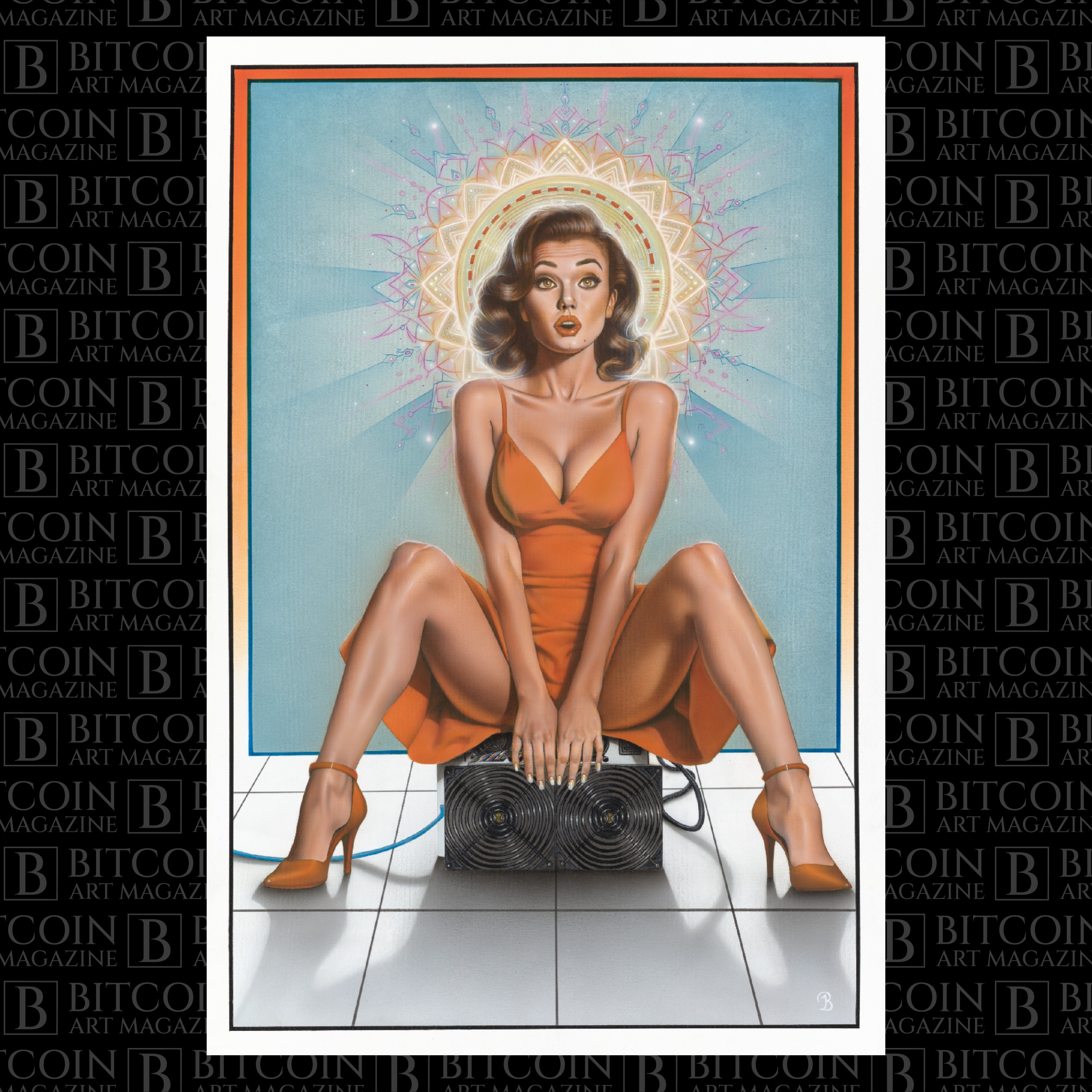
And I'm going to go ahead and share the post up in the nest here, so anybody listening
can see what we're talking about.
What inspired you to finally make some Bitcoin art, because you've been collecting Bitcoin
art for a little while now, and like the bulls as well, right?
So you're very familiar with the space, and you're a very talented artist yourself.
What was the, what was the, you know?
You know, first off, thanks everybody for joining, I appreciate it.
You know, seeing all the Bitcoin art and artists out there, you know, well, first off, let
me step back a little bit, I had taken a little time off doing art, you know, like I mentioned
before in the last one, I got three sons.
My wife is in the, she's in the corporate world, so I kind of took on the role as being,
you know, you know, I'm not going to say the stay-at-home dad, but more so taking care
of my kids when, you know, the after-school activities, and you know, especially when my
kids were younger, I was a stay-at-home dad with them.
So you know, I shifted my focus from, you know, instead of, you know, having my kids grow
up in daycares or, you know, having other people watch my kids, me and my wife had a conversation,
a real conversation about, you know, that just, we didn't think that that was the correct
way to go about it.
So I kind of put my stuff down.
I'm not going to say that it was a bad thing.
I've been, you know, I've enjoyed every minute of it, but it was one of those things that,
you know, I still did projects, you know, I still have clients and I've done projects
for clients when they came along, but for the most part, it was one of those things.
I kind of shifted my focus from, you know, you know, full-time art to, you know, full-time
art and study and understand a big coin, which I was still, the beauty of being a stay-at-home
dad is it allowed me that option, you know.
So that's what, go ahead.
Real quickly, you and you were a full-time artist before?
Yes.
Yes.
I actually owned my own company, I owned a business doing, so, you know, yeah, I owned
a company for many years doing art work, doing projects.
This is where I, you know, this is where the airbrush and aspect of it, because, you know,
just like any other art tool, any other thing to create art, airbrush, I consider it just
a tool.
It's a tool just like a paintbrush is.
When you know how to use an airbrush correctly, you're kind of combining all the worlds together
where you can use it as a pencil, you can use it as a paintbrush, you can use it as,
you know, and say a paint gun, but a very small, you know, you're able to layer paints and
do certain things with it that, you know, over many years, I'm not going to say I perfected
it, but I got decent at using it.
And my old business used to be, well, yeah, I, I didn't necessarily care for, you know,
I'm not going to say I didn't care for the business, but I got into a business because
I knew there was money to be made in it.
And what I used to do is I used to do high end kind of the highest and some of the highest
and stuff in Texas, airbrush and doing, you know, motorcycles, doing boats, doing, doing,
you know, any, you know, murals, any big projects that, that, you know, that, that people
would, you know, that I knew that I could make a living off of, so I've, I've seen a photo
of an airplane that you did.
Yeah.
So the, is it okay if I tell this story?
Is this, you know, some of you guys might like this story, it's actually a, yeah, yeah,
you know, I want to, I want to hear all about it.
So, so I, so I wasn't, I was, I've never been a, you know, growing up, I, you know, I
never was interested in the military, I was never interested in, in doing anything like
that.
One thing that I was always interested in was traveling.
And I've been able to do a, a good amount of traveling, I've did some traveling in my
earlier life.
My family liked, you know, we used to go to Mexico all the time, we used to, you know,
I've been to Italy a few times, and, and my, I have, you know, my three brothers at
the time were, they were, they had all joined the military, they were all in the Navy.
And every time I talked to them, they were living in a different part of the world.
They were in, you know, in a, traveling to a different part of the world.
And I was, I was actually doing this kind of, I was doing the, doing the airbrushness
because I, I started working for myself with all this when I was about 20 years old.
I worked for a company and they realized that, you know, just being a little more business
savvy with it, that I could, you know, I could do this myself and I could get my client
tell.
And so I was, I was doing that for, for many years.
And I just, for me, I realized, you know, I kind of came to a point that it was just like,
well, you know, I could keep doing this or I can kind of shift gears and try something
new.
So I ended up going into the Navy.
I did about four years in the Navy.
Again, wasn't necessarily a military guy.
I got into it for the traveling.
But you know, what, it allowed me some really cool things.
One, I, I lived all over the United States for the first year.
But then I lived in Hawaii.
That's where I was stationed.
So I stationed in Hawaii for, for almost four years because I, I, I, I was in a little
over four years.
You were, you were, you were on a, you were on a Wahoo?
Yes, I was on a Wahoo.
I lived in Honolulu, but I worked in Kaniyoi.
So Kaniyoi Bay.
I worked, I was in the Navy, but I was in aviation and I worked on a Marine Corps base.
And kept my, kept me as an artist quiet.
Never, you know, I had a job to do out there.
I never really told anybody about my artwork, about the work that I did.
But when people came over to my house, you know, I had paintings.
I had things that I'd done on my walls.
And we went out for, you know, one of the great things is it allowed me an opportunity to
do some travel.
And because I ended up, because I wasn't stationed on a boat, but, you know, I worked on helicopters.
And the way that it worked is when, when a boat from Pearl Harbor went out, we would
get, you know, if you were on a, a detachment, you would get to attach to that boat.
But you wouldn't do anything with the boat.
You would just maintain the helicopter on the back of the boat, the flight line.
And so we went on a deployment, went through Southeast Asia.
So I got to go to, you know, 13 different ports.
I got to go to about nine different countries when I was there.
Got to do a lot of really cool travel and see a lot of really cool things, collect a
lot of, a lot of cool stuff from different countries.
And what ultimately brought it out that I was an artist was, you know, you, you did
the thing that when you were on this detachment, you, the side of the helicopter has a, you
know, it's a thing called a son of a recover, but it's essentially a piece of metal that
goes on the side of it.
And basically each detachment that go out, they would design a certain theme for the detachment.
And I had, you know, not known if I was going to use it, but I had brought my airbrush.
I brought some art stuff with me and just in case, just in case I was bored.
And if I wanted to do some stuff and did some, did some artwork on the, on the boat.
But then I ended up designing this, the design and the son of a recovery.
And when you get back from the deployment, it goes up on the wall at your command.
And that's when people like saw, like, wait a minute, you do, you, you do art.
And I was like, yeah, that's, that's kind of what I did before I, you know, that's what I've done my whole life.
This is kind of, you know, the, why didn't you say anything, blah, blah, you know, not sure that it would have
mattered by any means, but, but I got approached by, by the commanding officer, my command.
And he basically, basically was like, Hey, we got, we got a helicopter that, you know, if you're
interested in it, you, you know, you can go work for yourself.
But would you like to design one of these helicopters and do some work on it?
I was a little hesitant at the beginning, but ultimately I got to go work for myself.
And so, you know, ultimately I said, yes.
And ended up doing, you know, I've always liked to try to tell stories with my, the work that I do.
What I tried to do with the work that I did on the, on the helicopter was because I was,
because I was stationed in Hawaii, I tried to give homage back to the, to the Polynesian culture,
try to use all the details that were surrounded me, every, everything that I saw all every day.
So, did, you know, did a Polynesian theme to it with, with a Hawaiian warrior on it.
But, you know, the military is the military.
And, you know, like I said, I've never been a military guy.
I've kind of always been a, a rural breaker.
I've always been kind of a, a vigilante in an aspect.
And, you know, throughout my years in art, one of the things that I've always liked to do is I like to hide art within art.
A lot of times I would hide art in projects and, and not tell anybody was there,
but just more so for, for me, I guess, in one, you know, to, to kind of get a, to get a laugh out of it or to put a little bit of,
say I was having a hard time with a customer or something, I would hide something in it just so I can, you know,
kind of get my giggles when I, when I saw the artwork.
And, so, you know, through the bureaucracy and through the, the, the red tape of how military goes.
You know, I can't say that things were running smoothly with it as, as I was, one, I was supposed to be in help with this helicopter because this was a, you got to keep in mind.
This is essentially a Black Hawk helicopter.
And, if any of you guys have ever been around a Black Hawk, these are, these are massive, you know, these are massive pieces of machinery, you know, pieces of equipment.
And, essentially, I found myself doing this thing all by myself.
You know, so, you know, just, just being able to have, you know, say I was doing work on the tell or something, but just having another person say, hey, hold this piece of tape and go down there so I could do a straight line or, you know, or do some, some masking paper with it.
I really didn't have that option.
So in, in essence, after a while, I found myself kind of getting.
Take an advantage of what, take an advantage of doing it, not going to say I became bitter, but, but at the same time, I, you know, I let my vigilante ways kick in and.
And so I did this, I did this whole, you know, because basically what it was is it was retired helicopter and the hell, what that means is the helicopter.
No, it's, it's done all the flight hours that it can do.
So essentially, they say that the structural mechanics of the structural frame is no longer usable.
So what they do on military bases, if you've ever been on one is they do a thing called like display, you'll, you know, display aircraft.
And that's when you go on to the base, you'll see, you know, aircraft that are that are on display.
But just, you know, not working, but as you come, come into the gates, you'll see them kind of on the sides of the roads.
And so essentially, this is what was going up.
This is what this helicopter was doing.
And my understanding was that like, Hey, this, this helicopter is going to be as soon as you're done with it, it's going to be going out.
They say go out, it's going out to the line.
It's going out towards supposed to sit for the rest of its time.
So I was like, all right, you know, and not to mention that these, you know, when you get to certain parts of the helicopter, when you get to the, the back tail of the helicopter and you get up to the, the rotor on the back, it's, it's, it's pretty high.
I mean, you know, you're looking at probably 12 feet up, you know, it's, it's, it's, it's pretty high off the ground.
So I decided to, you know, I was doing all this work on it, and I just decided from my own personal thing that I was, I was going to do, I was going to have a little fun with it.
And so, so I went in and, and on this Hawaiian warrior, what I did was, because the Hawaiian warrior had a cape on and the cape.
There's folds in the cape. And so basically I made it seem like the Hawaiian war, because essentially the, the command I was at, it was a submarine hunting group.
It was an EMS group. So they did search and rescue, but, you know, one of their, one of their jobs was to do submarine hunting off of Hawaii, or when it got detached to a boat, kind of do the same thing.
So the symbology that I used was, you know, a Hawaiian warrior, basically being, you know, the helicopter or the, you know, the ammunition that had on it.
And it was, it was coming down the side of the tail with the, with the spear. And on the tail, there was a, I, I designed a hammerhead shark.
Because if you know anything about Hawaii, Hawaii, especially if you're on the, the westward side of, of a walk. So there's, there's a mountain range that cuts in between.
And then you got the leeward side, which is Honolulu and everything. And then you got the westward side that is connoi, you know, place called Kailua.
And that's the more tropical side. Honolulu, Waikiki. It's not, it's Hawaii, but it's more commercialized. You go to the other side.
That's where you, you get a lot of the pictures and understand of kind of how Hawaii is. So a lot more rain, you know, a lot more palm trees.
But in the Bay, so there's a Bay called Kaniyoi Bay. And it's actually the, it's one of the most important hammerhead breeding grounds in the world.
It's where hammerheads naturally go to, to breed and basically have babies. So there's a lot of significance with hammerheads there.
So I, you know, wanted to make sure that I put that in there as well. So I put that essentially him coming down spear in a hammerhead.
But as I did the hammerhead, I kind of use Polynesian artwork. If he's ever seen Polynesian artwork. And I did it kind of in a design fashion where the, the colony, the artwork, the Polynesian artwork was more of a graphic, but as it got closer to the tail, it turned into a realistic look in a hammerhead.
And so he's coming down and he's spear in this hammerhead. And in the, in the tops of the, at the very tops of the tail, there's, like I said, the Hawaiian warrior had a cape on.
And the cape had folds in it like he's jumping down and it's blown in the wind.
Me being the smartest that I am, I kind of decided to have a little fun with it. And what I did was, because I, I essentially, you know, I didn't think anybody was going to see this.
You know, and I thought that I was going to keep it to myself. I thought that, you know, it wasn't going to be, you know, it's going to be, I'm going to hide it well enough that nobody's going to see it.
And this is something that, you know, as I see it over the years or whenever I see it, I can get a good laugh out of it.
Well, what I did was, in the folds of the cape, I actually airbrushed, will say a female anatomy, you know, some, some, some vagina's in it.
And just, you know, just, just have it a little fun with it, I guess.
And I tried to hide it well enough within the folds of the capes that, you know, it just, you know, nobody would, you know, you wouldn't, you wouldn't see it.
It's high enough up there that, you know, just something that, you know, I could, I could get a laugh out of what not.
And so at the time, you know, my wife was pregnant. We were just about to have our first kid, my first son.
And they, well, that's essentially what, why I was kind of being a smart ass with it because I was, when you, when you have a kid in the military, they give you baby leave.
And I was just, we had just had my son and I was supposed to be going on leave.
And the command said that I couldn't go on leave until I finished the helicopter because they were, they were, you know, they, they had to get it out to this spot.
And they gave it out to the line and, you know, all the, all the, you know, all the, the nonsense that goes along with that.
So essentially, I was, I was a little upset, but that's what, you know, one of the reasons why I decided to have a little fun with it, just kind of my little way of joking with it.
And I finished up the helicopter and I went home and one of my buddies that I had been on a deploy before I finished it up, one of my buddies who was one of my really good friends who I was on deployment.
He had come and he had come over because I was in this giant paint hanger, a paint hanger that, you know, was the size of a football field that, you know, 30, 40 foot ceilings in it.
It just this massive building, you know, that they would go and do aircraft in.
And so I was working for myself and there and he had stopped by one day.
And I had just pointed out, I said, what do you, you know, because I had a, I had a stand and everything up to it where I was doing the work.
And I had him come up and he was looking at it and he was, you know, enjoying it.
And I said, you know, what do you see, you know, and, you know, he didn't really notice anything. And then I pointed out something to just kind of smiled at him.
And, you know, apparently he thought it was the funniest thing in the world and we just kind of had a laugh about it kind of joke about it.
And I left, I went on, I went on leaves.
And I'm on, I'm going to, I'm about two weeks into my leave and I get about a week and half into my leave and I get a phone call.
And they, you know, from one of my buddies that worked that I worked with and he tells me, he says, hey, they pulled that helicopter into the, the command.
And it's sitting in the middle of the command and, you know, there's a bunch of people down here and they're all, they're all looking at it, but they're pointing at stuff on it.
What's going on? And I immediately got ghost white. I was just like, oh, no, I go.
Oh, shit. What? I'm like, there's no way. No, nobody knows anything about this. I'm not going to.
I said, look, I'll be down. Let me put all my stuff. I'll come down.
And so I come down to the, the command I drive across the aisle, because I lived in Honolulu at the time.
And I came down to the command and sure enough, when I walk into the command, because the, the paint that I had used, I had used some, you know, some, some high end, some high end paint
that had metallics and pearls in it for the, for the main color. And those colors are meant to win the sun shines on it to, to have a brilliance that comes along with it.
And so I come down and the hanger doors were open and the sun was shining right in on the helicopter.
And right when I looked up and, because not only that, but it wasn't on these stands anymore, they had taken it off these stands and they had put it on the ground and pulled it into the helicopter.
So it was a lot lower to the ground. I wasn't expecting any, any of that to happen. And so when I came in the doors, I just see a, a beam in, a beam in light source to shootin' in.
And it's like highlighting one of the, you know, one of the anatomy parts that I put on there. And I was just like, oh, no.
And I immediately went up to, to, to my buddy and I said, dude, did you tell anybody what I showed you? And he just got the biggest smile on his face. And he's like, dude, I couldn't help it.
And I was like, oh, no, no. And so, you know, it kind of, at that point, it kind of spread like, like wildfire.
And I was, you know, I was backpedal in trying to figure out, because this was already all painted and there was clear coat over it, you know.
So there was no, I mean, it was underneath. There's not much. I couldn't just erase it off, you know. And so I was, I was like, oh, my goodness, what do I do here?
So I kind of backpedaled a little bit and, and was stressed and big time about it. And, and ultimately, you know, because it spread like wildfire once, once somebody saw it is like, you know, is like, I'm say, lookin' at a cloud, but as soon as somebody saw it that way, you know, everybody pointed it out.
And I, you know, I, I didn't know what to do. You know, this is the first time that it happened to me and, and, you know, I was a little, I was a little embarrassed, but at the same time, I was, you know, I was in damage control mode.
And so what I did was, you know, I went back on leave and, you know, just hoping that this doesn't get to anybody significant within the command.
And at that time, we had changed our commanding officer. And so a new guy had come in and he was a real gun hoe, gun hoe, you know, officer guy.
And, you know, I'm workin' one day and I see the, I see him in a few other high up people in my command come down and start lookin' at the tail of the helicopter. And I was like, oh, no, this is not gonna be good.
And sure enough, I got the call like, hey, you need to go up and talk to the, to the CEO. And I was like, oh, no, here we go.
And so, went up, had a conversation with him. And he basically was like, you know, it's come to my attention that there's, you know, some, some stuff that might not be necessary on this.
Yeah. And, you know, I was, I was back pedaling. Like I said, I was, I was in damage control mode. I was, I was, you know, I was speaking on my ass trying to, trying to say.
And I initially came up with the, you know, with, that's where I came up with the analogy of, you know, it just came to me at that time. But I said, sir, you know, I know what people are talkin' about.
But I, I like to think that I hit them good enough in this thing that I was just like, you know, to me, it's like a cloud. I said, it's like once somebody sought that way and pointed it out that way.
It seems that people have laughed onto that. And I get it. It's a funny idea. You know, it's, it's an inappropriate idea.
You know, funny, I guess to me, but, but, you know, as, look, whatever you need me to do, you know, I'll take care of it. You know, so essentially I made him come down to the helicopter.
And I made him point out every one of the ones that he thought it was of a giant on there. And I had to put a piece of tape over each spot.
And I said, look, just, you know, send me back over to the pain hanger and I'll fix everything. So, which was good, which, you know, on the flip side, it was good because it allowed me to go back to work for myself.
So, you know, I essentially went down, had to send everything back down and, and fix, and fix what he, what it was that he found.
Now, I can't say that he found them all, but whatever ones he pointed at, I, I'm sure I'll fix that, sure I'll fix that.
And so went back, fixed it, you know, long story short is that helicopter is still in Hawaii to this day.
All that artwork is still on it, still sitting there. And yet, you know, so I like to think some of the things are high enough up there that, that only, you know, only I could point them out.
But, but yeah, it's, I probably shouldn't be saying that. I mean, it's on a military base, but I guess, you know, no longer in the military, so haven't been for a while.
So, yeah, I mean, essentially, you know, they were, you know, I did as much damage control as I was definitely caught, you know, that, that was one of the things.
But it wasn't bad enough because, you know, ultimately it wasn't bad enough because they came to me again and want to meet the design and other helicopter forum, which I, which I did.
And I did the, the command helicopter forum, which is still on the base that they used for their command to this day.
And when I posted pictures on the, on your, on the telegram chat, that was the one I posted pictures of. I didn't post the pictures of the one that I got in trouble with.
Oh, man.
Oh, yeah.
That is, that's hilarious. That's awesome though. So, I mean, I guess, yeah, I like and say is thank you for your service.
I appreciate it.
So cool.
Fucking a dude.
No, that's hilarious. That's, that's really cool, though, that, so you've been making art for forever, basically.
As long as I could hold the pencil, man, I've been, I've been drawn painting.
As far back as you can go, I have a, you know, I've, you know, was fortunate enough.
I won art, won some art shows, have some of the motorcycles that I've done, some of that.
Because essentially the ones that I would do is when people were doing, you know, I'd say show bikes or, you know, had custom bikes and they needed.
You know, they wanted a kind of the highest end stuff. They would, they would bring it to me and, you know, I've been fortunate enough that there's, there's magazines out there that have my stuff on the covers of them and, and one mini,
many custom paint shows or custom art shows with those.
So I got, got a few accolades under my belt when it came to all that and I'll just kind of get a little bit because ultimately that brings me back to what I was talking about with own in a business.
Is when I got out of the military, I always knew that, you know, there's, there's an industry here.
You know, I know that I can do it and kind of within the first year of me getting out of the military.
I opened up a business and started doing this stuff and, you know, did that, you know, I had a partner.
I went in partnership with the, with another artist to own a building and kind of did that for, for many years.
Ultimately, you know, ultimately I, I have my ex partner buy me out.
One of the things that I did not enjoy as somebody that tries to be healthy, somebody that is, you know, somebody that, you know,
tries to live a healthy lifestyle, I guess.
One of the, one of the, one of the worst sides of being in that industry is, is a lot of that paint is super toxic.
You know, you get into, you know, the, the urethanes and the, and the stuff.
Yeah, it's just, you know, the lacquer and stuff.
And it's just a super, super toxic, you know, environment to be around.
And, and I had, you know, you get to the point that you're doing this work and you don't even notice the smell of,
because ultimately when you're doing stuff on, on a lot of the stuff, you, you want to, you want to, you know, do it with certain paints that come out of certain ways.
So, ultimately, I couldn't even get to the point that I could smell it when I was using it.
And, you know, I had, I had another son in that time and, you know, as a, as a young dad and young kids, it just, I just got to the point that it was like, look, I, I don't know if I enjoy doing this.
I know that I can do it. I know, know that I can do it well, but at the same time, I think there's, you know, there's other avenues that I can do, or I can go doing this.
So, that's where I, I kind of switch lanes, you know, it was right around that time that, you know, me and my wife had that discussion of, you know, you know, kids and daycare, me doing projects, you know, all over the city for, for, for different companies and always being out and about.
And we just kind of game to that point that was like, look, we can either have the kids grow up and daycares or, you know, would you be, you know, she approached me with the, with the options.
I would you be okay with being a stay at home dad and kind of doing, you know, doing the dad thing and taking care of the kids, which I was, which I was totally up for, which I did.
But ultimately, that's kind of, you know, dad mode took over. Like I said, I would still do murals for businesses and, and clients, you know, around the city or, you know, there's a lot of different cities that I did.
And, you know, but my focus kind of shifted from, from, you know, art full time to, to doing, to doing the dad thing.
So it's kind of what I did and that's, you know, that's ultimately, you know, got into big coin right after I sold my, my company, which it wasn't, don't think it was anything massive, but, you know, the company.
But, you know, I had, you know, I had had my partner buy me out and what little money I did have. I was like, you know, I had learned about big coin prior to that.
You know, it was interested understanding it and kind of decided to kind of go full bore into understanding and learning and studying and just, you know, what is this?
What, what is going on with this? You know, what does this mean? And, you know, what, what are the technicalities behind it?
And, you know, so being a stay at home dad, it allowed me the opportunity to kind of dig into it a lot deeper.
And, and, yeah, man, so started, you know, was convinced, was convinced after all.
So I started putting my money into it, started, you know, kind of just collecting and, and, you know, had ideas, I have always had ideas of what it is that I wanted to do.
You know, had ideas lurking kind of with, with Bitcoin art and, you know, you know, before the space really got big.
But never really pulled the trigger, I guess, on a lot of it.
Just, you know, this last painting is just kind of, I felt that it was the right time for me to, you know, like I said in the last one, you know, I've seen the community through it.
I've always enjoyed art. I've always enjoyed people putting themselves out there.
And, you know, it's like, you know, one of the things that I can do is, you know, you know, when I, when I see people doing great work, I mean, one of the things I can do is help support that.
I can help support this, this movement, this, you know, this, this art revelation and the revolution in the Bitcoin space that's going on.
And just, you know, do what I can, what little means that I have.
But, you know, I saw a lot of people doing a lot of great stuff, you know.
But I also enjoyed the collectibles part of it.
You know, I enjoyed, you know, the work and the tangibility of the other stuff.
Like I mentioned before, and really enjoyed the, you know, just, just, I enjoyed everything about all of it.
But, you know, just as time has progressed, you know, things here and there and, you know, get into the point to see where it's at now.
It's just, you know, it's really cool to see.
It's, you know, yeah, it's just, I love to see how big this space has grown.
I love to see the creativity that people have brought to it.
I mean, I love to see the proliferation of all of it, you know, it's just, it's gotten really cool.
It's gotten really interesting. And a lot of, a lot of the work catches my eye.
And, you know, it's kind of a, a, a dual fold there where it's like, you know, I can, I can collect it.
But at the same time, I'm, you know, I'm, I'm helping out somebody, helping out somebody else who's, who's actually creating our work, you know.
So, yeah. So you've got, if anybody doesn't know, stack it, runs BTC collectibles community here on Twitter.
So join that if you're listening. You can find it by going to, going to your little menu and going to communities and searching for, I'm doing it right now.
I think it's just BTC collectibles community. Is that right? Yeah.
So make sure you are joined there. If you're listening to this and you like Bitcoin art or collectibles.
So tell me, did you were, were you ever into collecting stuff before Bitcoin?
My whole life. And yeah, that's been, you know, collecting, you know, like I said, when I was younger, grew up in a time when garbage fell kids were a big thing between me and my brothers.
We were, we were always trying to get the atom bombs. I mean, that's a, that's probably the reason why I have the character as my profile picture is just I've always had this infatuation with atom bomb.
Got into collecting, you know, baseball cards and football cards with my brothers and comic books, man, we're, we're big comic book collectors when they were first coming out.
So, you know, always had a collectors mentality, I guess, you know, toys, things that, you know, the things that not everybody else had are the things that we would be going after.
But yeah, so it's, it's, you know, just turned into a childhood thing to now I'm still a child that hard, I guess, when it comes to it.
So, it's interesting. I feel like Bitcoin and collectors, there's something that, that people who enjoy collectibles or that collect stuff as hobby seem to, I don't know, I guess there's, you know, there's parallels with Bitcoin and understanding of what Bitcoin is.
And kind of, in a lot of ways goes hand in hand, you know, stacking and hodling and, and it's interesting that the correlations there, but, but yeah, so then did you, so as far as Bitcoin collectibles, did you get, would you say that you started that, I mean, so did you start collecting Bitcoin collectibles or Bitcoin art first now collectibles are, you know, I would say a category of art.
Yeah, but it was the collectibles first. I think the collectibles came before a lot of the art, because I was spending time on Bitcoin talk and just seeing a lot of the cool stuff that people were coming out with.
You know, and so it started with the collectibles. Like I said, I like the the all encompassing, I mean, you have a great point with, you know, it's Bitcoin and collect this, there's a mentality that goes with it where it kind of, it kind of fits a, you know, a bunch of different groups, but it kind of can joins all of them together.
And so it was only natural that it was like, you know, I was into Bitcoin and then collectibles and, you know, you almost fill in two urges at the same time, but, you know, to me, it was a much more meaningful, meaningful thing, you know, like, like I mentioned on the last one, you know, bring in rare metals aspect into it, you know, gold and silver and then combining that with Bitcoin.
Bitcoin, having it tangible, you know, you know, it just seemed to me like the best of the best of worlds and yeah.
So something that just goes hand in hand and there's something super cool. I think a lot of us are drawn to as far as the physical aspect, especially I feel like a lot of those of us.
You know, of course, the NFT space is what it is and everything, but those of us who have a little bit of, you know, maybe more of an intention that Bitcoin is not a pathway to a more digital world, but a pathway to a, in a lot of ways, maybe less digital world, or the option to be able to live one foot in and one foot out of this fast approaching, very panoptic.
You know, or well in in many ways, but this, you know, hyper technique, technical or technological world, that is, that is, that is upon us really and looming more and more so every day.
And then a physical Bitcoin, you know, collectible, whether that is Bitcoin trading cards or coins or notes or Bitcoin art, there's something, there's something grounding and something that.
I don't know that I have a there's some feeling of something physical that is also related to Bitcoin, which is this, you know, massive rabbit hole of of amazingness and wonder and ultimately something that people collect and then that kind of all ties back in the money and and you know items of value that people have collected for ever since the dawn of time, starting, you know, whether it's seashells and glass beads or bullion or just nice stuff.
Okay, so yeah, I don't know is there is there anything that you wanted to ask the more questions for you, but is there anything that you wanted to that you wanted to mention or announce or talk about and specific or or anything before I ask you some more questions here.
Go ahead and I would like to, you know, like to explain a little bit of, you know, you know, the ideas that I've had with because I've got, I've got a few, few different ideas, I'm, I'm working on my next project, putting it together now and kind of explain a little bit, you know, you know, what it is that I'm going after with, with the style of art that, because this is all the art, this last project that I posted, it's, this is all stuff that.
This is nothing new to me, this is all, this is all art that that I've enjoyed my whole life, you know, since growing up, you know, so to me it's just trying to tell a story with with what, you know, because I make artwork that that I like, you know, it's great that other people like it, you know, and I think that.
As time progresses, you know, there, there might be a little.
I'm going to say shock value to it, but, but I like, I like being a little edgy with stuff, you know, and I've, I've, I've always been that way, you know, when it comes to the type of, you know, I've always loved anatomy, I've always loved female anatomy, melanatomy, but.
Specifically, you know, I grew up on pinup art, you know, and that's, you know, that that's something that, you know, goes back is, you know, as far as I can remember, just love in that style of art, love in that, you know, that the 60s or the 50s, the 60s style of woman with her hair with their clothing that they wear the poses that they're in.
There's just something, you know, very simplistic about it, but at the same time, very beautiful and elegant about it.
And, and, you know, what, you know, for me, it's like taking the old, the old school and, you know, and combining it with the new age, you know, this is where you bring Bitcoin into it.
That's where I thought it was going to be a perfect match is because, you know, you're bringing the old world and combining it with the new world, and you're finding a bridge, you're, you're finding an elegant way to, to bridge that gap and to present it, you know, and.
And at the same time, I tried to tell a story with it with as far back as I've been doing our work, it's my, my stuff has always been trying to tell a bigger story, you know, you know, I've explained you a little bit through our messages, but it's like.
You know, doing doing something that do it in a way that, you know, it might tell me a story in a certain way, but ultimately I wanted to tell you a story in your own way, you know, and I want you to not be able to just look at the piece of art and just sum it up.
I want you to stop for a second and analyze it.
And usually the way I've, the way I've always done it is, you know, like I said, I've, it's not always been vulgar stuff that I've, but hiding pictures within pictures within pictures.
And so it's, it's one of those things that, you know, if I can, if I can lock you in for a minute instead of just walking by and, you know, see, you know, like in an art show, seeing all this different art and kind of just summing it up, if I can get you to stop for a second and analyze it.
And then when you start analyzing, you realize, oh my God, there's more going on and you start seeing more and more stuff.
You know, it allows the imagination to move a little bit, you know, it allows allows a, you know, especially if there's some kind, if there's a little bit of emotion behind.
But what it is that you're presenting, it invokes an emotion, it invokes, you know, curiosity, but it also invokes the imagination to, you know, whether it.
You know, you can relate to it to a story in your life or you can, you know, or you just want to dig into the work to try to find the, the stuff that I've hidden into it.
Either way, it's, you know, it's, you're, you're, you're using art correctly for the sake of art at that point, you know, you're using it to, to get somebody to forget about everything else for just even just for a few moments.
And to get lost in translation with, with what it is that they're looking at, you know.
Yeah, well, I, I would say as far as, you know, combination of subject matter and, and bridging the old world with the new this, this piece that you just did on minor is, is just absolutely, it's just an amazing piece of art.
I, it's interesting. You know, I, I just did a two year tattoo apprenticeship and the focus on geometric tattoos.
But, you know, of course, I had to study a bunch of the OGs and so, you know, the, so I'm, I'm recently familiar with all of the, the pinup style and, you know, some of the Salary Jerry stuff.
And, and, and, and the other, other OGs.
But, yeah, no, I love how you've combined.
I guess what I want to say is I really appreciate and, as now, I mean, I've been, I just, I just went ahead first in the Bitcoin art.
I think it's almost been now three, three or four years now.
I think almost four years now. But, I really appreciate the way that you have so eloquently combined in, in this piece that you just made.
I like how you've, you know, I just, I like that you've combined, you've combined subject matter and you've, and you've created a piece of Bitcoin artwork.
And, it, it's not obvious. It's not, it's not just a bee slapped on something.
And now there's, you know, there's a lot of, a lot of people that I think come into Bitcoin art.
And, they just, they're super excited and, and inspired or, you know, they want to, they want to make Bitcoin art.
And, I was one of those and I just kind of went after it and it was a little bit clunky and rudimentary at first.
And, and, and just the obvious and that's, and that's okay. But, I've got a lot of respect for like someone like you who comes in and makes something that is, you know, combining your history, your artistic talent and your, your previous stylistic, you know, I guess subject matter and just, you know, vibe with Bitcoin in such, such an amazing way, which is what I feel like you've done with this piece on mine.
And, you know, it's a piece of Bitcoin art, but it's not overtly or obviously that at first. And, and I think that that's very clever in that, you know, I, I saw it and when I first saw it and saw it and you were working on it, I was like, oh, this is amazing. We got to put this in the magazine. So I'm really excited if you're still down to feature this in the, in the next issue.
Yeah, of course, of course, it's here is a week because I am, you know, it's now that I've been curating the magazine, I'm like, you know, I'm getting more like a little more analytical with like what, you know, and always asking the question, like what is Bitcoin art and like looking for good Bitcoin art kind of.
So I'm really excited about this. I think you've just done a fantastic, you're obviously extremely talented, which is, which is, which is fun and cool because you have, you have been in the space as a collector.
You've got to my pieces and I've seen you around for a while now, but I've just thought of you more as a collector. You had shared some of your, your art.
I remember with me that you've done in the past and I was like, oh wow, you're like super talented and I remember a while back asking when you're going to do a piece of Bitcoin art.
And, but I have a lot of respect that you kind of just waited and you, you were like enjoying the collector side of things and just observing the space and stuff.
And then, you know, you can't, you came out with your, your kind of debut Bitcoin art piece here in, in just such a fantastic, just such a fantastic way, in my opinion, as opposed to, you know, throwing, because I'm, you know, throwing some bees on stuff, which is, you know, I try not to hate on it too hard, but like a lot of people come into the Bitcoin art space.
And they just start painting Bitcoin bees or just adding Bitcoin bees to stuff. And there's a lot of great art that's done that way. That's awesome. Like no, no shade on anyone, but there's definitely a, I, I definitely, you know, think it's, you know, like, like, like finding the creativity of going, you know, there's a lot of stuff in Bitcoin that relates to Bitcoin.
It's not that hard to, you know, make a piece of Bitcoin art that is, that is, that is Bitcoin art, but isn't overtly or obviously so.
So I just, I think you combined Bitcoin and you've combined, you know, your, your styles and your medium and, and a whole another world of art, which is, I really special because it's the most trojan horse of Bitcoin art in my opinion, because you can, you know, you've taken a whole genre of art.
Let's say in this case, it's, you know, airbrushed pinup girls on motorbikes and airplanes and freaking helicopters and, you know, there's, there's a whole world of that that I know of that's, you know, that's really cool and also, you know, ties into a bunch of other, like, you know, even the tattoos, like, you know, old school sailor tattoos.
You know, there was a bunch of those on, on the base back in the day out in Hawaii and stuff, you know, and so you've taken it like a couple, I feel like world of art that have been around for a long time.
And then you've combined it with Bitcoin and just a very, a very eye catching and powerful way.
I appreciate that. You know, I think I agree with you totally on no shade on anybody else's work, but a lot of it's redundant, you know, it's just kind of like this.
The same styleized theme that you kind of see done in different ways and, you know, some people are very clever with how they do that.
Great. And I, and I love, and I love seeing it. But what I've, what I enjoy is I love seeing somebody style.
I love seeing somebody that has a certain way of doing things and they kind of stick to that style, you know, it's not like, yeah, I'm going to do it about Bitcoin, but I'm going to do it in a way that isn't, you know, is in the language that I speak in the art that I speak and do it in a way that, you know, it doesn't have to be.
It doesn't all have to have some shock value to it. But when somebody does it in a way that makes sense to them, I can relate to that. And I really enjoy that, you know, you know, one of, you know, I see that aerials in here, you know, one of the things I love about her work is, you know, her use of gold leaf in what she does.
I, you know, I've done tons of gold leaf. I've done every kind of leafing that you can. And just to see kind of the contrast that she uses with that, I think it's great, man. I think it's brilliant, you know.
Yeah, it's just, there's certain styles and certain certain characteristics that that some people have with it.
Nothing against the digital aspect of it, you know, because there's a lot of great digital work out there, a lot of great digital art out there. But this is just me personally speaking, but to do something to have an idea and then to bring that idea to life through using your hands, hands in your mind.
I just, you know, there's just something, there's something, you know, there's some, there's a different level to it to me, because, you know, you're, you're not, you're not relying on, you know, back to Lee and, and, and being able to change things easily, it's something that if you make a mistake, you're, you're left with that mistake, and you have to do something about that mistake.
You know, I could have agreed, I just wanted to say something on that, yeah, because that bring that, yeah, that's a great, a great, a great point that you have there. And so I, you know, I'm very, I'm not the biggest fan of NFTs and one of the reasons is just, you know, I mean, just to my friend who I, a friend just with four tattoos, he just, he's been developing an app.
That's it, it's a geometric, it's a sacred geometry out, if you have an iPad, anybody here, she check it out, it's on the app store, it's really cool.
It's a super simple easy way to make beautiful mandalas and geometric shapes on your iPad, but, is that, it's, it's, it's that, it, there's a, well, I just lost my train of thought for a second there.
There's a, what was I going to say, wow, I totally just lost my train of thought, that's okay.
I just want to make go off to one of the, you know, make another point on one of the things that you had brought up and, you know, just, you know, I, I'd never announced to anybody in this space that I was an artist.
It's kind of like, you know, I guess it's the same mentality I've always had, even like going back to the military story that I, that I told is I, I don't want to talk, you know, and I've never been that way with this stuff.
It's like, I don't, you know, I can talk about being an artist all day, I could, but I would rather, you know, if, you know, I would rather have something to say when I need to say it and then just show you that, hey, this is, this is who I am.
It isn't something that necessarily is, you know, that I have to glow about or I have to, you know, try to convince you about.
It's just one of those things. It's like, when the time is right, you know, I'll, I'll present it and it doesn't have to be topic of conversation.
I don't need the accolades for it. I don't need somebody, you know, I would rather do the work for the sake of doing the work and instead of talking about it, let you see it for yourself.
No, absolutely. And that, that's, I think, you know, there's a stay humble and stack sat and there somewhere. So I, what I was, what I wanted to respond to was doing work physically and not having a backwards and delete button in the difference between physical and digital artwork.
And it's something that I experienced incredibly so in this tattoo apprenticeship that I did is like tattoos being the highest form of like no back and delete.
Like they're like the, you know, on the polar other end of the spectrum of doing digital art, which I also do digital art where I use digital tools for some of my artwork.
And there's something human, extremely human about making a piece of art that's not perfect and that there's absolutely no fixing.
And, you know, from the spectrum of being able to do digital art and just delete and then retry and delete and retry as many times as you want in the matter of 10 minutes to perfect something and also getting things down to like a vector point of resolution, which I like will use Adobe Illustrator.
And you can just make the most or like the app my friend has and make the most precise within geometric artwork, you know, the most precise geometry.
It's like computer generated. So it's to the pixel to the thousand, you know, 10,000,000,000,000, you know, 10,000 of an inch perfection.
And then there's something really beautiful and about and and something that's just human about making artwork that you cannot get to that level of precision.
And so it's really interesting and you have on the whole spectrum, you know, like in prejudice artwork, you know, you've got digital artwork that's like pixel perfect all the way to impressionist artwork or abstract artwork that's still conveying like, let's say a meaning or a message, but that if you mess up, you know, like you said, there's no back delete.
And there's just something authentic about that. And I think we're going to see more and more of like a convergence or a separation or or or a defining as digital art and AI kind of comes more and more about where there will be a lot of people that are very much drawn to like human crafted piece of art and whether that's a painting or a tattoo, let's say, and that there's some wobbles in the lines and that's actually what makes it special.
And with like, you know, I can only, you know, with airbrushing or with with painting, you know, that that's that's really real and really valid. And I just think a really important point of the difference between physical and digital art.
And I, you know, it's neither really here nor there except that something to be noted is that when someone creates, you know, a piece of physical art, especially one that's so masterfully done such as your aunt minor beat like there's, there's some magic inside of that knowing that you did that by your hands.
And, you know, you, if any mistakes or errors, which there, I don't know about this piece you just did, but usually within every piece of art, at least that I make, there's some kind of mistake or error and that like part of the magic is like working around that or working with it in the real world with your hands.
And then there's like a problem solving there that you don't really get with that doesn't happen in digital art because of that back delete.
Yeah, you know, yeah, it's there's actually there's in a way there's a, you know, there's a beauty that comes with mistakes is a lot of times, you know, some of my, some of my most creative ideas are things have happened because a mistake happened.
And I had to go in and correct that mistake and a lot of times just going over it, you have to make something with that mistake.
And a lot of times some of the most, you know, creative things that I've done, you know, something that that somebody's drawn to will be like, God, how did you think of that?
And it's like, I don't want to tell him like, well, that was just that was a mistake that that that I had to do something with.
But I've seen a lot of good things that that come out of those, you know, if you, if you're willing to work with it a little bit.
But it's not a, you know, they're, they're almost blessings in disguise. One, they keep you honest, you know, it's, I don't think I've ever had a piece of artwork where everything just goes flawlessly and everything works out exactly the way you want.
But, you know, I think there's a whole other art to, you know, when you make those mistakes, how can you capitalize on top of them?
Absolutely. And it's kind of like Bitcoin. It's a little more in some ways, a little more immutable than being able to, you know, roll, roll back the whole, the whole piece.
Yeah. There's a level of conviction and investment and physical art that I think is very powerful and profound and very human and that I think is important, you know.
One of the things that I, but I have to say this, you know, when we're talking about the digital side and these are all tools.
And, you know, you, you know, that you can all, you can masterfully use them all and you can combine them all to, you know, you can, there's certain things that you can do digitally that you can, I'd say, that ultimately you can translate into something else.
You know, that's one of the beauties of the digital aspect of it. You know, is, is it allows your options to be broader? You know, it allows, you know, now when you, I guess when you focus all the attention into one aspect of it, I, I, like I said, there's nothing against digital.
I think, you know, think a lot of your stuff. I think a lot of people, you know, a lot of other people do absolutely stunning stuff with, with using the tools correctly.
But, but they're, they're tools in essence, you know, and just when you put the time in the effort into perfect tools, that's part of the master mastery as well.
You know, so it's, it's, it's being able to, it's being able to utilize the resources that you have and utilize them at a high degree.
You know, it's, you know, especially like, like we were talking about it, if there's, if somebody has a style with it, you know, use whatever means that you need to get to the, to the idea that you, that you have.
But at the same time, you know, there's, there's benefits and everything when it comes to this, you know, if you're willing to look in, if you're willing to, to utilize pieces of this or piece, there's nothing wrong with that.
I think that, you know, this is, you know, it's, it's, it's brought into the art world. It's brought in the horizon of, and the, you know, the, the aspects that you can use to make things come to life.
And when you're doing, just in my opinion, I guess doing artwork, you know, utilize the resources that you have, you know, utilize what you have at hand and just try to use them to the best of your ability to try to accomplish what exactly it is you're trying to accomplish.
It's not too wrong with any of that. I think it's still all, it's still art, you know, every, every bit of it is still art when you use it correctly.
Absolutely. And I, I really like, I saw indelible is in here and he's been doing some screen printing, but I really like screen printing.
I think it's a, that's a great, one of my favorite kind of combinations of digital and physical is, you know, I mean, I don't know how they, I actually know I should know I don't know how they did it back in the day, but, you know, today you make a, you know, you make a lot of that is, you know, digitally done and then you will, you know, make a film.
And then it transfers from the digital into the physical and I've done somewhere at hand drawn stuff and then I've digitized it and then I've, you know, added stuff or moved stuff or worked on it digitally and then made a film out of it and then brought it back into the physical through screen printing and made, you know, so screen prints or Sarah graph prints if you want to sound fancy, but flat stock screen printing.
And, you know, a lot of stencil stuff and, and, and yeah, I, and I also I, there's a, there's a lot of amazing, you know, no, no shade on digital art. There's a lot of phenomenal digital art out there for sure as well.
And your, Android Jones is, it's a really cool digital artist. I think, I think he's a prime example of that. Yeah, kind of masterfully masterfully utilized in pieces of software to create mind blowing things, you know, that that's kind of exactly what I'm related or what I'm touching on is there's, there's so many different ways to go about this, but what I like to see is that somebody puts the work in, you know, it's, you know, because a lot of these things are.
Art tools that could make, you know, make work. I mean, now that we have AI, it's like a whole nother ball field, but it's, I think AI is such, I think it's, I think it's absolutely just evil and such trash.
It's amazing and it's amazing and wonderful too. And it was anything I think is, you know, can be used for good or bad, but it's really interesting seeing all of the AI slop all over the internet.
What a time to be alive. Yeah, I think that I think art has a way of always leveling itself, you know, I think that they were talking about the NFTs, you know, you know, when that whole thing came into the, to the crypto space, there was just a proliferation of it.
And it was just like all the sudden, these things have massive value and also.
But, you know, art has a way of, of leveling a lot of that stuff out, especially going back to your point of what you're saying, you know, about, you know, there's something eventually the, the hand done stuff or doing stuff, you know, doing stuff that takes work or doing stuff by hand or, you know, putting, putting excess hours into some of these things.
Those will always, you know, you look back at in history and, you know, you know, at all the museums and stuff and that's, you know, that's hand work, that's hand done artwork that, that people put the time in the effort to, you know, there, I'm sure there was Edwin flows of things, but I don't know if you can, you know, the, the values always going to be in the creativity part of it and the fact that, you know, because a lot of times it's not, it's not just that.
That all of a sudden you just do a painting, you know, there's a lot of hidden stuff in between that years and years and years of masterfully trying to perfect like the tools that you have to use for, you know, so a lot of the times you get to see the, you know, I'll use an example is.
When, when I would do certain projects for, say, clients and stuff that I would do them in a certain amount of time, they would always want to haggle on price wise and I would always have my, you know, if I'm doing something very high and for you, well, you got to pay, you know, you're going to pay me a certain amount for that.
And, you know, the argument always was, well, you, you know, you only spent this much time. Yeah, but what you're paying me for is all the years that I put into trying to perfect this.
That's part of the pricing that goes into this, you know, it's it's just you just thousands of hours and thousands of.
You don't, you don't just start one day and all of a sudden pump out, you know, quality stuff and know how to use these, these, these tools, these art tools, just, you know, right off the back, you know, these are things that take time and effort to learn how to perfect.
And if you put the time into them, eventually you can get better at them. You could get faster at them. You could get, but it's that it's those thousands of hours, like you're saying before that.
That have the value, the most value of all of it, you know, I mean, there are, there are some people that can pick up these things and go straight to it.
I'm, you know, I've had to put the work into these things to be able to, to try to master these tools in the correct way, you know, the paintbrush.
I mean, it's, you know, a lot of people overlook the, like just to be able to do straight lines, to do perfect lines with, with paintbrushes, you know, people don't understand how long that takes to be able to work.
That takes to be able to, you know, perfect your eye and your hand to work together to, to be able to, you know, to pull straight lines, you know, like these are, yeah, these are things that take time, time and succeeding and time to perfect.
But that's just, you know, and a line is one of those things that it's just like it's such a simple thing to look at.
But, you know, the whole, the whole training behind it, you know, it's, it's, you know, I tell people it's like riding a bike, you know, it's like when you ride a bike, you don't, you don't just look down at the road when you're riding a bike.
You're always looking ahead, you're always looking what's in front of you and you ultimately have to train your, your eye and your hand to work together to be able to do that same exact principle, you know.
So it's a tattoo and is a, is a prime example of that, you know, to, to be able to do clean lines because it's not just the clean line.
It's a, it's a steady line that doesn't have wiggles in it, but it's a, it's a line that's consistently the same size all the way around, you know, something that seems so simple, you know, theoretically looks so simple, but technically is brutally hard to do and takes a lot of time to perfect that.
Yeah, yeah, no, absolutely tattooing is a great example of that it's, it's a, I'm hoping to start to get back into it here, I kind of take been, been focused on some other stuff right now, but the tattooing is really cool.
Um, I, yeah, I think my friend said, I think actually I think it's a lad in with the Quentin card said he's got an airbrush.
He has like an airbrush kit that he was going to send me, but I haven't ever really tried my hand at air brushing, but I might, I might hit you up for some tips and tricks when I do.
Airbrushing is, you know, one of the thing, because airbrushing is, you know, you're using a needle, just like you're using a needle with, with tattooing the difference with airbrushing is, and especially when you, when you got into doing the custom paint part of it, one of the things that you didn't, you couldn't do was, was get the oils from your skin on the surface.
So there's a difference from being able to, to put your hand on, say your tattoo and, and, and run your hand on somebody and, and nothing wrong with that.
But when you're, when you're, you know, when you're trying to perfect the airbrush, you're, you're using it in a way that you're not trying to touch the surface at all.
And so it's one of those things that, you know, you've got to learn how to steady your breath, you got to learn how to, you know, because, you know, the way an airbrush works is you push down, you push down for, for air and you pull back for paint.
So it's this, it's this, you know, it's this way of, of, of known how to utilize the pressure and the amount of paint coming out at the right time. And if you do it correctly, you can get hairline, you know, affects with it.
If you pull back, push down and pull back all the way, you can use it as a broad, broad stroke paintbrush as well. So it's a, it's a very diverse tool. That's one of the, you know, it took me, took me many years to, to get to a point that, again, I don't say I've mastered it by any means, but, to, to get to a point that you can use it as a pencil, you can use it as a paintbrush.
You can use it in a lot of different mediums. There's different effects through splattering that you can do with it. There's a lot of things that you can, you know, you, it's essentially it's a tool to little, it's a little more diverse tool, but at the same time, when you use correctly, you know, it's, it's like on my painting, you know, one of the, one of the, one of the things that I enjoy is, is skin tones with it.
There's a certain softness when you use an airbrush correctly in a certain amount of glow, softness glow that, that if you use it correctly, you can mimic skin in a way that, that looks like skin, you know, you can, you know, you can, you, it, they all have their benefits, you know, paint brushes have their benefit, used in the correct way, but airbrush combined with that.
It's, it's, it's another great resource to be able to know how to use, you know, I would say, I would say you've absolutely mastered the skin tones. It's, it's like, it's funny being an artist and I, I do, I look like I'm a geometric graphic artist. I don't even think I'm, I think it's more like a designer, I've never been good at any kind of like realism or photographic realism and figures and so forth. It's something that I would like to practice more.
But, yeah, when I see something like what you created here with the skin tones, it's just, I can't even comprehend it. It's, it's truly, truly, it's a, it's a whole, a whole other level of, you know, who does amazing form is Alex.
George Boideen, George Boideen, a lot like some of his, his figures and forms and I would say that's more like an impressionist style, but there's something really special about being able to do the human figure or human form.
And then the like skin tone, I mean, the skin tone that you've got in this piece is just, it's just to me at least the someone who has no idea how to do that. It's absolutely immaculate.
Something I wanted to mention along the point of pulling good lines. Do you have you done much pinstriping?
Yeah, pinstriping is something that I did. So when, when somebody would, would bring me a project, I would do all of it.
Okay, I would do, I would do the pinstriping, I would do the gold leaf and then I would do the, the airbrush and the artwork on it as well. Yeah, pinstriping is a thing.
Very, very, and that's a prime example of what I'm talking about. Yeah, just being able to pull a straight line. And I think when I'm, when I was talking, well, when I was talking to you about that recently, just now, that's what I was referring to is knowing how to, because you got to understand every bit of pressure that you put down changes the width of the line.
You know, it's like with tattooing. So knowing how to, you know, pull things in a certain way and go around curves and have the same pressure, the same consistency with lines.
I mean, people don't understand how, how difficult that, that really is. I mean, it's a, it is a, is a brutally painfully frustrating thing to learn, you know.
But once, yeah, once you start learning it, once you start being able to do it a little bit.
But it takes time to perfect that that's the only way to do it is it, it takes time. I have all the respect in the world for pinstrippers.
If, if anybody's listening to this and they haven't seen a video of someone live pinstriping a motorcycle, you got to go on YouTube or, or get on the internet and look up motorcycle pinstriping.
Some of these guys, it's, it's, it's mind blowing what, what they're able to do. And, and it's not only with how perfect they create these lines with curvatures in them and swirls and so forth.
But then they mirror it on the other side. It's symmetrical. Yeah, the symmetry behind it. Yeah.
It's, it's, it's, I can't wrap my head around it. Like, I don't, I don't think that's something that I, who knows maybe, but I, you know, when I, when I watch that, I'm like, I don't, I don't think I'll ever be able to do that.
Like, they pool the exact, so perfectly symmetrical, same shape, same sequence on the left and right. I don't, yeah. I don't, I don't know how, how you do that.
Yeah, it's not like tattooing takes a lot of time.
Stencil tattooing tattooing is hard because it's one shot. If you fuck it up, you, there's absolutely no going back on someone's skin.
So there's like a level of intensity to that. That's like very next level.
But then you, you do use stencils that, you know, today most people at least use stencils for tattoos.
So when you're doing something that has a symmetrical mirror left and right side, you've got something to follow.
These guys with the pinstrapping a lot of them, I've seen at least they, they don't have any, they're not using a stencil or anything of any kind.
They just freehand the one side and then they just go down the other and match it.
Yeah, it's, and not only that, but they make it look easy. They make it look very easy.
Yeah, that's, that's a, that's a whole nother, that's a whole nother side to it. It just, you know, the easier they make it look is the more practice and the more,
you know, the, the more professional they are with it. So that's why they're able to do it the way they do it.
Well, well, man, what's what do you got? You got, you said you got something cooking for your next project here.
Yeah, let me ask you this. What are your plans with on minor? Are you going to hang on to that piece for a while?
Are you thinking to offer it up for sale or auction, maybe?
Yeah, I think plan with on minor and then what's your, what you, you had mentioned some another project.
Will you give us any, any insight into what you're working on next? Sure. Yeah.
Yeah, before, you know, I'm going to do, I'm going to get this thing scanned on my plan on doing that here soon.
Get a scanned offer up. You know, I like the idea of, you know, I've always liked the idea of doing a limited, a limited amount of number of prints.
That I'm going to do the, because this is a, a 24 by 36 canvas.
And I'd like to do pictures that same size that do a number to mount and, you know, have people, you know, if they, you know, if they're, they're interested in collecting it to do it that way.
Ultimately, before I think I auction this off, I think I have a, you know, I would like to get a few more projects under my belt.
To kind of, kind of show my style a little bit more and, and kind of, you know, what I have to say.
And, and if the interest is there and, and, and people are willing to bid on it, yeah, I think that ultimately I would auction it up.
But, you know, if somebody, if it speaks to somebody and they, they, they, they want to own a piece of it, I'd like to, I'd like to be able to offer that up to them.
And, you know, the, one of the things that you're going to notice with, with my stuff is like I, like I said, I, this is all, this is, this is, this is, this is artwork that I would like to own myself, you know, this, this is why I created.
I, I think I don't create the style that I do for, for everybody else.
This is truly the type of artwork that I've enjoyed my whole life, you know, and bridge in the old world with the new world.
But, but I also like the, the, the risk a factor to it. I always like kind of, you know, flirting with that edge of, of sexuality with it in a way.
You know, try to do it in a, you know, especially if you're doing pin up, because, you know, pin up is always, if you've noticed pin up art, it's always, it's always flirted with that line of the, the sexual aspect without without being too overly exposed to too much exposure with it.
But doing it in an elegant way that, you know, makes your mind wander and, you know, there's, you know, they do it. Yeah, they do it in a way that, that, that, that, you know, it's tasteful.
A lot of it. A lot of it. There's some that gets a little, a little more to the, you know, towards the, the craft side of things, but there's a lot.
I, I really, I've, and with the tattoo, same with the tattoos, whether it's pin up on motorbikes or airplanes or tattoos, there's definitely, there's something beautiful, I think, about a point in human history and time where they, they, they, they did it in a way that was tasteful.
And that wasn't a lot of it, at least, and wasn't, you know, it wasn't overly just, it wasn't, it wasn't overly sexualized. It was, it was like, yeah.
You want to, it's something, something cool about, a cool about that, something I feel like, you know, something respectable about that, that's, that's exciting.
And at the same time, it's just, it's done respectfully.
You want, you, you always want to hint to it. You don't want to, you don't want to show it, you know, it's not one, because, you know, there's, especially some of the projects I've done over the years.
People, you know, it's like, when you see, it could be a beautiful pin up, say on a, on a, on a motorcycle or a project or something.
And you can, you know, they have it with the, let's say with the, with the boobs hanging out.
And it's like, there's something not so sexual about that when you're, when it's in your face. It's always the hint of it.
It's always that, it's always that aspect of making your mind, you know, allowing you to wonder a little bit that makes it sexual, you know, whether it's the hyped up leg with the skirt or, you know, you, you don't want to show any private parts with it.
You want to hint to it. You want to, you know, you want to draw the eye to it, but do it in an elegant way.
Something, something about leaving it to the human imagination.
That's exactly what it is.
And, and, you know, and we live now with this like overly hyper sexualized hyper photo realistic photo, you know, internet.
It's like a barrage of, of just ludity that's just, you know, shoved down our faces.
You know, and, and I think that it's, there's something really, really special about that time, not so long ago, but, but kind of a long time ago now, where that kind of art was, was risking was on what was edgy, you know, and it was done.
It was done really well and is done really well by people who still do it, such as yourself.
It's like the, like this last, the, the picture that I just posted, it's, you know, you know, you know that, you know what, if you've been around a Bitcoin minor, you know what a Bitcoin minor does, you know when it's turned on.
The amount of the amount of heat, the amount of electricity, the, the buzzing that's going on with it, you know, there's, you know, that's, I wanted to use that elegant way.
I wanted to use it in a way that, you know, make people might not understand why she's sitting on a minor, but I'll let you mind, you know, I'll let you mind wonder what it is exactly that she's doing on that minor, you know, and why, why, you know, there's a mandala behind her, you know, if you understand anything with the mandala and the, and the, you know, the many definitions or, you know, meanings of a mandala, you, you can kind of put two and two together, you know.
So there's, you know, there's a, so when I'm talking about the risque part of it, that's, you know, that, again, it's not a, I don't want it to be a shock value. I don't, I don't, I don't want that by any means, but I want it, you know, and I'll go to my, the next project that I'm doing.
The next project is, is going to be, it's going to be toe in that line still, but it's going to, the next one, you know, it might be a little bit louder than than the one that, because I've already, I already have the drawings and everything for it, but it's, it's, it's a little, it's a little more risque, but at the same time still, I'm still adhering to, you know, I've, you know, I'd like to do a series of the pinup style and that's kind of what I'm going after.
So I'm going to do a series of each one of these paintings that I come out with next. It's going to be, it's all going to be along the same line of, of, of, of kind of beauty of the women of, of, you know, certain poses and certain things that they're going to be doing.
But at the same time, you know, doing something with it that it might not be for everybody. I'm okay with that. That's, you know, this type of art is not, it's not meant to, you know, it's, there's a certain amount of people that grew up with this kind of art and, and enjoy, you know, toe in that line a little bit.
And not only that, but, you know, just, I haven't really, you know, I've, I've seen a lot of art. I've seen a lot of this, this, this art that's out there. And I just want to do it in a, in a different way that, that has something to say with Bitcoin is very relevant to Bitcoin.
But at the same time, you know, it might, you know, might make you stop and go, huh, a little bit, you know, and that's, that's all right. That's kind of what I'm going after.
I think that's wonderful. I'm really excited to see what you make next. And I'm also very excited for these prints you're going to make. I might, I might be able to acquire, acquire a print. I doubt I'm going to be able to, I'm still a pleb.
So I doubt I'm going to be able to get that original. But I think that, um, I'm excited to see this serious. I'm excited for you to do some prints.
And, uh, I'm excited to put on minor in addition one of Bitcoin, Bitcoin art magazine. So I, uh, yeah, man, this is, this has been really cool.
And it's great chatting and hearing a little bit about about your, a little bit about your story.
Yeah, I think I, I think I'd like to, I think the, the Las Vegas conference that's coming up eventually, I think that I would like to try to get a little bit of wall space there.
And, you know, a lot of the stuff that you're, you know, hopefully the digital prints and the, the scans, the high end aspect, because I don't think that, you know, the pictures that I've done, give, the picture looks so much better up in person.
You know, and I would like people to be able to actually see the, the technical aspect of it and kind of see the depth of it in person.
And if I can, if I can pull that or if I can, if I'm able to do that, I would like to showcase my stuff, whatever have completed that time.
I'd like to showcase it there.
I think that would be awesome. You think you, you, you'd make it out there in person. Would you, would you bring the, bring the family maybe?
Yeah, I think, I think I would definitely make it out in person. I have a buddy that, that lives in Vegas.
And, you know, if my, if my family wanted to come as well, I would love to expose them to the, to the, you know, every, my kids know that, that I'm die heart Bitcoin.
You know, I got, I got, I got Bitcoin prints and collectibles all over my house. So they, they know, and I've done my best to teach them about it.
But it'd be cool to get them in the atmosphere and you kind of, you know, my, my wife sometimes, you know, goes, you know, because you know, me and my wife couldn't be.
Different when it comes to, you know, she's over the years, she's, she's seen and she's trusted what it is that I do with all this.
I mean, she's always known about the art side of me.
But these ideas that I've had, I've been bouncing them off her. We go, so I got a couple dogs and we go on walks every night.
And, you know, I started having these ideas and bouncing them off her and, you know, it's one of those things that she's a very, say a lot, a lot classier than I am.
And so to be able to, you know, have some of these ideas and get some construction come some constructive feedback from her is, you know, kind of from a different side of it is always, is always helpful.
But at the same time, she's not, you know, I'm the Bitcoiner in the family. She's not, she doesn't really, it's not like a big interest to her.
But at the same time, you know, the Bitcoin that we have and everything that we have, obviously benefits us both the benefits.
And so over the years, she's very much trusted my intuition and my, you know, my reasoning behind what it is that I do with all of it.
And your thousands of hours of your 40 HP W, your thousands of hours of podcasts.
Oh, man. That's awesome. No, yeah. Cool, dude. Well, I am. Let's see. We're coming up on. What are we coming up on? I'm coming up on about an hour and a half. So, let's, I figure let's, let's sort of start wrapping it up.
At first, I kind of let a lot of the first couple of these run for like three hours, I think, but I'm trying to kind of wrap these up around that two hour mark because I'm going to be taking these recordings and probably just balancing the audio a little bit and maybe chopping off the beginning or the end.
And then I will be re-uploading everything to fountain, maybe rumble and an onic was mentioned wavelake. So I'm going to check out what those guys are doing right now, but I'm excited to have these episodes, you know, just kind of adding them towards the collective space of, of, of, of, of seemingly at times infinite Bitcoin podcasts, but there's not a whole lot that are centered and focused.
It's centered and focused on Bitcoin art. There's the Bitcoin muse and then there's art of freedom and they had there. I don't think art of freedom is currently happening, but I believe they will start up again at some point.
They've got quite a few episodes they've done. And so kind of hoping to keep carrying on the torch here of audible audio gallery as fractal, put it so lovely the other day.
And, and, yeah, so I don't know is there anything anything specific you kind of want to talk about here. I figure we'll chat a little longer and then maybe let some people if anybody wants to hop up on stage and like ask you any questions.
We'll do that. And then I also want to say let's definitely I'm excited to do another episode here in the nearest future with you.
And maybe once you're a little further along in the continuation of your series here and maybe, you know, talk a bit about that about what you're working on as you get more into it.
Yeah, absolutely. I just, I can't, can't tell you the appreciation. I can't tell you this enough.
What you're exactly what you're saying about kind of shining the light on this, you know, I'm a, you know, I'm a, I'm a small, you know, small fish in this giant pond of other artists and other people, you know, put stuff out there to say something.
And it's just nice to be able to have a platform that you can tune in and listen to whether it's the creative process.
What it is that they have going on or, you know, just, you know, what it's taken for them to get to where they're at and the ideas that they've had.
That's, it's very relevant, especially it's very relevant to people that that, you know, are trying to, I would say trying to get into it.
Some people are probably trying to get into the space, but at the same time inspire and other people to do bigger things and to do, you know, to do things of significance.
You know, it doesn't have to be significance to the community, but to them personally.
You know, if you can do, if you can accomplish, if you can put your mind to something and be able to make that idea come to life and listen to other people who have, you know, have done the same thing, you know, it's, it's, it's only fuel for it.
You know, and it's not a, it's a lot of times we need to hear this stuff, you know, a lot of times people need to hear, you know, understand that, you know, none of this stuff is easy for.
I know for me, you know, when you have an idea, it's one thing, but to put the time and the effort into make that idea come to life is no easy task.
You know, there's a lot that goes into it and to just know that there's, there's people along the same struggle as you are that are trying to accomplish and say the things that they need to say, you know, can give, can give you the little bit of push to whoever it is to try to go and say something yourself.
And, you know, you might not get the, you know, you might not get the feedback that you want, you know, initially, if that's what you're going after, but at the same time, you accomplish something of meaning of, you know, you put your mind to something, you put the means into accomplishment, and that's a big deal.
You know, that's a huge step for a lot of people.
You know, I have nothing but the utmost respect for somebody taking the chance, you know, that's a big part of it.
You know, you have to take a chance, you have to be willing to put yourself out there a little bit.
And even if you get, you know, I've gotten criticism for this piece, I'm okay with that.
That's, you know, it's not for everybody and that's okay.
You know, it's, it's something that I wanted to say.
I think I was able to say it in the way that I wanted to.
And to me, I can hold that. That's something for myself. That's something I get, I get to keep with me.
And you're not going to satisfy everybody all the time. There's nothing wrong with that.
But if you can satisfy one other person who sees your stuff and you can inspire something in them, that speaks volumes.
So that's a big deal.
I couldn't agree more. I, that's funny to me that you've, that anybody's had any complaints about this piece.
I feel like it's, it's, it's, it's telling the line of, of classy very well.
So that's, that's amusing to me. But you know, the internet's a big place and the Bitcoin space is very interesting.
It's, there's a lot of, there's a lot of, there's a very, we have a very, very,
probably have one of the most diverse collectives of people in Bitcoin and on Bitcoin Twitter.
So you've got, you know, everybody's got an opinion or an idea of what's,
health things should be. It's pretty funny. But I, yeah, no, dude, I, this is, this has been really good.
This is really cool. I'm, I'm enjoying doing these spaces. Like I said, I haven't really done a whole lot of public speaking.
So I'm a little nervous and I say, like, and you know, way too much and trying to get better at my purpose on my line on our last one.
I could tell I was, I was doing the same thing, but that's okay.
You know, it takes time to, to get used to a lot of the things to get.
Yeah. So, but I'm, I'm having a good time doing this and it's really cool.
I've, doing the magazine. I've been discovering some, I don't, they're not necessarily new artists,
but are, you know, people that are making Bitcoin art that have really, really amazing work and that they,
that aren't in the kind of, you know, spotlight on the little, you know, the conference.
Yeah, all our ease and stuff. So it's been cool discovering some new Bitcoin art.
You know, there's a lot of really talented people in your perfect example of that,
that are, that are phenomenal artists and with amazing ideas that are right here in our midst,
you know, all, all the way down to like, you know, actually like you, having been collecting Bitcoin art and,
and you know, but at the same time being a phenomenal artist yourself.
So I think that I'm hoping that this podcast or broadcast and the magazine can help, can help, you know,
create more of a platform for physical Bitcoin art, basically in a nutshell,
and help create representation for all of the phenomenal artists that are in this space.
Yeah, one of the, I just, I want to throw this out there going off what I was just saying.
One of the best pieces of advice or philosophies that I ever, ever got,
and it's a little brash, but when said to me, you know, spoke volumes,
but, you know, opinions are like assholes. Everybody has one, you know,
and that, and I know it seems a little brash, but when you sit down and you actually think about that,
that's, that's the truth behind it. You know, and everybody's different.
Everybody comes from different cultures. Everybody comes from different backgrounds.
That's just understand that that's going to come with it. And that's all right.
That's, there's nothing wrong with that. Yeah. Yes.
And that is a very, very, a very true, could not be true or statement there.
Cool. Well, let's say if anybody wants to come up and ask any questions or anything like that.
All right. Is anybody in the audience want to hop up here?
Anybody want to ask?
Stack it or is it, is it going to be just, just be?
Yeah.
And you had said, ultimately, it's a cryptobedango.
That's just, cryptobedango is just a, so going, going back to my,
my brother that passed away, my oldest brother, he used to go by cryptfandango.
Was, was his online persona. And it's just something that, you know, paying, again,
usually everything that I do, whether it's the, the just be, the crypt, the, the crypt, the dangle.
There's always a little bit of meaning behind that. So that's why I use, that's why I've used that.
But when it comes to the artwork, just be is, you know, it just, and it's literally just the letter B is, is how I will always sign my artwork.
That's, you know, what I would be preferred to in the, in the art world, because if you go back and look at most of my projects I've done, you, you know,
it's me if there's just to be there, you know, but, but paying homage to my, to my, to my brother Justin, it's just, you know, just be so.
All right. Well, I'm not going to, I'm not going to tell you to change your screen name, but, but maybe you should change your screen name.
What, what up, what up Chef Zero? How are you doing the day?
What is it? My big, my north homies. How are you? Excellent. And I'm really fortunate that I got to catch a live stream finally with all my homies here.
So that's fantastic. What a day. So amazing.
Outstanding. We're, we're, we're grateful to have you here and we're happy you could make it.
More grateful to be here. Believe me.
So I really enjoyed stack it. Sorry.
And first I just want to say celebrations are in order for Bitcoin magazine. It's a excellent achievement for humanity.
Absolutely. So good man. And I'm so glad to be part of the team, because it's really giving me a lot of energy.
Even to think about it. Genesis edition, dude, that is, I really mean it. Excellent.
Even for humanity. So I'm saying hello from Bitcoin Beach in El Salvador.
Let's go. Let's go live from Bitcoin.
I'm here. I'm meeting with Bitcoin, the Bitcoin, I miss Bitcoin for dinner tonight. So that's going to be fun.
I'm getting prepared. So I wanted to say, um, stack it.
Amazing technique. I'm looking to learn more and discover more about it.
I like your attitude.
Very and maybe you can answer me verbally.
Okay. So here's the deal. I'm having a good time here in Bitcoin Beach.
I've been here for about seven days. I am.
My history is I'm an inventor and a artist.
I'm a DJ. I spend DJ five PHIVE.
Some people ask you're an inventor. What is your event? Well, first thing that works on is a phone on lightboards,
which is a skateboard. It is in them. I'm sure you've seen them.
And my most current invention is called flex segment means flexible segment.
It's the last mile journey, all the scooters you see in around the world in the cities that are connected by Wi-Fi.
Okay. So those are the two of things. And then that's about all I say because I have so many children.
It would take a long time to describe them all. And so I have enjoyed invention, the gift of invention, the spirit of invention.
And also I want to become a better artist in different mediums.
So this is why it's a great invention for me, like a vision quest to be now in your presence and having a fun time.
And you made it you made it interesting.
Interesting statement Bitcoin magazine. Did you have a name Bitcoin art magazine.
This is also know I'm on the Bitcoin art magazine.
I don't know your voice well enough to know that you said you were talking about art.
And how like if there's a little imperfection in it, it's perfectly fine.
Yeah. Yeah. Yes. Yeah. So perfection in art is the actual expression of this creative expression.
That's what the universe honors the intentions of our art.
And so when you're expressing an art, a creative intention expression, you are doing something in my view.
And our view is priceless. So it art all art is perfect in that nature.
That's what's my comment back to you.
So let's see back to back. Right. So you know, I said, oh, you know why I'm here in.
I was out of the door because of the Bitcoin art gallery and institute.
We already we've been talking about this. Yes. I was I was going to I was going to ask you.
You got it. I don't know if you want to make any.
If you want to make any kind of announcements or speak a little bit on that or or tell us kind of what you got going on.
Okay. That's fantastic. Thanks for asking this. That's my main mission here.
So what I got going on is I've made I'm working my way up the chain of authority here.
It's very it's very bureaucratic here.
A lot of social culture and mixing did you know dipping and dancing you had to do to speak to the right people at the right time.
And that's kind of fun.
But I'm looking to present to you Kelly and Stacy Max and the whole crew of the Bitcoin country crew, you know.
About founding the baggy, which is what we want to do alongside with Bitcoin art magazine and melting it into a national institute of art for El Salvador.
In other words, incorporated into the institute would contain a actual physical location that would be teaching dance, music, painting, sculpture, visual arts, visual arts.
What have you, whatever you want, teaching it to the youth.
Have to become an artist because in the new day, your artistic ability, your ability to create, you know, instantaneously and spontaneously will be valued as a very high skill.
I agree.
Yeah, so that's what I'm doing with.
That's the, that is the achievement or the progress that I've made so far.
Now I'm meeting with miss Bitcoin tonight for dinner and her friends because they're the center of the cultural young people's cultural heartbeat.
I'm going to pitch the Bitcoin, you know, art, institute and guild and the whole deal to them.
And so we'll see what they say.
I'm excited to hear how it goes and that's awesome.
I think miss Bitcoin's definitely a pretty good, a good plug, if you will, into into like you're saying everything down there.
So that's super cool and I'm super excited to hear how it goes.
So just a couple more things then, man, thanks for that feedback.
I think I was kind of the main five at once to leave with everyone and just the enthusiasm.
So like having a brand new world of dimension to open up before you, you know, each step.
Yeah, no, I like the big idea that you're having.
You know, that's, I like what I like how you're thinking about that.
Okay, great. And then people like I'm saying, what's it for me?
Well, I get to become an artist like I like sculpture. I like doing painting.
I like doing all kinds of different art. I like drawing.
You know, I've been so busy inventing, you know, in my way that this is the one thing I've had to,
I've had to haven't been able to focus on to become to become in.
And that's what I really want has the trade off for me doing this.
I want to become, I want to have the studio here.
I'm going to tell you a great story. You're going to love this.
So my plan before I came to El Salvador was, you know, for baggy.
I'm going to see if I can move there and have this is what I would like.
I cook. I'm a master chef. I cook. I can become, you know, to have fun cooking there.
You know, pleasing people, healing them with food. Love foods.
You know, and I place to spin, you know, so I could have parties.
And again, here, the first place I show up in is no good.
It's like Russian facts and stuff. So random.
I just picked this place. I'm at the views resorts in Hells-on-Day.
Turns out the guy here, Diego, the owner, he's building a deck upstairs.
I'm in a four story building that's gorgeous.
I'll post a picture of it. It's gorgeous.
I mean, really nice like marble and stuff.
And him and me get along. We're like brothers now, you know?
He offered me a position down here. He's got a little restaurant. Diego's restaurant.
Look it up. And I want to help him and bless him, you know?
And I could really increase his business quite a bit. Plus,
the part of a place up there is you spinning. He's building it right now.
He's putting a cover on it.
So see how things are. What do they call it when there is?
The synergianic, you know, when your intention is correct.
So now he offered me so I can move down here over the course of the next couple of months.
And I already have a place to live.
A great opportunity to cook, to spin.
So I wanted to communicate with you today in invention.
There's five steps that you go through listening to the heartbeat of the universe,
the galaxies of the heartbeat of creation,
to come up with something that actually is an invention.
I'm going to give them to you now so that you can use them in your expression and your heart.
So the first thing is you get a cue.
Yo, yo, yo, look over here.
Then you get a clue.
Hey, look closer.
Then you get a code.
You can create it like you are.
You make something. You create something of fullness, of purity, of goodness.
Okay. Then you get a key.
The key is you own whatever it is you invented.
You can take it apart, put it together, destroy it, create it.
Whatever you want to do.
Gift it.
Whatever you're, whatever you will is.
But there is always a fifth step.
When I spell five, p-d-h-i-v-e, like A-l-i-v-e, five is a line.
There's a fifth step.
That, of course, you all know very well as intention.
You have to have the correct intention that honors the universe and its beauty and creative expression
to bring it into reality, to birth it, to give it birth.
And that's why I honor all of you and that what you are doing
is birth in creative expression, the pure form of art.
Pure art is, as you know, pure passion.
And that's what you're all, either seeking or you feel you're at.
It's interesting, listen to Stackett talk about his journey and how he's moving toward, you know.
So I just, if it's not too personal, can I ask your age, Stackett?
How old do you think I am?
Oh my gosh, great question.
Let me say 20, 28.
No, I'm older than that.
No, he's older than that.
I'm a little bit older than that.
You're in your service.
Yes.
I'm a little bit older than that.
OK, it's OK.
I don't need to know specifically.
So, uh, because I just, I'm curious, you know,
you're with your energy.
That's why I thought you were like 28 and stuff since you did all that already.
So it's a good heart.
Yeah, yeah.
You got it.
You got an healthy heart.
So, uh, that's amazing stuff stuff.
That's about it.
I just had one question.
Let's see if I have anything else to ask.
Oh, yeah.
So, the real important part here about the baggy,
the Bitcoin Artist Guild in Institute is I also am going to acquire some property
on which to build a sanctuary for artists to retreat to the Bitcoin artist crew.
The 345 of us that are in this group or wherever there is now.
I know I'm not sure yet.
Shout out real quick.
Anybody's not in our telegram group.
The link is in the bio of Bitcoin art magazine Twitter account.
And we have a very vibrant thriving.
Wonderful community of artists and art collectors and patrons of the arts.
And if you're not in it, come and hang out with us.
That's it.
Telegram group links in the bio of Bitcoin art.
That's right.
If you're not in it, you can't win it as Sinoa.
All right.
We'll picture that one right now and down.
Yeah, brother, man.
So, yeah, my homies, I'm just saying shout out.
Thanks for your time today.
Let me express myself and I hope I made some sense to you.
I think we should all get behind this.
You know, the artist killed here in El Salvador.
And we can have galleries in different cities that we can.
And online too that we can, you know, retail up to the art that you're making.
See my whole equation here is to feed you.
I want you to make money.
I want you to make.
Equitable trade off for all the energy you put into your creative productions.
And that's the reason I'm doing this is to give it a foundational.
Stability that will last you a long time so you can always.
In the guilds, you'll always find help.
You'll find resources.
You'll find finances.
You'll find whatever you need.
To make it happen for you.
Okay.
So I think that's about it.
I'm very, very excited to hear to get the full report once you get back.
And I hope you're really enjoying your time down there.
And if you are, if you go, if you see the waves.
Please take a little video for me at what the surf is doing down there.
So I haven't made it down to El Salvador yet, but I'm.
I am really excited to get down there and surf.
There's a very famous surf break down there.
And I really would like to go surf it.
So if you find yourself at the beach and you see surfers out there surfing.
And if you shoot a little shoot a little 30 second video for me and just.
Just DM it over.
That would be amazing.
Wait, guess what?
I'm surfer.
You don't know me fully yet, but I surf from Southern California for 30 years.
Black speech.
Women see you name it.
And so.
I already did that.
So I'll DM you that.
That's me.
Nice.
Have you done something I did when I got here?
You go surfing?
Well, you know, in my life earlier, I lived at the beach.
So, you know, I surfed every day.
I had a VW van.
I lived the old hippie life.
Okay.
I mean, have you paddle out down in El Salvador?
Oh, not yet.
No, it's huge.
Actually, I have a little bit of a cold.
Okay.
So I'm chilling.
You know what I'm saying?
Yeah, I'm just chilling right now.
I like it.
I want to surf Punta Roca.
It's one of the longest rites along that coastline there.
Nice.
Well, they got it right around the corner from Bitcoin Beach.
Oh, right.
Oh, right.
They got it.
I don't know.
I don't know if you know this, but they had a surf contest.
They still do it for one more day.
Punta mango down here.
Yes.
Surf contest down there.
Right now.
Cool.
And there's a lot of surfing activity here.
It's very fun.
Surfer community here.
And, um, he asked to know him.
We're living in the days of wonder when you say.
We're living in days of wonder we are.
There you go.
You know,
June scrolling Twitter some days, the,
it's hard to remember the orange pill when the,
when the whole,
the whole internet is trying to blackpill you.
But, uh,
appreciate you guys and your positivity.
And, and I agree we're living in days of wonder.
And it's a,
it's depend this time to be alive.
You know what I do?
I got a technique for that.
As soon as I start feeling the way you just said,
you know what I do?
I go to Bitcoin art magazine on telegram.
Yeah.
Yeah.
Exactly what I do.
Oh.
It's funny.
That's true.
I love it.
It's true.
It cheers me every time.
Bro, try that.
They're, they're,
they're good people to be found.
There are few remnants of magic left in this world.
Glad to be with you and.
Right on.
Thank you for coming up Chef Zero.
And.
Thanks for.
You know,
you know,
you ever read the book in search of Captain Zero?
No, I have.
Who should,
do you know who it's by?
Oh, let me see who it's by.
You got to.
Sure.
Captain zero.
Captain zero.
So I never heard of it.
What about you?
Zero.
The captain zero.
Yeah.
Down in, um,
Puerto Viejo on the.
The Caribbean side of Costa Rica.
So basically the story is that.
This guy.
I think it's from California.
His buddy.
Um, his buddy like was like living.
Basically his life long or childhood friend or something.
His surfer buddy disappeared.
We couldn't get a hold of him.
And so he went on the surf trip.
And he knew he would.
His buddy would be at one of the surf breaks down in central.
America.
And so he went on the surf trip.
Going to look for his buddy.
His buddy is Captain zero.
And found them down in Puerto Viejo, Costa Rica.
But I was down there a few years back.
And I met Captain zero.
But there's this.
This great book written about him.
Um, you kind of like one of those surf, surf legend books.
Nice.
Yeah.
Hey, do you, do you have a 40 or 60 more seconds?
Everyone?
I just want to share one last thing with you.
Yeah, absolutely.
Because it's in, it's in, it's a salute to your captain zero.
So the reason my.
My.
You know, that's yeah.
My chef zero is spelled away.
It is because that's my last name.
And I want to teach you or share with you the neolexa about us.
So when you look at my site, you'll know what I'm speaking about.
Okay.
You'll only take about 20 seconds.
It's 30 seconds.
So neo.
Means new.
Alexa.
L.E.
X.I.
Means.
You know, lexicon.
And I better mean said the Greek word for alphabet.
So I'm going to give you my key to the numbers and the letters.
I call it my children because.
They run the lines of force.
They run the reality that we live in.
And it's all done through mathematics, but divine, you know.
So I'm going to give you my neolexa bed on my model.
And you make up your own as you introduce yourself to the children, the family.
The numbers and letters.
So.
And it's a quiz.
So remember at the end, I'm going to ask you each one.
Oh, I'm going to ask you a question.
You have to answer it.
But I think you think of the answer.
I'm going to tell you mine.
Here we go.
Ready?
You're looking at my fingers.
One is done.
It's gone.
Look, it's a vector where we're standing speaking now.
Three can be four is more.
Look, it's a butterfly.
Five.
Membrace fella.
P H I B D is alive.
Six and nine cousins, uncles, sisters always up to tricks.
Seven lines of love flowing from heaven.
Eight.
Look, two C's.
O check.
Eight is great.
So who is zero in my family?
Well, zero in my family is a hero.
My hero because zero is the only simple.
That can exist.
And not exist at the very same time.
That's Nealex about it.
Fantastic.
I love it.
Well, I feel like that's a good.
That's a pretty good note to end on.
So I'm going to call this a wrap.
I'm a let's stack it.
You got anything more for us right now.
For love and perfect timing.
No, I think I'm good, man.
I don't know if it's real.
I feel like that's a good.
That's a pretty good note to end on.
No, I think I'm good, man.
I appreciate everything you're sharing with us, Chef.
Oh, sweet.
Four, eleven.
That's it.
That's the info for today.
People's.
All right.
You guys.
Thank you so much, Stacket.
Thank you, Chef Zero.
Thank you, Stacket.
We're super excited to.
To see what you're working on next.
And let's get.
Get you up here.
Soon.
When you're ready to talk.
Share a little bit about it.
Maybe some like sketches or something.
I'm excited to try and.
Start or start getting some of the artists to.
To share more of their process work.
We get some pretty good work in progress.
You were sharing some of yours on.
On minor.
So that was really cool.
I appreciated that.
And it was nice to see it.
And then we do get some good, you know,
like working progress videos from the artists here and there.
But I think people really love seeing how.
Artists create the creations that they create.
So maybe we can do a space once you're like.
Getting into your next project.
And we could, you know, share some photos in the nest of like.
Of like what you're working on and talk a little bit about technique.
Because I would love to.
You know, kind of pick your brain for some tips and pointers on how to airbrush.
Absolutely, man.
Absolutely.
Yeah, that's why I wanted to.
I wanted to, you know, kind of didn't want to.
Being the first one.
I wanted to throw you some DMs and just show you the process of kind of how I started.
And how I kind of went about it.
And ultimately the, you know, the, the, the, the final conclusion of it.
So yeah, cool.
Cool.
You got to see that.
Yeah, man.
I appreciate you.
I appreciate all of your support.
Once again, super huge shout out to stack it.
Just be.
He's one of our biggest patrons of Bitcoin art magazine.
And a deep heartfelt thank you to all of our patrons of Bitcoin art magazine.
Everybody who's pre-ordered.
We could not have done it without you.
And a shout out to all of our sponsors.
So we have some advertisements in the magazine really solid Bitcoin only companies.
I recommend all of them.
It was not an open call for advertisers.
They are all hand chosen by me and Kisa and have undergone our rather vigorous monetary
maximalist vetting process.
And a big shout out to all of the artists in the magazine.
Obviously couldn't do this without you guys.
And I'm just grateful that there are so many wonderful creative people creating beautiful works of art in this space.
And I feel very honored and blessed in this spot and time to be a part of it.
And super exciting announcement.
I just got the news as we speak the magazines.
That's the base edition unnumbered base edition magazines Bitcoin art magazine.
And the gold foil limited edition collectors edition of 210 gold foil magazines.
They are on the truck and route to me right now.
So they're nice.
They're nice.
They're nice.
They're going to be in the mail in time for Christmas.
The books.
We're still working on the finishing options on the books.
I bid off a little bit lot more than I could chew and thought I'd be able to do this a lot quicker.
But that's how it usually goes first time around.
But the books are in process.
We're just finalizing finishing options.
Unfortunately, I don't think those will be out in time for Christmas.
But the books where are working on them right now and they're coming up shortly.
So very exciting.
We will have the magazine in hand soon.
And I will I think I have some photos to share of it.
So I'm going to take a look here as soon as I get off here.
So thank you, stack it.
Thank you for your time.
Thank you for all of the time you've been spending and your dedication on the space as a collector.
And now as an official Bitcoin artist, as an artist and a collector and now an official Bitcoin artist, I guess.
Thank you.
Thank you for sharing your time and your work with us.
Thank you for having me on.
Thank all of you guys for sticking around and listening to some of my silly stories and just my process to it, man.
I really appreciate it.
I look forward to the future with all this.
Look forward to being able to share more with you guys.
I look forward to getting to hang out more.
So appreciate you.
Appreciate everybody in the audience.
Thanks for hanging in with us.
And I wish you all a wonderful rest of your day.
Take care, everybody.
Take care.
Thank you.
Thank you.
More from Bitcoin Art Magazine
View all episodes →
FractalEncrypt & Rebel Money on Bitcoin Art & Time | The Movement of Art w/ Yona...
Bitcoin Art Magazine
Apr 8, 2026·1:07:13·failed

Marcus Connor & The Bitcoin Roller Coaster Guy | Bitcoin Art Podcast w/ Asanoha...
Bitcoin Art Magazine
Mar 27, 2026·1:02:11·failed

