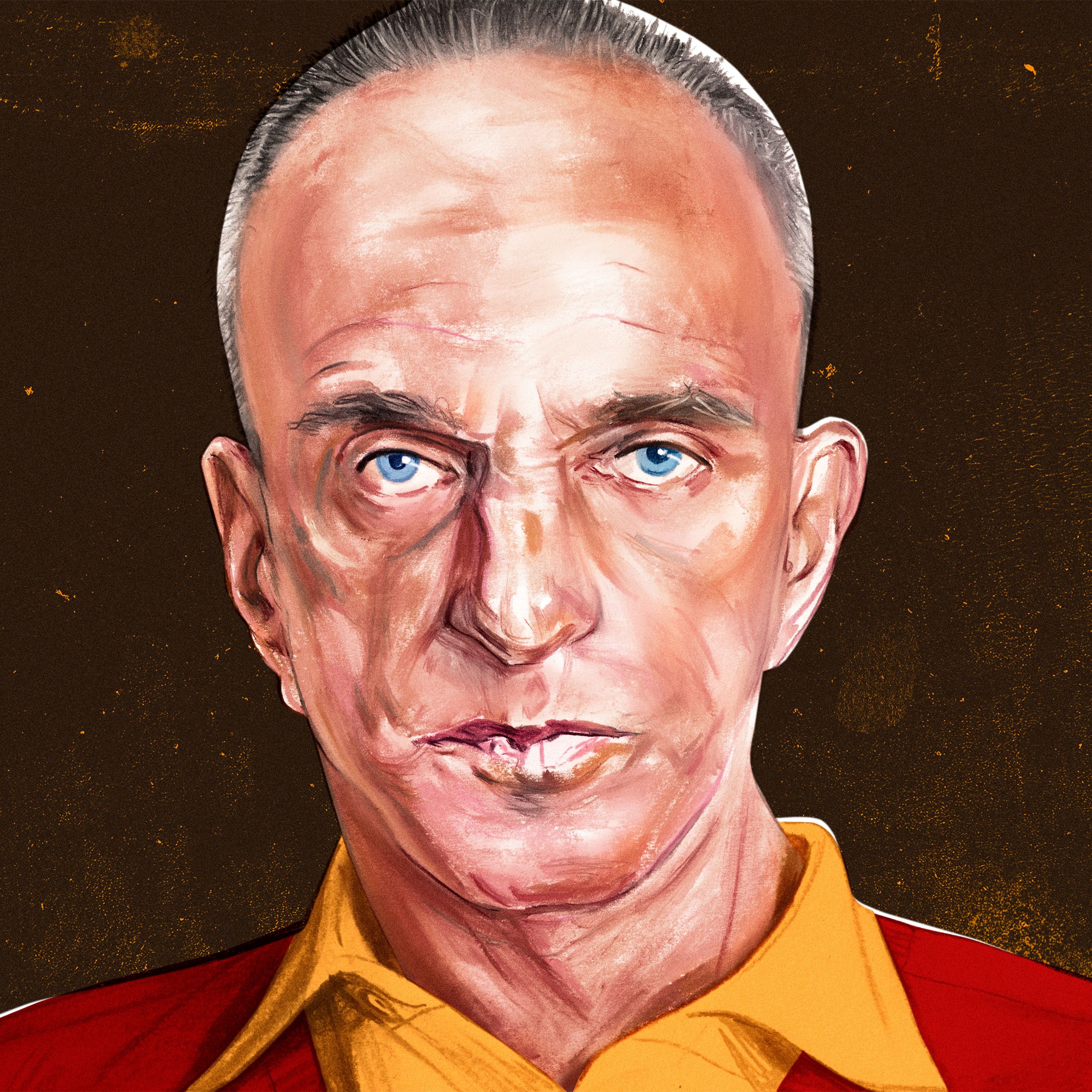
Kai Bird on Roy Cohn, a Founding Father of Donald Trump’s America
About this episode
During the height of Roy Cohn’s friendship with Donald Trump, according to the historian Kai Bird, “they were on the phone with each other a dozen times a day.” Bird’s new book, “American Scoundrel,” details Cohn’s profound influence on Trump—whom he met as a young real-estate heir in the nineteen-seventies—and how Cohn is “haunting” politics in our time. “I had written about Roy Cohn in [previous biographies] as this nefarious, minor, awful figure who was disruptive and divisive and unethical. And I suddenly realized that the establishment that I’d been writing about for forty years is gone. Their values and culture, the politics, the bipartisanship . . . that’s all gone,” he tells David Remnick. “Roy Cohn explains something about the dark side of America that I just didn’t understand.” They discuss Cohn’s early career as a prosecutor and his role as the “mastermind” of the McCarthy purges; his service as a lawyer and fixer for Mafia members, politicians, and celebrities; and an allegation of being involved in sex trafficking.
Further reading and listening:
- “How Roy Cohn Taught Donald Trump Everything,” by Kai Bird and Susan Goldmark
- “The Mobster Cosplay of Donald Trump,” by David Remnick
- “Adapting Oppenheimer’s Life Story to Film, with Biographer Kai Bird,” an episode of The New Yorker Radio Hour
- “Roy Cohn and the Making of a Winner-Take-All America,” by Naomi Fry
New episodes of The New Yorker Radio Hour drop every Tuesday and Friday. Join host David Remnick as he discusses the latest in politics, news, and current events in conversation with political leaders, newsmakers, innovators, New Yorker staff writers, authors, actors, and musicians.
Hosted by Simplecast, an AdsWizz company. See pcm.adswizz.com for information about our collection and use of personal data for advertising.
Get every episode summarized
Each time The New Yorker Radio Hour publishes, we email you a written briefing from the transcript — the topics, who appeared, and any specific claims, with the ad reads skipped.
Email me new episodesFree for 3 shows. No card needed.
Hosts & guests

Transcript ready
347 searchable segments. Every word is indexed and playable.
Full transcript
The New Yorker Radio Hour — Kai Bird on Roy Cohn, a Founding Father of Donald Trump’s America. Machine-transcribed; use the interactive transcript above to jump the player to any line.
The New Yorker Radio Hour is a co-production of WNYC and The New Yorker. Welcome to The New Yorker Radio Hour, I'm David Remnick. If Roy Cohn had never existed, it would have taken a novelist of real skill to have invented that life. Cohn started out as an ambitious prosecutor, and then he rose to the top of Washington's food chain at a very young age. He was already famous in his early 20s as Joseph McCarthy's attack dog in the anti-communist purgents of the early 50s. And later as a lawyer for hire, Cohn was friends with presidents and celebrities while working for mob families in New York City. He reveled in his reputation as a ruthless operator, and he was all around a nasty piece of work. In the 70s, Roy Cohn acquired a young protégé, a real estate heir named, you guessed it, Donald J. Trump. And through that formative relationship, it may be that Cohn is now more influential
in Washington than he ever was during his own lifetime. But we now know a great deal more about the links between Trump and his mentor, thanks to a biography of Cohn called American Scoundrel. Its author is the historian, Kai Bird. He had also co-wrote the definitive biography of nuclear scientist Robert Oppenheimer, which was the basis for Christopher Nolan's Oscar-winning film. I sat down to talk with Kai Bird the other day. You're probably best known for your collaboration with Marty Sherwin on the biography of Oppen heimer. What made you choose Roy Cohn as your subject? You knew you'd have to spend years of your life with a man who was in many ways miserable. Yes. No, it was an improbable choice for me, because for 40 years, I've been a biographer of the establishment. And then after I finished Jimmy Carter, I was casting around for a new topic.
And I realized that in all of these books, I had written about Roy Cohn in a paragraph, a couple of pages, as this nefarious, minor, awful figure who was disruptive and divisive and unethical. And I suddenly realized that the establishment that I'd been writing about for 40 years has gone. There are values and culture, the politics, the bipartisanship of someone like John McCloy, a Rockefeller Republican. It's all gone and it's been replaced by Roy Cohn who's sort of haunting us from his grave. And so I was quite upset with this realization. And I decided I needed to dig into maybe Roy Cohn explains something about the dark side of America that I just didn't understand. To push that point a little bit, I think what you're saying is that in the Trump era,
which has now been with us for at least a decade, that the key to the crypt here is Roy Cohn's influence on Donald Trump. Yes, absolutely. But ironically, I had four telephone interviews with Donald Trump. They were all bizarre phone interviews. Crazy. How were they bizarre? Well, they were cold calls. I got his cell phone number. I called him up like half of Washington. Yeah. Yeah. But I was the biographer. He had no idea who he was talking to. He had no idea who I was. Oh, wait. He just takes your call. You're just saying I'm kyberd and off to the races you go. It was crazy. What was he especially eager to get across to you? Well, the astonishing thing is how proud he was of Roy, how admiring. So he really loved him and appreciated him.
And he really did in his first term in the Oval Office at one point shout out, where is my Roy Cohn? In frustration. Where's my killer lawyer to get me off the hook? Yeah. Exactly. And I don't know. In my last phone conversation, Trump was president Trump was trying to get off the phone. And I was trying to persuade him that he should really sit down and talk with me in person. And I said, you know, I'm in Florida often. I could come to Mar-a-Lago, the whole repertoire dance, yeah. He wasn't having any of that. He said, his response to me at that point was, no, I can't do it. You don't understand. I'm the president. I have Russia calling. I have China calling. So then at the end of the conversation, he's clearly not inviting me to Mar-a-Lago. So I say, well, Mr. President, I just want you to know that this biography of Roy Cohn
is coming out on the autumn of 26. And he interrupts me and he says, oh, terrific. Maybe I can promote it. He says anything I promote goes to number one. Oh, my God. And then there's a pause and he says, well, of course, it has to be fair. Well, Kate, let's go back in time. I first encountered any knowledge of Roy Cohn. When as a kid, I was interested in the McCarthy period. And there was this very, very young age sitting at the elbow of Joe McCarthy. Where does he come from? What are his roots? He's from the Bronx. He's very much a creature of New York. His father was a Bronx New York state judge. His family was Jewish, democratic, liberal. And yet young Roy grew up with a resentment of the New York establishment. I try not to cycle babble in biography, but you do have to understand his childhood.
And one of his formative experiences was when he was eight, nine, ten years old, his mother Dora, an awful woman, a terrible mother who raised him with no guardrails, took him up to sing, sing prison every weekend to visit their beloved Uncle Bernie, who was the only banker from the 1929 crash who had been sent to prison for bank fraud. And Dora, Roy's mother, told her son, you know, this was a miscarriage of justice. Uncle Bernie was a victim of conspiracies by communists, Jewish communists, and wasp-powerful bankers who refused to bail him out. And this inculcated and the young Roy, I think, a resentment of the powers that be. And then he becomes a lawyer, he goes to Columbia University.
He's very much a creature of New York, but he's resentful of the white shoe law firms that will not hire him as a lawyer because he's Jewish. In the late 40s, early 50s, his politics suddenly veered to the right. Roy sees an opportunity to sort of prove his American loyalties by becoming a commie hunter and going after Jewish communists to prove his loyalty, but also gays in the State Department. And of course, we realize now he was himself a closeted gay man, never would come out of the closet. By the time Cohen was 24, he was part of the team that prosecuted the married couple that's now known to history as the Rosenbergs, Julius and Ethel Rosenberg. Tell me about that case and the role that Cohen played in it.
Yeah. He got himself hired as an assistant prosecutor on the Rosenberg case, the sort of real turning point, the sensational atomic spy case, in which most historians now agree that Julius Rosenberg was guilty of actually quite low level spine, inconsequential spine as such. And his wife, Ethel, was implicated. She probably knew what was going on, but she had no real involvement hands on in the spine. Roy engaged in exparte communications with the judge, Judge Irving Kaufman, repeatedly passing information, guiding the judge, and lobbying them at the end to impose the death penalty, not only on Julius, but also on Ethel, which they regarded as sort of an attempt to bring
pressure on Julius to perhaps name names and become cooperative, which they, Ethel called their bluff and refused to play that game. And so she was sent to the electric chair as well as her husband. One of the people he encountered when he then moved on to work for Senator John McCarthy, the Republican of Wisconsin, who was really the big red hunter in the Senate. One of the people he encountered there was Robert F. Kennedy. What was that? What happened there? Robert F. Kennedy is a young man right out of law school, wanted a job with Joe McCarthy. And his father, Joe Kennedy, lobbied to get him in the door. But as it turned out, Joe McCarthy selected Roy Cohn as his chief counsel and hired Robert Bobby Kennedy as the deputy. And they took an instant disliking to each other. It was just really bad chemistry.
And Bobby Kennedy didn't last long in the position and eventually flipped to the other side of the bench. A session went to work for the Democrats on the Senate committee. But they repeatedly clashed. And this was the origins of their bitter rivalry that stretched into the period when Bobby Kennedy became Attorney General. And when the Kennedy Justice Department indicted Roy Cohn not once, but three times and put him on trial for bribery and fraud, stock fraud, attempted bribery. And on all three occasions to the frustration of Bobby Kennedy and his prosecutor, Robert Markenthal, the illustrious New York prosecutor, Roy got off from New York jury trials. One of the interesting things, I didn't quite fully appreciate and you make it very plain
in American scoundrel. Cohn's battle was not only against communist or communism. It's also the liberal establishment, which in his mind was embodied by a Republican president, President Dwight Eisenhower. Oh, absolutely. Roy Cohn thought that President Dwight Eisenhower, General Eisenhower, was not really a Republican and not sufficiently anti-communist. Indeed, one of the things that I've really learned that I think historians have underplayed or misunderstood about the McCarthy era, is that Roy and Joe McCarthy were going after Dwight Eisenhower precisely because they knew that when he was the general during World War II, he had approved a decision to give officer commissions to veterans of the Lincoln Brigade, members of the Communist Party. Well, in 1953,
54, that fact could have been political dynamite. And they were beginning to go after, with Roy edging Joe on. Joe McCarthy was sort of an empty vessel, in my view. He was a sort of blundering alcoholic senator who was looking for publicity. And in Roy Cohn, he found a mastermind, someone who could knew the gossip columnist, knew how to push buttons. So he wasn't just a mere aid. Roy Cohn was the doctor evil of the operation. He was the Zvengali of the whole operation. And he was going after Dwight Eisenhower. And they hoped to bring Ike down and maybe have Joe run for president in 56. So the Army McCarthy hearings was, it was a real turning point. In my recounting of the McCarthy hearings, you understand suddenly that Eisenhower himself is unwilling
to attack Joe McCarthy by name. He thinks that he will be getting into the gutter if he names him. And he doesn't want to dignify Joe McCarthy's rantings. Eisenhower's aides understand that this is the really serious personal attack. And so they come up with a strategy to defang Roy Cohn. And they do so by essentially using the fact that he was gay, a man in the closet, and to highlight his, the favors he was trying to extend to his good friend and another Joe McCarthy, David Shine. And so that becomes the focus of the whole Army McCarthy hearings. But how do they do that in the 50s? It's a very different media environment and very different political environment. How did that play out? Well, remember at one point, Joe Welch for the
Democrats on the investigation in the Army McCarthy hearings, Joe Welch suddenly starts quizzing Roy about pixies and fairies. Question, did you think this came from a pixie? Michael, Michael, my son of the post, they find, I think he might be next for the last. Yeah, I should say, I should say, Mr. Senator, that a pixie is a close relative of a fairy. So it was all certain in you end, though. Wow, because what we remember is one sound bite. We remember of Joe Welch saying, have you no sense of decency surret long last? That was the sound bite. Yes. Of the McCarthy era, it was the turning point for Joe McCarthy and probably the end of him. Exactly. I'm speaking with Kai Bird. His new book is American Scoundrel, Roy Cohn's dark journey from
Joe McCarthy to Donald Trump. It was excerpted in the New Yorker and will continue our conversation in just a moment. This is the New Yorker radio hour. The Pentagon is battling the media on many fronts, even within its own ranks. The Pentagon fired the editor-in-chief, publisher, and reporter for the military news outlet, Stars and Stripes on Friday. The three employees claimed they were let go for insubordination after they defended their outlets independence in an interview with CBS Sunday Morning last month. That and much more on the next on the media from WNYC. Find on the media wherever you get your podcasts. This is the New Yorker radio hour. I'm David Remnick and I've been speaking with Kai Bird, the historian whose remarkable new book is about the life of Roy Cohn. It's called American
Scoundrel and it's written with Susan Goldmark. As a young man, Roy Cohn worked for Joseph McCarthy. An early in our conversation, Kai Bird was telling me that in his view, Cohn was the mastermind behind McCarthy's anti-communist purges in Washington, behind all the lies and the smears and the subterfuge that ruined so many lives and careers. Eventually, Senator McCarthy was repudiated, and the purges subsided. But Cohn was just getting started. I'll continue my conversation with Kai Bird. Now, Joe McCarthy, after inflicting so much damage, falls apart. He lets go of Roy Cohn, who sets up as a lawyer in New York, and you write that Roy Cohn represented not just one mafia family, but at different times along the way. He was involved with all five of the big New York mob families, including, of course, one of my favorites, the Teflon Don, John Gotti. What did Roy Cohn get out of these relationships? And what did the mafia chieftains get from him? Roy was known to
them. His father was a judge. He becomes very close to Fat Tony Solerno, who controls the concrete business in New York City, which later becomes important to the rise of Donald Trump and the building of Trump Tower. He likes these guys. And, you know, Roy talks like them. He has the language of the mafia also. And if you listen to Donald Trump today, he has the same language. It's just incredible. So, yes, John Gotti was one of his clients. He got John Gotti a four-year sentence for murder when Gotti walked into a bar in Staten Island. And in public, in front of 20 witnesses in the bar, he and his accomplices to thugs shot dead an Irish thug. And Roy got them off. He only spent two and a half years in prison for that. That does seem like a light sentence.
Yeah. How and when did Donald Trump meet Roy Cone? It was in October of 1973 in Manhattan at a private dinner club, little club, which was one of favorite Roy's favorite hangouts. And Donald had joined the club. He was 27. He had joined it because he wanted to get to know Manhattan movers and shakers. And there are several accounts of the first meeting, actually, in one of my phone call interviews with President Trump. He told me a story that was exactly opposite of all the stories that he had told decades earlier of the encounter. He claimed that Roy Cone had recognized him as a famous up and coming 27-year-old pre-must-date developer and had come to his table and introduced himself. And of course, I think
the more accurate story is that he was exactly the opposite. Went over to Roy Cone, recognized this powerful shady lawyer and told him that he was involved in anti-discrimination case. He was being sued by the feds for discriminating against black renters in his Queens apartments. And Roy told him, don't settle. You should sue the feds. And indeed, Roy got him to sue the feds for $100 million and it was dismissed a month later. It seems that right off the bat, right off the bat, Trump imbibes from Roy Cone some very direct, if you want to call them, principles or rules of the road, never settle, never apologize, never explain, attack, attack, attack, exploit the press, the smearous land or never admit the truth of anything. And these kind of ten commandments, as it were, etched in tablets, really stayed with
Trump. How did he imbibed them? What was the early relationship like? Well, you'd have to concede that Trump was, this is who he was. He's a hawkster, a con artist, a shady businessman from the get go. But when he met Roy Cone, he was really impressed that he was this lawyer who had been indicted by the feds three times for outrageous crimes. And there was lots of evidence that he was guilty and he'd gotten off. The Donald was very impressed by the fact he's gotten off. They'd gotten away with these things. And Roy told him, you know, this is how you defend yourself in this cruel world. The establishment is out to get you. And so he fed Trump's sort of victimhood psychosis. So I'm always the victim. Well Roy felt that too. I'm always the victim. Bobby Kennedy is always out to get me. And that's the source of the indictments.
And so you have to respond by attack, attack, attack, attack, attack the judge, attack the judge. Who does that? Who does that? You know, play your defense in the public arena, in the press, in the gossip columns. Now maybe nothing exemplifies Cone's hypocrisy more than his sexuality and what he did or did not do about it. You paint a picture of an extremely promiscuous gay man who never really hid it. And at the same time, he helped to persecute gay men during what we call the lavender scare and publicly opposed gay rights. How do you come to understand this in your book? Well, you really have to go back to the atmosphere than the culture of the 1950s. Here was Roy Cone who as a very precocious, bright,
manipulative young man, a fabulous lawyer with a photographic memory, famous nationwide at the age of 27. He knew he could never come out. That would be the end of his public career as a lawyer. And so he was just a man of his times. He just always denied that he was gay. Do you have sympathy for that? Yes, oh, absolutely. I think, you know, he was a victim of his times in that way. It's a tragedy. It explains something about Roy Cone. On the other hand, there are plenty of gay men in the 1950s who did not become Roy Cone's. Right? For sure. So it's not a sufficient explanation. Let's listen to a clip of Roy Cone speaking with Mike Wallace on 60 minutes about this very thing. And the doctors tell me I've strong faith in doctors now,
tell me in remission. I'm in total remission. When I talk to friends and tell them that I am doing a profile of Roy Cone, they say, asking this, please. And I'm sure you know what they tell me to ask you. Do you have AIDS? Oh, no. That's easy to answer. In another world, could Cone have helped other people by speaking to Ronald Reagan say about AIDS? He certainly knew Ronald Reagan. He helped get Ronald Reagan elected president in sort of some dirty tricks areas. But he also was very close to Nancy Reagan. And yes, he was getting experimental AZ teeth treatments. Precisely because I would argue Nancy Reagan got him ahead of the line at the National Institute of Health. He knew he had AIDS and he was still hiring hustlers, teenage hustlers to have sex with. So he was infecting them. It's outrageous. Now you interviewed a man named Richard Kerr who told you that he had been
trafficked as a teenager to Roy Cone. I think this is new information. And how did you find Kerr? And what made you believe that this was a story that you could use in your book? Because you have a very high standard of evidence. Well, I'm glad you picked up on this. That's a short chapter at the end of the book. And I was very skeptical. But my wife Susan Goldmark, who is my chief researcher and co-author on this project, she dug into, she was fascinated. She grew up in New York City. She was fascinated by the mob of New York City and the sort of the gay underworld in New York City in those years. And she was relentless in tracking down evidence that Roy had, well, he was a sex addict. And by the, you know, the last few decades of his life, he had sex almost every night, two or three times with hustlers. And she got wind of a scandal in Northern Ireland with a
boy's orphanage. And she found Richard Kerr and we interviewed him on the record on tape. And he told his story. He had been in this orphanage from the time he was eight. He was trafficked as a very young boy. And even, and then at the age of 16, he was traff, he was sent on a train to Venice where he had a sexual encounter in a fancy hotel in Venice with Roy Coln. And he described him and described seeing him later in New York. It's just an incredibly sad story. Were you able to get any corroboration from another party? Well, actually this spring, Richard Kerr succeeded in the Irish courts. And he was awarded a financial judgment. They
agreed that he had been trafficked. They didn't get into the Roy Coln connection, but it was clear that the people who had trafficked and were connected were known to Roy. And yes, I'm quite confident that this story is all true. What were the transactions between Roy Coln and Donald Trump? Other than the fact that Roy Coln was a kind of character mentor to Donald Trump? Well, concretely, he helped Trump build Trump Tower. He got the zoning variances. He got the tax abatements for the first big real estate deal, the Commodore hotel. Over the opposition of Mayor Ed Koch, who thought this was an outrageous tax abatement for a wealthy developer, completely unjustified. But Roy prevailed when he appealed, appealed, appealed to the New York courts. And Trump was forever grateful.
But this was a relationship that was also transactional socially. I mean, Roy introduced Trump to New York society. He Trump loved seeing his name in the gossip column as well. Roy would do that. He mimicked his language. He mimicked him in small things like the vanity license plates on his cars. He also mimicked Roy in other ways. Roy famously hated to see people taking notes in his meetings. And he never took notes. He conducted his law practice over the phone. And you see Donald Trump today, even in the Oval Office, he's annoyed when he sees somebody taking notes. He doesn't want a record. And he learned this from Roy. He don't leave a record of that can be picked apart. Well, Kai, tell me how that relationship resolved because as Roy Cohn became ill, it's my understanding that Donald Trump drew away from him.
Betrayed him in a sense. Yes, you know, in the, they're the heyday of their friendship. They were on the phone with each other a dozen times a day. And in night, you know, Roy was diagnosed with AIDS in October of 84. And he dies in August of 86. And those last two years, Trump sort of pulls back. And according to his switchboard operator in Secretary, he, he began to rely on Roy less and less for legal advice. So yes, he pulled back, but he didn't break with him. And did he stop taking his calls? No, no, he would take calls. He, there just wasn't as much of a relationship. And then when he was clearly evidently very getting sick in March of 86, he invited him down to Mar-a-Lago for a fabulous, what turned out to be a farewell dinner. Twenty plus people were there,
old friends. So it was a fabulous dinner, mini toasts. When Roy died, there was a memorial service several months later. And Trump turned up at it. And according to Peter Manso, the late journalist who interviewed Roy at considerable length, and we found his transcripts. And that was, became a great source for us in this book. Anyway, according to Manso, Trump did not give a eulogy or send up or talk at all, but he sat in the back and Manso saw him weeping. So there was we think, well, let's pause over that. Yeah, isn't that astonishing? I don't know if I've ever seen Trump laugh like in a real way other than at somebody. And I've certainly never seen him cry. Yeah. That is, that's an astonishing thing to conjure with. And it signifies, you know, a real friendship between the two men and an admiration.
You've described personal characteristics that they shared. Did they share a politics? Oh, absolutely. Both men represent this dark side of America that I argue keeps popping up every once in a while. That is very suspicious of immigrants, is nativist, and they feel insecure and afraid of multiculturalism. And they're deeply racist. Roy used the Yiddish slur word for blacks, which he picked up from his mother, Dora. They shared a lot of deeply resentful device of politics. Some other lessons that they seem to share or characteristics is that it pays to be bad somehow. One characteristics always struck me about Trump is the absolute shamelessness of his political
behavior and his personal behavior, a kind of amorality. And I can't help but think after reading this book, a superb book, by the way, that he had to have derived at least some of that from his mentor Roy Cohn. Oh, yes. I think he sucked it in. Roy was very open about his his shamelessness, his brazen violation of the rules. The rules are for the, are for small men, he would say. And loyalty was to be prized, but loyalty in the sense of mafioso loyalty. You do favors for your close circle. Don't pretend to think that you have to abide by society's rules. Roy had a schooner, a yacht at one time, and he named it the defiance.
And that's that's Trump's whole strategy. Defy everything, defy the powers that be, defy the establishment. He learned all of that from Roy and Roy's life showed him that he could get away with it. Kai Bird, thank you so much. Thank you, Dave. You can read an excerpt from Kai Bird's American Scoundrel, his biography of Roy Cohn at NewYorker.com. And of course you can subscribe to the New Yorker there as well, NewYorker.com. I'm David Remnick. That's our program for today. Thanks for listening, and I'll see you next time. The New Yorker Radio Hour is a co-production of WNYC and The New Yorker. Our theme music was composed and performed by Merrill Garbiss of Tune Arts, with additional music by Louis Mitchell and Jared Paul. This episode was produced by Max Bolton, Adam Howard, David Krasnow, Jeffrey Masters, Louis Mitchell, Jared Paul, and Ursula Summer, with guidance from Emily Boateen and
assistance from Michael May, David Gabel, Erica Huang, Elliot Wright, Alex Barish, and Alejandra Deckett. The New Yorker Radio Hour is supported in part by the Cherina Endowment Fund. Hey listeners, this is Liz Mains Amanzade, the New Yorker's Puzzles and Games editor. If you're someone who likes making lists and organizing your bookshelf, we think you'll love catalogs, our new daily game that challenges you to put things in order based on a hidden rule. You might be asked to sort Peppers by Spiciness, World Capitals by Population, or Martinscore Saisy Movies by Release Date. You can play catalogs every day at New Yorker.com slash games and in the New Yorker app for iOS or Android. Here's a helpful hint. The app
gives you free access to our entire archive of catalogs, along with our Wordsgramble game, Shuffle Lo, and the Mini Crossword. So download the New Yorker app for new games to play every day.
More episodes
More from The New Yorker Radio Hour

Edwidge Danticat on Haitian Americans in a Time of Peril
The New Yorker Radio Hour

Sarah Longwell, a Former Republican, on “How to Eat an Elephant”
The New Yorker Radio Hour

Gloria Steinem in Conversation with David Remnick, from 2015
The New Yorker Radio Hour

Ian Frazier and Samy Burch on “Coyote vs. Acme”
The New Yorker Radio Hour