Loading...
societyculturenews
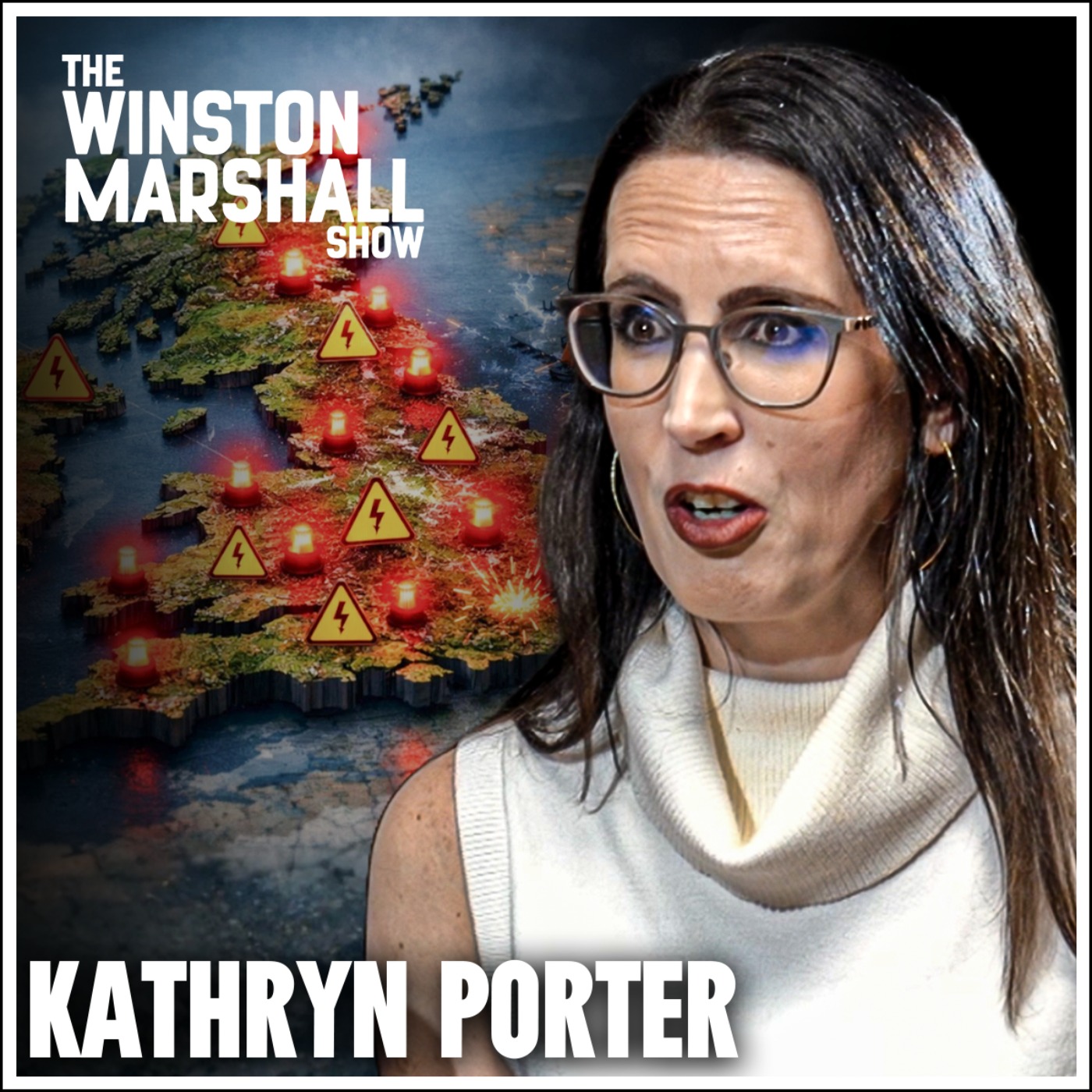
Kathryn Porter - ‘We Have Been Sold A LIE!’ The REAL cost of Net Zero They Won’t Admit
About this Episode
In this episode of The Winston Marshall Show, I sit down with energy analyst and commentator Kathryn Porter for a wide-ranging conversation on Britain’s energy crisis, the true cost of Net Zero, and the growing risk of blackouts.
We examine the rapid transformation of Britain’s energy system, the push towards renewables, and the unintended consequences of dismantling reliable baseload power. Porter explains why the UK grid has become increasingly fragile, why electricity prices remain among the highest in the developed world, and how energy policy is now colliding with economic reality.
The conversation explores the technical limits of wind and solar, the challenges of storage and grid stability, and the risks created by over-reliance on intermittent power sources. We also discuss nuclear energy, gas, and the geopolitical pressures shaping energy markets, from supply shocks to global competition for resources.
Finally, we debate the political incentives driving Net Zero policy, the widening gap between rhetoric and engineering reality, and whether Britain is sleepwalking into an energy crisis that could carry serious economic and social consequences.
A hard-headed conversation about energy, economics, and whether Britain’s climate ambitions are colliding with the physical limits of the grid.
-----------------------------------------------------------------------------------------------------------------------
WATCH THE EXTENDED CONVERSATION HERE: https://open.substack.com/pub/winstonmarshall/p/the-dark-truth-utility-companies?r=18lfab&utm_campaign=post&utm_medium=web&showWelcomeOnShare=true
-----------------------------------------------------------------------------------------------------------------------
FOLLOW ME ON SOCIAL MEDIA:
Substack: https://www.winstonmarshall.co.uk/
X: https://twitter.com/mrwinmarshall
Insta: https://www.instagram.com/winstonmarshall
Linktree: https://linktr.ee/winstonmarshall
----------------------------------------------------------------------------------------------------------------------
Chapters
00:00 Introduction
01:06 What Net Zero Actually Means
02:50 Deindustrialisation and Offshoring Emissions
05:00 Why Politicians Treat Net Zero as Dogma
07:27 Are Renewables Really Cheap?
10:48 Why Wind and Solar Need Gas Backup
14:12 The Hidden Risks to the Power Grid
17:30 Nuclear Power: The Energy Britain Should Be Building
21:15 How Energy Policy Is Destroying UK Industry
27:08 The Myth of Cheap Green Energy
33:44 Blackouts, Rationing and Grid Fragility
40:16 Why Britain Is Losing Energy Security
48:06 Global Emissions vs Britain’s Tiny Contribution
55:10 Why China and Others Aren’t Following Net Zero
1:10:59 Electrification: Can the Grid Actually Cope?
1:13:05 AI Data Centres and Future Electricity Demand
1:15:00 Britain’s Ageing Gas Fleet and Closure Risk
1:20:34 Final Reflections on Britain’s Energy Future
Hosted on Acast. See acast.com/privacy for more information.
Hosts & Guests

Transcript
Hey, this is Paige DeSorbo from Giggly Squad, and today I want to talk to you about Boost
Mobile.
Quick question, why are we letting our phone bills bully us?
Here's a money tip.
Stop paying a carrier tax.
When you bring your own phone and switch to Boost Mobile's $25 unlimited forever plan,
you can unlock up to $600 in savings that's real life money, not money trapped in a
pricey phone bill.
$600 is a trip, a shopping spree, or paying something off.
Your money belongs in your life.
You get unlimited data, talk, and tax for $25 a month with no contracts and no minimum
line requirement.
Your phone, your rules, had to boostmobile.com to switch today and unlock the savings you
actually deserve.
After 30 gigabytes, customers may experience lower speed.
Customers pay $25 per month while active on Boost Mobile unlimited plan.
Savings claim based on a January 2026 Boost Mobile Survey, comparing average annual payments
of major carrier customers to 12 months on the Boost Mobile unlimited plan.
Visit BoostMobile.com for details.
If you work in university maintenance, Granger considers you an MVP, because your playbook
ensures your arena is always ready for tip-off, and Granger is your trusted partner, offering
the products you need all in one place, from HVAC and plumbing supplies to lighting and
more, and all delivered with plenty of time left on the clock, so your team always gets
the win.
Call 1-800-GRanger, visit Granger.com or just out by Granger, for the ones who get it done.
You know what's wild?
Most people are still overpaying for car insurance.
That's because it's a pain to switch.
That's why there's Jerry.
Jerry's the only app that compares rates from over 50 insurance in minutes, and helps
you switch fast, with no spam calls or hidden fees.
Drivers who save with Jerry could save over $1300 a year.
Before you renew your car insurance policy, do yourself a favor.
Download the Jerry app or head to jerry.ai-acast.
Hello and welcome to the Winston Martial Show with me, Winston Martial.
I sat down with Katherine Porter, a British independent energy consultant and founder of
what logic.
Katherine has gone viral after appearances on various shows because she has become the
leading voice in the country, perhaps in the West, calling out the fallacies and the
follies of net zero and green policies.
And indeed in this conversation, we look at why it is the British energy is four times
that in America.
We look at why it is that we haven't gone to nuclear energy in the long history against
nuclear energy.
We look at the utility companies, some of the most hated institutions and companies in
Britain.
Now, Katherine also has some pretty bleak and dire predictions about the future of Britain
and the West if serious change doesn't come about.
And she has some ideas about what that serious change might look like.
Before you hear from Katherine, I just wanted to say thanks again for your continued support
without which we could not keep the show on the road.
And if you head over to winstonmartial.co.uk, not only will you enjoy ad reviewing and
listening, but you will hear an extended conversation between me and Katherine where she
takes some of our substackers superb questions.
That's all at winstonmartial.co.uk.
Otherwise without further ado, Katherine Porter.
Katherine Porter, welcome to the show.
A great pleasure to have you on.
I've been following you for some time and the first thing I want to talk to you about
is net zero because everywhere I go, I see net zero.
Not only is it on the radio, it's on billboards around London, I hear politicians banging
on about net zero.
We have our net zeroes, our Ed Miller band.
Even this morning when I left home, I had a fly through the door from the council,
telling me about their net zero plans.
I know that some of my council tax goes to net zero.
It's everywhere.
Net zero, of course, means net zero carbon emissions, although it's been used as well for net
zero greenhouse gases.
And it is kind of become dogma.
I was even on a panel on LBC with a Lib Dem politician, a Labour politician and a Conservative
politician.
This is a couple of years ago back.
And every single one of them, including the host, took for granted that net zero was
a good thing.
Is net zero a good thing?
No.
And certainly not net zero 2050, which is the official target.
It's just not achievable.
And in trying to achieve it, we're creating so much harm.
We had, so until about 2023, the Office for National Statistics was gathering or publishing
data on mortality associated fuel poverty and at the time, on average, 6 to 8,000 people
were dying every winter prematurely because they couldn't afford to heat their homes properly.
Now, likely that number's gone up because energy's become more expensive.
We're seeing massive de-industrialisation, huge job losses and industries on its knees.
And this is all because of this effort to reach net zero 2050.
But it's also entirely pointless because the measure that we're targeting is net zero
territorial production emissions.
So we're meeting this by offshoring all our manufacturing to places with dirtier energy.
Then all this stuff gets shipped back, which also involves a lot of emissions.
So overall, our efforts to reduce emissions are actually increasing global emissions.
So we're harming ourselves, we're harming our economy, we're harming people.
We're putting them at risk of blackouts.
And we saw in Iberia 11 people died in that blackout in April, which was in very benign
weather conditions.
So here in the winter, likely that would be far more serious with more lives lost.
I'm an offer for nothing, really, because we're just increasing global emissions.
But if there is a climate crisis, then surely we need to sort out our carbon emissions.
It's the climate crisis not being caused by carbon emissions.
The UK contributes 0.8% of global emissions.
So we could go to zero completely and it would make absolutely no difference to the global
climate.
Now, people like Edmila Band say, oh, we have to lead by example, that's all very well,
but nobody's following us.
We're harming ourselves to absolutely no benefit.
Meanwhile, China's building coal power stations at a rate of knots.
And if people just laughing at us, we're losing our international competitiveness, we've been
traveling overseas recently, and I'm constantly confronted with this question, like what
in earth are your politicians doing to your country with these ridiculous energy policies?
You know, I had that wasn't in Europe, presumably, because they were going about the
same thing.
No, no, yes, in Canada, but I was probably, I was in Alberta and I'm not Ontario in an
Alberta in particular, they're not on the same page as the big oil producer.
Yes, exactly.
Right.
I mean, I had so many people ask me outright whether Edmila Band is a Chinese agent because
that was the only way they could rationalize his policies now.
I don't think he is, but it's just bizarre to be repeatedly asked that question.
Well, several members of the Labour Party and the Tories are part of the club 48 group,
which is a Chinese lobby group.
In fact, Peter Madelson has been making money from, and this was exposed in the Madelson
affair from his, I forgot what they call global council, I think, his lobbying group, which
he was employed by Chinese companies like TikTok.
So there are various members of the Labour Party very much in the pay of China.
Well, maybe, but I don't really subscribe to those sort of conspiracy theories that people
put forward around this stuff.
I generally think that large-scale conspiracies are unsustainable.
Okay.
Well, let's stick to the environment, though.
So I just want to hammer down onto the very knob of this, which I was trying to get to
with the climate crisis.
So let's say China and America, and all these other countries, did go along with Net
Zero to stop the crisis, the quote-unquote crisis, would it then be worth it if there is indeed
a crisis, then surely we need to do something about it.
Right.
Okay.
So, not necessarily, because it might be more efficient to mitigate the effects of climate
change rather than to try and seek to prevent them.
And we know that the climate has changed ever since the Earth had an atmosphere.
So there's some degree of climate change, which will happen anyway, it's extremely difficult
to unpick how much wood and wood have happened anyway.
So, for example, there could be low-lying islands in the Indian Ocean that may have been
a risk of flooding irrespective of any human activity.
And in times gone by, people would just migrate.
You've had mass migrations of populations really since the beginning of humanity in response
to environmental factors.
So there should be more of a cost-benefit analysis done as to what is meaningfully worth
doing in terms of prevention versus simply living with the effects of climate change.
Okay.
So, you've focused there on climate change.
Now, I, in a court of view, that there is climate change.
It's not obvious to me, or certainly not self-evident, having read the IPCC reports and gone
deep into this, that it's necessarily caused by humans.
The level of carbon has increased, but I actually think that's a good thing.
And then it's a little bit controversial to say, but I think at the current rate, it's
0.04% of the atmosphere is CO2.
It's up from 0.3, 0.0, 3% at 0.0, 2% plants start dying.
And it's not until you get up to 0.1%, so we're miles away that it's again a risk.
In fact, sorry, 0.1% would be good for plant production.
So it seems to me that carbon going up is a good thing in terms of plants.
It's negative things that the ice caps are melting, so the sea levels are rising.
I say all this to say, it's a climate, it's a climate crisis, depending on whether
we can deal with the negative impacts of the climate change.
Do you agree with me?
Do you think I'm wrong?
Well, say this is my point about mitigation.
The way these policies have been derived so far has been, oh, climate change is happening.
That's bad.
We must try and stop it.
And that's essentially as far as it's gone.
Now, whether or not it's bad seems to be a matter of debate.
And I'm not a climate scientist, so I'm really that interested in getting into that as
a subject.
But what I do think that we need to be paying more attention is that the cost of what
we're doing is so high, and we are creating harm in our efforts to prevent climate change.
And so the question is, are those harms that we're creating appropriate?
And I really just haven't seen analysis on this.
So transition minerals, for example, in order to have the energy transition, we need, we're
moving towards low energy density generation.
This means it requires a lot more space, but also a lot more stuff, more materials.
That means you've got to dig it out of the ground, you've got to process it.
These are highly polluting activities.
They pollute water, they pollute the air locally, they meet people sick.
They're damaged habitats, and these are the minerals we need for renewable energy.
Everything from copper to rare earth magnets, they all, to varying degrees, are very polluting
to produce, and cause disruption to the communities that live in the areas where these minerals
exist.
So these are not neutral acts, but the trouble is because they're happening elsewhere,
we seem to think they're okay.
I mean, so there's a great example, Canada, right?
So there's an expectation that Mark Horny is going to come out with a new energy policy,
which is going to be very wind-led, and potentially involve a trans-Canadian power grid, which
they don't currently have, it's very provincial at the moment.
Now this strategy would involve lots and lots of copper.
And yet, a couple of weeks ago, I read that Canada's only remaining copper smelter thinks
it'll probably have to close in the next couple of years because of environmental regulation.
Now, if you are going to introduce an energy policy that requires large amounts of copper,
but you think copper is so dirty that you don't want to have any copper smelters, how is
that appropriate?
Yeah.
Because if it's essentially saying, well, as long as that pollution happens somewhere
else, we're good with it.
Well, that's pretty hypocritical.
Yes.
And so I would challenge Mark Horny and other policy makers thinking of similar things.
So well, if you think that smelting activity is so dirty, you need to be coming up with
energy policies that do not require large amounts of copper smelting.
Yeah.
It's so bizarre, and it's out of sight, out of mind.
Exactly.
Which is not acceptable.
And so this is one of the biggest issues that I have with these policies.
With the environmental movement more broadly, there's this huge obsession with carbon dioxide.
I, ignoring all the other harms, I don't actually think that dirty water is preferable to
dirty air.
I think we should be seeking to avoid both.
And we're not looking at sustainability in a holistic way.
If you're going to, I mean, look at wind power, for example, you need enormous amounts
of materials to build wind turbines, particularly offshore, and they work what 30% of the time.
So it's a massive waste of capital.
Because the wind don't blow the time.
Exactly.
The huge waste of natural resources, you're incurring all of that pollution, and using
all that space and affecting all of those habitats and all of those communities for something
that only works 30% of the time.
And the infrastructure itself has a life span that's not that long.
Am I right in thinking that?
So yeah, the turbines may be 25, 30 years if you're lucky.
Most don't, don't last that long because they get repowered, which basically means replaced.
Yeah.
So they're made with dirty energy in dirtier places than here.
Yeah, and then you can't recycle a lot of that stuff as well.
So they get buried and they get it.
It's the whole life cycle is actually fairly toxic when you look at it.
And if you seriously wanted to be environmentally sustainable in energy, you'd be pushing nuclear
much harder.
Right.
Nuclear seems to be, we'll come back to nuclear because this seems to be a no brainer.
Except as the economic challenges of maybe we should say to you, now are they invented?
Oh, yeah, I mean, so now we just heard that Hinkley's going to cost like 45 or something
billion pounds and be delayed even further.
Right.
Look at what the South Koreans have done and South Korea is in all of the international
nuclear treaties.
They're not doing anything funky from a safety perspective.
They have now built eight of their APR 1400s, four in South Korea, four in the UAE.
The average build time was eight and a half years.
And the average cost was between five and six billion US dollars.
So there is a fraction of what we're doing.
Why?
Because we make this stuff really expensive for no good reason.
I mean, look at the new terms crossing, more than a billion pounds has been spent on
that and they haven't even started digging yet.
We just make everything expensive because we have the most ridiculous system of regulation.
And so our planning and regulatory systems are terrible for any type of infrastructure
and the nuclear is just on steroids.
Okay.
So the reason why it would cost us 45 billion and it costs us half Koreans, five billion,
you're putting that discrepancy on regulation, not on almost all of its own regulation.
We've got some aspects around supply chain materials.
We've closed all our steel making capability and so on.
So they can access materials more cheaply than we can because they didn't close all of
their production.
But we artificially inflate costs because we either because we add ridiculous pointless
requirements.
See, if you look at Hinkley Point C, that EDF came along with the design which had been
approved in both France and Finland, not countries noted for a cavalier attitude to safety.
Our regulators required 7,000 design changes.
The single most expensive one of those was a requirement to build a fully redundant analog
control system, which hugely affected the design of the control room.
They had to find space for all sorts of extra cabling and so on.
But what was the problem that was designed to solve?
The control room already had all of the IT hardening that you'd expect, air gapping,
all the rest of it, and into a resilient power supply.
So pretty much the only thing that you would face that would require an analog system would
be something like an electromagnetic weapon.
Now who can do that?
The only people who have access to stuff like that are state level actors, so that would
be war.
So if you're at war, you have a whole range of other issues that you need to worry about.
You're no longer in that bracket of just normal nuclear regulation.
And so is it really reasonable that the regulators are trying to mitigate these very extreme
risks that are really unlikely to happen?
Another example is, so the regulators require the same in the US actually, that each new
reactor should have a lower work of radiation exposure level than the one before.
Now that sounds good in theory, you think, yes, continuing improvement, what's not to
like, until you understand that even the old advanced gasical reactors that are coming
to their end of life here in Britain have a lower exposure level inside the plant than
everybody gets outside just walking on the street.
We're all exposed to cosmic rays, which is radiation, and inside, even the really old
decades-old nuclear reactors, the workers are exposed to less radiation than they are
outside on the street.
So what perpest does it serve to lower that further?
None whatsoever.
All it does is create difficult engineering challenges that are expensive to solve, but
have no practical benefits.
OK, so you can have to explain to me how we got here, because let's say there was a climate
crisis.
And so the next question would be, how do we create energy that's not damaging to the
climate?
It seems that across the West, or certainly in Britain and Europe, the answer has been
renewables, rather than nuclear.
The Germans have been shutting down the nuclear plants, but it's not at all clear to me
why that decision was made.
Why did we take a step in that direction instead of the nuclear direction?
So historically, people on the left of the political spectrum have been against nuclear.
Part of that was to do with proliferation concerns, and if you remember back in the
80s, Green and Commons, C&D, and so on.
And part of it was because they just felt it was dirty, because of the waste.
You know, nuclear waste hangs around for a long time, but is volumetrically very, very
small.
And so it's pretty straightforward to deal with it.
And in recent decades, we've dealt with it very well now.
We do have a legacy issue with Selefield, but that dates back to the 1950s, the very early
days of nuclear.
What's the deal?
So Selefield is where we do our nuclear reprocessing, but it was also, it was originally called
Winscale and there were early reactors and nuclear testing, both for civil and military
nuclear happening at that site.
And they weren't disposing of materials correctly in the early days as a massive cleanup
job that's that's going on there.
But this is really a separate from modern nuclear waste.
Modern nuclear waste is handled in a very safe way.
There's not very much of it.
And it really isn't a concern at some point.
We'll probably find a hole in the ground to put it in.
And that will be that or better.
We will actually reprocess that waste.
And because there's still huge energy content in it, but nevertheless, it's not causing
anyone any harm.
And this isn't going to cause anybody any harm.
So the idea that nuclear waste is a big issue, I think is very inflated.
And the Canadian regulators calculated that if you were to meet your entire energy needs
your whole life with nuclear power, the waste would fit into a drinks can.
Wow.
So that gives an idea of just how little of it there is.
Wow.
And the other issue that people worry about is obviously the safety side, but deaths from
nuclear generation per unit of generation together with solar are the lowest of any generation
technology.
So everything else is more dangerous, wind, hydro, coal, gas.
Everything else is more dangerous than solar and nuclear.
And there are so few deaths associated with that in the statistical era.
But people over and later say, if you ask what was the most dangerous industrial accident
in history?
Chernobyl.
Right.
30 people died at Chernobyl.
But something like 10 to 20,000 people died at BOPOL.
They don't actually know because it's a multi-generational impact.
People think of Chernobyl, and maybe I'm guilty of believing this, that the sort of nuclear
fallout, I don't know, I don't have the correct terminology, you'll have to correct me
if I say anything stupid or anything more stupid, I'm sorry to read some dumb things.
But that sort of nuclear cloud spread across Europe and affected women's fertility and
cancer and all this.
So there's not really evidence of that.
There was certainly a very strong impact locally on the habitat, but I think scientists have
been pretty surprised the way that's regenerated.
And now you know that you get influences going and taking selfies.
So maybe a bit less so now that Russia has been bombing the place, but it's far less
dangerous, and it's recovered faster than people expected.
But no, the reality is that orders of magnitude more people died at BOPOL.
And we didn't decide.
What year was BOPOL?
I think it was in the 1980s.
So we didn't decide to ban pesticides on the back of that.
Maybe freaked out about chemical factories.
So like the sort of germ of the idea at the beginning of net zero is this climate apocalypse
that's nigh, the lessons we learned about nuclear from decades ago, presumably also exacerbated
by the idea that we were in nuclear Cold War.
So nuclear became a negative word as well.
Well, it did.
Until the 1980s, Western governments were running public service, advertising campaigns,
educating people about what to do in the event of a nuclear war.
One of the ones in Britain included instructions on what to do, should one of your family members
pass away.
And you were supposed to wrap them in plastic and put their name and address on a tag
just to even put them in a different part of your house.
I mean, for future disposal, I mean, it's pretty grim, really, and not surprising that
there were generations of people who were frightened by nuclear when they're hearing that sort
of messaging from the government.
In a time as well, obviously you didn't have social media and most people were getting
their information if not from the state directly, then from a very small number of trusted
media outlets.
And obviously now people get information in a much more dispersed way, and the states
are stopped trying to frighten people about nuclear more broadly.
So it's not really surprising that there was that fear factor when up until the end of
the Cold War, you were getting this messaging around, oh, yeah, you might have been a nuclear
war and you might have to dispose of your relatives.
Oh, your relatives remains, I should say, that's going to have an impact.
So tell me on this, the road to nuclear there, the hypothetical road to nuclear, as you've
laid out clearly, regulation is a massive problem.
I don't even know how we'd, to get through that would take a somewhat revolutionary government
literally, but as a massive parliamentary majority and the Conservatives absolutely
wouldn't stand in the way of this.
So they could legislate their way out of all of this stuff.
It's actually, they could pass the APR 1400 Wilver Act and literally legislate to say we're
going to put one of these Korean reactors at Wilver.
Now there's a little complication with Westinghouse and the licensing of the technology, but that
requires writing a check to Westinghouse.
That is just going to be a matter of negotiating a number.
And you just get the Koreans to come in and do it for you.
Get the Koreans to come in, rewrite all our regulations and lead the build and bring
their own people, because we haven't got the skilled workers to do it.
Now the ideal scenario would be that in the process of that and it wouldn't just be one
reactor, it would be five or six, they would be training up a local workforce and we'd
be rebuilding our local supply chains.
Much as EDF has had to do at Hinckley and so it's entirely possible to do this.
Well the other big hurdle presumably would be financing it.
Right, so the government should issue nuclear bonds.
Specific nuclear bonds, you refinance after construction, because what the market hates
and investors have really been deterred by construction risk in nuclear, because the regulatory
landscape is so uncertain and so changeable that trust with the private sectors really
been broken.
Now, the government can still borrow more cheaply than anyone else, so the government should
issue specific nuclear bonds refinance those after construction, nuclear power stations
are extremely profitable to run.
And so once you've de-risked that construction phase, this would be a very straightforward
investment prospect.
Would you want the, would you should, would you advocate for those being nationalised nuclear
plants?
No, no.
Government finance system, you license out the operation to experienced operators, you
would expect them to take a stake, but they'd probably want a stake, and I would also sell
it to the public, you know, you could have a just sell tell-sid for nuclear, I reckon
people would be quite happy for that, and it would be really valuable.
I mean, once they're built, these things that extremely profits will to run, look how
much money EDFs we're making out of the AGRs and size will be, the limited fleet that
we have left.
And we're buying quite a lot of EDF's energy, right?
Am I wrong in thinking that?
So EDF owns the remaining nuclear plants, Centre Casm, I norrisly stake, but EDF owns
most of them and EDF operates them.
Wow.
Just the humiliation of having the French controlling our, I mean, we sold it to you.
We're selling our infrastructure off to our historical enemies, although maybe not considered
so anymore.
I want to understand why our energy is 4X, the American, American energy, I'm talking specifically
about industrial electricity prices where the UK, it's something like 32 cents per kilowatt
hour compared to the states, which is 8 cents.
And our household electricity is 2X, the Americans, to 30 cents compared to 18, or 36 cents compared
to 18 cents.
So how is it that we've got into this place?
OK, so there are two main drivers of that.
One is that since the American started hydraulic fracking for oil and gas on shore, they have
become extremely rich in oil and gas.
So up until that time, they were importing their oil and gas.
Now they're major exporters.
I think it's something like 40% of Europe's gas now is coming from the United States.
So having that huge natural resource, obviously, is a big factor.
But the other big factor is that we load all of our transition policy costs onto electricity,
almost exclusively onto electricity.
And that's making our electricity bills incredibly high.
So we have massive subsidies for primarily for wind, some for solar, but primarily for wind.
It's low energy density, which means you need a huge amount more infrastructure to connect
it up.
So if I wanted to build an 800 megawatt gas power station, and the units don't really
matter, but will they 800 megawatt?
That requires a single grid connection, so one set of wires.
The equivalent wind farm would be 60 turbines.
So you can already see that you need 60 wires there.
Now your gas power station will run more than 90% of the time.
It's capable of running more than 90% of the time, but your wind is exactly.
So to get the same amount of generation over the course of a year, you'd need three
times more wind turbines.
So now you're looking at 180 turbines, compared with your one gas power.
So 180 turbines all needing wires to connect them up.
Now obviously each turbine isn't connecting all the way to the grid, but they each need
to be connected to some sort of a hub, and then that comes to the grid.
Now most of these are being built in places that don't already have infrastructure, such
as the North Sea.
So you've got much longer links to bring that to where it's being used, which increases
prices.
What if you're going to need that many more wires, that's that much more copper and plastic
and all the other stuff that goes along with that, more pylons or, you know, so you just
need a huge amount more stuff.
The amount of concrete and steel you need to build all of, you know, the 180 wind turbines
compared with your gas power station, the amount of land it requires, you know, so this is,
so when the low energy density is not for free, so it makes real focus on the intermittency
as being one of the major costs and it is a major cost, but the energy density is another
huge cost that that imposes a massive additional infrastructure requirement that you just don't
have with conventional energy.
So and all that gets added onto bills.
If I wanted to build or exploit a new oil or gas field in the North Sea, then I would
have to build the pipeline to bring that back to shore.
If I want to build a wind farm in the North Sea, consumers pay for the power lines and
bring that to shore.
How do, how do consumers do that?
It's added onto bills, directly isn't the pipeline added onto bills?
Nope.
Why not?
The developer, the oil or gas company pays for the pipeline, and then they might add some
cost recovery onto the price at which they sell the oil and gas.
Quite, isn't that so?
So that's added onto the oil and gas price, that gets added then onto the wholesale price.
But what happens with wind is, so they will sell their wind power at the wholesale price
and the whole network cost just shows up in a completely different area of the bill.
If your eyes are the windows to your soul, and your glasses are the windows to your eyes,
then it's pretty important to find your perfect frames.
That's why at Warby Parker, we've made shopping for eyewear as easy and fun as can be.
Peru's endless styles in our stores, or use our app to virtually try on frames and get
personalized recommendations.
To find your next favorite pair of glasses, sunglasses, or contact lenses, or to locate
your nearest Warby Parker store, head over to WarbyParker.com.
If you work in university maintenance, Granger considers you an MVP, because your playbook
ensures your arena is always ready for tip-off, and Granger is your trusted partner, offering
the products you need, all in one place, from HVAC and plumbing supplies to lighting and
more, and all delivered with plenty of time left on the clock, so your team always gets
the win.
Call 1-800-GRANGER, visit Granger.com, or just out by Granger, for the ones who get
it done.
Right, so it's immediately socialised, so there is this one element of why the prices
are so much higher.
It's a huge element of it, because you see, so we pay a big subsidy for the capital cost
of building these renewables, then we have to pay all these extra network costs for the
infrastructure, then we have to pay for backup, because most of the time it's not window
or sunny, so we have to build a whole separate power system to be available when wind and
solar aren't available, and keep in mind that our peak demand for electricity in Britain
is dinner time in the winter, and what do you not have at dinner time in the winter?
Sun.
Exactly.
So zero solar contribution to peak electricity demand, and then you also have to manage what
we call the real time intermittency, so the power grid requires generation and consumption
to be very closely matched in real time, and if it's not, that has an impact on the way
equipment functions, and fundamentally it'll break if these aren't held in balance.
So in the past, you had a predictable generation, because you turned it on or off, and it would
basically be on or off, but your variability was on demand, and that was quite weather-driven.
Now you have very variable generation, largely weather-driven, as well as very variable
demand, and so the actions that the system operator has to take to keep these things matched
up, and across every location on the grid, not just on average, are now very significantly
higher, and so the cost of those actions is increasing by billions of pounds every year.
So this also has added straight to bills.
So you have all of these cost elements mounting up, and that are the results of weather-based
renewables.
Wow.
So renewables really are incredibly expensive.
Yeah, they are, and so when people say renewables are cheap, they're driven by this idea that
the wind and the sun are free, which is true, but the machines to convert that free
wind and sun into electricity are actually very expensive, and the infrastructure that
you then need to bring that electricity to consumers is very expensive, and...
And pollutant.
Well, and polluted, yeah, but that doesn't show up on the bill necessarily.
The generation that you have to have available for when it's not windy and sunny, that has
to be paid for, and then the management of the grid becomes more expensive in the presence
of weather-based generation.
So all of this adds up onto the bill.
There's another thing I wondered how it added up onto the bill is the windfall taxes on
North Sea oil.
Right, so they don't show up in oil and gas bills.
They don't.
Can you explain to them what gas and electricity bills are, I should say?
Can you explain to me why not?
Because I would have thought a windfall tax would have meant that the supplies...
So we see it more directly in petrol prices, but then we have huge other taxes on petrol
as well.
Yes, it impacts, to a small degree, the cost of gas, but the...
So you have the wholesale price of gas, the wholesale price of gas effectively takes that
into account, but the amount of gas we're getting from UK production is relatively small
now.
So it's there, but it's not a major drive.
So carbon taxes are a much bigger component than the windfall tax.
Well, come back to carbon taxes.
So there was a quite famous argument that our net zero's are, Ed Miliband, possible
future prime minister had on sky news.
Oh, yeah, I wouldn't see.
But you're sort of...
Have other understood you correctly suggesting he was right then to say that the windfall
tax wasn't...
No, so what he was trying to say was that the windfall tax wasn't making oil and gas
more expensive.
Well, that's not correct.
The windfall tax is making oil and gas more expensive.
But as I said, the main way that manifests is through petrol prices rather than gas and
electricity bills, because there's just so much other stuff being added on to gas and
electricity bills.
So it does still make...
So different types of energy?
Well, yeah, and I think this is one of the areas where I think the media doesn't necessarily
help, because we get all this talk about energy companies, particularly when it comes to
profits, and they don't distinguish between the different types of energy.
So oil and gas and gas and electricity are different.
And all they say, oh, they both have gas.
But when you're talking about oil and gas, you're really talking about upstream production.
And that's a very different activity to retail, which is to selling to our homes and businesses.
And there's a huge amount of cost that happens in between those.
Would you mind just painting a picture for me for those difficulties?
Okay.
So, well, oil is separate because we don't typically have oil coming into our homes.
So where we get exposure to oil prices directly is at the petrol pump.
So you get...
That starts with crude oil.
That's what comes out of the ground.
Then that has to be transported to a refinery.
Then that has to be refined into different types of products, one of which is gasoline.
But there are many other products that are made.
So jet fuel, various different types of feedstocks into chemicals, productions, I'm, you know,
bitumen and tar and stuff for roads.
I mean, there's a whole load of different stuff that comes from that process.
So gasoline is just one.
So then you've refined it into gasoline, you then transport it to petrol stations.
Then the government adds an enormous fuel duty onto it.
That is the bulk of the cost you pay at the petrol pump is the fuel duty.
And then you put that in your car.
So...
And that fuel duty is because they're trying to incentivise us against...
No, no, that's been there forever.
Right.
We've put fuel duty on petrol for decades.
Is it an easy way to get tax in the shop?
Yes, it's just a revenue.
Easy, ever-need.
Yeah.
And that's been, yeah, well before anybody thought about net zero, we were, we were taxing
petrol and diesel at the pump.
So that, that's really where we see the petrol, the oil side of the, right, of the coin.
Obviously, there's a wide economic impact because oil is used very widely across the economy.
It goes into making plastics and medicines and all sorts of other stuff.
But those are more indirect impacts.
Gas, yes, so we, the gas comes out of the ground, it gets piped to the shore.
But then pretty much it just goes into the grid.
Sometimes you have to do some stuff to it.
But if it's already meeting the specification, you put it into the grid, and then it gets transported.
So there are costs associated with that and delivered into people's homes.
So it's a much more straightforward process.
And then for electricity, you have, and because gas is setting the wholesale price of electricity,
so the gas comes out of the ground, it comes into the grid, it gets transported to the power station,
the power station burns it to generate electricity.
There's also a carbon cost then that gets added onto that.
Part of the carbon taxes.
Yes, so when you consume gas in industry and power generation,
you have to then also pay the carbon tax.
So that then is added onto the selling price of the electricity in the same way
that refinery margins added on when you get going from oil into a petrol.
So then you have the wholesale price of electricity,
then you have the cost of transporting that to people's homes,
but then the government whacks on all of these other costs as well, the subsidies,
then the cost of building your network, the balancing costs,
smart meters, the warm homes discount, which is basically just wealth redistribution
that suppliers are required to do.
They take money from one set of consumers to give to another.
Up until recently, the energy company obligation where they're paying to install insulation
and stuff in people's homes, so all of that,
lots of stuff that aren't really to do.
And then obviously the cost of their supplier doing all the billing and the metering
and all of that stuff.
And is that separate from industrial electricity?
No, the industrial electricity works in broadly the same way.
Okay.
They have some energy, what we call energy intensive industries,
so people who use a lot of electricity,
they have some exemptions and rebates when it comes to some of the policy costs.
But the basic way in which the bill is constructed is similar.
So effectively, for gas and electricity, you get the wholesale price.
So for gas, that's the cost of it coming out of the ground,
plus bringing it into the national grid, the national gas grid,
the cost of moving it to where you are located,
the cost of all the metering, the cost of the billing and all of that stuff.
And that's where you pay.
For electricity, the same gas costs to bring it to the power station.
You add on the carbon, you add on the operating cost of the power station itself.
That gives you the wholesale cost of electricity.
Then you have the electricity transportation costs, the meter in the billing,
and then a whole load of subsidies and policy costs added on top.
And then that's where you pay.
Explain to me this carbon tax then,
because presumably this is part of net zero madness.
Yes.
Yes.
So it started off with the EU, the emissions trading scheme.
And effectively, and then with Brexit, we set up our own one,
which effectively mirrors the EU on low odds, has traded a lot lower.
Now that Kistarma said he wants to harmonize the two schemes
that are trending together in price, so the UK carbon costs,
they jumped up like 25% straight away when they made the announcement,
and they've been converging.
Last few weeks, they've been doing something funky, but overall, they've been converging.
So the way this is set up is that various sectors are issued with allowances
and various sectors have an obligation to submit allowances.
So literally an allowance is a permit to emit carbon dioxide.
And each one is for one ton.
And so if you're a power station, or if you're a industry of some sort,
and you're going to use gas, or you're going to burn it,
and that's going to give off carbon dioxide,
you require these permits in order to do that.
And so gas power stations have to buy these carbon permits,
as well as having to buy the gas.
And so it's like another input cost into their process.
And the point of the permit, or is to disincentivise carbon.
Correct.
It's not like they're not planting trees in Kenya to actually offset the carbon.
No, which I've looked into is not necessarily a very good idea.
Exactly.
So this allowance system works this way,
and then you can trade the allowances as a market,
so the people who receive the allowances from the government,
they can sell them, and then they'll be able to use them by them.
They're trying to force the energy companies to focus on renewable energies
by this task, because they're trying to make it more less profitable.
Yeah, but it doesn't.
It doesn't work.
So the only reason it would work is if you could meaningfully switch.
Now, there was some degree of switching in Britain
when we still had coal power stations.
You could switch from coal to gas,
and that would lower your carbon obligation.
But now we don't, now we don't have any coal power stations.
So it's literally just a tax,
because the mechanism for delivering new renewables is through subsidies.
It's not.
It requires subsidies.
There's no market mechanism.
So the carbon price is far too low to encourage gas to renewable switching.
And in any case, it wouldn't work,
because you still need the gas for when it's not windy and sunny.
So it's just a tax, it doesn't achieve anything.
These subsidies, can you break this down for me?
How is this working?
OK, so we started subsidising wind in 1990,
and the justification was,
oh, well, it's in her mature technology.
So if we were, it's going to be too expensive because it's not mature.
So we need to subsidise it to help the markets
and the technology to mature so that it can be price-competitive
with other forms of generation.
And then we can stop subsidising it.
But we've never reached that point.
The market is now mature, and it's still not price-competitive.
And the reason is that the capital cost is extremely high,
but the operating cost is extremely low.
So normally, when you sell a product,
you sell it at the operating cost plus some markup.
And that markup will cover your fixed costs of your business,
like your head office and your insurance and all that stuff,
plus some profit.
But they have to repay the capital cost,
and the capital cost is enormous.
So it would take many, many years
to cover the capital cost through the selling price of the electricity
when you're operating cost is close to zero,
because then your markup is extremely small.
So when people say, oh, we've got to get off gas pricing
because it's making it artificially expensive,
this is a total red herring,
because the subsidies provide a guaranteed income
at a level which allows the capital cost to be recovered
historically over 15 years,
that has now just been increased to 20 years.
So this price is guaranteed for the 15 or the 20 years,
and then that should cover the capital costs.
And it is always, always higher than the cost
of generating electricity with gas.
The only time it wasn't was very briefly in 2022
during the gas crisis.
So basically, it took crisis levels of gas pricing
before gas became more expensive.
For a long time, I thought this whole thing was a folly,
but it's much worse than a folly.
Yeah, it's a scam.
Well, so a scam suggests people are engaging
in criminal behavior.
I'm not aware of criminal behavior here.
This is legal, but it's not in the interests of consumers.
And consumers have been sold a lie that renewables are cheap.
Renewables are not cheap, and they never, ever will be.
It is in the interests of those industrialists
or the eco-industrialists.
Yeah, the subsidy farmers.
The subsidy farmers.
Yes.
There's not an envy else's interest.
So in that sense, it seems to me to be a scam
and their interest.
Well, yeah, but so it's not illegal, though.
It's not illegal, okay, fine.
The term scam suggests a tremendous amount of money.
Instead of the green new deal, he said the green new scam,
I think, well, maybe he said,
but I mean, this is a political rhetoric, yeah.
Sure.
I think we need to be accurate with our language, say.
Fair enough.
I respect that, absolutely.
This brings me to utility companies, right?
So in Britain, everyone hates utility companies.
Yeah, and it's very unreasonable.
Okay, so let me just, before you can explain
why it's unreasonable, let me pay a picture.
According to you, you got 63% of Britain's
hold a negative view of utility companies.
That's water electricity gas, not just energy,
just the energy that we've discussed.
And 33% one-third, very negative.
The very, there's various other polls that show this.
49% of Britain's no longer trust energy companies
up from 34%, 51% of Britain's blamed
greed of energy company bosses
as the top reason for high energy bills.
And that's ahead of international events
like the Ukraine war, which they only 36% of them fought.
And only 15% of them thought that it was net zero policies
that were the problem.
So as well as corporate greed and profiteering,
as one of the reasons why they hate,
they perceived corporate greed and profiteering.
There's, of course, the high bills.
I'm sure that's another poor value for money.
That's another reason why people hate them.
Poor customer services, I've certainly been on hold for
enough hours to have a deep contempt for these,
even the best of them and these companies
and other failures.
There's another aspect as well, I think,
which is a sort of a distrust of the privatized system
so that people don't, I think it's like maybe
that a deep socialist side of the British spirit
that doesn't, not held by everyone, of course,
but there's an element of our country
that will always feel that way.
But you think they're wrong to feel this way.
Yeah, quite strongly actually.
Okay, so as of all, nobody is profiteering.
You have, so the reason that people think
there's two main reasons.
One is the way the press reports on energy companies.
So it lumps together all different types of energy companies.
We effectively have three distinct groups of companies here
and they are distinct with one exception, they're distinct.
So you have oil and gas producers,
people like Shell and BP.
These people actually have a very, very small proportion
of their activities in the UK
and they do not sell gas and electricity to people's homes.
Shell did this a little bit for a little period of time,
but it was very marginal.
What they do is they get oil and gas out of the ground
and they sell it and they do this worldwide
and very little in the UK.
So when you read stories about BP and Shell
making massive profits,
this is not at the expense of British consumers.
These are worldwide operations, very few of which are in the UK.
But actually, they contribute quite a lot in taxes
and it's to our benefit that they do well
because they are in the FTSE 100.
Most of us have pensions invested in the FTSE 100.
So if these companies do less well,
pensioners do less well.
That tends to get forgotten.
Then you have regulated utilities.
This is the water companies
and the electricity and gas network operators.
They have regulated income.
So they're regulators of what in the case of water off gem
in the case of gas and electricity,
determine what they are allowed to charge
and how much profit they're allowed to make.
And if they make higher than expected profits,
it tends to be because the regulator
didn't get its sums right.
So again, not profiteering.
And then you have the suppliers,
the people who sell gas and electricity
to homes and businesses.
Now they hardly make any money at all.
Under the price cap that operating profit
is limited to 2.5%.
Now the average in the FTSE 100
is like eight or nine percent.
The best performance is 70 or 80%.
Now most of them achieve much less
than the two and a half percent.
Now if you're limited on how much you can charge people
and it's a very low amount of money,
then you are limited in terms of how much you can spend
on your operations,
which is why the customer service is so bad
because they have no money to spend on it.
They're expected to do everything on a shoe strength.
And if you don't invest,
then you're not gonna have a good service.
So they are absolutely hamstring now.
Until a couple of years ago,
the operating profit was even smaller.
And they were making so little money or losses
that half of them went bankrupt.
And it cost consumers billions of pounds
because they went bankrupt
and lost a lot of money in the process, consumer money.
So all those credit balances were gone.
They were lost in the bankruptcies.
And all the hedges that they had,
they were sold to pay off creditors
under the insolvency process.
So they had to get replaced by the new supply
who took over those customers.
And those two things together, billions of pounds
that all got added onto bills.
So suppliers, they operate in an extremely regulated
low margin business.
They are not making huge profits quite the opposite.
The only exception to this is Centrico,
which owns British gas.
And that's because they actually do have
an upstream gas production business.
And so when gas prices go up in the global market,
they will make more profits.
They also have a trading business.
But actually it would be illegal
for them to cross subsidize that into the retail market.
And it would be extremely undesirable.
I calculated that in 2022,
they could have undercut every other supply
in the market and forced them out of business.
Is that actually what we'd want?
Well, would we have wanted that?
Because lots of people were saying they should do it.
But that would have been the consequence.
They would have been the only supplier left.
So we'd have had cheaper energy?
You would have had for a few months.
And then they would have had a monopoly again.
And they would have been a monopoly again.
Yeah.
But they would have even have a monopoly.
I don't know.
No, it's not a regulated tariff, but they would be a monopoly.
They would have been a regulated tariff.
Yeah.
And as the monopoly provider,
they'd have all the power.
So what's off-gem going to do realistically?
They'd say, well, right.
Because if they were like, we're not a week.
It's just going to close all our call centers.
There's so many.
So, so these would be undesirable outcomes.
Plus, they're also in the FTSE 100.
So again, everybody's pensions,
which everybody just overlooks this fact,
is not insignificant.
If you want Centric to do badly,
you're going to harm pensioners.
So, that's, so nobody here is profitering.
The water sector is very, a very special case.
And the primary responsibility for the issues in the water sector,
rest with off-what, off-what caused and created these problems.
So, first of all, it set up a price control that it did not understand.
It's a five yearly price control cycle.
So, the water companies submit business plans to off-what,
off-what approves them.
And this determines what they're allowed to charge.
And how much they're going to spend on infrastructure.
Now, a conventional capital market theory
says that debt is cheaper than equity.
And so all of the regulators essentially use that
to underpin their price control.
Now, the energy sector has been really in a state of change
because the current setup with suppliers
were created with the Utility Act 2000,
almost immediately after that,
we started the energy transition.
And so you were never in a steady state situation in energy,
but in water, it was considered a steady state.
So, if you have a setup where for five years at a time,
you're going to have very steady income and expenditure,
you can do something called securitization.
That means you're borrowing against future revenues.
Now, this is, there's nothing dodgy about this.
People like football clubs do it.
If you can expect to have stable income from season tickets,
you can borrow against that and use,
when you get the money in from the season tickets
to service and pay down the debt.
And you might want to invest in a new stand,
for example, so you need a bunch of money,
you can securitize your season tickets
or some portion of the season tickets.
And this is how you get money in, refurbish your stand
and then you pay it back with the future season ticket receipts.
Very straightforward, method of financing.
There's nothing wrong with it.
But what off-what created was a scenario
where you could securitize the whole business.
And that's what Macquarie did with Tim's water.
He went, okay, well, we've got these stable revenues coming in.
We'll to securitize all of it.
So they did that.
They issued debt against the revenues
that they were the regulated income
that they were given under the price control.
And then they said, right, well,
debt's cheaper than equity.
So what we're going to do is we're going to use this money
that we've raised to repay the shareholders.
So they paid dividends to share buybacks.
And at the same time as allowing this,
which was perfectly legal,
off-what also approved business plans
that under-invested in the asset base
because they wanted to keep bills low.
And so consumers benefited from this.
Now that you've got to do catch up investment,
bills are going to go up.
What people don't realize is that they had artificially low bills
for years because the investment wasn't happening.
So they did have some benefits from this situation.
So off-what allowed large amounts of capital
to be extracted from the water companies
through perfectly legal financial engineering
and simultaneously an under-investment in the asset base.
And then Macquarie sold its interest in Tim's water.
Most of the water companies got sold to other investors.
And the new investors are left holding really poor quality assets
that require catch up investment
because they've been allowed to erode over these years.
And so these people are not responsible for the problems
and to make matters worse.
So these, you know, rickety assets now leak.
And so off-what comes along the fines though.
And you're like, so that's taking more money out of the sector
that's needed to do these repairs.
So every step of the way off-what is made
is made really, really dumb decisions.
So nationalizing the water sector is the last thing you want to do
because who would you put in charge of it?
If you nationalized it at the same civil servants
that are working in the regulation
that made all these stupid mistakes.
Studies show that 100% of everybody in the world
wants to curl up indoors and do nothing
because it's so darn cold out there.
That's why many people are turning to bombers
whose pillowy plush slippers and warm marina wool socks
have been said to be the most comfortable in the history of fee.
Bombas products have been found to boost cosiness
way up to 1 million percent.
Okay, enough fake statistics.
But could bomba socks and slippers really be the cure?
Go to bombas.com-audio
and use code audio for 20% off your first purchase.
That's B-O-M-B-A-S dot com and use code audio.
When you manage procurement for multiple facilities,
every order matters.
But when it's for a hospital system, they matter even more.
Granger gets it.
And knows there's no time for managing multiple suppliers
and no room for shipping delays.
That's why Granger offers millions of products
in fast, dependable delivery.
So you can keep your facilities stocked, safe,
and running smoothly.
Call 1-800-GRanger.com or just stop by.
Granger for the ones who get it done.
So what you need now,
and it's not complicated.
So the public has to accept
they're going to have to spend more money on water bills.
Part of that is fair because they spent less
for all those years of under-investment.
Their bills should have been higher in the past and they weren't.
So there has been some benefit
that people received historically from lower bills.
Now they're going to have to pay higher bills.
They didn't choose it.
And that sucks.
But this is the reality.
The money has to be spent.
And what off what should do is put in place
in fact, I would abolish the price control altogether.
I would put in place an entirely different set of metrics.
You restrict,
do you keep your horizon
and you set targets
and performance indicators over those five years
and you say to the companies
that you have to accrue your dividends
and management bonuses.
So you set them in a pot.
And if you meet your targets,
then you can pay out that money.
And if you don't meet the targets
and you have to use that money to improve.
It's very straightforward.
And because another big problem with all of this
and it's true in energy as well,
the process of setting the price control is very expensive.
They go through these huge negotiations,
then they appeal to the competition of markets authority
and it consumes huge amounts of resource.
It will do much better to go back
to a more principles-based approach
to regulation.
Now, some things you can't do on a principle's basis,
like you do need prescriptive rules
about what can be in the drinking water, for example.
But overall, you should be more
having a better alignment of incentives.
Now, if you had done something like this,
the people who would have invested
in your water companies
would have been pensions companies.
They want to receive long-term stable income.
So, if you'd come to them one year down the line
and said, you know, we've leveraged up the company
and here's a big pile of money,
they've gone, what the hell are you doing?
Right.
Last year I gave you a pile of money
because I wanted to receive long-term stable income.
If I wanted a pile of money,
I would have just kept the pile of money I had.
So, why are you now giving me a pile of money?
It's not what I need.
They don't need piles of money.
They need stable money coming in over long periods of time
because that matches their liabilities.
If you have pension obligations to pay in the future,
you need to have money coming in
that will match off those payments that you have to make.
And so, regulated utilities are a natural investment
for pension companies.
So, you need an alignment of the owners
or the providers of the capital
with the interests of the business, if you like.
So, the consumers want to have water companies
that provide them with clean water when they need it
and don't leak.
And don't leak in either direction, clean water
or sewage discharge.
And they want to pay stable amounts of money
to achieve that.
They don't want to have highly variable bills.
So, that's in everybody's best interest
and consumers want to pay stable amounts.
The pension companies want to receive stable amounts
and that should be how it works.
Hearing you speak now,
I think about the British post-war tradition
of dealing with these sort of situations.
And it seems far more likely to me
that the negative feeling towards utilities
or let's say water in this case
will only be exacerbated against the private sector
or sort of private ownership of such companies
if the prices go up and there might be a battle for making these public.
But even if you nationalize it,
the prices will still have to go up.
It's not the provision of capital that is the issue here.
It's the fact that you need to do a lot of catch-up investment
on the asset base.
And the money for that can only come from consumers or taxpayers.
Right.
And what will happen then is the price in this,
if I play this sort of counter-future factual out,
the prices will go up and then everyone will blame.
Well, this is the fault of the private sector when they owned it.
So, and this is where you get a lot of dishonesty from policymakers
and you see it in energy as well.
It has suited successive governments to point fingers
at private companies to mask
that either their own failings or the failings of regulators.
And this is dishonest.
I mean, look at in the energy sector.
We had, in 2016,
the Competition of Markets Authority wrote a report
and it said there'd been 1.6 billion of excess profits
in the energy sector and this was because of profiteering in suppliers.
And that was why we had the price cap.
Except it wasn't true.
It was not true.
Now, I was one of the very few people at the time
speaking out against it because I actually read an interview
with Ian Conn who was chief executive of centricard at the time
so the owner of British gas.
And he said, it's not true.
We haven't been making all this money.
And I thought, well, you know, you would say that wouldn't he?
And then I thought, well, yeah, okay.
Being biased doesn't make you wrong.
And actually, we have all of the data available to check this.
So I went away and I looked at the numbers.
And I found that the big six, as they were then,
between them in the year before the CMA report
had made less than 1 billion pounds
on their retail gas and electricity sales.
So how could they make 1.4 billion of excess profit
when the total profit was less than 1 billion?
Not possible.
So I was like, these numbers don't tie it up.
Now then, somebody called Stephen Littlechild
who used to run offer, which was the electricity regulated
before off gem was created.
So he is a deep expert in energy regulation.
He wrote a paper and he said,
the competition of markets authority did not follow its own guidelines
when it made this calculation.
And he re-did the calculation in line with the guidelines.
And he found the detriment was not 1.6 billion.
It was 170 million, so 10 times smaller.
And he said that was almost certainly
because off gem was restricting the number of tariffs
that suppliers were allowed to offer.
So in the years up to that,
suppliers were not allowed to offer more than four tariffs
to consumers.
So this was a big distortion of the market.
And so he was saying,
there was a disbenefit to consumers,
but it wasn't because of suppliers trying to
make profits.
It was because of a regulatory distortion.
Now,
this whole thing came about by a series of errors,
off gem's error in the simple tariffs policy.
This competition market authority error
in the 1.6 billion,
which then led Parliament to the error
of introducing the price cap.
And now over with you to paste the price cap,
which is exactly what happens when you have price caps.
And not only that,
because the price cap is a very crude and blunt instrument,
it doesn't respond quickly to changes.
So if you cap the retail price but don't cap the wholesale price,
and wholesale prices start rising quickly,
which is what happened in late 2021 and early 2022,
those suppliers will be forced to buy their energy
at a higher price they can sell it,
and they'll go bankrupt.
This happened in California in the 2000s.
The exact same thing they put in place a retail price cap,
wholesale prices went up,
and their utilities went bankrupt and required bailouts from the state.
Now you can go back on my blog and I wrote all of this in 2017
before the price cap came in.
And five years later, what happened?
Exactly what I said would happen.
So it suits governments, the point fingers.
It suits governments to deflect benefit,
defect blame by saying,
oh no, it's these greedy companies that are responsible
for these problems.
But more often than not,
it's created by regulators who lack the competence necessary
to maintain an orderly market.
Well, I wonder if this explanation
will reach the British people,
and they'll be convinced of it,
because the hatred is so deep for the utility companies.
Well, it is, but I think I see a lot of revenge fantasies
around the water sector at the moment,
and it's just not constructive.
The reality is we have water infrastructure
that is falling apart,
and we have to fix it.
And there's only two ways you can do that.
It's higher bills or higher taxes.
And that's it.
There's no other way.
If you nationalize it,
we'll pay higher taxes,
and potentially higher bills as well.
But you've got the cost of having to actually nationalize it.
You can't just take the assets away.
You know, I've seen people on social media suggesting
that you could just confiscate the assets.
You cannot do that.
That would, the damage that you would do
to the investibility of the UK
would be enormous.
If you started confiscating assets
from private companies,
you're going to destroy confidence in the UK,
and there will be a massive flight of capital out of the country.
It would be absolutely disastrous.
So you cannot do that.
These assets are legitimately owned by private companies.
They have borrowed money against these assets
to try and stop addressing some of these problems.
You cannot confiscate the assets.
You just can't.
If you think they're not meeting their obligations,
you can put them into a special administration,
and then you sell the assets where you pay the creditors,
and then, you know, you're in a different mode,
but you just can't take them away,
and just treat them as your own.
So I think people are angry, understandably,
but it's not productive.
They have to accept,
and they obviously don't want to accept this,
but they have to accept that more money
needs to be spent on these assets,
and that money's only going to come from one of two places,
taxpayers or billpayers,
and fundamentally they're the same people.
You.
Catherine, you have a new report.
Yes.
Electrification can the grid cope
before you answer that question.
What do you mean by electrification?
So as part of the net zero drive,
the government wants us to stop using oil and gas,
and to move to electricity generated with renewables.
Is this what Ed Milibank calls the green transition?
Yes.
Okay.
So can the grid cope?
Well, this report is saved 200 pages,
and it says no, no, no.
Lots of times for 200 pages.
Every which way it cannot cope.
Actually, no, big no, nothing, no.
No.
Okay, so slightly less facetiously.
So I looked at what the expectations are
on demand from electrification,
out to about 2030.
And so we've got lots of forecasts
from the Climate Change Committee
from the National Energy System operator,
and from the Department of Energy Security in that zero.
And effectively, if we move to electric heating,
all get electric cars,
and electrify industry,
we'd add something like seven to ten gigawatts
of demand by 2030
to put that in context.
An average winter day would be about 45 gigawatts
at the peak at dinner time.
So that's quite a big chunk.
That's, you know, close to a fifth,
or over a fifth of the demand that we have at the moment.
So that will be a big increase.
I also looked at AI data centers
because they've been designated
as critical national infrastructure.
So although that's not technically electrification,
that would be a big source of additional demand.
And based on the data available at the time I wrote the report,
that would be about another seven gigawatts,
potentially by 2030.
So then I calculated this by looking
to all the different policies that we have
around electrification,
like the heat pump subsidies and all that stuff.
So then I looked at how likely it is
that we're going to electrify to that degree by 2030.
The good news is very unlikely.
And in fact, the driving narrative
around electricity demand is reduction
because of the industrialization.
So this is not a good thing.
These are not generally processed efficiencies.
These are people closing factories
and making people redundant
and moving that production to Asia
where energy is dirtier.
So this is very negative for the UK economy.
And we're not going to get data centers
because there's just no capacity on the grid
and you have to wait decades
to get a connection to the grid anyway.
So what we are seeing is technology companies
approaching a gas grid operator
to try and get on the gas grid
and build their own generation on site
more than people trying to connect to the power grid.
So the good news is we won't electrify
at the pace that the government wants.
But the bad news is...
But the bad news is...
Britain becomes even more of a background issue.
What they do, the really bad news is
that we will struggle to meet the demand
we already have in 2030
if we don't take steps.
So we know we're going to lose
about five gigawatts of nuclear generation
because it's coming to end of life.
Now we've got Hinckley Point opening
and we've probably got some small gas power stations opening.
So that will probably net off.
The big risk that we have
is with our gas power stations.
We have about 32 gigawatts of gas generation.
A third of it was built in the 1990s.
Another third was built in the 2000s.
Those 1990s assets are coming to end of life.
And I've just got funding to do follow-up research
to really dig into reliability data on these assets
to refine the picture.
But I, in this report, identified 12 gigawatts
of at-risk generation.
So about a third of our gas fleet
is at risk of closure in the next five to seven years.
Unfortunately, to get a new gas turbine
is about a seven-year lead time.
To get a new rotor is about five years,
even to get components for a major maintenance outage
is about a year and a half.
So if we don't start doing something very soon,
we'll start losing our gas fleet
and that means that on low wind days
we won't have enough generation available
to meet demand and we would have to ration.
And so I think we've got about a 65% chance
that we would have to ration.
And I think the first time that that situation arises
will have a blackout
because there's so much complacency in the system operator.
They don't believe this is real.
And what happens is that the decisions around rationing
would have to be made quickly
and they'd have to be made by people who work in the control room.
And it hasn't been done in decades.
We really did demand controls in the 1970s.
And so who in that control room
is gonna have the courage to do it?
I think they just won't.
They'll want to get sign off,
they'll want to get approval from senior management.
They won't be able to get that in time
and they'll just be a blackout.
So this is a really serious risk.
We also have risks that we are not investing
in our power infrastructure.
So we had a huge spike of investment in the 1970s.
So again, that equipment is getting old.
A big chunk of our grid equipment
was installed before 1980.
And there's not a proper plan for replacing that.
So that also puts our ability
to meet demand at risk.
And then Nissan puts out reports
on the same days of the budget
so it didn't really get any attention.
Saying that it's also by 2030,
we might see offshore gas pipelines closing
because they don't have enough throughput.
And that means on cold winter days
we might not have enough gas coming
into the British gas system.
And so there won't be enough gas
to both heat people's homes in generator literacy.
So Catherine, in the name of trying to deal with
a non-existent climate catastrophe,
we are going to, according to you,
we have a 65% chance of an energy catastrophe.
Yes. So whether we're facing
a climate catastrophe or not,
we are creating an energy security catastrophe.
And people die in blackouts,
and people die when energy is expensive.
And so it seems perverse to me
to create these very serious harms
in the pursuit of trying to reduce harms
from climate change.
Because why do people worry about climate change?
For the most part is because they think
it'll harm people's lives and livelihoods.
So directly creating harms
to lives and livelihoods
in the efforts of preventing harms
to lives and livelihoods is perverse.
I should not start a new debate,
but I'm not convinced that that is the main reason
because if you listen to them,
they also say we need to have less humans as too many humans.
So the suggestion to me is that they don't actually...
You do, OK. Yeah.
I mean, it might be a view held by some activists,
but I think if you were to look
at the population more broadly,
I think there's a general sense
that people think something should be done
about the climate emergency.
Now, as you ask them how much they're willing to spend,
they get rid of the less enthusiastic about it.
But... They should go on holiday on planes too.
Well, yeah, I mean, I think polling is shown
that although it's declining,
typically a majority of people
have wanted to see action on climates,
but when asked how much they'd be willing to spend,
it's been something like £10 a year
or some crazy low number
that would really not achieve anything.
So yes, I accept there are some activists
who just want to reduce human beings.
But I think the bulk of people
who think something has to be done about climate change
are not in that extreme, right?
Their view is, well, we think climate change is harmful,
so we should try and stop it.
And they need to understand that the steps
that we're taking in that effort
to try and stop it are creating harm.
And lethal, potentially lethal harm.
Well, no, definitely lethal harms
because people die from fuel poverty.
As I said, six to eight thousand people each year
in the UK were dying,
because they couldn't heat their homes,
or dying prematurely,
because they couldn't heat their homes adequately.
And oh, and I stopped publishing these days
a few years ago, so that may be higher now.
We just don't know.
I did a freedom of information request
and was told that it was under review
and they couldn't say when the review would be completed.
We shall see.
And by the way,
when the environment is colder,
there's more deaths.
Yeah, and we'll be able to do a normal cold.
Come on for the show to discuss this.
When it's warmer, few people die,
because we've covered so much ground, Catherine.
And it's been horrifying and fascinating.
And you're such a clear speaker.
Thank you so much for taking your time to do so.
Is there anything you'd like to bring attention to
before we wrap things up?
Where can people find your what logic reports
that you've done?
What logic is your business, right?
It is, yes.
OK, and so this is a consultancy business.
That's right.
OK, and is there anything web people will...
Yes, so on my website.
On your website.
So what?
hyphenlogic.com?
Great.
We'll put a little link forward.
Yes, great.
And in the blog section,
I write slightly less regular than it used to be
because I'm quite busy.
I'm observations on the energy market
and ideas of how we can fix various different things as well.
And my reports are all on there, same.
Catherine, you're a star.
Thank you so much for speaking with me.
You're very welcome.
Thanks for listening to The Winston Martial Show
with Catherine Porter.
Head over to winstonmartial.co.uk
right now for that extended conversation
between me and Catherine,
where she takes some of our sub-stackers
superb questions.
That's all at winstonmartial.co.uk.
Otherwise, remember to press subscribe
and follow wherever you get your podcasts from.
And until next time, be well.
Hey, this is Paige Desorbo from Giggly Squad.
And today I want to talk to you about Boost Mobile.
Quick question.
Why are we letting our phone bills bully us?
Here's a money tip.
Stop paying a carrier tax.
When you bring your own phone
and switch to Boost Mobile's $25 unlimited forever plan,
you can unlock up to $600 in savings.
That's real-life money, not money trapped in a pricey phone bill.
$600 is a trip, a shopping spree,
or paying something off.
Your money belongs in your life.
Get unlimited data, talk, and texts for $25 a month
with no contracts and no minimum line requirement.
Your phone, your rules.
Head to boostmobile.com to switch today
and unlock the savings you actually deserve.
After 30 gigabytes, customers may experience lower speed.
Customers pay $25 per month
while active on Boost Mobile unlimited plan.
Savings claim based on a January 2026 Boost Mobile Survey
comparing average annual payments of major carrier customers
to 12 months on the Boost Mobile unlimited plan.
Visit BoostMobile.com for details.
There's one place for the newest drops in wellness and performance
and the biggest sale of the year.
It's the drop by GNC, curating the best of what's new,
handpicked by the pros who know what works.
And right now, get it all by one, get 150% off
during the semi-annual live-well sale.
From crushing workouts to leveling up to nutrition
and everything in between,
get the best deals on the latest innovations.
All the newness is all on sale right now
during the live-well sale on the drop by GNC.
When you manage procurement for multiple facilities,
every order matters.
But when it's for a hospital system, they matter even more.
Granger gets it,
and knows there's no time for managing multiple suppliers
and no room for shipping delays.
That's why Granger offers millions of products
and fast, dependable delivery.
So you can keep your facilities stocked, safe,
and running smoothly.
Call 1-800-GRanger, click ranger.com, or just stop by.
Granger, for the ones who get it done.
Thank you.


