KG: Iran Responds to U.S. 15-Point Plan & Commodity Impacts on AI Chips, Materials
About this episode
Iran has acknowledged the 15-point plan from the U.S. to end the war. Even though the response wasn't as constructive as many hoped, Kevin Green believes it offers the first steps to an eventual deal. He explains the impact these headlines have on bond auctions and treasury yields. A potential premium in the chemical and materials industries is also on KG's radar, and it's not just because of volatility in the crude oil trade. He expects those impacts to affect AI chips.
======== Schwab Network ========
Empowering every investor and trader, every market day.
Options involve risks and are not suitable for all investors. Before trading, read the Options Disclosure Document. http://bit.ly/2v9tH6D
Subscribe to the Market Minute newsletter - https://schwabnetwork.com/subscribe
Download the iOS app - https://apps.apple.com/us/app/schwab-network/id1460719185
Download the Amazon Fire Tv App - https://www.amazon.com/TD-Ameritrade-Network/dp/B07KRD76C7
Watch on Sling - https://watch.sling.com/1/asset/191928615bd8d47686f94682aefaa007/watch
Watch on Vizio - https://www.vizio.com/en/watchfreeplus-explore
Watch on DistroTV - https://www.distro.tv/live/schwab-network/
Follow us on X – https://twitter.com/schwabnetwork
Follow us on Facebook – https://www.facebook.com/schwabnetwork
Follow us on LinkedIn - https://www.linkedin.com/company/schwab-network/
About Schwab Network - https://schwabnetwork.com/about
Get every episode summarized
Each time Schwab Network publishes, we email you a written briefing from the transcript — the topics, who appeared, and any specific claims, with the ad reads skipped.
Email me new episodesFree for 3 shows. No card needed.
Hosts & guests
Transcript ready
40 searchable segments. Every word is indexed and playable.
Full transcript
Schwab Network — KG: Iran Responds to U.S. 15-Point Plan & Commodity Impacts on AI Chips, Materials. Machine-transcribed; use the interactive transcript above to jump the player to any line.
Obviously a very headline driven market. So let's get out to KG. We've got so much talk of talks of a ceasefire, no confirmation yet. That is what is obviously keeping us cautiously optimistic here with the energy risk premium and obviously the data starting to flash these stagflation rewarning signs. Obviously the OECD expecting inflation to pick up is something that's catching a lot of attention. But just walk us through the headlines. You're watching as to what is feeding into the price action today KG. Well, we are getting off of the lows from early on this morning. If you're looking at the futures market, this is after reports from a semi official at news agency from Iran stating that they have actually sent over an official response to the US's proposal for their 15 part ceasefire plan. And they now publicly have acknowledged at least through this news agency that there are some some talks actually taking place here in the markets optimistic that maybe a deal can be done. Now there's also what you know they followed up on that.
The US's proposal is really not serious, but at least there's something that's kind of going back and forth between both of these countries, which is why we are once again catching a bit. And then also seeing oil kind of pull back here to have been from what we saw early on here. Obviously this is going to be a headline driven. You kind of talked about the Treasury auctions. I think that's been a very, you know, big undercover story. If you will, the two year auction we had earlier this week is one of the worst ones that we've seen in a very long time. It's probably about three and a half, four years or so. And if you're looking at the five year auction that we had yesterday also get also once again very weak. And it's because of the direct bidders. Those are the financial institutions that are going out and committing dollars in order to purchase these treasuries and not waiting for kind of that final, you know, take down, if you will, or that dealer take down. And so that has been a little bit white. The seven year treasury auction. I'll be honest with you, Sam. It will be something that we'll focus on, but it's not a very popular maturity. So those usually already come in a little bit weak. Now could it be weaker. That could be the case name that caused a little bit of volatility.
But I think the next auction that you're going to be really focusing on is going to be the 10 year. And if there's any appetite that is there. But those direct bidders backing off, those are not only just the international markets, those are domestic US institutions, our own financial institutions that are working off on purchasing some of these treasuries, which once again a little bit of a cost for concern, but it's not really kept capturing the headlines because of some of the other geopolitical rest of the app. Yeah, I heard the seven year note auction described as the awkward kid on the block. And obviously we don't usually pay a lot of attention to that, but we have been in this context because obviously this move higher in yields is catching a lot of attention. It seems like it's been driven by term premium, but also some of the inflation expectations. I mean, obviously the OECD headline out this morning is pretty alarming. I don't know, 4.2% versus a 2.6% last year. Who knows if this is going to be changing the calculus. Obviously good news on the jobs front to 10K on the headline, but outside of oil. I mean, I know you look across all the commodities, KG. What are you paying attention to? Because I've been doing a deep dive on some of the headlines surrounding helium and the shortage starting to impact a tech supply chain.
You'd wonder how much of this is actually being priced in right now when you obviously have markets like Asia, which are no doubt exposed to that, but just walk us through anything that you're looking at right now. Yeah, so for helium, one thing that we have to kind of know when you're looking at inventory levels and production levels, they're very volatile. We have seen shortages in the past that have not coincided with Middle East events or anything of that nature, but if you're looking at the backdrop just for viewers to understand the United States is actually a number one producer of a helium product. So there's companies like Lindy that has actual exposure there, which is one of the reasons why we are seeing materials moving higher as well as air products and chemicals or ticker symbol APD. You look at both of those stocks, they are moving higher because of the potential premium that you can see when it comes to helium. Now industrial uses, especially now with city conductors, helium is utilized as a coolant for a lot of these particular programs as well as a cleaning for a lot of the inputs for city conductors.
You also have them for rocket fuel systems and things of that nature. So the supply market, once again, very volatile. You are seeing this trade actually being put on some people have already identified this and we could actually see this kind of continue as far as the shortage. And that could also lead into maybe some production challenges over the long term when it comes to the semiconductor space. But if you go back and you look, yes, it's going to be a problem with the bigger issue in my opinion is still going to be the actual energy flows, utility flows, the electricity flows for countries like Taiwan, which are once again kind of drawing down on their overall stockpiles in general, because if they don't have the electricity, they don't have the energy in order to manufacture, they won't really kind of need the helium. There's a concern there, but right now if you're kind of looking at the semiconductor space, there's certain premiums that are still being built in because they have pricing power to the upside that they can leverage and that can expand margin. So helium is a problem. It's always been a volatile market, something to keep your eye out on. But for right now, I think that that's a very small niche segment that some investors are definitely capitalizing on.
I haven't heard anything from the commodity community that it's going to be something that sustains for a very long time as far as these shortages. Yeah, and you raised an interesting point. I know you and I have discussed this as well before. I mean, when you say Taiwan, its energy vulnerability is very much something that people have been paying attention to because of the potential for it to impact some of that silicon production. So obviously the tech exposure to Taiwan's create is something that we're going to be paying a lot of attention to, I think, over the coming weeks as well, KG. Hard assets, gold silver, the metals. What are you seeing there? Because I was speaking to Larry McDonald yesterday and he was building the case for at least laying it out for why we have seen this migration out of paper assets into hard commodities as well, even though gold and silver has come off a bit. Yeah, you are seeing a pull back to the downside. You know, we kind of talked about this in morning movers. It's really kind of simple to see the inverse relationship between the dollar strengthening and gold and silver and other assets moving a little bit lower.
Also yields moving higher. It has been a headwind and then you're seeing the direct correlation or very strong correlation between dollar strengthening and oil strengthening. So if you have an inkling on one of those markets, you have conviction on one of those markets as far as the direction, it seems like there's probably also other pair of trades that you can place at least for now in order to capitalize on those. If you're looking at the aluminum space, I think that's actually very interesting. You are seeing a run on aluminum in Japan and actually in the first order, they had some of the highest rates or prices for aluminum that they've seen a very long time. Now, obviously that's going to be country specific, but there's still pockets of shortages that are taking place in the physical markets. But if you're looking at the paper markets, I think the market where we're really focusing on the economic growth story. And if you think that the economic growth on the global scale is going to slow down, then a lot of those industrial metals probably will pull back here, especially inventory levels for copper, copper inventory levels have been actually elevated for very long time, which is why we're seeing a pull back. I think there's also maybe an opportunity there, Sam, though, for recycled businesses to actually catch a little bit more of attention.
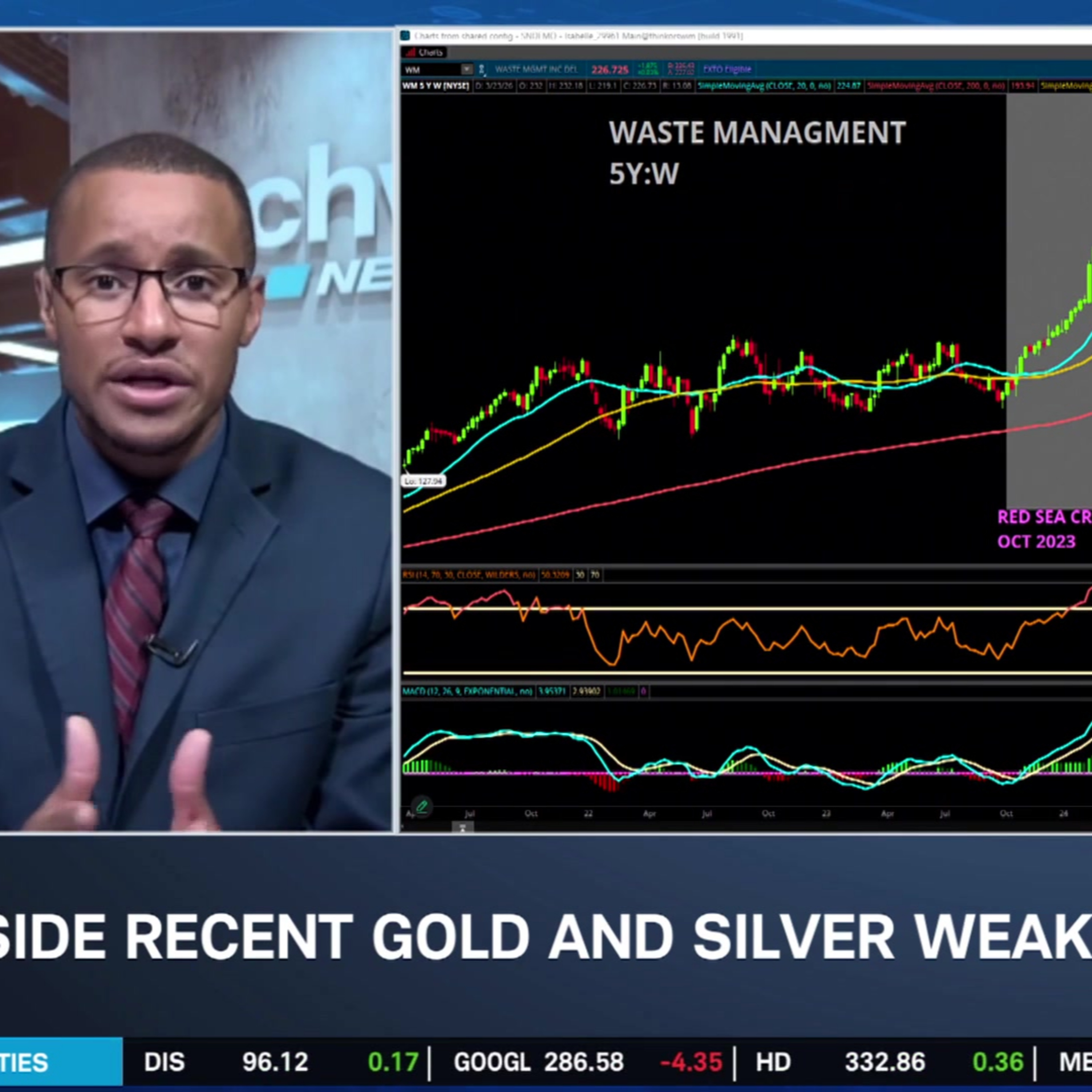
If we do see this escalating and actually transfers over into the Red Sea, and we see the Babelman Dabstraight starting to be contested, the recycle business on a global scale is going to see a significant amount of demand here. And you could have companies like Waste Management, which has some exposure as well as Republic services, which is another company that actually handles garbage, as well as recycling and reprocessing chemicals actually catch a bid. If you look at this time period back with the Red Sea, which is about almost two and a half, three years ago, Waste Management caught a significant bid about 35%, very low beta trade doesn't disconnect from the S&P 500. But something to keep on your radar, if this continues to persist, I always think that the recycled markets are going to start catching a premium and we're not able to get, you know, or, or, you know, mining materials in place in order to smell them into the final product. So keep your eye out on this space, especially for Waste Management coming down in the 50s, as well as the 20 week moving average key area of support that it compiles off of.
Very interesting. I mean, that chart really says it all, as you can see on the history of that, as you say, with the Red Sea. I mean, that's very interesting to keep an eye on. Thanks so much, KG, for highlighting that. Really appreciate it. All right.
More episodes
More from Schwab Network

Stock Market Today: ORCL & ADBE Earnings, AEO Plunges Near 52-Week Low
Schwab Network

Thursday's Final Takeaways: Crude Taps $103 & PPI Hotter than Expected
Schwab Network

Balancing High-Conviction AI With High-Dividend Diversification
Schwab Network

EARNINGS PANEL: ORCL, ADBE
Schwab Network