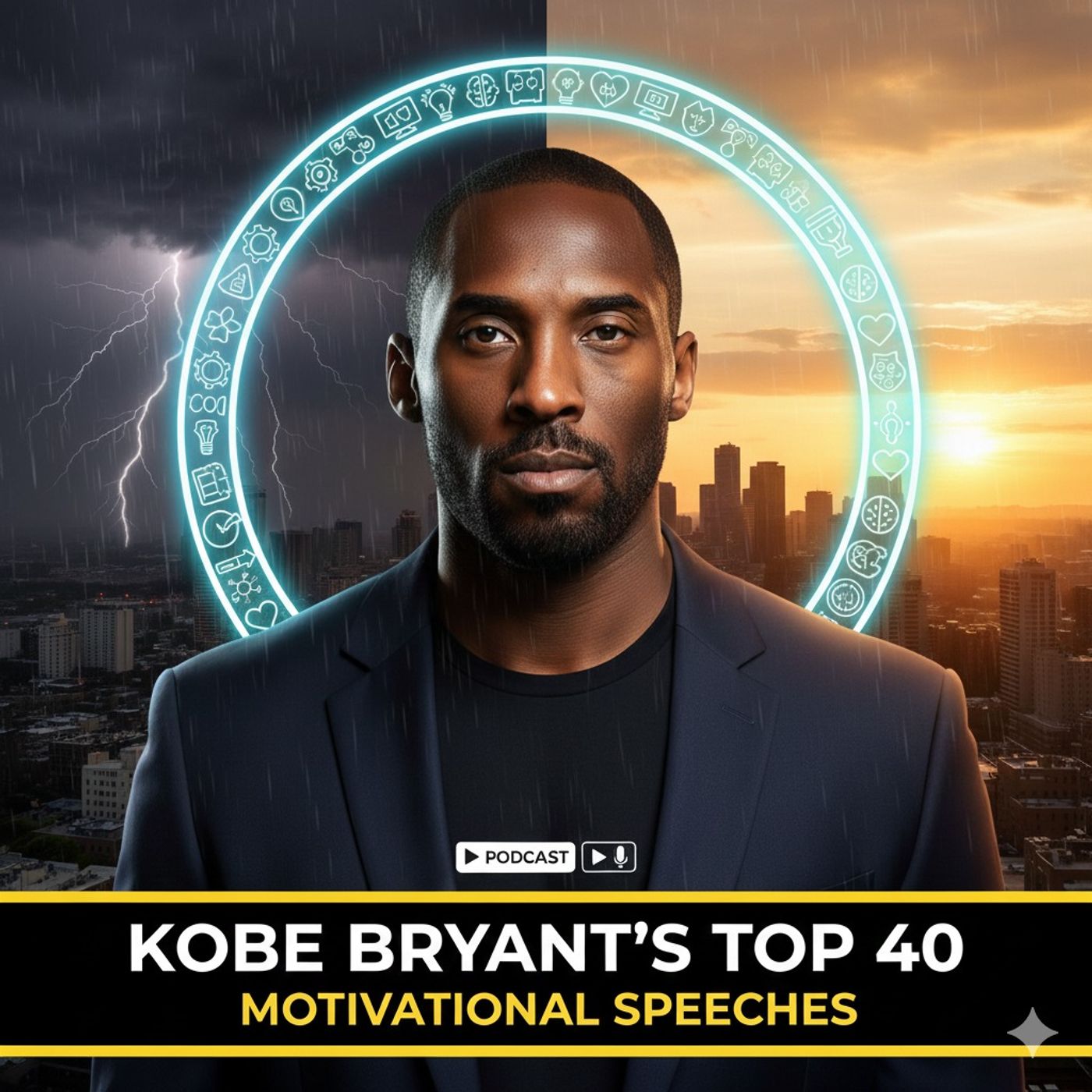
About this episode
Best Self-improvement Motivation
Kobe Bryant’s Top 40 Motivational Speeches
Get inspired by the most powerful speeches from Kobe Bryant. Discover the Mamba Mentality, relentless work ethic, and winning mindset that changed lives. 🏀🔥
We Need Your Love & Support ❤️
https://buymeacoffee.com/myinspiration
#Motivational_Speech
#motivation #inspirational_quotes #motivationalspeech
👉Best Audiobooks for You - 👍
Hosted by Simplecast, an AdsWizz company. See pcm.adswizz.com for information about our collection and use of personal data for advertising.
Get every episode summarized
Each time Motivational Speeches publishes, we email you a written briefing from the transcript — the topics, who appeared, and any specific claims, with the ad reads skipped.
Email me new episodesFree for 3 shows. No card needed.
Hosts & guests

Transcript ready
391 searchable segments. Every word is indexed and playable.
Full transcript
Motivational Speeches — Kobe Bryant’s Top 40 Motivational Speeches. Machine-transcribed; use the interactive transcript above to jump the player to any line.
Freight rail does more than move goods. It drives America's economy. Every dollar invested generates another $2.50 in economic activity spurring growth from farms to factories. And here's the best part. Freight railroads fund their own infrastructure, saving taxpayers' billions while powering the economy forward, from reducing highway congestion to delivering goods safely and efficiently. Freight rail keeps America moving. Learn more at AARC.org, slash America's engine. Now, finding a doctor is a little less challenging. United health group is investing in tools that make it easier for patients to navigate healthcare and pay less. These transparency tools help patients find providers, and this is the big thing. Compare costs up front. The big picture, more transparent pricing, benefits everyone. And these tools from United Health Group can help patients save hundreds of dollars annually. Learn more at unitedhealthgroup.com slash commitment. You're up to 0. What's the story? Are you not happy or you're only half happy or
instead of be happy about you're up to 0? Job's not finished. Job finished? I don't think so. I'm going to ask you a crazy question. After we split apart, were you trying to get more championships in me? Absolutely. You are. Absolutely. And I knew you were going to get one. I knew you were going to get one. Because of the energy, you're going into Miami and Dwayne and everything that was there. I knew you were going to get that one. So I knew I had to get at least two or three. I wanted you to get that. I needed that. I wanted that. I wanted people to say, see, see, this is what they're missing here. This is what they gave up for. Kobe should have been the one to go. I needed that. I wanted that. I wanted everybody to hate me. I wanted to fuel off of that. I'm just coming back with so much anger, so much vengeance. Right after you won, I went out to the track and I ran. I did my conditioning. I did my drills. I woke up the next morning. I hit my weights. I did my cows and shots. I did everything humanly possible to get myself ready. But I was, I needed that. I was like, yeah, good.
My brain cannot, it cannot process failure. It will not process failure. Because if I have to, if I sit there and have to face myself and tell myself, that you're, you're a failure, I think that's, that's a worse, that's almost worse than death. You getting up six in the morning, man. It's five, 30 in the morning. What, what, what, what time are you going to sleep? I don't need too many hours of sleep, man. I can go off at three, four hours. Really? Yeah. Three hours? Damn, you did, they told you I got sleep apnea right? I need, I need about six, seven hours. What's a normal day like for you, particularly in the off season when you talk about getting up there early. I want to know what time you get up. I want to know what you do when you get up. Well, I know I'm going to wake up at about 4.30 and 4.30 in the morning, 4.30 in the morning and I get ready to work out. This past summer, I couldn't, you know, run like I normally do and do all the shots because of my name.
Right. So I'll get up in the morning and do my therapy, do weights, things that I nation, I do that about twice, three times a day sometimes. No, but the key is when you get up that early in the morning, you finish your workout, 12 o'clock, 12, 30, whatever. You have the rest of the day to kick it with the fan. You know what I mean? Instead of waking up in the middle of the day, you get all of those hours in, then your day shot. Right. You know what I mean? So if you get up at 10 in the morning, train at 11. 12, say 12, train at 12, train for two hours, 12 to two. You have to let your body recover. So you eat, recover, whatever. You get back out, you train, start training to get in at six, train from six to eight. Right. And now you go home, you shower, you dinner, you go to bed, you wake up, do it again. Right. Those are two sessions. Right now, imagine you wake up at three, you train at four, you go to four to six, come home, breakfast, relax. So, so, now you're back at it again, nine to 11. Right. You relax and now I'm starting your back at it again, two to four. And now you're back at it again, seven to nine. Look how much more training I have done by simply
starting at four. Right. And so now you do that. And as the years go on, the separation that you have with your competitors and your peers just grows larger and larger and larger and larger and larger. And by year five or six, it doesn't matter what kind of work they're doing in summer, they're never going to catch up. If you want to be a great player, if you play every single day, two to three hours, every single day, we're a course of a year. How much better are you getting? Most kids will play maybe, you know, an hour and a half, two days a week. Well, the math one, it's not going to get it done. It's not going to get it done. Right. So, if you're obsessed with obsessively training, two, three hours every single day, over a year, over two years, they're going to accelerate. You make quantum loops, man. I wasn't invited to parties or, you know, family gatherings on the weekend. So, in five days and Saturdays, I would go to my rec room with my basketball and basically juggle myself to sleep. I think that that was the best thing that could ever happen to me because
of doing those lonely hours in the rep room, I discovered the hunger, the motivation, the desire to be the best possible basketball player that I could be. I think I've ever said this before. This kind of makes me seem very psychotic, but whatever. I used to play the Halloween theme song over and over and over in my headphones, pregame, seriously, seriously. And it was important that it was Michael Myers because the mask itself was void of emotion. Void of emotion has nothing to do with hype, has nothing to do with camaraderie's stone coat killer. And I would listen to that song over and over and over and over again. That's that's when you know you better run because that's what a lot of people do. Yeah, it's like you're coming out. It's going to be a tough night. We get into a city. One of these cities is very late. And immediately we all go to the gym, you know. Oh my guys, it's, you know, it's mellow, it's me, it's broad, it's coping. Like, we all go to the gym. We all get our work here. It's real late. And so after we get done
getting our work in, me and my guys, we say, hey, like, let's meet for breakfast in the morning. Like, you can't sleep. Whoever first one wake up, hit us up. We don't go eat. And so, we do that. We probably get like three hours of sleep. We can't sleep much when you're traveling across the world. You know, like we were traveling. And we get probably like three hours of sleep. And we we wake up. We go down to where the food is. And as we walk it down, you know, slurping with, sleeping our eyes, Kobe Bryant is sitting there. Well, ice on his knees already, right? So we walk up to cold. We like cold. What's up? And he was like, oh, yeah, man, I just finished a, finished workout. And I'm about to go do another one. And at that moment, I was like, wait, hold on. We just worked out about three hours ago. You know what I mean? And like, you've done another workout and you about to go do another one. That's when I was like, okay, I got to get my stuff together. I got to get my shit together. You know, the mama mentality simply means trying to be the best version of yourself. That's what the mentality means. It means every day, you know, you're trying to become better. And it's a constant quest. It's an
infinite quest. You know, the passion came from the love for the game. You know, I loved everything about it. Like the smell of the ball. You love the smell of the ball. Yes, the ball. You know, the smell of like brand new sneakers. You like the sound of the ball makes when it hits the ground. Sneakers in the gym. Yeah, ball going through the net. Like all those things, I love. And so the passion comes from that because once you have that love, you just want to be a part of this thing all the time. I had a summer where I played basketball when I was like 10 or 11 years old. And here I come playing and I don't score one point the entire summer. Really? Not one. How old were you? 11, 10, 11. You're playing against other 10, 11 year olds, right? You need to score once, not one. Were you in the game? I was in the game. How did you not score? Because I was terrible. Really? Yeah. That's 10, 11 years old. You were that tough. I mean, I, you know, and I had these big knee pads on because I'm growing really fast. I have socks all the way up here and I have like the pod top. It's like giddy as hell. And I scored not a free throw, not a nothing,
not a lucky shot, not a breakaway layup, zero points. And I remember crying about it, me upset about it. My father just gave me a hug and said, listen, whether you score zero or score 60, I'm going to love you no matter what. Wow. Now that is the most important thing that you can say to your child because from there, I was like, okay, it gives me all the confidence in the world to feel. I have the security, but the hell with that, I'm scoring 60. From there, I just went to work. I just stayed with him. I kept practicing, kept practicing, kept practicing. But you know what, there's three people in my lifetime that I admired or how hard they worked. Jerry Rice and Walter Payton, Kobe Bryant. Yeah. And his was legendary, you know, Kobe as far as he never worked out just once a day. Wow. You know, like you just said, he would get up in four in the morning. Yeah. Or he said, meet me at a gym in four in the morning. And he would work out for me, you know, two, three hours lifting because he knew he had to get stronger.
You had to get bigger. You'd basketball, but you just get stronger, right? Yeah. Then he would go eat breakfast. And then he'd come back and he'd make five hundred shots. So he'd be there another two hours. Then he'd get ready for practice, right? He'd go through a two and a half hour, three hour practice like it's nothing. Then he'd go have lunch and blah, blah, blah, he'd chill off another hour and he'd come back at night and work out again. And it was crazy to me because he had his method of it was scientific, you know, because he was like big. If I work out three times a day, and all these other guys who are so-called great players work out just for practice, they just work out that one time a day. He said, over five-year period, they can't catch me. I've worked out that much. I've worked on my body. I've worked on my footwork. I've worked on my shot. So five, ten years from now, they can't catch me. Did that far behind him? So at 13 years old, I had a, I had a kill list, you know, they used to do these rankings. So street and Smith basketball rankings. And I was nowhere to be found because I was like six, four, scrawny,
like 160 pounds soaked and wet. So I was like 57 on the list. And so I will look at 56, 55, all the way up to number one, who these players are, with club teams they played for. So when we go on an AAU travel circuit, I got to hunt them down, right? And so that became my mission in high school is to check off every other person, all those 56 other names, hunt them down and knock them down. A lot of the kids that I was playing against were intercity kids. And so you're looking at me as if, okay, this kid is soft, right? Here's a shift worth noting, better health care is care that meets patients where they are. United health group is bringing it directly to living rooms. This is a win for patients managing chronic conditions. And here's the interesting thing, by closing those care gaps, administering in-home exams and identifying risks earlier, more diseases can be prevented and patient outcomes can improve in 2025 alone. United health group patients received over 19 million home visits. Learn more at unitedhealthgroup.com slash
commitment. Few things are as uplifting as the greatest moments in sports. And nothing brings us together quite like team USA at the Olympic winter games from NBC Universal's iconic storytelling to the innovative technology across Xfinity and Peacock. Comcast brings the Olympic Games home to America, sharing every moment with millions. When team USA steps onto the world stage, we're not just watching. We're cheering together. This winter, we're all on the same team. Comcast, proud partner of team USA. It's from the suburbs of Philadelphia. It's father played in NBA, pretty professionally. It's got a DZ. It's got a DZ and born on second, but you know, all this sort of stuff, right? And so it felt like they could try to be physical or try to intimidate me and do all this other stuff, which they couldn't, right? But now I'm saying, okay, well, you're trying to attack me. How am I going to attack you? How can I mentally figure out ways to break you down? How can I show you that no? I have the edge, right? And so that's when it first started for me. It's figuring out how to get the upper hand on an opponent that way.
And what would you do to mentally break people down then? We used to have an all-American camp that used to go to. At the time, I first showed I was a sophomore. And one of the things I would do is why everybody would be at the cafeteria work, you know, eating and doing all sorts of stuff. I just go back to the gym. I just go back to the gym. They'd be resting and they'd see me leave. But now you're in a tough position because you're like, okay, I want to be like, I'm following the kid to go work out, but I know he's working. He's up early and he's doing all the same stuff. And so that was my way of showing them. Yeah, yeah, maybe from the suburbs, but you're not going out, work me. Wow. And I'm mentally going on. Did someone teach you that? Was that just the thing that you decided, like, how many getting people's minds? I think it's just figuring out ways to be better. At 13 years old, I played the longer game because my game wasn't about being better than you at 13. It was to be better than you when the chips are really on the line. So when we played at 13, I would size you up and see what your strengths and weaknesses are.
How do you approach the game? Are you silly about it? Are you goofy about it? Are you good at it? It's just because you're bigger and stronger than everybody else. Or is there actually thought and skill that you put into it? Right? And when I'd play, I'd play to my weaknesses. I wouldn't play to my strengths. I'd play to my weaknesses because when you're playing Summer Basketball, there's so many games. So there's not a lot of skill work being done. So when are you going to get better? Right? When you're playing in competition situations, you're only playing to your strengths wide because you want to win. Right? So what I would do, I always work on the things during those games that I was weak at, left hand, pull up jump shot, post game. Right? So I have a strategy. So then, fast forward to when I'm 17, and my game is completely well-rounded and that player at 13, that's why 13 is still doing the same shit at 17. Now you got a problem. Right? There's a quote from one of my English teachers, a little marion named Mr. Fisk. And a great quote that said, rest at the end, not in the middle. And that's something I always live by. I'm not going to rest. I'm going to keep on pushing now.
There are a lot of answers that I don't have, or even questions that I don't have. But I'm just going to keep going. I'm just going to keep going and I'll figure these things out as you go. Right? And you just continue to build that way. So I try to live by that all the time. Those times when you get up early and you work hard, those times when you stay up late and you work hard, those times when you don't feel like working, you're too tired, you don't want to push yourself, but you do it anyway. That is actually the dream. That's the dream. It's not the destination, it's the journey. If you guys can understand that, then what you'll see happen is that you won't accomplish your dreams. Your dreams won't come true. Something greater will. Here's why practice was important to me. Not just the standpoint that I enjoyed playing. Like I enjoyed being there. I enjoyed getting better. But as a leader of a team, it's also your responsibility to elevate the rest of the guys. But people tend to get stuck on a lot. They say, okay, the way to make players better is to pass them the ball when they're open.
That's a very trivial way to look at things. What you have to do is you have to get them emotionally to want to be better. You have to get them to an emotional space where they wake up every morning, driven to be the best version of themselves. How do you do that? And in practice for me, it was a chance to drive them, to challenge them. This is where you have to know your teammates. Because if it's late, you have to back-to-back and we have to practice the next day, you show up. Guys don't feel like going through the motions, don't feel like practicing. It's important to know each and every one of them individually. Because then you know with a nerve to touch. Some guys is like, okay, come on, let's, you know, we can do this. That'll get them going. Other guys don't know. You got to figure out what button to push. I guarded Kobe in the garden. I can't remember how much you had, but I know I had multiple steals to wear in the game on in my head. All I'm thinking of is when I have this conversation on brother after the game, how I'm gonna tell him how I stole a ball from Kobe. I'm thinking
about all these things in my head. I'm like, soky. The fourth quarter start. When you were already celebrated? Well, of course it started. And Kobe said you had a great game. But I'm looking like, there's 12 minutes. What you talking about? What was that? You ain't saying nothing the whole game. I've been talking. I don't stole a ball. I'm hyped to tell his Kobe Bryant. He said not one word to me. The man come down. You remember he came shot fake, shot fake, threw it off the glass, called it through it to the corner. I'm like, bro, what's you all? Bro, you've been regular all game shot. Get to the spot, shot fake, spin pivot over here, spin back on the foot, drop it off the glass. I'm like, bro, what's going on? Then he pulled up. I'm like, 35 feet on some Steph Curry's. But what Steph was doing there? He pulled up and laced it. I'm like, they call the time out, Dan Tony, looking at me. I'm like, bro, I
think the best way to prove your value is to work. It's to learn, it's to observe, to be a sponge. You always want to outwork your potential. As hard as you believe, you can work, you can work harder than that. And that's when I try to do when I first came and lead. But basketball is such a direct competition sport. At me coming in at 17, I hated when like my teammates would say, you know, I get hit with an elbow, right? Shack would hit me with elbow in practice. And like, you know, you know, Nick Van Axel would come up and say, are you okay? Am I, are you okay? That was wrong with you. So like, I always had that extra chip on my shoulder. So like, every day in practice for me was really trying to annihilate everybody that I was playing against. Because I wanted to prove you don't need to babysit me. Like, I'm fine, you know? Basketball for me was the most important thing. So everything I saw, whether it was TV shows,
whether it was books I read, people I talked to, everything was done to try to learn how to become a better basketball player, everything, everything. And so when you have that point of view, then literally the world becomes your library to help you to become better at your craft. The world becomes your library to help you improve your craft. Better your craft. Yes indeed. So because you know what you want, the world's given you exactly the information 100% better. Because you know what you're looking for. There was a, there was a year played Indiana Paces in the finals. A rolled by ankle really bad, Jalen Rose stepped underneath on purpose. He admits it now finally. Roll by ankle really really bad. I came back finished a series, but I couldn't touch a basketball until mid-September, which is driving me crazy. I couldn't train. But I looked at, this was like the 10th time I rolled my ankle in one season. So I'm looking at them saying, okay, I got to address that. And so being that I couldn't get on the basketball
court, what I did was I took tap dance classes. No kidding. I took tap and tap was like the best training for me in the world. Because the strength of my feet, the change my rhythm and my approach to the game. I was able to change speeds when I came back to the following season. You know, I think dancers put way more strain on their body than athletes do. And I think there's a lot that can be learned from that. My daughter took ballet for several years and I was sitting there in the class, right? And I didn't know what I was getting into. I don't know anything about ballet, right? But I'm sitting there in the class and I'm watching her and watching it get the first position, the second position. I'm starting, I'm learning the structure and the rules that go along with it. As athletes, there's a lot to be learned from that. Because if you simply go out there and perform and play, yeah, you'll be great every now and then. But if you play with structure, if you understand the rules that come along with that, the discipline that comes along with that, then you reach another level. You're playing against the Golden State Warriors. Score is 107, 109. You guys are close to getting into the playoffs. You know exactly what happens
in the game. You go up. You're about to take your shot in and all of a sudden, boom. Yeah. The Achilles happens, right? How the hell do you tolerate that kind of pain? You know, I use this, I tell this example and I think it's the best way to explain it. You know, you have a hamstring injury, you pull your hamstring really, really badly, you can barely walk, right? Let alone play anything. Doctor tells you go home, sit up on the couch, rest your hammy, stay off of it, don't get up, no sudden movements. You're at home, all of a sudden a fire breaks out in the home. Your kids are upstairs, your wife is wherever she may be, you know, it's just going down. I'm willing to bet that you're going to forget about your hamstring, you're going to sprint upstairs, you're going to grab your kids, you know, make sure your wife's good, you're getting out of that house, right? Hamstring be damned, you're not going to fill your hamstring, right? And the reason is because
the lives of your family are more important than the injury of your hamstring. And so when the game is more... United Health Group is bringing in-home treatment directly to patients, closing caregabs, identifying risks earlier and improving patient outcomes. In 2025, patients received over 19 million home visits. Learn more at UnitedHealthgroup.com slash commitment. This winter, we're all on the same team. Comcast, proud partner of Team USA. Porting the injury itself, you don't feel that damn injury. Not at that time. He ruptures his Achilles tendon. Danny says to me, so I reach back there and try to pull it back down. Yeah,
I said, no, it doesn't work that way. He said, you go see, I know, he goes, you know, I'll be try to walk on my heel to see if I could run on my heel, see if I could play that way. I said, it don't work that way. He goes, can we go on the back? Maybe you could tape it up. I could finish the game. I said, it doesn't work that way either. I said, let's shoot the free throws, but it's up to you. Do you want to shoot? I'm shooting them. I've talked to them. To this day, pretty much, it was a shot at Paul Pierce. When he played, he walked off. Yeah, and he, he will, will see wheelchair, all wheelchair off the cords, and then came back. Right. Kicked our tails. The rest of the game. So that was the message that he was sending to everybody. And it was sent. Loud and clear. It's 3.30 am. My foot feels like dead weight. My head is spinning from the pain meds, and I'm wide awake. Forgive my vending, but what's the purpose of social media if I won't bring it to you real? No image. It feels good to vent to let it out. The feelings of this is the worst
thing ever, because after all the vending, the real perspective sets in, there are far greater issues and challenges in the world than a torn Achilles. Stop feeling sorry for yourself. Find the silver lining and get to work with the same belief, same drive, on the same conviction of ever. One day, the beginning of a new career journey will commence. Today is not that day. If you see me in a fight with a bear, pray for the bear. What have you learned about yourself through these 20 years of being in the NBA? Wow. What I've learned is to always keep going. Always. You know, there's been times, particularly in my career, where it just feels like this is the end. But what I've come to find out is that, you know, no matter what happens, the storm eventually ends. And when the storm does, and you want to make sure that you're ready. And so I've really learned, but one foot in front of the other, good, bad, and different. Eventually, that storm passes. We were in Vegas for the start of training camp. And we were getting ready for the Olympics in Beijing. We're going to
head to Beijing. And I wanted to establish myself as a young leader on the team by waking up bright and early day one. So the goal was to be the first one at breakfast. So I set my alarm. I make sure I'm about sunrise. I get out of bed. I put on my gear and I head downstairs. But when I get there, Kobe's already there with ice packs on his knees, during his sweat. Now, it took me a minute to figure it out, but this guy wasn't only awake before me. He had already worked out. He had just played in the finals days earlier. Meanwhile, I'd been off for months and I was still exhausted. What he had done that morning was incomprehensible to me. That dedication he had only days after falling short of an NBA championship. That taught me some I've never forgotten. Legends aren't defined by their successes. They're defined by how they bounce back from their failures.
But what does losing feel like to you? It's exciting. Why is it exciting to me? Because it means you have different ways to get better. There are certain things that you can figure out, that you can take advantage of. Certain weaknesses that were exposed, that you need to shore up. So it's exciting. It sucks to lose. But at the same time, there are answers there. If you just look at them. Because you get the information from losing more than from winning, probably. Yeah. The answers are there when you win, too. You just have to look at them. So it's a constant process. It's exciting when you win. It's exciting when you lose because the process should be exactly the same. Whether you win or you lose, as you go back and you look and you find things that you could have done better, you find things that you've done well, that worked, figure out how did they work, why did they work? How can you make them work again? But the hardest thing is to face that stuff. We flew back to LA that night and I got home. It's probably like three in the morning.
And I went down to the high school. She's down the street for my house. And the janitor let me in a jump. And I shot all day. I mean, all day. And this is right after that playoff game. And I didn't leave the jump. I just kept shooting, shooting, shooting, shooting, shooting, shooting, practicing and practicing. And I got a chance to let out the steam of disappointing my teammates and millions of fans. I got a chance to let all that out instead of bottling it up. And then vision that moment over and over and over and over and over. That was a huge sum for me because I felt like everybody had written me off after those airballs. I think the greatest fear that we face is ourselves. Actually, I think it's not anything that's external or anything that's superficial. The greatest fear you face is yourself. Because we all have dreams. And it's very scary sometimes to accept the dream that you have.
And it's scary. You're still to say, OK, I want that. It's scary because you're afraid that if you put your heart and soul into it and you fail, then how are you going to feel about yourself? So being fearless means putting yourself out there and going for it. No matter what, go for it. Not for anybody else, but for yourself. Doubt is such a strange thing. There'll be times where you succeed and there are times that you fail. So wasting your time doubting whether you're going to be successful or not is pointless. It is. You just put one frame in front of the other. You control what you can't control. And then you see what the outcome is. If you win, great. You're going to have to wake up the next day and do the journey over again. If you lose, sucks. It's going to have to wake up the next day and do the journey all over again anyway. What I try to do is just try to be still and understand that things come and go. Emotions come and go. The important thing is to
accept them all, to embrace them all. And then you can choose to do with them what you want versus being controlled by emotion. You know, a lot of times I've seen players, even myself, when I was younger, being consumed by a particular fear. And to the point where you're saying, okay, nah, it's not good to feel the fear. I shouldn't be nervous in the situation right now. And it does nothing but grow. Versus stepping back and saying, yeah, I am nervous about the situation. Yeah, I am fearful about the situation. What am I afraid of? And then you kind of unpack it. And then it gives you the ability to look at it for really what it is, which is nothing more than your imagination running its course. When I was playing and teammates would say, Kobe's not out on the road. What is he doing? You see me on the plane. He's reading. What is he reading? He's writing. What is he writing? I'm practicing. I'm writing. I'm practicing. I'm understanding how to tell stories. I'm reading Joseph Campbell and how to create arcs, compelling arcs and plots.
I'm reading that stuff. So this is going back 15 years, right? So I don't just retire right dear basketball and luck in the winning and Oscar, you know what I'm saying? That stuff comes from hard work and from studying for 15 years, how to write and how to organize structure, right? And you can't do that without having a serious love or commitment to the craft. So when you saw that you couldn't motivate others and they were lazy or they didn't put out the same effort that you had in yourself and expected in them, how did you respond? Well, I grew up to Phil's office and Mitchell's office and we have a nice salary cap conversation about how we can move these players and get them out of there, pack them up and move them out. So you were the general manager? Well, no, but I was the one that was like, listen, at the end of the day, the career set and done, you know, I'd be damned if I don't lose these championships because I'm playing with a bunch of lazy dudes. This is not happening, right? So, you know, this train is going
this way, one way or the other. You're going to be on it, you're going to be off it, you're going to be under it, right? It's just, it is what it is. It is what it is. So if you, you know, I like to motivate players to be better. I don't want to have to motivate people to get into the first place. How much more do you want from me? More. How much more successful do you want me to be? More successful. How many records can my records break? More records. But, but I'm the best. But are you a different animal and the same beast? What the f**k is that mean, Kobe Bryant? You're welcome. What the f**k is he talking about? You see a player of pump face, they generally, if they're right handed, the right leg always goes behind, right now with Dimitri. What the hell? So, player gets the ball and throw a pump fake, they do this, right? It's how the back leg goes back. Who the hell is going to shoot the ball from that position? Nobody, right? So why would you fall for
that pump fake, not a million years, right? So if a person is going to pump fake and you're looking at his foot, he's in that position, you know he's not going to shoot, he's going to drive the ball, he's just back up, right? Now if they're in this position, now you know that's a real threat. So when you think about the greatest players of all time, 90, 80% of them have got gift of natural talent, ability, body, right? So Jordan, 48 inch vertical, right? You got the big hands, right? You got LeBron, right? You have Shaquille O'Neal, right? Then Magic, 69 point guard with vision, Kobe, standard. If I give you six, six and then took every six, six guard in the NBA and NBA history, you would never find him. You would never find Kobe because he didn't have big hands, right? He wasn't quick, he wasn't fast, 38 inch vertical, got standard. Now if you don't have a 30 inch vertical, you're not even a shooting guard in today's game, right? And what he did with
that body, it's like you took, you took a S500 and he was pushing it like a Bugatti. That's what we look at. We look at the normal person fighting gods. I always dreamed as a kid that it was possible to score 80 or 90 or 100. Lay down, not imagine playing through the lakers and I would imagine with the uniforms with like I'd imagine we'd be playing the smell of the arena and all that stuff and I would see myself getting hot. So you just keep dreaming and dreaming and dreaming and before I go to sleep, I'm like at 120 points. So when you grow up downloading that into your brain over and over and over and then you know that summer, I made a thousand shots of that and it weren't just shots. There were shots that you saw in that game. There were specific shots. So when you download that into your system and you go on in the court and you're just executing things that you've done thousands of times before and you have that dream, then that becomes possible.
We're not on this stage just because of talent or ability. We're up here because of 4am. We're up here because of 2 days or 5 days. We're up here because we had a dream and let nothing stand in our way. If anything tried to bring us down, we used it to make us stronger. We were never satisfied. Never finished. We'll never be retired. My high school English teacher, Mr. Fist, I actually paid attention one time in the class and she said he had this beautiful quote and it read, rest at the end, not in the middle. And I took that to heart. I believe there's time for resting at the end, but for me, that time is not now. My next dream is to be honored one day for inspiring the next generation of athletes to have a dream, sacrifice for it, and never ever rest in the middle. It seemed like it was yesterday I was about your guys' age and I had a dream. I had ambitions of being one of the greatest basketball players of all time and through hard work and dedication,
that dream came true. But I want to tell you guys something, something to be mindful of. When you have a dream, the one thing you have to watch out for are those out there that don't try to crush your dream. You cannot allow that to happen. That is your biggest challenge. So I challenge you to have your dream go after it with all you have and be legendary in your own right.
More episodes
More from Motivational Speeches

Why You Can’t Get Rich Looking Poor | Dan Lok
Motivational Speeches

Why the Worst Number in Business Is ONE | Dan Lok
Motivational Speeches

Why the Best Leaders Are Full-Time Learners | Darren Jacklin
Motivational Speeches

Why Selling Is Not a Four-Letter Word | Dan Lok
Motivational Speeches