Loading...
newshistory
Kristi Noem OUT at DHS. The Science of Second Chances in Criminal Justice (with Jennifer Doleac)
About this Episode
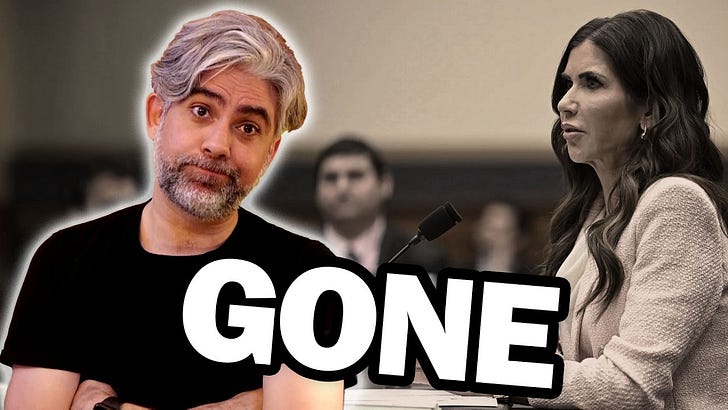
I didn’t expect the day’s biggest story to land before the show even got rolling, but the first major cabinet domino of the Trump administration has finally fallen. Kristi Noem is out as Secretary of Homeland Security.
The immediate cause appears to be a congressional hearing exchange that went sideways. During testimony before Sen. John Kennedy, Noem said that a $200 million ad campaign — one that prominently featured her — had been approved by the president. The White House later said it had not, and it’s that contradiction that seems to have been the final straw for Trump.
It’s no secret that the ground had been shifting under Noem for a while. Critical press coverage had been building, particularly around operational issues inside DHS. Some of it focused on headline controversies, but much of it involved the less glamorous details of running a department: delayed contracts, paperwork sitting unsigned, and basic administrative work that insiders say was slipping through the cracks.
Politics Politics Politics is a reader-supported publication. To receive new posts and support my work, consider becoming a free or paid subscriber.
Complicating matters was the presence of Corey Lewandowski, who had developed a reputation inside the department as a, let’s say, aggressive and polarizing figure. According to people around Washington, he made enemies across the bureaucracy, and those tensions ultimately became inseparable from Noem’s own standing within the administration.
Trump’s apparent choice to replace her is Sen. Markwayne Mullin of Oklahoma, a former MMA fighter who has built a reputation in Washington as a loyal Trump ally and a frequent presence on television.
In some ways, Mullin is a pragmatic pick. Replacing a cabinet secretary this late in a term can be politically tricky because any nominee must survive Senate confirmation. A sitting senator already has relationships and credibility inside the chamber, making it easier for colleagues to vote yes even if the appointment is politically uncomfortable.
That dynamic worked to the administration’s advantage when Marco Rubio moved into a cabinet role earlier in the term, and it could play out similarly here. Senators are often more willing to confirm someone they know than an unfamiliar nominee from outside Washington.
Noem’s departure also lands in the middle of a broader policy fight. DHS remains partially shut down due to a standoff between Democrats and the administration over immigration enforcement policies.
From my perspective, this moment could provide Democrats with a face-saving off-ramp. With Noem gone, they could claim a political victory and move toward reopening the department without appearing to capitulate entirely on their policy demands. The alternative — maintaining a shutdown while security risks mount — carries its own political dangers.
When federal security agencies operate without full funding, the political blame game gets complicated very quickly if something goes wrong.
Fallout from the Texas Primaries
Meanwhile, the ripple effects from the Texas primary elections are already shaping the next phase of the campaign cycle. Sen. John Cornyn and Attorney General Ken Paxton are heading toward a runoff, and President Trump has signaled he may intervene with an endorsement.
Paxton has already indicated he won’t automatically step aside even if Trump backs Cornyn, raising the possibility that the party’s internal fight could stretch out for weeks. Democrats, for their part, clearly prefer facing Paxton in the general election given his long history of scandals and investigations.
Another runoff will take place in Texas’s 23rd congressional district, where Tony Gonzalez is facing intense pressure after admitting he had an affair with a staffer.
The admission carries serious implications. Relationships between members of Congress and staff can trigger ethics violations, and Gonzalez now faces an ongoing investigation. Leadership within the Republican caucus is reportedly signaling that even if he wins the runoff, he could still face consequences in Washington.
In other words, his political future may already be decided regardless of how the voters rule.
Chapters
00:00:00 - Intro
00:01:01 - Kristi Noem
00:08:07 - Markwayne Mullin
00:11:19 - Interview with Jennifer Doleac
00:33:22 - Update
00:33:54 - Cornyn/Paxton
00:36:47 - Tony Gonzales
00:39:36 - Mullin’s Senate Replacement
00:41:36 - Interview with Jennifer Doleac, con’t
01:00:14 - Wrap-up
This is a public episode. If you'd like to discuss this with other subscribers or get access to bonus episodes, visit www.politicspoliticspolitics.com/subscribe
Hosts & Guests

Transcript
On this edition of the program,
Kristi Nome out, who's going to replace her?
It's Senator Mark Wayne Mullen.
Also, we have a conversation about the science of
second chances. It's all coming up.
The following is brought to you by Justin
and other pilot.
Hello and welcome everybody to the
pilot of the program for March 6th,
2020, six-year-old pal Justin Robert Young joining you
from the San Francisco International Airport.
It was planning on doing a little bit of an intro here for our
episode did not expect it to be so jam-packed with news because
the first domino has finally fallen.
One of the original cabinet secretaries, one that has been encircled for quite a bit is now
an ex cabinet secretary.
The Department of Homeland Security, which is currently still shut down for those
keeping track at home, now does not have a leader.
Kristi Nome is out.
Kristi say hello to cricket, at least when it comes to your secretarial chances.
What apparently was the straw that broke the camel's back was her
testimony before Congress wherein in answering a question to Senator Kennedy of Louisiana.
A question that was blessed by the White House for the record, she was asked whether or not
the $200 million ad campaign, which primarily featured her,
would was approved by the president.
She said it was Donald Trump disagreed.
And so now we finally have a camel with a fractured spine.
Before we get into kind of a lifetime achievement award that she has gathered over the last
year and change, let's just understand that this has been a campaign to get her out
for months. It has been active.
You've seen soft emotions of her handling of the Alex Pretty shooting in Minnesota,
the sideline of Tom Holman.
I've highlighted this for you guys. You know, certain articles that come out
are hit pieces because of how they are framed, because of who is talking and who is not talking.
There's no doubt that in an article, I believe this was the Wall Street Journal that came out,
where Tony Fabrizio has quoted on the record
that that is blessed by the inner inner inner circle of Donald Trump's orbit.
And I would say Susie Wiles has her hand on that knife because Tony Fabrizio does not leak things.
He is in charge of handling very sensitive information to the president.
The kind of raw intel that goes into larger situations. Anything involving him does not come out
unless somebody wants it to come out because he's not a he's not a talker. Susie Wiles is not a talker.
But there's a lot of enemies that have been made by not only Kristina Um, but also her little
boyfriend, Cory Lewandowski. By the way, she didn't deny having a sexual relationship with
under oath, which is fascinating. While her husband was in the audience, a verse with gossip about
that as well. DHS was poorly run. And beyond all the immigration stuff that you've seen,
beyond, you know, whatever the deportation quota numbers that were being driven by Steven Miller,
there's a lot of little stuff. And that was partially in the world of the Wall Street Journal article
about just blocking and tackling, like not signing deals that were on her desk for months and
months and months. The steel that was needed to build the wall on the southern border, the price went
up because she just took through damn long to sign the paperwork. What I am hearing now from DC
and everybody I know in DC is thrilled about this. I'm talking about left, right, and center.
I'm talking about hardcore mag of people. I'm talking about people that hate the administration.
Nobody is mad about it. In fact, this might be the most popular thing that Donald Trump has done
in his tenure is firing this lady. But one of the things that I've heard is
it's calling the Windows. He's, you know, quite frankly earmuffs to all the kids that are listening,
but he's an asshole. He's a micromanager. He's a bully, and he's not good at his job.
And so when you have somebody like that, that is just, you know,
pushing people around and putting people on edge, I heard something months ago.
That people internally were freaking out because nobody was paying attention to the fact that
he shouldn't be working there. He's a special governmental employee. He's only supposed to be
working for 130 days a year. He was manipulating the laws and just disregarding the fact that he
wasn't a special governmental employee. What I've been told over the last few hours is like,
he just made a lot of enemies. There were a lot of people that did not like this guy.
And therefore, it did not like Kristie Nell. But they were, they were, look, the terror twins
together. There was no, there was no distance between them. And now she's out.
We will see what that does. If I were, if I were the Democrats, I would use this as an
opportunity to end the DHS shutdown because you have at risk right now, blowback from the Orion
War, Homeland Security kind of stuff. And more safety that goes beyond immigration. Right now,
they are holding out the department because of immigration. But there are non-immigration things
that you don't want to have the blood on your hands if something really, really bad happens.
You know, they were lucky that this shooting in Austin happened on 6th Street at 1.30 in the
morning. So it's, you know, there's three people dead terrible. It does look like this guy
would have motivated by the Iran War on some level. But to be quite frank, as somebody who lives in
Austin, sometimes people get shot past last call on 6th Street. So it's not a man bites dog level
tragedy. That's not to say that one won't happen. And if that is the case, then Democrats are going
to really, really feeling if DHS wasn't funded. Christine Ombian out is a fig leaf, take it,
reopen the department. That's my opinion. Who knows whether or not they'll do it. We all know that
the real answer is that the Democrats are going to get crushed by their base no matter when they
make the deal. It's, you know, a matter of when they feel like getting crushed. Let's talk about
the replacement. Mark Wayne Mulling. Is he going to be better? He's a lot better liked in DC.
I'll tell you that. Former MMA fighter wants threatened to fight a union representative during a
hearing, which is a really funny clip. In fact, well, can you can you find that clip of Bernie Sanders
going on? No, no, no, no, no, we're not going to do that here. Let's play that clip.
Now, let's talk about Mr. O'Brien himself, his behavior. Everybody knows this here in the last
time. And when I kind of had a back and forth, but after you left here, you got pretty excited
about the keyboard. In fact, you tweeted at me, one, two, three, four, five times. And let me read
what the last one said, said, greedy CEO who pretends like he's self-made. What a clown fraud always
has been. Always will be. Quit the tough guy act and these Senate hearings. You know where to find
me. Any place, anytime. Cowboy. So, this is a time. This is a place. You want to run your mouth.
We can be too consenting adults. We can finish it here. Okay, that's fine. Perfect. You want to do
it now? I'd love to do it right now. We'll stain your butt up. Yeah. You stand your butt up.
Hold it. Oh, stop it. Is that your solution? I mean, hold it. No, no, sit down. Sit down.
Okay. You don't know. You're a United States senator. Sit down. Okay. Sit down, please.
All right. Can I respond? Hold it. Hold it. They got it. They got along afterward. In fact,
that guy that he was fighting with spoke of the Republican National Convention.
That being said, he's got a much better reputation. And certainly he's loyal to Trump. Trump
likes him. He's young. He's good on camera. Trump likes that. Probably the only reason my
Christy gnome was there, although I never thought she was good on camera. And
you know, considering we're talking about an X MMA fighter taking this job, it brings a measure
of respectability back to the office, which shows you where the bar is with a secretary
Paw Patrol being out as she was referred to by the excellent three-year Letterman Twitter account.
We don't know. Here's what we do know is that Mark Wayne Mullin taking this job
means that he is more likely to get confirmed. Because that was the other problem with any of
these cabinet secretaries being replaced now is that they're going to face hard uphill confirmation
battles. It makes it a lot easier if you confirm somebody that is from the Senate because you
get that Marco Rubio effect. You're not voting on a stranger. You're voting on somebody that you
know. It makes it easier to take a tough vote because you can say, look, I know Mark Wayne,
he's a good enough guy. It's blah, blah, blah, blah, blah. I got a little more in the update
about the senatorial replacement process. But we will get to that after we begin our interview
with Jennifer Dollyac. She has a brand new book out. Let's go ahead and third that.
It is my absolute pleasure to welcome to the program, Jennifer Dollyac. She is the author
of the science of second chances and one of my favorite people to talk about not only a criminal
justice reform, but also what I think is probably the most potent, undelt with cable of American
politics. And that is crime, especially in big cities and how to get real results out of it.
Jennifer, welcome to the program. Hello. Thanks for having me.
Tell us about the premise of your book. I know that this has been your area of research for many,
many years, and you finally put it all down. Give us the log line here.
Yes. So I am an economist by training. I was an economics professor for many, many years,
and escaped academia about two and a half years ago to join Arnold Dentures, which is a philanthropy
and policy organization. And AB is very focused on evidence-based policy. So I still think about
research and evidence, but I'm no longer doing it myself. But yeah, I basically spent a lot of
time as a researcher trying to apply the economics toolkit to figure out what works to make community
safer. So economists are very good at distinguishing correlation from causation. We're more obsessed
than other social scientists are with that. And so we have, we think a lot about running experiments
or finding natural experiments that can tell us whether our policies and programs are actually
working. And if they're not working, figuring out how to make them better. So that's what I do,
and that's what the book is about. The book is really structured in a way where I step through
what the research says, but how to intervene at each stage of the criminal justice process
to bring the frustration cycle and give people a real second chance.
What is the biggest thing we are doing wrong right now as a country generally?
I think the biggest thing is how we try to deter crime. So I think, you know, we have a basic
intuition, and I share this intuition as an economist, that that people will respond to
costs and benefits. We're always weighing costs and benefits and thinking about the trade-offs
involved in our actions. And one way to prevent people from committing crime is to increase the
cost of committing crime. So that's a good idea. And the way we've tried that over the last
several decades in the United States is to make prison sentences longer and longer. So if you
commit crime and you're caught for it, then it will sentence you to a really long prison stay
as a crime. Yeah. And that sounds like it should deter crime. But what we've learned over the past,
again, many decades, is that people who are at risk of committing crime, the people we're trying
to deter are typically not thinking very far ahead. And so we can deter their behavior, but they're
much more present-focused than the average person. And so a low probability threat of a long
sentence actually doesn't change behavior very much. What we need to do to change behavior is
increase the probability of any consequences at all. And the context where mid homicide in this
country, there's like 50 to 60 percent chance you're arrested for it, much less convicted, just an
arrest. So it's essentially a coin flip. Lower level offenses, it's much better. But you can commit
murder and it's a coin flip if you get arrested. That's right. Yeah. And in some communities,
it's much worse, right? So I think a big challenge in a lot of poor minority communities that are
really homicide. Part of the reason that we see just continue cycles of violence is the
probability of getting caught is really low. And then also that incentivizes people to take the
law into their own hands, because they know that it's not the accountability. And so figuring out
ways to increase the probability that people get caught faster will I think increase trust between
communities and law enforcement and address that problem. But it will also deter crime. And we have
lots of evidence that that's the lever we need to be calling to have a big impact on public safety.
And frankly, it's just the opposite of how our criminal justice system is built right now.
So right now, the system is we are arresting less people, but we are putting them in jail for
longer. We are we have harsher sentences. Right. You are suggesting that this would it would be more
of a evidence-based solution if we arrested more, but put them in jail for less time. That's
right. Exactly. So if we were to focus our attention and resources on police investigations
on solving more crimes faster, that will it'll it that's the consequence will then register
for people. Because right now what we set up is is a lottery essentially. Like if you're really,
really unlucky, you get caught for the crime you committed. And you go to jail for the grand jackpot
time. That's right. And so most people rightly assume that if they steal a car, they're probably
not going to get caught. They're right. Right. They're probably not going to get caught. And so if we
can switch that to be, you're probably going to get caught. And even if the consequence is much
lower than what they face now, that will deter behavior much more than our current system does.
So I'm going around my team in Arnold Ventures going around and talking with lawmakers about
this evidence and really trying to convince folks to shift our public resources, our tax dollars,
prison is really expensive. You know, like making prison sentences longer is really expensive.
And so if we can shift even a portion of those dollars into police investigations to help police
solve more crimes faster, we'll get a much bigger bang for our back.
So the, you know, if we're going to take these ideas and put them into practice, that would
mean less on the side of like mandatory minimums and looking at gigantic prison complexes because
you are looking to either parole people or, or you know, have just smaller sentences for these
crimes. But we are shifting that into, you know, a shoe leather on the ground police force kind
of stuff. Yeah, higher more detectives, more training for detectives. It turns out detectives in
this country don't get much training. So we're actually working with a partner organization to
build a detective school and roll it out as a randomized trial. What is my hold on? What is the
baseline training for a detective? Yeah. So so in most places, you know, police officers get a ton
of training, but the promotion to be a detective is often based on seniority. So it's just,
you just kind of learn on the job as you become more senior and you're doing that new job. And so
you're just a beat cop and then you've either been there long enough or let's factor in any kind
of politics that goes into any job where people get promotions. I don't want to single out cops
per se. I assume it's a lot of the same human ideas, but you just become, you just get kind of
kinged. You just become sort of like a super cop and now you're a detective. Yeah. And you know,
we can give departments the benefit of the doubt and assume they're trying to pick people. They
think we'll be good at this, but but the reality is we just haven't as a country invested really
heavily in figuring out how to do this. We've really we've left this this skill and this muscle slip
of it. We focused really all of our attention on the longer prison sentences and not enough on how
to solve our crimes faster. So having, you know, helping people invest in their skills as detectives
and investigators, but also you can think about all the high tech tools that are available.
The, you know, having more cameras, DNA databases, all of those kinds of things. Yeah.
Those are going to increase the probability of getting caught too. And, you know, they come with
potential privacy costs. And so we need to have that conversation and figure out how to do this
way. People are comfortable. But that's the those are the sorts of tools where a little bit of money
could go a long way. You know this very well from the this area of research that one of the tricky
parts about these questions is that you are not talking. I mean, on on an abstracted level,
you can talk about federal funds that would be allocated to cities around the country. But
we all know that the higher up the money by the time that it gets to a a lower down level target,
it oftentimes is not exactly what you would have wanted. You are you are thinking more locally
from a state or city perspective to fund a lot of these things. Is there a city now that you would
look at as a model that is doing things better than average? So not a specific city. We're doing a
lot of work at the state level. So most of the conversations I have are with state lawmakers and
talking about about grant program as you're talking as you're discussing. So you know, we have been
supporting a type of bill or model bill called the victim act that is basically trying to help
local law enforcement solve more crime. And so it's modeled off of federal cops grants, which
have been used for a long time to provide more resources to police departments across the country.
These victim act funds would provide resources specifically targeted at increasing clearance
rates or solve rates for crimes. And so we're seeing these what's really exciting about this,
I think, is this new way of thinking about this problem and this new potential solution kind of
breaks up the stale old political conversations we're having. So you know, typically we have like
the far left is saying this is all a matter of, you know, poverty. We have to solve poverty if
we're going to a reduced crime, a far ride that says, some people are just bad people and we have
to lock them up forever. I think like the middle 90% of the country looks at that and says,
those are options like that's both crazy, right? And so coming in and saying actually just
solving more crime faster, that's what's going to really work. People who are inclined in a more
tough on crime direction are happy to shift their attention there. And people on the left who care
about the communities that are suffering from violent crime that aren't getting the accountability
injustice for victims, they also are on board with accountability for people who have actually
done real harm. And so we're seeing bipartisan coalitions of lawmakers, you know,
introduced bills in places like Michigan, Utah, Texas, Pennsylvania, really just states all over
the country, which is, which is really cool. When we think about crime, like city-based crime,
and this is something that I feel like I can speak as a tremendous expert,
having lived in Oakland and now Austin. But when people think of city crime, in my opinion,
they often think of either what you've mentioned, kind of crimes of opportunity, theft,
carjacking, smashing grabs, that kind of stuff, muggings. And then there is the
related but semi-separate issue of kind of chronic homelessness or vagrancy that goes on top of that.
I would have gone over the moon if somebody had suggested that there was going to be a targeted
enforcement when I lived in Oakland on muggings and smashing grabs. Like these and bippings,
as they call them, you're smashing out your window and taking things from your back seat or your
trunk. This is like, I think a clear lower level of crime that, you know, for a certain population,
you can turn your head for long enough. But I do think that it's corrosive to population
retention. It's corrosive to quality of life. And I do wonder if we are at a breaking point
with some of this stuff, or at least, like, and this is the way we look at it on this show,
is this an opportunity for a politician to have an issue that does have popular support? Because
I don't think anybody is on the side of more muggings and smashing grabs. Right. They're
certainly not going to run on that platform. Yeah. I do think it's a huge opportunity. Again,
I think our public conversation on criminal justice policy has been really stale for the past decade
or so. And it really is, like, these two camps have emerged and they're just like, you know,
they're planting their flags and both of the positions are, I think, are not appealing to most,
most Americans. They just seem like over fixations because the way that you put it, I think,
was correct, where it's like, okay, well, either you want to solve capitalism or you want to
just find the bad seeds and bury them as deep underground as possible. So they never deal with
it. So we never have to see them again. Right. And it's not to say that there's not
chronic problems with poverty that we can deal with. And it's not to say that there aren't some
people that are the worst of the worst of the worst that do deserve the kind of gigantic sentences
that are often handed out. It just seems like a fixation on edge cases that leaves a part,
everybody else that gets their car broken into or gets stuck up or has their car stolen,
where we're now, it's just a regular thing you have to deal with where everybody shrugs and
says, well, that's insert city. And the fact that I can't even name one city where everybody would
say that shows you it's a chronic problem because you have the same thing in DC that you have in
Oakland that you have in LA and certain other places where it's like, you know, I guess,
let me, let me ask you the question. The thing that people on the right will say is that a lot of
this is brought on by Lax prosecution from district attorneys. And that is something that has very
much been a point of fixation over the last 15 years that are desire to keep people out of prison,
to solve the problem of people going to prison too much was to just not charge them from your
point of view in researching this. Is there any merit to that argument? Yeah. So I do want to say
upfront, like I think, I think, you know, we've seen, we've seen a bit of a backlash to the criminal
justice reform, traditional criminal justice reform movement or the past several years because I
think that movement lost sight of public safety. And and they were really focused on, they were
really 100% focused on reducing the harms of the system. And that is important. That is a cost
right of our interventions and we should keep those in mind. But those interventions also have a
benefit, which is reducing crime and keeping communities safe and crime is really costly to
communities. And and then on the flip side, I think the far right has been totally focused on
the harms of crime and not at all the harms of the system. And I think, you know, the reality is
both of those sets of harms are important. And the benefits are also important in terms of
crime reductions. And so like, we have to be able to weigh these different trade-offs on the
question of progressive prosecutors and thinking about this, this question of, could we reduce
the the heavy handedness, say, if the criminal justice system would that have benefits? I was
too skeptical going into or just any handedness, which is really my friend, just any kind of hand
at all being involved. Let alone the heavy variety. Yeah. Yeah. So I think, you know, there
everyone would agree that if someone's an active public safety threat, they should be off the street.
That is the person we should detain, pre-trial, and and you know, that is that is the person
that jail in prison are for. That's how we prevent crime. The difficult piece is figuring out who
is a public safety threat, right? And it's harder to guess than people might think and anyone
could anything could look at a red flag and retrospect. And we're never going to prevent all crime.
The optimal lot of crime is non-zero. That is my most general view as an economist, right?
The cost of what we have to do to get to zero crime society. We would not want to live in that
society. But there are, so I think it's, I think we across the country, cities across the country,
with the pendulum swung too far in the direction of, of, of lifting of like hand off people,
especially for low, low, low offenses. And that's where we're seeing the backlash in places like
San Francisco, New York, Pennsylvania, and really those places have cracked down. So I mean,
talking about the bipping, the breaking into cars in San Francisco and Oakland, I know in San Francisco,
at least, my understanding is that problem has been almost eliminated because they did finally
just cracking down on those. It's not that hard to prevent and catch these guys, right? You just
sort of have some. I mean, when my MacBook was stolen out of my car last year in Oakland,
it, I knew where it went because it tracked it. It tried to. It wasn't, I mean, like, it is not,
it is not a unsolvable crap. This isn't the multi-falken to figure out, you know, where,
where my missing stuff went. And I think in San Francisco, they were doing some like,
I'm forgetting the exact word, but like we haven't like decoy cars with stuff in them and waiting
for people to break into them and then the cops would arrest them. And I mean, everybody knew where
stuff was going. I mean, they knew where it was being sold after market. They knew largely who
was doing it. And it's not, yeah, there are areas where it is high, high traffic. I don't know
if it's gotten better in Oakland since last fall. Yeah, I don't know. I was a victim of it, but yeah.
Oakland and San Francisco are different cities. Different administrations. Different
administrations. I mean, the point is, we agree. This is a policy choice, right? It's a policy
choice for us to go after some types of crimes and not others and some type of offenders and not
others. And I think we've really struggled over, you know, many decades with figuring out what to
do with these really low level offenders who are cycling through the system clearly because they're
struggling with some sort of mental illness or poverty or or something like that. It feels to us.
I think I think the reason that's felt difficult is seems obvious that just putting that person in
jail is not going to address the root problem they were facing. But having no consequences for
bad behavior leads to more bad behavior, right? Like we know that. And so what do we do with these
folks? And so that's where, you know, I'm really interested in places just trying stuff. Like,
I don't think we're going to be able to just like have a debate about it and figure it out. We're
going to have to come up with a bunch of ideas. Go out into the real world, try them, see what's
most effective in different places, and then scale the solutions that are working. And so for one
example of a study in this space that I did with Amanda Egan and Anna Harvey, some some colleagues
of mine, we went to Suffolk County, Massachusetts where Boston is located and looked at the decision
about whether a prosecutor decided to forward or just drop a low level nonviolent misdemeanor case.
So these are, you know, these courts are flooded with these cases. This is shoplifting,
trespassing, public drug use, that sort of offense. So exactly the offenses we're talking about.
And if you're on the progressive prosecutor's side, you would say prosecuting someone for these
cases is just pulling them into the system and making things worse. If you're on the prime side,
you would say, you know, dropping in a case would just embolden them. There are no consequences
for you to keep doing it. So what is it? Which one is it? And we use, we found a natural experiment
in that case where people cases are randomly assigned to different prosecutors, some are more
lenient, some are more harsh. So by luck of the draw, some people get lucky, get a lenient
prosecutor, their case has dropped. And it turns out if you're that lucky person whose case gets
dropped because you had a lenient prosecutor, you are 50% less likely to come back with new charges
in the in the future. So 50% likely, less likely to reaffend in the future. So in this case,
the progressive prosecutors are right, right? There was a criminogenic effect or crime producing
effect of pulling people into the system. If it was their first case, if it was the first time.
Okay. Now I talk about this and then people usually on the internet say, but this person has been
through the system 37 times. And it's like, okay, that is a different problem. Right? Clearly,
yes. Clearly, that would not work for that person, right? But the point is, airing toward leniency
for someone's first defense can be really useful. And then the people who come back, well,
then we have to do something else. Now all of a sudden, you're like, okay, everybody gets one,
like the Spider-Man and family. Right. And then it does become complicated because you don't want
a policy. We're just like, everyone gets one free shoplifting charge. Like that would be bad.
But you know, yeah, you don't want a hard code that, but, you know, uh, but there is,
there is something, there is something to it. Yeah. Although I don't know, I don't, maybe that
is the right. It's like, you know, you, you want to at least know that it's like, okay,
if you do get what if, if your first time offense will be looked on lighter, which I would guess is
probably a general case anyway. I'm sure judges and prosecutors probably look at first time
offenders less than they do repeat offenders. Absolutely. But, but just pushing moving the needle
a little bit more. So that's where I think also the conversations about this, you've got like
left leaning prosecutors and right leaning prosecutors and people think that the more
liberal progressive prosecutors are dropping all the cases and the tough on crime prosecutors are
prosecuting all the cases, but it doesn't go zero to 100. It's more like, it's more like 60 to 40,
right? It's like, what are 60, 40 to 60? So it's, it's just, it's moving the needle within,
it's like, how many of the cases are we dropping? Because they can't, they just cannot prosecute
all of the cases. That wouldn't be if you took their time.
This is your update brought to you by takepolitikseriously.com. Get two bonus episodes each and every
week. If you wanted our election recap, then you had to be on the subs deck, our immediate election
recap. Now, normally I would be using the A block to talk about the election, but we got more news.
And so, you know, down the bench it goes. Takepolitikseriously.com. Two bonus episodes each and every
week. Thank you to everybody who does it. We really, really love and appreciate you. Okay. Let's talk
about those elections because we have some follow on from that. John Corning and Ken Pax did
pushing toward a runoff Donald Trump comes out yesterday and says, look, I'm going to make an
endorsement. Whoever I endorse, I'm going to ask that the other person drop out of the race.
The rumor, according to Atlantic, is that John Corning is going to be the one to get that endorsement
and based on the retweets of Chris Lasavita who is running the Corning campaign, I would agree
that that is the most likely scenario. Ken Paxing comes out and says, look, I'm not dropping out.
I don't care who Donald Trump endorses. I'm not dropping out. I believe that John Corning is
beatable. They spend a lot of money and couldn't even get over 60%. And, you know, that's that.
He came out today and said, look, if the Senate passes the SAV Act,
then I'll consider dropping out. Are we on the way to some kind of mediated settlement? Is there
an appointment that Ken Paxing can make that would swage the base? We'll see. The reality here is
that John Corning is probably the better general election candidate. The Democrats are certainly
more worried about John Corning than they are Ken Paxing. They are salivating for Ken Paxing.
And Ken Paxing is dragable scandal-wise. You know, he can say all he wants that,
oh, well, they had to dump $70 million on me to drag my poll numbers down, but they did.
And they came down. Do you think that you're not going to see a tremendous amount of money that's
going to get dropped on your head from Talarico? Because I'll guarantee you, it's exactly what's
going to happen. There are rumors that there's another shoe to drop with Paxed.
You know, I don't know where to categorize it, just so you guys know,
there might have been another dalliance for Ken. And maybe there's a consequence to that dalliance,
and maybe that consequence was resolved with taxpayer money. Anyway, no idea if that's true.
Came across my radar. We'll see whether or not it happens. People that I talked to said they'd
heard it, but nobody has receipts. We'll find out. The other big topic during the election is that
Tony Gonzalez is now going to a runoff with Brandon Herrera. He did that two years ago.
This time, Brandon Herrera got more votes during the election the primary night than
Tony Gonzalez did. Tony Gonzalez, of course, scandal plagued as he slept with a staffer.
And later, that staffer killed herself. So for the first time ever, Tony Gonzalez came out onto
the Joe Pags show and admitted that he did have an affair with his staffer. Indeed, he said he had
reconciled with his wife and he had reconciled with God. He said he had sought God's forgiveness and
he had received it. You know, I'm not a particularly religious man, so I didn't know that God gave receipts
like that, but apparently he did. So good for Gonzalez. The problem is he is now admitted on the
record that he slept with the staffer, which is an ethics violation. And with there being an ethics
investigation that is now ongoing, it appears that there is a critical mass enough within the
Republican caucus to suggest that he needs to drop his reelection campaign that from the combined
leadership. What does that mean? Well, I'll give you my read on it. I think what it means is they
are saying you need to drop out now because it doesn't matter if you win. You've already admitted
on tape that you did the thing that we could kick out for and we'll kick out. So even if you win,
you're not going to win. Like it's it's over, Tony. The only question is whether or not you believe
it's over. A point that was made on Twitter that I would like to echo here is for all the old heads
who remember the Gandhi, Gary Condit, Chandaleevi situation. If you sleep with a staffer and then
that staffer later dies, there is no comfort that the American people have to use saying I'm not the
reason she died. The bigger problem is that you slept with a staffer and unfortunately for you,
like many, many people who sleep with their staffers, there is now a larger tragic consequence that
has brought all that to the fore. Tony Gonzalez also called the widower of his now dead staffer,
Gay. I've heard through back channels that that is not true. He denies it at the very least.
Okay. One last thing and that is who is going to replace Mark Wayne Mullin. We don't know. There's
a lot of names that are floating out there. Two things to keep in mind. Number one, Kevin Stitt,
the governor of Oklahoma is going to be the one who names it. He's fighting with Donald Trump
right now so it might not exactly be somebody that Donald Trump likes. That being said,
Oklahoma is a bit of a weird state. The person that gets named to this seat to fill it immediately
is legally unable to run for it. So whoever gets it, it's going to be a quick trip. They get the title
and then they're going to be out. They cannot legally run for it in the special election.
So there will be a real special election here. You're going to see a big fight about it and eventually
someone's going to get named to it for the rest of Mark Wayne Mullin's term. But it's not going
to be somebody who is immediately named. With that being said, I have an Oklahoma who would love
to have a title and would have no qualms, immediately relinquishing the position because he has no
interest in actually running for that seat. Ladies and gentlemen, I'm here to tell you, I would
like to draft Andrew Heat. And I have already pitched this to him and he has said, I'm in.
So I want you to at reply, governor Stitt of Oklahoma and say, draft at Mighty Heaton on Twitter.
He is standing ready to serve. He'll take any vote you need. He already leaves and lives in D.C.
He doesn't need to be moved anywhere. He is there to fight for the good people of Oklahoma.
And he's ready to go. Take politics seriously.com where you need to go. If you want to support
this show, two bonus episodes each and every week. And now, back to Jennifer Doliak.
Here's the other thing that I think is kind of downstream of this, but people don't think of it.
And yet it often goes hand in hand, especially in some of these cities that have had
persistent crime problems. If you don't have a solid floor for criminality, where a certain level
of criminality is punished and questions of exactly how long you go to jail, we can have that or
prison, we can have that dialogue. But if you are not being arrested for things that the average
citizen looks at and says, well, wait, hold on. Is that legal? Why is that a thing? If I look
that up, there's a law that says they can't do that. Then it also affects social services that
lay on top of it. The safety net that's there. Because in my opinion, and again, this is just my
own lived experience of being in big cities that often have very big hearts when it comes to
empathetic, robust social safety nets for people that are falling through the cracks.
If you can do both, break the law and enjoy the social safety net, you will.
Like, and it degrades public sympathy. It degrades the ability that people want to keep these
systems in motion. I think it is a challenge or I'll leave it a challenge and not say a possible
graft effect by some of the people that and NGOs that run these programs. But like, it's, I think
that they go hand in hand. I think you do need a solid firm criminal justice policy. If you actually
want to straddle out, people who do desperately want help and can be provided help
by the state. Because I think that part of the issue that we have now, especially in a lot of
these big cities where the budgets for these programs continue to go up and it doesn't appear that
there are, that there's progress being made, is not necessarily because the programs are poorly
run, although some are, but it's not necessarily because of that. It's because if you've got a population
that is not going to face any kind of criminal repercussions, then you're going to mix in two
groups that don't necessarily have the same goals. They don't have the same goals of getting
better. And that's what every one of these programs are stated and funded to do is help people
better their station in life. Yeah. I think, I think it's helpful to think about, you know, we have,
we have both carrots and sticks at our disposal, right? And so I think the ideal scenario is,
is that we can, we'll be back up. In general, most people grow up and grow out of crime.
Like in general crime is a young man's game, right? You do a lot of dumb stuff when you're 18 years
old, especially if you're drinking with your friends. And so, and most people do grow up and become
less impulsive, less reckless. And also, even people who don't have that, that stark age effect
that we generally see in the population, people do hit points in their life where they're like,
I don't want to live like this anymore. Like, I don't want to just be cycling back through jail
and prison. Like, I want better for myself. And we need some, we need something there for them
to give them that opportunity to change when they're ready for it. Yes.
So that's where, you know, the public safety net does come in. And we do need, we want to have
food stamps. And we want, you know, all of these other things to be available to people,
even if they have a criminal record, especially if they have kids with their kids, it's going
to affect the kids trajectory. So there is something about like having the opportunities there
and the safety net there for people when they're ready to change. And also, we need to know that,
people need to know that there is going to be some accountability if they don't change.
Right? So it can be, we can offer the carrot if you do this. You know, if you act behave well
and you want to change, where we have these opportunities available to you. But if you don't,
then we're going to, we're going to, we're going to catch you. Like, we're going to catch you.
Yes. And that's a very short thing. And, and so a lot of these questions become like, how can we
speed up, like what intervention, what I'm interested in as an economist is like, what interventions
can we use to, to try to speed up this process where a lot of people will naturally reach a point
where they're just ready to grow up and clean up their act? How can we facilitate that?
To speed up that process and then, and also to, to make sure we have, we can, you know,
really leverage those moments when they, when they do arise. And right now, we're doing a very bad
job of that. We're just sort of like, I think most people assume like some people are just bad people.
And so we just don't want to support bad people. And the reality is, most people are not pure evil
or pure good, right? There's a, no. And people do bad things and, um, and it's better for all of us
if we can help them, um, you know, create a more stable life that doesn't involve
criminal behavior. I do have to ask you about the homelessness and vagrancy question. And,
whether or not that, that factors in there, because I do think that that is, if, if there is a
defining trend of my lifetime for big cities, things that did not exist in the same way,
uh, when I was in my 20s that it does now in my 40s, it is in our, our most populous, uh, rich
cities. You see public vagrancy and homelessness. It has been an incredibly tricky thing to deal with.
I think some cities have dealt with it a lot better than others. Uh, the question that seems
to stall those that have the biggest problem is how much of vagrancy or homelessness should be
a crime. And, and how much should be, it be punished by you going to jail. Uh, what does your
research show on that? Yeah. There really isn't a lot of research on this yet. I mean, I think,
I think we're pretty far from having the like what's the optimal policy here. I, I do think that
this is part of the conversation about disorder in general, where I think part of the, uh, the
progression that we made as a society post-COVID was this, this, this conversation about we might
be uncomfortable with the idea that we're giving someone who is clearly just sick or poor.
And that's the reason for their continued criminal behavior. I bet they're, or for, you know,
living in a, in a, in an encampment or the public drug use or whatever, um, it doesn't feel,
it's not like a violent crime, right? And so it's not as bad as if they're, many,
a smarter, um, and, and clearly they need some other help. Jail isn't going to cure them of whatever
the problem is that they have. And also if we live in a city, they're, they're, I think, is this idea,
this sense of there's like a, there's like a social compact that we should all be able to abide by.
And in order for a city to be a thriving community, we can't have people shooting up on the sidewalk,
like that just can't, people don't want to live like that. And I think coming to the,
like coming to the collective decision. Especially when you're paying the mortgages and rents
that are usually in the areas where that, those, those things are happening. That's right. And I
think, uh, you know, this is something where the economist in me generally just says, like,
look, we're going to take everyone's preferences given. I think it is generally okay that different
communities are going to draw a line at different places and say, this is the amount of that behavior
we're going to tolerate. And it might be up here. It might be way down here. But at some point,
if you don't want people engaging in certain behavior, then there needs to be some consequence for it.
And, yeah. And so is, you know, a criminal record, a good thing? Well, I mean, my research on,
on, you know, the first time defendants showing that avoiding that first criminal record is really
helpful. I bet, you know, if the first time you're arrested for, for camping on the sidewalk,
a lot of people would consider that a wake-up call or at least like realize, I need to go
somewhere else, right? That I should not be camping here. And that will work, right? We don't need
to give in the criminal record and the lengthy prison sentence in order for there to be consequences.
Now, other places have tried using tickets. But I think just sort of like increasing the
probability of any consequence would, would be really helpful. And then I think taking, reducing the
weight we've generally put on like, house of the ear should the consequence be. It just turns out,
it doesn't really matter as much as in these cases, it's like, you know, you camp somewhere for
two months and then all of a sudden, you're in jail for it. It just doesn't, that doesn't work.
Yeah. You need to have like a consistent response in order to change behavior.
Something should happen within 12 to 24 hours, ideally, even if even if the interdiction is not
particularly, you know, a consequential, there needs to be a persistent idea that this is bad.
You cannot do this. This is not what happens in this. Right. And for homelessness more broadly,
I mean, and then to the question of like, well, how do we make sure people have places to live?
It's like, well, build more housing. I think would be my number one prescription, right? This is just
yeah. I mean, that's and that's why I wanted to even in that question, separate the idea of
homelessness and vagrancy because I do think that they are two different issues where, you know,
they're obviously related, but nobody in general, especially in, you know, progressively minded
liberal cities like I've lived in most of my life, would would say, oh, we don't want to deal with
homelessness. We don't want to aid people in homelessness. We spend millions of dollars every
year on solving this problem in a way that does not seem to have gotten us a lot of traction
on the issue. In fact, by the numbers, the head counts have often gotten larger. So there is
obviously a broken pipeline between our empathy to help solve this problem versus the results
that are happening, which oftentimes to me gets to vagrancy versus homelessness. If you were
sleeping in your car because you are missing on a rent payment and you don't have anybody locally,
then there is I think a tremendous amount of money, a tremendous amount of empathy to solve
that problem. If you are living paycheck to paycheck and you just can't afford rent and you
desperately want to get in somewhere, then yes, that's a housing constraint where we do need to
build more and we do need to push rents down on apartments and stuff like that or even create
novel stuff that we've largely phased out like efficiencies that are not the same kind of
apartment that we would normally think of, but for people that are in that homelessness to
home situation can be very helpful because they are cheaper. And then there's the vagrancy side,
which is oftentimes the poster children for it, which are repeat offenders, mentally ill and
drug users oftentimes, at least in every bit that I've seen on it. And in that case, there does
need to be a difference that we are dealing with a different problem. It needs a different toolkit
than somebody that is the victim of domestic violence and doesn't have money to get them in their
kids into an apartment right now. And so they're sleeping in their car. I think these are very
different problems that we need to deal with differently. Yeah, I have quoted my book from the
San Francisco sheriff that was talking about the San Francisco's moves to try to clear some of the
encampments and the public drug use. And he said something along, I'm not going to remember the
exact quote, but something along the lines of, I'm never going to tell you that jail is going to
cure someone's addiction, but the threat of jail could be the incentive someone needs to go
engage in treatment, to go get treatment, right? And so it is part, you have to have the treatment
available, but you have to have consequences that will push you in that direction. And so I do
think like that's the place where thinking of the criminal justice system as part of the solution
is helpful. Yeah. Now what you're describing also gets to I think what is a really complicated
question, which is another thing that jurisdictions are really struggling with where we don't have
great evidence on what exactly they should do. But for people who are struggling with untreated
mental illness or substance use disorders, and they don't want help, right? Yeah. So I think
there's there the people who are on the streets and because there's no room in the shelter,
and then we build another shelter and they're happy to take a room. And then there are people who
are like, no thanks, I'd rather be outside. And it's like, okay, what do we do for that person,
especially if we can see that they're that they might be there's a world in which they could be
a threat to someone, right? And usually I think the harder question is people who are not
obviously a threat to other people, they're just clearly not in their right mind and sort of
disruptive to the neighborhood and the community. And so then you see cities having more conversations
about when should we be using civil commitment? Like when should- Yeah, involuntary commitments,
or what we used to think of as sanitariums and stuff like that, which were largely closed down
in the 70s. Right. We didn't like the way that those institutions were run then. And so you know
one, I think no one would want to just recreate that world. But I think we shut those down and then
just like shunted everyone into the into the person system. And that was it. That's isn't working
either, right? So, but so there is I think we're just kind of grappling with like there is always
going to be some segment of the population that needs treatment and doesn't want it. And when
and different communities are going to have different comfort levels for like where to draw the line
that we say sorry it's up to you you don't get to you don't get to decide anymore like the state
is going to step in and and take care of you. And that's a really complicated situation. And
obviously like it's just like nobody wants nobody wants that problem. But it is I think a fundamental
part of this conversation. There is a line of thought and I don't know whether or not I would
fully agree with it. But I've agreed with it more than I thought I would over time that like one
flew over the cook who's nest did more damage to society than Lenny Reif and Stahl. But you know,
there is a problem that we had with removing that layer as uncomfortable as it is. And as
bad as it is to think about the idea that somebody who is just a different kind of thinker could end
up in a sanitarium or something like that. That is an uncomfortable thought. But I don't know if we
are we are better with you know, all these years in in the background for either putting more
people in prison or now just kind of leaving them out on the streets like I don't think that either
of those what we're we're meaningfully better than what we had before even if it had serious
problems. And obviously this is like the most extreme scenario is the worst case is like someone
needs treatment and will not accept it. But but this is I mean like every town that has chronic
homelessness is grappling with them. They're the mascots like these those cases. Yes,
they are edge cases. Yes, they're not everybody. You shouldn't design an entire system. But you do
need to design a system that deals with that kind of person because they are the most visible
and oftentimes the ones that create the scenarios that are the most unfortunately. And so then the
conversation sort of becomes well, okay, if we know that mental health treatment access to mental
health care is really important, which it is. I mean, even you know, we've got this same
the population that doesn't want it. But like, okay, we're going to mandate it in some way. They need
they need care. And then there are a lot of who do want it, you know, or would engage if if
they were offered. And we have a massive workforce for shortage in this country of mental health
workers. And so so how like what are the policy levers we can pull then to get people into care
they need? And sometimes, you know, you have this is a place I am optimistic that there will be some
AI tools that are like, you know, specifically designed to try to mimic therapists and could be
better than nothing, which is what a lot of people are getting. And then there's evidence that
you're just having warm handoffs. So there's a program in Johnson County, Kansas where they took
people who were churning through the jails there and they screen them for symptoms of mental illness
and anyone who's screened is having untreated mental illness. They, you know, after they
were released, they called them and just offered to make them appointment at a local treatment facility.
And that was it. That was the entire intervention. And they didn't like follow up with them. They
didn't drive them to the appointment. Anything like that. But that didn't that was they just offered
to make an appointment and made the appointment. If they just made it super easy, right, to go to
the appointment. Yeah. And that intervention reduced recidivism by 17%. And it's just like,
that's it, right? Like, so some of the interventions we could think of are like,
build major facilities. Like, it's like the really tricky stuff to figure out how to grapple with
where you draw the line. And it's quite about becomes a constitutional question and all this stuff.
And then there's some stuff we can that places are trying where, you know, a lot of stuff we try
isn't going to work. But some stuff we try does work. And so we see problems like this. And it's like,
if this continues, like, if we can replicate this and it continues to work, we should be doing this
everywhere. Like, this is such an easy win, you know? Yeah. If there is a light touch solution,
then we should just apply it. Yeah. For sure.
Jennifer Doliak, your book, The Science of Second Chances, available now.
I will, I know that your publisher has told you that everywhere they should buy it everywhere.
And everybody should buy it anywhere that they possibly want. I know the authors can't say it.
So I will say it publishers care about Amazon. Go buy it on Amazon and leave a review.
That's what they look at. It's fine. It's fine. You're not allowed to say it. I can say it for
you. Leave a review. Buy it and leave a review. That's those are the biggest things that really,
really matter. And I know that this is a phenomenal book. You're really going to enjoy it,
especially if you've enjoyed this conversation. Thank you so much for joining us, Jennifer.
Thank you, Justin.
And that'll wrap it up for us today.
Politics, politics, politics written and hosted by me, Justin Robert Young,
for Dog and Pony Show Audio in Austin, Texas.
Will Saddleberg is our producer and our editor. I wanted to just throw a few of these in here.
One week ago, we talked about America as a floor plan with Kevin Ryan. We got a few good emails
about that. Alex wrote, the Pacific Northwest is the network closet. Detroit's the garage.
Puerto Rico's the nursery. Guam is the panic room. Colorado is the gym. Tennessee is the bar
liquor cabinet. New Jersey, the driveway. An Alaska is the shed. Love all of these.
Dr. Whiskey says, Florida's the mudroom. It's swampy and it's where a lot of people come in from
the outside. The South is the kitchen because everybody loves Southern cooking. Love, love,
both of those. Whenever there's something good, you have you have cooking in there. Bring it on in.
If you want to email the show, it is the Young American at gmail.com. It's where you can email
cool things like that. You can find follow and share video clips of the show on TikTok,
Justin our Young, Instagram, Justin our Young and Twitter, Justin our Young.
If you would like to watch us on YouTube, it is politics, politics, politics. Find us there or
find us on substack. Substack TV gives you that full television experience right there
through your substack subscription, including the free subscription. Just boom. Beautiful footage of
me. You can support us paypal.me slash payjury. Venmo is just in Desh Young,
Desh 20 cash app is px3 cashings. I mean, anything you like in the mail post office box,
153184 Austin, Texas 78715. Again, the only place where you can get our bonus content is
take politics seriously.com. Paying members get two bonus episodes each and every week either
three bucks a week or 99 bucks for the entire year. That's 150 episodes of px3 for under $100
and our foundational tear gets their name right at the end of the podcast like these fine folks
roll the tape will sunny black L3PO people Scott middle age Mike Tom Nick Syrigini Jeremy
pro idiot Chiller tomatoes Neil Casey. Oh, yeah, it's Adam a B puppy Dr. Whiskey fat Tony
speech is from New York will the board be Michael Matt TP for Bongo Andrew Edwin Sam Andrew
Phil Edison Paul Gloria Young my mother a dog name truckers Jerry trucker John Berkeley Stephen
zombie doc that a wrap it up for us a great week big news week. We had good elections. We
got a lot of good stuff coming up very, very excited more ads more races more polls maybe even
the return of the pole dance coming up seen that out there in the ether a little bit. I think
it might be time to dust off the old music till then is your old pal Justin Robert Young saying
some shows talk about politics others talk about politics and still more discussed politics but
this is the only show that dares discuss. Oh, three time in club hopes you have enjoyed this
roller dog and pony show audio
More from Politics Politics Politics
View all episodes →
A Deep Dive Into All Things Iran War. Plus, Oscar Nominee Picks (with Ryan McBet...
Politics Politics Politics
Mar 12, 2026·2:43:48·failed

The Dumb State of Iran Discourse. Scoping Out Trump's Wartime Deadlines (with Ki...
Politics Politics Politics
Mar 10, 2026·1:26:52·failed