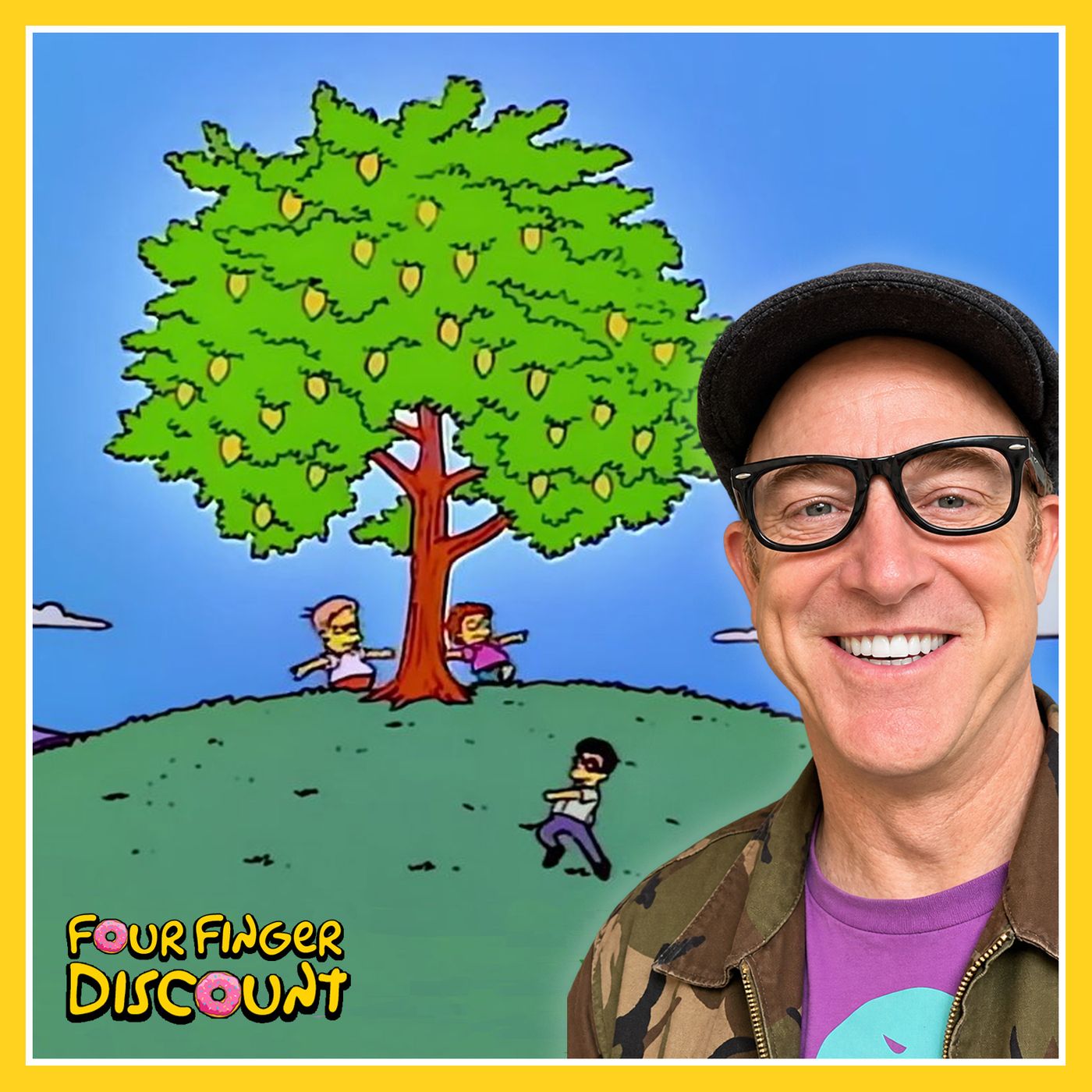
About this episode
We discuss the "lemon face" scene and how it's developed its own life in meme culture, the reason so many fans have a nostalgic connection to the story, how the episode was originally pitched and so much more.
Plus we get a crash course in comedy writing, as we delve into Brent's career working on hit shows such as King of the Hill, The Office, The Ben Stiller Show, Late Night with David Letterman and Mr. Show, just to name a few.
Subscribe to Brent's YouTube channel at youtube.com/@ProfessorBFo
Support the show on Patreon at patreon.com/fourfingerdiscount
Listen on Spotify - spoti.fi/4fDcSY0
Listen on Apple Podcasts - apple.co/4dgpW3Z
CHAPTERS:
01:56 - Why “Lemon of Troy” Still Connects with Audiences
4:00 - The Origin of Springfield vs. Shelbyville
6:39 - “Behaviour Over Banter” and Grounded Comedy
9:35 - Inside The Simpsons Writers’ Conference
14:14 - Pitching the Lemon Tree Story
20:00 - Roman Numerals, Movie References and Joke Construction
24:05 - The “Lemon Face” Meme and Comic Contradiction
28:00 - Springfield Pride, Shelbyville and Childhood Adventures
34:00 - The Episode’s Title, Childhood Memories
38:38 - Brent’s Early Comedy Career: The Ben Stiller Show and Originality
43:00 - Learning from James L. Brooks, Judd Apatow, Bob Odenkirk and David Cross
49:05 - The Office, King of the Hill and Leading a Writers’ Room
56:30 - Showrunning, Rewrites and Making Great TV Under Pressure
01:03:00 - Comedy, Networks and King of the Hill
01:10:20 - Disappointing Conan O’Brien, Late Night and Creating “If They Mated”
01:18:44 - Brent’s Comedy-Writing Class and Creating Your Own Script
01:21:00 - Homerpalooza, Voice Actors and What Makes a Line Land
01:26:00 - Writing for Performance and the Science of Funny Words
01:30:00 - The Simpsons Season 6–7 Writers’ Room
01:32:57 - Brent’s Favourite “Lemon of Troy” Moments
01:35:00 - “Squozen,” Cousin Love and the Brilliance of Animation
01:38:30 - Brent’s Ultimate Five-Episode Simpsons Marathon
CHECK OUT OUR OTHER PODCASTS:
Goin' Down To South Park - spreaker.com/show/goin-down-to-south-park
The Movie Guide with Maltin & Davis - themovieguidepodcast.com
The One About Friends - spreaker.com/show/the-one-about-friends-podcast
Talking Seinfeld - spreaker.com/show/talking-seinfeld
SpeaKing Of The Hill - spreaker.com/show/speaking-of-the-hill-a-king-of-the-hill-
The Office Talk - spreaker.com/show/the-office-talk-podcast
Become a supporter of this podcast: https://www.spreaker.com/podcast/four-finger-discount-simpsons-podcast--5828977/support.
Get every episode summarized
Each time Four Finger Discount (Simpsons Podcast) publishes, we email you a written briefing from the transcript — the topics, who appeared, and any specific claims, with the ad reads skipped.
Email me new episodesFree for 3 shows. No card needed.
Transcript ready
857 searchable segments. Every word is indexed and playable.
Full transcript
Four Finger Discount (Simpsons Podcast) — Lemon Of Troy (with Brent Forrester). Machine-transcribed; use the interactive transcript above to jump the player to any line.
Don't you get it springfield? It's over! You lose! Now if you'll excuse me, all this talk has made me hungry. Forfinger discount, dude! I'll see you soon. Hey everybody, welcome to Forfinger discount with this week. We're heading all the way back to season 6 to review one of my favorite simpsons episodes of all time. It's Lemon of Troy and we're joined right now by the writer of the episode. It's Brent Forrest. Hey, how are you doing, sir? Hey, so happy to be here. We're very happy to have you. Now I was just telling Guy off my before we started recording. We released a book about 10 years ago, a Simpsons book. I had my top 5 episodes in there and I went, I'm pretty sure I included this one in my top 5. And I did. This is my top 5 simpsons episodes of all time. I love Lemon of Troy and I'm just so excited to finally get the chance to talk about it with you. Oh, thank you. I'm so flattered. It was a successful episode at the time.
Yeah, I was in my 20s when I wrote it and I love it when stuff is still good. 10, 20, even 30 years later. So I can't wait to talk to you about how this one came together. Well, I've just started watching the show with my kids, sort of revisiting these odd episodes with my kids. Because I thought, I'm going to let my kids watch it a couple of years ago and then itchy and scratchy came on and I went, oh, maybe a little bit too young for this. But now they're just turned 8 and 5 and they love it. And we watched Lemon of Troy last night and rewashed it for this podcast. My kids were just in hysterics. They thought it was the funniest thing. They love it. I thought, isn't it great that this show that I love when I was a kid, 30 years later and kids are now still enjoying it just as much? I'm glad you said that. This one in particular has a nostalgia for childhood feel to it. If you see in the episode, you know, it centers around kids going on a mission and using all their gear and all that stuff of like having camouflage paint and binoculars and walkie talkies. And you know, when you were a kid, you know, 19 years old, why did you have that stuff?
You were hoping to go on some kind of adventure. And that's what this one is really powered by that energy. Let's stop forget the Baron von Kostion disguise kid as well. The MVP of this episode by the way, Brent, who would have thought that Christopher Nolan would have made the second best exploration of great mythology than I say this. Yeah. Well done you. Thank you. Thank you. You know, the secret of this episode was that I had discovered the way you got handed an episode. You have to understand in 1996 when I joined the staff. I think it was 96. Your whole goal as the staff writer was to was to pitch a story and have them choose you to write that story. Then you would get to leave the writers room for a few weeks and write your episode. So there was enormous pressure on us to come up with an episode that would get chosen by the showrunner. And what I had figured out was all of the stories on the Simpsons were combinations of characters in conflict.
So, you know, this week it's Homer versus Mars in the A story and Bart versus Lisa in the B story. And next week is Mars versus Crusty in the A story and Bart versus Grandpa in the B story. So you were looking for these unique combinations. I was looking for a combination that had never been done. My first year at the Simpsons, I pitched Homer versus Patty and Selma. They had never done Homer versus Patty and Selma. And I recognized that Patty and Selma were like one character. They always appeared together. And so when I pitched that, I was assigned the episode. The following year looking for a new combination of characters in conflict. I thought, oh, I'll do one better. I'll do Springfield versus Shelbyville, Town versus Town. And that is where the origin of the show comes from is looking for a unique conflict that had never been done. For in something I was thinking is this episode came along and adjust the right time for the show. And also for the viewers as well because I mean, it feels like the viewers of the show would be invested in Springfield and its residents.
As much as the as much as those residents themselves are that people watching the show would have as much pride in Springfield. Well, that's what I said. I didn't thought of that. You know, by this time it was season five or six, six, I guess. The end of six, yeah. Right. So now this show was familiar to them. They knew a lot of the lore. And so they would have had a certain degree of a patriotism for Springfield too. That's a really insightful comment. There you go. I'm not even even a broken clock is around twice a day. So you're right. This episode does capture that nostalgia of childhood because every time I watch this it reminds me of school holidays. We call them school holidays. You got summer break or whatever where you have some with your friends. You think what are we going to do? And it's like the idea of just crossing town and going to like another suburb of where you shouldn't normally go. It's such an adventure. So you pack your bags and you get on your bikes. And this this episode just does such a good job of capturing that vibe. I'm glad you said that it's interesting to know that even in animation, which is artificial.
We are looking for real emotion to power it. And in fact, you really had to on the Simpsons pitch stories, right stories that were emotionally grounded. Had something mature that they were exploring the show was created in part by James L Brooks. We remember Matt Grayning's name is the illustrator and the names of so many of the great writers and actors on the show. But James L Brooks was part of the DNA of the show and Brooks is the master of character comedy mature characters in relationships. He had done Mary Tyler Moore, taxi, broadcast news, terms of endearment. And that is in the show. So when you say, Oh, I felt stuff watching it, that's the influence of Brooks and what the writers had to do to get a story successfully across was tapping to some real emotion. That seems to be a point of commonality with a lot of guys you've worked with, though, it seems, Brent as well.
I mean, I remember reading a bit about when you were working with Judd Appetal, it might have been on undeclared. But he wrote a big thing on a whiteboard saying, might have been something that behavior over bits. Well done. Well done. It was behavior over banter. Yes. The pacemakers that I've worked with, they have this in common. So Judd Appetal, Greg Daniels, who created the American office. All the best comedy writers seemed to really love a kind of comedy, which you could call behavioral comedy. This is something I really explored as a student of comedy. The secret of me as a writer is I was not one of these people who were funny as a teenager. I was a short story nerd, a very serious person who sort of stumbled into the comedy profession and had to learn it by watching others. And at first I was very interested in comedy mechanics. How does this joke work? How does this punch my work?
And I discovered there was a lot that you could pick apart like a scientist of comedy. But ultimately I came to understand that there was a deeper way of looking at comedy that the pacemakers were interested in. Judd articulated it perfectly with behavior over banter. And he did that when I was working with him on a show called Love. I was the head writer of the show. Judd was really into naturalistic, realistic, grounded comedy. And we had a great staff of writers, all of whom came from parks and rec or at least most of them, good comedy writers who had been writing comedy in a clever joky tradition at parks and rec. And we turned in some scripts. We put in our first four scripts. We handed to Judd who had been away directing train wreck. He came back to the writers room, reads our scripts and goes, no, no, no, no, there's something terribly wrong here. And I was baffled. I was like, these are funny. You're full of jokes. Everything's great. No, the tone is wrong.
He made us go back to watching Larry Sanders, an HBO show, well worth watching the pacemakers love Larry Sanders. And he said, look at the style of this. It's not based on bits. It's not based on cleverness. It's based on behavior. It's based on the way the characters are acting. The things they're hiding about themselves. The way they're trying to come across and how they're failing to come across that way. And he said, give me the comedy of behavior over banter. It became one of the great mantras for me of my career. Yeah, the thing is with this episode as well. It's like you're saying it's happened to the emotion. James L. Booksy said he's the emotion guy. Was he the one when you're trying to pitch a story? Is it like, I know I'm pitching it to the room. I'm really pitching it to Jim. Is that was that the mindset? Oh, absolutely. You know, the Simpsons, the season at the Simpsons would always start the same way with what was called the writers conference rate. The writers retreat. You know, we would go to a hotel in Santa Monica called shutters, a fancy hotel. They would rent out the whole top floor.
There would be tons of food and no one would eat any of it because everyone was so nervous. This was the day you were going to pitch your story. And the writers were giving like three days off to come up with a story and get your pitch ready. And this was the only time that you knew you were going to see James L Brooks. He would come to the story conferences. And so he was sitting there and you would pitch to the senior writers, the head writer and Jim. And his laughter was what you were really going for. I remember it. Everybody who's worked with Jim knows his laugh. And by the way, you can hear his laugh on famous sitcoms like Taxi. If you watch that show, everyone can hear James L Brooks's laugh. It's very distinctive. And it was that it was the prize you were going for in the in the pitch. Was he an encouraging guy in that regard? I mean, even if you had a pitch that was not quite there, would he sort of give an encouraging laugh or a bit of it, not a pity laugh, if you know what I mean. But would you be able to tell if you'd really nailed something as opposed to being say 70% of the way there?
Oh, what a great question. I'll be honest with you. I don't remember James L Brooks being famous for encouraging. I don't think he was discouraging, but I think he just had that kind of elevated taste where he was going to react honestly. And if he liked it, you knew it was good. He was one of those guys. I'm an encourager when I lead artists. I hear 70% of a pitch and I go, oh, you are two thirds of the way to home run my train. Because that's what I want as an artist. So, you know, he's not the only kind of leader there is. This is another, you know, ongoing monologue in my brain is how do we get the best out of artists, in particular writers in a writers room. I feel like the symptoms when I was there was a difficult room. It was a cold room. It was a room full of very, very intelligent taste making writers. And certainly the young writers like me who were hired in season 5, 6, 7, we were intimidated by that environment.
We pitched less because we were afraid of embarrassing ourselves. And so I think that's a little less efficient. I would rather have you pitch more in an environment where you can't embarrass yourself. And I think that room will beat the tough rooms any day of the week. Was lemon of Troy what you were leading with or were the other ones that were turned down before was lemon of Troy like a backup or was this the one you went in hoping to sell. Yes, as I recall, I had only that one to pitch. But it's a good question. I do remember David Cohen, a writer I used to sit next to who goes on to create Futurama. I remember David definitely pitch to in a story conference and they were both great. These are the vegetarian and Homer Paloza. And he didn't have time to write both so they gave me one of them. I wrote Homer Paloza. It was David Cohen's pitch. But I think he was exceptional. And most of us would bring in just the one. This is it. This is your shot. And the pitch would last like 20 minutes. It was an involved storytelling process.
Act breaks and jokes were pitched in the story. Can you remember how you sold this? What did you sell on the basis of? You know, you would always start your story with what we call a set piece. And if you watch the symptoms, you can see this structure. There's usually a kind of independent comedy event that starts the episode. And then that kicks off into the story. So in this case, I would have pitched it like this. Bart Simpson is cruising the streets of Springfield on a skateboard and he comes across what every ten year old dreams of finding wet cement. He is going to write his name and what cement. And he's going to be famous forever. And we see his fantasy of like thousands of years in the future where people are looking at the what cement. Who was Bart Simpson? He's just delighted. He draws his name in the cement. Oh, God, I'm the greatest ever. He gets busted. They tell his parents and he gets a lecture from March. Okay, and Mars says, um, Bart, how could you deface your own town? Aren't you proud of Springfield? Look around.
We have the Springfield isotopes are beloved baseball team. We have the fishing hole where kids go and get their fish every day. And we have the lemon tree where kids are going to get lemonade for as long as people can remember. It's your town. Bart, you've got to let it. So Bart goes off for the kind of patriotic walk through town. He's the isotopes in the fishing hole and the lemon tree. Okay, now this is the key. The lemon tree. Okay, so what you're hearing right now is me doing a replication of the actual storytelling process that you would do in the story conference, right? It's an oral story. I'm in the old kind of Mark Twain tradition of like, you know, listen to a tale. And this one, you know, I had just learned that was, you know, after two years of being at the show that if you could kind of spin a yarn like this, this was how you would sell the show. And I was aware that I had a kind of a, a fable on my hands because this is the way I said, you know, Bart comes to the lemon tree where the kids picked their lemons and they make their lemonade.
It's a very important tree to the economy of the kids of Springfield. But this tree, it grows right on the border between Springfield and Shelbyville and the lemons fall equally into either side. Okay, now that feels almost biblical, right? You know, the lemon is falling equally to either side is kind of an old testament feel and the recall is the Garden of Eden. You know, it's, it's just kind of storytelling. So Bart gets into an argument with his rival, the Bart of Shelbyville, the bad kid over there and the yellow each other. You guys suck. No, you guys, so our time is better. No, you're telling us, you know, and they throw lemons of each other and Bart gets the best of them and, and walks away. But the next day when they come back, the limit tree has gone and they see as a trail is dragged into Shelbyville and they realize, we've got to do what we have never done before. We have to go into enemy territory. We better bring our gear, our camouflage paint, our walk of talkies, our binoculars, our little code charts that we got from the back of a cereal box. We're going in boys and we're getting that tree.
So that would be like that's one. You know, that's how you tried to sell these things. That's the story pitch and Brooks is like, right? You've done it again. And Julie captain is going, who was this person? Well, you heard me do Marge's voice, right? I discovered that you had a better chance at getting jokes in the show, getting your stories picked up if you could do a couple of the voices. So I learned to do Marge and I learned to do grandpa. So grandpa would sound like this. I used to be full of piss in vinegar. Now I'm just for the vinegar. And this leads into something I want to ask about real quickly. It's just a little bit of a throw away. But you mentioned the very, very start with the inside incident with that and Penny's name in the in the what cement. I loved it in the future. There's one particular line that said and it really seems to be emblematic of Simpson's voice that just sort of bled at into just general comedy tone.
Yeah, which is you've got a character saying what's normally him amazes us. It's just the way that is said. I know I've incorporated that into my everyday life. I've been trying to crack a gag and I know so many people who have both professionally and just personally. I mean, is that was that the tone of voice that was used in the in the in since as HQ at some stage. It's like, I'm telling you a gag and I'm telling it like this. Yes, that's good. No, that that kind of artificial voice that you sometimes see like old movies and you know black and white TV shows. The the phoniness, you know, there were several writers who were great at that kind of material. The one I'm thinking of is George Meyer. Yeah, it's very true. I'm a clue as well. It's a former clue is sure. Phil Hartman. I can own me all my life. Yeah, Phil Hartman. Phil Hartman was the master of the phony guy. Almost all his characters, Lionel Huts, the lawyer, but then look at him on a Saturday live unfrozen Kays man lawyer. If you have not seen it, you are in for a delight people. Look at Phil Hartman in that jackhandy sketch.
It's his wheelhouse, the phony guy. Nobody could do. I'm fully and you can't tell right now. I'm looking whatever on it. You don't know. You know, that was Phil's wheelhouse. Well, not so much 90s kid and he was the slasmami neighbor in so many movies during the 90s where he's just this prick that you know, yeah, yeah, he knew he was the bad guy and he was full of it. But he just loved him anyway. He was just so good at it. Yeah, yeah, great. I also think that the first act in this episode in particular does a great job of just establishing a story like you. So many story beats it's things like, you know, the fly motorcycle Roman numerals at school. Yeah, just just just occurring during the first act. Yes, by the end of it, it all pays off. Thank you for noticing that the Roman numerals, I think, is a real clinic in the disguised setup. So, you know, the way you you really get an explosive pay off is to disguise the setup. So in this case, we needed an example of bark being just so bored at his life being wasted. In school. So that was somebody goes, the lemon tree has been stolen. He can go great. I can escape from this, this waste of life. And so I thought, well, what's that thing you learn in, you know, elementary school or you're like, I am never going to use this Roman numerals perfect. Right. So, so he's learning Roman numerals.
And I think this teacher says you're going to use this one day and he's like, sure, right. And then, you know, out he goes. And then the fact that it's actually the thing that will save his life when he's in his zoo, and it's like, you know, room 12 or something is is the one that doesn't have a tiger. And of course, the thing that really makes you laugh in that scene is the so called topper. The topper is the joke on top of a joke. So the joke is that, you know, bark didn't learn this in school because he thought it was useless. And now it's going to save his life when he remembers, wait a minute, Rocky 13, Adrian's revenge or whatever. Rocky seven, Rocky seven, yeah, yeah. Okay. Five plus Rocky two. Right. So you think that's the joke. But then he then he tops it with they never even tried to teach us this in school. That I thought was was what took it over the top. But it's got a terrific bait and switch even baked into it with Mrs. Kay saying, yeah, whatever, whatever.
It was like she doesn't even care. She's tapped out. So you never you would never expect it to come back the way that it does. I love the gag about motion pictures as well. She says how you know, emotion pictures were made. All right. That's right. That's right. There's so the way the setup is disguised is the setup looks like it's just a joke. It's indistinguishable from any other moment of comedy that's just a joke. And when you hear something go, oh, I know why I heard that it's not to set up something later. It's just to amuse me now in this comedy. That's how you disguise the setup. Brent, I am very much the millhouse in the bottom millhouse relationship that Dan, when I have I was stoked to see that this was such a millhouse heavy episode. It seemed that way to me at least. Yes. Well, thank you for pointing that out. You know, I remember when I was writing this episode, it suddenly hit me that you could have internal arcs within the larger arc. Right. The larger arc is get the lemon tree back. But within that, you had all these characters. So the millhouse arc where he meets the millhouse of Springfield or Shelbyville.
And then the the Ralph and Wiggum thing, the bully and the picture Martin and Nelson. Yeah. Martin and Nelson. That's it. Yeah. Yeah. So so all of those I was aware of the fact that I was creating arcs within the arc. I felt very clever for having figured that out. I think some of my favorite symptoms episodes of all time are the ones where you see characters who wouldn't normally hang out with each other hanging out with each other. And that's what this one does so well. Like you said Martin and Nelson. I think we've ever seen them hanging out together. Yes. They they used that formula and that sort of that relationship in future episodes because it just works so well in this one and but on the road when they go for a joy ride with Bart's fake license. They invite Martin and Martin and Nelson to sort of become friends and that one as a result. I think because of the success of lemon of Troy. Oh, that's so interesting. As we're reflecting on it now, I'm noticing that there's emotion in both of those little mini arcs as well, right? Millhouse that discovers that his enemy is like him and it's a sweet moment, right? It played real. It's quite emotional. And the the bully sticking up for the picked on kid and his joy in that is also emotional. So it's not just jokes. There was some drama in there.
I think it's the first time he's got a real softer side of Nelson as well. I mean, he saved himself by saying, I don't normally hang out with this guy, but he's still the right thing at the end of the day. Yeah. Well, yeah, they're true to the spirit of spring. It was like this. You've created this wonderful dirty half dozen who are on the men on this mission. Yeah. And yeah, characters, yeah, you normally wouldn't align with the one other but works so well together. I hope you're happy that you've given birth to a I don't know if it is a meme or not. Yeah, I was going to touch on this. So the the the sour face lemon face meme. So have you seen the this lemon face name that this episode is spawn. It's where the tow truck driver of Shelbyville. Each lemon or is it who's eating the lemon in the me. It's it's it's the father of Shelby. Yeah, he says I'm in hungry and he bites the lemon and instantly regrets it. But he's so trying to save face. He just sort of gets that sound lemon face, right? That's become merchandise now. Wow. He's from this. No, I have not seen a penny of that. But you know, I am interested in in when when stuff is successful. And you know, I'm still really an analyst of comedy. So what I see in that meme is there's two things going on.
There's what I call comic irony and what I call the core comic contradiction. All right. This is me as professor professor be full. Comic irony when you attempt to do something and you accomplish the opposite when something that fires. It's always funny. So in the attempt to eat a satisfying lemon. He accomplishes the opposite. He makes his mouth pucker, right? Trying to get the joy of eating against the opposite. That's always going to be funny. But the thing that takes it over the top is the core comic contradiction in the attempts to seem one way you seem the opposite. It's behavioral comedy. Okay. He's trying to maintain that he's not suffering. And that's what we're laughing about in your pitch of it. You pointed out it's the behavior of trying to save face. You know, as a joke analyst, it was at the Simpson's that I discovered so often when something made you laugh. There were two or more dynamics happening at the same time. So, you know, I teach classes as I promised I would mention at at Brentsforster.com you can find my, you know, four classes a year that I typically teach in the classes.
I talk about how I figured out at the Simpsons this, this idea of what I call stacking and it was the stacking of comedy mechanisms to get a laugh. So I mentioned comic irony when things backfire, the core comic contradiction. PUNS visual gags there are a lot of different distinct dynamics and comedy. But when you pile them up, you typically get a laugh. All right, that's what stacking is. I promised I would nerd out a little on comedy for you guys. And there it is. I love that you just sort of broke down that the lemon because all of us just know it's just lemon face meme. But you've made it. There is psychology to this lemon face. Something else you should point out that was that in many a cafe and coffee shop around the world, you will find a tip jar that says, here's a tip. I put a pinch of sage in your boots and a spicy scent will be your reward. I think you need you need a cut from these tip jar. That's great. I also too were talking about how the town of Springford, they're proud of their town. But I've read that, you know, you have to make sure that you sort of tidied up Springfield sort of to get that message across that.
Springfield is a nicer place compared to Shelbyville, right? What I think this episode does well is that everyone thinks for some reason, everyone thinks that their hometowns know good for the most part. We see the worst of it, right? But if you're not from there, you better not put it down. That's what this episode does. It's like, you know, everyone's, you know, bats heading on Springfield and then marginalization, you're like, no, it's a good place. Yeah. And how we're allowed to badmouth Springfield, how dare that Shelby badmouth Springfield, we have to get him for it. That's what it's like in real life. You can put your own town down. But if someone else from out Saudi, what town puts it down? How dare you? Oh, I love it. That's so cool. To me, what that says is there are elements in the storytelling that people respond to personally, even if the author didn't intend it. Because for me, that's not what I was connecting to, although I kind of get it as a story. And you can see I wrote jokes in that in that realm where the Shelby Villars are also patriotic. And they say that's why we beat your sports teams almost 50%. So, you know, actually, I understood the points you're making, but I feel like you actually feel it, you know, for your town, which is so cool.
Yeah. And this episode also getting back to the Roman numerals, I still have a vivid memory of being at school. And when the teacher was down to start introducing Roman numerals, I knew what they were because I watched this episode. I remember my teacher, Mrs. Price said, how did you know that, Brennan? I learned it from the Simpsons as she was gobsmacked. My favorite saying you had fun, you learned a little something to. Oh, cool. I love that Shelby Villars was just founded by this degenerate. And you actually have a chance to celebrate his degeneracy. Yeah, Gemini's brainfield has got the noble spirit and big and big and a game the smallest man. Well, Shelby Villman happened to be converting with these two chances. Yes, yes, yes. Well, I'm just tradition, you know, before I got there, that original staff, they were so comfortable being subversive. And so it's all through the cartoon. And I think actually because the cartoon is a somewhat more innocent medium, you can get away with more mature material sometimes watching a Codalobrines monorail episode a couple days ago.
And just marveling at how good it is. And there's a joke in there where. There's a monorail comes to as built in Springfield. Maybe you've seen the episode. They built on a rail and they have they have a like red carpet opening of it. And so it's like a red carpet opening. Well, what celebrities have showed up for the red carpet. Look, it's cross the the clown coming out of a limousine and cross the stash house. And immediately a woman runs up to him with a baby and says, Christy, you've got to acknowledge our child's right. That's a dark, dark, dead, dead clown, right? By the way, they they top the joke with a visual where they zoom in on the baby and the big brushes, bow, bow hair. It's such a wonderful visual joke. But I was struck by how how you can get away with darker humor in a cartoon because it's so intrinsically innocent as a medium.
And not so on the nose that kids won't get it anyway because I watched these with my kids and like jokes like that in particular. I sit there and I go, don't ask me about that one. Don't ask me about that one. And they don't they just they sort of they sort of chuckle or that is sort of just go straight over their heads and move on to the next bit. They just don't even enter their minds. And I think that's what's great about the symptoms is they throw these. They call dark jokes in, but they're not so dark that kids are put off by it. Yes. Yes. You hit it on the head. You know, when when comedy writers trying to figure out what their tone should be. They, you know, they're adults smart adults. They want to do adult material. But in America, we've for a long time had what's called prime time TV. And this by the way was pushed by the Christian right in the early days of television. They said there's got to be time where the family can sit down and not hear about anything. They don't want to explain. You know, and I am no Christian. I'm of militant atheist, but, but what I had a daughter. I did not want to explain sex to her, you know, ever.
So he is you can do jokes about sex. You can do jokes about anything drugs. As long as it goes over the kids heads, it's okay. And so yes, you see tons of that. And that's the way you entertain adults and kids simultaneously. I forgot how much margin homer got down in the classic era because I'm watching it with my kids. And I'm just like, Jesus. Brent, one of my favorite things about doing for finger scan and the other shows that we do on the network is we'll revisit episodes. And I'll find that there are bits of business or lines of dialogue that are, as I said, I've incorporated into my sort of everyday vocab. Yes. Oh, this is from that. And this happened. This happened in lemon of Troy. I mean, this is not necessarily a boom. Yeah, punchline kind of gay. But Millhouse just see the inside. Oh, they're always eating candy and shield. They love the sweet taste. Yeah. Like, why do I love that so much? That's where I remember him, you know, pitching that line. That was George, you know, he was a genius for flucking these phrases out of the ether.
Like I say, often it was from old movies, you know, okay, when when I want a news reporter would flash a picture in the Simpson thing, go, there's your shot boys. You know, what is that? And only George able to stop, you know, and so they love the sweet sweet taste would have been George putting all tiny language in a modern kids mouth. I think we've had that more than once. The Bobo episode, where Mr. Burns is playing with Maggie and the bear in the in the sand pit. Yes, all time. Lume over there. What a scoop. Yeah, there's some reason just absolutely tickles me. Yes. Was it was always a lemon tree in this one here? Obviously it rhymes ish with Helen. Was lemon tree always what this episode was going to be about? Yes, it was. My mom, when I was growing up had a big lemon tree in the front yard and it kind of implanted on my brain.
It was always that lemon tree in my mind. You know, it was associated for me with being a kid. So there was some kind of, you know, subconscious connection there. I got lucky with the title. Honestly, into a lemon tree and then, oh, lemon of Troy sounds like Helen of Troy. So that was just pure luck in the title, honestly. If I had chosen a grapefruit tree, we would have a very, very, uh, were title was was this the most enjoyable episode of the Simpsons for you to ride because it took you back to your childhood and so many ways. It did do that for sure. It did do that. I remember there was a moment where I had a kind of, um, almost like psychic flashback when I wrote the joke of, uh, Bart looking at the Shelbyville kids through binoculars with Milhouse. Do you remember this moment and he's looking at him and Milhouse says, I thought you said you could read lips. Bart says, I assumed I could. Now that to me is just remembering being a kid, hearing about lip reading for the first time and just instantly going, oh, yeah, I'm sure I could do that.
I could do that. You just look at how I could be. And it isn't at the moment where David Cohen said that that's the moment there are a mind of you. He's childhood as well. I remember David praising me for that feeling and that was the line that he pointed out. Yeah. It really does have a very stand by me kind of feel this episode. I got to say, I mean, there were so many influences and inspirations that come through. But yeah, that was one that came through when I was, uh, when I was revisiting it. While saying earlier, too, that I love the ones where it incorporates relationships that you don't normally see, but also just ones that just incorporate the town in general. Yeah. I just, I just love that where my favorite episode of all time is 22 short films because it just feels like that is the closest to having spending a day in the life of Springfield being a fly in the wall of Springfield. That's what it feels like for me when I watch that episode. And you actually wrote a statement for that one as well. You wrote the, um, the Krustyberg scene, correct? I wrote two bits in that one, but they were not Krustyberg. One was, um, Burns and Smithers on a tandem bike. I would the B. Yeah. Okay. Yeah. Yeah. With the B. And the other was a Homer has groceries in one arm, magging the other.
He goes to buy a paper at a kiosk, sense magging down, gets the paper, closes the kiosk, babies in the kiosk. That killed my kids. My kids thought it was the funniest thing of all time. And he rips out close off. They had to pause it. I was so glad. Yeah. I was very proud of that as a physical comedy joke. I remember just going, Oh, this is great. It works perfectly. It seems naturalistic, but then in result such a astrophie. That one way, if you look at the way the Stimpsons would write jokes. So I wrote that gag, a physical comedy gag where Homer is like, Oh my God, I've locked my baby in a little glass cage and I can't get her out. And another writer pitched the topper where the baby rolls Maggie rolls the newspaper up like a blanket around her and reveals a headline that says deadbeat dad beat it. And it just clever. No, and, and of course I get credit for that. It was my segment, but I did not write that.
Was that, I mean, obviously, I'm probably wrong, but was that in some way a reference to Dama Dama when Jim Carrey look, he's wallet in the new stand? No, not at all. I feel like I wrote mine before he wrote his I hope so. I certainly not that before. Hopefully they stole it from me. You know, are very into originality and to redo a joke that you've seen elsewhere is completely unacceptable for comedy writers. At least most of them, I've heard that there are, I don't want to say the name of the show. There's a multi cam show that a friend of mine worked on and he called me and he goes, Oh, the showrunner's like they did that on the old new heart show. Let's do it. He couldn't believe it. It was the first time he'd ever heard a showrunner comfortable with redoing old material. For the most part, we rigorously disallow it. What if you're taking Homer's advice and getting an existing product and putting a clock in it?
I remember that. What was that from? So that was when her does the baby translator and Homer says, I know her people are afraid of new things. Why just taking existing product and put a clock in it. So so even if the idea is all right, they've done this somewhere else. We can put our own spin on it. Also, no, it's going to be a completely original concept. You can't do that either. Is that what you're saying? Certainly when I was coming up as a young comedy writer, I had come from the Ben Stiller show, which was a sketch comedy show on Fox, which was all tastemakers. It was Ben Stiller, Judd Appetow, Bob Odin Kirk was our head writer, Jeanine Garafalo, David Cross. These were the alt comedians of Los Angeles in in you know 1995 or whatever. And there was such a rigorous discipline of originality. You would never copy somebody else's joke. If you discovered that the joke you pitched had been done somewhere else, that's it. We're not doing it. So you know, that's that's the discipline I grew up with. It's a good one to to employ because it just means you require originality and originality is going to make people laugh a lot more than derivative comedy.
But it was always more than that. It was considered a sort of ethical orientation towards comedy creation. It's kind of a double it's sore though isn't a Brent because I mean when the Ben Stiller show came out at middle you're having sketches like let's make a lassy movie but Charlie Manson will be lassy and you're going to get maybe 10% of the watches is going to go this is the funniest thing ever seen. The most original thing I'm ever seen and 90% going I think we're going to cancel this after six episodes. But admittedly you know 10, 20, 30 years down line people are going to go Ben Stiller show was one of the funniest and most original things ever. I mean you have to be you have to be sort of cognizant of that it's like you're going to be mad him flying maybe guys aren't ready for this yet but your kids are going to love it. Yeah, well you're totally right and and the the people that I came up with the these great talents like Odin Kirk. You know Judd Apital for sure I mean Judd had such an influence on me his attitude always was we're probably going to get canceled statistically speaking if you get a show on the air they're going to cancel it.
So let's go out with quality material that that helps our careers because the industry will will think better of us even though this show is dead and he was totally right. I mean you look at freaks and geeks that show is canceled but. Judd just kept on making great stuff like that until the industry caught up with him so you know the Ben Stiller show is definitely that way super low rated was you know we were up against 60 minutes at the height of that shows popularity so that was the number one show on TV we were ranked I think I think we were ranked 100. So it's a bit of a show's reputation if it doesn't become a huge success because then later than the track it's like you feel like you're part of a club if you do enjoy it and you do find it. Yeah you're so right about that yeah I totally agree and and this one was for the comedy hipsters the Charlie Manson lasty one that Bob Odin Kirk did I've watched that recently it really still holds up for me and the genius of Odin Kirk.
And that guy was and is one of the greats like he was famous as a sketch writer before he was on the Ben Stiller show you know people would become famous as writers in the writing community. Colonial Brian was one like that you know everybody knew his name everybody knew he was great Bob was one of those Robert Smigel was one of those. And you see Bob there doing Manson he was just starting really to discover acting this. He's early on as an actor he's so good in everything he does it feels weird to say this is someone who is just a fan but there's a great sense of sort of pride you feel when you buy stock in someone early and it pays off down the line. I remember writing this article about when better calls all started saying it is weird that I'm proud of Bob Odin Kirk a person I have never met and never will yeah but I knew that there was something there and he's it's paid off in space because he's so good and everything he's done and I mean watching on Mr. Show I'm talking we're probably able to get you open the floodgates go for it.
We have to put a language warning on this but watching Mr. Show back and then it's like no one says what the fuck like Bob Odin Kirk is incredible yeah. Yeah but the people that you've worked with I mean I don't know is there a commonality to the sort of the people that you have chosen to learn from or have maybe taken you under the wing people I mean learning that you're that your first mentor was Susan Harris and I mean we're Golden Girls guys. But working with Jim Brooks working with Judd Apatow working with Odin Kirk working with cross what do you derive from that you derive a little bit of something from everyone or is there an overriding comedy philosophy that you've sort of maybe a clean from these people there are common all commonalities for sure and you know I really did feel like an outsider coming into comedy I was a short story writer so I had some confidence in writing in truth it was fake confidence I really did not know. What I was doing but thought I did and so I did welcome to writing yeah I mean I was writing short stories they're not funny and and their prose and their language heavy and in fact in comedy you're writing for performers you're writing the way people talk not the way they think a lot of stuff I had to learn from others but the common denominator of so many of the titanically successful people I encountered I was say the number one thing is this.
Unshakable conviction in their own taste it would astonish me they all had it you know I would meet you know I mean Judd Apatow 24 and he knew what was funny and he knew what was not funny and I was like how do you know and they all did Odin Kirk you know Odin Kirk was so enraged at much of what was successful out there and some of it was a claimed and successful he couldn't stand it and he never doubted his taste. This was true of all of them Jeanine Garathola when Jeanine Garathola laughed at something you knew it was funny just period she wasn't going to laugh at something that wasn't funny and if she did laugh it was and I envy these people I was like how did you get that and over time you know I've tried to develop it and I think to some degree I have and that we all have it it's it's really just starting by going. Don't pretend you like this if you don't even if people tell you it's good don't pretend you like it if you laughed out loud even though you shouldn't have take note of that that's your real response so if you if you honing on that as a discipline you can develop that skill.
The first handle being told or realizing that something you thought was great wasn't great. Well you know we do road test our stuff in comedy and nobody knows even the greats don't know for sure if their stuff works this is why you know stand-up comedians are essentially testing their material all the time and they're and they're going up there thinking this is going to be funny and they know that they don't really know until they've tried it so there's just a subjective element to comedy for sure but there are you know principles that we learn over time like you know what Susan Harris taught me silly isn't funny you learn that with the hard way like twice and you never again risk putting your silly crazy zany hilarious material out there because you do and just watch what happens when a serious group of comedy fans sits there and they go what are you doing your what is this this is you're being ridiculous it's it's it's what bombing is you know trying to be crazy so you learn that you want to start in a tone that's very serious and if you start bombing you're like bombing I'm not bombing I meant to be serious this is very serious material it's in fact tragic and grave and that's the energy that you're feeling for me
because I'm comfortable with that and that's the kind of story I'm doing now like you get into that tone and you're safe and then you can start you know getting playful and funny again so you know tricks that you learn over the years how did the vibe of the Simpsons room Diffa from others that you'd been in at that point the Simpsons room was uncommonly challenging for me and and really everybody in it that the Simpsons had an elite writing staff in in season one through four it was all hardward lampoon writers you know Coggin race Jane yeah yeah for the most part Coden Greg Daniels George Meyer John Schwaldor a genius a true genius and so the the sort of mental firepower in that room was was intense and the standard that they had brought to comedy was so hot so after season four half the staff leaves to create other projects and then these you know seats open up in the writers room
essentially that's how I got in there in season five you know writers had left and they were hiring new writers so when I came in there the feeling was this is the greatest show ever this is the highest standard of comedy ever and the veterans that are sitting around me are the best writers ever and now the showrunner David Merkin says open your script to page three we need a new joke for Homer at the bottom of the page and the room goes into silence as everyone tries to think of a brilliant joke for Homer and what you would see is very little pitching I mean long periods would go by with nobody saying anything and then you know often you would try to pitch something and it would get like a little Twitter or Twitter of laughter it felt high stakes there was a guy who sat next to me whose name I will refrain from saying he was hired at the same time as me he had a contract in four
months his contract was up and his job was to pitch jokes and he said nothing for four months because he just felt like better to get fired which I know I will be rather that than embarrass myself with a bad pitch in front of Greg Daniels George Meyer Mike Reese you know John Schwartz wonder and so that's that's what was I think that's it's not the way I lead a room when I've got to the office and finally you know in season nine they let me run that room and when I ran the room at King of the Hill anytime ever lead writers I do the opposite I start by lowering the bar there are no bad pitches I just want to hear you pitch if you have the courage to say anything you get a pat of the back for me and I literally will have my hands at the keyboard a screen behind me and anything you pitch you'll see me right down and it appears on the screen okay and ask me going yeah it's good enough to be up on the screen you start a room that way and everybody wants to pitch and I just happen to feel that it's the
more efficient way it's the happier way to do it comedy is a trial and error process in a trial and error process the team with more trials will typically win so in my room where everybody's pitching I will beat the Simpson's room where nobody's pitching so was that one of the reasons you left the Simpson obviously went to King of the Hill but was it sounds like it wasn't wasn't a fun experience but it was a much more stressful experience than Saking of the Hill sounds gladitorial oh you know it was it was challenging but of course I loved it I loved the show and I was young and learning and couldn't believe I was there so I looked back on those years very very fondly the hours were long 10 a.m till 10 p.m. every day you were expected to be there and the and the showrunner would you know drift in and out you know your time was was wasted but you know we loved it there were incredible writers there so I remember it fondly King of the Hill was was more difficult in some
ways for me because I ran the writers room Greg Daniels who would go on to create the American office created King of the Hill and he was one of the more senior writers when I was at the Simpson's when Greg and Mike judge created King of the Hill Greg brought me into run the writers room because he knew that I was trained in that Simpson's system of generating scripts so that was my responsibility there but you know I did only one year at King of the Hill they they wanted me to stay and I wouldn't do it it was because I was burnt out from one year of running the room explain writing running a Rodas room what does that entail for those at home yeah you know traditionally American TV has involved a lot of episodes you know 22 would be a typical order for a season and you're trying to keep the quality of the scripts up a comedy is as good as the scripts and the casting but really you know the casting is always good it's it's the scripts so television shows
in the in the States revolve around the writers room the writers room is the nucleus of the show the showrunner is also the head writer typically but the showrunner will if they are smart deputized the running of the writers room itself the the writers room runs you know typically starts at 10 a.m. and goes as late as we got to go someone's got to sit at the head of a conference room table and lead these writers through the process of creating stories generating those stories breaking the stories which means figuring out okay nice oral pants but what are the scenes what are the act rates what are the endings um and then when the script comes in we've got to rewrite that script together we've got to punch it up we've got to replace dialogue that isn't funny with dialogue that is funny and solve other story problems along the way maybe we're cutting scenes and adding them so the writers room is its own thing that has to go
on all day the showrunner is above the head writer the showrunner can step in and become head writer but typically is off approving costumes and looking at casting and and doing the million things that the showrunner is obliged to do the showrunner is the decision maker everybody's coming to the showrunner so you know I have had a career where many times I've been hired as the head writer beneath the showrunner and what does that entail show up at 10 I mean when I'm the run in the room we start at 10 this is a novelty in my experience most writers rooms want to show up at 10 talk about Star Wars for 40 fuck of minutes and I'd never like that I'm like let's let's get out early but let's just start on time so you know I always sharp 10 and and then you know if you're these if you're running the room what you do is you start talking out loud about what we're doing and you try to create a group of minds amongst you know five to eight people
okay welcome what we're doing here is we are talking about episode 104 the A story we got Michael and Dwight open up a dry cleaners and we got some great pitches yesterday about act one we did not get that act break what are we thinking this morning what do we think the act break could be here and okay so you can see me just starting the thought process and inviting pitches the writers room what it runs well is the most miraculous thing in the world it is literally if I said to you tomorrow I want you to do a podcast with a guy who is twice as talented as me and then the next day I want you to do a podcast with someone who is five times more talented and I mean legitimately five times more pitches five times more ideas five times much life experience as much perspective um you'd be working with Leonardo da Vinci of comedy right that's what the room is when you get the group mind going it's five different minds in sync all working on the same
piece of craft which is the script it's uh it's the greatest yeah and helping those ideas coalesce into an episode a series yes yes exactly yeah so you know it's it's something that uh I've been lucky enough to do many times um but yeah it can be exhausting when you're doing 22 episodes it's just it seems like um well you know it's a given example of what's the heart about the the American TV system it's deadline driven you know you can imagine if you're investing in a television show uh you do not want to pay more than you have to for it so writers are expensive something that it took me a long time to learn was that the the deadline driven uh portion of making TV is is part of what makes it unpleasant at times that you are the one investing your money you don't want to spend more than you have to one of your big expenses is writers every day that
you run that writers room beyond what you have to cost you more than you want to pay so over time the the producers have figured out what is the precisely exact minimum amount of time that's every right to get this up to the level of quality that we expect and demand okay they figured out what that means is the the scripts are never up to that level of quality until the last minute and at every point along the way anybody can come in and go uh Brent uh can i talk to you for a minute you're responsible for these scripts you run this room you're the the buck stops with you the scripts are not good at the 104 we're shooting that on Monday it's not good enough okay they can say that and they will be right because it's not going to be good enough until Friday night at the last payable moment of the of the process when we've punched it up so you have to have a little bit of
ice water in your veins to run the room and and somehow insulate the staff from that critical energy that can come in at any time and be a go between between the suits and the creatives i guess as well you know the showrunner typically is um uh you know i have been lucky that i have been a little insulated from the critical uh worry warts at the network while running running the rooms but yes i think in in theory you know the showrunner has got to listen to the fears of the executives and then uh essentially ignore them when going back into the writers room because the artistic process the creative process does not thrive in a fearful energy it it kind of goes away in a fearful energy you know where you really see this is on the set the set is where this artistic vulnerability peaks what we are asking actors to do is to uh imagine that what you
have written on the page is real become the characters that you have proposed and feel the things that the characters are feeling it is such a bananas thing to ask of a human being you must create an environment of emotional safety there and and you know warmth uh love this these are the qualities of the directors that last they project a safety and the the head writer asked you the same for the writers to some degree it's honestly amazing that stuff gets made really when you so when you break it down like that there were so many variables so many disparate elements and some of them would appear to be in conflict with another and you have to find a way to balance them it's it's it's remarkable yeah and when it and when it works i mean that's that's why things stay with us so much whether it's episodes like lemon of droi or like the Odyssey it's i'm canny because we also do a king at the hill podcast as well called speaking of the hill and the last episode we reviewed
on the podcast was Peggy's turtle song the episode that you wrote no kidding it literally was the last one we reviewed we got we got to the review and we go written by Frank Farah's stuff wow how would you describe the difference in comedy between the Simpsons and King of the Hill because a king of the Hill for me is as a kid who grew up in the 90s i didn't i wouldn't say i didn't like King of the Hill i never really gave it the chance i just looked at it and went this doesn't look like the Simpsons and i and and i think i maybe watch like five minutes or so and it just felt like i was like where's the joke so i don't i don't understand it as an adult now married two young kids i watch it and i go well i arguably find it's just as funny as i find the Simpsons now as you asked about that there there are two very different shows and deliberately so Greg Daniels who was one of the writers in the room when i was at the Simpsons co-creator King of the Hill with Mike Judge and they very deliberately were trying to do something different in animation specifically it was looking for naturalism in animation known it really
done it and by naturalism i mean that feeling that you're grounded that the characters are real the style of the animation to begin with these are Mike Judges you know freehand drawings um Mike who is a humble genius if you talk to Mike you know part of of his uh cleverness is to sort of be a kind of an all shucks kind of a guy it does talk a bit like this uh it asks you questions Mike didn't you play in a blues band in austin texas oh yes i did i hit him heritage a major grandfather not just look at class and uh at the library and learn how to play and and you know he's always down playing his guess one of them is his freehand animation king of the hill all those characters those are real people that Mike drew by looking at them you know he looked at photographs he would go out of the street he would he would have uh uh people take pictures in malls of the people
walking around and then he would draw them and those became characters on king of the hill so the realism the naturalism the pacing of it they deliberately they being Greg and and Mike they they decided to do an animated show that wasn't at the pace of a Warner Brothers cartoon or of the Simpsons you know what we love about animation is that zany speed no Mike and Greg uh said we're gonna we're gonna put pauses in we're gonna slow it down you look at the opening credits of king of the hill the opening song uh i can't remember the tune exactly but it has this this pace ding ding ding ding ding ding ding ding ding and it slows down and a leaf drifts down into frame and it's Mike and Greg going we're not doing hyperactive we're slowing it down and then you know in the pilot you start with four guys drinking beer and what i'm says yep and then there's a pause and another goes yep i mean they said we are putting the brakes on yeah and that was original so
you're feeling that for sure in the show and that's probably why as a kid you're like what is this you know i want my by zaniness right uh the other thing that you see in king of the hill is political and cultural commentary was at the core of all the early episodes i mean i didn't fall the show too much after i left but certainly the template that we set um mike and Greg in season one and and and me running the writers room with them in season two all the episodes were uh taken from culture conflicts and uh they could be simple ones like um husky bobby was when we did where bobby becomes a model in a uh catalog where husky kids close right that was really about the conservative male hey kill being uncomfortable with his son being a model uh being effeminate you know is essentially about homophobia um and then you have the episodes that same season
hilloween which was taken right from the headlines we had discovered that there were these haloween haunted houses that christian evangelicals were putting on that were these boring anti-abortion uh haunted houses we couldn't believe it and we did an episode about it i i can't remember a show as effectively going after cultural clashes since all of the family in the sixties and seventies in in america and i can't imagine anybody really doing it the same way now because uh political conflict has become you know something the networks are really averse to i mean i know the last time i worked at netflix uh we tried to do some anti-trump comedy and they were like no no no no they really were like we aren't doing that and i get it i mean they're just algorithm driven and they're like why would we alienate some of our audience but at king of the hill we did not have
that figure at all we you know it was a again a pretty young staff um comedy writers in general quite rebellious love taking the shots at the uh the the source of power and in america you know the christian rights the moralizing um authority figures have always been a target of comedy and we would go after them you know consistently because the characters were southern and because they were christian um there was a natural sort of empathy that you know as a good writer you're going to have your characters so i think i think we got away with it i know that you know um uh my friend need bar gotsy the comedian he's from the south he's from chennessee need said that growing up he felt like king of the hill was for him you know he's he's a uh political conservative and yeah he felt king of the hill was for him it shows how effectively we um we empathized with the right while skeuring it well i just i just love there's the episode where the the Asian family move in next
door the car and family and Hank is accused of being racist because he doesn't like this guy and he goes i'm not racist he's just a prick you know why can i'm not like a guy because he's Asian he's just he's not a good person but i love the way that he he told that story you know that's yeah the show is very non-judgmental king of the hill i mean if it if it is judgmental against anyone or anything it's more like this bad mode to behave it like self-righteousness or something like that i mean it's they're never really taking shots at anyone for a political point of view it's more like now he's just a shit human being yes yes and hypocrisy you know comedians love to attack hypocrisy and we would we would attack it on both the right and the left i think you know we we piled on the right quite a bit more but um the left you know it took some shots too like uh there was an episode in season two called the unfyrable employee and this was based on the discovery that voice team yeah yeah yeah the cast me as the as the voice of the drug addict uh gosh yeah the premise was
somebody discovered that in the american workplace if you identify as a drug addict in treatment you're now covered by the americans with disabilities act and he fired and so the idea that Hank would have some drug addicts that he couldn't fire seemed very funny to us and yeah i got to i got cast is that the reason i got cast in that was you know when we would do the table reads sometimes the writers would fill in and do the voice and i had a take on on the drug addicts which was essentially the manic depressive character it says a lot about me that i was able to do this but you know it's the characters like oh i got it oh we're gonna clear out these files we're gonna hold his system we're gonna redo the whole office mr. hale wait and then cut to he's on the ground like i can't do it i am very glad you brought this up Brent because i think this was a question that we were asking more than once during that episode when we reviewed it's like what drugs is this guy on because sometimes he's coked up sometimes he is uh you know he's like he's
taking a couple of hits up a nice big split sometimes he's on heroin that's what it seemed like is this guy a polymath drug user or with some but he's also super relatable because in that scene in particular you don't have to be a drug addict to behave that way i always say to my wife right today's that i have clean the garage yeah i get in there with the best of intentions and within five minutes was on the full crying i can't do it it's too much they've a well i'm getting it i'm getting it that relatable i think um first of all i imagine he was a cocaine addict that was my backstory but the the pattern of um of of manic depression where you get kind of too excited and confident and then uh you're too much in despair i think it's common with artists you know um i've been thinking that maybe coderal brion is essentially uh manic depressive i i shouldn't speak for this guy but hit ability to pour on that energy is so wonderful and yet i know the guy has a kind of a tragic side and and uh you know i'm noticing that more and more with with artists i certainly relate to it
oh yeah who among us did did you work kind of was gone by by the time he got to the simpsons rotto was he still there just uh we overlapped just a little bit but essentially you know him leaving was part of how i got hired um i had just had had did you join the simpsons team yeah i had just come off to Ben still a show so i was a young writer in my twainys and bottled and Kirk had liked my sketch packet he um he actually helped me select seven sketches that of all the ones i'd written on the show he thought were my best he put the packet together and then he gave it to uh Robert smigal who was at saturday night live in coderal brion who was starting his own talk show coden like my packet and called me and said i want to hire you as a writer on my show just to give you the idea of the personal magnetism of coderal brion he got me so hyped up to be a writer on his show to leave l a come to new york start on a new thing i was so excited when i hung up the phone i ran through west hollywood i remember i ran
three miles just on the on the second hand energy of coden it was like i got my next shot now what next was that the head writer of the simpsons david murkin was in touch with coden and he said yeah coden you get new writers you got any fun you like and and coden is yeah i think we're gonna hire this guy this Brent Forester a kid Bob Odin Kirk likes and david murkin said oh really and called me in for a meeting at the simpsons and murkin said you're gonna go right for this no name talk show that's gonna go down the tubes how about you join the simpsons in season five and i was like obviously i will join the simpsons i had to uh call coden get apologized because i said you were kind enough to believe in me and hire me and i'm not going to do it although i had said i was going to as as an apology thank you gift i wrote up a list of 10 bits he could do on his new show and he used two of them for 10 years one of them was i said announced that you don't
have the budget to do a satellite interview and just show a photograph of person's face with the klutch kaga uh brilliant so i gave him that one and the other one was i said uh take true celebrities who are dating and merge their photos to show what their children might look like i called that if they meet it and he did that for 10 years as well how does that conversation go is that as intimidating as being in the simpsons writers room of James out looks at how do you you promise Conan i'm gonna join your show yeah how does that phone call go you know i mean it was all to my credit that that you know more than one show wanted me but i did feel really bad about it you know um i felt like he had believed in me and he was being generous and i was like bailing on him and it's literally i gave him this gift of ideas as a way of saying uh here is something for free in gratitude for you doing something nice to me so you know he's a great human being um
Conan and and people wanted him to like them i think they still do you know Conan's approval is very valuable to uh comedy people have you ever wondered what if if i had stayed with Conan yeah i mean i knew writers on that show you know it was a wonderful time for them they had such a blast creating that show the first few years you know they were doing crazy crazy bits uh and Conan loves writers it was it was a magical place to work as i understand have you what have you worked with kind of synths or have you ever considered you know okay are you still friends with the guy or is he just completely just shut you off from life now because you are you you you you disappointed him you know i've i've definitely run into Conan over the years we have had a project that um we were attached to do a couple of times it was um a comedy idea that i had for 30 years about uh historical reenactors at an an American history site one who plays Thomas
Jefferson and one who plays Jupiter Evans who is the famous black man servant of Thomas Jefferson uh you know this idea always fascinated and amused me and Conan and i were attached to doing as a show for NBC at one point but i never managed to sell that to any network uh no matter how i configured it at a certain point the networks will go this is too controversial for so i finally did it myself as a youtube uh series i shot three episodes of something i call historic freedom bird which you can see on my youtube channel uh if you love youtube go to um professor b-fo that's b-f-o when i sign my emails instead of writing Brent Forrest or i write b-f-o apostrophe so professor b-f-o uh and and check out historic freedom bird i would say yes i'm loved with my proudest achievements has the democratization of media things like youtube do you feel like that is
just giving you so much more scope so much more space to because i imagine that any creative person has just got a bunch of stuff in the bottom drawer a bunch of stuff on the hard drive it's like no one's ever going to go for this but i can i can do it for five bucks and i can send it out to the world and i can see what happens 100 percent i think it's it's the great transformation of uh the industry in our lifetime it used to be when when i was trying to you know break into the biz if you wanted to make something if you wanted to shoot something and edit it you had to go to film school because they were the ones who had the cameras and the film which was expensive and god knows the editing equipment you who who would know how do you do get that all that change in our lifetime and the places to platform your stuff now just for everybody so the truth is certainly in comedy it is a medium that thrives on great writing and great performing uh if you have that it
does not have to have bells and whistles in the uh capturing of it uh you know you can go to a theater and and laugh your brains out uh with two characters pinned to mining working on a submarine right that's not high production values but you will die laughing if the writing is good and the performing is good so you can prove this if you are talented and industrious and want to make stuff you can write good stuff start with short stuff it's easier uh finds plenty people to perform it shoot it with your phone edit it and put it on youtube and if you do that and it is good the industry will come to you this is my firm belief and the you know message that i'm amplifying to anybody who who's who's listening and it's what i'm doing now too you know it's frustrating to try to sell stuff to the buyers you know the beloved buyers netflix amazon hulu hbo uh apple tv pcock you know these are the buyers and uh you know it can take a year to work
up a pitch that you take to them and they say no too long too long for most artists i think it's time for all of us to stop waiting for permission to make stuff and just go make it that's why i did a store up freedom bar that's why i launched the youtube channel is i've decided i want a place that's like an art gallery where i can hang stuff that i make so that's my long answer to your question yes abundantly uh youtube is the future for all of us yeah something interesting you you said there Brent was that when you're naming the i guess the power brokers or the uh the gatekeepers or whatever you're mainly not you're naming streamers and cable places you're not really going to the networks anymore you're not going to a bc and bc fox anyway like that you're so right you're so right and uh maybe that was self limiting i mean i i did a lot of pitching in 2025 and i did pitch to fox uh and i did pitch to a bc hulu uh i pitched to nbc pcock well you pitched to them now you're pitching to both sides of the hyphen you know you you i pitched a show um in 2025 uh which was
basically the office set in like a wells Fargo which is a crappy you know stating the load out here and i just called it bank and i picked it i thought this is an nbc show so i pitched it to nbc and pcock simultaneously that's the way it goes yeah um it's it's a hard time to sell to the big buyers now they are really driven by celebrity attachment i would say uh so you know it's all the more reason to make stuff outside the system the encouraging thing that i am saying to all the creators out there who found uh 2024 2025 uh a shrunken uh uh development industry less buying of scripts okay yeah that's a bummer the upside however is if the big buyers are not developing where will their development come from it will come from the outsiders making stuff on youtube making original stuff that will get bought by by the big buyers and we're already seeing it happen
now you know pretty consistently i'm pitching you i know i'm picturing you in that room at a whiteboard just writing down want to make bank this is how it went i don't tell me otherwise oh that's great uh very good pitch thank you very much um and i did open with uh the main character the manager the kind of a michael scott of bank is a guy called gary flat a short man in cowboy boots uh and and the opening is him you just hear voice over bank and you see the definition you know uh money as in we're making bank and then bank trust as in you can bank on me so uh you were one uh step ahead of my opening of that pitch i i attribute all my success to the six step system uh uh of of Brent forest oh thank you well thank now you're just chilling for me um you know since 2020
i have taught comedy during the pandemic when we were all you know on a on our on our psychological deathbeds asking why are we here and also frozen the whole industry stopped and i started teaching uh comedy online it's been incredibly gratifying to me first because as i mentioned i've always been the analytical comedy writer i was not naturally talented i had to learn it through the job and it made me a collector of mechanics dynamics devices tricks and nothing makes me happier than just sharing them all with the young whatever the novices of any age who are trying to learn this craft uh more than that though i have discovered that my mission here is to encourage artists and that is what we need more than anything all of you who are artists and listening know exactly what i mean it is a tough thing to say i am going to use my imagination to change my life in the world right and you can do it you will do it but sometimes you need
encouragement and that's that's where i come in as a teacher my six steps system thank you for missing it this is uh you know i teach two classes what is called writing the pilot and the other is called joking comedy writing writing the pilot is the one that everybody wants to take because it's a five-week class in which i lead you through the process of turning your idea into a pilot and there's six steps that i you know brought from my experience in writers rooms uh that i will i will lead you through it is life changing when you have an idea for a script and you actually write it i think this is probably true with all great projects you have an idea for a project and you complete it and i am so happy to have helped so many people do it uh if you are one of those people wants to do it go to my website renforster.com i have a class coming up uh september 20th i teach this a few times a year so it's rare it's super cheap uh i'll just be frank with you i don't
like charging people money for anything my five-week class is two hundred dollars as always less than tycoon dole lessons and if you can't afford two hundred dollars write me an email uh you got a scholarship for free um i like helping artists i hope you're one of them and i hope you find me when you're running gags for the simpsons because you mentioned earlier uh but the performing was the performing is good then it's gonna be funny when you wrote gags on the simpsons did you write with the voice cast in mind going i know this is a gag that hank will smash or dan or julie or did you or did you make sure that you wrote jokes that you knew could be funny regardless of who's saying it oh what a great question the uh answer that i want to uh break down is first of all good jokes generally do look good on the page and amuse you on the page so you know a good simpson scripts you know you can read that in last and chuckle in your bed um so it doesn't require performance
necessarily good writing but um yes for sure when you're writing comedy you're hearing the voices of these performers and for sure there is such thing as as good comic performance i was watching lala polusa uh homer polusa rather the other day and this is an episode where it's about a music festival and we cast a lot of musicians and so there's dialogue in there written by simpsons writers delivered by musicians who are not professional comedy actors and i swear to god you see well written material delivered by peter frampson and sonic youth there's a section where it's just them talking to each other and the show just dies okay and and then you hear hankas area deliver one line uh hank has to uh he he's the uh the emcee of uh of uh lala polusa and he's introducing homer simpson who's one of the freaks uh in the freak show getting hit with a cannon ball
okay so homers become a freak in a freak show at a music festival and hankas area delivers the line like this ladies and gentlemen introducing the man who represents everything about rock and roll except the music helm simpson right that's his delivery and it's a comic delivery uh i'm imitating him you know that that's an example of a comic performer upping the comedy the good voice actors always do you know they tried to replace the simpsons uh voice actors at one point the fox studios realized they were paying them so much and they started bringing in um uh voice actors who could imitate homer and imitate uh bark when was this during your time that no it was after my time yeah yeah i'm sure i'll be banned from fox forever mentioning this but it was my understanding that you know they were just sick of paying the actors this much money and they and they tried to bring in imitators and were completely unable to do it you know nobody can really do homer accepts uh
dance is telanetta and that's true across the board for all of those uh actors because if if fox could have replaced them they would have it might be easy to sand light them but you can't become the character yeah yeah you don't have the soul you have the skin but not the soul uh just a rewind just a little bit brin uh look i'm probably waxing it or a car a bit too much here but it's one of the top five simpsons exchanges of all time for mine in the home of a loser where it's uh billy corgan smashing pumpkins i'm a simpson smiling politely that just kills me well can i tell you a story about that that that line is often quoted to me and uh i like to point out that in my draft uh i had written the parts for Courtney love and when we couldn't get Courtney love we we went to uh billy corgan so in the original draft there's a different joke there now this is a a little bit of a thinker so forgive yourselves if it takes you a moment to laugh but when Courtney love was in the uh the episode um she walks up to homer and she says homer i saw your acts
Courtney love and homer says homer grateful that was the blind before billy corgan's life almost as good oh man that brin toe well they're the kind of joke so when you're a kid watching you have no idea what's going on but i just you know it sounds funny yeah quite no why it's funny you just because my kids well i'll wash you with my kids recently and they laughed at that and i said why'd you love that and he goes because i'm a silly oh that's great why that will laugh you know it's just it's sounded silly you know yeah that's true you know when i was uh uh a dad with a young daughter when my daughter was i don't know four or five years old i i noticed that there was a joke form that would make her and all her friends laugh and it was the same joke form every time so i always involved an animal at a birthday party opening a present and there being a different animal inside and the animal then inside would say boring so it'd be like okay so once there was a giraffe having a
birthday party she got a present she opened it up and inside was a little tiny dog and the dog went boing and they would laugh and then i would do okay i know another one i this you're gonna love this one okay once there was a monkey had a birthday party open up a little present inside was a tiny elephant and the elephant went boing always would get a laugh with five year old you can eat as that why didn't you wait and oh you obviously wouldn't have made a father when you're on the sims i should you work into a sims and script somewhere oh yeah yeah not anymore this is the sixth step boy but that's actually mentioned on the sims and crusty says it goes funny words that sound funny go come on go yeah sure were there any sort of we need to like go to words or sounds you sort of went to and you went and it's not quite working let's just throwing this oh absolutely you know this is part of the science of comedy you'll hear old-time comedy writers say the case sound is funny and and there's a a play by Neil Simon called the sunshine boys about two old
borscht belt comedians and they talk about the case sound the case sound is funny the truth is some words are funnier typically than others punchier for sure it comes down to what are called polosives like the word explosive without the ex on postive a plosive is a word that is a hard consonant so ppdxk those are our hard consonants those are closeives for this reason two towns okay we're pushing up a script where is our character from misery or canabunc ports it's pretty clear that the second one is going to be easier to get a laugh off of and part of it is just delivery right delivering staccato words is a little more energetic did you have a fun that you wrote a joke and the Simpsons cast delivered in a way that you made it even funny than you originally intended you went oh wow that's not the way I intended for it to be delivered but that's even better I saw this happen one time I never forgot it it was in the episode
Lisa gets an elephant homework gets an elephant yeah yeah yeah yeah yeah yeah yeah yeah yeah so at the table read of that episode there's a scene where a Homer is making money by showing off this elephant in the backyard and people are kind of like oh look at the stupid elephant and Lisa says dad you can't do this how would you like it if people came in the yard and made fun of you and then we cut to a character who was called slack jawed yokel uh a yokel is a term for like a red country pumpkin became clatus yeah it became clatus it became clatus because of the way Hank Azaria delivered the line now the line that was written for slack jawed yokel was uh to give you the setup again Lisa says how would you like it if people made fun of you cut to slack jawed yokel har har look at that pointy haired girl that was the line as written Hank Azaria delivered it this way har har look at that pointy haired girl a little more yokely when he has their hair did
in there it got a giant laugh at the table because of his surprise delivery and the character was born I mean I think we did a hundred clearest the slack jawed yokel episodes after that and he was born in the funnier than written delivery of the line by Hank Azaria you see that in this episode though as well I think with um the main bully in shall we bill is called shall be I believe yeah and the big neo yeah his dad uh voice by hank i believe is um yeah yeah i believe doing a Walter Mathaum impersonation which is sort of a play on dancy basing home run Walter Mathaum as well right yeah yeah that's an unexpected twist and one that i really appreciate yes well you you nailed it it was it was a Walter Mathaum voice and and you're right also been in the first few episodes of the simpsons a dan is doing Walter Mathaum as Homer he changed that voice after a few apps it was taken in the omen shorts as well he's really Walter right that's right so this episode here's our at the end of season six did you write this one almost like it was a season finale because
the real season finale of season six is part one of who shot mr. Burns that's more of like a cliff hang out more of a publicity stunt this one to me always felt like a true season finale incorporating the town it feels like a real grand adventure was it ever sort of pitched that way to be the season that was it was it selected to be sort of like a a mini season finale do you think i think that's really an astute observation that it could have been a season finale because of the scope of it town versus town no it was never uh thought of that way the uh the who shot mr. Burns will always going to be the cliff hanger of that season and uh that was the the brainchild of billocally and Josh Weinstein two of the great you know showrunners ever for uh the simpsons i always thought obviously bill and josh took over in season seven season season eight as well for some reason i've always thought this one was like a season seven episode it feels like a bill and josh episode it's it's because that real grand emotional emotionally driven core to it that i just feel like
it sort of it would just it's perfect like a season seven episode oh you always think i've always to get this the end of season six well i think maybe what you're perceiving there is the way the uh writers room came together and evolved so you have the original writers of seasons one through four and then a new crop comes in to replace maybe half the staff in seasons five six and seven that new group really hits their stride uh in in the latter part of six and and then going into seven and so it was it was the young writers uh coming into their own by young writers i'm thinking of me david Cohen and bill and josh bill and josh were uh youngsters who went who rose to uh showrunner status internally promoted but uh our showrunner was david merkins who had come from outside the show he had come from uh uh sketch and he had come from a show called um oh it was Chris Elliott's show oh get a life get a life oh holy moly i'm sorry i use this line all the time to the point where it's
become quiet and all band-talking um to borrow a line from the war we used to make things in this country get alive the bin still a show mr show oh my goodness that's also the result of they're not being so many avenues and various channels and ways to sort of get content out there it was very selective of what was put out there so there wasn't as much a sort of i feel like now there's so much out there nothing sort of stands out anymore um i think there's a good point there uh what i'm realizing now is that there's attention in the art form of television comedy maybe uh television entertainment generally uh certainly in the american system and the tension is between speed and quality you know it's a business so they're trying to make a lot of these things and they're trying to make them quickly and that is not the way to quality now the audience wants quality and will will gravitate towards quality uh so you know how do you get both now what i'm noticing is the shorter orders um uh that writers are unemployed much longer now than they used to be
i think that actually will create um greater quality potentially because projects will have longer to gestate uh and and stuff like uh widows bay a new show on apple you know that's a project that a writer Katie dippled had in her you know uh her backpacks for ten years i've heard you know that maybe come more than or yeah there's that old adage what you you can have it good you can have it quick or you can have it cheap you can you can get two of those at any given time but you can't have all three or you get all three you've got a unicorn uh huh it's still very very true we should maybe talk a bit about lemon of Troy well i feel like we've done a long time so we went through the entire episode but i just wanted to ask you look what are some of your favorite moments from this episode braddle what are the ones that you've saw maybe the most proud of when you go back and revisit it well as i mentioned i really liked that uh moment where barth says uh i assumed i could uh read lips um i i liked um the the fantasies that the kids had when they when they trial their gear
where where uh mil house believes he's invisible i remember enjoying that um of course the ending you know the the hell in a Troy ending i think it's you know certainly in the top two best endings of uh an episode of tv that i have personally written and how did i get there is a good question i still asked myself that i think really what happened is i saw that i was doing an epic and i saw and i had always felt that this was like um you know ithaca and Troy i knew that that uh the Trojan horse was a was a thing and i kind of back engineered a way into it i think back engineering is the secret to uh clever endings you kind of know where you want to get and then you're like how do i disguise all the little things i need to make it happen well i love the love swatzwolder's ideology though of he just wrote a script and then fixed it afterwards yeah he said that he got the hardest part out of the way first you got the i you got the story written yeah and then he just then he
touched it up yeah got the bones and then put flesh on it yeah uh by the way as Australians we do appreciate the bad next two shout out or as you call it the road warrior for me though i've got a very fond memory of watching this with my family um see my mom she was never a bigger simpsons fan my dad you know sometimes we watch it but i distinctly remember watching this episode and when homie says don't worry boy i've got a plan he throws the meat out and the dog just eats it as a hungry boy he's got a taste for meat now yes if we are doing frozen uh that's i frozen and we are doing favorite moments um this is a word that you might have invented brinth um uh millhouse has got his lemonade stand and realize there are limbs we've squawes in our holster plot oh thank you yes yes i was so happy to use that word which i'd probably carry around my notebook for years yeah i try to think of other things like well the fact that uh shall we woman hatton is just such a just so nonchalant about his cousin loving
like cuz they're attractive i thought that was the whole point of this journey yes yes that's the subversive you know elements of the of the senses you know the the simpsons could get away with pretty edgy material like that in part because the innocence of a cartoon balanced it out and and certainly made moments like that extra funny hey guys back to what you were saying for that king of the hill i mean i think people maybe not so much now but tended to regard animation as a genre when it's a format you can tell any story with animation it's it doesn't necessarily have to be a half hour sitcom it doesn't have to be the flinstones the jetsons the simpsons it could be any foodly absolutely you know the the simpsons itself evolved from a uh fairly realistic family show basically an animated sitcom to a show that really started to do movie parodies when coney ol brine came in the monorail show is basically a parody of a musical called the music man and some disaster movies like towering and furno and earthquake and it was coney who more than anybody
discovered the language of cinema can be imported into animation very effectively did you intend first shall we feel as a tan and the task to be the villains of this episode or do we just organically just gravitate towards that mentality yeah they were always a villain's i think but of course there's that statement being made of like their identical there's nothing different about you know the the uh the springfield kids walk through they're going look at this place they're they're fire hydrants are different color it's the tiniest differences i think they call it the narcissism of small differences and there's one more thing i wanted to ask so you got you're very selected with the who you chose you took martin nelson who you tamed who team up you got the house there he's essentially with bartton and he finds the other mill house then you have you have Todd and you have database right yes you know get their moments but were there scenes where they did more or were they just sort of just there to sort of pat the group out of it yeah free the directors cut no i got track the story for them at all i i never really got database this was a
character that uh uh was not appealing to me and and and unrelatable so there was no hook and i just let him dangle he seems more of a funny voice than anything else but he does get to deploy that very well that because this is also one of my favorite moments i think when Bart and and shall be having their sort of to and fro with all their uh childish insults i think Bart gets the upper hand at the end you get a great reaction shot from shall be full of and then database of the lens and checkmate he's got a way to his two cents it's marvellous all right well before we let you go uh Brent we always ask our guests um about it's 1998 and the fox have come to you to put together a friday night simpsons marathon consisting of five episodes which episodes are you choosing and why and which one are you going to kick off the evening with great great great oh god there's too many to choose from so i'll just go randomly here uh least of the vegetarian by david kohen mr plow i remember really feeling
this is something special here oh gosh uh the the the stone cutters uh where where Homer joins the masonic cult i remember being very funny uh let's see from the from the david mercenary oh uh you know great jane was having an incredible episode that was called homer bad man i watched that with my kid yesterday and i sort of went there's a lot here there's a lot here in this story they didn't get any of it i i skipped the one bit because i was like i when will you rise at the end he's got the quimby video i'm like oh we might just fast forward this little section here while i haven't walked the while you know just my fondest for Greg as a as a as a comedy right you know what even better is Bartsell sells his soul that was a Greg those scripts that was exceptional and really has that kind of feeling of uh of expert storytelling that i put that on there instead of uh instead of homer bad man the reason i'm laughing about homer bad man Greg Greg was so irritated that we would
spend all this time writing clever titles for since the zeppes people would just wrap their brains trying to do a clever title and Greg's is like nobody sees the title why are you wasting our time and so as a rebel act he began naming his shows the most generic thing so one of Greg's episodes was homer versus opu he's like that hard to work and then then uh homer bad man was about home sexual harassment and it was like how much can i reduce the effort in the title bad man was one word he wouldn't even take the effort to put a space between bad but that episode is just so great because i watched it yesterday and it's just as relevant now as it was back in the mid 90s it's incredible yeah how about that that sequence where uh the homer says i i just want to get away i just want to be under the sea yes then there's a whole new pair on the right i remember being in the room
when we were pitching jokes on uh on the lyrics for homers under the sea okay and you're looking for for funny content about him having been accused of sexual harassment but it's also marine themes and i remember just racking my brains what's the funny line and somebody pitched um under the sea under the sea i'll be exonerated down where piranha's mated under the sea and i was like let's go home no one's gonna be funny whoever said no accusations just bring the crustaceans after that now i think that's when you can go home i'm sorry we're bridges name checking all my favorite lines from the simpsons is that it's fantastic but but thank you so much brats been absolutely pleasure to have you on we we feel like we're gonna have to get you back from a pollute because one of my favorite episodes and watching it as an adult i just i've now hit that point where i'm now home watching it so i'm now watching it through
homer's eyes and that's also so great but simpsons you watch it through your barn size when you're a kid as you don't know you realize your home and i'm slowly becoming grandpa oh wow that's great all right well thank you again brats been absolutely pleasure make sure you check out the links for all of brats stuff in the description of this podcast but for now brats thanks for your time and we'll see you in the near future for sure feels like when dubs cry nice work great job guys that was fun
More episodes
More from Four Finger Discount (Simpsons Podcast)

FFD Action News: The NEW Simpsons Movie, Groening confirms "Hit & Run", Simpsons...
Four Finger Discount (Simpsons Podcast)

Remembering The Simpsons Movie (with Chris Stanley)
Four Finger Discount (Simpsons Podcast)

The Bob Next Door (S21E22)
Four Finger Discount (Simpsons Podcast)

The Mail Is Here! #11 - Homer's best side hustles, why Mona's a bad mother, anot...
Four Finger Discount (Simpsons Podcast)