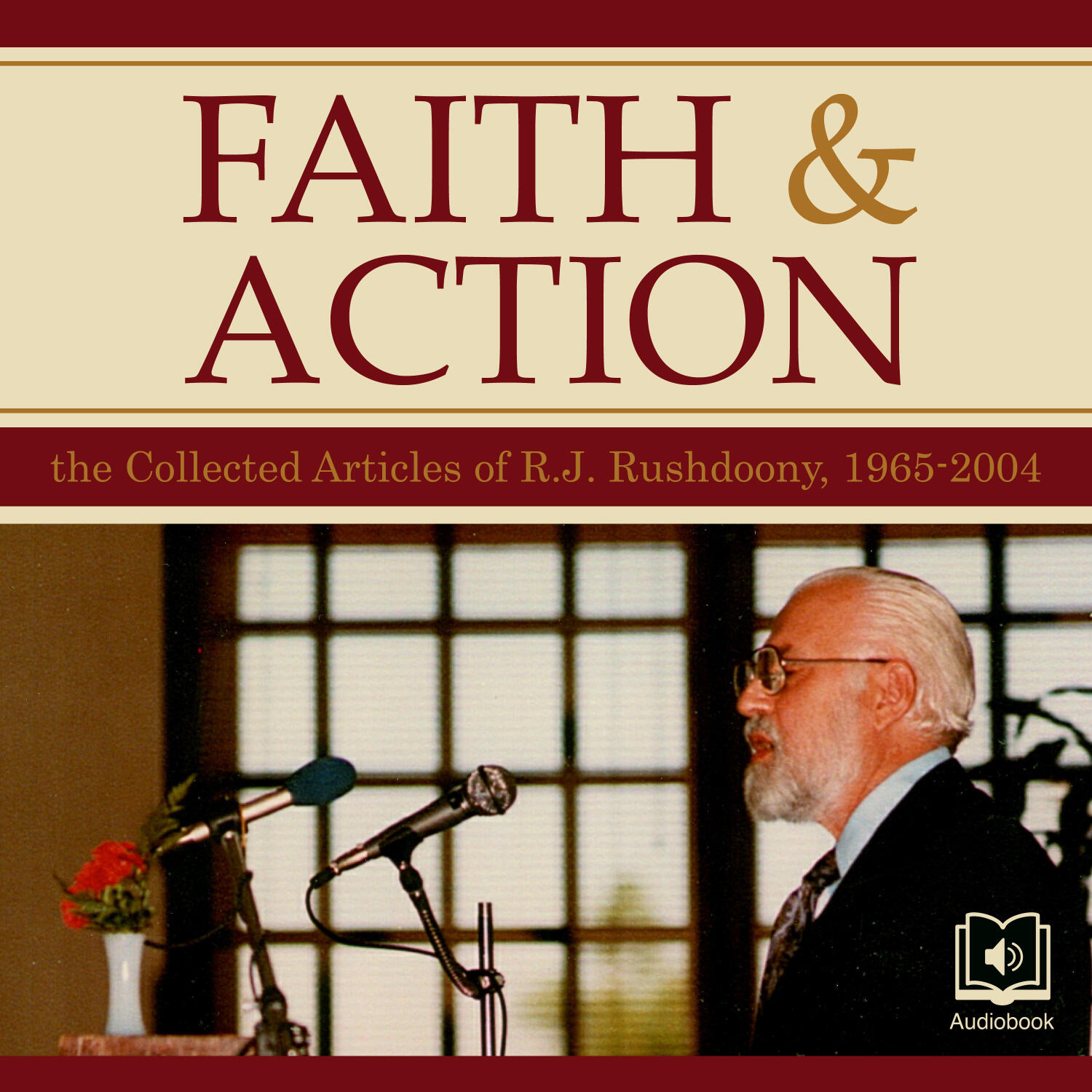
In “Locale of Meaning” (Chalcedon Report No. 172), Rushdoony argues that the decisive shift of the modern age was the relocation of meaning from God to events themselves. Whereas biblical faith locates all meaning in the sovereign Creator—whose eternal decree gives purpose to every atom, moment, and event—modern thought claims that meaning arises from the relationships of events, human experience, or social processes. This shift necessarily transfers authority from God to man: if meaning is not given by God, then man must create it, and with it, law. Hence law becomes logic, experience, class power, or social consensus rather than divine revelation. Rushdoony contends that this is the essence of humanism and that many Christians unwittingly adopt it by seeking salvation from Scripture, meaning from sociology, and law from the state—thereby hollowing out the gospel itself. Against this, he insists that God alone determines meaning, law, and history; obedience to His law-word defines the meaning of events, while rebellion brings judgment. Meaning does not emerge from history—it governs history because it proceeds from God.
William J. Brantz in the shape of medieval history, 1966,
wrote of the new sense of meaning which marked the passing of the medieval era.
In such man as Shakespeare and Marlow, a new view of man and history was apparent.
The older view, often marked by Hellanic influences, give way to the conviction that meaning lies within the relationship of events.
Such an understanding is so natural to modern man that it requires some reflection to see the error in it.
For biblical faith, the source of all meaning is God the Lord,
because he is the creator of all things in heaven and on earth,
all things have their being and meaning only through his eternal counsel and decree.
The true meaning of all things is the God-ardiend meaning.
Moreover, because God is totally God and totally self-conscious, there are no gaps in his world of meaning.
In other words, there is not a meaningless moment in our lives or experiences, nor a meaningless purposeless atom or second and all of creation.
In him there is no darkness at all, and we live in a universe of total purpose and meaning.
Thus, while there is a meaning in all events, and no event is empty or purposeless,
the meaning thereof lies, not within the relationship of the events, but in God the Lord.
The modern age, by shifting the little call of meaning from God to the events, also thereby shifted the determination of events from God to nature and man.
If God establishes the meaning of my life, it is because He creates and determines it.
If I establish the meaning of my life, then I declare that I make and determine my life.
If I am a Christian, I develop the meaning of my life under God and in terms of His Word.
If I am a humanist, I claim to develop the meaning of my life in terms of my Word.
This same principle applies in the area of law.
Humanism seeks to develop law within the relationship of events and in terms of them.
Law is then a product of man's history, not God's revelation.
Law then can be, as some once commonly held, a product of man's logic.
Law as logic is man's analysis of the meaning of events in terms of his autonomous reason.
From Plato on, we have had a very widespread emphasis on law as logic, the product of man's critical analysis and summation.
In the century, the stress has been on law as experience.
Man's social experience enables him to see what his problems are and then how to answer them.
Laws are then framed to give authoritative expression to the wisdom of experience.
Other relational views of law are possible.
The Marxists see law as the instrument of class, power and an expression of class-created meanings.
One way or another, humanism sees law and meaning as forthcoming from the relationship of events.
This is, of course, a clear-cut manifestation of humanism.
For man to admit that's meaning and law are alike derived from the God of Scripture and only derived from him is to admit that he must believe in the God of Scripture and he must obey him.
Such a confession is a nathema to the humanist and he will not make it.
Rather, the implicit humanist confession is that I, man as God, make all meaning and I create law.
This is a logical confession for humanism.
It is, however, no confession for a Christian.
Unhappily, too many churchmen make it.
They go to the Bible for salvation, to the sociologist for meaning, and to the state for law.
Not surprisingly, their doctrine of salvation is soon compromised, weakened and broken.
A God who is a God over only a sliver of life, the salvation realm, cannot see of and really has no realm.
The modern age, both in and out of the church, sees man as God and lawmaker, man as the determiner of meaning.
Of course, this doctrine had deep roots in the medieval era.
The game of chess was very popular with the aristocracy then, because it allows the human will to plan beforehand the sequence of events as against other wills.
In effect, the appeal to the medieval aristocracy was the hope that by his own determination, man could say, I prevail.
On the other hand, autonomous man, then and now, does not like our Lord's words in Matthew 6, verse 34.
Tick therefore, by seeking first the kingdom of God, note thought for the moral.
For the moral shall tick thought for the things of itself.
Sufficient unto the day is the evil thereof.
God determines all history.
His law decrees the future of our events and relationships.
If we believe and obey the Lord and walk in his laws, we are blessed, and our future is as God has declared it.
Deuteronomy chapter 28
If we sin, the wages thereof are death.
Romans chapter 6, verse 23.
God's law word sets forth the meaning of all events.