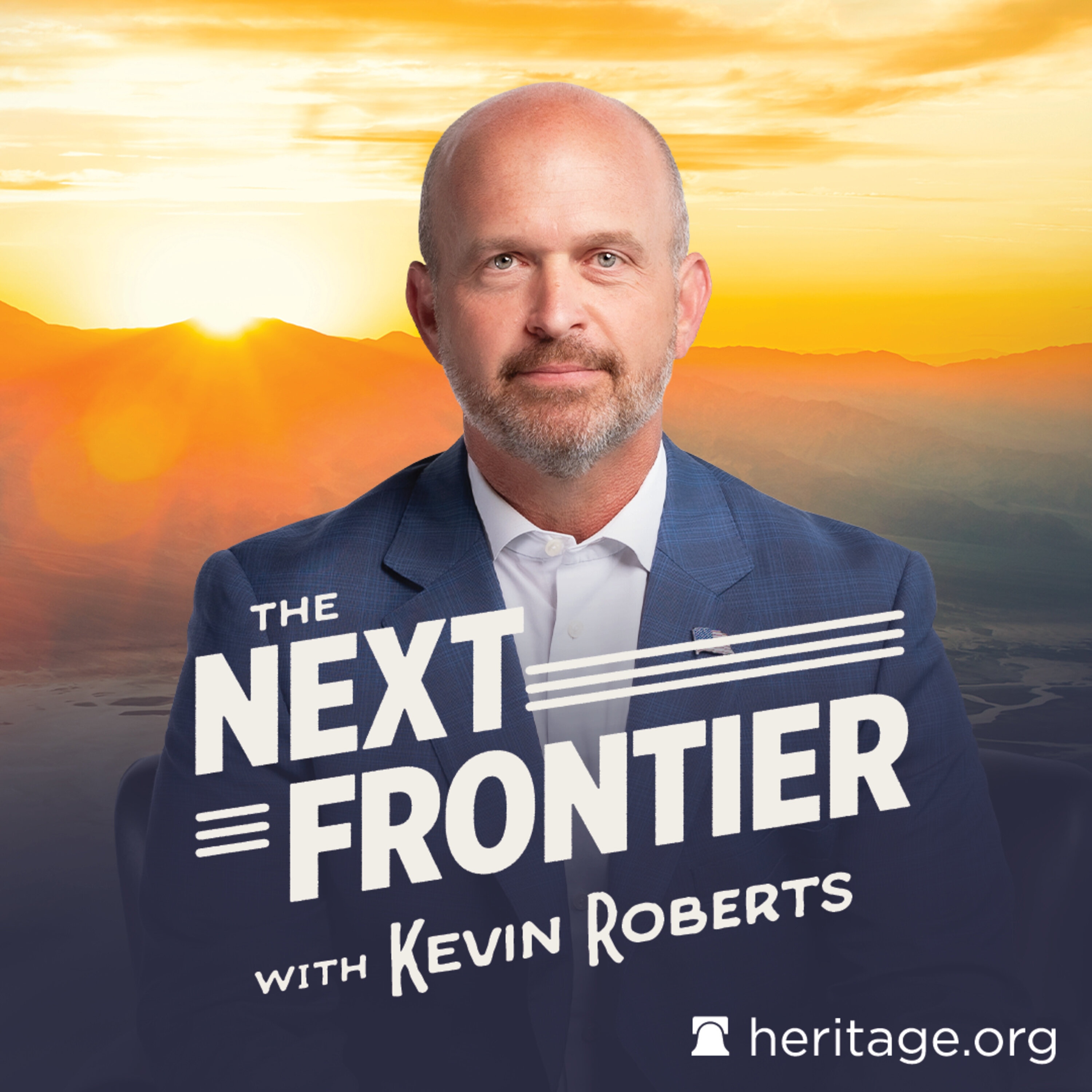
Make America Creative Again | The Next Frontier with Dr. Kevin Roberts
About this episode
In this episode of The Next Frontier, I'm walking into two of America's most important cultural institutions—The Kennedy Center and the Library of Congress. One was built for performance, the other for preservation. I'm here asking a simple question: What does it take to keep a cultural inheritance alive?
If we want great art to remain part of American life, we can't treat institutions like scenery: useful only when they flatter our side. We have to treat them like what they are—an inheritance, and inheritance requires work, maintenance, humility, and willingness to keep the doors open.
This video would not be possible without the generous donors of The Heritage Foundation. If you like our content, please consider supporting The Heritage Foundation by making a donation of any amount here: https://secured.heritage.org/?utm_medium=organic&utm_source=podcast&utm_campaign=kevinrobertsshow&utm_content=260310-krshow
Dr. Kevin Roberts is the President of The Heritage Foundation.
See omnystudio.com/listener for privacy information.
Get every episode summarized
Each time The Kevin Roberts Show with Larry O’Connor publishes, we email you a written briefing from the transcript — the topics, who appeared, and any specific claims, with the ad reads skipped.
Email me new episodesFree for 3 shows. No card needed.
Transcript ready
347 searchable segments. Every word is indexed and playable.
Full transcript
The Kevin Roberts Show with Larry O’Connor — Make America Creative Again | The Next Frontier with Dr. Kevin Roberts. Machine-transcribed; use the interactive transcript above to jump the player to any line.
The Melania leaned over to me during the Kennedy Center honors and she said, don't touch those lights. And so you're not going to touch those lights. 180 million collection items. 180 million. Correct. Correct. We're just library in the world. We think of ourselves as a forever institution. We need to be here forever and preserve these things. I'm walking into two of America's most important cultural institutions. One built for performance, one built for preservation. So I'm asking a simple question. What does it take to keep a cultural inheritance a lot? The Kennedy Center was conceived as a temple to artistic excellence, ballet, opera, theater,
dedicated to beauty, skill, and the deepest expressions of the human spirit. We met up with Richard Grinnell, president of the Trump Kennedy Center, to get an inside look at what it takes to keep an American tradition alive. Well first of all, welcome to the Trump Kennedy Center to the opera house here where we do amazing musicals and all sorts of special programming. I think the first thing that I have to say while sitting here is, I haven't really sat in these particular seats, these need work. The velvet is not in great shape, the seats are not in great shape, the arms. You just feel like America's cultural institution has been neglected. And that makes me a little sad. I, of course, came here at the request of the president and on my first day when I arrived. I'd say within the first 45 minutes the first thing I did when I got here was to say, can
I speak to the CFO? And they told me, well, she's not working today, she works from home. And I said, great, can I get her on Zoom? And I started speaking with her and just asking some math questions, some really basic math questions I've got to finance background. So I thought it might be simple questions, how much money do we have in the bank? What's our liabilities coming up around the corner? What do revenues look like? I just wanted to get a general sense, the very first person that I spoke to. And she acted like she was part of the PR team, she was spinning me more than anything. And it was troubling. I got off the phone and immediately thought, wow, this is not good. And within an hour she had resigned. She resigned because I asked her some hard questions. Yes, math questions of a CFO. And she said, I'm out of here. And so I didn't have to make that change, she made that change simply because I was asking
questions and trying to get to the bottom of what was going on. That, to me, is indicative of what the next year unfolded like. We had a rainstorm pretty quickly after that and an immediate flood. And I just decided to bring the president over and to say, you as an incredible construction guy who likes to do this on his free time, walk into the basement with me. And I've learned a lot about construction from him, well being here. And he saw it immediately and he was able to talk to the guys who run this building, who had said, you know, it's been neglected for 10 or 15 years. The deferred maintenance is really bad. We should think about tearing it down and starting over. And the president had an immediate reaction saying, no, we're not going to tear it down. We're going to fix it. And he immediately went to Congress, asked for the money. That's a long answer to say, this place is America's cultural center. We should have been taking care of it.
We didn't. And I think one of the reasons why the media in Washington right now is freaking out is because they ignored this place. We had media coverage that only focused on programming, who's the latest, the greatest coming in. No one was asking these questions. I've asked reporters consistently, do you know what debt reserves are? And they didn't know. And they were covering this place. And I said, well, you know, what's interesting is when I arrived, we were paying staff with debt reserves for our balloon payment in 2030. We were digging into our debt reserves to pay for operations. And so that's unacceptable. I think it's immoral, maybe even criminal, but it's definitely immoral. And I wanted to fix that. The president wanted to fix that. And so when the, when President Trump came and wanted to really save America's cultural center, he realized it needed to be saved financially, as well as physically.
And that's what we've been doing. And saving America's cultural center should, it should, transcend partisan politics. But of course in Washington these days, nothing transcends politics. But that's all the more reason for you and the president. God bless the two of you for doing it, for doubling down and saying, we are going to get this place fixed. We're going to address the deferred maintenance. Look, one of the things I've been fascinated by since I arrived at Heritage four years ago is cultural diplomacy. Yeah. And this is something you're truly an expert in. And so that's top of mind for me is I stand here with you because of your expertise, but also visiting the Trump Kennedy Center. What's the importance of cultural diplomacy right now in the 21st century? Look, I think a lot of countries have cultural ministers because they know that they've got to win this battle on the culture. I think Republicans have given it up for so long. It is something I think the president cares about. He always wants to fight on this issue and bring people together. And we should have it nonpartisan or bipartisan, whatever you want to call it.
When I came here, we had a system where we employed people to look at different cultures, different countries and figure out what programming could we bring here. I decided to flip it. And instead of that, we went to all of the embassies here because the world is represented in Washington, D.C. Washington, D.C. has a luxury of being able to quickly tap into the world with a couple of phone calls. You know this. And so we decided to go to the embassies and say, what do you have? What do you want to bring here? Also, can you pay for it when you come here so that we wouldn't have to necessarily just pay for it? But countries want to bring their program in here. They want to celebrate cultures. They want to celebrate the best of what they have. They want to showcase it to Washington. The language of culture is usually poetic. It concerns beauty, meaning, and inspiration. The language of running a building starts with leaks, ledgers, and broken seats. But stewardship is never just plumbing and budgets.
The moment you touch a flagship institution, you touch the politics that surround it. Sometimes, even the politics people try to bring into it. As I sit here, now in an empty Kennedy Center, I think often about the performances my wife and I have seen here. I think about the importance of this place for America's cultural identity, but really the cultural identity of the West, something that you and your own experience in international relations are an expert in. But the other obstacle that's out there, just given the nature of political discourse in Washington, is that the media and, of course, some of their allies in Congress continue to impose upon this cultural institution, politics in a way that politics doesn't belong in, in the same way they've done that in classrooms, right? And so, along with the physical restoration of this place, which is a glorious plan, by the way. What do we need to do even more broadly as a society to get politics out of where it doesn't belong? I don't think you're going to get it out. Look at for optimism here.
Out of this city, right? I mean, we shouldn't be surprised that Washington, D.C. is the most political city in the world. America is the greatest country, and our politics are going to be great because of that. And so, I've been around the politics enough to where I am really dismissive of it here in Washington. When I get out of Washington, people don't care so much. And I think that bubble mentality is what we need leaders to do. We need leaders to understand, when you're fixing a cultural institution, it's a good thing and people support it. Only in Washington is Republican money going into the arts a bad thing, right? So I thought, in the beginning, there was a chance that maybe, because the President of the United States, a Republican was asking for $257 million to be put into the Kennedy Center to support the then Kennedy Center to support this institution and to fix it
and to make it grand again, I thought that the Democrats would support that. They haven't. They've turned arts into a partisan issue. And I think that it's clear because we decided that we were going to get into it. It's not dissimilar than the union issue. When the President decided to go after unions, when President Trump decided to campaign with first and second generation Americans, the Democrats really melted down. I don't want to see that here. I want us to be sitting in these seats. And the person that's right next to us may be voted, maybe didn't vote, maybe voted for somebody that we don't vote for. But at the end of the day that we don't care, right? And that's what we want because we've got an amazing stage. We saw Les Mis here, we saw the sound of music here, we've seen some amazing shows and the performers shouldn't expect the audience to agree with them either.
And we've got to get back to that. The real test of an arts institution is whether people still choose to show up. We cannot have the cancel culture in this type of setting. I'll finish with this, I don't quote The New York Times very much. Last summer, The New York Times did a front page piece about how Broadway was dying, about seats not being sold. People not going to Broadway. And the conclusion of that was if you bring back a revival and within kind of the arts community, a revival is like, you know, something that was already on the stage and we're going to bring it back and updated a little bit, the old stuff, the common sense stuff. If you do a revival, it's much better for ticket sales. People want to come to see that. Now, when you take a movie in today's world and you turn it into a Broadway show, very risky, not a lot of people are going to go in the beginning.
The critics may like it because it's cutting edge, but the people don't. And so if you want to have an institution that's around forever, I came here and I said, you got to do three things. You have to put as many people in the seats as possible, but we know in a post-COVID world, all ticket sales are struggling and The New York Times showed us that with Broadway. You have to have individual sponsors, people who are just wealthy, who like the arts, who say, you know what, I want to see Tchaikovsky and so I'm going to write a big check because I love that score, right? Or corporations who say, this kind of aligns with who we are, our people like this and so corporate dollars, individual dollars, ticket sales, all need to come together to get us to at least revenue neutral. And if we make a little money, then we can do some arts education, right? And so that's what we're trying to do is be able to further the arts.
I love arts education. I, you know, as a child, I tried the violin, I tried the piano. I tried the cornette. I love trying new things. And I think young people really respond to music, to acting, to programming. Not everybody is just a sports guy, right? And so it's really important to me that we remove the politics and have places like this that celebrate everyone coming together and watching some amazing performances. A performing arts center is a living organism. It needs audiences, patrons, discipline, and constant repair. But if you want to know what a nation truly values, you also look at what it refuses to let disappear. The Library of Congress safeguards the record of American imagination. Dr. Kevin Butterfield, historian, fellow historian, fellow Kevin for that matter, research center
director here at the Library of Congress, I just have to say. From me, not even on behalf of the audience, what a treat it is to be here, thanks for your time. So happy to do it. Excited to show you things in this room and in this building. People will know as they're watching the show what I'm up to and being here because they know that what we're trying to do is to reveal to them sort of an insider's view for important cultural institutions and any American would know right off the bat, the Library of Congress is one of them. But tell us, given your experience here and also leading up to here, why what happens inside this building is so important for the everyday American. For one thing, it's more than just this building. We happen to be in the Thomas Jefferson building, the beautiful building just across from the Capitol. Everyone can recognize the dome, beautiful space open in the 1890s, but the Library outgrew that quite quickly. There are more buildings, including off-site storage to hold the roughly 180 million collection items. 180 million. Correct. Largest library in the world. Unquestionably. And no, this isn't the National Archives.
The difference matters. What's the difference between the Library of Congress and the National Archives? So the Archives, much younger, really than the Library of Congress, I see what you do there. We're created to become a repository for all the official records produced by all the branches of the government, and those things are contained there and including off-site storage all around the country, by the way. Millions of items. I don't know the exact scope of the National Archives, but the Library for quite some time actually served some of the purpose that the Archives currently serves, for instance, the Declaration of Independence, the original manuscript, was actually here for decades in the 20th century. And only with the opening of the Archives building on the mall, did it move in a grand procession to be displayed there. But the Library preserves things that are not official government records and the Archives are there to preserve those. And then you see the record up close through objects that were never meant to last. You may be delighted to find some familiar friends sitting alongside America's oldest
and most important works of literature. Within this collection, as you say, there's a lot of surprises. Cat in the Hat, including Dr. Seuss. And this is, I actually had this next to another instance of great American literature, some of which people know instantly, the Cat in the Hat, some of which they may have forgotten. This is actually, but both of these are pedagogical. These are teaching tools. And Dr. Seuss, the other guy, so he wrote this with an opportunity to teach young children how to read in ways that were a little more interesting than the Dick and Jane primers that might exist. Noah Webster was doing something quite similar in trying to create and capture a way to teach Americans how to read and spell and pronounce English. This is in the 1980s. Noah Webster takes off, and this is long before his dictionary, but he decides that there is a market for a purely American English speller that can be used and assigned.
And it was. This is, as you see, a young woman in the 19th century actually created a sampler to preserve this thing. It's been worn to tatters, but we have it here at the library. The Cat in the Hat is perceived, by the way. But both of these books were there to teach, and with this one, he uses only a couple of hundred words. There's none of the fancipl made up, Susie and words that we know. It's all real words, because he wanted to create something that students, young kids, could read and begin to be able to read for themselves. Webster was doing the same thing. Well, Professor, you taught me something today. I never thought about the importance of these two things, Cat in the Hat, with Noah Webster's work. We're a really important part of our American story. They both are teaching young people what American English is, right? And Webster was very self-conscious about it, because there were no American spellers or anything. Fidelian. And he knew, he knew, he was also quite grandiose about it, but he believed that if we could find a way to all, as Americans, say things in the same ways, not have regional dialects
that were dramatically differ from other parts of the country, that he might help through his own efforts, do the same sorts of things that the framers of the Constitution were doing, knit the nation together. And so when Webster writes these things, and they wind up becoming, by the way, by some measures, the single best-selling book ever written by an American, because they're sold in the hundreds of millions of copies over the course of the next hundred and some odd years. But he knows that he's doing something very important to teach and unite Americans. I don't know if Dr. Susie said the same sense there, but he certainly made an impact. It's called fully significant. That's right. The produce was a huge influence on millions of children, but one other work stands out as the most important novel in American history. The famous novel now known as Moby Dick. Herman Melville's Moby Dick, totally unappreciated in its own moment, was printed in December of 1851, the American edition. We're actually looking at it here. This is the original cloth binding. All you can see on here is just a life buoy, a sort of a light preserver.
It doesn't say Melville doesn't say Moby Dick. It says Harper and Brothers, I believe, New York. But as we turn into this, and you get a chance to see the very first American printing of Moby Dick, you can see a book that has become, some ways described, a degrade American novel, and it goes on for several hundred pages. He changes his mind a couple of times about what he wants to call it. First, he thinks it might be the whale. He decides Moby Dick kind of splits the difference, he calls it Moby Dick, or the whale. It's printed actually a couple of months earlier in Britain, in a bad, it's filled with errors, including a very important error. There's an epilogue to Moby Dick where you find out the dish mail survives, sorry to spoil, they all come from Moby Dick. But you find out that he survives, the British edition left that out, and critics seized on it, saying not only is this book incomprehensible, but it doesn't even follow the basic rules of having the narrator survive the action.
How could we even be reading? The British are thinking, how perfectly American. It gets panned, and that is one of the factors, including the fact that maybe it was just a bit ahead of its time in some ways. I mean, there is something kind of proto-plus modern about what's in this work. But it has been re-invigorated in the 20th century, starting with Melville's The Anniversary of his birth in 1919. People began to rediscover Herman Melville only by the 30s, 40s, and 50s as it becomes sort of the great American novel. But this is a very first printing of Moby Dick in that original cloth mining. Well, it's tremendous to see that original printing, and it's also worthy of the reminder for American students who might say that they suffered through having to read Moby Dick to understand that it's important for two reasons intrinsically as a work of great American literature, but also as the quintessential American novel whose popularity and the appreciation of it really increased deep into the 20th century.
And one of the great things that I love about these kind of first moments is no one knows what's going to become of this book. These works have endured because they address what is permanent in the human soul. Their restoration is not nostalgia. It is the recovery of a vital inheritance, timeless, transcendent, and worthy of the civilization that produced them. If we want great art to remain part of American life, we can't treat institutions like scenery, useful only when they flatter our side. We have to treat them like what they are, and inheritance. And inheritance requires work, maintenance, humility, and willingness to keep the doors open. I'm really enthusiastic about the future. It's going to come back bigger than ever before. Thanks for your leadership. I can't thank you enough. Your great guide through each of these books will inspire a lot of people to appreciate the importance of preserving the past. Thanks so much. Take care.
More episodes
More from The Kevin Roberts Show with Larry O’Connor

How We Take Back the Smithsonian From the Communists
The Kevin Roberts Show with Larry O’Connor

Why Are Mass Deportations So Important? | The Kevin Roberts Show with Larry O’Co...
The Kevin Roberts Show with Larry O’Connor

Can the Rise of Communism in America Be Stopped? | The Kevin Roberts Show With L...
The Kevin Roberts Show with Larry O’Connor

How the SAVE America Act Exposes A Deep State Agenda | The Kevin Roberts Show wi...
The Kevin Roberts Show with Larry O’Connor