About this episode
March 1, 1910
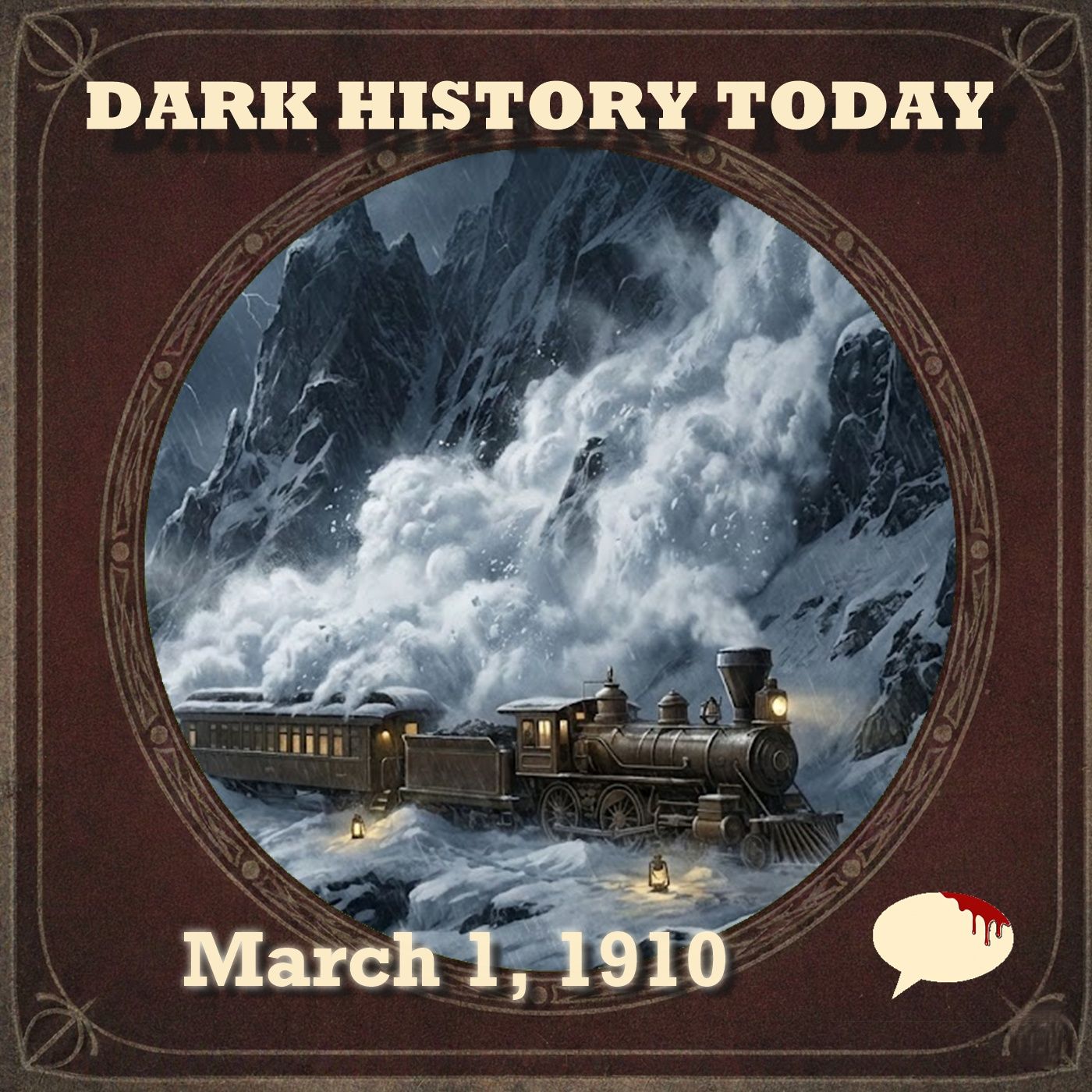
Two Great Northern Railway trains sit snowbound at a tiny depot in the Cascade Mountains, trapped by a nine-day blizzard that has buried the tracks under seventeen feet of snow. The rotary plows are broken. The shovelers have walked off the job. The telegraph lines are down. Some passengers escape on foot down a near-vertical slope. The rest stay, because the railroad tells them it's safer to wait. On the last day of February, the snow turns to rain, and then comes the thunder. Just after one in the morning, a slab of snow half a mile wide breaks loose from Windy Mountain and sweeps both trains — locomotives, passenger cars, mail cars, and all — 150 feet down into the Tye River valley. Ninety-six people die in the deadliest avalanche in American history. The town is so haunted by the disaster, they change its name.
Become a supporter of this podcast: https://www.spreaker.com/podcast/true-crime-historian--2909311/support.
You can pay more if you want to, but rent at the Safe House is still just a buck a week, and you can get access to over 400 ad-free episodes from the dusty vault, Safe House Exclusives, direct access to the Boss, and whatever personal services you require.
We invite you to our other PULPULAR MEDIA podcasts:
If disaster is more your jam, check out CATASTROPHIC CALAMITIES, telling the stories of famous and forgotten tragedies of the 19th and 20th centuries. What could go wrong? Everything!
For brand-new tales in the old clothes from the golden era of popular literature, give your ears a treat with PULP MAGAZINES with two new stories every week.
This episode includes AI-generated content.
Get every episode summarized
Each time True Crime Historian publishes, we email you a written briefing from the transcript — the topics, who appeared, and any specific claims, with the ad reads skipped.
Email me new episodesFree for 3 shows. No card needed.
Hosts & guests
Transcript ready
137 searchable segments. Every word is indexed and playable.
Full transcript
True Crime Historian — March 1, 1910. Machine-transcribed; use the interactive transcript above to jump the player to any line.
Most people would rather attend a corporate team building workshop than search for auto and home insurance. Go team, feel that synergy! That's why the Zebra searches for you, comparing over 100 insurance companies to find savings no one else can. Compare today at the Zebra.com Who's ready for the truss fall? Wellington, Washington, March 1st, 1910. The mountain had been patient for nine days. On the 10th, it stopped waiting. Wellington was not much of a town. A power plant, a post office, a grocery, the baylay's hotel with its well-stocked kitchen, a saloon, and a handful of shacks clinging to a shelf of rock at the West Portal of the Cascade Tunnel, five thousand feet up in Washington's Cascade Range. The whole place existed for one reason, the Great Northern Railway. Every soul who lived there worked for the railroad, and the railroad was the only way in or out. The nearest real settlement, a whistle stop called scenic,
sat miles down a treacherous grade to the West, to the east, the tunnel board through the mountain toward Levenworth and the dry country beyond. On the evening of February 22nd, two Westbound trains left Spokane three hours apart, headed for Seattle and the ports of Puget Sound. Train number 25 was the Spokane local, a passenger train hauling seven cars behind a big 12-wheeled locomotive. Train number 27 was the fast mail, loaded with letters and parcels and a handful of clerks to sort them. Together, the two trains carried roughly 125 passengers and crew. The trip to Seattle should have taken half a day. It would take the better part of forever. The trains cleared the Cascade Tunnel and emerged at Wellington on February 23rd to find the world had turned white. Snow fell at a foot per hour. On the worst day, the gauges measured 11 feet. The drifts buried the tracks in both directions and kept piling higher. Great Northern's rotary plows, massive spinning blades mounted on locomotives,
chewed into the snow and choked on the trees and debris mixed into it. One broke down. Two stalled between slides. The fourth got stuck at the east end of the tunnel. The shovelers fared no better. Hired hands, most of them paid 15 cents an hour to dig out the line by muscle alone. After days of backbreaking labor in a blizzard, they demanded a raise to 25 cents. Superintendent James O'Neill refused, so they put down their shovels and walked off the mountain. Hard to blame them. By February 26th, the telegraph lines had come down. Wellington was cut off. No messages in. No messages out. No way to know when help might come. Or if anyone was sending it. The passengers ate their meals at the Baylays Hotel and stared out the windows at the white wall closing around them. The women cried. The men went quiet. Avalanche's thundered down the surrounding slopes at irregular intervals. Each won a reminder of what the mountain could do when it felt like it. None hit the trains, not yet.
Some passengers decided not to wait around to find out. A group set off on foot toward scenic, picking their way along the buried tracks and sliding a thousand feet down a near vertical slope to reach the station below. One man leading an earlier party had been swept away by a slide and buried alive. He turned up at a lodge miles away, half frozen, but breathing. Word came back to Wellington. He made it, but nobody else should try. The ones who stayed had their reasons. Some were too old, too young, or too injured to walk. John Gray had boarded the train and nooksack with a broken right leg. His wife Anna and their 18-month-old son, Varden, were with him. Ida Starritt was traveling with her seven-year-old boy Raymond and her mother. Catherine O'Reilly, a 26-year-old nurse from Sacred Heart Hospital in Spokane, stayed. John Parseybach, a 24-year-old rotary conductor, married six months, stayed. Earl Longcoy, 19 years old, barely arrived from Wisconsin to serve as O'Neill's secretary, stayed.
There was also the question of the tunnel. Some passengers begged the crew to back the trains inside, out of the path of any slide. The railroad men refused, and not without cause. Steam locomotives belched smoke and carbon monoxide, and everyone knew what happened when trains stalled in tunnels. The passengers at Wellington were caught between two ways of dying, and had to pick which one scared them less. They chose to stay in the open, at the base of Wendy Mountain, and hope. On the last day of February, the snow stopped. Rain moved in, warm and steady, and with it came wind. The change in weather felt like mercy. It was the opposite. Rain on a mountain of fresh snow is a trigger. The water seeps between the layers, loosens the bond between old crust and new slab, and turns the whole slope into a loaded gun. Then the thunder started, just after one o'clock on the morning of March 1st, a violent electrical storm rolled through the cascades, lightning cracked against the ridge line. Charles Andrews, a great northern
employee, was walking toward one of the bunkhouses when he heard a sound that did not belong to thunder. He turned toward Wendy Mountain and saw it coming. A slab of snow, ten feet thick, half a mile long, and a quarter mile wide broke loose from the summit, and began to move. The slopes above the tracks had been stripped bare by clear cutting and wildfire, and there was nothing left to slow it down. Andrews would describe the site 50 years later. White death moving down the mountainside above the trains, relentlessly it advanced, exploding, roaring, rumbling, grinding, snapping, a crescendo of sound that might have been the crashing of 10,000 freight trains. The avalanche hit the two trains and picked them up whole, locomotives, box cars, passenger cars, sleepers, mail cars, and hurled them 150 feet down into the tie river valley. It wiped out the depot, the water tower, and several cabins. It buried everything under 40 to 70 feet of snow and shattered timber. The baylay's hotel, the largest building in Wellington,
stood untouched. The avalanche had passed within yards of it. Most of the passengers and crew had been asleep. Some were killed instantly by the impact. Others suffocated in the dense packed snow, alive and conscious in the dark, with no room to move and no air to breathe. The people in the hotel heard the roar, rushed outside in their nightclothes, and found the trains gone. Where the tracks had been, there was nothing. They scrambled down the slope and began digging with their hands. 23 people came out alive. Fireman Samuel Bates was pulled from beneath a locomotive after six hours. Ida Starrott was trapped for 11 hours before rescuers reached her. Her son Raymond survived with a gash across his forehead that he carried for the rest of his life. The Gray family, John, Anna, and Little Vardin, 18 months old, were all pulled from the snow. John's broken leg had broken again. 96 did not come out. 35 passengers. 58 great northern employees sleeping on the
trains. Three railroad workers in the cabins. Among them, Earl Longcoy, the kid from Wisconsin. John Parseybach married six months. Catherine O'Reilly, the nurse. Nine male clerks, most of them in their twenties. One of them, Alfred Hensel, survived only because he had fallen asleep at the far end of his car. The avalanche broke the male car in half. The eight men on the other end all died. The telegraph lines were still down. No one outside willing to knew what had happened until a traveling engineer named Mackie walked to scenic with the news. Rescue parties arrived on March 2nd. Newspapers called the site Death Hill. Bodies were strapped to toboggins and sletted down the mountain to trains at lower elevations, which carried them to Everett and Seattle. Some were identified, some were not. The last of the dead was not recovered until late July, 21 weeks after the slide. At the corner's inquest, great northern called the avalanche an act of God. The jury agreed.
No one was held responsible. O'Neill, who had been offsite working on a rotary plow when the slide hit, spent the rest of his career with the railroad. He died in 1937. The company invested millions in concrete snow sheds. In October of 1910, the name Wellington was quietly retired. The town became Thai after the creek that ran through it, in the hope that a new name might bury the memory. It did not. When the new cascade tunnel opened in 1929, it bypassed the site altogether. The town emptied out, burned, and vanished. One footnote, a man named Joseph Benier had been identified by several acquaintances as one of the Wellington dead. Benier turned up alive at a funeral parlor and announced, my friends say that you have me dead downstairs. I want to say that I am the livest man in town. Not everyone who walked off that mountain was so lucky, but every single one of them lived. Not one person who left Wellington on foot before March 1st
perished in the avalanche. The ones who stayed stayed because the railroad told them it was safer to wait. Today, hikers on the iron goat trail can still find rusted spikes and twisted scraps of rail from the wreckage, half buried in the overgrowth at the bottom of the ravine, a thousand feet below where Wellington used to be. The mountain, of course, has not moved. Looking for excitement? Jumbo Casino is here. Play anytime, play anywhere. Play on the train, play at the store, play at home, play when you're bored. Play today for your chance to win and get daily bonuses when you log in. So why are you waiting for or don't delay? Jumbo Casino is free to play. Experience social gameplay like never before. Go to Jumbo Casino right now to play hundreds of games, including online slots, bingo, slingo, and more. Live the Jumbo Life at JumboCasino.com.
Some days call for some oomph to amplify your everyday look, like when you want the look of false lashes without the extra effort. Reach for Thrive Cosmetics Liquid Lash Volumizer Mascara, or when you want all eyes on your smile, keep Empower Gloss Ultra Glossy Lip Serum in your bag. It's a burst of 24 hour hydration that smooths like a serum, shines like a gloss, and can be worn sheer or layered. You'll also look and feel your best with Thrive Cosmetics, plus every product is 100% vegan, cruelty free, and made with clean skin loving ingredients that work with your skin, not against it. And for every product purchased, Thrive Cosmetics donates to help communities thrive. So every time you use your favorite Thrive Cosmetics product, you're helping communities you care about too, amplify your everyday. Go to Thrive Cosmetics.com slash shine 26 for an exclusive offer of 20% off your first order. That's Thrive Cosmetics, C-A-U-S-E-M-E-T-I-C-S dot com slash shine 26.
More episodes


