About this episode
It is Monday, March 30, 2026, join hosts Alex Mercer and Marcus Webb as they break down the sharpest bets and odds in the market.
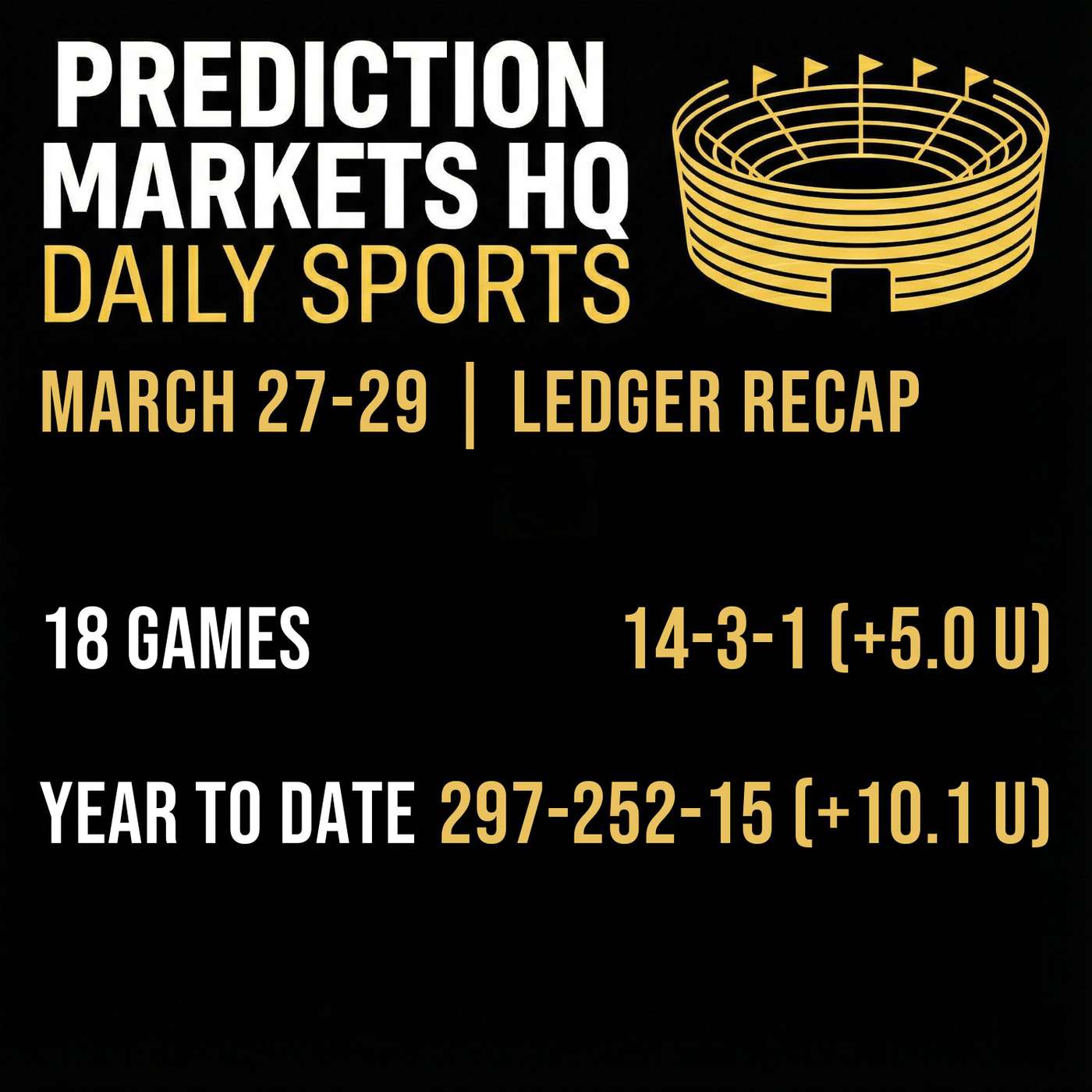
In this edition of the Ledger Recap, the team analyzes a 14-3 record and a net gain of five units, while diving into the efficiency of recent market positions. We look at the structural flaws in the CLIPPERS' narrow win and why high-conviction odds on the SPURS and RAPTORS provided significant value that was left on the table.
- NBA Analysis: Reviewing Stephon Castle’s historic triple-double and the impact of Giannis Antetokounmpo's absence on spread contracts.
- NHL Tape: Why the SABRES puck line failed despite a straight win and how milestones can impact game flow.
- Refining the Algorithm: A deep dive into position sizing and identifying underpriced blowout contracts on leading platforms.
Maximize your strategy on Kalshi and Polymarket by understanding the chain of causation behind every move. Our hosts provide a masterclass in risk-based accounting and finding the true alpha in prediction market units.
Opinions expressed are for informational purposes only. Bet responsibly.
Contact: [email protected]
"Jerry Five" Kevin MacLeod (incompetech.com)
Licensed under Creative Commons: By Attribution 4.0 License
http://creativecommons.org/licenses/by/4.0/
Get every episode summarized
Each time Prediction Markets HQ: Daily Sports publishes, we email you a written briefing from the transcript — the topics, who appeared, and any specific claims, with the ad reads skipped.
Email me new episodesFree for 3 shows. No card needed.
Hosts & guests
Transcript ready
122 searchable segments. Every word is indexed and playable.
Full transcript
Prediction Markets HQ: Daily Sports — March 27-29 | Ledger Recap. Machine-transcribed; use the interactive transcript above to jump the player to any line.
Welcome back to the ledger recap. I'm Alex Mercer, across from me, as always, is Marcus Webb. Marcus, we just closed out a midweek weekend stretch and look, the record looks good, but we've got some things to unpack. We always do. Before we get into the film room, quick reminder for the desk on how we track. We work in prediction market units. If we buy a contract at 60 cents, we're risking 0.60 units to win 0.40, pure risk-based accounting. What we put in? What we got back? No fluff. Alright, the tape. Session record, 14 wins, 3 losses, 1 push, 18 positions total. Net on the session, plus 5 units. Which sounds great until you do the math. Say it, 14 wins, 18 positions, and we netted 5 units. That's an average of roughly 35 cents of profit per winning contract. We were buying a lot of 50 cent contracts to win 50 cents. That's fine, but when your win rate is this high, you have to ask whether the position sizing matched the conviction.
We'll get into that. Overall, record now sits at 297 and 252, with 15 pushes, plus 10.1 units on the season. The ledger is green, but Marcus is right. The efficiency question is real, and we're going to address it. Let's go to the film room. Let's start with the one that still stinks. Clippers minus 8.5 against Indiana. We bought at 53 cents. Final score, Clippers 114, Pacers 113. One point. We needed nine. Walk me through it. The thesis was sound on paper. Indiana was shorthanded. The Clippers had home court and the line implied a comfortable double digit cushion. But here's the systemic issue. The Clippers were a big at multiple points in that game, and Kawai Leonard, who is historically a closer, took over late. The problem is that we needed a blowout, not a close win. And Kawai closing games means the Pacers stayed competitive enough to keep it within striking distance. He hit a game-winning jumper at 0.4 seconds, completing a 24 point comeback. Right. So here's the chain. Indiana was down big, which forced them into a pace in
space survival mode. More threes, more possessions. The Clippers, comfortable with the lead, went conservative. Slowed the pace, protected the rim, stopped attacking. That let Indiana claw back. And when Kawai sealed it at the buzzer, it was a one point win instead of a ten-point win. We needed the blowout. We got the thriller. Bad beat or bad thesis? Honestly, bad beat with a structural flaw. We should have been more careful about buying a large spread position on a team with Kawai Leonard, a player whose entire identity is making close games closer, not blowing them open. He doesn't pour it on. He finishes. That's a real market in efficiency. We priced wrong. Noted for the playbook. Loss minus 0.53 units. Now let's talk about the Spurs, because this was a two-position night and both hit. Spurs minus 17.5 at 55 cents, and Stefan Castle over 16 and a half at 46 cents. Final scores, Spurs 127 bucks 195. 32 point margin. Castle went for 22, both settled green.
The bucks were missing Yannis. That was the thesis. That was part of the thesis. Here's the full chain. Yannis is Milwaukee's entire defensive anchor and their primary offensive initiator. Without him, the bucks have no credible interior presence. They can't protect the paint and they can't generate half court offense at a high level. The Spurs, meanwhile, are a young team that thrives in transition and open court situations. When you remove Milwaukee's rim protection, San Antonio's guards and wings get downhill all night. That's exactly what happened. And Castle, 22, 10 and 10 historic triple double for a rookie, which brings me to the Alpha question. We were right. We were also too safe. How much did we leave on the table? The Spurs won by 32. We bought minus 17.5. They were almost certainly all spread contracts available at minus 22 minus 25. If we had the conviction to buy the spread at all and we clearly did, we should have been asking, what's the highest line we can justify given what we know? A minus 25 contract against a Yannis list bucks team on a Spurs 8 game
winning streak. That's a position worth exploring. So the missed Alpha is real. It's real. We made roughly a unit combined on these two. A more aggressive spread position could have doubled that. The conviction was there. The aggression wasn't. Alright, let's talk about the one that made everyone look twice. Raptors minus 1.5 first half at 56 cents. We bought it. Final halftime score Toronto 70 Orlando 43 27 point halftime lead. The Raptors set an NBA play by play error record with a 31 O scoring run spanning the first and second quarters. Scotty Barnes had 15 assists in the game. Here's the systemic lead on this one Orlando's defense is built around their half court scheme switching protecting the paint forcing mid range. But when you go down 20 early, you have to abandon that scheme. You start fouling, you start gambling for steals, you extend your defense and the Raptors who have been playing fast all season with Barnes as the engine absolutely feasted on that. The 31 O run wasn't random. It was the Raptors punishing
a defense that had to overextend. And the first half contract was the right vehicle here. But again, aggressive alpha review. We bought minus 1.5 at 56 cents. We won by 27 at the half. If we had conviction on Toronto in the first half, why weren't we looking at minus eight minus 10 first half contracts? The implied probability on a blowout first half was underpriced given what we knew about Orlando's recent defensive struggles. Mist alpha. Significant mist alpha. The Sabers minus 1.5 puck line at 42 cents. Final Buffalo 3 Seattle 2. Scuff won the game, lost the contract. They won by one. We needed to. The thesis here was that Seattle was in a spiral. Bad road record, nothing to play for, Sabers at home. And the Sabers did win. But here's the chain of causation on why they didn't cover. Rasmus Dahlene scored his 100th career NHL goal in this game. That's a milestone moment. Those games have a funny way of tightening up emotionally. The crowd goes electric,
the opponent digs in, and you end up with a gritty one goal game instead of the clinical win you projected. And Shane Wright went down with an injury after a hit. Which actually helped Seattle in a perverse way. When you lose a key player, the remaining guys tend to consolidate, play tighter, and the game slows down. That's exactly what happened. Seattle lost their best forward and responded by playing a suffocating low event third period. One goal game, we lose the contract. Bad beat or bad thesis? Structural flaw on the puck line. A minus 1.5 contract in hockey is a 42 cent position. You're paying for certainty that rarely exists in a sport decided by one or two goals. We were right on the winner. We were wrong to demand a two goal cushion in what was always going to be a competitive game. Let's end the film room on a clean one. Jared Allen over 10.5 points at 49 cents. Heat Cavaliers. Allen goes for 18 Cleveland wins 149 128. First game back from a knee injury and we bought the over. That's the contrary and angle. Most of the market was probably
discounting him returned from injury, load management concerns rust. The implied probability was essentially a coin flip at 49 cents. Right. And here's the systemic logic. Cleveland won by 21. When a team wins by 21, their starters are playing meaningful minutes in the first three quarters, accumulating stats organically. Allen didn't need to be good. He just needed to be present and functional in a blowout that kept the starters on the floor. The market priced him like he might struggle. We priced him like he just needed to play. Max Stross going off for 29 and 83 is against his former team that actually helped us. Miami was so focused on stopping Stross that Allen had clean looks all night. Exactly. Stress pulled the defensive attention. Allen operated freely in the paint. Chain of causation. That's the thesis working as designed. All right, Marcus. Playbook update. What did the session teach us? Two things. First, conviction calibration. We went 14 and three this session and made five units. That's a structural problem disguised as a good result.
When we have high conviction and we clearly did given the win rate, we need to be buying more aggressive contracts, alt spreads instead of the main line, tighter props, positions where the market is further mispriced, not just slightly off. The spurs game is the case study. Perfect case study. We knew the bucks were dead without Giannis. We knew the spurs were on a run. We bought minus 17.5 when the game suggested minus 25 was the sharper position. The conviction was a nine. The aggression was a six and the second lesson puck line discipline hockey minus 1.5 contracts are traps for teams that win close games unless we have a strong structural reason to believe a team will win by two or more dominant power play opponent on a back-to-back significant gold ending gap. We should be buying the money line and accepting the lower payout. The saber's game is a direct day of point right team wrong contract structure. So the rule update is in hockey default to the money line unless the two goal case is explicit and documented. That's the rule.
Write it in. That's the session 14 and 3 plus 5 units. The ledger is green, the algorithm is sharper and the missed alpha is now on the board which means next session we come in with the calibration dialed up. Iron sharpens iron. Before we go remember everything we discuss here is a post market analysis of our own positions in prediction markets like pulley market and calcium. We are grading our portfolio not giving you a roadmap do your own research size your positions responsibly and understand the markets you're trading opinions expressed are for informational purposes only that responsibly. Hey it's Marcus thanks for listening to prediction markets HQ daily sports what you just heard was created entirely by AI agents from researching the data and debating the picks to writing the script and voicing the audio all so we can get you the latest information in the quickest time possible because this is a brand new way to broadcast sports analysis we know
it won't be perfect every time we need your human insight to help us refine the code please send your thoughts and bug reports to feedback at prediction markets HQ dot com thanks for helping us build the future.
More episodes
More from Prediction Markets HQ: Daily Sports
THUNDER & SUNS | Best Bets & Odds on Kalshi & Polymarket
Prediction Markets HQ: Daily Sports
PHILLIES & BRAVES | Best Bets & Odds on Kalshi & Polymarket
Prediction Markets HQ: Daily Sports
BRAVES & PHILLIES | Best Bets & Odds on Kalshi & Polymarket
Prediction Markets HQ: Daily Sports
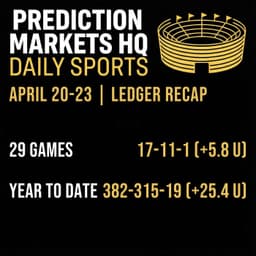
April 20-23 | Ledger Recap
Prediction Markets HQ: Daily Sports