Loading...
newseducationhistory
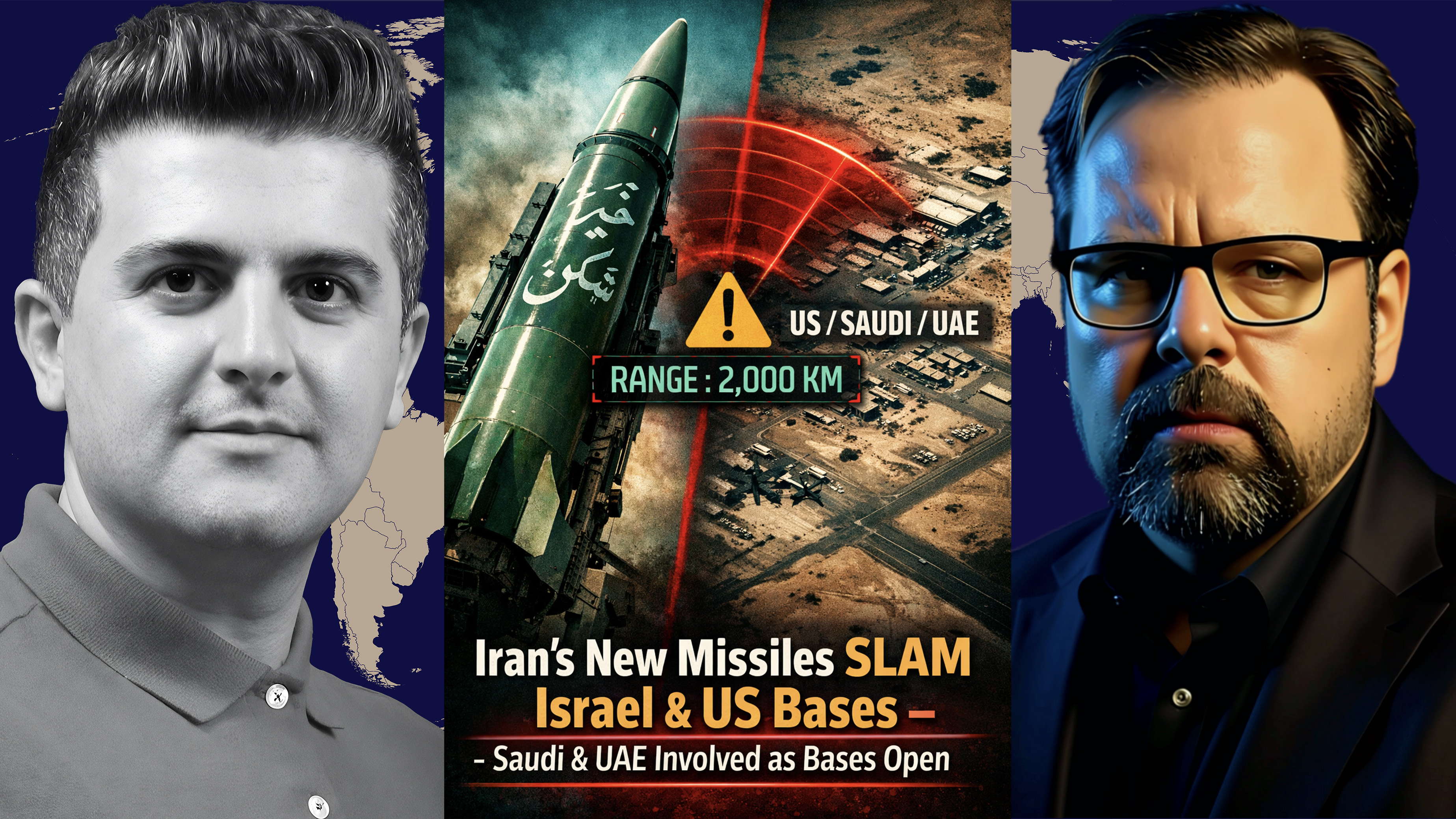
Mark Sleboda: Iran’s New Missiles SLAM Israel & US Bases - Saudi & UAE Involved as Bases Open
About this Episode
Analysis of the escalating Middle East conflict reveals US/Israel strikes on Iran have failed to achieve regime change. Despite claims of destroying Iranian military capabilities, Tehran continues missile/drone attacks and has weaponized energy markets by targeting Gulf infrastructure and restricting Strait of Hormuz traffic. The conflict has expanded regionally, with attacks on nuclear facilities raising stakes. US faces critical munition shortages while Iran maintains escalation dominance through asymmetric warfare. Economic consequences include soaring energy, fertilizer, and food prices globally. Russia and China benefit strategically as Washington struggles with unrealistic military options and internal dissent. With diplomacy unlikely and both sides escalating, the war of attrition shows no clear exit ramp, risking broader regional destabilization and global economic shock. Ground invasion scenarios dismissed as strategically unviable.
Hosted on Acast. See acast.com/privacy for more information.
Hosts & Guests
Transcript
Every idea starts with a problem.
Warby Parkers was simple.
Glasses are too expensive.
So, they set out to change that.
By designing glasses in-house and selling directly to customers,
they're able to offer prescription eyewear that's expertly crafted
and unexpectedly affordable.
Warby Parker glasses are made from premium materials
like impact-resistant polycarbonate and custom acetate.
And they start at just $95, including prescription lenses.
Get glasses made from the good stuff.
Stop by Warby Parker store near you.
Dreaming of getting the all-new iPhone 17 Pro
designed to be the most powerful iPhone ever.
Then stay in bed and let a boost mobile expert deliver
and set it up for you.
Oh, actually, they will have to get up and open the door.
Oh, right.
Delivery available for select devices
purchased at boostmobile.com in terms of life.
The longer you stay alive,
the longer you can enjoy boost mobile's unlimited plan
with a price that never goes up.
So, here are some tips.
Do not parallel park on a cliff
if you want to enjoy an unlimited plan
with a price that never goes up.
Do not mistake a wasp nest for a piñata.
If you want to enjoy an unlimited plan
with a price that never goes up.
Do not microwave a hard-boiled egg
if you want to enjoy an unlimited plan
with a price that never goes up.
Stay alive and enjoy unlimited wireless
for $25 a month forever with boost mobile.
After 30 gigs, customers may experience lower speeds.
Customers will pay $25 a month
as long as they remain active
on the boost mobile unlimited plan.
Hi, everybody.
Today's Saturday, March 21st, 2026.
And our dear friend, Mark Sloboda,
here is, he's here with us.
Welcome back, Mark.
Nima, thanks for having me.
It's always an honor and a pleasure
to be on dialogue works.
It's an honor to have you on, Mark.
And let me start with what's going on
in the Middle East.
Something is blasting.
Last time we talked,
it was totally different.
Well, right now is drastic changes
are happening in the Middle East.
And the latest, Mark, news show
that Donald Trump is somehow
wants to go on the ground in Iran.
They're talking about the hard island.
They're talking about the southern part
of Iran sending the troops, Marines there,
to invade Iran.
And so far, what we've heard from them
that they have destroyed everything.
Navy, you know, Air Force, air defense system.
What is your understanding of what is happening
right now on the battlefield
and the whole dynamic politically and militarily?
Yeah, there was a quote from the economist
of all places, the British news magazine
that is, you know, extremely pro-Western anti-Russia.
So Mark, sorry for interrupting you.
Please go to boosty.co,
at sign the real politic.
This is Mark's web page
and he's putting a lot of stuff there.
You can find them so much in.
So you can find a lot of information there
and you are going to enjoy it.
I'm sure about it.
Go ahead, Mark.
Sorry for interrupting you.
No, no, no, not at all.
I mean, if you have a bit of a masochistic tendency
for more cynicism and fatalism and realism
than by all means.
So yeah, the economist had a quote in the last week.
It was from one of their reporters
that he was commenting on Twitter X.
And he said that, yes, yes,
evidently it's true that the United States
has destroyed 100% of Iran's military capabilities.
However, that it's that 0%
of Iran's military capabilities
that is destroying middle Eastern Gulf Arab state
energy infrastructure,
closing the straight-of-war moves
and sending the global energy markets
and economy into a crisis.
So yeah, the Trump administration,
as it has in so many other situations,
it's propaganda rhetoric
is of the caliber that would make
Baghdad Bob Blush, right?
I mean, it's an absurd fantasy land.
The US is this absurd, you know,
court of the emperor with no clothes.
And no one is allowed to say,
I mean, the Western mainstream media doesn't dare say,
yeah, none of that is true.
I mean, it's quite amazing.
What a completely propaganda-blinded society
that they live in, it's quite frightening, of course,
because it leads to all kinds of scary foreign policy choices
like we're seeing right now.
The reality of the situation is that the US believed
that the US and Israel believed
that they were going to achieve regime change
probably within days, right?
They believed that with decapitation strikes
taking out the Supreme Leader
and a lot of the top military and political leaders
that the regime was fragile, it would collapse
and then something and then regime change.
I mean, that's the, I mean, the classic South Park meme
of norms collecting underpants.
Phase one, norms collect underpants.
Phase two, question mark.
Phase three, profit, right?
I mean, and that's the story here.
Phase one, drop some bombs and kill some people.
Phase two, question mark.
Phase three, regime change, right?
Of course, it didn't happen that way
because the US government operates
from a caricatured assessment
of all of its adversaries, Iran,
but also Russia, China, the experts, quote unquote,
who inform the US government about these countries
and probably most countries in the world, to be honest,
are the anti-Iranian, anti-Russian, anti-Chinese ideologues
that have an extremely distorted views
of the realities of these countries.
So, you know, they believe that,
oh, the majority of the Iranian people
is just waiting to achieve freedom
and throw off their dictatorship
and if we just kill their Supreme Leader, that's it.
It will all be over and then they'll have freedom
and come by ya.
They believe that, they believe their own propaganda,
Kule, and, you know, after the episode in Venezuela, right,
which really wasn't a military success.
It had very little to do with the military.
It was a CIA success where Delci Rodriguez
and Victor Lopez and other top figures
in the Venezuelan government were co-opted or blackmailed
or whatever it is that they do.
And they turned Maduro over to the United States,
which is why there was really no fighting
except for his Cuban bodyguard evidently.
And there's a reason why he had Cuban bodyguard.
And the Trump administration, Trump, and, you know,
and some of his top people, obviously,
were riding a Neocon Viagra high coming out of that.
So they had all kinds of inflated beliefs
in their own power and what that power could achieve
on other countries coming out of Venezuela.
And enough of the US's top military people,
including the chairman of the joint chiefs,
Dan Cain, they tried to warn them,
though, well, this probably isn't gonna be that easy,
that it is going to be difficult.
And it probably won't work out that way.
And the same thing with the CIA's intelligence assessment,
that the regime would probably not fall
that the IRGC would just become more embedded, right?
And more in power.
And, you know, that's exactly what we've seen.
They wanted to believe otherwise,
Trump wanted to believe otherwise.
Whitkoff and Kushner, who are not only his two top diplomats,
Whitkoff being his real estate buddy from New York
and Kushner, his son-in-law,
but obviously they're his close advisors on everything too,
right?
And that type of, you know, nepotism within competence
and, you know, leads to all sorts of things.
The, we heard from a British diplomat this week
that they believed that Kushner and Whitkoff
were essentially Israeli assets.
So, I mean, that's why.
Now, I don't believe that all the US was pressured
and tricked and dragged into this.
I mean, Trump may act like a pure, overgrown manchild,
but he is not, right?
He is an adult.
He's the leader of still, in many ways,
the most powerful country in the world.
And the US doesn't get dragged into anything.
The US does the dragging.
So that's not to absolve Trump or, you know,
of any responsibility for, you know, what has happened.
But the regime change didn't happen.
Even after the Supreme Leader, the head of the IRGC,
and, you know, numerous, the defense minister,
numerous other people were killed.
And gathering them all together in one place
while the US is setting up an armada off your shores,
that was dumb.
I mean, let's, let's, let's be honest.
I mean, were they, did they have some mass martyrdom
packed or what?
I mean, which also doesn't make much sense
considering that all of the Iontholas family
was there as well as wives, his children,
his grandchildren, right?
They were wiped out as well.
And you have to think if you have some type
of Shia martyrdom death wish,
it probably doesn't involve taking out your,
your children and grandchildren in life as well.
So, you know, why they thought they could have this meeting?
And I don't know.
It was stupid.
And, you know, Darwinian survival check, they failed.
They, the US is sitting off your coast
and they have a penchant for decapitation strikes.
You don't all gather your top people together.
Let's, let's be frank about that.
But they did, and what, what they did do beforehand
is the Ayatollah al-Hamadi set out
that each, you know, top government military people
should have a chain of succession going down
at least four levels.
So, there was people to step into all of these places.
And while the US and Israel obviously believed
the whole thing would collapse, instead,
it appears actually do have been working
maybe a little better without maybe some of these people
in the top positions.
They went into a mosaic defense mode automatically
that devolved power to different regional commands,
all operating, you know, with very little
to non-central oversight, you know,
according to pre-arranged orders and their own assessments.
And replacement stepped right into place
for all of these people.
For the supreme leader, his own son,
the, it's a question whether he is technically
an Ayatollah yet, but much tabo.
And he is,
he is Ayatollah.
He is Ayatollah.
Okay, all right.
So he has been declared an Ayatollah.
He is, you know, what the Western media describes
as a hardliner.
He's worked extensively with the IRGC, right?
I mean, he is, and he through his work
with the whole security apparatus,
you have to believe that he has a firmer,
shall we say less clerical, less,
maybe too academic, idealistic vision of the world
that perhaps his father had.
But he's a little more grounded in the grim reality,
I would say, by everything that we've heard.
And you have to remember that this supreme leader now
just had his father killed, his wife killed,
his children killed in the, you know,
these attacks by the US and Israel.
So a bit of an axe to grind there, I would say.
I mean, the chances of diplomacy
and at this point seem very slim to none to me.
I mean, for a whole host of reasons, not only that,
but, you know, what the US has done,
what Israel continues doing
and Israel is continuing the capitation strikes.
In the last week, we've seen the Secretary
of the National Security Council
who has, by all accounts, been running the country
in military mode since the death of the supreme leader,
Larajani, he was killed.
The intelligence minister was killed.
The IRGC spokesperson was killed.
The head of the besiege was killed, right?
That's just in the last week, right?
So the decapitation strikes continue.
And there's an argument that we made that Israel
is actually killing off anyone and everyone,
particularly those who might be seen,
Larajani was viewed as at the very least pragmatic,
you know, willing to negotiate.
Because Israel doesn't want any negotiation.
They want the US to be forced to, you know,
or, you know, forced maybe too strong a word,
but to ride this to the end, whatever that end may be.
But, you know, despite all of the claims
of completely wiping out Iranian air defense,
Iran, completely wiping out Iran's missile launchers
and drone launch facilities and everything,
we see that it's quite not obviously the case.
What, are we on the 70 something round of missiles
being launched from Iran, some three or so ways?
It's 71, yeah.
71, yeah.
And actually in the last few days,
those numbers have ticked up,
you know, not insignificantly for missiles,
for ballistic missiles and cruise missiles,
but dramatically for drone launches.
Drone launches have just gone up in the past two days.
So, quite obviously that is not true.
I posted them on my own page.
I'm sure many of you out there have seen them.
These underground hardened, you know, very,
not just holes in the ground,
very high-tech facilities underground.
Iran knew this was coming.
They've known this for, and they built hardened
underground facilities to launch their missiles,
to launch their drones,
to store their fast speedboats
and anti-ship cruise missiles and so forth,
which makes it them very hard to target and destroy.
So, they have enough of these obviously
that they are able to continue.
And, you know,
the command and control is working surprisingly well.
And despite the claims that Iranian air defense
has been completely destroyed in the past two days,
we just received word of an F-35 vaunted stealth fighter,
hit, possibly survived and returned through a golf base,
but definitely hit.
And according to the Iranians hit in Iranian air space.
So, quite obviously the air defense is still kicking.
So, now we're in that long-range strike war of attrition.
After the failure to get regime change,
that we were in in June of 2025.
And this is exactly what I have been warning about
others in the alt media as well,
that this was, you know, the stupidity
for the U.S. of getting involved in this war,
because they're Achilles heel, their weakness,
is their low stockpiles
and extremely low production rate of critical munitions,
particularly air defense, right?
The Patriot, the PAC-3 interceptors,
the FAD interceptors, which it makes less than 100 a year.
The PAC-3 interceptors, something like 620.
I mean, that's nothing.
We have to fire two, three, or sometimes,
as we've seen in the last week,
six or seven interceptors at a single ballistic missile
and sometimes still not hitting it.
So, there's actually an open question
about the effectiveness of the Patriot system
and the FAD system, perhaps as well.
But not only the defense, right,
the air and missile defense,
but also critically low levels
of precision standoff munitions,
primarily the Tomahawk and the Jassams,
which is an air-launched cruise missile.
And from everything you can tell that the Armada,
that the fleet in Armada might be too grandiose or the fleet
that the US assembled off the coast of Iran,
has apparently fired off all of the Tomahawks
that they had or just about.
And there's not an easy way for them to be reloaded.
They can't do that at sea.
They have to go to a base.
And all of the US bases in the Middle East
have been targeted and continue to be targeted
on a regular basis,
which means they have to go to Crete
or somewhere in the Pacific to reload,
which is why now everything seems to have stripped
to these Jassams, these air-launched cruise missiles.
But still a limited supply of those as well, right?
A few thousand.
And that was before this conflict,
you know, with no ability to rapidly replace those numbers, right?
So, as long as Iran can keep stiff-barming the US,
keep some semblance of air defense
and force them outside of Iranian airspace
so that they have to use these standoff missiles
to hit Iran, that they have, you know, low numbers of.
That's very good for Iran.
And that's by and large as far as we can tell
what has happened so far.
Now, if the US manages to achieve
some level of air dominance over Iran,
then they can switch from the standoff precision weapons
if they have very limited numbers of
two ordinances like the J-DAM,
which is old dumb gravity bombs fitted with glide kits.
Then they have to be like within 40 nautical miles range
in order to launch those, right?
So, in or very close to Iranian airspace,
and depending on what you want to hit,
where in Iran, like in Iranian airspace.
And they have effectively, you know,
infinite numbers of those, you know, effectively.
And when Donald Trump made these bizarre claims,
oh, he has enough of munitions,
that's what he was actually talking about.
Or, you know, and that's the way he interpreted
whatever it is was explained to him.
Now, that would be very bad for Iran.
If they can fully switch to using J-DAMs
or even gravity bombs, you know, old dumb gravity bombs,
then they can just bomb and bomb and bomb Iran months.
Months, you know, it's a very bad,
it would be a very bad situation for Iran.
But that is not the situation as of still today,
three weeks into the conflict.
We saw that air defense is still taking down drones,
they're taking down F-35s,
so they've still got something left and kicking.
And that's keeping the US outside of Iranian airspace
and that's good for Iran.
And the way Iran has responded
is not only to hit Israel this time,
but to hit all of the Gulf state vassals allies,
you know, the Arab Gulf state allies
that have US military bases, which is practically all of them,
that have been used to launch this attack.
And they have been hitting, you know,
following an escalatory plan and escalatory ladder,
if you hit our energy facilities, we hit the energy facilities,
right?
And this is coupled with the de facto closing
of the Hormuz straits,
at least to all Gulf and Western traffic.
Now, Iran's own traffic is still going through the Hormuz,
right?
They're actually, according to some reports,
exporting more oil through the Hormuz
than they were before the conflict.
And Chinese bound tankers are going through
some Pakistani, some Indian.
So, you know, anyone who's not part of the West,
you know, can make arrangements.
But the coupling of the damage to the energy infrastructure
of these Gulf state countries
and the closure of the strait of Hormuz,
this is Iran's sanction option.
This is their nuclear option.
They are waging an asymmetric war
against the United States and Israel.
Their job is to make the energy markets scream,
thus making the global economy scream
until Trump and Netanyahu stop.
That's their whole game right now.
And it's an enormous amount of leverage.
The U.S. has no ability, right,
to unblock the strait of Hormuz.
The U.S. Navy, I mean, Trump made comments about it
like a week ago, oh, we're going to, you know,
clear it out, we're going to escort ships
and the Navy's like, no, we're not.
You see how long that coastline is against Iran
to get into the strait of Hormuz?
And we'd be hit by drones and missiles
and anti-ship cruise missiles.
And sea mines, if they lay those, anything.
I mean, there's so much.
And the Navy's like, no, we're not going in there.
That's a death trap.
We've wargamed that out.
It doesn't end well for us.
And then Trump tried to get all of his allies, right?
Or ostensible allies.
The UK, France, Japan, South Korea, even China.
Well, you all have to go in and free the strait of Hormuz.
And everyone's like, yeah, no, you know,
you got this.
And he was furious.
I mean, he's throwing petulant fits like a child,
threatening NATO, all of this stuff.
But the reality is, is the US has met
another geopolitical hard limit.
And that is, right now, Iran has escalation dominance
in this conflict through keeping the strait of Hormuz closed
and the ability to inflict damage on the energy infrastructure
of the US's Gulf state vassals, allies, so forth.
And it really came to a head in the last 48 hours
when Israel slashed the US, take your reading,
attacked Iran's South Pars gas field.
This is the largest gas field in the world.
So it's a big deal.
And this gas field, I mean, it actually, you know,
it runs, you know, under.
It actually is connected with Kitar.
The Iranian side, it's called the South Pars,
but it's actually, you know, the north side of that,
and, you know, South to Qatar.
And what Iran immediately hit in retaliation
was the Qatari, Ross Lafon, LNG facilities,
which they destroyed 17% of Qatar's LNG,
refined, you know, liquidation and refinement capacity.
Now, their whole LNG was already shut down
because, you know, of the threats of damage
of drones and everything else.
They're the second biggest exporter of LNG in the world,
which has led to gas production.
That's what we're talking about.
Through the group, we're in Europe
and for countries like South Korea and Japan
that are heavily reliant on it.
But now this is permanent damage, right?
And they say the damage is extensive.
This is not something they can just replace
and repair overnight.
This costs them tens of billions of dollars to install.
And it took them years to do that.
So even if this conflict ended with war,
the markets, the gas markets would not return
to normal for years into the future.
So now Trump immediately backed off,
blamed it all on Netanyahu.
Meanwhile, the Israelis saying the US was fully involved
in this whole affair.
And that's probably likely.
It seems that Trump, I don't know why they didn't believe
the Iranians would immediately strike back
on their own escalatory playbook,
but they did.
And the markets went into the energy markets went insane.
And the US says, no more attacks on those things.
Not yet, anyway, you know, the stop, stop, stop.
Israel stopped, you know, and then more threats in Iran.
But quite obviously what Trump was doing was backing down,
right, because he was afraid of Iran's further retaliatory strike.
And how could four years into the future,
then Iran has a whole hit list, an escalatory hit list of facilities
all over the Middle East.
They can hit that will.
The hustle doesn't have to hurt if performance pressure is making
it hard to breathe, grow therapy helps you navigate stress,
set boundaries, and actually feel like yourself again.
Whether it's your first time in therapy or your 50th,
grow makes it easier to find a therapist who fits you,
not the other way around.
You can search by what matters,
like insurance, specialty identity, or availability,
and get started in as little as two days.
There are no subscriptions, no long-term commitments.
You just pay per session.
Grow helps you find therapy on your time.
Whatever challenges you're facing,
grow therapy is here to help.
Grow accepts over 100 insurance plans,
including Medicaid in some states.
Sessions average about $21 with insurance,
and some pay as little as $0 depending on their plan.
Visit growththerapy.com slash start now to get started.
That's growtherapy.com slash start now.
Growtherapy.com slash start now.
Availability and coverage vary by state and insurance plan.
You know what's wild?
Most people are still overpaying for car insurance,
just because it's a pain to switch.
That's why there's Jerry.
Jerry's the only app that compares rates
from over 50 insurance in minutes
and helps you switch fast with no spam calls or hidden fees.
Drivers who save with Jerry could save over $1,300 a year.
Before you renew your car insurance policy,
do yourself a favor.
Download the Jerry app or head to jerry.ai slash a cast.
As each, as the US and Israel step up the escalatory ladder
against Iran, they can move up that ladder
and permanently cripple the energy and trade markets
in the Gulf, which of course will affect the whole world.
And this is amazing.
Until now, really, or maybe the last year,
maybe you could count China's use of rare earths
as leverage against the US as well.
But until the last year, really, the US
had this position as the hegemon, right?
That they weaponized their economy
and the global financial architecture they control
against other countries, right?
With sanctions, with cutting off of swift,
all of this existential economic warfare
that they waged against Russia.
And Russia weathered it, but they didn't really
have the means to strike back directly.
Well, Iran is in an existential situation
and they have the means.
And they have hit back at the global energy markets,
the global economy, and weaponized the global economy
against the United States, right?
And they've called into question
the entirety of the relationship
between these Gulf Arab states and the United States
because supposedly the US is there to provide them security.
And the opposite is happening.
They are being targeted because the US is there
and using, you know, it's the facilities
they provide it to them.
So this has enormous global economic
and global order potentially changing consequences,
like the conflict in Ukraine,
but particularly as far as energy,
you know, things of perhaps to an even greater extent.
This is amazing.
And the conflict has already spread across the entirety
of the Middle East and beyond, right?
We've had actions from Sri Lanka all the way to Crete.
I mean, that's all far, this conflict is spread.
And in the north, from the Caspian and Georgia,
all the way down to, you know,
the southern points of Saudi Arabia and the Gulf states,
this is a regional conflict.
It has spread horizontally so fast
and involved so many countries.
And the pandemic, just the breaking news,
Iran just hit the Dhammona and here is the footage
in 20 people were hit.
And it's out through.
I saw these reports before we sat down.
I checked the news and they were still reports.
But so the story is the US after launching these attacks
on the South Pars field and then backing down
is trying another escalatory step.
And they hit the Bouchir nuclear plant,
well, not the plant itself,
but buildings as part of the complex yesterday.
And today evidently they hit the Natans nuclear enrichment site.
And the Iran has responded by opening them
on the escalatory ladder and firing back at Dhammona.
And for those who don't know,
Dhammona is a nuclear power plant for Israel,
but more importantly, it's also where they do nuclear enrichment
and build their nuclear weapons.
That is another of Iran's nuclear options.
And actually, when I was involved in war games,
when I was in university, this was an option
to always play against Israel.
If Israel uses a nuke, you hit this site in Israel
and it's effectively your own nuke, right?
That's, and that's, I would suspect that this was
probably a warning shot, right?
This wasn't something that was intended
to completely destroy the reactor
or those reactors are actually built
to withstand a lot of damage.
So there's a question about that.
But this was probably a warning shot, right?
Because the same thing at Boucher,
as Boucher is a really interesting case.
He, Boucher is nuclear power plant in Iran.
It was largely constructed by Russia
and it's run to a large extent by Russians.
The Raw Sadim had, at the beginning of this conflict,
some 640 personnel there, right?
Who were operating this plant?
Now, I didn't read about a week ago
that hundreds of them were evacuated,
but you have to imagine, I don't know how many,
but there were still some there.
And I saw the strikes at Boucher yesterday by Israel
as essentially a threat to Russia,
get all your people out of the country now
and probably stop helping Iran as well.
Which of course, Russia's not going to respond well to.
But following up with the attack on the tons today,
that presents it with a different image.
It's not just a threat to Russia.
It is a step up the escalatory ladder
hitting Iranian nuclear sites.
And Iran is in that mode, tit for tat, bam.
And not just a straight up tit for tat,
they just go right up the escalatory matter, right?
It's that tit for tit.
It's tit for tat.
And so they go for the Mona.
And like I said, this first one was probably
a warning shot where they demonstrate what they can do.
But let me just let me show another footage
that just came out.
Whoa, whoa, whoa, whoa, whoa, how about it?
It's, yeah.
Things are out of completely out of control, right?
You see, this is, we started off with mostly,
you know, the decapitation strikes by the US and Israel
and then attacks primarily on military sites, right?
Not only exclusively, right?
We saw, then we started to see oil depots being hit
on both sides, right?
And then we saw this big escalation this week
with the Israeli US attacks on the South
part of the gas field, the runs response against
Ross Lafone, the other facilities.
And now we're hitting nuclear sites.
We're just jumping up, but we're not climbing the
escalatory ladder.
We're like jumping rungs at this point, right?
Because the US is freaking out.
They're by the relative power between Iran and the US
and Israel.
They have very different levels of victory in this.
The US outright said that their goal is regime change, right?
Trump says he wants to decide the next supreme leader
of Iran, right?
I mean, they were quite clear about this.
Netanyahu, you know, this is the culmination
of 40 years of my life's work to get the US to fight
this war for us.
So they set the bar very hard.
Hi, and now the conflict has gotten so nasty
at such a quick level is moving up the escalation ladder
and the Israel continuing decapitation strikes.
It's really hard to find an exit ramp
to step down from this country.
Even to de-escalate is very hard at this point.
So what we have instead is a conflict that is just
getting worse and worse day by day,
and the US is in a bad position.
They have not achieved regime change.
There's no sign of internal destabilization in Iran.
Their Kurdish proxies and all of their other proxies
are hanging back and they're like,
yeah, we don't trust you.
You just threw our fellow Kurds under the bus several times
and they look pretty tough in there.
And so everyone in Iran keeps hitting Kurdish facilities
in Iraq on a daily basis anyway.
And Iran has activated all of their allies or proxies,
I don't know who everyone to term it,
the access of resistance, all sorts of proxia groups,
Qatayb as Balan and numerous other groups in Iraq
are hitting US facilities and Kurdish facilities
on a daily basis in Iraq.
Iraq is a battleground, right?
A big part of the war is actually being fought in Iraq.
Again, and it's something that is so primed
to destabilize the fragile Iraq
because it's primarily the US hitting pro-Iranian Iraqis
and of shia, primarily shia distraction.
And Iran hitting anti-Iranian Iraqis,
primarily of the Kurdish distraction, right?
And you can see where this could lead
to a renewed civil conflict in Iraq very easily.
So that's a very dangerous situation.
But also, Hasbalah has stepped back into the chat
and contrary, they received them all, right?
Just a couple of years ago, but they're back.
I mean, and their Israel saying,
well, we didn't think they were still capable
of this kind of thing.
And Israel is trying, airstrikes,
trying another ground incursion,
but it's all not looking really good.
In fact, the Trump administration evidently tried
to get the new al-Qaeda ISIS regime
of al-Jolani in Syria to start a two-front war
against Hasbalah.
And they're like, no, we're kind of, you know,
just settling in here.
We don't really want to mess it up with Hasbalah again,
you know, right now.
So they've declined, again, leaving the US with no,
in Israel, with no real allies in this.
So, and the Huffies have now just declared war
on the United States as well.
And they are primed to put a double whammy
on the global energy and trade market
because they can close off the Al-Mandab straits
in the Red Sea.
Now, Saudi has pipelines across the desert
that they can bypass the Strait of Hormuz
to a certain capacity, not their full capacity,
but send the oil instead through pipelines
across the desert to the ports on the Red Sea
and then ship it out that way.
Again, they don't have full capacity that way,
but, you know, still, the Huffies shut all that down.
And that will, I mean, just further,
you think oil prices are high now, just wait.
Oil prices, gas prices, right?
And it's not just oil and gas,
because actually fertilizer,
your reaffertalizer was one of the,
also the primary exports out of the Gulf
as a byproduct of oil refining.
And that's being stopped,
which has led to fertilizer prices going through the roof,
which leads to agricultural prices
and food prices going through the roof.
And with food prices and energy prices,
which means gasoline prices in the US,
all going through what's going to be hyperinflation very soon.
Mark, we already have the trucker strike here in Brazil
because of the price of it.
And it's hugely influenced in the whole economy here.
It's going to affect the whole world,
or most of the world to a very big extent
and keep getting worse on a daily basis, you know, now.
Except for Russia, of course.
Because Russia exports oil and gas,
and Russia is the world's biggest fertilizer exporter.
And Russia is a huge food exporter as well.
So, and all of the munitions,
the air defense munitions and potentially offensive munitions
that either were or could go to Ukraine,
are now no longer going to Ukraine, right?
And we had a headline in the telegraph yesterday
that Zelensky is on a dumb tube.
Forget about me, tour of Europe right now
because everyone is forgetting him,
of course, in the scope of this conflict.
And Russia's also getting some feedback for years
that the US and the West are catching in economically,
but they're also catching in militarily in blood as well.
And the Western media is full of reports
that Russia is providing Iran with all sorts of help
in intelligence, satellite, Dama, drone tactics,
and possibly actual military supplies
and other things as well.
We don't know, there's a lot of rumors and so forth.
But certainly, everyone seems to agree
on the intelligence and the satellite data
and the data sharing and helping them
hit all of these sites so precisely.
And it's some payback and the Europe is screaming,
out there, Russia help the Iranians hit the US
and the Israelis and their Gulf vassals.
And Russia's like, haven't you been proxying the Kiev regime
to hit us for the last four years?
Paybacks of a female dog, isn't it?
I mean, so now, this is all through a certain extent
because it is vitally geopolitically important
to Russia and China that the US not achieve regime change
in Iran, right?
So up until that point, this is fabulous for Russia.
I mean, from a very cold-blooded, real politic point of view.
But as long as the Iranian government survives
and pending a global depression,
which would then bring everything crashing down
in the short term at least, this is all very good.
In fact, the US even withdrew a few,
they didn't really, saying they withdrew sanctions,
they announced temporary waivers on oil tankers
that were already at sea, it's not a lot,
but it's a step back.
Any step back from sanctions symbolically at this point
is a sign of the failure of these policies against Russia.
So, Russia right now is just,
they're catching in on the oil, the gas, the fertilizer,
and everything, and militarily,
they're getting some payback against the West, right?
So, from the Kremlin, they're, I mean, of course,
things could still go wrong
and they wanna make sure the Iranian government survives,
but they are exploiting this situation to the Hilt.
So, and we don't know what China is doing, right?
We satellite data almost certainly,
and what else, we don't know.
But considering that Iran exports pretty much
all of their oil but China,
and it's a significant, not a majority, you know,
but still a significant part of their energy mix
that they also have a vested interest in, you know,
sustaining the Iranian government through this.
And right now, I mean, things could still go bad.
Iranian air defense could be completely wiped out
in the next few days, and then part of the calculus
will change, the U.S. will be able to bomb freely at will
across the Iranian air space, and that will be bad.
But right now, Iran has escalatory dominance.
Everything the U.S. is doing to escalate
against energy sites in Iran,
they can hit back even harder against, you know,
Gulf sites or U.S. military bases or Israel,
and the U.S. is absolutely outraged and frustrated
and Trump is torn between escalation
and looking for an exit ramp declaring victory
and trying to go home.
And he's obviously torn between those two impulses right now.
They obviously do not have a plan.
How to proceed at this point.
Of course, that's very dangerous when the U.S. is like this.
And we always do have to remember that Israel does have
nuclear weapons, and so does the United States,
which is kind of the ultimate escalatory dominance
of its own.
But of course, that has a huge political diplomatic
repercussions if it gets that bad.
I don't see it getting quite that bad,
not yet anyway, but certainly it's just...
Hi, this is Pablo Torei from Pablo Torei finds out,
and today I want to talk to you about boost mobile,
because we spent a lot of time analyzing
inefficiencies in sports, overvalued contracts,
money tied up in the wrong places, and so on,
but those inefficiencies aren't just on a roster.
Sometimes they're in your own monthly expenses.
Boost mobile says switching to their $25 unlimited forever plan
can unlock up to $600 in savings a year.
That's $25 a month for unlimited data,
talk and text when you bring your own phone.
If that money is trapped in a pricey phone bill,
it might be worth a second look.
Visit boostmobile.com to learn more.
After 30 gigabytes, customers may experience lower speeds,
customers pay $25 per month, as long as they remain active
on the boost mobile unlimited plan.
Savings claim based on a January 2026 boost mobile survey
of 1,000 Americans with single line unlimited plans,
comparing average annual payments of major carriers
to 12 months on the boost mobile unlimited plan.
For full offered details, visit boostmobile.com.
There's one place for the newest drops
in wellness and performance, and the biggest sale of the year.
It's the drop by GNC, curating the best of what's new,
handpicked by the pros who know what works.
And right now, get it all by one, get 150% off
during the semi-annual live-well sale,
from crushing workouts to leveling up to nutrition
and everything in between, get the best deals
on the latest innovations.
All the newness is all on sale right now
during the live-well sale on the drop by GNC.
We're on riding a tiger for a sooner or a month.
I think right now what's so important,
it seems that in the mind of the Trump administration
and the way they're thinking about how to somehow gain
some sort of leverage, it seems that the ground operation
is so popular in the United States, I'm such a joke.
They're not gonna survive, you know,
I don't know if the Trump is not a rational thinker.
No, they're not, that's the thing, they are not rational.
They, they, I mean, they try to present Iran
as some radical, crazy, theocratic bunch of crazies.
That's the Trump administration.
I mean, have you listened to any of the prayer sessions
in the White House, right?
The ex-F having military commanders
informing the entirety of the U.S. military
that they're doing this to start Armageddon
to bring the second coming of Jesus Christ,
which multiple complaints were launched
from within the military over that.
I mean, they're the bunch of crazy,
the maniacal radicals at this point.
They're not operating from a logic driven viewpoint,
which is of course dangerous for Iran
and everyone else in the world at this point.
But, these two expeditions,
there's now two marine expeditionary groups
that have been sent, right?
The U.S. has triply from the Pacific
and there's word that the U.S. has boxer
at a San Diego is also being sent.
So each of those expeditionary groups
has a total of about 2,500 total Marines.
So that's 5,000.
But in reality, only about a couple thousand
of those are actual, shall we say, combat groups.
The rest of them are support troops.
So really, it's like 2,000, 3,000 troops, really.
What is the size of Iran's military?
A 500,000 standing, you know, 1.0 million
with reserves and everything like that, right?
The U.S. has not achieved air superiority over Iran
or the state of Hormuz or anywhere else.
Iran can continue to launch drones, anti-ship crews.
One of these two little expeditionary,
do you see how far up the straight of Hormuz,
how far up that gun they would have to run
to reach Harg Island?
That's a chicken shoot.
I mean, that's like a shooting gallery.
It's ridiculous, right?
What, they think 2,000 troops is gonna take
the port of Al-Bah.
It's mad, they're mad.
I have to think that, I mean, either this is some
ridiculous bluff or the military people, I don't know,
they're not in charge of presenting options
to Trump, they're realistic at this point,
because this would just get U.S. troops killed
to no real effect, right?
Even if the U.S. had complete air dominance
over the target area, this would still be extremely difficult
next to impossible.
And according to some sources, they're considering,
this is even more fanciful, some kind of
the largest special forces operation in history
to drive deep into Iranian territory, storm their underground
bunkers and retrieve their enriched uranium
and get it out of the country.
It's like James Bond movies have better,
more realistic plots than that.
I mean, come on, it's just insane.
Is it bluff?
Is it some type of further escalatory bluff
or are they really that mad?
And if they are that mad,
then they're just gonna get lots of Americans killed,
which, of course, could have lots of unforeseen consequences.
We don't know what spiral that will send us down towards
with Americans then being for blood against Iran
or against Trump, depending on the political winds,
it could get much nastier
or it could lead to the downfall
of the Trump administration rather quickly in the United States.
So I can't take these ground and force talks seriously.
If they are serious, then it is a disaster
that will make Gallipoli look like a victory, right?
I mean, that it would just be madness,
stupidity of madness.
Mark, what Donald Trump want?
What does he want from Europeans in the history of the foremost?
Because he's just keep backing Europeans and NATO allies.
What does he want?
What are you?
He doesn't even know.
He doesn't even know.
That Europeans don't have the naval capabilities
to do anything that the U.S.,
I mean, they have other naval capabilities
that are nowhere what the U.S. Navy is capable of doing.
And the U.S., I mean, they're just poultry.
And the U.S. Navy is saying, no, we can't go in there.
We'll get shot up.
The only thing the Europeans could possibly do
is to present more targets for the Iranians to hit.
I mean, use them as human ship shields.
I don't know.
I think he just wants the Europeans on board
mainly for political reasons, right?
Not necessarily, militarily.
And maybe they'll understand that
and send some token force or something,
but for their own political reasons,
they're not doing that at this point.
Now, there's a real question.
The U.S. has a real dearth of
demining capability of ship demining.
They don't really have any capability at this point, right?
The lateral combat ships were supposed to do that duty
when the rest of the demining ships were decommissioned
and they've proven completely incapable of it.
So, I mean, they could be wanting to beg
some demining ships from Europe,
not that Europe has so many of them,
but still, no one does demining at sea during combat.
That's never been done.
No one has ever done that.
They're not gonna add the mark.
Iran is talking with 20 countries have,
can they call Iranian officials,
they want to make some sort of deal between Iran
and their countries.
I don't see Iran mining the strait of,
they don't need to go that far.
Yeah, I mean, it would be,
that would be an escalatory step.
Obviously, they've chosen not to do that
because right now, they have the abilities
to selectively let traffic throw the strait of foremost.
If they mined it, depending on what types of mines they used,
I'm sure they have a variety,
but that would be a much more difficult
and that would be a huge step up the escalatory ladder.
That's a playbook up the escalatory ladder
for another escalatory situation further up.
But we're not there yet.
Iran, meanwhile, has taken a very maximist position
as a result of all of this
because they feel they have the leverage in this situation.
Now, I defined before this conflict begun
that if they survived, if their government,
their regime survived, they won, right?
Just like the power imbalance between Israel and Hamas.
You declare, Israel declares their goal
is to destroy Hamas, Hamas survives, Hamas wins, right?
That's the thing.
But Iran is now demanding all sorts of things.
They're demanding reparations.
They're demanding a permanent treaty
that would have to be signed by Congress
saying that the U.S. will never attack Iran again.
They're talking the U.S. withdrawing
from all of their military bases in the Middle East, right?
None of those things are gonna happen.
I don't care what dominance Iran has over the current situation.
They don't have enough leverage over the United States.
Oh, and they also want all sanctions removed,
which is also, I mean, that has to go through Congress
and so forth.
So I perfectly believe that the U.S. at some point
could try to declare victory.
We won, we destroyed all of this, blah, blah, blah,
and we're just gonna go away and stop actively attacking
and hope that the Iranians stop
and open up the straight-of-four moves.
It's not clear that they will at this point,
but I cannot see the U.S.
conceding any of those Iranian demands, not.
So that leaves a very opposition
where this conflict, at least the foreseeable future
is hard to imagine ending.
I mean, at some point, Iran is going to start suffering
shortages of missiles.
They can still produce some and they will
and they can produce greater numbers, probably, of drones,
continuing to move forward.
And the U.S. is rapidly running out of interceptors.
I mean, rapidly and standoff munitions.
But it's a lot easier for both sides to exhaust themselves
in a long-range strike war of attrition
than it is a more classic on the ground,
the war of attrition that you're seeing
between Russia and Ukraine, Slash, NATO, and Ukraine,
the Kyrgyzstan and there.
This is all much more expensive stuff
that flies through the air at each other.
And by definition, that is more expensive
and there's less of it than say, troops.
And I heard Erogchi, the Iranian foreign ministers
say, send your troops, we'll be waiting for them.
And then they would be, I mean, that would be a chance
to kill Americans in a way that they can't easily reach out
and do, even with long-range strikes,
considering how the U.S. has evacuated all their bases.
They really, in some ways, they might look forward to it.
It reminds me, Mark, it reminds me of Ukrainian counter-offensive,
you know, it was just stupid.
It would be stupider than that.
It would be stupider than,
it would be stupider than the Kursk-Fullz crusade.
It would be stupider than that.
But we are not dealing with rational leaders in it.
I mean, they try to present the Iranian leadership
as, you know, crises, right?
They're the crises, I mean, quite obviously,
on multiple levels, right?
On obviously on religious grounds,
when we're talking the Christian Zionists
and the actual Zionists in Israel.
But also, they're not operating
from a realistic, logical understanding
of the world and of their own military power
and what it is achieving and not achieving in Iran
and elsewhere.
I mean, we saw the first defection
from the Trump administration in this last week,
the head of U.S. Counterterrorism Center, Joe Kent,
who was personally appointed by Trump,
he resigned in protest over this attack on Iran,
saying that Iran presented no even in threat
to the United States and that this is being driven by Israel.
I think that's a bit of a cop out.
But yeah, there's no question they played a role
in encouraging it, that's for sure.
And then Trump tried to say that Joe Kent is weak on security.
Now, as the next U.S. military member,
let me just say that Joe Kent was a green beret
at 11 times combat veteran
and then an operative on militarized missions
for the CIA, but he's weak on security.
Get the fuck out of here, you piece of it.
The guy who didn't serve the army is like that.
But Mr. Bone Spurs himself, right?
Draft dodging Vietnam.
Yeah, yeah, Joe Kent is weak.
I mean, I don't have to like Joe Kent.
I don't like his pilot.
No, you're not talking,
you're talking about the position they're taking.
Shrode principle, right?
That hats off, hats, hats, his career is over.
I mean, he'll never, he's under investigation now, right?
I mean, he'll never serve in government again.
So, I mean, that wasn't a small thing to do,
but he's the first one to say,
this emperor has no friggin' clothes.
I mean, that's, he said it and no one else has,
not even his direct superior Tulsi Gabbard at this point.
So, what a embarrassment that that whole,
what a disappointment that she is.
Exactly, exactly, yeah.
Big disappointment in Tulsi Gabbard.
Thank you, thank you, Mark, for being with us today.
Great pleasure.
As always.
All right.
Till next time.
See you next time.
Here we go.
Hi, this is Farnoosh Tarabi from So Money with Farnoosh Tarabi,
and today I want to talk to you about Boost Mobile.
Quick money tip, stop paying a carrier tax.
If your phone bill feels trapped in a pricey plan,
this is your sign to unlock savings.
Boost Mobile helps you reset your spending
with the $25 unlimited forever plan.
You can bring your own phone, pay $25,
and get unlimited wireless forever.
And that simple switch can unlock up to $600 in savings a year.
That's money you could put towards paying down debt,
investing, or something that actually brings you joy.
Those savings are based on average annual single line payment
of AT&T, Verizon, and T-Mobile customers,
compared to 12 months on the Boost Mobile Unlimited plan
as of January, 2026.
For full offer details, visit BoostMobile.com.
There's one place for the newest drops in wellness and performance,
and the biggest sale of the year.
It's the drop by GNC, curating the best of what's new,
handpicked by the pros who know what works.
And right now, get it all by one, get 150% off
during the semi-annual live-well sale,
from crushing workouts to leveling up to nutrition
and everything in between, get the best deals
on the latest innovations.
All the newness is all on sale right now
during the live-well sale on the drop by GNC.
Guys, it's no use putting it off.
The best time for an underwear refresh is now.
Tommy John underwear is designed for a perfect fit
that stays put all day.
There's zero shape thanks to four times more stretch
than competing brands.
And their innovative horizontal quickdraw fly is a game changer.
With over 30 million pairs sold,
there are thousands of men out there more comfortable than you.
Don't settle for less.
Go to TommyJohn.com today for 25% off your first order
with code comfort.
That's TommyJohn.com slash comfort.
Tommy John, comfort perfected.
More from Dialogue Works
View all episodes →
Matthew Hoh: US Missiles Are GONE – Here’s What the Pentagon Isn’t Telling You
Dialogue Works
Apr 23, 2026·56:39·failed

Ray McGovern: The Way a Long Iran War Destroys Israel and the Entire GCC
Dialogue Works
Apr 23, 2026·52:36·failed

