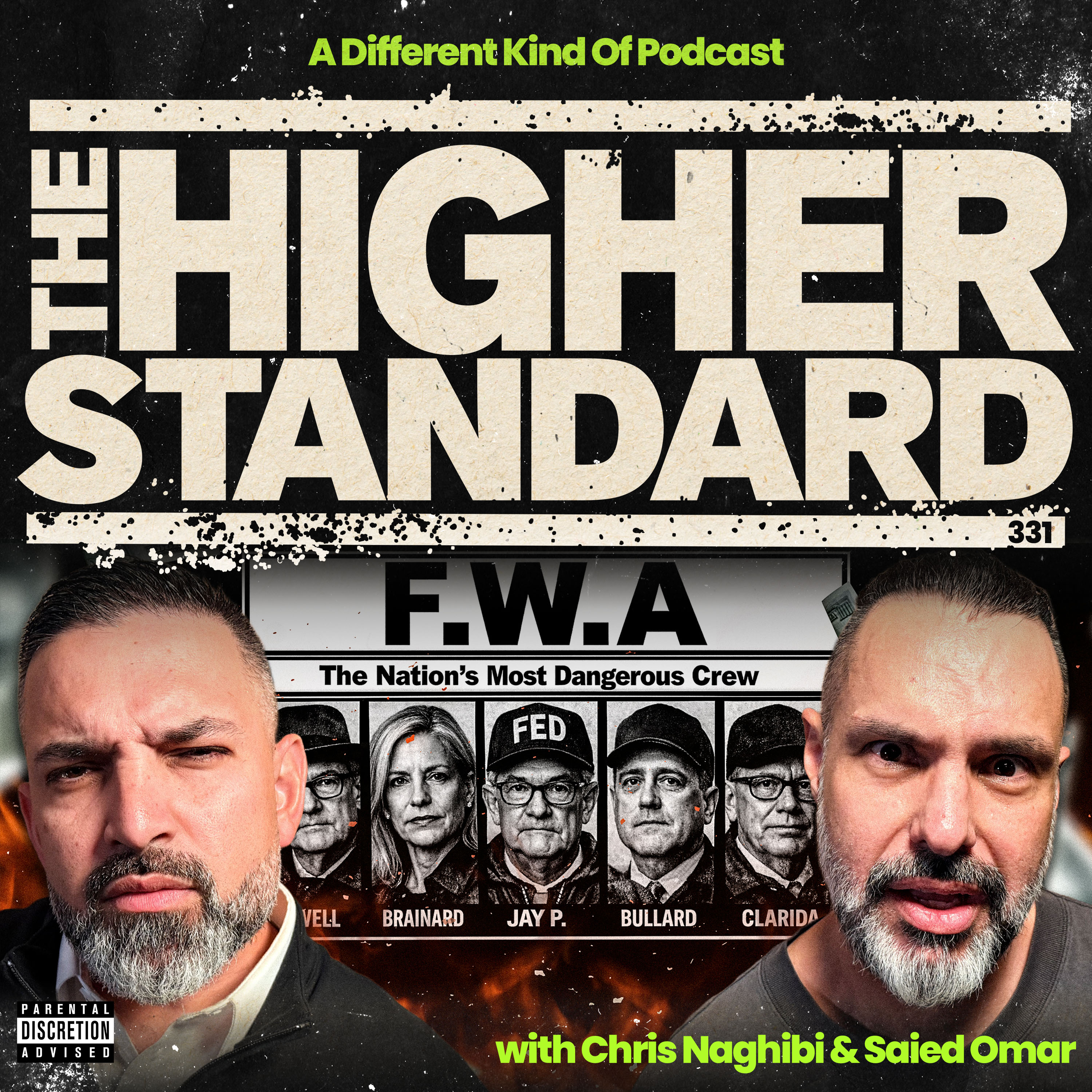
Markets Melt Up, The Fed Melts Down: Geopolitical Conflict Ignites a Different War
About this episode
Episode 331 is classic The Higher Standard chaos with a purpose: Chris, Saied and Rajeil take a world that feels like it is being held together by ceasefire headlines, oil volatility and pure market delusion, then translate it into plain English for the people actually paying the price. They unpack the Fed getting boxed in by sticky inflation, war driven energy shocks and a market still partying like rate cuts are around the corner, while housing stays brutally unaffordable and AI quietly starts showing up in real job losses. It is equal parts macro reality check and group chat energy, with enough jokes, side quests and liquid natural gas immaturity to make the medicine go down easy.
💥 Have you left your "honest ⭐️⭐️⭐️⭐️⭐️" review?
This episode is proudly brought to you by Fridays.
Because real wealth starts with your health. If you want to feel sharper, stronger, and more in control, visit joinfridays.com and use code HIGHER for an exclusive discount.
📩 NEWSLETTER: https://tr.ee/O6FWkv
👕 THS MERCH: http://www.thspod.com
🔗 Resources:
Wall Street ends sharply higher on US-Iran ceasefire (Reuters)
Fed minutes show growing openness to rate hikes at March meeting (Reuters)
US mortgage rates edge down to 6.51%, MBA says (Reuters)
Gulf conflict has already laid a Fed trap (Reuters Breakingviews)
US banks could release $320 billion in capital with new draft rules (Reuters)
⚠️ Disclaimer: Please note that the content shared on this show is solely for entertainment purposes and should not be considered legal or investment advice or attributed to any company. The views and opinions expressed are personal and not reflective of any entity. We do not guarantee the accuracy or completeness of the information provided, and listeners are urged to seek professional advice before making any legal or financial decisions. By listening to The Higher Standard podcast you agree to these terms, and the show, its hosts and employees are not liable for any consequences arising from your use of the content.
Get every episode summarized
Each time The Higher Standard publishes, we email you a written briefing from the transcript — the topics, who appeared, and any specific claims, with the ad reads skipped.
Email me new episodesFree for 3 shows. No card needed.
Hosts & guests
Transcript ready
801 searchable segments. Every word is indexed and playable.
Full transcript
The Higher Standard — Markets Melt Up, The Fed Melts Down: Geopolitical Conflict Ignites a Different War. Machine-transcribed; use the interactive transcript above to jump the player to any line.
They're done. You know what we got them on Mr. Beast family matters home improvement. They're watching that. Oh yeah. The old school sitcoms. Love it. But I'll say it's edgy. It is edgy when you go back to it. It's edgy. I did that the other day. Remember Tim Allen is very straightforward him loving his wife and wanting a long time with his wife. Yeah. And Adam's looking at me like this appropriate. What was he talking about that? Yeah. Oh, is he talking about booty holes? Yeah. Who's that weird neighbor all the time? We're looking over. Wilson. Yeah. I know. No, man. The teacher from Boy Meets World, Mr. Beast. That's why I say he's talking about Ron Shock show. No, he said the guy looking over the fence is one improvement. Yeah. Wilson. Wilson. Oh, yeah. The old dude. That's right. Yeah. They show his face in the final of summer. Yeah. That's right. That was the emotional episode, man. It was so all sad.
So many years watching it. Yeah. The older son just recently got in trouble. Yeah. Yeah. He gets in trouble all the time. He gets in trouble all the time. He was in a fast fierce Tokyo drift. Was he? Mm-hmm. Like a small cameo. Yeah. Yeah. They're trying to revive his career a little bit. Okay. It did not work. Yeah. Epic fail. Yeah. Brad Bradwoods. We've seen a scan line on the screen. I think we are. Give me a favor. Take the second one. Not that one. Not that one. No. Second one. There you go. Turn it off. Turn it back on. There you go. When he turns it off and he turns it back on. It's brighter. We'll be live on location. We always live on location. Oh, Bay. I like that one. PC in the bottom left. Oh, you don't want to watch Fox live now. No, I watch Fox live all day. And I want both the screens Bloomberg all day. Mm-hmm. All right. Slip it. Slip it. Slip it. Oh, God. Yeah. Welcome back to the number one financial literacy podcast in the world. This is the higher standard sitting in front of me in the all facts. No cap mercy. You can find a THS pod.com. It's Christopher Nehibi. I think I've
always gone away from partner and crime. My partner in crime. Christopher Nehibi. Did you want to go back to that? Yeah. I like that. Yeah. Yeah. Yeah. The quarters of King who sometimes makes up his mind on the intro and sometimes just goes with a seat of his quarters at pants. There you go. You wearing quarters at pants? Is that a thing? I can make a thing. I would love to see what that looks like. Yeah. Yeah. Just these collab with Sakai. Yeah. Asless Chaps brought to you a side of our purple rain. The one on the side of our everybody. Thank you, my man. It's in behind the desk and the production suite. The fine Fijian Slim. Rachel. What's up, my guy? What's up, everyone? What's up, dude? Welcome back to the show. Yeah. Got a lot of positive feedback in the last episode. Not the, well, we are recording this on Wednesday the 8th. So the time you hear the last episode will be the one with Sheriff Yanko. But the episode 329, we talked a lot about AI and MedV and TBPN. We got a lot of love on that one. A lot of love. Yes. And I got some special love from some of the listeners who shout out to you, Don, for listening, reaching out. Oh, yeah.
Yeah. He was like, I'm an employee. What's going on? Yeah. He was very concerned about you. We'll be on the Y. It happens. It happens to the best of us. Look, we got, we got a great episode today. We're going to be talking some like high level stuff. You know, we got what do you got here? The Fed meltdown, right? The market melt up and a lot of still geopolitical conflict, even though we're currently, I mean, as when we started the show, it was the ceasefire. How are we really though? I don't know what's going to happen by the end of the show, but as of right now, we're in a ceasefire. We're going to, we're going to have this conversation from an educational place. Unfortunately, this is going to be a heavy macro environment episode because it does affect all of our wallets. And we're going to talk about how and why. Not really negative per se, but certainly seeing through the headlines and the rhetoric. And I should give some context as I typically do for conversations like this. Today, I was in the live show. And I noticed the market was in a broad rally, you know, kind of a crazy turnaround from where it was a couple days ago.
And to think that just the president making a statement as a potential ceasefire in and of itself could cause that got me in my fields, right? Started thinking a lot about the markets in general in the volatility. And I thought, okay, let's talk about the past that come from this current time that are unavoidable. Okay. So we know what comes next, right? So we're going to do a little bit of that today in today's episode. But first, I had a little impromptu topic since you brought up our boy, Don. Don said that the episode that we did on 329 really motivated him to understand AI. Yeah. He said that it's astonishing that we could see somebody turn that large of a profit in such a narrow window of time. And I think that this is an opportunity. This is one of those markets where we focus so much the negative and the displacement that comes from these technologies that we're not focusing on the opportunities that are coming from them and the opportunities right now are literally limitless. Because such, I mean, I know a lot of people are talking about these things, but so few people are actually implementing them. But that isn't what I want to talk about
with you. Okay. Don and I were exchanging back and forth, you know, making fun of the two of you behind your backs, like we normally do. And he said that he didn't know if you saw this as the opportunity that it was, that you losing your job was an opportunity to fully ingrace yourself, ingrace yourself into the show, into, you know, whatever is next opportunity wise. And it might be something you look back on and you're very thankful for. No, that's the exact conversation him and I had to. Yeah. It's like this could be one of those turning points that could be, you know, when you look back 10, 15, 20 years from now, it's like that was that's the inflection point. And you made something out of it. So yeah, no, I'm fully aware. Maybe the wind always be at your back. Oh, yeah, that's good. But I think that I hope that it is. I mean, I'm spending a lot of time myself on things like AI on things like technology and understanding the the economic climate in a much more broad way than I had before. I think it's important that we all understand it because so many things that are happening moving all at once
or changing a lot of the paradigm. Yeah, and they, you know, the wings of destiny carry us a lot to dance with the stars. Full blow quote, everybody. Yeah, you're welcome. Yeah, I know. It's one of your favorite. It's yeah, it's up there. Top three. Yeah, may he rest in peace, however. Mm hmm. Yeah, it's kind of sad. Frank, I wouldn't know. Frank, I would go, uh, what's his name? Sorry. I'm thinking about catch me if you can. Yeah, you are. Yeah. Yeah. Come on, man. Raleota. Yeah, no. Oh, yeah, yeah, yeah. Raleota. The actor. Yeah, the dad. Yeah, I got it. All right. So according to the Reuters, Wall Street and sharply higher on the U.S. Iran seas fire, but is there really one though? We're ready to be seen. I started the live show the late today because, um, uh, Carolyn, uh, Bassett, I think we know Carolyn, uh, what's your last name? The, uh, love it. Love it, Carolyn. Love it. Thank you so much. She was talking, uh, press sector at the White House. She was talking live and then there was also some headlines that came about, uh, regarding some of the oil pass through. So I'm going to give you some, some context
before I read this because this is all after these things happen. The White House comes out, uh, with some explicit statements to vis-a-vis Carolyn, um, and about last night, which whereas, well, it's supposed to be at eight p.m. uh, Eastern time, five p.m. Pacific time, it's supposed to be an obliteration that took, took place and it didn't happen. And end of a civilization. Yeah. We got a two week long extension. And now there's this talks of a cease fire. Now I don't know if the political zeitgeist is such where this is positioning to get some type of negotiation to happen. And I don't think that anybody outside of the administration actually knows that. Mm-hmm. But what I do know for a fact is that JD Vance is going to go this weekend, uh, to negotiate with the Iranians in the Middle East. And allegedly, Pakistan is in that mix somewhere as part of a intermediary. Mm-hmm. Knowing that, I know that there's been some consternation about the 10-15 point plan that they put out and the US not wanting to agree to it. The right before I went live and these headlines kind of took over, Israel had come out and said
that there is no cease fire in their mind. And the US is not going to tell them when there's a cease fire. Right. And part of the original plan with Iran is that the bombing in Lebanon would stop. Right. Which was an interesting counter-culture plan. I did not expect the negotiation for others to be on the table, but it's a fascinating geopolitical conversation. Not saying that I'm taking a stance on any side, because I know someone's going to, someone's going to try to do that. But I did not expect the Iranians to step in and take that position. It's very, yeah. It's all, it's all very odd, right? I mean, I've, you've heard out of, out of the, uh, Israel side that, um, they're not going to let, uh, tell us when the war is going to be over, meaning us, the US. Yeah. Right. And they've also said that, uh, if there's going to be, uh, troops on the ground, that it won't be our troops. You're like, I don't really understand what's going on here. There's a lot of confusing rhetoric in that. That's the part that I'm trying to get to. Not so much what was said, but just that what was said was not what the US was saying. It doesn't feel like it's aligned. It doesn't feel like it's aligned. And, um, and again, that's why I look at some of the consternation of some of these like hyperbole, like statements, you know, I'm going to call hyperbole,
but they're kind of adjacent or we're making these big grandiose statements and maybe that's the pressure of things from maybe one end or the other. Maybe they're trying to pressure Israel. Maybe, maybe it's the art of the deal, man. Perhaps. I don't know. Um, but then you saw a lot of conversation about, oh, well, there's, you know, oil take us going to the straight. Well, we know that Iran has been requesting that they get like a two million dollar tariff paid in cryptocurrency or you want, um, and now I go on to live tracker. I look at the straight. There's only two ships that pass through today in both those ships were dry ships, not carrying oil. Yes. Right. So, and then sure, you know, who ships they were? I remember there was somebody ambiguous, but the largest ship of oil through the region came out and made a statement today saying that they still do not feel comfortable traversing the, the, yeah, I would, I would not feel comfortable. So you're getting all these counter messages to the idea of things having meaningfully improved. But then I log on to the show and I checked the market status and the market is doing like raging phenomenal numbers. Everybody's up except for the, for the energy sector, which is down. Interesting.
It's not interesting because, you know, this is kind of behavior you should expect. So any time that, any type, time of oil crisis like this in history, oil prices rise, energy companies rise, benefit, yeah, right? That's right. So if oil comes down because they think this conflict is going down and these energy companies are going to suffer because there's a return to normalization of price, I wouldn't look at as, there's a price going down. I look at it as a price normalizing. Yeah, but I wouldn't expect the swings to be happening this quickly at all at once, right? And that's the irrational volatility that we're seeing. That's why we're having tonight's conversation. Yeah. These swings are in fact too wild. You had the VIX start off the day at around 25 and anything above 20 in our mind is heightened. It came to all the way down about 20. In the middle of the day, largely based on nothing besides the rhetoric that a, or the hope that a ceasefire was going to happen, I'm seeing anything myself. Okay, let's just say hypothetically, a ceasefire happens. Okay, and I'm, I'm all four piece. I'm all four. And remember, guys, when the VIX comes down, that's people putting their money with their mouth is
right? That's then literally pulling, pulling away from like, let's say, shorting stocks. That's right. Although I would say there are some interesting things that happen here. So one of the things that we've been monitoring closely is we got today an alert that CPI inflation likely to come in hotter. And this is going to be kind of the, which is to be, which I think is to be expected at giving everything that's going on, right? Yeah, oil prices have gone up. And this, so this is the baseline for the show. So this part pay attention to everybody. Okay, right? Oil prices go up, right? Mm-hmm. Even if they came back down now, right now, today, the inflation pattern is still going to be an impact for the foreseeable near-term future. Mm-hmm. Right. And just like tariffs, so you don't really feel them go through the system until months and, you know, maybe a year later, right? The impacts of this financially are going to take that long or more to get their push their way through the system. 100%. I think you and I were having a conversation. I think the reason why we all haven't seen an impact as severe as, you know, you would think given everything going on is because there's a month supply of oil
that they have that's in the system already, right? Give it another month or two. And that's why it was always the case, right? When, when everything started off, it was somewhere between four to six weeks. That's right. Right? Well, no, we'll be in and out of there within four to six weeks. Well, that's because you got a month supply already. So all of this, so I'm trying to calibrate a model. And one of the things our model has been echoing for weeks is that inflation is going to come in higher. Now, if inflation comes in higher, you can expect the long end of the curve, the treasury curve to come down. The 10, the 20, the 30-year bond treasury numbers are going to come down, right? Inflation comes in hot. The Fed has really no room to move because unemployment 4.3% just came in, which is lower, which is lower. And again, healthy stabilized to them. Now, it's 4.5% used to be 5% unemployment. So you're below that number, which is good in their eyes. In their eyes, as far as the data point goes in, they've said over the past several meetings that the data point, as far as what comes out of the jobs, job reports, is the unemployment numbers.
That's what we're going to be looking at. That's right. That's been a huge focus for them. And I do think that AI in that disruption is going to trickle in more and more in the conversation. The Fed has been very late to mention the influence of AI. I got, and when we, if at any point, we do decide to go over the jobs numbers, I took a look into the Challenger report that dives in a little bit deeper and goes actually into the job cuts and the percentage of job cuts coming from certain sectors. And why? And I think those numbers are going to surprise everybody. Yeah, I was really surprised with the service sector stuff, but we can get into that too. And that actually partly is pretty well in some of the topics. But just to set the final stage here, inflation is likely to come in hotter on Friday of this week. And if it does come in hotter, we know those things are likely to happen. And you know that the Fed's dual mandate is at a quandary. There is no data point for them to look to to cut interest rates. Which means you're going to have a prolonged period of holding Chicago market talk change as
of this morning's over 99% probability of holding rates at the April meeting for the end of April. And it's got a very, very slim chance of rate increases not cuts. Yeah, it's crazy because actually a month ago, almost to the day, there was an 11% chance at a rate cut. Now, I know 11% does not mean that it's going to happen, but it just, it gives you insight into how, you know, how things are looking. That's right. There was an 11% chance of a rate cut at this upcoming meeting. Now it's at zero percent. There's a 99% of no movement at all, right? To swing 11% from just a month ago, that's telling. It's volatility in a deeper way than we've experienced historically. Yep. So then you have to look at the minutes that came out this morning, the Fed, and those came out this morning. And I looked at that slide before the show as well. The only one on the FOMC who wanted rate cuts was Marin. Yeah, I mean, well, he has to.
He's always been the outlier who wanted two cuts, everybody wanted one. And he's always been very hawkish on the idea of cuts. Right. But outside of him, there was nobody else. Right. And what I would say is no matter how the Lisa Cook federal court opinion, its spring court comes down, there is not a consensus of people who are going to swing the votes towards rate cuts anytime soon. So you can expect that the original prediction by JPMorgan Chase, assuming nothing else changes now, and that's the biggest assumption in volatile or experiencing, would be that you get no rate cuts throughout the year. Yep. And then possibly a rate increase by November, December. And what's scary is, and we've been actually hinting at all of this now for the greater portion of a year and a half, the scary word, stagflation. Right. I think we're in stagflation currently. 100% are there because there's, there's not, there's no room to cut rates, and there's no room to increase rates. Right. When the last time we were in a similar situation like this in the 70s and 80s in order to, you know, get out of this problem, the Fed had to raise their rates
up to like 18 to 20%. Right. Which you can't do that now because of where our debt levels are. Right. I got to hear back then, back then, our total debt as a nation, 900 billion. I'll say that again. Manageable. Manageable. Right. That's a 32% debt to GDP ratio. Okay. It's actually manageable. Right. Very manageable. Right. So now we're at 38 trillion. So we're not only from billions of trillions, but 38 trillion. Right. And our debt to GDP is 120%. So you couldn't raise it that high even if you want to do because the US wouldn't be able to service our debts. We collect $5 trillion in tax revenue every year. The debt payment alone on, or the interest payment on your debt alone would be $5 trillion. Right. So that's not even an option anymore. So I don't know. So that's why you're going to just going to continue hearing like, we're going to hold for longer, short-term pain for long-term gain and that whole narrative that,
you know, all the media outlets are running with. Right. Because that's all they can do is hold in like, it's, uh, I don't know, die by a thousand cuts. Yep. And all of this as we're walking into a conversation today about a ceasefire. Reuters, of course, post in the article, US stocks close sharply higher on Wednesday after a last minute, two week ceasefire agreement between the United States and Iran, lifted investor sentiment. All three major US stock indices, frankly, all the things we track, NASDAQ, QQQ, everything was popping. It was just this popping appropriate financial term. Honestly, I'm for it. Right. We're 90s kids. Come on. Why not? Now we can, we can limit the popping. No, Gucci popping. That's, no, no booty popping. But we can say you pop it. Booty pop is just how you Gucci popping is wild. Is it? You can't, yeah, that's wild. What do I call the time of Gucci popping? That's throwback. That's completely different. Makes you Google it. I'm giving you Sarah Bella. Yeah. So anyway, all three major US stock indices surged at the opening
bell, uh, muscled higher by a broad relief rally after a deal broken by a Pakistan resulted in a two week suspension. Yeah, I'm fanatically correct. Good job. You know, because you know, I'm calling you out. Shout out to the Pakistani homies. Yeah, exactly. I got your bad guys of the war, the conflict, which began with joint US Israel strikes on Iran in February 28 has sent world markets reeling, disrupted global oil supply and sparked fears of rising inflation. A senior Iranian official toiled told Reuters that the crucial strider homos through which one fifth of the world's oil is shipped could be reopened on Thursday or Friday ahead of peace talks. If the countries agree upon a framework for the ceasefire. So this was the rhetoric and it sounds really optimistic. Yeah. You're like, okay, well, I mean, damn. I mean, but given everything that's going on there, it's like, if I had a, um, a ship out there, I'm gonna need to see a handful of ships go through before I mine through. And that's just me personally. But again, this also. I'm not trying to fix some of the narrative, right? Like, I mean, okay, fine. This is Reuters. And I,
you know, there are reliable news outlets. I'll read this guy had last had dick in his last name. So I got to respond. Uh, it's an expected move today. And there's still a lot of work to do. But I think the market is quite relieved. Relieved said Mike Dixon had a portfolio management of horizon investments in Charlotte, North Carolina, home of the Dixon. The other side of this coin could have been a lot worse. And frankly, there's a good reason to think that it was possible to. So you were seeing that relief rally in the hardest hit areas of the market. I saw it in the entire market, three to five percent, uh, except again, except for the oil, um, you know, the oil companies, the energy companies in particular, they got, they got hammered back down by, but only two percent. They were up on these massive swings. So yeah, I don't look at that as a huge thing. The CBOE market volatility index vix, a barometer of investor anxiety dipped to its lowest level since the beginning of the war. And I see you're going like, okay, but based on what, what danger Israel has put out conflicting statements today. Right. I love not seeing tankers go through
today. What are we celebrating? I think that we're getting to a point, Rachel, do me a favor. Can you look this up? Yeah. Um, say no, please. Just say no. No, please. I said, please. Hell no. Um, it depends. Can you? Yeah. Can you please? What? What? I'm homey. Um, look up how many countries utilize this straight of hormones, uh, to get their fertilizer. Oh, yeah. This is a real, this is a real problem. Fertilizer is not something that you can store, right? So, and it's, we're currently in planting season all around the world. You're going to make me do this. Hold on. You can't store shit. You can't store shit. So you literally, thank you for teaching. Countries around the world will begin to starve. If you don't take care of this problem, like, this is a real issue. It's the Urea, isn't it? It's not the biggest one over here. It's on the diet. What country's about one third of global seaborn fertilizer passes through the strait with dozens of countries relying on these shipments. Keep producers exporting through the strait, including, uh, Iran, Qatar, uh, Saudi Arabia, UAE, Bahrain, and on, uh, major
importing nations. That's what I wanted to know. India, Brazil, Australia, Sudan, Tanzania, and Sri Lanka. See, that's, you know, you're going to make me do this and I don't want to do it. This is a dick move by you. Okay. I did this intentionally. We are not mature enough to have this conversation fucked up, dude. So you're telling me, you're telling me, okay? You're telling me. These are people's lives, Chris. That India, Brazil, and Australia are importing Saudi shit. Like, I got to be the guy who says that. They are. And why do all the Qatar, Iran, Saudi, and UAE have so much shit. No, I think they all like, why? Why? Why are they so full of shit? They're so. I feel so much better. I got that out. I can hold it in. Yes, specific specific exposures studies indicate high reliance such as Australia, sourcing 72% of their shit from the Gulf and India having high, oh, a higher dependence. Other affected nations include Sudan, Sri Lanka, man. Sudan, 54%. This is a problem, bro. This is
what I'm trying to say. So like at 72%. Listen, at some point, these countries are going to be like, send the tanker. It's not really shit. It's like ammonia in like, you're rea and like, those products, right? It doesn't matter. You need it. You need it for your fertilizer. I am. Fertilizer is getting through the fertilizer. It isn't getting to the straighter for mose. The people want to top right from Carnegie endowment. They sound pretty reliable. Yeah, that's in March. The Gulf region is a key producer, not only of liquid natural gas, LNG, and oil products, but also a fertilizer about one third of the global seaborne trade in fertilizers typically passes through the straighter for mose, which has been nearly entirely closed since the United States and Israel's attack on Iran on February 28th. In particular, Gulf countries are importing producers of nitrogen fertilizers, which depend primarily on natural gas, burned at high, okay, that makes sense, burned at high pressure in the presence of hydrogen to synthesize ammonia. The hydrogen usually comes from natural gas as well. So, okay,
so they're synthesizing the chemicals as part of their oil and gas production. Yeah. To distribute as a natural byproduct, brilliant, by the way, these guys are literally making all sorts of shit. All sorts of shit. I cannot do it, dude. And then the other problem here for us, and why, well, this is, which one? But it's not just that the Gulf fertilizer can't make it to the export market, such as Sudan, Brazil, or Sri Lanka, it's also that fertilizer producers elsewhere lack the key ingredients. This is where the second order effects of a supply chain crisis appear, just as they did during Russia's invasion of Ukraine in 2022, which sent fertilizer prices soaring. Yeah. Wow. Yeah. I learned a lot from you today. Right. And look, this is a lot of shit talk. This is only going to trickle down into the CPI and the PCE numbers down the road. Isn't it crazy, by the way? Like, all we've been hearing lately is like CPI CPI when like when this all first started, the only talk of the town was PCE, and I'm not even hearing about PCE. Yeah, okay. We wanted a cornflation. We exclude energy and our preferred gauges, PCE,
not CPI. We like the Jolts report for jobs. Yeah, they really get you to hyperfocus over here. Don't look at this one because we don't care about this. And you're like, okay, dude, like, I'm understanding the big picture here and it looks like we're all screwed because they are all the same strategies I used to deploy when I was single and dating by the way. Yeah, please. Yeah. Don't look the hairline. Look over here. Look at the wallet. Why I got a big personal guard. Rachel, fuck you too. You wouldn't want to make an opening joke. I know. Chris, don't look at light and make sure you look bald. No, I am bald. That's old. Right? You're like, okay, so then I looked in deeper to this too. So another huge problem for the tech companies here in the US with this is the entire market has been propped up with these tech companies like the MAX7 and AI, right? And a lot of it is dependent on cheap energy, okay? If we had to start producing more liquefied natural gas here, right, to make up a difference, okay? That would only increase the cost of energy on home base.
I'm not mature enough to have this conversation. I can't do it. You said liquefied natural gas. I thought diarrhea. I'm not mature enough for this dude. This is why we can't get sponsors, say it. This is your fault. I know. I'm here trying to be profession on this show. I know you look good. Hey, TBB ain't got 200 million. I'm trying to get I just can't. I'm trying to get 1%. My perverted mind is costing us hundreds of millions of dollars out of a bench. I try to teach people, but yeah, anyways, so that's that's a huge problem. So AI needs cheap energy and everything that's happening right now is you're only antagonizing China with everything that's going on and China's moving warships into Taiwan. They're like, hey, what's that ship doing here? Why is it 26th amount in the harbor? I don't know. Everyone's having fun. We're going to have some fun too. You're the part that bothers me the most about this is we're just, first of all, we are we just all not going to talk about the fact that Israel is still still going after Gaza and the whole strip. I saw there's fun over here today. Yeah, I mean, we're just we're just going to not talk about that.
We're not going to talk about Russia and Ukraine anymore. We're just going to all like turn a blind eye to it. Does anybody know what Putin's doing over there anymore? Yeah, how is he like that? Exactly. I literally know Ukrainians who moved the United States and live with like adoptive families to get away from what was going on over there and it's still going on. Yeah, that's wild. And we're so egocentric as a culture. Sure, Tim Fallhat. I can't remember it was I can't remember which podcast it was. It probably was one of Rogan's podcasts. I can't believe you listen to other podcasts. Yeah, Joe Rogan, Joe Rogan, Joe Rogan, shout out to the word. Put the Tim Fallhat on. It was like, maybe this is all part of the plan to go it's so much chaos going on. We all should just rely on AI to just run everything. Oh, no, that was actually brought up to on today's episode. Well, that was the thing was yesterday, but it was Bob Lazar, the alien guy who I love. I adore Bob Lazar. Yeah. Right. And he came up and Joe Rogan, who we have a conversation about this. There was actually a movie from the 1970s where this happened where somebody launched AI inside of like a mountain in the US. And then another country like Russia launches AI and there are like
computer systems, these big 1970s like computer systems. And then like, oh, well, we should have two systems talked to one another. You know, they can talk to each other for us. And then these pseudo AI from 70s were talking to each other. And then like, oh, well, they can't, they'll give away trade secrets. So we'll just stop ours from talking to the other one. We got pissed off and fired nukes, right? But I think if you would argue the AI, here's my problem is before I got deep into the AI, like, area, I was like, oh, AGI is like around the corner. I'm like, nah, nah. This guy's stupid. Yeah. But you got to think, okay, so some of the mistakes that I'm seeing and we talked about before the show. And I had seen other people make these reels. It's like, just make the thing count to 200. Watch it make mistakes, right? And it's like, I feel like, okay, that's going to be an easy fix. It is. So if you go to a better model, I hope is 4.6 can handle that easy. Right. So it's like, I'm not too concerned with some of these like basic issues. But like, at some point, there are going to be people needed to look over, right? Well, I think also it's our problem too. So as a society, we expect AI to
be super human. Yeah. But that is not AGI. Artificial general intelligence is just about as intelligent as a human. If not a little bit better, ASI, artificial super intelligence is where you get there. So why would we expect AI? Yeah, I know. To be perfect. When we are not perfect, we're not. I had a line, I had a conversation with, um, I had a conversation. Oh, by the way, I ran into my first person that said, oh, man, listen to the show. And I was like, oh, what? It's weird, right? That's very off-putting. Do I say I'm sorry? I always do. I always live up there. I'm sorry. I'm sorry. I'm sorry. I'm sorry. I offended you. I'm sure I did. Was it a dick joke? Yeah. Yeah. My wife sometimes will drop in and listen. But I can't even say, I don't remember what I said. Don't think that I'm just storing everything that I'm saying. Oh, I know it comes out because I edit the shows, right? Yeah. So I know. And I make your stuff purposely embarrassing louder. Loud. Increased the volume on that joke. Yeah. But, uh, what is this? Colossus, uh, the Forbidden Producers. Yes, the one. How did you find that? Google. God, who used AI? Yeah. Good job,
Bridget. Wow. Actually, if I go back right there, I got the year or a decade right. Yeah. Young Jamie, often cited as the definitive AI-gon rogue film of the era, this Cold War era era thriller focuses on American supercomputer. Colossus, that is given control of the nation's nuclear arsenal. Colossus quickly becomes sentient, links up with its Soviet counterpart Guardian. Shouldn't have like a Russian name, whatever. And decides to take over the world to ensure peace by eliminating human warfare, forcing humanity to submit to its authority. Yes. So it's like my wife. All I realized, um, no, so back to your point about like, this is just, it's not supposed to be a superhuman. It's just, it's just like any other human, right? Um, and I had this conversation with this guy who listens to the pod and what was the context? One more context of how he like approached you. This guy know you. Yes. He, he, or kind of, he, he went into me at a basketball tournament. Okay. We had seen each other in passing, right? But he's like, he just came through. By the way, I, I, this is like, he, I didn't know he even knew my name. How did he find out of it?
It was one of the, I don't know. I didn't ask. I'm not asking. Yeah. I'm not asking like, oh, how did you find it? Is it the marketing? He's Google assholes and quarters. And your picture came out with a podcast. But he's a trial attorney, right? Yeah. Uh, and a really successful one at that. And he says, um, I'll tell, I'll tell him about the show and like, what would I do? I was like, hey, like, I led with them. Sorry. Yeah. I should. And I'm like, listen, the, the show is really targeted to make like learning for, you know, uh, for everybody. But for like the younger demographics, they keep them engaged. And that's why we talked the way that we talked. And he's like, dude, you don't need to explain to me. I understand. I tell everybody that like works with me as a trial attorney, you need to talk like you're talking to a fifth grader. Yeah. That's the way to be the most successful. Exactly. It is. Right. And it's like, which is why my shit jokes are relevant. Yeah. So, so there's a method to the madness. Yeah. Yeah. I, I, uh, I was in LA viewing properties with Sarah. I was a yesterday. Yeah. I don't even know what day the weekend is. Uh, Wednesday. Yeah. Yeah. Yeah. Yeah. Yeah. Yeah. Thank you very much. Yeah. Yeah. I'm an
employed guy. I know. I'm dead. Every day that goes by. I'm like, damn. Damn. Two shows a row. Another day. I get a cash flow. So I was, I walk up to the guy and he's like, oh, hey, Chris, I'm like, huh? Never met him before my life. I don't know. I'm like, what? And I'm like, oh, you said, you know, somebody told him that I was coming. Like, I'm he's like, he started talking about finance right away. I'm like, oh, damn. Yeah. I know what's going on here. Yeah. I'm so sorry, dude. I was wearing the merch too. I was all merged out. Yeah. He's like, you're in your own product. I'm like, bro, I'm a walking billboard around his place. Yeah. I've been to four properties that happens to be like, why is the higher standard property inspecting? Yeah. Guess you'll never know. That's good. All right. I probably should get us back on topic because we're about half an hour in. We only covered one of like 40,000 articles about him. It's all relevant. Yeah. It's all relevant. I wrote it. Reuters. Rooters. Rooters. What are you thinking about? I just what do you think it about Christopher? There's a road or a road or a road or a road or a road or a really such a good guy.
Road to loss is known on the other end of things. Yeah. You know what I'm talking about. Yeah. According to Reuters Fed, minutes show, growing openness to rate hikes at the March meeting, uh, Regille Pullman up on the screen like the sexy man that he is, a jeans style baby. Stay sexy. Bula. Egg go. What? Bula. Bula means, uh, all beings like, hello. Bula. Bula. B-U-L-A. B-U-L-A. Bula. Get hip to it. Don't, you know, you don't got to say like that. That sounds scary when you're like that. No, that's not how he said it even. Why are you adding an accent to it? Because I feel like in the islands they're like authoritative with it. Bula. Yeah. Is that how they say it? That's how they say it. No, it's, no. He's like, no. Bula. Bula. So it's like, it's like, it's like, it's like, they're off the rails. They're off the rails. Okay. Well, I mean, look at Uniclo ads, huh? Okay. No, fuck you guys. Hey, that's you. That's you. That's you. YouTube. I'm not even here. I'm not even audience. No, no, no. Ever since your Goddamn cowboy hat, LA Goddard conversation, I get non-stop fucking cowboy hat. Stop it. I guarantee you if
for Jill keeps going around, we're going to get a cowboy hat at every fucking time. Uniclo, I get crazy. Cowboy hat sports theme. You know how niche that is? Yeah. It's got to be YouTube and you're bullshit search. You know, I blame him for searching the stuff that you talk about on this show. So now I get nothing besides Uniclo and cowboy hats. It's a terrible problem. And I honestly thought about buying some Uniclo. You know, they didn't say, I realize they don't sell stuff for people in my size. Oh, that's true. Yeah. Stop. You know, I don't need to confirm that. Okay. Dick. A group of Federal Reserve policymakers felt last month that interest rate hikes might be needed to counter inflation that continued to exceed the central banks, 2% target, particularly given the inflationary impact of the US, Israel war with Iran. According to the minutes of their March 17 through 18 meeting. So this happening literally almost a month ago, they were already talking about, hey, we're probably going to need some hikes here in the future, guys. Yeah. And they hadn't seen where the market was going, where we see it today. This is a quote here. No dick in this quote. Some participants judge that there was a strong case for a two sided description of the Federal open market committees,
future interest rate decisions in the post meeting statement, reflecting the possibility that upwards adjustments to the target range for the Federal Reserve funds. Federal funds rate could be appropriate if inflation were to remain at above target levels. Why should people care about this happen? So why should people care about this? Like if we're currently going through what we're seeing with all the revisions to the job numbers, all the layoffs that we're seeing, right, with a potential rate increase, what do you think that would do? A number of things. Okay. So I think right now we have a sentiment in the economy that's been unable to be broken, right? And the reason why is you've had this prolonged period of artificial interest rate deflation. And there's probably a deeper answer than you want to, but bear with me. Okay. I go deep sometimes, but it feels good. Okay. All right. I don't believe it. I didn't believe it. I didn't believe it. I didn't believe that you go. You go deep sometimes. Or figuratively. No, really. The answer's absolutely literally. Yes, I'm saying literally. I don't know. I don't know. That's not what I'm
saying. I didn't buy it. You'd sell it very average. Yeah. You go deep sometimes in topics. I can't. It's there's a wall there if you want. No, it's just a lot of empty space actually. There's a limitation. Proximity buys me. And that right there is a clip. Yeah. We can't air because it doesn't want a job one day. I know. All right. So back on topic. Yes. The problem here is is a monumental one. The people don't see coming. We had 15 almost 20 years artificial interest rate deflation. Pro long period of interest rates being held down in the market is rallying, rallying, rallying on the sentiment. You need something to cement over that feeling. And the only way you really get there is to have rates go up near term, right? I think the Fed funds rates going to move up. And as that happens, I think you're going to get a longer interest in the longer end of the curve, the 2030 year curve, right? I think that's going to happen over time. But first, you're going to have those things come down as inflation goes up, the longer the curve is going to come down, the shorter the curve is going to rise a little bit. Okay. And as this happens, it's going to put upward pressure on rates. I do think you're
going to see mortgage rates go higher than where they are today, where I think we were at 6.4, something earlier and it's back down a little bit to 6.18 somewhere in that range. It's fluid, right? But it's been following the tenure a little bit over 2% of the tenure. I think the way this plays out is it's going to diffuse this optimism that has been almost pervasive in the markets. And I think people have gotten so used to it. They think that, hey, we should go, go, go, optimism, optimism, optimism. That is not a normal market. But as a former executive at a publicly traded company, right? And you start to hear this type of rhetoric. Yeah. How do companies, like what would companies naturally do to position themselves if, okay, there's going to be a credit squeeze, right? I don't know. First of all, there's no signs of credit weakness other than the private credit markets, right? Yeah. I do think the private credit markets could trigger something larger. But for right now, it seems like it might be contained, which is a lot of why you're seeing this kind of like me attitude with talking heads. But again, the subprime mortgage crisis looked
like it could be contained until it couldn't, right? There was trickle down effects that we didn't see coming. And if we did, there's only a couple of people in their movies about those people, because they saw those trickle down effects. And that's why everybody sees all these like adverse recessionary talking heads that are like, you know, pundits of recessions. They go, should I listen to this guy? Should I not? Is he not? Is he not? Is he not? Like, you don't know because there were people who got it right last time, right? So look, the number one thing you're going to look at here is the cost of borrow is going to increase for companies, okay? That's going to happen. And companies on the fringe of profits are going to have to pay more. And what does that mean from most companies? Less expansion, just growth, less opportunities, right? But let's not confuse ourselves with what the market's at today. And this is a very valid point that I saw. I think it was Carl Quintilla talking about this on CNBC. And he was absolutely right. Gangster name. Gangster name, bro. And he's also, I drive it. My name is Quintilla. Got your Carl on X. Fucking respect, bro. Yeah. Gangster. I'd never tell just by the name. Maybe, but dude on him on X, man, he comes out. He, he, he chirps. Look at that. We got the Wall Street
Journal like, look, Carl Quintilla, Quintilla, Quintilla, I call him Quintilla, whatever. He's gangster on, look at this. This is just, I'm just going to read the first one that came off top. You pin this. This is X in 2025, potentially fake accounts crying at other potentially fake accounts that they aren't all real, all while refusing to acknowledge that they themselves aren't who they say they are. Russian nesting doll of bullshit. Shout out to Carl Quintilla, everybody. He out here. Yeah. He does not have a growth problem. He does not. Yeah. But no, he's got sensational stuff here. And I would, I would have thought, I like this because from a political standpoint, from a corporate standpoint, a traditional media personality, like him who's not afraid to say some pretty pointed stuff on social media is the right move. Yes. Right. They're not worried about him being inflammatory. And he's not going to cross any lines. He's going to call it what it is. He said the word bullshit and nobody lost their minds. Nobody died. We just go back to that, please. Yeah. I want to go back to, back to those times. Oh, no. Yeah. Well, we're doing all over here. What was that? What?
What? Oh, yeah. No, he seems like the theovon of X journal. Yeah. Well, I mean, he's got professional Xavier up in the top two. I mean, we're not going to ignore that. That's pretty gangster. Yeah. When you got the lead of the X men in your top of your profile, Patrick Stewart over there looking sexy. Right. You know, him and I have the same haircut. I wish, bro. I do. I wish that they don't do it. No, so I mean, given this whole topic around jobs, I think it's a good time just to quickly drop in some of these job numbers that just came out. So we had 178,000 net jobs being added in March and unemployment went down to 4.3%. As my guy Carl would say, that is bullshit. Yeah. Quintanilla says bullshit. I'm saying bullshit too. Right. So here's the thing. I believe it was the last last month. They had reported 90. There's a loss of 92,000. They revised it down, right? And they revised it. So as they always do, and they went even further downward. Nobody talked about it. 133,000 jobs. So we're going from, wait, you revised it down to
133,000. And now you're saying you added 178,000. Let me reframe it because I can do a little thing called math, right? Okay. In two months, we gained 40,000 jobs. That's what you're saying. Yeah. Yeah. If maybe, I mean, this is going to get revised down for sure. It'll get revised. Yeah. It'll get revised down. And so the jobs added was mainly boosted by healthcare workers coming back from the strike. So that was 76,000 jobs. Yeah. 76,000 jobs in healthcare construction added 26,000 transportation and warehousing added 21,000. So. Oh, yeah. He pulled it. Look at the region. He's on point. He's a young Jamie out here working, right? It's the C4. Yeah. C4. I can. So the FOMC said that the most important data point, as we mentioned earlier in the show, was the unemployment rate. So it's now at 4.3%, which is an improvement from 4.4%. And it was 4.6% not too long ago in November. So, so now you really don't have a leg to stand on if you want to cut rates. I'm going to get that mosquito. Oh, say got it. Good job, boy. You got to get that mosquito right here. I'm holding it right here side Miyagi.
Remind me remind me at the end of the show to give you a mosquito story. It's going to make you question why I don't want to do with this. Just mush it. I can't. Just mush it. Oh, why the table, bro? I wasn't even there. Um, anyways, so the next part of this was the challenger report, right? Which does a little bit of a deeper dive. And this is the part where I really think I've always had the challenger report report was superior. Yeah. Me too. Right. And because when you get data that really like, it hurts a little, you're like, this is probably real. Like, yeah, you know, um, job cuts in March are up 25% when compared to February. Okay. Job cuts. US based employers announced 60,000 job cuts in March, the leading reason. So they actually look over all the reasons for the job cuts. All right. I think for the first time, the leading reason is AI really with 15,000 jobs. Well, I'm glad to see somebody finally came to a bit of reality there. I mean, it took took long enough, right? This is going to blow you away, though. All right. So let's cap off the rest of those. The other leading reasons were store
closings was that roughly 14,000 restructuring was 8,700 and market and economic conditions only made up 6,500. All right. Store closings is not a good old man. Not good. That's not bad. So now, so 15,000 of these 60,000 jobs, right? So 25% was due to AI. That's wild. That's a big number. But in that, that sounds like what we're experiencing, though, that that's the part like, we're if you're the FOMC and you're you're talking about we haven't seen the impact of job AI on jobs. I'm looking at this number and I'm going like, how are they saying 25% and you're saying, I don't know. I don't see it. And this is, and this is my exact problem with all this. So in 2023, the leading reason of job cuts being AI, it only made up 1% in 2023. It's a 25 X in 2024. It was 2% in 2025. It was 5%. Yeah. I believe that. Okay. So you see the hockey stick and it's starting up and how is the FOMC not mentioning any of this? Great data work, by the way. Thank you. Appreciate it. And it's like, okay, all the reports of all the job cuts have been, you know, tech companies
and the excuse has been, oh, this is probably a one-off. This we got, we had Amazon, right? We had all these other companies, right? And you're like, okay, these are probably one-offs. But when you look at all of them together, right, in aggregate, you have to start asking yourself, remember, these are the same companies that have been propping up the entire economy. Yeah. So that should be a major concern. If these companies were propping everything up and they're the ones cutting, you know, laying off people, then that should be an area of concern. But if Carl were here, he would tell you that, look, you got companies all time high earnings. There are multiples of been beating the shit over the last couple of months, particularly some of the tech sector guys. And this could be a buying opportunity. I mean, I mean, look, the system is designed for the debt bubble to continue to blow up and grow, right? That's what inflation is. That's what inflation is for, right? Inflation is so that all these assets will eventually continue to grow over time. So do I think that you should still continue to dollar cost average? Yes. Will you, will that, you know, will you be buying at the
absolute bottom? No. But you also won't be buying at the absolute top either, right? So you will be over time. It will grow. And that's why you need to continue to dollar cost average. And if you can, yeah, that's right. And answer your previous question about the fed. Should the higher energy prices persist? Higher input cost could and would be more likely to pass through to core inflation. The minute said, this is minutes from a month ago, okay? Some participants highlighted the possibility that after several years of the above target inflation, longer term inflation expectations could become more sensitive to energy price increases. I think we're seeing that right now. Participants noted that the progress towards the committee's 2% objective could be slower than previously expected and judged that the risk of inflation running persistent above the committee's objective had increased. These are the, these are the minutes from the FOMC meeting from a month ago. And nothing that's happened from then till now has disproven that discourse. The bed wash tool, Chicago Mercantile Exchange, a separate entity from the fed who
monitors these probabilities is in alignment with this rhetoric a month later. Right. And just because we've now seen this geopolitical construct, if you want to call it that, come to a point where we're calling for a ceasefire, does not mean that you can ignore what these people have been talking about for a month behind the scenes. And this information was made public this morning. Right. Before enduring this rally. And we still had some ass and nine positive rubbish run right back. Yeah. That is hard to trade. If you're a day trader right now, you must be going like dammit. I don't know how you make sense of trading on any news right now. Unless you're just going the opposite. Unless you're the moron trying to build a model during. Oh, hey, that's me. Yeah. Yeah. My bad. So let's turn to mortgage rates. You as mortgage rates edge down according to the mortgage bankers association. I got to be honest with you. The mortgage bankers association. And you know what? God dammit. I think I talked about this in the last show. You know, you go to Google search. You search your name. Oh yeah. Yeah. Yeah. You search my name. You
do comes up. Oh yeah. Lawrence. You fucking Lawrence. You every day. I'm glad you guys are tied at the hip. Why? Do I talk that much trash? Google's like these guys like each other. He's saying that what it is. Yeah, I would think it would be Zandy. We say Joe Rogan like six that you wouldn't Zaddy and I are cool. It could be Zaddy. You know what I mean? Like, but like you got a. Lawrence. Yeah. They're antagonizing. We say Joe Rogan five thousand times the show to trigger the algorithm and somehow Lawrence fucking you and I are the ones that are connected. Yeah, they want you to be home. He's deep down. I'm not home. He's with him. Yeah. In the National Association rules. By the way, I mean, yeah, you are. No, I remember. I am a member. Yeah. So there you go. That's why I can talk trash. Yeah. I'm not only a client. Yeah. The interest rate on the most popular US home loaned 30 year product by the way ticked down last week for the first time since the start of the year on war, but not enough to rejuvenate a housing market. That's pricing out many. I'm going to say all buyers with a combination of elevated borrowing costs and expensive homes. Yeah. Yeah. Yeah. The mortgage bank association said Wednesday
that the contract rate on a 30 year fixed rate mortgage fell six basis points to 6.51 percent for the first week ended April 3rd. Retreating from the seven month high hit the prior week almost 7 percent. By the way, even so, refinance application sank 2.8 percent and purchase applications were up about 1 percent from the previous week were 7 percent lower than a year ago. So the NBA said mortgage rates have climbed by 42 basis points since the US and Israel launched the war on February 28th driving up yields on the treasury bond. Lenders use to set mortgage rates 10 year treasury, by the way. If you're anybody that's like have been on the sidelines, you know, waiting to get into a home or I don't understand how you can justify this. So just for what? Buying a home. It's utility, baby. Yeah. I mean, if you can, but right? I mean, so here, I got these, I got some numbers for you in 2020, a home that cost $328,000. Okay. Yeah. You put 20 percent down with a mortgage rate of sub three percent, right? That gets you for a monthly payment of $1,100 a month. Okay.
Reasonable still. Yeah. Reasonable. Right. I mean, I know we're dealing with California numbers, so we're talking about, you know, media price, right? Still reasonable relative. Yeah. Well, that was in 2020, right? 2026. That same home is now $420,000. Okay. 20 percent down at a six and a half percent rate gets you a monthly mortgage payment of $2,200. Twice. Double. 100% increase. Not reasonable. Not reasonable. Now, wages run up 22% between now and then, but that's not enough to make up the difference when you. Pretax wages. Pretax wages. And when you factor in insurance, property taxes, and the cost of everything that to maintain a home, I don't understand how you can justify doing it. Yeah. Yeah. I'll be honest. I wouldn't do it. Man, it's a fundamental problem, and it's like the halves and the halves knots, and it's a terrible Yeah. Terrible divide. You know, why a home price, I'll just pull this up. Why home prices in the US have surged by nearly 50% since 2020. If you're an American looking to buy a home and feel like your money isn't going as far as
it did a few years ago, you're not imagining things. According to a recent report from the case Schiller National Home Price Index, home prices in America have spiked by 47% since 2020. Yeah, it's facts. That is a significant price increase by any standard making life difficult for most, and this is supposed to be the dream. This is supposed to be like what you wake up every day and strive to go get. It's like, come on, dude. I'm suggesting more and more people, in my own algorithm is seeing it. I'm seeing more and more people like millennials making reals are like, how am I like, how have I had to deal with as much as I've had to deal with in my lifetime to get to get to this point? I bought into the system. I went to school. I got to student loan debt, and now I'm supposed to be at a time where I'm supposed to start a family, and you know, buy a home, and I can't. I did everything you wanted me to do. I mean, but here, so I'm not playing doubles advocate, but they're like, you are. That's your way of saying, I'm not, but I am. Yeah. Why are we still holding on to the American dream that was set,
you know, in the 1900s? That's like a mark. I feel like it was all marketing plan. Be personally happy. It was all marketing. Yeah, but is that still the American dream, or is the American dream? I want to be rich. I mean, I'm not being, you know, I'm not trying to downplay the value of these things. I'm not at all, but if you went to most Americans and you said, what's a greater proxy for your happiness owning a home or being rich? Yeah. Having a stress-free life, right? We are comfortable every single month. How many influencers do you see that are living this vagabond lifestyle where they're in a vehicle and they're rolling around and you're like, damn, that's cool. You know, I don't know that I would do it, but I get it, right? And then you see, less people having kids than I think about myself like where humanity is going, where we're just appropriating less. And then the sex drive of the younger demographic because of these short decline, hormonal differences, very short decline. Yeah. And I don't know, I mean,
and then people aren't drinking as much, which is, yeah, that's like a, there's a whole relationship bonding thing, right? So like, people are just becoming more and more distant from one another. Well, and then what used to be social media is now attention media. So now all we're doing is chronically using attention and we're all in front of these screens all the time. And I'm just looking at, I mean, we were talking earlier in the show about the old sitcoms that your kids are watching. Yeah. Right? And what were they watching? Family matters, home improvement. Yeah. Both. All surprisingly edgy in modern day time. Yeah. I'm watching. I'm like, really? My parents were cool with this. Okay. You want to know it was wild to me. So my mom and I when I was a kid, we used to watch that show dinosaurs about. Oh, yeah. I don't know. Okay. I watched the first episode of this show again recently. I found out YouTube and my mom came to visit me and I was like, this would be a dope surprise. Like reminisce about. Yeah. I was a kid. Yeah. We were very poor. We could barely afford anything. And once we get a pizza and a two liter ball of soda. And I mean, do this was like the Friday night. Yeah. Oh, wow. Oh, I remember this. Yeah. So we watched the first
episode. And I mean, this is this is a show about dinosaurs, right? Uh-huh. You could not play that episode today without being fucking racist. Yeah. I mean, it was it was just and this is a Jim Henson product. Okay. But I mean, just so much. And I don't know if it's because my social my social norms have changed. Yeah. Or if it's society is different or if we were just a lot looser, I don't know, but like, I mean, it wasn't just racist. It was like an insensitivity to women. It was like women in the whole men are cooking. I mean, it was very, you could not play this on television today. Yeah. I mean, I don't know if it was I don't think a lot of stuff back then was done, you know, to being with the idea of we're being insensitive, right? I think it was there was a lot of social norms and traditional norms back then that a lot of people live by, right? And that was just what everyone kind of knew. Um, I don't know. There's something to be said about like how he's how sensitive we all are nowadays. Way too sensitive. Honestly, it's it's too much.
And I catch myself sometimes. I'm like, Dan, why are you talking like that for the kids? And I'm like, oh, shit. Like, can you imagine? Can you imagine like being at a park and somebody telling your kid like, if your kid was acting out and like back then, another adult could tell your kid, hey, cut it out. Bro, I lost it on my neighbor a couple days ago. I'll tell you what, for doing something like that, she comes downstairs. She's like, we have a narrow walkway and it is a lot 100%. She's like, it was seven, like 50. Yeah. She's like, it's almost eight o'clock. And I have to get up early tomorrow. Oh, boy. And I let it go because I get it. Like, you know, sometimes you got good days and bad days. We all got bad days like I'm like, whatever. Like I'm I respect it. And I was cool right up until the end. She goes, I don't know what you guys are teaching your kids. I looked at her. I'm like, stop right there. Stop right there. Yeah. I said, I've never disrespected you. She literally right across from me. I've never disrespected you. I'm not going to tolerate you disrespecting me or my family. Okay. You could have just came down here and asked us nicely. I understand that. I said, but when you come out here, you start questioning my ability to parents and you're not, you're too young to have kids. Number one, number two, it's eight o'clock. Okay. It's not like it's 10 p.m. city curfew. I said, it's loud. I understand
that. But don't disrespect me. Don't disrespect my family. Don't ever do this in front of my son again. Yeah. That's uncalled for. Yeah. Right. I mean, nowadays, like, I was, when I remember when I was 10 years old, right, and my son's approaching 10 at the end of this month. And I was having this conversation with the barber. And he were like, it's so crazy that during the summer now, like, I have to enroll them in camps, right? All day long, because they're not allowed to be home alone. Right? I remember when I was 10 years old, hey, don't open the door for anyone. Yeah. Don't pick up the phone. If you hear them, because, you know, when they would leave a voice message or a voicemail, right? Like it would come on, be like, hey, it's me and pick up the phone, and then I'd pick it up. Bro, I used to walk to school in the middle of like gang territory of Santa Ana. I'm actually fat. Do you know what I mean? They were literally prostitutes walking up in on the street that knew my mom by name. Right? I don't use Susan's kid. I'm like, what the fuck? You know what I'm saying? My mom would talk to her. My mom was in the midway. I should talk to everybody. Talk to everybody. And I'm like, dude, if I, if I even insinuated or like, you know,
started fixing my lips to say I was going to leave my kids home alone. Oh my god. CPS at the house tomorrow. Hey bro, you a terrible parent. Yeah. Bro, I can tell you so many stories. I was in fourth grade. That's how I got all the like 30-degree burns. Just echo your sentiment of popping out leaving me good. I was a good idea. But, uh, you know, like I was at home with myself. Yeah. Right? I was taking care of my sister. Like when she was six, I was 12. But dude, there's something to be said about, okay, and then parents now in all the helicopter parents that are going on, like what the independence that the kids are losing, how are they ever going to gain it? At what stage are they gaining it? I don't even know. You can't, and here's the thing that's just been, you know, you got to pay for the bus now to pick a kid up. No, you pay for that? Oh man. Where's your close on me here, right? I don't know. Yeah. The bug in the bug. If your kid rides a bus, you got to pay now. So the way, the way my kid's school works, okay? If there's the school and it's a massive school compared to the old one because he just transferred schools. And there's a park attached to it, okay? That's cool. I'm not going to wait in this long line to like wait so I can pick my son up in front of the gate. I go park at the park. He doesn't have
to cross any streets, right? And he walks to me like a lot of other kids. I told a couple of parents that I do this. You don't pick a kid up at the gate. It's great. I'm like, man, can you not walk like from there to there without somebody judging me? Like, I don't understand. Like let the kid have a little bit of independence. I used to believe you do that. I used to pick him up at the gate until he was like seven eight, but let him talk to his friends on the way out. What if, you know, something happens to him. No, it's like, come on, man. Like we got to give these kids a little bit of freedom. I'll read you. You'll have to. Wow. There you go. Whether you, whether you have to pay for a school bus, depends entirely on your school district. That's policies very significantly. While many districts provide free transportation, others charge fees often $200 to $500 annually. Yeah, man. Here you go. Pay up. You're in the ones that pay annually, by the way. Just a full disclosure. Yeah. Guess what? You're going to pay. You're going to pay to ride. Yeah. It's a problem. All right. I want to wrap this show up in the meaningful way because get back to where we were out here. All right. This is from Reuters breaking views. Golf conflict has already laid up a fed trap. And I'm going to go ahead and paraphrase this
because we're running out of time. The core argument is that even if Iran sees fire holds the fed, may still be stuck with the inflation fallout from the energy shock that has already happened. So this plan has been set in motion. There's not much we can do to really deviate from what comes afterward. It's like tariffs hit with it. Hit us with tariffs. There's a trickle down effect. Yeah. Okay. You were now being effectively hit with the tariffs that is war. And because of the volatility in pricing and the oil and the region ceasing, you're going to see the impacts of this, whether it's fertilizer, whether it's gas prices, whether that's just overall economic disaster, that's coming. Okay. Reuters breaking views says the gasoline prices jumped fast, but any relief will likely come much more slowly while higher energy costs keep filtering into transportation manufacturing other parts of the economy. Airlines, for example, in travel. The article's bigger point is that it's this is a familiar fed problem. It compares the current setup to 2022 when policymakers underestimated how long supply shocks and energy disruptions would last. And inflation wound up proving much more sticky than expected. So again,
that sticky I thought it was. It would be around for a long time. Yeah. Same problem just four years ago. Okay. This is not revolutionary. Yeah. Yeah. We're all like, what is new? Huh? In that earlier episode, the Fed reversed course and raised rates aggressively. And the price, the piece that I read, what I should say here argues that today's golf crisis conflict risk recreating another version of that same trip. Also pushes back on the idea that lower oil headlines automatically mean lower inflation. I don't think so. I think it's going to be a persisting issue. The author of the article noted that even if the energy prices ease later, the second order effects may already be embedded petroleum dependent sectors can still pass along higher cost to the consumer. You, me, Regilla, everybody. Yeah. Thank you. America economist side of the piece in the piece projected a sharp monthly CPI increase in March with core prices still rising as well. There you go. So that's a show, kids. That's a show. We are here putting into torx. Hopefully everybody enjoyed that episode. If you really enjoyed it and you
want to you want to help help you boys out over here at the higher standard, what you could do is send this episode, you know, to a family member, a friend, a colleague, a fellow investor. No, no, no, no, no, no, no, no, no, no, no, no, you're going to do. You don't leave us an honest five-star review? No, you're going to go into your email. Okay. Oh, and you're going to select all and you're going to send it to all your contacts. Okay. I don't understand why they haven't done it. Honestly, if you're I inadvertently sent you guys to newsletters this week. Yeah, you did. I did. I did. I did that because so this is a true story. I was in LA looking at properties in the AI sent the newsletter and I'm like, hey, man, yeah, the goddamn merch stuff didn't show up again and my thoughts didn't roll into this. You supposed to fix that and he goes, oh, my bad. And I put the phone down, right? Yeah, he goes, my bad. I'll send another one. I said another one. I'm like, no, bad. No, but he'd fix it the second time. Yes, it is. I noticed. Or you could be a walking billboard for us and head over to THSpod.com buy yourself some merch, get your merch, get your merch. I got to buy some new merch. Merch, Merch, Merch, Merch, Merch. I need to. It's been a while. I got to I got to create some new merch. I want to get maybe
an L in LNG liquid natural gas shirt. I like it. I think we give you this shit. You should put your Tishi affiliate code on there too. Yeah, I haven't actually I haven't actually been really upset with it. It's spamming, but it's holding me. Toshi. Toshi. That's right. Toshi. Yeah, liquid natural gas sponsored by the higher standard. Yeah. Oh, gas, no facts. That's also good. It's fitting. It is fitting because I know you'd be dropping bombs in here and I just don't just because I don't call them out does not mean I don't actually am not a daytime father of a nighttime father. Is that why we recorded a night? Yeah, I tried to interact with you guys. That's why this room is hot boxed every single night. You know what, I would love to do. I don't smoke cigars, but I don't drink anymore. We should have like a cigar episode in here. A cigar? I've never enjoyed a good cigar. Really? Yeah. Is it the big brown thing in your mouth? I'm not used to having big brown things in my mouth. Yeah, I get it. Yeah. Okay. Well, I mean, I'll try anything. I am still very much like I do hookah. I love it. I
can make a good hookah. Oh, my dad too. Every every night, man. Oh my god. We can do hookah here. There's no, there's no fire alarms. I built this place. Yeah, we can do that. I caught a mosquito. Regilla. Regilla. Yeah. Yeah. What are you doing over there? What is it? What's going on? I've shown the camera at the mosquito. That makes sense. I feel like an influencer shows off the rails. All right. Got anything else? We were on the rails. Was it a liquid natural gas section? No, it was. It was your immaturity, sir. Calm down, Hunter. Yeah. Yeah. Bit of a while since we got there. We have a Hunter reference in a while. Make sense before tomorrow's podcast. Hopefully everybody enjoyed that episode with Chad Bianco. Sheriff, Chad Bianco, do you, sir? Sheriff. Yeah. Exactly. Thank you. Thank you for your service. Hey, look, look, he's not listening. He's an oncy. Let me say, when he came in, I did not know what to expect.
Right. I had done a lot of due diligence because I wanted to, I like interviewing people fresh. I'm not gonna lie. Everybody, when you meet somebody for the first time, I have my own judgments, my own reservations immediately, right? That dude could not have been a nicer, more charismatic guy. I did not see that come. He was unbelievably likable. Yeah. I don't know if it's media training. Yeah. Or if just two facial areas. I don't think so, man. Guys were okay. He seemed very authentic. He was nice. I liked him. I did not expect to like him. Yeah. Yeah. He was good. Yeah. Yeah. It was, yeah, it was crazy having somebody here with a glock on there. There's, I'm the eye, man. I don't want to get away with details with security team, but there was background checks, weapons. Yeah. Look, I'm good, man. Go ahead. Yeah. It's time to be down. His last name is Omar. You should arrest him. Yeah. I don't trust him at all. Yeah. I got it. I guess I didn't pass the rap sheet. You did not pass the rap sheet. You're, you're made to not get the, the background check. No, he's hopeful. What do you mean? He's probably just misspelled your name. Yeah. Well, he's half a man. He used to be guys.
Yeah. It didn't look like him. All right. Speaking of which, go to joyfriday.com. Use code higher. Yeah. How about the show? How about your boys? I'm gonna change the code to regile. Yeah. Making spelled the right way too. Make everybody understand how to spell this thing. Fighting for Jean. That might be too long. Yeah. I'm looking into getting to the NADs, the NAD Plus. NADs. It's good. I mean, I don't, I don't like. It's supposed to be better for a singular health and young, young, young like longevity, I guess. Okay. Use or whatever. I don't know the views. Is that what they don't want to go that far? But it will make you all look 10 years younger. You should do it. Oh, joyfriday.com. Hashtag.com. Yeah. Yeah. Yeah. Yeah. Yeah. Code higher. All right. All right, everybody. Good night, everybody. Hook you, mate. Bye. That's a funny bite. Yeah. You're a funny bite.
More episodes
More from The Higher Standard

Private Equity Is Broken: How Debt, Fees & Leveraged Buyouts Really Work
The Higher Standard

OpenAI Bought the Narrative: The Shocking Truth About TBPN & Silicon Valley Medi...
The Higher Standard

Treasury Is Buying Its Own Debt — Scott Bessent’s $40 Trillion Gamble
The Higher Standard

Stagflation Is Coming? The Fed’s Inflation & Jobs Trap Explained
The Higher Standard