Loading...
newseducationhistory
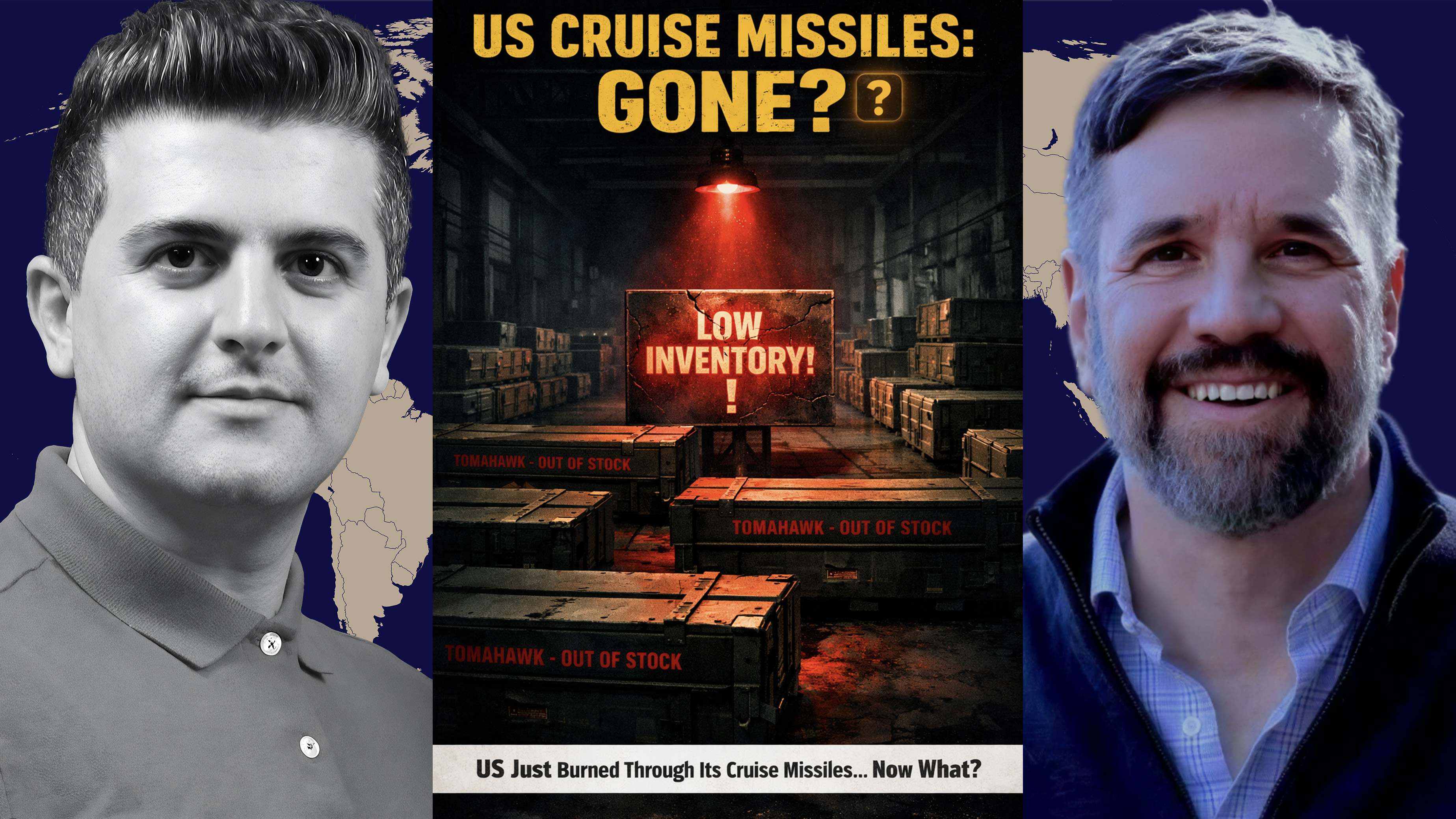
Matthew Hoh: US Just Burned Through Its Cruise Missiles… Now What?
About this Episode
Analysis of Middle East escalation following strikes on Iran's energy infrastructure. Discusses Iran's threatened retaliation against Gulf state facilities, the strategic logic behind Israeli-American escalation efforts, and why the war increasingly favors Tehran. Examines the administration's lack of coherent strategy, logistical challenges including depleted cruise missile stocks, and the continued effectiveness of the Axis of Resistance. Key insights: Iran's strategic patience, the impossibility of achieving stated objectives without massive ground occupation, European reluctance to fully engage, and economic warfare impacting global energy markets. Questions the viability of current policy, highlights internal dissent, and warns of prolonged regional instability with risks of wider economic disruption.
Hosted on Acast. See acast.com/privacy for more information.
Hosts & Guests
Transcript
Every idea starts with a problem.
Warby Parker's was simple.
Glasses are too expensive, so they set out to change that.
By designing glasses in-house and selling directly to customers,
they're able to offer prescription eyewear that's expertly crafted and unexpectedly affordable.
Warby Parker glasses are made from premium materials,
like impact-resistant polycarbonate and custom acetate,
and they start at just $95, including prescription lenses.
Get glasses made from the good stuff.
Stop by Warby Parker store near you.
You know what's wild?
Most people are still overpaying for car insurance,
just because it's a pain to switch.
That's why there's Jerry.
Jerry's the only app that compares rates from over 50 insurance in minutes
and helps you switch fast with no spam calls or hidden fees.
Drivers who save with Jerry could save over $1,300 a year.
Before you renew your car insurance policy, do yourself a favor.
Download the Jerry app or head to jerry.ai-acast.
Recently, our company's softball team lost the big game by one run.
Then Dale tried to console us with the quote,
winning isn't everything.
Dale's a loser.
I played a win, like early payout from Beth365.
If my team goes that big, I could pay it out instantly,
even if they blow the lead later.
Sounds familiar, Dale?
Beth365.
Winning is everything.
Gamely problem call 100 gambler, 21 plus only,
must be physically located in Virginia, TNC's apply, in app only.
Hi, everybody, today's Wednesday, March 18th, 2026.
I'm your dear friend of brother Max, Matt.
Oh, I said Max.
I don't know where did it come from.
But welcome back, Matt.
And great pleasure to have you on.
I don't have you.
Your mic is muted, yeah.
No, you're not back.
You're my just little button here.
Yeah, but also to what happened was my phone connected to my computer.
And then so, yeah, that's the thing.
So my apologize for being late.
And then I got to keep all my paraphernalia here separate from one another.
So, yeah.
But anyway, it's good to see you.
Thanks for having me, Neema.
Good to see you, Matt.
Let me start, Matt, with the new escalation in the Middle East,
which was the attack on South Parse, you know,
the refinery in, as they call it in Iran,
the assailant refinery, with one of the biggest, you know,
in one of the most important refineries in Iran.
And this is a new escalation.
This is something beyond what we've seen so far.
The attack on the oil and, you know,
these sort of infrastructures that are so much important
because the whole region is going to be influenced by this sort of escalation.
How do you see what AY are they doing this?
Because this, to me, it seems that so much desperation.
When you go after oil infrastructure, oil facilities,
it seems that something so wrong is happening in their mind.
Yeah, there are several things.
And of course, the response from Iran
has been that we're going to strike facilities now
in Saudi Arabia, Qatar, and Emirates,
and the Iranians' actual issue, actually issued evacuation notices
for those facilities.
So, and I don't know anyone who doubts
that the Iranians are going to do that.
If one thing those of us in the West should have learned by now
is that the people that we fight very often mean what they say.
They're incredibly sincere about their statements and their actions.
Yeah, I mean, the prevailing wisdom here, I guess,
what I'm seeing and reading from experts and commentators and whatnot
is that the Israelis are doing this to one,
to try and bring the Gulf states fully into the war.
And the Israelis also made clear that they did this
with the blessing and the cooperation of the Americans.
So, people recall a week or so ago
when Israel struck those fuel tanks outside of Tehran
and it caused that really massive environmental catastrophe.
The Americans made it known that we weren't involved
with this, the Israelis didn't tell us.
And so now, as soon as this hack was carried out,
the Israelis are saying the Americans are with us on this.
You know, the idea being is that they're trying
just as the Iranians tried to expand the war,
the Israelis are doing so as well, hoping that the Gulf state reaction
will not be pressure on the United States to end the war,
but rather entering into the war, right?
Using their military capabilities,
of which we've only really seen a limited amount.
We've seen some, but not a lot.
In the same way that the Iranian use of economic warfare here
to try and harm the entire world,
put pressure on the United States that way to end this war,
as well as then serve as the deterrent going forward,
as to why the US and Israel wouldn't attack Iran again.
The Israelis, I think, are making the same calculation,
but the rest of the world will put pressure on Iran
and that a complete disruption of energy coming out of the Gulf
and all its other adjacent industries and commodities.
If we had forgotten that I had that fertilizer comes
from petroleum, you know,
we've certainly been reminded of it in the last couple of weeks
and we will be reminded of it this summer
when our produce is super expensive in the supermarket once again,
not that it ever stopped being expensive in the last five years,
I guess.
But yeah, I mean, so I think that's the idea there,
the thought behind why it is we all do this,
why do they want to expand the war this way?
You know, but I think it's to your point as well,
the desperation that they're in,
this is a war that is being carried out in favor of Iran right now,
certainly we can go over why I see it that way,
but the idea that Iran has the initiative,
time seems to play in Iran's favor.
Iran has clearly stated and obtainable
political objectives and a strategy
that they are executing to achieve them.
The Americans in Australia don't have that.
And so what I think you have to say as well
is that this strike on the natural gas processing facility
was done in conjunction with a resumption
of decapitation attacks, right?
Of assassination attacks,
we've seen three major Iranian figures killed
in the last 24 hours or so.
So I mean, so that resumption again of just brute force,
brute warfare, this strategy of hoping that maybe
we'll just pull out the right jenga piece in the tower
or the right card in the house of cards
and the Iranian government will topple or it will inspire,
I know this is your favorite talk at the topic,
it will inspire sectarian uprisings in Iran, right?
I mean, that fantasy that they hold on to.
So, I think there's a number of reasons here,
but none of it is because the Israelis and the Americans
are dominating in this war.
None of it is because this war is going in favor
of the Israelis and the Americans.
And it's certainly not because the Israelis
and the Americans have the initiative,
they're doing everything they can right now
to regain that initiative
and that doesn't seem to be the way it's gonna go.
I think when you're living in a house of glass,
you have to be careful about what you're doing.
You know, Israel is so much dependent
mad on desalination power plants.
Yeah, yeah.
Not Israel alone, but all of these Arab states
together with Israel.
And are they really suicidal?
Because...
There was a strike on the Iranian desalination plant
about the middle, right after the first week of the war,
I guess maybe about two weeks now.
And then the Iranian response was to hit the desalination plant
in the Emirates.
And that seemed to stop.
That seemed to cut that off.
But the Israelis and the Americans view the Arab states
involved in this as expendable.
They view them as buffers.
They view them as a cannon fodder, essentially.
Bits of property and territory and terrain
and infrastructure that they can give up,
that they can use to absorb Iranian drones and missiles.
And then with the hope, the fingers crossed,
hope of strategy of hope,
that somehow there are the Saudis and the Kuwaitis
and the Qataris and the Emirates, et cetera,
are gonna come into this war fully on behalf
of Israel and the United States.
Again, it's a strategy of hope.
And that hope gets more desperate.
Each day the war goes on where it's clear that
even if the Americans and Israelis did have a strategy,
whatever it was, it was never gonna be achieved
or it was absurd or again,
it's just based upon this idea that we're gonna bomb them
so much that they're just gonna break and fall apart
and then while they have our puppet in place
or there'll be such chaos there,
that they'll be a failed state, et cetera.
And that's not the way it's gonna go.
And as we said, the time seems to be
on the Iran side here.
I mean, the Iranians went with a strategy
to achieve their objectives of getting deterrence
in the region by putting pressure
on the America's allies in the Gulf
as well as putting pressure on the entire world.
And they have an ability to do that, which we've seen.
And here the Americans and Israelis are,
let's try and escalate this war by getting the Iranians
to destroy Gulf state energy infrastructure
in the hope that the way this is gonna roll
is that they're gonna come in on our side,
fully on our side.
They're already certainly defending against
the Iranian missiles and drones.
But yeah, I mean, it's just absolute madness.
It's just absurd.
I didn't interview yesterday on TRT
and I was apologizing essentially
because as well as other interviews,
because you know, we say this
and then the host kind of says,
because we're all like this, this is incredulous.
This makes no sense.
You know what I mean?
But this is the reality.
We're dealing with Israeli United States
and nothing makes sense about this,
other than their imperial and Zionist ambitions.
I think Matt what's going on in the mind of these Arab states.
I don't know if he and I stayed told them
before the attack happened.
But right now Iran would hit them
and would hit them hard, in my opinion.
Because the parliament, the head of the parliament
said that the military, you know,
the head of the commander of military said that
and the Bloomberg reported moments ago
that some regional energy facilities
are being evacuated after Iran issued an evacuation notice.
And here is the question right now for these Arab states
because they're coming together in Saudi Arabia.
I don't know if you heard about that.
The foreign ministers of these,
all these Arab states together with Turkey
and Azerbaijan, they're going to get together
in Saudi Arabia to talk about what would be the future
of this sort of escalation.
If many of these countries cannot survive it,
this is the problem and they're going to talk about it.
And how much that would influence the decision makers
in the United States, that's a big question in my opinion.
Because Donald Trump doesn't seem to care about these countries.
Now he takes them for granted
and these countries attempts to buy themselves
into a position of not privileged,
but into a close or top tier position with Donald Trump.
It's show that it didn't work.
You know, last year when Donald Trump visited the Gulf region
and they rolled out the red carpet,
he went to all their palaces and they swore hundreds
of billions of dollars in investments in the United States
as well as two of the Qataris gave him
a half billion dollar airplane.
You know, that didn't matter
when they picked up the phone to call him
and say, you know, Mr. President, don't do this war.
He wasn't listening to them.
The idea that the Gulf allies are now understanding
that the Europeans are now understanding
that the Ukrainians are accepting is this idea
that there is a hierarchy in the American Empire
and Israel is at the top of it.
And there is a big gap between that top tier in the hierarchy
in which Israel is and all the rest of the nations.
Sure, the Europeans rank above the Africans,
but you know, when it comes to things like this, you know,
that this is what to expect.
And so what will come out of this meeting
of these foreign ministers, we're all waiting to see
and maybe they will be so concerned with the short term,
so concerned with keeping their grip and power,
so concerned that they will become the next American
Israeli project that they will go along with the Americans,
so just that fear keeping them in order, right?
But maybe they will be more courageous.
Maybe they'll be more bold and maybe they'll have a better
and wiser long term perspective on this,
seeing how this just doesn't end.
This will always be the case.
Either Iran is shattered into a dozen different pieces
like Syria or Iraq was and the Gulf states
pay the enormous consequences of that
and costs of that.
Or Iran resists, Iran sustains itself through this war.
And then the war starts up six months from now,
12 months from now, two years from now, five years from now again.
I mean, so I would hope that that's way these foreign ministers
are approaching this with a longer perspective on this
as well as to calculating what is in their best national interest,
not short term and not for their own portfolios,
but what is actually the best interest of their country
in terms of one sustainability through the next generation,
but also two, sovereignty.
When it comes to the timeline of the war
and how long does it take to get out of this,
here is what JD Vance just moments ago said.
This nobody likes war, right?
And I guarantee the President of the United States
is not interested in getting us in the kind of long term
quagmires that we've seen in years past.
I know the President, I know the way that he thinks
about his America's national security,
that is not a risk with this President at all.
What he has also said consistently for 10, 15 years,
maybe even longer as Iran cannot have a nuclear weapon
and he's willing to take action diplomatic, ideally,
but military action, if he has to,
to make sure that that doesn't happen.
Is that convincing?
Not what an absolute liar he is.
What a terrible liar he is, what an absolute pony.
Everything about this guy just represents
the worst aspects of this moment.
And just forgetting about nonsense,
what he's saying there, the lies he's saying there,
the glorification of the great leader, Donald Trump,
all the things he has to do as Vice President.
But just say, let's just focus on the key point he had there
about Donald Trump not allowing Iran to have a nuclear weapon.
Well, first of all, Iran doesn't have a nuclear weapons program,
hasn't had one since at least 2003.
But I guess that, you know, facts and reality
don't matter to these people as we know.
As anyone who's watched the American Empire
for their entire lives will tell you whether they're 15 years old
or 85 years old, facts and reality don't matter.
It's the mythology, it's the narrative.
It's that the fact that the United States Empire exists
at the intersection of greed is good and might is right.
And that's all it matters, you know,
but this idea that is true though,
say they are committed to that.
Say Donald Trump for the last 15 years,
he's gone to bed every night and set up prayer
to the good Lord, asking him not to let the Iranians
have a nuclear weapon, right?
You know, how is that gonna be achieved?
There's no ability to do that
without physical occupation of Iran by the US military,
by the Israelis, by proxy forces, et cetera.
It's to prevent them from doing that.
Unless we physically control all these different spaces
that the Iranians possess or can build,
there is no way of stopping them from getting a weapon
unless you do it through a political effort.
And that political effort was what Barack Obama did in 2015
with the JCPOA agreement.
That effort stopped, you know,
any prospect of Iran getting a nuclear weapon
not that they were even in the process
of getting one at the time.
And it was a good, solid agreement agreed to
by everyone except the Israelis and Zionists here
in the United States, including many members
of President Obama's own party like Chuck Schumer, you know what I mean?
So, you know, this idea that the purpose is to stop
and Iran from getting a nuclear weapon,
how is that going to be achieved?
I mean, in the same thing too,
if you look at the Israelis just yesterday,
these challenge 12 in Israel put out this statement saying,
we just spoke with a senior official,
here are the objectives in the war.
Here are the five Israeli objectives in the war.
The first two concern of Straits of Hamuz,
which wasn't an issue until the United States
and Israel attacked Iran.
So now suddenly the objectives become something
that you yourself have created.
I think that's like learned in the first week or two
of strategy 101, don't do that.
You know, don't have a policy or strategy or actions
in place to have to then,
that you then have to clean up for.
And I'll say, you know, as far as the European allies
and the Gulf allies go of the United States,
in the rest of the world,
the quickest way to reopen the Gulf of Australia,
the Straits of Hamuz, reopen entry into and out
of the Persian Gulf and the Gulf of Iran
is for American and Israeli warplanes to be shot down,
not to send ships to the region
to somehow open the Straits.
You know, the reality is the quickest way
to open the Straits of Hamuz would be for other countries
to shoot down American planes and Israeli planes.
That's not gonna happen, of course,
but I mean, that's the fundamental absurdity in all this.
But the, you know, support corner of those railings,
there is the first two objectives
are that regarding the Straits.
The next is the missile program,
which has the same problem as the nuclear weapons program.
But at least the missile program really exists.
How do you eradicate it?
In order to do so, you have to have soldiers
throughout the entire country ensuring that
they're not building these weapons
and then launching them in a country
that's four times the size of Colorado.
There's been a lot of great maps going around on X recently
and, you know, showing how big Iran is compared
to South Vietnam, a country at the US
have 560,000 soldiers in and could never actually control.
I mean, this was the fundamental issue I encountered
when I first got to Afghanistan in 2009
and saw the terrain, saw the geography,
saw the Afghanistan was really like with my own eyes.
You're in a helicopter and you see
that we've garrisoned this one valley.
But then there are 15 other valleys that we have in garrison.
And this absurdity of that somehow,
this is how we're going to stop Al-Qaeda
from having base camps in Afghanistan
when they didn't even need those to begin with.
We'd have to garrison every valley in Afghanistan.
We'd have to use the United States military
as it wasn't World War II with 13 million men
in order to do that.
You know what I mean?
So the absurdity of those objectives
and just the impossibility of them, how are they reached?
And then the fourth objective for those railings
was regime, I mean, sorry, the nuclear weapons program
discussed and then, of course, the last one is regime change.
This is a coordinate challenge, well, as of Israel.
And the same thing, how do you reach that?
But I think it's clear for both the Americans and the Israelis
if you can't get regime change, civil war or a failed state,
again, a replication of Syria and Libya
is the next best thing.
Matt, do you feel that the Trump administration
is somehow from within, is having
some sort of difficulties?
Let's put it this way.
We had Joe Kent come, the resignation of Joe Kent.
He said he knows the region.
He was fighting in the region.
And his wife was killed in the region.
He comes out and says, no more war
where they're on because Iran doesn't have, doesn't bring
an imminent threat to the United States.
And he was Donald Trump said when he was informed
about the resignation of Joe Kent, he said that,
of course, he cannot believe it on the left.
And he's a leftist and then something,
he couldn't go that far.
But he said that.
It's not because he's watching that socialist on dialogues
works, that's the reason why, yeah, yeah, yeah.
But we see something, you know, he's not a, you know,
he was occupying a very important position
in the Trump administration.
That's the importance of his resignation.
What is your understanding of the Trump administration?
Oh, it's just a clown show at this point.
And I think it always has been.
It's full of, I mean, this is one of the,
you know, certainly, we've probably spoke
about this before.
So apologies for repeating myself,
but, you know, the comparisons between 2003,
the Iraq invasion and this war in 2026 are very apt.
And there are similarities and differences.
One of the differences is that in 2003,
the United States was led by competent liars.
And here in 2026 were led by incompetent liars,
as well as to the cohort, the cadre,
the people around the President of the United States,
say what you will about them.
They were abhorrent, they were murderous,
they were war criminals.
But they at least were ideologues.
They at least had some degree of beliefs and principles.
However, abhorrent they were,
these were people who had loyalty to institutions,
who had loyalty to structures,
who had thoughts that came from something greater
than themselves.
You compare that to what you had,
again, no matter how abhorrent they were.
Compare that to what you have today,
where the President is surrounded by sycophants
and conmen and opportunists.
These people are sadists and nihilists.
They are simply unmoored.
They have no loyalty to anything,
except their own self-interest.
Many of them are in their positions
because they've been able to succeed
in a corrupt American political media environment.
I mean, just look at today at the people
who are testifying right now
from the Senate Intelligence Committee, maybe over now.
You've Chelsea Gabbard, you have Cash Patel.
Later today, Pam Bondy is gonna be testifying.
I mean, none of these people have any type
of ideological core.
They have, again, no,
they come from no institutions, no infrastructure.
There's nothing to point to them and say,
this is, I understand this person's arguments.
I understand what they will likely do next
because there is some type of intellectual
and, again, using this in the most subjective,
relative sense, moral attitude towards them,
or attitude that they possess, right?
So, say even the most ardent Zionists as dehumanizing
as they are, particularly when you get into
that real rabid Jewish supremist aspect,
there's at least a structure to it
that you can ascertain that you can articulate
and define them with these people, that's not there.
And I think that, again, as criminal
and as revolting and as murderous as say the 2003 invasion
was in the people that let it and sustained it,
what you have here is something different.
And so, yeah, the inability of this administration
to control things is clear.
And you could see that domestically as well.
You saw how clearly their immigration raids
throughout the United States got completely out of control.
How they were, essentially, defeated and had to retreat
from Minneapolis by the people of Minnesota.
So, but in the larger sets, again, I said this before
about the Iranians having the initiative
and having initiatives, one of the principal things
in warfare, and if you cannot control the initiative,
you don't have the initiative, you're not gonna win the war.
And the Americans simply can't do that.
They are forcibly, they are reacting over and over again
to what the Iranians are doing
or to what the Israelis are doing.
So, I mean, you know, you look at the headlines
in the United States and for people who say,
those are just headlines, it doesn't matter.
Then I'm gonna tell you what, you don't understand warfare.
You certainly don't understand warfare
in the modern context, if you think headlines don't matter.
But, you know, the headlines yesterday
in the United States for one, Joe Kent,
the director of the National Counterterrorism Center,
resigning because, again, as you said,
this war is a war choice, a war of aggression
where Iran was not any threat to the United States
or at least not an imminent threat to the United States
and that this war is being done on behalf of Israel.
That's the one big headline, you know, states.
The other big headline, the Gerald Ford has to go back
to Greece or Crete or wherever
because it's laundry room caught on fire.
I mean, the $15 billion ship,
it has to be taken out of the combat zone
because they had a really bad fire
because somebody left too much length
in one of the dryers or something.
You know what I mean, like the inability for the Americans
to put forward objectives, put forward
any type of strategy or plan,
then let alone control or manage
what is in their power to control and manage
is simply very clear.
And so this is, you know, for lack of a better term,
a clown show, you know, it's remarkable
and it's terrible because people are suffering,
people are dying, you know, you have family on Iran.
I feel stupid for not even asking you how they've been,
you know, but like the idea that people are dying
and suffering and all this, whoever they are
with these people at the top, it's just sickening.
It makes me want to vomit.
I thought that, again, I thought that the gangs
in power, whether they be Bush's people
or Obama's people were revolting enough,
but this is on another level.
No.
Matt, you remember when Tulsi Gabber was announced
that she's going to be part of the front administration,
we thought that she's going to be a game changer.
And today we had this hearing of Senator,
and she was asked various questions
about the war with Iran.
And here is what has happened,
and there are, you know, sort of reactions to the questions.
Hi, this is Farnoosh Tarabi
from So Money with Farnoosh Tarabi.
And today I want to talk to you about Boost Mobile.
Quick money tip, stop paying a carrier tax.
If your phone bill feels trapped in a pricey plan,
this is your sign to unlock savings.
Boost Mobile helps you reset your spending
with the $25 unlimited forever plan.
You can bring your own phone, pay $25
and get unlimited wireless forever.
And that simple switch can unlock up to $600
in savings a year.
That's money you could put towards paying down debt,
investing, or something that actually brings you joy.
Though savings are based on average annual single line payment
of AT&T, Verizon, and T-Mobile customers
compared to 12 months on the Boost Mobile Unlimited plan
as of January 2026 for full offer details
visit BoostMobile.com.
Taking care of your eyes shouldn't be a hassle.
That's why Warby Parker is a one-stop shop
for all your vision needs.
Our prescription glasses and sunglasses
are expertly crafted and unexpectedly affordable.
Stop by a nearby store or use our app
to virtually try on frames and get personalized recommendations.
Do we mention we offer eye exams
and take vision insurance too?
For everything you need to see,
head to your nearest Warby Parker store
or visit WarbyParker.com today.
That's WarbyParker.com.
That opening statement as submitted
to the committee in advance of this hearing stated
that as a result of last summer's airstrikes quote,
Iran's nuclear enrichment program
was obliterated and quote, correct?
That's right.
And is that in fact the assessment
of the intelligence community?
Yes.
So the assessment of the intelligence community
is that Iran's nuclear enrichment program
was obliterated by last summer's airstrikes.
Yes.
In the opening statement you submitted
to the committee last night also stated quote,
there has been no effort since then
to try to rebuild their enrichment capability and quote, correct?
That's right.
And that's the assessment of the intelligence community.
Yes.
The White House stated on March 1st of this year
that this war was launched and was quote,
a military campaign to eliminate the imminent nuclear threat
posed by the Iranian regime and quote,
that's a statement from the White House quote,
the imminent nuclear threat posed by the Iranian regime.
Was it the assessment of the intelligence community
that there was an imminent nuclear threat posed
by the Iranian regime?
The intelligence community assessed
that Iran maintained the intention
to rebuild and to continue to grow
their nuclear enrichment capability.
Was it the assessment of the intelligence community
that there was a quote, imminent nuclear threat posed
by the Iranian regime?
Yes or no?
Senator, the only person who can determine
in what isn't is not an imminent threat
is the president.
False.
This is the worldwide threat hearing
where you present to Congress national intelligence,
timely objective and independent of political considerations.
You've stated today that the intelligence community's assessment
is that Iran's nuclear enrichment program was obliterated
and that quote, there had been no efforts since then
to try to rebuild their enrichment capability.
Was it the intelligence community's assessment
that nevertheless, despite this obliteration,
there was a quote, imminent nuclear threat posed
by the Iranian regime?
Yes or no?
It is not the intelligence community's responsibility
to determine what is and is not an imminent threat.
That is up to the president based on a volume of information.
No, it is precisely your responsibility
to determine what constitutes a threat to the United States.
This is the worldwide threats hearing.
Yeah, you, it's just, Matt, you know, it's amazing
to see Torsi Gabbard was, she was not able
to influence Donald Trump,
but she got each and every influence from Donald Trump.
And she's right now, we can say she's Donald Trump
because she's just repeating what Donald Trump was telling us.
Yeah, interesting, because I have worked
with both of them before, years ago, you know,
when Senator Ossoff, I knew as Jonathan,
who was in, I think it was Hank Johnson's office.
He was a staffer.
And great guy to work with.
And I knew Torsi Gabbard,
when she was representing the Gabbard,
and I worked with her quite a bit on anti-war things.
Trying to keep us out of the Syrian war.
In 2019, I stood in front of the Capitol building
with her, excuse me, 2018, with her
and the late Walter Jones.
And as her and Mr. Jones introduced a resolution
for the House of Representatives
that would have made impeachment proceedings automatic
for any president that used military force
without congressional authorization.
And now we see who she is here, right?
Who she, who either she always has been
or who through getting close to power
and wanting more power has let herself become.
And I think it's probably more the form
it always has been.
But yeah, certainly, she is doing her job very well
on behalf of the president of the United States,
even though Senator Ossoff did a pretty good job there
of having her lay out how there was no nuclear program,
a nuclear weapons program.
According to American intelligence,
it's, you know, whatever the Iranians had
has been destroyed, and even recently.
I mean, so the assessments have been,
there is no threat.
And yeah, we'll see more things like this over and over
and over again, as the war goes on,
the absurdity will grow just larger and larger.
And you know, almost I think in parallel
as a suffering to the destruction,
the expansion of this war grows, the absurdity,
the scenes like we just saw with Tulsi Gabbard there.
We'll continue to grow as well, you know.
It's that, like Socrates said,
the line between the tragic and the comic
is like the line between light and shadow.
You know, it's inseparable.
And so we'll have the tragic goal along with it,
or the comic goal along with the tragic
and the war, as it always does.
That's why I tell people the best books
you can read about warfare are, you know,
catch 22 or mash or, you know, slaughterhouse five
or things like that of, you know,
that those are the types of things
that will really tell your warfare is like
because it is just imbued with a level of absurdity
that is just something that you have to witness
to really, truly appreciate, I think.
That's the new images coming out of the war.
It seems that the United States is burning
through its cruise muscles.
And what is your understanding?
Who's running the whole operation?
Is that Donald Trump?
Does he know about anything militarily
about the military aspects of what's going on?
Or it's just about the policies that he's talking about
because it seems to me that there is no connection
with what he's talking about
and what's going on at the battlefield.
Yeah, and certainly if you look at what Hegg says,
says General Cain is a little more circumspect,
I think he's still a true believer in it all, I think.
You know, with the Navy running out of cruise missiles,
you can see that in a sense that
this was something that should have been well understood
and I'm sure it was, but I'm sure the planners had said,
look, once our ships fire off their cruise missiles,
they either have to go back to the Mediterranean
or they're gonna have to go to Diego Garcia
to refill their missiles on the ships.
The Navy ships, the destroyers use a,
it's called a vertical lawn system.
People have seen that when the missile just fires
right up out of the deck.
And that, you can't really replenish that underway.
You know, you can't really have another ship.
I mean, supposedly they're able to, but they don't do it.
You know, because I guess it's just too difficult
or too complex and people who know about this better
than me can fill in the comments.
I'm sure Scott Rader can talk about this
much better than I can.
But, you know, the idea being is that, okay,
because what we also could do is in Bahrain,
but we're not gonna be able to utilize
the fifth fleet port in Bahrain.
And I guarantee there are planners who said this
in the Pentagon and they were told to shut up,
you know, shut up in color, right?
I mean, this idea of like, or don't worry about it,
or why don't you believe, like we believe
that this is all gonna go the way it's gonna be.
Why are you being so negative?
I mean, I heard that a million times in my time
in the military and, you know, but like, you know,
so this is all predictable.
That at some point, your destroyers and your submarines
are gonna run out of Tomahawks
and then they're gonna have to go a long way
to get new ones.
They're gonna go to the Air Garcia
because they're not gonna be able to get back to the Med
because they don't wanna pass the Hoothies, you know?
So, yeah, I mean, the miscalculations here,
the lack of foresight, the hope, again, the belief that,
this is all gonna be over in a number of weeks
or don't worry about running out of cruise missiles
because time we do, a rod's gonna be so degraded,
everything's gonna be falling apart,
they're not gonna be able to fight back.
We won't even need any more cruise missiles at,
you know, when we're going into the fourth week of this war,
you know, by then the three weeks,
we won't need any more cruise missiles.
It's all gonna be pretty much over at this point
and we'll just be doing large bombing runs
by B-52s and B-1s and B-2s, you know,
something we've seen now in the last week,
we've seen evidence of American and Israeli warplanes
over the skies of Israel, something you didn't see
in the first couple of weeks.
But everything we're seeing in terms of the videos
being put out of the B-1s and B-52s that are heading out
to launch strikes on or on, the videos I have all seen
have them carrying standoff missiles, you know?
So that it's still not safe enough, it appears,
for the B-1s and the B-52s to come in
and drop large amounts of bombs.
And I'm sure that was the calculation,
that was in the planning that by this point,
getting into, again, through three weeks of this war,
getting into the fourth week of the war,
that by this point we would have total dominance
and we could just essentially carpet bomb,
they don't like that term, but the carpet bomb
for lack of a better word, you know,
whatever we wanted to and we could drop large amounts
of 502,000 pound J-Dams wherever we wanted to,
you know, as well as bunker busters
and penetration munitions and things like that.
Yeah, that's simply not the way it's played out.
And so I think this example of the Navy running out
of cruise missiles is very, very much a really pointed
illustration of the overall flaws in the strategy,
the lack of planning, the lack of preparation for this,
you know, again, where are you gonna replenish
your missile stocks on our destroyers?
Where are they gonna go?
And you know, in the military you get taught the,
was the six peas or seven peas, you know,
prior proper planning prevents piss poor performance.
I mean, that's something that every prince
in the military teaches its officers and NCOs,
like the first day of officer at NCO school, you know,
and you just see this year, you know, over and over
and over again.
And then you can trust that with the Iranians,
with their preparation, their planning for this.
Again, their ability to maintain the initiative,
their ability to set political objectives
and have a strategy that they can execute to achieve it.
And then the other thing I would say too,
just as we're talking now about,
I'm talking now about why, find impressive
about the Iranians and why they are,
this war is in their favor now,
why time seems to be on the side.
Is that they demonstrated a degree of strategic patience
here that is just remarkable.
The fact that they went through two iterations
of conflict with Israel in 2024.
And then of course, a 12-day war last year.
And they didn't use their best missile systems.
That they didn't deploy large number of decoys
in their attacks to give away that,
that's what something they might do,
like they did in the first day or two of this war.
That they undersold their drones.
It just certainly did not give away at all
how they would employ them, the tactics they would use,
and how they can defeat American air defenses
and allied air defenses.
You know, as well then too, just the fact that the Iranians
had an understanding of the American command and control system,
you know, throughout the region,
the footprint of the American military
and intelligence services through the region,
and they've even able to hit that over and over and over again.
We've all seen the photos of multiple destroyed radar systems
that cost hundreds of millions of dollars or billion dollars.
And the more important thing is that it can't be replaced.
You know, so now you see this emergency evacuation
of fat missile systems from South Korea, right?
To the United States, to two, excuse me, the region.
So I mean, the strategic patience of the Iranians here has been incredible.
And you know, you're faced someone who's willing to do that,
who's willing and able through three iterations of prior conflict,
understand that they have a longer plan,
understand how they can control what they're going through right now,
and they're able to hold back all those things,
their missiles, their drones, their intelligence capabilities,
because now's not the right time.
We've got to stick with the plan.
Wow, that's a dangerous adversary.
That's someone I don't want to fight, you know?
So the other, and then the other thing too,
I should say since I'm talking about this all now,
is this notion that a lot of us,
including especially myself, got wrong the status
of the axis of resistance.
Certainly, the area is out with a side overthrow,
and that, of course.
I think the lava's are surprised at what the Yemenis
or the Houthis are doing right now.
Are they really agreeing to the ceasefire
with the Americans from last year?
Did they really get hurt so bad that they can't participate
from, you know, the war with the United States,
both in the Biden and the Trump administrations?
Or, and this is what I think is very likely,
are they just being held in reserve?
And the Iranians and the rest of the axis of resistance
are waiting to introduce the Houthis into the war
when it's the best time.
Now, again, you go back to Iranian preparation,
planning for this war, there's strategic patience,
and that makes sense about the Houthis.
Now, where, I mean, I think I got this really wrong,
and a lot of other people did too, was Hizbala.
And the idea that many of us thought Hizbala
had been neutralized, that the Israelis had effectively
knocked Hizbala out of the conflict,
because again, Hizbala has in the last 15, 16 months,
presented no threat to Israel,
and has abided by that ceasefire,
even as the Israelis have bombed
his Lebanon thousands of times.
And now we see Lebanon or Hizbala come into this war,
right away, in coordination with the Iranians,
you know, in a well-organized, structured way
to put pressure on Israel,
to allow the Iranians to focus their attention
on the Gulf states, you know,
as well then, too, the Iraqi militias
that have come into play here,
that have struck American bases throughout Iraq,
but also American bases throughout the region.
And the Iraqi militias were something that, you know,
especially after those three American soldiers
were killed in Jordan in the winner of 2024.
You know, I think a lot of us thought
that the government in Baghdad had been able to,
you know, put them on a leash essentially,
had got them to keep quiet.
And nope, we were, I was wrong about that, you know,
certainly wrong about that.
So, you know, I mean, this, this, the fact that
Axler's distance was not neutralized,
that it is functioning as it was intended,
and that it's only now it's being deployed as intended,
as we've seen over the last few,
posted the last few years.
You know, I think that's really remarkable,
and that should give anyone who thinks it's wars,
not in the favor of Iran, a great deal, pause.
Matt, Donald Trump is sending USS Tripoli
with 2, 2500 Marines on board,
and they're talking about, you know, going,
I don't know what this guy is.
So, you know, when I was in Iran,
everybody was asking me if Donald Trump would attack you,
and I said, no, because he's not stupid,
he's not going to attack you on.
And right now, I say, I was so stupid,
that believe that Donald Trump would not be attacking.
Because this guy's that just doesn't understand
what he's talking about.
And here is what CNN reported on that.
Hi, this is Pablo Torei from Pablo Torei finds out,
and today I want to talk to you about boost mobile,
because we spent a lot of time analyzing inefficiencies
in sports, overvalued contracts, money tied up
in the wrong places, and so on.
But those inefficiencies aren't just on a roster.
Sometimes, they're in your own monthly expenses.
Boost mobile says switching to their $25 unlimited forever plan
can unlock up to $600 in savings a year.
That's $25 a month for unlimited data,
talk and text when you bring your own phone.
If that money is trapped in a pricey phone bill,
it might be worth a second look.
Visit boostmobile.com to learn more.
After 30 gigabytes, customers may experience lower speeds,
customers pay $25 per month, as long as they remain active
on the boost mobile unlimited plan.
Savings claim based on a January 2026 boost mobile survey
of 1,000 Americans with single line unlimited plans,
comparing average annual payments of major carriers
to 12 months on the boost mobile unlimited plan.
For full offer details, visit boostmobile.com.
If your eyes are the windows to your soul,
and your glasses are the windows to your eyes,
then it's pretty important to find your perfect frames.
That's why at Warby Parker, we've made shopping
for eyewear as easy and fun as can be.
Peru's endless styles in our stores,
or use our app to virtually try on frames
and get personalized recommendations.
To find your next favorite pair of glasses, sunglasses,
or contact lenses, or to locate your nearest
Warby Parker store, head over to WarbyParker.com.
That's WarbyParker.com.
CNN that the unit is being sent,
they're not revealing exactly where it would be deployed
or what it would be used for.
Earlier, President Trump dismissed a new warning
by Iran on U.S. ground troops in the region.
Here's what he said.
The Iranian regime has spelled sky news.
If you put boots on the ground in Iran,
it will be another V&M.
Are you afraid of that?
No, I'm not afraid of anything.
Because he's not one of them.
His son is not one of them.
And he doesn't care in my opinion.
I mean, I think there's an in this is not to be glib
or to be a ballacran thing,
but I think there's a very good case to,
not that they ever would,
because I discussed his cabinet before,
but for the 25th Amendment to be invoked
and for folks who don't know,
the 25th Amendment of the U.S. Constitution
puts him establishes criteria in a process
for the president to remove from office
that he'd no longer fit to serve in that capacity.
And I think this man's mental acuity,
this man's cognitive ability is just not there.
And this is what should have been done
with Joe Biden as well, of course.
But yeah, the idea of these 2,200 Marines
or whatever on the Mew,
as it's called, the Marine Expeditionary Unit,
is somehow forcing open streets of Harmoos is ridiculous.
They don't have that capabilities
or not advertised as having that capability.
You talk to anyone who knows anything about this,
they'll say there's no way they could do something like that.
You know, the Mew, essentially,
of those 2,200 Marines, roughly 1,000 are fighters,
if you will, right, are infantry
and associated Marines, Combat Arms Marines.
So they can do things like they can seize all platforms.
They can board tankers.
They can launch raids where they go
and they hit something and they pull back out.
They can be used as a floating base for commandos,
like Delta and the seals,
like they were used in the Maduro,
kidnapping the Iwojima was used for that down there
in the Caribbean.
I mean, a lot of what you see these mues used for
are used for things like sending Marines
into reinforced embassies, right,
using the Marines to help evacuate embassies.
And I think that is, well, I was astounded
that there was not a Marine Expeditionary Unit
already present in the region to do that
because you have a history of that.
You just in 2019, you had the Marines
reinforce the embassy and Baghdad
because there was very serious and sincere concerns
that the embassy was about to be overrun.
I have a friend who was a diplomatic security officer
at the time, like that wasn't a joke.
You know, I mean, let alone in the history
of the American Embassy in Beirut, you know,
I mean, so plenty of examples,
you know, the American Marine Corps experience
in Lebanon, you know, going back to the 1950s.
But the, yeah, so the idea that this force of 2000 Marines
is somehow gonna be used to open the Straits of Mous,
like as if I think people have in their head
that the Straits are closed
because the Iranians have built the castle on an island
and they've stretched a giant chain across the Gulf,
right, across the mouth of the Straits,
you know, like it's 16, 21 or something like that.
You know, and the reality is,
is that we're not even certain
if the Iranians have mined the Straits of Mous.
We say we're uncertain
because I don't think the Iranians have said they have done it.
We've not seen any evidence of it
and more importantly, ships are passing through.
The Iranians are letting through ships
that they want to let through.
And this is where, again, this is all bonkers
because you have the American saying
we're allowing the Iranians to ship to come through
because you're saying, well, how come the Americans
don't blockade in the Gulf of America
and not allow the Iranian ships to pass through?
It's because this isn't such a bad position
for the United States that the Iranian strategy here,
the use of economic warfare is so profound.
It's so confounding, it's so overwhelming
that the Americans can't stop the Iranian ships
because if they do, then that pulls
about three million barrels of oil off the market.
And now the Chinese, where most of this oil is going to,
are now really gonna start pulling from the market.
And now, as I think Brent was at 110, I think earlier today,
WTI, which is the American Benchmark, was at 100.
Now you're gonna see that go up to 120, 125,
that happens.
So just the fact that the Americans can't even do something
like stop the Iranians from selling their oil
as the Iranians are blocking the streets of Harmoos,
just shows how the Americans have put themselves
in the position here where, again, they don't have the initiative,
but everything they do provides more dilemmas
and problems for themselves.
So, but the idea that we know it's not mine
is because these ships are coming through.
And I very doubt very much that the Iranians have opened up
a special channel for these ships
and they're guiding them through that way.
I don't think they would do that.
I think they just have a mind to get,
because they don't need to mind it.
They can just do what we call control by fire.
And as long as they have not even,
as long as they have the threat of drones and missiles
to hit ships going through the streets
or just in the Persian Gulf or in the Gulf of Milan,
that's all they need.
They just need that threat.
And the shippers and more importantly, they're insurers
are not gonna allow the ships to proceed.
This is the same thing that happened in the Red Sea.
The Houthis didn't have to hit very many ships today
to get essentially half or two thirds
depending upon when it was the timeline
of ships to stop using the Red Sea.
And the shippers and their insurers said,
you have to go around South Africa,
add on two weeks of travel time to this shipment.
Yeah, I mean, so the absurdity of all,
we look at this, and we just say,
how do they think this is going well?
And how did not foresee this?
And then there's no way for them to make it better.
And now there's speculation about vading Iran,
which is just absurd.
We can't invade Iran proper.
We don't have the force, we don't have the troops.
Again, they said earlier,
you need essentially the size of a force
that the Americans had on World War II.
So what you could do could you send these Marines,
could you have the 101st Air Assault
or the 82nd Airborne jump into certain islands,
particularly islands that might be unprotected,
put the flag on the ground, shoot some videos,
make it look like we're doing something.
Sure, but then what happens?
Now you've got American soldiers
who are essentially unprotected,
facing the same Iranian ballistic missiles and drones
that we've been talking about for the last several weeks.
What would that do besides getting American casualties
in having some videos of the flag fluttering
on some Iranian beats that no one had ever,
the beach of an island that no one had ever heard of before?
I mean, so the choices here are either create more problems,
like let's stop the Iranians
from sending their tankers out to China.
Let's do, okay, that's gonna create
this bigger problem for us with the markets
or this idea of like we can land the Marines on this island.
Again, no one's ever heard of it before,
but we can take some videos
being on Instagram and what would actually accomplish,
nothing, and we'll probably get some Marines killed.
I mean, those are the choices they seem to have here.
Really, it's just amazing, absolutely amazing.
We shouldn't be surprised at all, of course,
but here we are.
Before wrapping up, Matt, it seems that finally,
I don't know how serious is that,
but Europe is showing some sort of spine finally
to say that the United States to Donald Trump
that we have different policies
when it comes to the war in the Middle East.
How long can they sustain this sort of position?
Are they gonna keep their position
or they're gonna sell it as we've seen in the other cases?
I think they're gonna, with the exception of a few,
like Spain and Pedro Sanchez there.
I think they're trying to play both sides of it.
So you saw them send ships to the Eastern Mediterranean.
You've hear them talking about the fending their bases
in the region, but when it comes then to this idea
of we're gonna join the war, they say no.
So they're kind of joining the war,
but they're not joining the war.
I mean, they're saying it much more eloquently
and articulately than Donald Trump did,
when he says like the war's just beginning and it's also over.
But there certainly is a vagueness there, I feel,
a desire to maintain relations with the United States,
looking past Donald Trump and just trying to get this
and hoping for some type of Deus Ex-McKena
that's gonna end this war.
Again, the best thing that they could do,
the Europeans could do, was not gonna be sending ships
to the Persian Gulf to open the streets of Hamuz,
but to shoot down the American warplanes
and the Israeli warplanes.
That'd be the easiest way, you're not the easiest way,
but that would be the way that actually opened up
the streets of Hamuz.
The fact that the Europeans and the Japanese
and the South Koreans and the Australians, et cetera,
are looking at the very real possibility of a regional war
which would be ruinous and of course,
could escalate, could spread beyond the region
and the very near certainty of a global recession
and possibly a global depression because of this.
And they would still rather risk all of that
than put their ships into some type of flotilla
that's gonna reopen the streets of Hamuz.
I think that tells you everything you need to know
about just how screwed up, how unwinnable
and how just frankly ridiculous this war is.
And so I think that's the European view on this.
Let's be vague, let's not ruin future relations,
let's not make things uncomfortable at Brussels
that are supreme headquarters of allied forces, you know,
at NATO, but let's also to make sure that our public knows
that we're not getting involved in this.
And in this case too, I think it's not even like,
certainly, I don't think anyone on your program
as a phantastarmor, or Mert Sir McCrone, or any of them.
And why, what they do is don't, I think,
for pure self-interest or calculating a way
to distract their public from the problems
in their home countries, you know, the Ukraine war,
of course, has a lot of those elements to it.
But in this case, I really do think
that the reluctance of the Europeans
to be involved in this has a lot to do
with just common sense, had a lot to do
with just their own intellect, and they're saying,
this is a bad thing, this is not going to end well,
this is something we do not need to jump into this quicksand.
I mean, we saw the British buckle and tell the Americans,
yes, you can use our bases for defensive missions.
And then you saw B1s take off, you know,
as if those were defensive missions,
or anything like that, you know, going to bomb targets,
going to shoot missiles at targets into Iran.
And I think the big thing, though,
is to your seeing some pushback,
you had that big article yesterday in the Guardian,
where Jonathan Powell, who was the British National Security
Advisor, who was at the negotiations
between the Iranians and the Americans in Geneva,
who they are, he witnessed Whitkopf,
he witnessed Kushner, he saw how incompetent they are.
He had the Guardian had an article
where his articulation of what he saw occur there,
that the Iranians were acting in good faith,
that a deal was possible,
that what had been put on the table before
was more than fair, it wasn't a complete deal,
but it certainly was heading in the right directions
for a deal, essentially establishing the British position
that the Americans are lying about this lack
of diplomatic opportunity.
And of course, the kicker in that article
at the very end, where you had someone from the Gulf states
say, we all understand Kushner and Whitkopf
to essentially be agents of Israel
who are leading Donald Trump into this war.
And then, of course, ties into what Joe Kent said
and what many other people said.
Thank you so much, Matt, for being with us today.
Great pleasure, as always.
Yeah, thank you, Nima.
Thank you.
Hi, this is Pablo Tore from Pablo Tore finds out
and today I want to talk to you about boost mobile
because we spent a lot of time analyzing
inefficiencies in sports, overvalued contracts,
money tied up in the wrong places, and so on,
but those inefficiencies aren't just on a roster.
Sometimes, they're in your own monthly expenses.
Boost mobile says switching to their $25 unlimited forever plan
can unlock up to $600 in savings a year.
That's $25 a month for unlimited data, talk and text
when you bring your own phone.
If that money is trapped in a pricey phone bill,
it might be worth a second look.
Visit boostmobile.com to learn more.
After 30 gigabytes, customers may experience lower speeds,
customers pay $25 per month, as long as they remain active
on the boost mobile unlimited plan.
Savings claim based on a January 2026 boost mobile survey
of 1,000 Americans with single line unlimited plans
comparing average annual payments of major carriers
to 12 months on the boost mobile unlimited plan.
For full offer details, visit boostmobile.com.
The Bleacher Report app is your destination for sports.
Right now, the NBA's heating up, March Manus is here,
and MLB is almost back.
Every day there's a new headline, a new highlight,
a new moment you've got to see for yourself.
That's why I stay locked in with the Bleacher Report app.
For me, it's about staying connected to my sports.
I could follow the teams I care about,
get real-time scores, breaking news,
and highlights all in one place.
Download the Bleacher Report app today,
so you never miss a moment.
More from Dialogue Works
View all episodes →
Nima R. Alkhorshid: Iran-US Double Ceasefire: What Just Happened?
Dialogue Works
Apr 8, 2026·37:17·queued

Col. Larry Wilkerson: US & Iran NOW in Direct GROUND WAR – Air Strikes Hit DEVAS...
Dialogue Works
Apr 8, 2026·1:01:29·queued