Loading...
news
Micah Goodman: How Israel and the US may prevent World War III
About this Episode
Welcome to What Matters Now, a weekly podcast exploring key issues currently shaping Israel and the Jewish World, with host Amanda Borschel-Dan speaking with author and public intellectual Micah Goodman.
In the sixth day of the United States and Israel's joint war against the Iranian Islamic Republic, Goodman takes stock and allows himself to wonder: What if we actually won this war against the evil regime?
We discuss the trickle effect on the Iranian people, the Mideast region and the world at large.
At this historic juncture, Goodman is hopeful that not only will World War III be averted, but peace may come to the region as Israel's existential threats are neutralized.
And so this week, we ask Micah Goodman, what matters now.
What Matters Now podcasts are available for download on Apple Podcasts, Spotify, YouTube or wherever you get your podcasts. This episode was produced by Eli Katzoff and edited by Ari Schlacht.
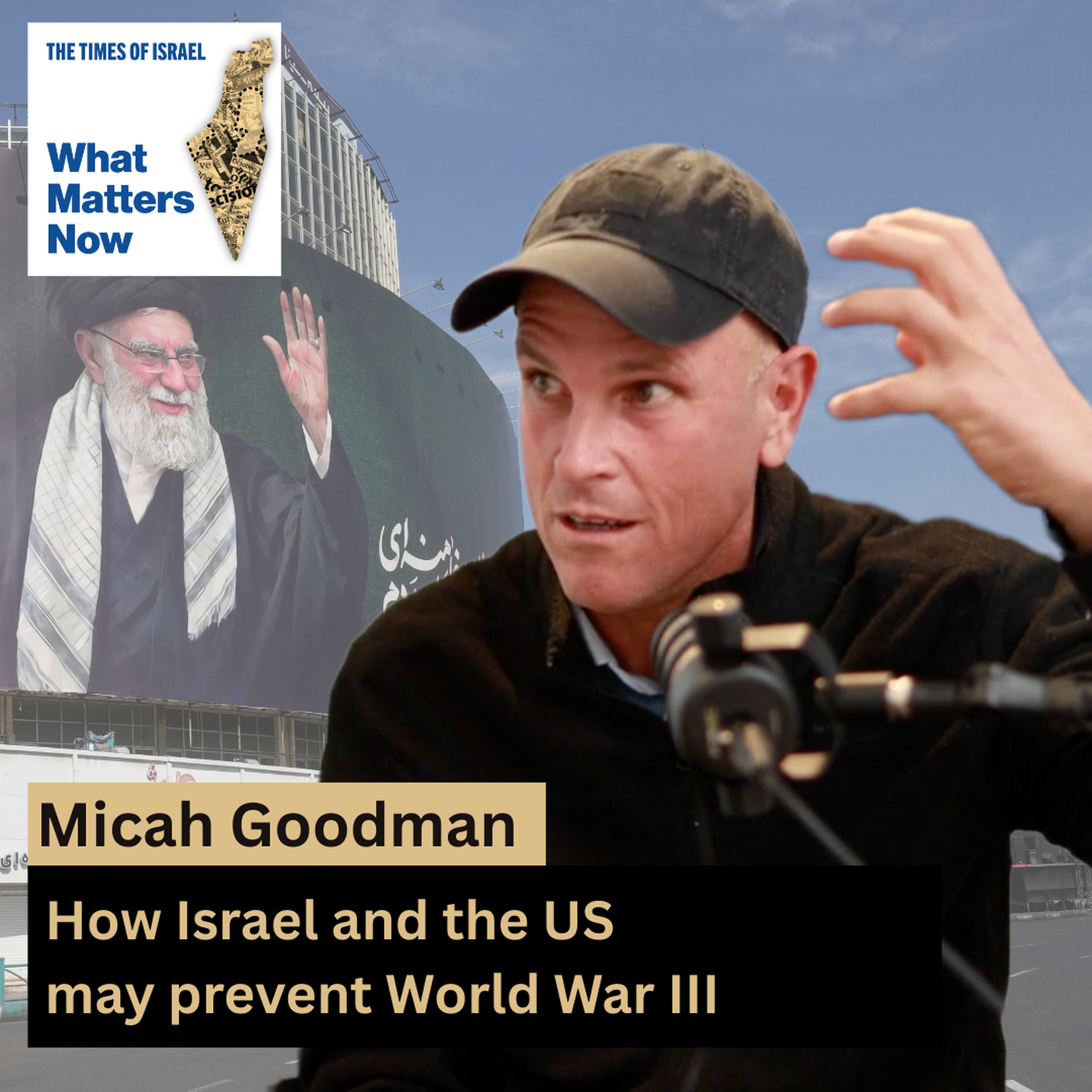
IMAGE: Dr. Micah Goodman/ A billboard showing a portrait of the late Iranian Supreme Leader Ayatollah Ali Khamenei in Tehran, Iran, March 5, 2026. (AP Photo/Vahid Salemi)
See omnystudio.com/listener for privacy information.
Hosts & Guests

Transcript
Welcome to the Times of Israel's What Matters Now.
I'm your host Deputy Editor Amanda Borssell Dan here with Public Intellectual and Author
Mika Goodman.
Mika, thank you so much for joining me in our Jerusalem office.
Hey Amanda, I'm very happy to be here.
It's such a pleasure always to speak with you.
And Mika, you and I have this bad habit of speaking every time something really important
is happening in the world.
I like this habit is this is a this is a way we could keep track of what's going on.
Today, of course, we're going to talk about what's happening in this region and war with Iran
was broke out on Saturday morning when the U.S. launched an attack on Iran joined by the
Israeli Air Force.
So Mika is going to talk about what kind of juncture we are in terms of the historical perspective.
And we're also going to discuss what it is to be Israeli in this moment.
All of this and more when we're back.
And we're back.
I'm Amanda Borssell Dan here with Author and Public Intellectual Dr. Mika Goodman.
Mika again, thank you so much for joining me.
And you and I spoke very soon after the Hamas infiltration into Southern Israel on October
7th 2023 in which 1,200 were slaughtered 251 were taken hostage.
We spoke again after most of the hostages were returned.
We've spoken several times throughout this war.
And I like to ask you today as an Israeli, as Mika, what are you feeling?
When you at for the first when the first time you asked me that question, Amanda,
a few days after October 7th, we made this interview of what matters now.
And I want to quote myself, okay?
I said, as an Israeli, I am we are experiencing a cocktail of emotions.
We're experiencing anxiety because it was so much anxiety.
We were afraid we're going down.
This whole project might be destroyed.
And we're experiencing grief because all our close and loved ones that were slaughtered.
And we're experiencing rage because we had to be experiencing
shame, embarrassment because of the collapse of the Israeli military in October 7th.
It was a cocktail of emotions, but they weren't diverse emotions.
They were all negative emotions.
Yeah, seeing me this a day two and a half years later, a day after Purim or two days after Purim
where we're in the beginning of this massive war with Iran.
And again, there's a cocktail of emotions.
But this time they're not all negative.
This time they're much more diverse.
I think I represent 90% of Israelis when they say, but there is anxiety, of course there is
anxiety. We have no idea how this is going to end up, but there's also a hope
because this could end up in a way that will really define the Israeli victory.
There is, there is grief.
We are getting hit.
There is that family in Bicemish.
There is sadness, but there's also pride because we're seeing Israeli greatness.
We're seeing Israeli success.
So this cocktail of emotions is much more diverse and one more thing.
There is one emotion that we share for week one of October 7th and this moment.
And that is unity, but it's different unity.
The unity of post October 7th was unity after we got hit, we united.
Now I think you'll agree with me.
In Israel there's a sense that we united, but not because we got hit because we're hitting back.
It's a unity with different flavor.
So I think that kind of captures where I am isn't Israeli and I think I'm very typical.
I'm very typical in this sense.
We are all a cocktail of emotions and I think the diversity of our emotions
kind of captures this moment in history and my best way to capture this moment in Israeli history
and by the way I think not in Israeli history.
I think now it's fair to say in world history is that and we didn't understand that in October 7th
that's like a juncture in world history.
This is a moment of radical uncertainty because this could play out to many different directions.
And we have no idea how this is going to play out which puts this in real radical uncertainty.
Yeah and with uncertainty there's always anxiety.
I think that has been the cause, the root cause.
I personally think it's been the root cause of much of the Israeli Palestinian conflict as well.
This uncertainty, what will be tomorrow, what is the future of the Palestinian people,
etc. causes this uncertainty which leads to anxiety which leads to rage.
And the question I have for you right now, Israelis are very proud.
We're very proud of what we're doing.
I think we're also very proud that we're prepared for this war on the home front
because if you look at our neighbors they're being hit so hard.
UAE is being hit multiple times over what Israel is unfortunately also feeling.
And yet we are prepared.
Our population is for the most part safe so that's also part of the pride.
But the question is what about the rage and the rage that we Israelis have felt for so long
against this Iranian regime which has funded Khazbullah, which has funded Hamas,
which has funded the Khutim.
What are we going to do with this rage and how long do you think this is going to last as well?
Well to understand, there is a lot of rage where I think what we're doing is very calculated.
What you see the Air Force and the intelligence forces and the Mossad, this is all very calculated.
And in some ways some of these moves are very gentle.
I mean very fatal but yet very surgical.
You don't see here the rage that somehow sabotaging our ability to be effective.
And I think this is part of what's very interesting in this moment because in Israel,
throughout the world we saw two Israeli qualities.
In Gaza and in Lebanon we saw one Israeli quality which we didn't know that we still have
another's the ability to sacrifice.
The ability to get hit again and again and to continue fighting.
We saw how strong Israeli will is in the campaign in Gaza and in Lebanon.
In Iran, we see something else that's being tested.
Israeli creativity, Israeli innovation, Israeli out of the box,
thinking Israeli technology.
Wars are one.
There is a big theory.
Who wins wars?
Societies are high on will.
Societies are high on capabilities.
And many times there's zero sum game machine will and capability throughout this war.
We saw Israel performing high will in Gaza, Lebanon and very mind-blowing capabilities
here when we're hitting Iran.
And this is part of why we're hopeful.
I mean there's in this juncture and history, there is anxiety and there is hope.
If it's okay, I want to try to understand why this is such a juncture and history
because there's many scenarios that could be that come out of this moment and at this juncture.
And there's many aspects here.
So let's start with the Israeli-American relationship.
This is an incredible paradox.
A day before the war began or two days before a poll came out.
And in the poll, Americans were pulled.
What do you feel about Israelis and what do you feel about Palestinians?
And for the first time in American history, right?
More Americans were pro-Palestinian than pro-Israeli, right?
In incredible numbers actually it was very clear.
Now this is a massive shift because there used to be 60-30 for Israel.
And now what is it?
50-45 Palestinians?
It doesn't matter what it is.
The fact that it is is what's remarkable.
So this is our lowest point of the Israeli-American relationship, the lowest point.
And what leads many people to think that Israel, that there's
Israel fatigue in America.
And it's very possible that America won't be a superpower backing Israel anymore.
And then the history of Zionism, that is very scary because one of the main paradigms of Zionism
is the Israel to survive.
We have to be backed by a superpower.
It was the British superpower in the 1930s.
And we had a few months by the way we were backed by Soviet Russia and the war of independence.
And then it was France in the 50s.
And then it was America after 67.
We were always backed by some kind of a superpower.
And my God, it seems like we're losing the support of America.
And for the first time in Israeli history, we might not be backed by a superpower.
That is very, very scary.
And at the same time, the this relationship and independence is in its lowest point.
American Israel goes to this unprecedented war, where two armies are fighting shoulder-to-shoulder
together as allies and as partners.
And so far, they are very successful.
So this is the strongest point of the relationship between Israel and America.
And this is an incredible paradox.
The lowest point is the highest point.
And the highest point is the lowest point.
And what does this paradox mean?
Well, so I was listening last night to some podcast.
I was winterstly very late because I was listening to podcasts of American isolationists.
And wow, what a scary narrative they have.
Israel is taking America to a war that is going to crush the economy.
It's going to turn into World War III into another forever war.
Oh my God.
You know, Trump's narrative is no.
We're taking Israel to a war that's going to defeat Iran.
It's going to change the Middle East and change the world.
So this means that if this war goes sideways, if this war goes wrong,
then the isolationist narrative wins.
It becomes dominant.
And if that happens, if Israel, if this war destroys world economy,
if this war will be seen as a failure, a failing war that Israel sucked America into,
the consequences for the Jewish people and for Israel will be horrendous.
But what if this works out?
What if after America went to a war in Afghanistan and spent
trillions of dollars, thousands of casualties entailed?
Then it went to a war with Iraq and took them 10 months to find Saddam Hussein.
And trillions of dollars and thousands of casualties entailed.
And these two wars they had NATO and international coalitions,
then they go to a war,
partnering with scrawny little Israel.
And what if this is, this turns out to be successful?
It took 10 months to get Saddam Hussein.
It took us 30 seconds to get Haminei.
What if this turns out, what if this, what if this doesn't go sideways?
So then isolation as narratives become weak.
And the narrative that it says that Israel is our strongest and greatest and most
reliable partner becomes strong again and the relationship is saved.
So everything, the stakes are so high when it comes to that alliance.
But hey Amanda, let's shift to the global level, not only the alliance level.
The isolation is say that Israel is taking America to World War Three.
If this is successful, this war is the war that doesn't lead the world to World War Three.
It prevents World War Three.
Let's see how this is played out.
I had a conversation with our friend Javiva about this.
Where World War Three breaks out when China makes a decision to go for Taiwan, to grab Taiwan.
And if China goes for Taiwan, America will have to stop that because that means that China
will have control over the chips industry, which will give them the AI dominance.
Whoever dominates intelligence dominates history.
So America will have to stop China.
That leads to World War Three.
Now Iran has a role here in this whole superpower class between China and America.
Iran sucks American resources to the Persian Gulf or to the Arab Gulf.
Everyone will call it to the Middle East.
If Iran is off the map as a destabilizer, if it stops distracting America from pivoting to the east,
if it stops, so America, so there's no second front distracting America from stopping China.
But it's much more than that.
America has been losing wars for the past 30 years.
If it finally wins a war.
And Israel is, and this alliance, if it leads to victory.
So for the first time in many, many years, America will have the ability to do something
that it couldn't do for the past decade.
And that is the turrets enemies.
Everybody's watching.
Everybody, the whole world is at Russia is watching.
China is watching.
Everyone is watching.
When day five, so far, so good, they're watching.
The mind-blowing capabilities of America is real combined.
America comes out of this war and they realize that American technology,
American Army, American fighting tactics and techniques are so dominant.
No one can really challenge them.
And for the first time for 10 years, America doesn't want to be the world's cop anymore.
And that enables international chaos to rise
for the first time American could deter China and could finally stabilize the globe,
which means this war, if it's not successful, it could lead to World War Three.
No one will be afraid of America anymore.
China could grab Taiwan and America will lose the appetite and the ability to stop them.
But if they win, this prevents World War Three.
So the stakes are so high on so many levels and finally the regional level.
And day five, it seems like this war is finally the region is uniting behind America and Israel
attacking Iran.
This is a process happening.
If this ends well, we might have a whole new Middle East.
Now if this ends really well, like beyond what we could hope for well,
and there is a new government in Iran, a new democratic, a democratically elected government in Iran,
so we will have peace with Iran.
You know, the real peace that will heal the Middle East is not the Abraham Accords.
It's the Kameh Khorish, the Cyrus Accords between Israel and Iran.
And imagine that alliance and somehow connected the Abraham alliance.
And this is so on a global level, the stakes are so high.
On a regional level, the stakes are so high.
On the America, Israel level.
So and since anything could happen and all options are open,
we've never been in such a juncture where it's so clear that that world history is about to change.
It could change for the good.
It could change for the bad.
And we're in a moment of radical uncertainty.
But if you are reading my body language, this is an Israeli body language.
We know that there's uncertainty.
So we don't want to be trapped in hubris, but we're hopeful.
This could happen.
This could be the right ending for the story,
the good ending for the story that began in October 7th.
Mika, so much intact there.
Global, regional, American.
Okay, so let's talk this through for dummies like me.
And just kind of simplify things a little bit.
All right, let's start with the US-Israel relationship.
And the leadership between the two countries,
between the US and Israel is very strong.
The relationship between Prime Minister Benjamin Netanyahu and US President Donald Trump
is super strong.
We've had ups and downs, of course, because egos are definitely at play.
But the question is whether the American people
are behind this war as well.
And so far, a lot of the polling is a little ambivalent.
The Senate did allow the war to continue.
That was a very important vote this week.
However, if you're talking about the global US-Israel relationship,
all eyes are still pointed on every kind of slightly genocidal act,
meaning there was the school in Iran.
And Israel says that it was not operating in that area
when the schools allegedly, at least flattened.
But any slight misstep like this is another way
for the American public at large to piggyback on all the genocide allegations against Israel.
That's happening.
It is definitely playing out.
You cited the isolationist, right?
But I would say to you that the left is as equally dangerous and scary to Israel
and a very scary place to live.
Let's start with that.
No, this is incredible.
We have the right and the left in America that disagree over everything,
it re-ever one thing, and that is Israel and rejecting Israel.
The progress of left and the mega-right.
But what about the normal, sober left?
Is there one?
Is there one?
Is there one?
What about the...
No, seriously, is there one?
Because we had Gavin Newsom, who is the governor of California,
likely we'll run for president.
I listen to Gazem to Newsom.
He's making a prediction.
We all think this is going to go sideways.
Now, since we're making predictions,
it's not just abstracts,
speaking, they're making predictions,
but this thing will end up bad.
And now, history is happening.
What if it does end up bad?
So all their predictions, suddenly, they look like cynical pessimists
and their distrust of Israel seems unintelligible.
Finally, this is a moment that if it ends well,
we might wind back some of the left,
which is not completely sucked into the woke narrative.
And wind back the normal sober parts of the right.
So this war, it all depends on the result.
This war could destroy the Israeli-American relationship,
where parts of America don't see Israel as an ally anymore,
but as an enemy.
If this goes wrong, it's horrendous.
And if this goes right,
this could actually heal the relationship between Israel
and the sober parts of the Democratic Party and the Republican Party.
I am not so sure why, because...
You think it's not dependent on results?
I think people in the US, so many people,
are so blinded by their hatred of US President Donald Trump,
that it doesn't matter what's going to happen in this war.
And I also think that,
as much as he is, of course, a Republican and the head of the Republican Party,
he's also a very independent thinker,
and he's somebody who doesn't have another election to win.
And so he's not necessarily listening to the electorate
in this particular war.
So I do wonder if what you're saying,
if it's so result-dependent is actually accurate.
I think everything depends on a result in this war.
This is a war that we have to win.
This is just like a war of independence.
Just like the moment after October 7th,
Israel had to win those wars.
This is one of those wars we have to win.
But this time, it's not only Israeli history,
that's on the line.
American history, world history,
preventing World War III,
that level of history is on the line.
And I think it's really to understand that it's very to understand
that they're carrying the faith of humanity.
How crazy is that?
I think we understand that on our backs today.
I think Israelis and Jews in general have understood that
for many, many generations, but...
Yes, I think Jews kind of always understood
that they have an important role in history,
but now it's real.
Now it's visceral.
Now we feel, I literally feel the weight on my shoulders.
And we have the power to actually carry it out.
So, okay, that's the US-Israeli relationship.
And you heard my doubts on that.
I don't think we ever convinced real hardcore woke
progressives to see the result,
to see the blessings that Israeli actions
bought to the world and the Anal,
the Alliance is healing the world.
But there are normal people on the left
that will be able to see the results.
They are not all postmodern.
They have their own factors,
also real objective facts.
That's the part that we can win over.
I don't know if you're right,
because obviously, at the same time,
this is an election year.
It's very pivotal for the US.
But we're seeing people who are generally
considered centrist, who are saying,
I never had anything to do with APAC.
I would never take an APAC.
Israel is so poisonous for any kind of center left and beyond.
Let's agree on the weirdness of this moment
that the lowest point of our relationship
is the highest point of our relationship.
How could we, and that's the incredible paradox
of this moment regarding the relationship?
All right.
All right.
If we lose, what does it mean to lose?
Let's try to define a lot.
Luzer think is if America stops its war
before, not in its own conditions,
because there's an anti-war protest movement in America
that gains a lot of gravitas,
because the economy is collapsing,
because the Iranians, the Stomach Republic
managed to, I don't know, to attack
critical mass, critical mass of casualties,
for many, many possible reasons,
America decides to leave the war.
And if America leaves the war before the targets,
before it's not in its own terms,
that means we have a capable Iran still standing,
led by this deocracy,
and filled with vengeance,
and they will see that as an absolute victory,
that they were attacked by the Israeli army,
by the American army,
and they survived,
and including todayway, they interpret the Qur'an,
including the way they interpret Muslim theology,
there is an idea that,
this is Sagi Pulkais,
an Israeli great teacher of Islamism,
and there is an idea in the Qur'an,
or the way they interpret the Qur'an,
that victory is guaranteed.
In the end, victory allows victory,
which is the victory of the believers as guaranteed,
which means, as long as you participate in the battle,
you're participating in the battle
down the long-term least of victory,
which means participation itself
is a form of the victory.
Us Westerners, we measure victory by results.
For them, just to survive,
just participation is victory.
But from the end of this war,
the Ayatollahs are not governing Iran anymore.
And let's say,
even if it's not a democracy,
even if it's like a junta,
or like Pakistan,
having the generals control over some kind of a democrat,
in some kind of a democratic system.
Any level, which is not theocracy anymore,
there won't be a narrative
that Islam managed to survive,
the infidels,
and that will be seen in the region
as an American-Israeli victory.
Okay, so what you're saying essentially is,
you don't need utter regime change.
That would be nice.
I think it would be nice.
Yes.
Okay.
But as long as it's not Ayatollahs
at the head of this regime any longer,
then it is still a conservative victory for you.
Yes.
And there's no Ayatollahs
and the ideology
that are role-destroying Israel,
death to America,
it's not a slogan,
it's not even a policy,
it's an identity for the Islamic Republic.
It's not what they do is who they are.
And this is wired into their constitution.
So exporting the revolution,
destabilizing countries in the Middle East,
building a nuclear capacity,
building the rockets,
and attempt to destroy Israel
and bring down weapons of civilization,
this is who they are.
Now, if it's not a theocracy anymore,
but a junta doesn't have that revolution
ideology anymore,
so they could save face.
It's not them surrendering to America
when they give up proxies,
rockets, and nukes.
It was the theocracy that was important.
It's not us.
It was them for us.
We just want to save Iran.
So if it's a bunch of generals
that give up the nukes and the proxies
and they're in the missiles,
that's good enough.
Now, what we really want and need
is the liberation of the Iranian people,
is democracy,
but it's enough that the ayatolls
are not governing Iran anymore
for it to be seen in the region
as the failure of Islamism itself.
And the victory of the end,
that would change the region.
Understanding who won
would change the region.
Let's do a little bit of a ripple effect of this.
Okay?
And of course,
we're Israeli,
so let's be very egocentric here
and talk about the proxies,
right?
And so for decades,
Israel has been plagued by these proxies,
Chesbala, especially,
and Hamas,
and then more recently,
the Khutim.
And so if in your scenario
that there is no democracy,
but the generals are in charge,
how do you think that this would affect
the whole proxy network?
Well, if there's not a theocracy anymore
with the idea that you have to export the revolution,
the proxies,
the losers support,
the proxies,
the proxies,
Chesbala can't pay salaries
to its to its own terrorists anymore.
Hamas have no hope of being rebuilt by anyone.
The Islamic jihad,
the Islamic jihad,
they have no hope of being rebuilt.
So this would mean,
for Israel, for the Israel's first time,
for the first time,
for the first time ever since its birth,
it won't be under an existential threat.
We don't even know how it helped.
I think we have enough from
inside the West Bank and within the country
that we still have some existential threat.
Yes, but yet all these forces within West Bank,
within if they're not backed by Iran,
they're significantly weaker.
So yes, Israelis will be under threat.
But Israel, as an entity,
won't be under kinetic threat in the Middle East.
We don't even know how to imagine that kind of reality
that opens so many opportunities for us.
It does just imagine that going to Lebanon,
going skiing in Lebanon,
how great would that be going to the beach?
All of that.
Okay. I'm planning on hiking in Iran, by the way.
I'm sure you are.
Because I know.
The unfolds are the mountains,
oh, at the north of the hill.
The full beautiful countryside, for sure.
I mean, how we're going to go to a short break
and then talk about World War Three.
All right.
I believe the world is fundamentally perfect
and the world is fundamentally broken.
This is adapting the future of Jewish education.
Join me, Samantha Venakor,
Minerad of the Jewish Education Project,
and CEO David Brightman,
every week with an expert guest
as we discuss the biggest challenges,
nuances, and opportunities in Jewish education.
Israel is a miracle,
but Israel is also a country.
Here is the thing.
I think Iranian Jews
are the way American Jews were in the 1960s and early 70s.
Adapting isn't just a podcast.
It's where the boldest ideas
for securing our Jewish future
through the power of education come to life.
Listen wherever you get your podcasts.
And we're back.
I'm Amanda Borssell Dan
in our Jerusalem studio with Mika Goodman.
Mika, we are on the brink of World War Three,
or at least talking about it.
So let's talk it to you.
And I agree with you.
I think that this risk board is set.
That we are one step to here
and one step to here.
And you mentioned China.
And China is definitely the villain de jour.
Right?
If you remember when we were growing up,
it was the Russians
who are the villains in the movies,
and then it became the Arabs
who are the villains in the movies.
And that was definitely the Chinese.
Right?
Any kind of movie has,
well, there could be some Arabs there too.
But the Chinese are the big bad guy in the world.
And you started to explain how there's Taiwan
and how you ask deterrence and blah, blah, blah, blah.
I'd like you to take that.
Take me to that one one more time.
One more time.
You know how Rizbala is a proxy of Iran?
And it was created as a proxy.
So is so is you won't be able to attack Iran?
Because it always,
its resources will all be sucked into Lebanon.
We will always be preoccupied with Rizbala.
So that's the rule of Iran for China.
If Iran is always destabilizer,
and America always has to look at its resources
here in the Middle East in order to guarantee
that the flow of oil from the Middle East
so it has assets resources in the Middle East
and they're not invested in the area of China, Taiwan.
So that's run rule that Iran has.
In a second role, probably
a more important role just by the fact that Iran
is destabilizing the world and gets away with it.
All that was eroding Americans deterrence for years.
Because the ever since America
went to a war in Afghanistan that didn't work out in Iraq,
that didn't work out.
Two things happened.
One the world realized.
Other for the bad guys realized
that America doesn't have to win wars.
But didn't we say that already with Vietnam?
Oh, Vietnam, yes.
And then in Vietnam,
many people saw that America can't win wars,
but somehow Ronald Reagan managed
to restore American deterrence.
And that deterrence was enough to win the Cold War.
You're talking about the nuclear arms race.
That's right.
Because Russia had their own Vietnam on steroids
in Afghanistan.
In America somehow and Russia out Vietnam,
the America, they were in deeper trouble than America.
And then during the Cold War,
America was able to deter its enemies
and tell it wasn't anymore.
One of the unintended consequences of 9-11
was it went to two wars,
which during those wars, two things happened.
The bad guys in the world realized,
okay, American power is not so effective
in Americans' lost appetite
to be the good cop of the world.
That's world is to somehow create stability in the globe.
And when those two things happened,
so Putin was like, yeah, I could go think,
I go for the Ukraine, no problem with that.
And seems like the world order was collapsing.
Now, people in the America left are saying
there was America is doing now in Iran,
is a part of the collapsing of the world order.
Again, a country is violating international law
and invading in someone else's business.
But if this works out well,
it will restore world order.
Because two things will happen.
If this is successful, Americans will like,
okay, we can do this.
That will might come back to America.
And the enemies of America realize, okay,
we don't mess with America.
America is clear superiority.
So in that sense, if this war goes well,
it prevents World War III and brings stability.
If this goes sideways,
America won't have any more political capital
to intervene in China, in Taiwan.
America and people won't want to do that.
China will know that.
And that brings World War III much closer.
So on so many levels, how this,
I mean, at this moment, we're five days into the war.
Saturdays and day Mondays.
Day Wednesday, Thursday, six.
We're six.
Okay, we're in the six day.
We've won them in that out of time.
Come on.
Right.
Because so so so in all these dimensions,
is this the war that
brings us closer to World War III?
Like the isolationist and the progressives are saying?
Or is this a war that prevents World War III?
Beyond speculation,
Israel is not thinking about the answer.
Israel is trying to become the answer to that question.
Israel and America today, their armed forces are now trying to become the
right answer to that question.
Okay, let's talk a little bit about the international stage
and how it's being accepted on this stage.
And I'm talking about initially, we heard from the UK
that they were not going to join up.
And then we heard a softening of the position
that they would have some defensive
maneuvering and that the US could use their bases
for defensive type actions.
We're hearing things from France, Germany,
ambivalent messaging out of there.
Those are the big three out of Europe that I'm hearing from.
And then at the same time,
what about Saudi Arabia?
What about the United Arab Emirates?
What about all of these guys who actually have skin in the game
and are getting hit?
In the meantime, as you said, it's the US and Israel
neck and neck doing this together.
Do you think that we need these other actors
to prevent World War III?
Or would their very act of joining
in this effort spawn it?
For example, I don't know.
I don't know. I just...
Iran had like three or four cards in their deck.
One was shutting down the Straits of Hummus.
Seems like I'm not sure they're successful doing that.
The second is to attack the Emirates, Saudi Arabia,
and hoping that these countries will put pressure on America
to stop the swore.
Maybe that's backfiring also.
Maybe in some of these countries,
putting pressure on America, they will be joining America.
And then they have...
Their third...
The third card they have is the missiles,
but maybe America and Israel is taking out their missiles.
They are the Kalka Kalka.
They are land-to-land missiles.
And finally, the proxies.
But it seems like Qizbalah is...
I think it's regretting the fact that I tried to join the war,
as well as using that in order to completely destroy Qizbalah.
Now if that goes well, by the way.
So if they lost all their cards,
now this is I know I'm sounding very hopeful,
but I am hopeful.
And things have always go sideways,
and they could go sideways.
But this moment, Iran showed all their cards,
and their cards are empty.
I would suggest that they have a fifth card.
Okay.
That is acts of terror.
And that's something that they've done historically
to a massive scale.
And that's something that they're threatening to do right now.
And this is why this war has to end with regime change.
I mean, even mine are regime change,
turning from a theocracy to a junta.
I mean, we wanted to turn from theocracy to a democracy,
while the Iranian people being liberated.
But even in fact,
but because as long as it's a theocracy,
they'll be at...
If this war ends, so Iran will have to...
We'll have to wait for their massive revenge against Israel, the Jews, and America.
But if it's a different regime,
it's not bear shame.
It's not their failure.
It was the other ones.
We could open a new page with the West,
and with Israel, and with their people.
So that's why this has to end with the regime change.
Once we start it,
it can't end with the deal with the Ayatollahs.
It can't...
What you said about that card of terrorism is a real card.
And by the way, they could pull it out a year from now, two years from now.
That's why it has to end.
Once we started,
it has to end with some kind of regime change.
Hopefully, a real regime change,
with the people that Iran can govern Iran,
the Iranian people are probably the most pro-Israel people in the Middle East.
That could lead to an alliance that will heal the Middle East, the hiskamekosh.
I am an optimist, like you are,
and I was just chatting with a friend yesterday about visiting Lebanon,
because I think it is so possible that if this head of the...
Head of the activists, I don't know what you want to call Iran,
if this head falls,
then anything is possible here.
If this heads fall, so if you're Lebanese, that means that your country is not governed by Iran anymore,
it's governed by Lebanon.
And Josef Aoun could finally completely control Chisbala,
because we're doing two things.
We're weakening Chisbala,
and toppling the regime in Iran.
The combination of both to liberate the Lebanese people from Iran,
this might lead to the liberation of the Iranian people from the Islamic Republic.
Real victory looks like if you'll win to a war that liberated two people.
Now, I'm not saying the right deal is,
we didn't go to the sword to liberate the Lebanese and the Iranian people.
Let's be honest, we win there to save Israel and to save the West.
But it gives more purpose and more value and more ethical meaning to the sword,
knowing that real victory leads to not only stopping World War III,
not only healing the region,
but also the liberation of the Lebanese and the Iranian people from the same regime,
from the Islamic Republic.
Not to be a downer, but we should be a downer.
We'll be a downer and then we'll bring it back up, right?
Okay, so not to be a downer,
but the one proxy that I don't see really being affected by this is Hamas,
because Hamas is now basically in its own bubble.
It's holding onto power, onto terror, onto its people.
Do you see any way that the fall of Iran can help the people of Gaza?
It's hard to see that.
It's hard to see.
I mean, you could say that the whole region will be healed,
so I'll also back on their process,
but I don't, but I don't actually hear I think Hamas will always be a problem.
And even if after Hamas is dismantled,
we'll still have terrorism from Gaza.
That's not going to change.
But when Hamas is a part of a network that its heart is Iran,
Hamas is an existential risk,
meaning it could threaten the existence of Israel like it did in October 7,
because it activated the octopus.
And when it's not a part of the octopus or it's not a part of the ecosystem,
it's a threat to Israelis but not to Israel,
which means Israelis will still be hit and die because of Hamas,
but Israel won't.
Israel could survive Hamas.
So in that sense, if this is the end the way we need it to end,
there will be wanted to end the way our soldiers are now fighting for it to end.
And if it ends that way,
it doesn't end at the problem of Hamas,
but it transforms the nature of the problem of Hamas.
It's not an existential threat anymore.
Now we need to bring it back up.
We spoke about the paradox of the Israeli-American relationship, right?
And let's speak about two Israeli paradoxes, okay?
This is being Israeli is so weird,
because you wake up after October 7 and you realize we don't have an army.
It failed, it's dysfunctional,
it can't protect its own civilians,
it's incompetence.
This is not an army.
This is a group of out,
this is a losing dysfunctional team, the Israeli IDF.
And they look at the IDF now,
partnering with the American army, doing these mind-blowing,
and by the way, ever since the pages,
the pages was a turning point in the way we understand the Israeli army.
So who is the Israeli army, the highly functioning army we see now,
or the not functioning army of October 7th?
Ain't what the real answer is?
Both, both.
That's who we are.
Yep.
And Israelis know this intuitively that when Israel is bad, we're the worst.
And when Israel has its, and it's a good version, it's the best.
And it's both.
And if wherever can't understand who is the real Israel,
that's the real Israel, that combination is the real Israel.
And when we look at that also another,
and also another,
when we look at the Israeli society,
we see the highest levels of polarization is really hate each other because of politics.
I hate you because you voted for BB.
I hate you because you're against BB.
I hate you, like,
and in that sense, Israelis are like in Brazil,
they're like in America like any society that's infected by the mind-virus of polarization.
But while Israelis hate each other just like many Western countries,
they also love each other.
Israelis are family.
We saw it.
We see that throughout the war.
We saw that in October 7th.
We saw that when the Hodgesus came home,
how every one of us experienced it as our son or daughter or brothers and sisters
that came home.
And we're experiencing it now when we are all here together,
fighting, I mean, observing this war,
fighting this war, rooting for this war together.
And here's the second,
it's never Israeli paradox.
It's that this layer of love that Israel you have,
and brotherhood and sisterhood does not soften the hate.
It's like siblings.
It's like it's just added to it.
So we hate each other.
So being Israelis, I want you to die because of your politics,
and then I'll die for you because you're in Israeli.
And these are two statements are true.
Now, while many countries on the left have only the hate,
Israel has a love hate paradox.
And again, the layer of the love does not soften the hate,
and the hate does not weaken the love.
They're just two exist.
So if you want to understand Israel,
to understand that the Israelis that are highly functioning now
are still the dysfunctioning people of October 7th.
And the Israelis that love each other now,
still the same Israelis that hate each other
and in different circumstances.
So if you understand these,
so if you understand these two paradoxes,
then you understand Israel,
or in other words,
you understand that you can't really understand Israel.
Very dysfunctional family is what you're describing.
Mika, I always learned so much from you.
Thank you so much.
Thank you very much.
Thanks for listening to The Times of Israel.
What matters now?
Please check out another episode next week.
This episode was produced by Ali Katsov.
If you have any questions or comments about this,
or any other episode,
please drop us an email to podcastatimesavisrael.com.
Until next week, Shalom.


