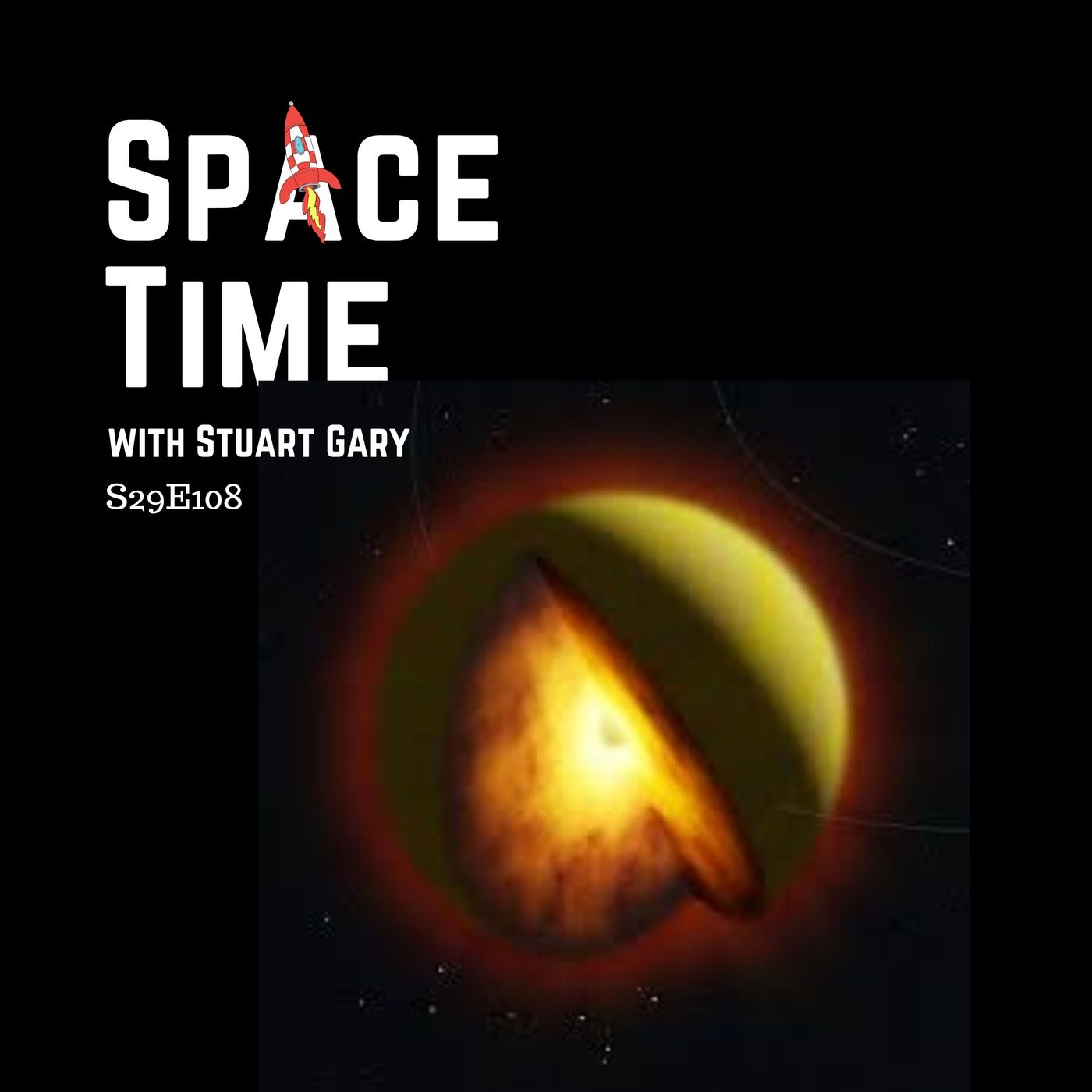
Molten Planets and Solar Storms: Unveiling Cosmic Wonders
About this episode
Our Guests This Week Dr Benjamin Pope from Macquarie University Chelsea Gohd NASA Public Engagement Specialist Astrophysicist Jason Rhodes NASA JPL Astrophysicist DIda Markovic NASA JPL Astrophysicist Eric Huff NASA JPL Our regular guests: Alex Zaharov-Reutt from techadvice.life Tim Mendham from Australian Skeptics 🌏 Get Our Exclusive NordVPN deal here ➼ www.bitesz.com/nordvpn . The discounts and bonuses are incredible! And it’s risk-free with Nord’s 30-day money-back guarantee! ✌ If you’d like to support the podcast and gain access to bonus content by becoming a SpaceTime crew member, you can do just that through The Big Bang editions on Patreon, Spotify and Apple Podcasts. Details on the Support page on our website https://www.bitesz.com/show/spacetime/support/
Get every episode summarized
Each time SpaceTime with Stuart Gary publishes, we email you a written briefing from the transcript — the topics, who appeared, and any specific claims, with the ad reads skipped.
Email me new episodesFree for 3 shows. No card needed.
Hosts & guests
Transcript ready
460 searchable segments. Every word is indexed and playable.
Full transcript
SpaceTime with Stuart Gary — Molten Planets and Solar Storms: Unveiling Cosmic Wonders. Machine-transcribed; use the interactive transcript above to jump the player to any line.
In today's digital age, your data is everywhere, and it's constantly at risk. Many organizations still rely on outdated fragmented tools, making data management slow, complex and cumbersome. But there's a game changer on the horizon, Cohesity Data Cloud. With Cohesity, you're not just equipped with any tool. You're empowered with a single AI-powered platform that enhances data protection and unlocks valuable insights. Imagine detecting threats faster with AI and automation and recovering your data in hours, not days. This isn't just about reacting. It's about building resilience across AI, cloud and identity. Interested in transforming how you protect your data? Visit Cohesity.com-data-cloud. Cohesity resilience everywhere. Hey, it's Kelly Rowland. You may not know this, but I have Exima. So I get how it can still your time. But why let Exima take over when you can talk to your doctor about Ebglyse? Ebglyse, lubricism app LBKZ, a 250-mg per 2-ml-liter injection, is a prescription medicine used to
treat adults and children 12 years of age and older, who weigh at least 88 pounds or 40 kg, with moderate to severe ebglyse. Also called a topic dermatitis that is not well controlled with prescription therapies used on the skin, or topicals, or who cannot use topical therapies. Ebglyse can be used with or without topical corticosteroids. Don't use if you are allergic to Ebglyse. Allergic reactions can occur that can be severe. I-problems can occur. Tell your doctor if you have newer, worsening eye problems, you should not receive a live vaccine when treated with Ebglyse. Before starting Ebglyse, tell your doctor if you have a parasitic infection. Pay partnership with Lili. Respect your time. Ask your doctor about Ebglyse and visit Ebglyse.com, or call 1-800-LiliRx or 1-800-545-5979. The Space Time Series 29 episode 100-8. Full broadcast on the 9th of September, 2026. Coming up on Space Time. Discovery of a new class of molten planet. Ancient tree warnings about the next big solar storm. And two giant blobs of hot rock
discovered on the Earth's core mantle boundary. Or that and more coming up on Space Time. Astronomers have discovered a new type of molten planet behind our solar system. The findings reported in the journal Nature Astronomy suggest this strange exoplanet stores large amounts of sulfur deep within a permanent ocean of magma. The exoplanet known as L9859D is about 1.6 times the size of the Earth, and orbits a small red dwarf star about 35 light years away. Observations with NASA's web space telescope suggested something unusual. The planet had an especially low density given its size,
and it piece to contain significant amounts of hydrogen sulfide in its atmosphere. Until now, astronomers would have placed the planet like this into one of two very familiar categories, either a rocky gas twirl for an atmosphere of hydrogen or a water world made up of deep oceans and ice. But the new findings show that L9859D fits neither description. Instead, it appears to belong to an entirely different class of planet, one containing heavy sulfur molecules. To try and look at what's going on, astronomers use computer simulations to try and reconstruct this strange world's evolution over the past 5 billion years. By directly linking telescope observations to these physical models of planetary interiors and atmospheres, the authors were able to determine what must be going on deep inside the planet. And their results reveal that the mantle of L9859D is likely molten silicate similar to lava here on Earth, with a global magmaeration extending thousands of kilometers beneath. This vast molten reservoir allows the planet
to store extremely large amounts of sulfur deep inside its interior and maintain that over geologic timescales. The magmaeration also helps L9859D to retain a thick hydrogen rich atmosphere containing sulfur-bearing gases like hydrogen sulfide. And normally, this would be lost into space over time due to x-ray radiation produced by the host star. The studies lead all of the Harrison Nichols from Oxford University says the findings suggest that L9859D may be the first recognized member of a broader population of gas-rich sulfurous planets sustaining long-lived magmaerotions. Now if that's the case, it means that aversey awards within our galaxy, the universe for that matter, may be even greater than previously imagined. Web observations from 2024 pointed to the presence of sulfur dioxide among other sulfur gases high in L9859D's upper atmosphere. The new models show that these gases can be created when ultraviolet light from the host star, the red dwarf, L9859, triggers chemical reactions.
At the same time, the magmaotion below acts as a massive reservoir for buffering these volatile gases, storing and releasing them over billions of years after the planet was formed. This combination of deep volatile gases within its interior and ultraviolet-driven atmospheric chemistry explains the planet's notable properties. According to the simulations, L9859D likely formed with a large amount of volatile material, and may once have looked more like a large subneption planet. And over billions of years, it gradually shrank as a cooled and lost some of its atmosphere. Now of course, magmaotions represent the universal initial states of all rocky planets, including planets like the Earth and Mars. So the new insights into magmaotion physics can inform scientists about our own world and its primordial history. This is space time. Still to come, what ancient tree rings are telling us about the next big solar storm, and two giant blobs of heart rock discovered on the Earth's core metal boundary.
All that and more still to come. On Space Time! New evidence in tree ring records are warning scientists that our sun can become far more violent than previously thought. The findings reported in the journal Communications Earth and Environment demonstrate how our local star can unleash a solar storm far larger than we've ever recorded, and a study of some of the planet's oldest trees suggested we could soon be due for one of these events. The first clear signs of exceptionally high solar activity came from Japanese cedar trees. In 2012, first in Miyaki, we were studying slices of ancient Japanese cedar taken from a tree filled in the 1950s. It had grown on Yakeshima Island, a protected site famed for its long-lived trees, some of which have stood for millennia, laying down one ring of wood after another year after year. These tree rings are not just markers of age, they're also
annual records of the Earth's atmosphere, and studying them could help scientists predict and prepare for future disruptive solar storms. The key is the relative proportion of carbon 14 in each tree ring. It reveals how active the sun was each year. While examining these ancient tree records Miyaki discovered that between the year 774 and 775, the amount of this isotope, carbon 14 in the cedar, jumped by about 12 parts per thousand, roughly 20 times larger than the change expected from ordinary variations in the sun. The massive spike means Earth's atmosphere must have been hit by sudden burst of unusually energetic particles, and the same signature was later identified in trees from North America and Europe, and the measurements of another radioisotope, radium-tenon ice-coast sampled, further confirmed the discovery. Now, scientists initially speculate that the cause may have been a nearby supernova explosion, a gamma ray burst, or maybe a blast from a neutron star. Now these have all been ruled out because
the nearest possible sources are far too distant, and that lifts solar flares from the sun as the most likely cause. Solar flares happen with magnetic energy that's been building up in the sun's atmosphere suddenly released. In a matter of minutes, a patch of the sun can brighten violently, ejecting radiation across the electromagnetic spectrum from radio waves to x-rays. Often these eruptions are accompanied by streams of high-speed charge particles and vast bubbles of magnetized plasma known as coronal mass ejections. Scientists know unusually large solar flares have hit the Earth before, the most famous being the Carrington event in 1859. That eruption was so intense that telegraph lines across Europe and North America caught fire. Telegraph operators suddenly got electric shocks, and a rural light snow that confined to polar latitudes was seen deep into the tropics. Ever since, Carrington has been the benchmark for solar violence. But the strange thing is, even Carrington wasn't powerful enough to leave a clear carbon
14 signature in tree rings. To do that, the sun would need to unleash a storm at least 10 times larger, a super flare. Now, since Miyaki's first discovery, scientists have found five more Miyaki events occurring roughly every 2,000 years. In 2013, Miyaki's team found a second spark in cedar and cypress rings confirmed in European oak and Siberian large. Then using burlium-ten measurements from Greenland ice cores and matching the carbon 14 signatures in Polish oak, cydas were able to identify another in the year 664. In 2022, two more events were identified, followed by a fifth in subfossil scotspile from the French Alps in 2023. That one dated back to a massive blast some 14,350 years ago. Although these super flares are rare, they still represent a challenge for scientists understanding of solar physics. That's because stars like our sun aren't expected to produce events on this scale. However, the evidence is clear they have happened
in the past and could happen again. To determine how likely these super flares are, scientists have been sifting through the records, combining high-resolution carbon 14 data from tree rings spanning almost any time millennium. And they've now come up with 8 more signatures, not quite as big as the Miyake super flares, but significant nevertheless. Five of these when newly measured in European oak, mainly from Germany and France, were three came from existing tree ring data sets. They then modeled Earth's carbon cycle to search for abrupt increases in carbon 14, finding four candidate intermediate events around the years 14, 553, 675 and 954, meaning a frequency of around 1 every 200 years. Benjamin Pope from Aquarius University says the exact nature of the danger posed by these intermediate class events depends on what's actually causing them. Pope says if the culprit is a coronal mass ejection, the main threat would come from the way the event distorts Earth's magnetic field. It could trigger a geometric storm,
driving unwanted currents through power grids, pipelines and other long conductive systems. The damage would be uneven, shaped by geography, geology and the layout of the infrastructure on the ground. Earth warns of a scenario in which an event may take out critical manufacturing capabilities. But interpreting solar events from carbon 14 can be complex. See, the carbon 14 spikes made high in the atmosphere, it then has to filter down into the air that the trees absorb. And by then, a tree may already be growing new wood using carbon stored from previous years. Wood that's formed at the start of the annual growth season could be especially prone to this blurring, while later growing wood may offer a clearer annual signal. Pope says some tree rings start growing around spring, but the carbon they used to grow that ring could be from previous years. The point of this work isn't only to work out how often civilization might be jotted by a super solar storm. Miyaki events may be telling us something profound about the sun
itself. Pope says the real question remains when will the next big solar storm come and just how bad will it be? So there's this thing called radio carbon dating where you measure the contents of carbon 14 and isotopes that's radioactive compared to carbon 12 which is most of the carbon in the world which is stable and you measure the content of carbon 14 and something and you're able to tell how old it is because carbon 14 is produced by radiation hitting the atmosphere. It filters through the atmosphere, the carbon cycle into plants and animals you and me and we are all constantly being topped up with fresh carbon 14 from the air and from the things we eat. The thing is though when we die which does happen to all of us, this top up stops happening and so it means that now the amount of carbon 14 which is radioactive and starts to decay is like a clock that can tell you how old something is. So the thing you need to know in order to tell how old something is is you measure the amount of radio carbon in it and you compare it to the amount of sugar that's started with but here's your problem. How do you know how much it started with and so there's actually a different
amount of radiation striking out the sphere every year producing a different amount of radio carbon and so there's no really easy way to be able to say from a physics or astronomy how much you should have started with and therefore how old the sample is. So what you got to do is take advantage of another type of clock that nature has provided us with that is tree rings. So every tree ring records a euro of growth you can see there's in your hardwood table and so the trick is that a good year and a bad year are usually the same good year and the same bad year for all the trees of the same species and same region and so what it means is that the pattern of long and short tree rings is really the same across all the different trees of the same species and same region where I might mean all the hew on pines and Tasmania or all the oaks in Europe or something right. So I mean quite a big region and quite a big species right and so what you can therefore do is you can read these like a barcode and say how old some tree rings are to the exact year. What you do is you start by day's in training when you look at an old tree today and you know what the day is
today and you count 200 years down back in time but then you look at older trees there might be in buildings or there might be fossilized in bulk or whatever you look at these older trees and you try and say okay where do these barcodes overlap who want me to and so you can build up a library going back millennia sometimes for some species and some regions of these tree ring barcodes that allow you to do a science called dendro chronology which is Greek for tree timing. It means you can find a sample of wood from any given year going all the way back to the ice age and so it means that you can say I know exactly how old this wood is and then I can measure the amount of radio carbon in it and therefore I can tell how much radio carbon it started with and so scientists have been using this for decades in order to do archaeology better. They've also been interested in doing astronomy with these trees so using the world's forests as the world's biggest telescope by saying well okay we're interested in not in the archaeology though we might be that specifically in how and why does the amount of radiation hitting atmosphere vary from year to year and so turns out that this is basically related mainly to solar activity so there's some waxes
and wanes and strength in terms of magnetic fields every 11 years and so when the magnetic field strong it blocks out a lot of radiation from reaching the earth and when it's weak a lot of radiation is let through it's like a force field protecting this from cosmic rays so I mean sometimes you have more radio carbon sometimes you have let so fast to good and so there was the scientist who for me archae was her name would be called the mearchy events to this reason who went and took a bunch of tree rings from the 700s AD and she measured their radio carbon content and found something shocking there was a single year huge influx of radiation about 774 AD unlike anything that had previously been measured in these tree rings and that was called the first mearchy event after that she took very precise measurements of a number of other such events which were maybe a little bit smaller and other scientists including our team have discovered other ones down the track and so there's maybe half a dozen rock solids discoveries of mearchy events and maybe a half a dozen more where different groups of people dispute like oh I think there was a big radiation event in this year so the critical thing is we don't know what they are
and these events happened all over the world they weren't just in Japan or Australia they absolutely they're everywhere so we know this was a global event absolutely and so we don't know what they are the fact that it was global probably tells you something it was astronomical right and the biggest sort of candidate for something that influences the radiation environment of the year is still the sun so a few of us have looked at is there any evidence for supernovae doing this and the answers they can know we've measured across a whole bunch of supernovae years no radiocarbon influence from from the sort of known supernovae it really is probably something much more local but what exactly the sun must be doing to cause these really up for debate is it possible that something other than the sun is causing these I think most people don't think so but certainly there are possibilities I think and these are fairly common it depends what you mean by common for astronomers very common you know they happen once every thousand years for you and me when we take off our hatches astronomers yeah probably not that common once every thousand years and something I'm losing sleep over the same news though once every thousand years they seem to
happen at random we haven't yet found any way of predicting the release is not a periodic once every thousand years the random once a thousand years until it means what's the chance it occurs and say in the next decade that could be one to check you're talking to an astronomer here is waiting with baton breath for edicarene and explode and the bedel goes to do its thing so I would love that that sort of that that sort of where I'm coming from so these are very exciting I think if one of these things happened I think we'd answer a whole lot of questions but we'd also be pretty concerned I think there'd be there'd be a lot of reasons to be worried one of the reasons I'm doing this research is because there is a remote but not tiny possibility that one of these will happen in our lifetime lots of 1% probability things happen all the time insurance is what we do to deal with those eventually problems come up now the trouble is if this is some kind of global event that brings in a lot of radiation we don't really know what it is how do you ensure against something you don't understand but where there are certain possibilities and let's talk about those but there are certain possibilities where it could be catastrophic for certain possibilities where it could be more than nine and a lot in between we need to understand these things so that we can
sort of find ways of protecting ourselves against them we've experienced the Carrington event 1859 that caused problems but we managed to survive that because we were only learning technology back then it was telegraph operators and people like that who went up getting electrocuted oh yeah so the listeners yeah so the Carrington event was the first recorded solar flare and it was also the biggest ever recorded solar flare that seems like a bit of a coincidence but the trick was we went very good at finding solar flares back then and so only unusually large ones would have been found and so what it did was there was a huge coronal mass ejection when mass from the coroner of the sun that is sort of surroundings gets ejected that is thrown out in the solar system as a huge blob of plasma and that struck the earth in the actual plasma directly isn't what caused problems on the earth it's that the plasma ship the earth's magnetic field and got deflected sounds good but it bent the magnetic field you know what happens when you move a magnetic field through a loop of conducting wire you generate a current and so what this did was it created a lot of currents in shate telegraph systems on earth and even in the 1850s
then that was just getting going that caused a huge loss of information power all these sorts of things in this nascent communications and power grid that the earth had now this could be catastrophic if the current and event happened today yeah in 1989 northeastern the United States was said Quebec especially oh yeah which isn't the United States but close enough they had huge blackouts absolutely and just in the last year we actually had blackouts in parts of Victoria as a result of a small solar fleeting yet and so like you know power companies satellite companies pay attention to either little ones if they if they sort of strike us in the wrong way and so a current event if that hit the earth today what you'd be looking at is unless we took appropriate steps to mitigate it really quickly you'd be looking at a catastrophic loss of a lot of satellites and the communications that depends on you'd be looking at power going out in a whole lot of high latitude countries unless people had really good forewarning and we're able to disconnect lots and lots of stuff now this would be blowing out transformers in how high latitude countries go okay well maybe that would not be destroyed directly too badly it depends
in the details but the trouble is you know where's all the industry in the world where you're thinking China Japan Europe North America that's all at high latitudes all the really high tech manufacturing so you'd be losing so much of the world supply chains all this business is now remember when the Suez Canal was blocked and all the terrible things happening in the straight at home news today there'll be nothing in comparison to the supply chain losses you'd see here and so that's really and these what are the products get off right yeah these are just minor events that last a couple of days it'll take decades to replace those transformers that blow that don't keep it really good of two three thousand transformers sitting there they have to be built oh yeah no we don't have stockpiles we don't have stockpiles you know you'd really need to bring those factories back online immediately and start to roll them out and reinstall them across power grids everywhere and yeah I mean if we took a proper action to have everything disconnected and to have repair kits and stockpiles like maybe it wouldn't be catastrophic but it's the sort of thing we really need to be investing money and time into sort of preparing for so that remember when COVID happened we all got vaccines within the year in the same way it's really important that
we have a lot of science and technology rolled out to forecast what the sun could do to us and start to take steps to mitigate it and so that instead of taking up civilization for decade causes some hiccups and some problems which we get over and we have no idea what's causing these things they're not just unusually high climaxes of solar max or anything like that we don't really know so the issue right is we don't see any radio carbon signal from the Carrington event at all it basically didn't affect anything that we can record in feelings so one interpretation of these of this Miyake events is that these are super duper Carrington events that is they're really enormous Toronto mass ejections maybe a hundred times bigger than Carrington which is pretty scary so if you get something a hundred times bigger than Carrington I don't know what you do like that you're looking at satellite for toast power grid internet god knows that would be a global crisis and yeah there might be ways to avert it but the best way to avert it is to understand the physics of what's going on on the other hand it isn't it's not that there's there's very little radio carbon signature of the biggest ever solar event and that's because most of the particles from those
CMEs don't actually reach the earth and so they don't produce radiation in the up-to-atmosphere that would produce this radio carbon so on the other hand there's these other types of solar event called solar energetic particle events SEP events or solar proton event where the sun releases beams of high energy particles and they can totally do this and you and I don't notice that they're going on they certainly cause problems to satellite they don't do anything to the magnetic field really that would blow out power grids on the earth so and scientists would find that our instruments go completely crazy while it's happening but otherwise other than maybe damaged to satellites which could be quite serious but on the ground you're not going to see all the transformers collapsing into civilization it probably wouldn't be great for us to have such an enormous solar energy particle event but we could probably cope with it other than the satellites just you wouldn't want to be in the south of the land again normally at the time that surely Helena absolutely not and you also wouldn't want to be in high altitude aircraft of poles I've seen papers saying that a sufficiently large solar energetic particle event occurring while there were aircraft over the poles which is all the time could actually have
really serious health effects astronauts just were there they're not going to get better necessarily there's one public just the other day pointing that yeah and so I mean in terms of commercial flights you do have a bunch of atmosphere protecting you but it's not as much as you'd like and so it could cause pretty serious illness even death if it's a really really really big event but astronauts they don't have much protection at all if you were in orbit or into planetary space good luck mate that's probably the end of you even these solar energetic particle events could be quite serious but the sorts of things we worry about are probably more specialized and more details than with these enormous coronal mass ejections but some of these theories they're there've been other things discussed the idea that might actually be the opposite is where the sun's magnetic field reduces a lot people are sort of debating is it possible that a shut off of that force field protecting us from cosmic rays could produce something like the arc event and the answer is a solid maybe I think people don't really think so but some people have certainly argued that that's Dr Benjamin Pope from a quarry university and this is space time
still to come two giant blobs of heart rock discovered on earth's core metal boundary later in the science report and you study suggest El Nino is intensifying as the planet warms all that and more still to come on space time in today's digital age your data is everywhere and it's constantly at risk many organizations still rely on outdated fragmented tools making data management slow complex and cumbersome but there's a game changer on the horizon Cohesity data cloud with Cohesity you're not just equipped with any tool you're empowered with a single AI powered platform that enhances data protection and unlocks valuable insights imagine detecting threats faster with AI and automation and recovering your data in hours not days this isn't just about reacting it's about building resilience across AI
cloud and identity interested in transforming how you protect your data visit Cohesity.com slash data cloud Cohesity resilience everywhere hey it's Kelly Rowland you may not know this but I have Exema so I get how it can steal your time but why let Exema take over when you can talk to your doctor about Epglis Epglis Lebrichizmab LBKZ a 250 milligram per 2 milliliter injection is a prescription medicine used to treat adults and children 12 years of age and older who weigh at least 88 pounds or 40 kilograms with moderate to severe Exema also called a topic dermatitis that is not well controlled with prescription therapies used on the skin or topicals or who cannot use topical therapies Epglis can be used with or without topical corticosteroids don't use if you are allergic to Epglis allergic reactions can occur that can be severe i problems can occur tell your doctor if you have newer worsening i problems you should not receive a live vaccine when treated with Epglis before starting Epglis tell your doctor if you have a parasitic infection paid partnership with Lily respect your time ask your doctor about Epglis and visit Epglis.com or call
1-800 LilyRx or 1-800-545-5979 shop vans and Albertsons for fresh savings every time you shop this week at vans and Albertsons get fresh boneless skinless chicken breast for 199 per pound limit and locally grown grape re cotton candy grapes are 299 per pound with digital coupon plus 24 packs of canada dry or 7-up 12 ounce cans are 499 limit 1 with digital coupon enjoy fresh and delicious savings for every meal hurry in these deals won't last visit vans or Albertsons.com for more deals and ways to save scientist have discovered two immense ultra hot rock structures located at the base of the earth's mantle some 2009 kilometers beneath Africa and the Pacific which are affecting the underlying liquid out core the findings reported in the journal nature geoscience show that these enormous blobs of solid superheated material encircled by a pole-to-pole ring of cooler rock have been shaping its magnetic field for millions of years
while we've traveled 25 billion kilometers in a space the deepest we've ever gone below our feet it's just over 12 kilometers consequently little is known about conditions at the core mantle boundary where the base of the mantle meets the top of the outer liquid core it's the most significant interface in the earth's interior and the region where new research is now uncovered exciting magnetic activity both measuring ancient magnetic fields and simulating the processes that generate them are technically demanding to investigate these deep earth features scientists need to combine paleo magnetic observations with advanced computer simulations of the geodinomoe that's the flow of liquid ion in the outer core which generates earth's magnetic field numerical models enable the authors to reconstruct the observations of the behavior of the magnetic field seen over the past 265 million years the results reveal that the outer cores up a boundary is far from uniforming temperature instead it displays strong thermal contrasts with localized hot regions
cat by these continent-sized rock structures it also showed that some parts of the magnetic field appear to have remained relatively stable for hundreds of millions of years while others have changed significantly through time one of the studies authors Andy Bigin from the University of Liverpool says the findings suggest there are strong temperature contrasts in the rocky mantle just above the core and that beneath the hotter regions the liquid ion in the core may stagnate rather than participate in the flow seen beneath the cooler regions these findings have important implications through the questions surrounding ancient continental configurations such as the formation and break-up of Pangaea and it may help resolve long-standing uncertainties in ancient climate paleobiology and the formation of natural resources these areas have always assumed that this magnetic field when averaged over long periods behaves as a perfect bar magnet aligned with the planet's rotational axis however these new findings suggest that may not necessarily be the case this is space-time
in today's digital age your data is everywhere and it's constantly at risk many organizations still rely on outdated fragmented tools making data management slow complex and cumbersome but there's a game changer on the horizon cohesity data cloud with cohesity you're not just equipped with any tool you're empowered with a single AI-powered platform that enhances data protection and unlocks valuable insights imagine detecting threats faster with AI and automation and recovering your data in hours not days this isn't just about reacting it's about building resilience across AI cloud and identity interested in transforming how you protect your data visit cohesity.com slash data cloud cohesity resilience everywhere hey it's Kelly Rowland you may not know this but I have exama so I get how it can steal your time but why let exama take over when you can talk to your doctor
about epglyss ebglyss lubricism ab lbkz a 250 milligram per 2 milliliter injection is a prescription medicine used to treat adults and children 12 years of age and older who weigh at least 88 pounds or 40 kilograms with moderate to severe eczema also called a topic dermatitis that is not well controlled with prescription therapies used on the skin or topicals or who cannot use topical therapies ebglyss can be used with or without topical corticosteroids don't use if you are allergic to ebglyss allergic reactions can occur that can be severe eye problems can occur tell your doctor if you have newer worsening eye problems you should not receive a live vaccine when treated with ebglyss before starting ebglyss tell your doctor if you have a parasitic infection paid partnership with lily respect your time ask your doctor about ebglyss and visit epglyss.com or call 1800 lily rx or 1800 545 59 79 shop vans and Albertsons for fresh savings every time you shop this week at vans and Albertsons get fresh boneless skinless chicken breast for 199 per pound limit 10 pounds and locally grown grape re cotton candy grapes are 2 99 per pound with digital coupon
plus 24 packs of canada dry or 7 up 12 ounce cans are 4 99 limit 1 with digital coupon enjoy fresh and delicious savings for every meal hurry in these deals won't last visit vans or Albertsons.com for more deals and ways to save and time out of tech another brief look at some of the other stories making using science this week for the science report a thousand year record of sea surface temperatures reconstructed from glypicous corals suggest El Nino is intensifying the planet warms with the El Nino southern oscillation enzer variability in the eastern Pacific roughly 35% higher now compared to pre-industrial times the findings reported in the journal science use high resolution measurements of modern and fossilized calapagas corals to reconstruct sea surface temperatures in the region over the past millennia and then compared those with climate simulations the fine out if the changes in enzer were impacted by global warming they found that variability in enzer was seen an unusually strong shift in the past 40 years
with modern variability nearly 37% higher than the pre-industrial record scientists have discovered that some centenarians may host rare cancer killing cells the findings published in the journal cell reports claims this rare type of immune cell starts expanding and cloning itself in people who live past 100 which they say could be hopping preserve their longevity by killing cancers before they grow the cells are cd4 cytotoxic t lymphocytes which are already known to kill some cancers and they appear to be more common in humans above the age of 100 to better understand them the authors analyze the blood of 28 people aged either 70 to 99 100 to 10 or over 110 in these groups the authors say the proportion of cd4 cytotoxic t lymphocytes had a median percentage of 4 9.6 and 17.6 respectively suggesting a real expansion past the age of 100 a new study has flipped the historic narrative about Australia's
thylacene that has many in tiger fighting the native apex predator was significantly different from the wolves and wild dogs it was likened to before being hunted to extinction a report in the journal nature communications claims scientists from flenders university examining thylacene skulls found their jaws were probably unsuitable for holding down large animals like sheep instead their long deep jaws with powerful snapping bites would have been more suited to subdue relatively small prey meanwhile a report in the journal bio med central ecology and evolution claims test many tigers hunted more like foxes the authors from the universe of the sunshine coast based their findings and a comparison of thylacenes with 48 living and extinct prey tree mammal species from the mystic dogs through the African wild cats a new study is found that the use of artificial intelligence large language models are making writing stars more similar in the process losing the individual identity and personality behind the work
the findings reported in the journal nature human behavior based on analysis of more than 880 thousand texts across different writing times the authors suggest this could make it more difficult to identify important clues about aspects of a person's identity personality and even mental health from their language they analyzed Reddit stories news articles academic papers essays social media posts and political speeches over time to see how the rise of widespread chat bot usage has changed writing style and they found evidence of both an intermediate shock where the introduction of chat GPT coincided with the sharp dropping variability and a sustained effect in which higher levels of AI usage have continued to reduce the complexity of language over time Apple's new iPhone 18 pro 18 pro max and false ultra have just been released and fans are growing wild needless to say the long awaited new passport size fold ultra heads the lineup
but the conventional flagship 18 pro max won't be left out it features larger battery smaller dynamic island a two nanometer a 20 chip set variable aperture main camera and a triple 48 megapixel rear camera system of course price will be a big factor this year with a 12 gigabyte ram and two terabyte model costing just over four grand with the details were job by technology editor Alex the harrow royte from tech advice start life we've got the iphone 18 pro the pro max but of course the big one that everyone's talking about is the iphone fold now this promises to have the most crease free display ever because they're talking about a piece of ultra thing glass on top the OLED in between and then a second piece of glass on the bottom with a liquid metal hinge Samsung has only got one piece of glass on top and then it's got titanium on the bottom now you can still see the crease on samsung's fold eight but you can barely feel it and i've got a Google pixel fold 11 pro and you can feel the crease you can it sort of feels a bit deep but on
the samsung it's it's virtually not there but the expectation is that apples is going to either not be there at all or it's going to be the flattest crease of all time which is incredible and i can't wait to see it and you are right they've gone with a passport size rather than the full size we officially don't know but i mean the rooms are so strong people have got millions of videos of a dummy unit like if apple doesn't come out with the fold new phone it's going to be a big massive disappointment for people the share price will crater but look it's also going to be the first apple keynote with its new CEO and 15 years john turners and engineer who has been with the company for 25 years worked on iphone's ipads airpods you know vision probe everything and this is effectively the start of a brand new era with what should be apple's most successful popular and ai enabled iphone's yet and tim cook is now the chairman of course and still got his handle the tiller he's still the mentor that's there doing all the international relations and the things that a chairman of the board does the john turners is now firmly in command we will see what sort of performance he gives of course apple no longer does live keynote unlike what do
will or samsung do but look apple is apple i'm expecting great things and uh you know will we see hints of new touch screen max and other things i don't think so it's the iphone event they're going to be all hands on deck for that there'll be more announcements later in the year for first touch screen max and of course we'll have an event next year by the end of the first quarter and we will have the iphone 18s the regular ones plus also the iphone 18e which will be the the low cost one and the iphone 18 amos by people who might come this week we shall see that's Alex ahara Roy from take advice dot live and this is space time and that's the show for now space time is available every monday wednesday and friday through bites dot com sound cloud youtube your favorite podcast download provider and from space time with
steward gary dot com space times also broadcast through the national science foundation on science own radio and on both i heart radio and tune in radio and you can help to support our show by visiting the space time store for a range of promotional merchandising goodies or by becoming a space time patron which gives you access to triple episode commercial free versions of the show as well as lots of bonus audio content which doesn't go to air access to our exclusive facebook group and other awards just go to space time with steward gary dot com the full details you've been listening to space time with steward gary this has been another quality podcast production from bites dot com it's fall in america make it count at the ram driving to fall sales event make it powerful with our strongest ram 1500 ever make it move with the ram heavy duty with an available commons diesel and make it go the distance with a 10 year or 100,000 mile powertrain limited warranty hurry and now for great deals during the ram driving to fall
sales event excludes fully electric vehicles applied to 2026 model year vehicles non transferable visit moapart dot com for complete details and a copy of the powertrain limited warranty come into the register trademark of commons ain't ram and hammy are registered trademarks of fca uslc shop vans and albertons for fresh savings every time you shop this week at vans and albertons get fresh boneless skinless chicken breast for 199 per pound limit 10 pounds and locally grown grape re cotton candy grapes are 299 per pound with digital coupon plus 24 packs of canada dry or 7 up 12 ounce cans are 499 limit one with digital coupon enjoy fresh and delicious savings for every meal hurry in these deals won't last visit vans or albertons dot com for more deals and ways to save it's fall in america make it count at the ram driving to fall sales event make it powerful with our strongest ram 1500 ever make it move with the ram heavy duty with an available commons diesel and make it go the distance with a 10 year or 100,000 mile powertrain limited warranty hurry and now for great deals during the ram driving to fall sales event excludes fully electric
vehicles apply to 2026 model year vehicles non transferable visit moapar dot com for complete details and a copy of the powertrain limited warranty come into the register trademark of commons ain't ram and hammy are registered trademarks of fca uslc
More episodes
More from SpaceTime with Stuart Gary

Comet Births and Neptune's Secrets
SpaceTime with Stuart Gary

Dark Matter Signals and Lunar Origins: Exploring the Universe's Mysteries
SpaceTime with Stuart Gary

Discovering Blazars and SpaceX's New Spaceport
SpaceTime with Stuart Gary

Martian Waters and Cosmic Secrets: Unravelling Mars' Ancient Liquid History
SpaceTime with Stuart Gary