Loading...
tvfilm
Moving the Tassels: A Conversation with Paul James Hatke
About this Episode
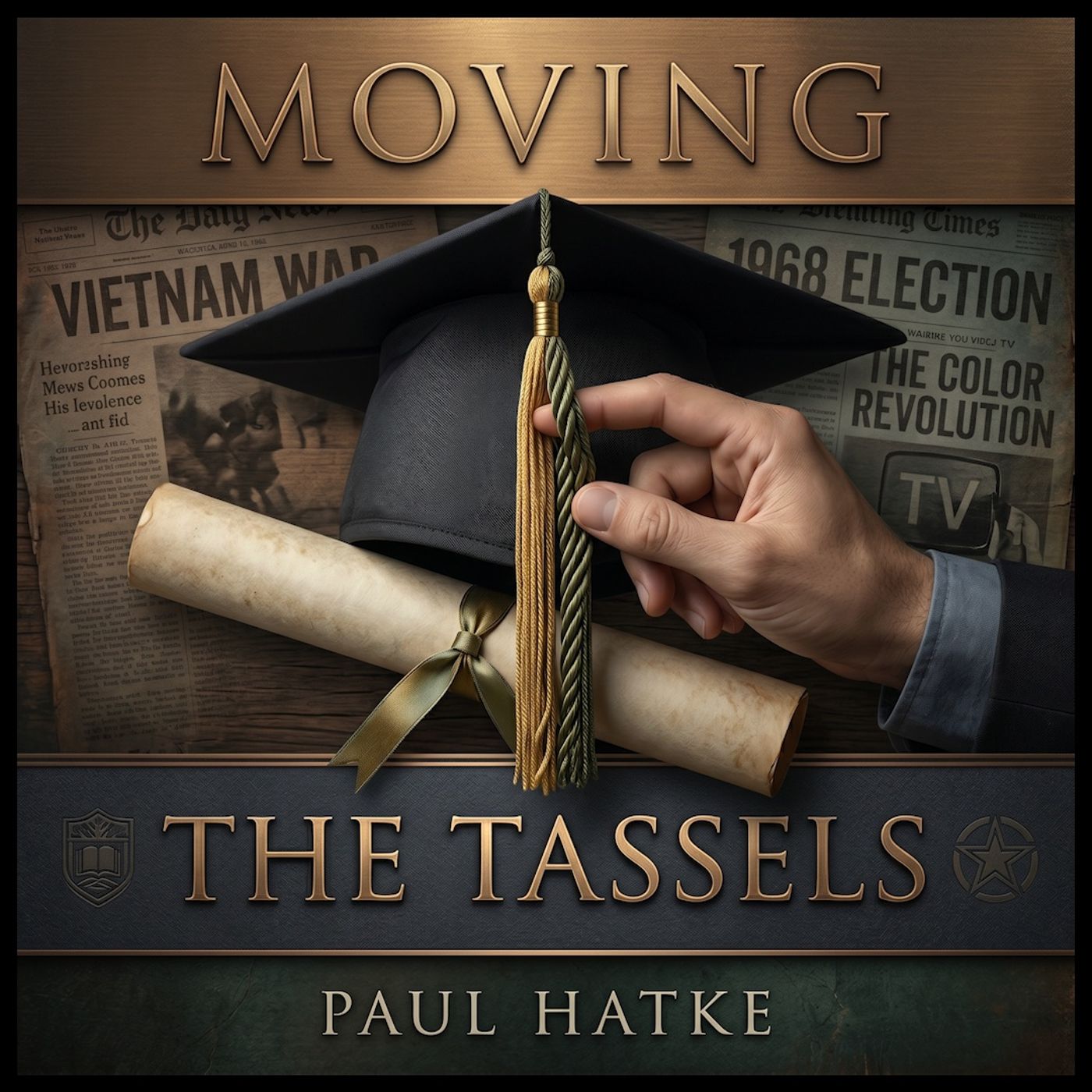
What does a teenager in 1968 have to teach us about the choices we're facing right now? In this episode, we sit down with author Paul James Hatke to unpack his debut novel Moving the Tassels — a gripping story set against Vietnam, political unrest, and the weight of decisions that can't be undone. This isn't just historical fiction; it's a mirror held up to the moment we're living in.
Grab your copy on Amazon or Barnes & Noble and decide for yourself which side of the tassel you're on.
Grab your copy on Amazon or Barnes & Noble and decide for yourself which side of the tassel you're on.
Hosts & Guests

Transcript
Hey, it's Benji Cole, son of Al Cole from CBS Radio and host of the syndicated talk
show, People of Distinction.
The talk gives you an in-depth view of some of the most dynamic, insolent, and successful
people on the planet, run to our website Al Cole Enterprises.com for more info.
Email me through Benji at Al Cole Enterprises.com if you'd like to get involved with what
we have going, and as always, please continue to like and follow our broadcasts.
People of Distinction is internationally syndicated, solely due to the love and support that
you all continue to give.
We're available across all major distributors, and as long as you keep following, we're
going to continue to put out the content.
Now sit back and strap in, because on the line with us today, we have Paul James Hatkey.
Now we're going to be discussing his novel, Moving the Tassels.
It's Amazon, it's Barnes and Noble Men, it's a lot of other places.
It is an absolute pleasure to have Paul here on the line.
The moment you start to do research on this novel, you are going to be taken back to a
time that maybe you might be familiar with, or a time that maybe you read about in the
history books or heard about it through family discussions.
It's also going to happen eerie similarity to what we see happening around us right now.
History repeating itself, but listen, the year is 1968.
Two assassinations, two months apart, a cold war that could go nuclear any morning, and
color TV bringing Vietnam straight into your living room for the first time.
Wes Patterson, our protagonist, wakes up as a high school senior in this novel, the question
that he has to answer, college, military, marriage, or drifting.
They don't feel like they're concepts from 40 years ago.
They feel like they're concepts from this morning.
This is layered, man.
It's nuanced and it's much more than simply an entertaining read.
Sip bags, strap in, trust and believe, we're going to scratch the surface here today,
but by the time we've concluded, the onus is going to be on you.
Head on over, purchase your copies, and fill in those gaps.
Paul, welcome to the network, and thank you for being with us.
How are you doing today, sir?
I'm doing fine, and she's thank you for having me.
Paul, when the opportunity presented itself to have you as a guest, we jumped at it.
Your novel is very entertaining, but it also has some stark contrast.
It can overlap with where we currently find ourselves, and I know a lot of people,
when they read Wes's story, they're going to see themselves a bit within it.
And I think that is a mark of a great writer, and we're looking forward to the discussion
and with a reflection.
Let's start off.
First and foremost, man, tell us more about yourself and your background.
I retired from Pell Communications Company back in 2011.
I had 41-year service with the company.
I always had a little bit of an interest in writing,
jotting down little notes things to tap, and something I decided to try to publish a novel,
and not look back thinking I wish I had done it.
I'm married to a wonderful lady by name of Rose, and that he was a little bit surprised when I
actually came out with this, that she was encouraging to some degree.
We've come from Louis O'Kentucky.
Still very sad here.
Been retired for 15 years, and it's done some volunteer work,
worked at a big box store for a short period.
Still keeping in touch with some of the people I had worked with in occasion.
It's always a pleasure meeting up with them.
Paul, I appreciate the backdrop.
Now let's jump into the book.
Okay?
The anchor for today is moving the tassels.
Tell us more about it.
I began this around 2015.
Chapter four in the book is where I started on this.
It was a memory of a Friday night high school football game.
This is probably the most truthful part of the book.
The rest of it is taking bits and pieces and thanks every call.
Adding some twists and turns in the book, but this particular chapter four
was Friday night football game that was pretty truthful to what occurred.
I decided after reading it and trying to polish it a little bit
that I could add to that particular chapter.
And that's where I came up with the book.
First decided to call it senior year of 1968 and 1969.
I thought that's really not a very good title.
I had to search for a title and what I thought about
being probably most common past school seniors is the moving of the tassels
with the very joint where I came up with the name on this.
Paul, I love the fact that you introduced that into the conversation because honestly
that's really where I wanted to go next.
Your title is unique, but it is something that we've all experienced.
And I think it can be very symbolic as well.
Not only in life in general, but especially with the book and the subject matter.
Moving the tassels, like you mentioned, it evokes a very distinct image of
a graduation, maybe not necessarily high school, whether it's college, whatever the case is.
But there is that very specific gesture of moving the tassel from one side of the
graduation cap to the other.
What I think is unique is your book is set in 1968.
This small physical gesture in 1968 means something entirely different, right?
It's not just the transition from one thing to the next, although it is.
It's just in a much grander scale.
What does it mean?
In the sense of your book to move the tassel from, quote unquote,
naivete to something else.
Talk to us a little bit more about that in the connection to your title and why you chose it to
be the representation.
I had to reflect on what was going on at the time.
One of the big things was the Vietnam War.
We were a divided country on this.
People from World War II veterans that fought Germany and Japan.
And they were upset at their children for the protests that were going on.
I think a lot of the people that were protesting were seeing the war as a political war that was
making businesses wealthy.
You see a lot of them seeing friends that were not coming back from the war.
It was difficult.
This was bringing Vietnam War into our living rooms, probably for a lot of people.
The head color TV was a big part of it.
We've seen this in color.
We were having reporters go in the fields and reporters seeing people that were being
injured.
It was a difficult thing.
And being divided like that, it was tough.
Music was adding to this, too.
Just four, four and a half years earlier, we had the very invasion of the Beatles and numerous
other groups from Great Britain.
And there's a lot of protests going on with music, kids that were listening to the radio,
or being influenced by, you know, examining your conscience.
You wonder what we were doing.
What was going on?
It was a transitional period, a number of things.
Not only being in Haskell, more kids were graduating from Haskell.
A lot of them going on to college.
We had muscle cars being developed into Troy.
The expressway systems were beginning to elase across the country.
We were beginning to work differently.
Computer operations were on the upswing.
We was preparing to go land on the moon, which is very similar to what's going on today.
We got the astronauts circling the area, probably a much more sophisticated
equipment, space caps.
It was an interesting time.
It's one of those times, I guess, like everybody would say.
You didn't live that particular period.
It's difficult to really express what we want through it.
People, this is a book that you need to add to your shelf for its Amazon.
It's Barnes & Noble.
It's entitled Moving the Tassels.
My Paul James had key.
Whether you've lived through it firsthand, or you've just heard about it,
to me, the connection that it has, the similarities that can be drawn,
are where the power lies.
Because there are a lot of overlapping things we're talking about in the book,
a very big transitional period, which I believe we are in the process.
We're at the precipice of one right now, from a lot of different areas.
But one thing that is undeniable is there is a very big transition that we are moving in
to and moving through at this current moment.
And I think that's why this book offers so much.
You mentioned something a moment ago, Paul, with regards to the things that were happening.
It brings up an interesting question here, because your main protagonist,
Wes, he is kind of in the middle to a certain degree.
I mean, you chose a young man who's observing these changes.
He's not a protester.
He's also not a soldier.
As the observer of all of this, I think it's an interesting position that you're putting the readers in.
Because you're not having them necessarily a line with one side or the other,
right? They're kind of right there in the middle, observing everything.
I believe that wasn't happened, Stan.
And I believe there was a strategy behind it.
And that's where I want to go next.
Why was the quote unquote title of observer the right moral position for your protagonist?
Well, I was right in this and trying to recall how I felt.
It's far from an autobiography that I was thinking about some of the things I was going through,
some of the people I knew that were in the service.
I had a couple of friends that had been called up to go into the Navy.
And I had a couple others that had joined the Marine Corps.
I had some family members that were in the Marine Corps.
And I guess I felt a little bit where I can't really choose and take sides on this.
I can express my opinion on one side or the other.
My family was involved in World War II, your degree.
I respect that, I respect what they did.
I guess this was a little bit difficult to make to go too much further with on this.
But I did want to try to present both sides of what was going on up there.
Yeah, this is far from an autobiography.
But you put yourself in the character's position.
And your readers are going to do the same thing.
Whether they live through this time or not,
they're going to join in on this adventure alongside your protagonist.
And by playing the mid ground, it allows them the freedom to truly examine each side.
And make the decision for themselves.
Would they be in support of that war?
Would they be in support of the protests
or whatever else was happening around this turbulent time?
Is a great aspect that you've added in.
And it allows a deeper connection with the readers.
Thank you for sharing.
My final question for you, Paul, as we close out.
We've discussed a lot, but is there anything you'd like to let our listening audience know
before we let you go?
You're completely about it now.
Part of the backdrop on this.
But it's a high school kid that's going from 17 to 18.
The draft is still going on.
Plus, a number of people were probably more people than the generation before
were going to college.
And once again, there was young people that were getting married.
Some people setting up career going into some career field.
Of some sorts.
It's just a time of transition.
And I hope I had expressed that a little bit, even for the protagonist.
He was not an A student by any means.
He had an older sister that's co-filed some that was.
And he drew some questions from her or asked her some questions once in a while.
She seemed like she had it all together and he didn't.
Some of his friends had it all together and he didn't.
And he was looking around.
And to see where he was going, even graduating from high school
was something he was not fully sure of that he was going to be doing.
He had the questions of having enough credits to get through.
And he does.
That's where he did get the opportunity to move his tassels from one side of the
more-to-board hat to the other.
Yeah.
I hope there are some parts that would be
filled in by the readers that they may enjoy.
Again, I deal with this particular time.
It was such an interesting time to grow up and experience.
I tried to draw on my memory trying to be as accurate as I could
on some of the things that were happening.
Now, people, I'm going to say it again before I offer my final spiel.
Remember, Amazon, Barnes and Noble, the book is entitled Moving the Tassels
by Paul James Hatke had on over there,
purchased your copies today.
This book is entertaining to no end.
But it offers a deeper message.
Paul has reminded us that moving the tassel
in that physical activity, it isn't about knowing the future.
It's about choosing who you are before the future chooses for you.
Ask yourself what you're doing right now.
That's the tassel. That's the move.
Deciding where you're going next and what is happening.
Hat on over, purchased your copies today.
Leave us the comments, let us know what you thought.
I'm excited to see how this conversation develops.
Paul, this has been an absolute pleasure, man.
Such an honor.
Keep up the fantastic work.
And once again, thank you for being a guest on People of Distinction.
Thank you, sir.
It's been a privilege and honor speaking with you on this message.


