Loading...
fictionscience
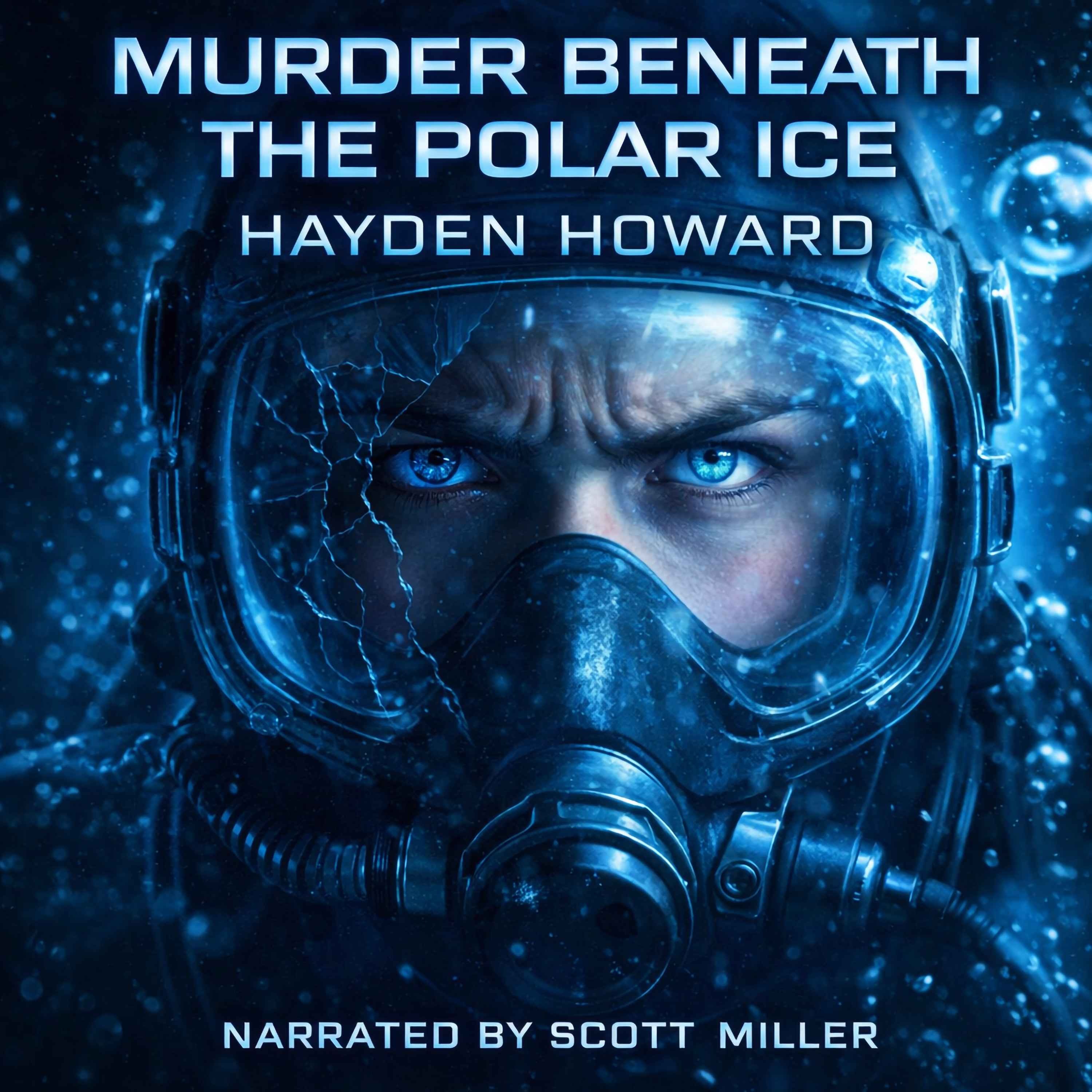
Murder Beneath the Polar Ice by Hayden Howard
About this Episode
Beneath the Arctic ice, a diver obsessed with life finds himself forced to choose who deserves to live when machines and men collide in silence. When one violent decision echoes upward into the political world above, he must face whether he has defended his crew—or ignited something far worse. Murder Beneath the Polar Ice by Hayden Howard. That’s next on The Lost Sci-Fi Podcast.
Hayden Howard was born in Santa Barbara, California, in 1925. His birth name was John Hayden Howard, and he wrote under the pen name Hayden Howard. Between 1952 and 1971 he published about twenty science fiction short stories.
Today’s story can be found in If magazine in July 1960 on page 114, Murder Beneath the Polar Ice by Hayden Howard…
Next on The Lost Sci-Fi Podcast, A powerful man on a lonely Saturnian moon believes he has found the key to ruling the Solar System. But when control slips for a single moment, the most obedient servant on Phoebe may decide the fate of them all. Failure on Titan by Robert Abernathy.
☕ Buy Me a Coffee - https://lostscifi.com/coffee
===========================
🎧 Newsletter - https://lostscifi.com/free/
Facebook - https://lostscifi.com/facebook
YouTube - https://lostscifi.com/youtube
Instagram - https://www.instagram.com/lostscifiguy
Bluesky - https://bsky.app/profile/lostscifipodcast.bsky.social
👕 Merchandise - https://lostscifi.creator-spring.com/
===========================
❤️ ❤️ Thanks to Our Listeners Who Bought Us a Coffee
$200 Someone
$100 Tony from the Future
$75 James Van Maanenberg
$50 MizzBassie, Anonymous Listener
$25 David Bell, Steve, Miriam, Someone, Someone, Eaten by a Grue, Jeff Lussenden, Fred Sieber, Anne, Craig Hamilton, Dave Wiseman, Bromite Thrip, Marwin de Haan, Future Space Engineer, Fressie, Kevin Eckert, Stephen Kagan, James Van Maanenberg, Irma Stolfo, Josh Jennings, Leber8tr, Conrad Chaffee, Anonymous Listener
$15 Every Month Someone
$15 Someone, SueTheLibrarian, Joannie West, Amy Özkan, Someone, Carolyn Guthleben, Patrick McLendon, Curious Jon, Buz C., Fressie, Anonymous Listener
$10 Anonymous Listener
$5 Every Month Eaten by a Grue
$5 TLD, David, Denis Kalinin, Timothy Buckley, Andre'a, Martin Brown, Ron McFarlan, Tif Love, Chrystene, Richard Hoffman, Anonymous Listener
https://lostscifi.com/podcast/murder-beneath-the-polar-ice-by-hayden-howard/
Please participate in our podcast survey https://podcastsurvey.typeform.com/to/gNLcxQlk
Hosted on Acast. See acast.com/privacy for more information.
Hosts & Guests
Transcript
Beneath the Arctic ice, a diver obsessed with life finds himself forced to choose who
deserves to live, when machines and men collide in silence.
When one violent decision echoes upward into the political world above, he must face whether
he has defended his crew or ignited something far worse.
Murder Beneath the Polar Ice by Hayden Howard.
It's next on the Lost Sci-Fi Podcast.
Hayden Howard was born in Santa Barbara, California in 1925.
His birth name was John Hayden Howard, and he wrote under the pen name Hayden Howard.
Between 1952 and 1971, he published about 20 science fiction short stories.
Today's story can be found in if magazine in July 1960 on page 114, Murder Beneath
the Polar Ice by Hayden Howard.
Wavelets of cigarette smoke drifted across the comfortably lounging and listed man in
the air-conditioned compartment of the Fleet Ballistic Missile Submarine, as they sat
watching Barney.
Sweat streaming from his swollen vein forehead, hurried and grotesque in his black rubber
diving suit, exploding triumphant curses like underwater demolition charges, Barney finished
tightening the control cables of what resembled a torpedo with two open cockpit.
This time the little gal raises her hydropelanes.
At this contrast of men, the murderer had to grin, but carefully in order not to sweat
and ruin the insulating qualities of his three woolen layers of long johns.
The Submariner seemed quiet talking and cooperative, as well adjusted as sardines and a can.
The diver Barney was foul-mouthed and fiercely individualistic.
A wonderful guy is diving, buddy.
A legend in his own time, Barney was reputed to a verison from the mine-steroon waters
of the Korean coast.
At the time of the Wansan Incheon landings to give advice to General MacArthur.
As an underwater demolition team diver, Barney dated clear back into the murderer's childhood
recollections of World War II, to dim names like Quadulent and Guam, where former C.B.s
became combat divers to wire and blast Japanese underwater obstacles, and leave welcoming
signs for the Marines.
Barney was only quiet about two things, his age and his circumference.
He still fancyed himself a baseball catcher, and his stubby fingers showed the deleterious
effects of grabbing at foul tips with a bare hand, but those same fingers could expertly
repair a wristwatch, and the automatic transmission of an admiral's car, and hawk one and borrow
the other.
Barney had managed to put his homely younger sister through college, and was now maneuvering
to marry her off to a lieutenant commander on the staff of admiral Rickover.
And he could expertly joke the fears out of his diving, buddy.
Winking at his comfortably smoke-filled audience, Barney dumped the sack of non-magnetic tools
into the forward cockpit of the minisub, he personally had built, and cocked his head.
Murderer here is hoping the villain is a sea-serving.
Don't laugh, you sea-horses.
The latest scuttlebutt from Alaska has it that every time a picket boy goes dead out here
under the ice, the last sound at broadcast is a sword of two-feet crunch.
They push the joke a little further.
Turn your periscopes on the blade murderers wearing.
John Paul Jones used to issue those for cutlaces.
Murderers helping to fight the sea-serpent hand-to-hand.
His grin widening with embarrassment, the murderer felt called upon to retort.
I'll give you a better suspect for stealing our picket boys, Santa Claus.
These are his territorial waters.
Are you aware that in the middle ages Santa Claus was the patron saint of thieves?
Now, Mr. Collegeboy, Barney began.
You just want to show us you also studied history, not just marine biology.
This boy will even tell you a long Latin name for a little something that floats like
dandruff in the water.
A touch of pride appeared in Barney's voice.
He can tell you its whole life history, man what eats it, and why it's important, and
why it will be a lot more important fifty years from now when your kids will need a lot
more food from the sea.
There was a perceptible slowing, and the weird sound from the atomic submarine's heat
exchanger muted.
Barney glanced at his pressure-proof watch.
The murderer tensed.
That's Collegeboy, it may look like a tennis player.
Barney went on as if nothing had happened, but in the water, when murderer sees something
swimming down there, he doesn't care how big it is.
We were installing the broadcast aerial from a picket buoy up through ice, and murderer
just retracted the magnesium flair pole, so I'm half blinded.
I looked down.
I see something so big I want to get out of there on a bicycle, but down murderer swims
with the magnesium flair in one hand, and is cutless in the other.
It's as sharp as big as a small whale.
The flair hypnotizes it.
Round and round they go, with murderer stabbing away, letting in sea water, until that shark
bugs out of there like a bare-bottom boy from a swarm of bumple bees.
The murderer studied his death gauge to cover his embarrassment.
The reason the shark had been so big was that it belonged to a species with the way-like
habit of straining the water for minute crustaceans.
It was harmless, and it went from his first thrust, then it's chagrin-hide, it tends
to armor toughness, and it had been like trying to stab a submarine.
It left because it had no reason to stay.
I'm relieved, one of the submarineers left, that stabbing fish is how we got the name
murderer, not only fish, Barney went on enthusiastically.
This boy almost got himself court-martial.
They're working from the icebreaker, out from Point Barrow, diving from a whale boat,
and before the Annapolis Ensign can say a word, murderers over the side, we put our faceplates
in water.
He's bubbling down on a walrus.
I swear he rides it like a buckin' horse.
You need a long blade in the Arctic, and ugly.
We've been a cable to that walrus from the icebreaker.
The walrus stalled the winch.
What about tusks, a submarine's voice asked?
The murderer had been well aware of tusks.
For three days he had been studying the walrus herd with fascination.
These staring-eyed, noisy mammals were living in icy water that would numb and kill a man
in a few minutes.
Some of them were diving to clam beds more than 250 feet down, where their bodies were
subjected to a pressure of more than eight atmospheres, and shallower water, where cockles
predominated.
He had actually observed them raking the muddy bottom with their tusks and rising with
great disintegrating masses of mud and shells between their flippers.
Few men had ever seen that.
He marveled at the evolutionary process by which some primitive land mammal of the Eocene
period had become the walrus.
Why he had swum down and attacked the walrus, he did not know.
Afterward he fell to shame, not just because it was a dumb thing to do, manned he'd had
three ribs cracked and should have been killed.
Not because it was a showoff thing, was sailors urging him to stand in front of its hoisted
body so they could take pictures for their girlfriends.
Not because Barney lost his appetite for a couple of days and didn't seem very eager
to dive near the herd.
What bothered him was the indescribable feeling he'd had as he swam down with his knife
to the walrus, a feeling closer than hunger.
When we get back I'll show you the photographs.
Barney was insisting probably, when they assigned this boy as my diving buddy.
They sent his name along, murder.
If it swam, murder will go down after it, they said, and they weren't lying.
And that was not how the name originated.
Sitting there in the drifting cigarette smoke, feeling the sweat soaked through his long
johns, the murderer wished the submarines commander would hurry up and decide on a position,
let them out of the boat, get it over with.
Probably by now even the guys who were in UDT training with him believed he got the name
by murdering fish, they gave the name to him.
But it was during an orientation meeting with diagrams and graphs and talk of megatons
and current born radioactivity and a model of an atomic depth charge on the table.
An incredulous revulsion that come over him, this mindlessly mechanical can of death that
could poison, could make useless two billion struggling years of life, all wasted single
celled ancestors, diatoms, copapods, wondrous fish.
During the discussion he had kept exclaiming, it's murder, it's murder.
This was how he had acquired his name.
Hey, murderer, one of the submarineers laughed, you should cut off a sea serpent steak for
the skipper.
I bet he'd go for one, speaking of murderers, the murderer blurted, suddenly detesting
the name, raising his clean cut angrily intelligent face, flooding his long johns with angry
sweat.
You all are potential murderers, on a big scale, let's say 10,000 victims a piece.
I kill a few fish so I'm a murderer, but you are all gears and cogs of a mass production
murder mechanism called the Fleet Ballistic Missile Submarine, an impersonal machine
that not impersonal, the commander's voice said clearly as he came into the compartment.
This boat is just another tool for survival, like a shield or spear, men make the decisions
for it.
Barney in an attempt to ease the tension, you want us to bring you any ice cubes, commander?
The commander's gray eye studied Barney's red vein ones.
Just bring yourselves back, Barney, we'll settle for that.
He touched the minisum.
All I can say is we think we're in the sector where the picket buoy shorted out.
There have been such meager appropriations for hydrographic surveys in the Arctic Ocean.
We have in a very clear picture of phatometer landmarks, even in this sector, so the navigator
has depended pretty heavily on his dead reckoning and the inertial navigation.
What I'm getting at is don't spend too much time looking, use conservative search patterns,
give yourself plenty of margin to find your way home to us.
We'll do our best to hold this position, slowly the commander smiled, we'll keep the
coffee hot until you get back.
The murderer watched them roll the minisum along on its cradle and into the chamber.
From the stern the minisum looked less like a torpedo, instead of the compacts round
propeller blades associated with high speeds underwater.
The minisum had long narrow blades, which might have looked more appropriate on a right
brother's airplane.
These would unwind through the water so slowly there would be no cavitation, no tell-tale
bubbling sounds.
One last thing the commander said, including the murderer in his grey eyes, no aggressive
action.
If you should meet someone, break off contact in a dignified manner and come home.
Strangely, the commander smiled again and glanced at his watch.
Right about now my two kids are waking from their afternoon naps and running out into the
backyard in their underpants to swing on the swings.
No aggressive action, okay?
The murderer felt thankful he was not the commander, with the responsibility for sixteen
hydrogen war-headed Polaris missiles on his back.
Weighted down by his air tanks, the murderer crawled into the chamber beside the minisum
and reached into the stern cockpit.
He unreeled a few feet of the red wire and plugged it into the chest socket of his electric
suit-armor.
Out there you couldn't search very long without battery heat from the minisum.
Automatically checking his full face mask, he connected with the black wire and tested
his throat mic, earplugs circuit.
One, two, three, four, shut the door.
Barney's voice croaked weirdly.
For complicated two-man disassemblies underwater, the traditional hand signals were not enough.
The minisum acted as a telephone exchange.
Turning from the minisum, Barney plugged into the telephone connection in the wall of
the chamber, giving them the word.
From the way the Arctic Ocean fire hosed into the chamber, the murderer guessed they had
at least a hundred feet of water standing on them.
This captain had no intention of smashing his periscopes on pack ice.
Finally, the murderer grinned while the water crept up his body.
He knew the limiting factor in their search for a picket buoy.
Any picket buoy was the survival time in their air tanks.
As for the minisum, it had the capability of keeping their corpses warm for several hours
thereafter.
With its gyroscope, efficiently clicking commands to the rudder, it would maintain a
straighter course than any man could steer.
If it could eat fish and reproduce itself, the waterline rose above his glass faceplate.
On the curved ceilings of the chamber, the air shrank into a squirming bubble.
The pressure had been equalized.
There was a cold metallic screech as Barney opened the outer hatch into the Arctic Ocean.
Valve and additional hiss of compressed air into the minisum's forward flotation tank.
The murderer gave it a gentle push and wrote it out.
His hand on the air released Valve now to prevent the increasingly buoyant minisum from
falling upward against the white glaring underside of the ice pack.
There's a hell of a current up here, Barney's voice croaked.
The murderer glanced down, and his free arm clutched the cockpit in an anthropoidal
fear reflex of falling.
The water was that clear.
In there, the submarine seemed to drift away like a great dirigible in the wind, but
the murderer knew the minisum was actually doing the drifting, tinkered carefully with
your gyroscope, Mr. Navigator, Barney laughed, and we'll go take a look for your sea serpent.
He gave Barney a straight course into the current.
The murderer had had nightmares of being lost under the Arctic ice pack.
Keep an eye peeled on the ice, Barney muttered.
The murderer kept both eyes on the instruments, and gave Barney a 180-degree change of course,
trying to determine the speed of the current.
One way is as good as another, Barney laughed.
Unfortunately, this had to be a visual search.
The drawing-board boys had designed the picket buoy so they would not be detected, and thoughtfully
made them self-destroying in case they were.
If anywhere near the submarine would be recorded, and the under-ice warning system had actually
worked against their own submarines.
But the picket buoys in this sector, one by one, had died without a warning sound except
as scuttlebutt would have it.
A toothy crunch, this pack ice has changed, Barney's voice muttered.
Barney and the murderer had been one of the diving teams out there when a submarine ejected
the buoys beneath the polar ice.
A buoy would squirt from a torpedo to, when the non-magnetic float struck the underside
of the ice, metal rods clutched upward like the legs of a spider clinging to the ice.
A thread-like cable lowered the tiny instrument capsule into the depths.
The capsule's small size was intended to foil typical mine detection sonar, while the
float was supposed to merge with irregularities of sonic reflection on the underside of the
ice.
Some admiral had even ordered the float's painted white, but they still cut off light and
appeared dark from beneath the ice.
After the divers had melted a quick hole through two or three feet of pack ice and extended
the whip-like aerial into the polar air, headquarters could keep track of the drifting
buoys location.
Intermittently, for the classified number of years the batteries were supposed to last,
each buoy would broadcast its own identification code, only coming through with a high wattage
warning when its instrument capsule in the depths of the Arctic Ocean was awakened.
The Joker here, the murderer thought, was that the aerials might be hard to see, but
any simple fool could make himself a radio location finder, live buoys could be honoured
from the surface ice.
Oh, dry I am, Barney's voice croaked on musically.
Oh, dry I be, nobody knows, nobody cares.
Now the white underside of the ice drooped in downward bulges, indicating thicker masses
of old ice that had been frozen into the pack.
The murderer saw the gray outline of driftwood entombed in this old ice, drift ice from the
Siberian rivers, Barney croaked.
When we planted the picket buoys, our sector didn't have any of this.
The murderer looked down at his instruments, preparing to change course.
My God, look, Barney's voice croaked.
And his black rubber arm pointed upward.
The murderer's breathing stopped as he made out something quivering up there.
What is it?
Animal, vegetable, or mineral, Barney weased?
If it's animal, I don't want to be around when whatever laid these eggs comes back.
Swing up there on the underside of the ice in a gelatinous mass, at least twenty feet
across, it resembled a mass of gigantic frogs eggs.
But the murderer decided there was too great a variation in size for them to be eggs.
It was nearest the outside of the mass seemed clear, more transparent than the surrounding
gelatinous substance.
The murderer's excitement began to fade.
They're not eggs, he said disappointingly.
I think there only bubbles encased in some sort of soft plastic, mineral, Barney said,
with some relief in his voice.
Now I see that dark part in the middle as the shape of a can.
The bubbles must be to float a mine or secret mechanism.
His voice ended excitedly.
Barney wanted nothing to do with live things.
He liked mechanical devices that clicked and buzzed and could be taken apart and then put
back together.
He eased the mini-sub up toward the gelatinous mass.
Don't bring the mini-sub too close, the murderer of gasped.
Using a mechanical click as the impersonal gadgetry within the can detected their approach
and cocked the lifeless steel prongs of a detonator.
Barney laughed in excited contrast, even our air tanks are non-magnetic.
Or if it's hydrophonic, the noise level that set it off would have to be plenty high
because of all the crunching sounds every day in the ice.
Now I'm going to find out what it is.
Barney rose from his cockpit, trailing his green-stain canvas bag of non-magnetic tools.
You're not going to cut into it, are you?
The murderer cried.
That's what the taxpayers pay me for, to protect them from… you name it.
Murder?
You sail the mini-sub off until all my telephone cable is out.
Just like when we practice disarming our picket boys, I'll tell you every move to make.
If it's a mine, the murderer said, I'll be as flattened as you.
Take notes on your navigational pad.
I'll start with a little experimental cut into the jello.
We can't go off and leave this thing.
We'd never find it again.
Man, it wouldn't be exactly smart to tow it to our submarine until we know what its
insides are supposed to do.
Barney's black rubber arm was sawing vigorously up and down.
This jello is tougher than it looks.
Very ingenious.
I'll bet this was a compact little bundle when a submarine ejected it into the water.
Probably sea water makes it swell, and chemicals fizz in sides so that the bubbles appear and
float the can up to the underside of the ice.
This is important, Barney's voice croaked on.
I've come to some thin, shiny wires.
They seemed to be all through the jello and the curve back in toward the can.
The murderer clenched his hand.
He could feel the tendons and imagine the wonderfully intricate nerves of his living hand.
He'd been frightened many times under the sea.
Occasionally divers talked about which way they'd rather go.
Nitrogen narcosis was popular among the heavy drinkers.
Barney's choice, a nice, close mine explosion because it would be so quick.
They thought the murderer was crazy when he said he'd rather be eaten by a great white
shark than smashed by some miserable explosive gadget.
Now I'm spreading two wires apart.
Barney said, call me.
But I've left the layer of gelatin around each of them.
I will not cut the wires, and I'll try not to let them touch each other.
Gradually his head and shoulders disappeared up into the gelatinous mass.
Don't snag your tanks or regulator on a wire, the murderer breathed.
Now I'm cutting within a few inches of the base of the can.
Only Barney's kicking legs showed.
My air is filling the cut, and I'm going to open up a chimney.
Bubbles emerge from the side of the swaying mass.
Suppose this thing is atomic, the murderer said.
It would crush our ballistic missile sub from here.
This is peacetime, boy.
Nobody's full enough to let an atomic mine go dripped and around with the ice.
The murderer looked down at the hard metal shell of the minisub.
You could blast and smash it, and it would still be metal.
You even could vaporize it, and its atomic particles be somewhere, or changed into energy,
but nothing really lost, because it had never been alive.
The murderer thought of the commander's two kids waking from their naps.
It had taken life two billion years to get that far, and it all could be lost.
Right now was Barney committing aggressive action?
He thought again of that orientation class where they theoretically learned how to disarm
an unexploded atomic depth charge.
He had expressed his feeling that these atomic charges were murder.
The fools had laughed and begun calling him murderer.
The bottom of this can is his blank, Barney said, as a sailor in one of those modern art
museums.
I'm going to cut my way along the side of the can and see what I can see.
A little fish, perhaps lost from its school, peered into the murderer's glass faceplate.
Its swinders eye grew inquisitively larger, and he thought of the millions of cooperating
cells that made up its eye and optic nerve and receiving brain, and the marvel that the
individually drifting cells of two billion years ago could have achieved this.
There was a contradiction, he thought.
He was amazed by life, and yet he speared fish.
Did he enjoy feeling life wriggle on the end of his spear?
I've reached the top, Barney's voice croaked.
There's a rod here.
Like this, a vertical rod.
It extends up into the ice like what the aerials of our picket boys.
I knew it wasn't a mine.
This is how they plan to detect our atomic submarines.
This will make a very interesting present for Admiral Rickover.
At this instant there was a darkening slap against the murderer's mask.
His eardrums burst inward.
His intestines squeezed up into his chest from the force of the underwater explosion.
He blacked out.
Icewater seared his face.
He was drowning.
Convulsively his hand groped for his mask.
The glass was intact.
His hand dragged the mask back to a proper fit upon his face, and compressed air forced
out the seawater.
He could feel the telephone cord pulling at his mask.
Everything was blinding white, and he realized he was belly up beneath the ice.
Barney?
The telephone wire began to drag him down head first, and he went down at hand over hand
toward the slowly sinking minisub.
Barney.
Further down he saw Barney's black rubber suit spread eagle in sinking, and he swam
clumsily down past the minisub.
He clutched Barney's black rubber arm and dragged it toward the minisub.
The black rubber's suit seemed to have no bones.
Everything drooped and swayed as he tried to fit Barney into the stern cockpit.
When he wrapped Barney's wires to tie him in, they came face to face.
There was no glass in Barney's mask.
The glass had burst where the face had been.
Barney's eyes narrowed, and helpless rage at Barney's death.
Dragging himself into Barney's forward cockpit, he valved air into the minisub's forward
flotation tank, raising the torpedo-like nose.
It was then that he saw them up there, silhouetted, small, and frog-like against the blinding
white ice, two divers.
The two silhouettes were looking down at him, and he knew they had been attracted by
the explosion of their gelatinous picket buoy.
He looked all around for the dim gray outline of their submarine, but there was no sign
of their home, and his gaze concentrated with wide-eyed intensity on their black paddling
shapes as his minisub rose from the depths.
He saw them exchange hurried hand signals.
They began to swim away side by side.
Their fins fluttering rapidly now.
They were swimming a definite course, and still there was no sign of their submarine,
as his minisub and exorably gained on them.
Now that he had reached their altitude, he noticed they were already tiring.
One diver looked back, then swam frantically to catch up with the other.
Like a slow fighter plane, the minisub came in on them from behind, and one diver pushed
at the other.
They again exchanged hand signals, losing yards to the minisub, and one began to swim hard
while the other turned back, facing the minisub, raising his hand in what appeared to be
a courteous military salute.
The minisub kept coming straight at him.
When the diver spread his arms in a gesture of peace, the minisub's torpedo-shaped nose
rammed his belly, unsheathing his long blade, the murderer struck.
As the diver wriggled, the murderer withdrew the blade and struck again, airbubble streamed
from the diver's chest with each exhalation of breath as he backwatered.
His expression seemed mild surprise as the murderer struck a third time, driving the
blade down between the man's neck and collarbone, pushing him deeper.
The next blow smashed the mask, belatedly the man's hand flurried, seeming to clutch
at his bubbles as he sank.
The murderer looked up.
Far off onto the ice the other diver had stopped, was looking down, watching, and the
murderer held up his blade as a signal, and turned the minisub upward after him.
This diver took evasive action among the downward bulges of old Siberian ice, and suddenly
vanished, although there was no sky glare in the water.
The murderer suppose the diver had found an open lead in the ice and would rather freeze
to death, or at least put up a fight from the edge of the ice and die in the water.
Looking more air into the minisub's flotation tanks, the murderer steered it rapidly up
into the oddly round, oddly dim lead in the ice pack.
At the edge of his mask vision he glimpsed a longish tubular shape suspended in the water,
but the minisub was rising too fast for him to get a good look.
The overboient minisub bloomed above the surface and sloshed back, rolling unsteadily while
the film of water slid off his mask without freezing, and he saw.
The white blur became the biggest twin-roaded copter he had ever seen, squatting there on
the ice, white except for its glass.
Then his eyes were attracted by motion, by the parka-clad man hauling the surviving diver
up on the ice.
Other darkish figures were simply standing there, some of them beginning to point.
Looking them was a smaller helicopter, with the loop-shaped aerial of a radio location
finder mounted atop its plastic dome.
There was something wrong with the sky, and the murderer realized it was not the sky.
It was a vast white canvas dome dimpling in the polar wind.
The unnatural circle in the ice and the equipment grouped around it all were hidden from
aerial observation.
Looking at him from the fuselage of the huge helicopter, and so close that his eyes had
avoided it, was a metal boom with a hoist cable taught into the water, tethering something
below the surface.
Some of the men were running toward the huge helicopter now.
In front of them at the edge of the ice lay shapeless bundles of what appeared to be
black rubberized canvas, and he wondered fleetingly if these contained more of the soon-to-be
gelatinous picket buoys.
One of the figures was aiming something at him.
As the murderer let air out of the flotation tanks and swiftly sank, he realized it had
not been a gun.
It had been a camera with a telephoto lens.
He passed the tubular shape on the end of the cable.
It was an anti-submarine torpedo.
When he sank deeper he passed a cylinder dangling from two black rubber insulated cables.
He valved compressed air back into the flotation tanks and came up under the ice, so hazardously
close he had to duck his head, as he steered a weaving course among the downward bulges of
old Siberian ice.
Even though he had been deafened, he felt the sonar pulsing against the ice, searching
for him.
When he felt it knocking against the mini-sub, pinging against his air tanks, thudding
accusingly against his bones, it followed him wherever he steered.
He smiled blarily.
This would be the ultimate if they unleashed the expensively intricate homing torpedo.
At one man riding a cheap mini-sub constructed by a big-handed happily singing petty officer
on his own time.
He hoped they would waste the torpedo on him.
If he had to be destroyed by a gadget, an infernal machine, at least it was better to
be killed as an individual rather than in a group so large he would be nameless in death.
Abruptly the sonar left him.
They must have decided he was not going to lead them back to his submarine.
Now they were hurriedly ranging for it.
He cruised on and on with his dead cargo.
Then he felt the echo of sonar from the submarine's hull.
He must be close.
The helicopter with its sonar system lowered into the water like a fisherman's hook had
caught the fleet ballistic missile submarine.
He could feel the submarine's sonar searching frantically.
They would be sounding for another submarine.
He could imagine horror on the sonar man's faces as they realized they couldn't detect
anything at the apparent source of the unidentified sonar that had caught them.
The submarine's sonar caught something, him.
He steered directly into it and found the submarine.
Bow into the current, the grey undersea boat was still holding its position.
The murderer, guess the commander, had decided that the best move was no move.
Valve'ing out air he brought the minisub down, opened the outer hatch and dragged the
minisub into the water-filled chamber.
A great weariness had come over him and it was all he could do to lock the hatch.
He knocked on the bulkhead while the persistent sonar pinging went on and on.
And tapped very gently, although they might as well hammer with a wrench.
It wouldn't make any difference now.
The murderer realized they were waiting for him to plug into the telephone socket and
give his maximum depth and time spent there, and other decompression data he hadn't kept.
They intended to decompress him as if this were just another safe and sane training exercise.
In the chamber lights Barney's rubber suit had sagged over the side of the minisub like
a black rag doll.
The murderer hadverted his eyes and plugged in.
One, two, three, he said automatically.
Barney?
Barney's dead.
This is the commander.
There's a submarine out there.
For some reason we can't locate it with our sonar.
Have you seen it?
Commander it's a helicopter.
They have an anti-submarine torpedo in the water.
I'm having difficulty reading you.
Helicopter.
Anti-sub torpedo.
Did they take any aggressive action against you?
The pen zone how you look at it.
Their picket buoys are under here.
Barney tried to recover one.
It was booby trapped to destroy itself.
Barney?
The commander's voice persisted.
I told you he's dead.
I got one of their divers.
He was attacking you.
I killed him.
He was trying to get away.
There was a long pause.
Only the persistent knocking of the giant helicopter's sonar reached the murderer's
ear.
When the commander spoke again, it was as if murder had been done.
Did they know?
The other one looked back.
Sure they know.
They know.
Then they may consider we're the ones who've taken aggressive action.
The commander said slowly, we'll have to wait.
If we move off, their commanding officers on the spot may feel committed to local retaliatory
action.
We'll have to wait while they're radioing for instructions.
We'll have to hope their side will decide to take this before an international court.
Court?
What sort of court?
A murder court?
Let's hope it's only one murder.
The commander's voice came through distantly, and not 100 million.
Well, I'll have to sit it out.
As decompression began, the murderer sank down beside Barney's body in the water-filled
chamber.
Superimposed upon the commander's two little kids, swinging on their swings, he saw the
surprise face of the diver, and even the little fish lost from his school, and its wondrous
eye.
Two billion years of evolution, waiting for a verdict of life or death.
Next, on the Wascifi podcast, a powerful man on a lonely Saturnian moon believes he's
found the key to ruling the solar system.
But when control slips for a single moment, the most obedient servant on Phoebe may decide
the fate of them all.
Failure on Titan by Robert Abernathy.
More from The Lost Sci-Fi Podcast - Vintage Sci-Fi Short Stories
View all episodes →
The Gate to Xoran by Hal K. Wells
The Lost Sci-Fi Podcast - Vintage Sci-Fi Short Stories
Mar 23, 2026·54:49·pending

Death of a Spaceman by Walter M. Miller Jr.
The Lost Sci-Fi Podcast - Vintage Sci-Fi Short Stories
Mar 20, 2026·49:58·pending

The Body-Masters by Frank Belknap Long
The Lost Sci-Fi Podcast - Vintage Sci-Fi Short Stories
