About this episode
Get every episode summarized
Each time Documentaries publishes, we email you a written briefing from the transcript — the topics, who appeared, and any specific claims, with the ad reads skipped.
Email me new episodesFree for 3 shows. No card needed.
Hosts & guests
Transcript ready
338 searchable segments. Every word is indexed and playable.
Full transcript
Documentaries — Namibia’s hydrogen superpower dream. Machine-transcribed; use the interactive transcript above to jump the player to any line.
This BBC podcast is supported by ads outside the UK. Puerto Rico is having a moment of global attention, behind it are decades of execution, preparation and business momentum. Global companies manufacture, innovate and scale here with confidence. Not culture or business, culture and business. Puerto Rico, it's not what's next. It's where. Visit investpr.org forward slash business. This message comes from Schwab. At Schwab, how you invest is your choice, not theirs. That's why when it comes to managing your wealth, Schwab gives you more choices. You can invest and trade on your own. Plus, get advice and more comprehensive wealth solutions to help meet your unique needs. With award-winning service, low costs and transparent advice, you can manage your wealth, your way at Schwab. Visit Schwab.com to learn more. Now, I've just come to what was once a railway station called Grasplats
or a grassy place in the middle of the Namibian Desert. The old station building was crumbling, empty window frames, and it's the only building for miles around as far as you can see. Over one hundred years ago, in this spot, a railway laborer called Zakiraya Zliwala found a shimmering stone. His discovery led to a diamond rush in this remote corner of southwest Africa. Prospectors flooded to the small harbour town of Luderids nearby, bringing a boom that lasted a few decades, and then it all faded away. I'm Johannes Del, and in this edition of the documentary from the BBC World Service, I'll be asking whether after decades of being a sleepy backwater, Luderids is in for another boom. This time, one based on green hydrogen, and fueled by the abundance of sun and wind in this part
of Africa. We see new energy, new investments, new opportunities, new services and amenities that never would have come down to Luderids. It is European countries who are pushing a multi-billion mega project here, in a bit to cut dirty emissions from their heavy industries. I want to know whether Namibia's ambition to become a green hydrogen superpower can succeed, will it harm one of the world's most fragile ecosystems, and will the profits benefit a legion of young unemployed, hoping to become part of a sustainable future? At the end of the day, Luderids is a good town for investors to come benefit, but the people from the town, we don't benefit from the kings. People don't know what big project it actually is. Follow me to one of the remotest spots in southern Africa, to find out whether it could play a key part in the fight against global warming, while bringing prosperity to its people. Landing at Luderids Airport is a little different,
after an hour's flight over uninhabited desert, the South Atlantic appears. Ladies and gentlemen, from the Atlantic, welcome to Lurids, I'm going to play with us. And just be advised, the wind is quite, it's quite heavily going on the outside, that is we take care of what is your decenting down the stairs. It's sound advice. This place is famous for its fierce wind that greets you, as you make your way to the terminal, a single story building in the middle of nowhere. The road to Luderids passes a jumble of sand-filled ruins left over from the diamond heyday. A reminder that boom can quickly turn to bust, which begs the question, is green hydrogen a clean of fuel aimed at cutting emissions from heavy industry a genuine prospect for the long term, or just the next set of ruins waiting to happen?
The ghost town of Kolmanskop is worth a stop for a guided tour. In the early 1900s, this was one of the wealthiest towns in the world. Its citizens enjoyed surprising comforts and the most inhospitable of places, with well-stocked shops, theater, a bowling alley and even a small tram. Ice was available to cool the champagne, and those luxury goods were brought in from Luderids Harbour. The poor town provided the lifeline for Kolmanskop, and its own fortunes rose and fell with the diamond trade. It went back to being a sleepy fishing town, so that economically the town has been struggling. Let's fill Balhau. Until the autumn of 2025, he was the mayor of Luderids. When I visited, he had just resigned and could not speak on the record, so I caught up with him later, connecting remotely. He says what makes the town special are its people
who call themselves Buchters, a term derived from the Afrikaans word for bay. This town was so isolated and cut off from the race of the world, so this community had to become self-aliant, and it didn't make any difference to them if you were wealthy or poor or black or white. There were really such a tightly woven society, and that's what makes you a Buchter is just when you're part of that fabric. But the community is struggling. As elsewhere in the Mibia, young people can't find jobs. Alcohol and drug abuse are a problem. Something Phil Balhau knows better than most, having overcome addiction himself when he was younger. The reason why people getting to these socio-economic evils is the lack of hope, the despair, the last two years was really challenging being the mayor, because everybody comes to your office and hope that you can unlock somewhere an opportunity, but the opportunity aren't there. If Green Hydrogen is meant to fix unemployment and create opportunities,
what is changing for people right now while the big projects are still on paper? It seems just the prospect of a major development has got the town moving. The new leader at Maritime Museum here is part of an impressively development of the huge old power station that runs provided the electricity for Kormonskov. On the top floor, high above the exhibits of ships, fishing and deep sea mining gear, that famous wind is hammering at the heavy iron doors. And it's that relentless power along with the equally relentless sunshine, which has brought Green Hydrogen Developers here. So what is the plan? One of the world's most ambitious hydrogen production facilities is developed here by the Namibian registered company Hyphen. It's still in the feasibility stage, but on paper at least the numbers are staggering.
The total investment amounts to over 10 billion US dollars. The size of Namibia's entire economy is just over 13 billion by comparison. The extensive infrastructure will be built in the nearby National Park, the same area where diamonds were once found. And by the end of 2028, the company wants to produce enough hydrogen to export one million tons of ammonia. That's the derivative that's easier to store and ship. To make the hydrogen green, Hyphen wants to build massive solar and wind turbine farms, initially producing 3.75 gigawatts of power. The energy needed to extract the gas from water. It's all a bit hard to take in, so I try to get my head around some of the numbers by climbing in the saddle. I'm doing a little workout using one of the exercise bikes in the fitness house, generally here in the old color station.
And the dashboard on the bike tells me that I'm producing an average of 170 watts of power. Compare that to the renewable energy capacity, the green hydrogen project expects to have. My very rough calculation is that it would take 20 million of me working out to equal that capacity. Right. One of the most crucial figures, though, is the number of jobs Hyphen hopes to create. 15,000 during construction and 3,000 permanent roles once operational. But who are those jobs for? Locals or imported skills from elsewhere. After my gym workout, I met two youth activists in the restaurant just opposite, who should be first in line for new opportunities if this boom is more than just a promise. Like many young Namibians, Lucille Adams and Junior Mutalini are not formally employed,
but they have multiple projects on the go, from ocean education to sport coaching and wedding photography to name a few. In short, they are making the best out of limited opportunities. What does it like to grow up here? As a child, it was wonderful actually. Like, we are people from the sea. You talk about fish, you talk about kelp, you talk about oysters, you talk about so. Our elders used to know that if my father is in the fisherman and his father is a fisherman, my house would always have fish. Because that was how we operated in Luttered. The talk of the town's green hydrogen, the country's biggest investment coming in. What do you as young people and youth activists think of it? This is a great massive project, which can able to change many people's life. But it's bringing a lot of mixed feelings. There will be a job opportunity to provide it. It can also change the economics of the living standard here of people in Luttered.
But how will the youth benefit from this project? And if everybody is going to benefit, how? What do you think is everybody going to benefit and how? I don't believe so. We have been going to meetings with investors and with people from outside, but no action after it. Like, we will come back to another engagement with the same people and then we will have the same conversation over and over and over. So at the end of the day, Luttered is a good town for investors to come benefit. But the people from the town, we don't benefit from the kings. People don't know why. What we are getting ourselves into. If people don't understand what's coming, can they ever truly give their consent or benefit from the project? I need to understand the basics. What exactly is being planned here? And what has to go right for it to work? This is not the future we were promised. Like, hell that out for a tagline for the show. From the BBC, this is the interface,
the show that explores how tech is rewiring your week and your world. This isn't about quarterly earnings or about tech reviews. It's about what technology is actually doing to your work and your politics, your everyday life. And all the bizarre ways people are using the internet. Listen on BBC.com or wherever you get your podcasts. You're listening to the documentary from the BBC World Service with me, Johannes Dell. To find out how the hydrogen economy works, I've come to Namibia's busy capital, Windtook. So here, this is one that I'm going to show you in the domestic version. I'm at the University of Namibia to meet Zivaya Chiguvara, the acting director of the Namibia Green Hydrogen Research Institute.
Dr Chiguvara showed me around his laboratories, where his team are testing materials to see how they can safely store and transport hydrogen, a gas that is very volatile as he explained to me in his office. Maybe a very small lecture in chemistry. Hydrogen is the most reactive element known. It is usually joined together with other atoms or molecules, as in the case of water, for example. Two atoms of hydrogen are joined together with one oxygen. So in order for you to actually produce hydrogen, you need to supply electricity through a process of electrolysis. And when you supply that, the water molecule will break any hydrogen on one side and oxygen on the other side. If you now produce that electricity from renewable energy sources, then we call the hydrogen produced green. Hydrogen is widely used in the manufacture of steel chemicals and fertilizers.
It's usually made using fossil fuels, resulting in what's known as black or grey hydrogen, which is cheaper to make. But the green variety could help cut emissions from dirty industries. To make it requires not just sun and wind energy, but a lot of fresh water, something this desert nation has very little of. The solution is to take advantage of Namibia's long coastline and desalinated seawater. But that is a process that turns out a chemical laden cocktail of extremely salty byproduct called brine. If we are not careful, the fishes might start migrating away from the place where we are used to having them, and this could disturb the livelihoods of the peasants. So our idea is we can actually mine from brine and remove certain chemicals in a commercial venture, and we are now busy with the economic modelling. So that's the process for producing green hydrogen. Use renewable energy to power electrolyzes
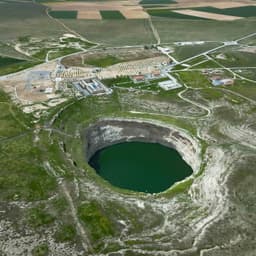
the technology that will break water molecules to free up the hydrogen gas. Technically, it can be done. My next question is a crucial one. Can it be done here without damaging a uniquely fragile place? The National Botanical Gardens on the hill above Wintook are as close as our get to see the unique flora of the former diamond mining site near Lüteritz, known as the Spelgbeet, that's German for Noggo area, and it remains strictly of limits to the public. It's now known as the Tsalkaib National Park, which means soft sand in the local Namibic language, and it's here where hyphen is planning to build. So this is the desert plant house. That's what we call it, yes, and it houses all the plants from the very dry areas of Namibia, and we have to have them under roof because just a little bit too much water for these plants, and they will die. They will start rotting them.
Die, so that's why we're here. Harto Kolberg is one of Namibia's leading botanists. Together with her colleagues Sophia Makali, she's running a project listing all of the countries endemic and near endemic plant species, flora unique to Namibia and the region, including those in the Tsalkaib. Would this be an area that is particularly rich in endemic and semi-endemic species? Absolutely, so the Spelgbeet has been a restricted area zone for many, many years, so it's safe to say it's a good example of what an anti-stead area ecosystem looks like. There's a very high biodiversity, especially when it comes to succulents, and yeah, so I would like for it to remain that way, but looking at the initiative of introducing the bean hydrogen, it's going to have a real serious impact on the biodiversity of this, yeah. I've even heard the name biodiversity hotspots.
A hotspot meaning a place where there are many different species, and I don't want to kill you with statistics, but please do. In Namibia, we have got about 3850 plant species. In the Tsalkaib Park, we have 36% of the total of the Namibian flora is found in that park, and another 46%. So nearly half of the plants found in the park are found only there or mostly there. My trip to the capital has underlined just how complex the green hydrogen debate is, and it's not just above the Tsalkaib National Park, but the Ocean 2, which has been the lifeblood of Luterids for generations. I've come to Shiawater Bay half an hour's drive out of town
where the pupils of the Luterids Blue School are enjoying their weekly oceans day. It's part of the school's mission to educate the future guardians of the sea. I want to teach marine and maritime because I know a lot about marine and maritime, since I live next to the ocean and I grew up yet. What's planned right here would profoundly change these children's futures, and what their hometown of Luterids will gain and what it might lose. Do you see dolphins all the time here? It's not the sea level in the wild. So the kelp farms over in that area, that's why all of the dolphins gather there. This spot hyphen is hoping to build its desalination plant at the processing facility that will turn hydrogen into ammonia, which can be more easily stored and transported. That at least is the plan, and if it becomes reality, this untouched moon landscape is going to
become a giant industrial zone. There are a lot of competing interests here, and I'm just wondering whether multiple green futures can share the same water. Just offshore, where I spotted some dolphins earlier, a small company kelp Blue is farming giant algae that provides specialist fertilizer and are also good at capturing and storing carbon from the air. We grow the baby kelp in a laboratory. We put it onto a twine, that twine we then wrap around structures at sea, and then it does the rest itself with nature. That's Edward Heel, kelp Blue's operations manager at the time, describing how to plant a kelp forest at sea. He's taking me towards effectively a nursery for embryonic seaweed or gametes, run by Jamie Coutier, the biosystems lead. Is it possible to see them? It's in there, it's a bit noisy, so let me just
Ah, so we're into some kind of shipping container, but it looks actually like a laboratory inside. We'll make the oceans environment in these tanks. Is it salt water? Yes, yes, it's sea water. We just filter it. The stage from gametes to juvenile kelp, it needs to be quite biosecured, so that's why we have the mechanical injury filters, and then at a certain age we know, okay, they're ready to fight whatever they will face offshore. You get attached to baby kelp. Do you miss them when you plant them out? Oh, definitely. And it's actually very sad if they don't make it out. Thank you Thank you so much, thank you for showing me your hand. And back into the sunshine and the warmth. Of course one question, because there's so much happening in Luderids, and there's the green hydrogen, the hottest kelp live alongside big industrial development as it's planned. We don't overlap in any way with those projects that you mentioned, but it's more than commercial aspects
of having an increase in property prices and increasing rent. We don't overlap in terms of any of our areas or the impact of each other, doesn't overlap at all. So while kelp farming seems compatible with the hydrogen plants, not everyone involved with the oceans is so optimistic, because this part of the coastline has been specially designated as the Namibian Islands Marine Protected Area or NIMPA. Both trips take visitors to the rocky islands of shore, which are home to rare bird life, including the African penguin, now threatened with extinction. I'm meeting someone who's helping to save them. Neil Shaw is the operations manager for the Namibian Foundation for the conservation of seabirds. The green hydrogen development, does it raise concerns for these animals and for
coastal and ocean life in particular? Yeah, so I'm linked to the green hydrogen project is the expansion of the port and that is likely to also bring more vessels down in the area, so big concerns the noise pollution, but also where they plan to expand the port. It is a particularly biosensitive hotspot and can have quite severe ramifications on the marine ecosystem that the penguins and other coastal birds rely on. So there is a real tension between the need for development, for jobs and innovation and the need to conserve this precious environment. Is it really possible to build something on such a massive scale as the hyphen green hydrogen project without major impact on both land and ocean? I want to ask the company how green their project is in practice and how locals
will benefit in a measurable way. Tony Boykis is responsible for environment, social and governance issues at hyphen. She's worked in renewable energy for years. Why build in such an ecologically sensitive area? The first point is you go where the resource is. In the south is where you have a co-location of fantastic wind and solar resources and maybe it has to be competing against other projects globally and that's where you're better to advantage lies. How are you then develop it? So it's not a failure complete that because you're developing this project there that you will have a devastating impact on the environment. The how is also important. That's why we undertake environmental and social impact assessments to understand that environment. Boykis says that when it comes to jobs it's for her to figure out how to marry the company's needs for jobs and skills with the actual supply of people available. We've undertaken a national skills audit and in addition
to that launch what we're calling a national skills sensors where people can go onto a platform and basically register themselves. There's a self-assessment to say hey I'm sitting in kitments who are I'm a welder but working as a taxi driver and I'd love to and here's my CV and supporting documents. There is a long-running experience for African countries for developing countries of being the supplier of raw materials. How confident are you that this will be a different story this time that it's not going to be just greed rather than green? I like that greed rather than green. Speaking as an emibian right more so than a hyphen employee. Very confident. Why? Because for the first and I have to say goddamn time we have a resource that can't be exported. We cannot export the sun nor the wind. So the 10 billion euros that is required to produce ammonia must come to Namibia. So what we're exporting is finally something that we produced in
Namibia. But before the first shipment leaves Namibia's shores a lot still needs to happen. Not least because a new government seems to be favoring oil and gas discoveries of the Namibian coast over green hydrogen. Former leader it's mayor Phil Bulhaw says Namibia with the official youth unemployment rate is around 44 percent has no choice but to look at both. Obviously it's completely contrary to the green initiatives but when we look at just the desperation and need for this nation to industrialize and develop we really don't have much of an option. As for the hyphen project he says the town is prepared for all scenarios even if it doesn't happen. It would be really sad because it would really unlock literates and the south of Namibia massively. But yeah we're ready to adapt and move on to whatever is next.
For youth activists Lucille Adams and Junior Mutalini adaptation is a way of life but their experience has taught them to remain skeptical. Our natural resources if we end up to mess it up it should be so hard for us to get them back as they are. If something end up to go out of their hands what is a way forward and who's going to be hold accountable? Is this going to be good for us for generations to come? Identity for me please a big role because that's what makes us you know whenever all of this material things falls away it's only our identity that we have left. I came to Namibia looking for the next boom and found hope and skepticism in equal measure. It may be blessed with renewable energy potential but it's a long way from the markets it hopes to reach and the green hydrogen market itself is shaky with billions of dollars in investments with drawn from the sector in 2025 alone. Hyphen insists it will stay the cause but the margins separating
success and failure are fine. If it all comes to nothing due to its may fade back into obscurity once more albeit with its unique natural surroundings untouched and the bookter spirit very much alive. This edition of the documentary was written and produced by me Johannes Del. The executive producer was Anna Stewart. It is a CTVC production for the BBC World Service.
More episodes