Loading...
artsbookseducation
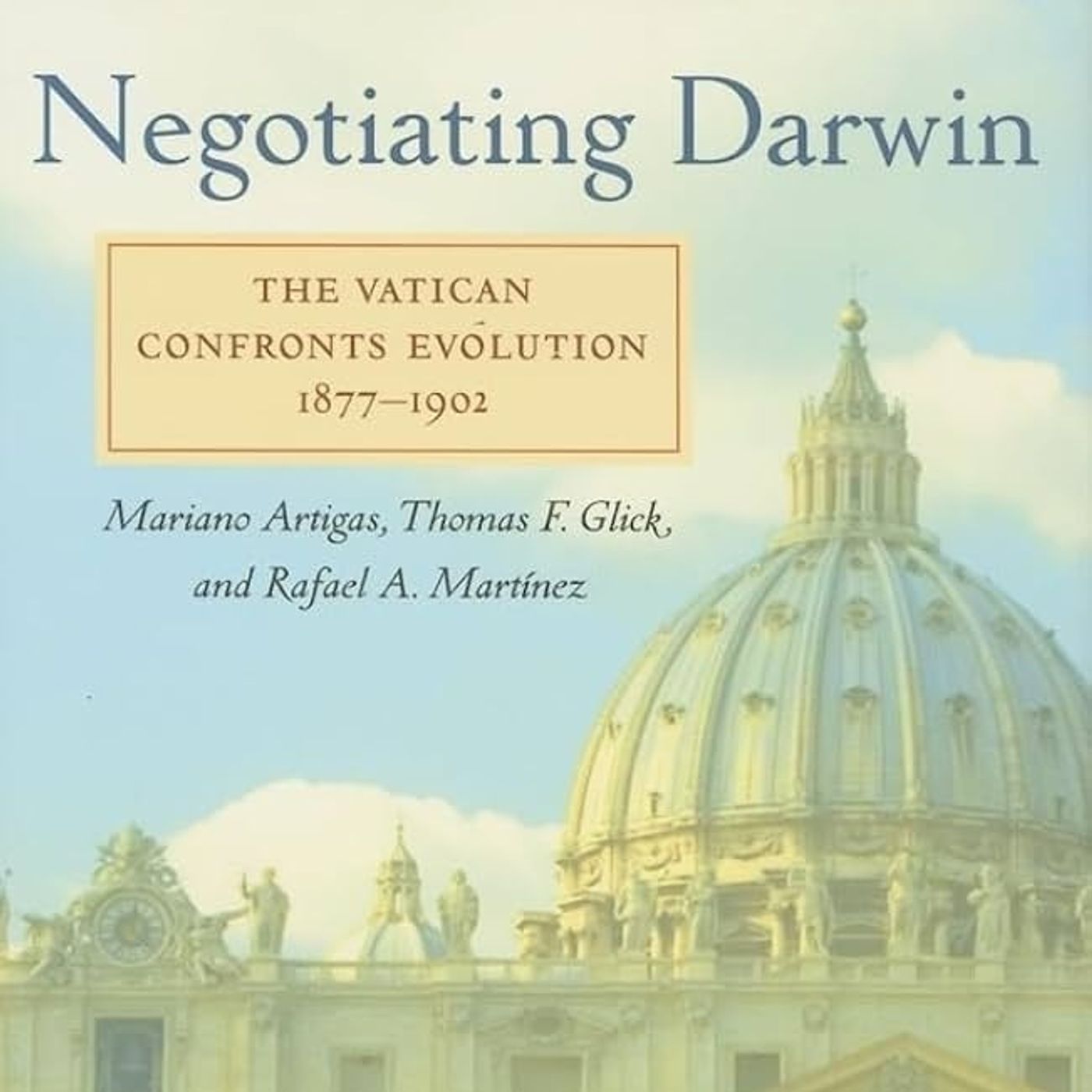
Negotiating Darwin: The Vatican Confronts Evolution
About this Episode
Explores the complex and often contentious relationship between the Vatican and the theory of evolution during a critical period. It details how the Congregation of the Index, rather than the Holy Office, handled cases of Catholic authors who attempted to reconcile evolution with Christian doctrine, revealing that official, public condemnation of evolution itself was largely avoided. The text highlights specific instances involving figures like Raffaello Caverni, Dalmace Leroy, John Zahm, Geremia Bonomelli, and St. George Mivart, illustrating the differing outcomes of their theological and scientific engagements, including retractions or unspoken prohibitions. Furthermore, it examines the broader intellectual and political context, such as the rise of "Americanism" within the Church and the influence of journals like La Civiltà Cattolica, which shaped the discourse surrounding these debates. The sources ultimately demonstrate that the Vatican's approach was often reactive and nuanced, influenced by external denunciations, internal theological disagreements, and a desire for prudence in the face of evolving scientific understanding.
You can listen and download our episodes for free on more than 10 different platforms:
https://linktr.ee/book_shelter
Get the Book now from Amazon:
https://www.amazon.com/Negotiating-Darwin-Confronts-Evolution-Historical/dp/080188389X?&linkCode=ll2&tag=cvthunderx-20&linkId=df5db7917af84a7d0308b46957fbd9e2&language=en_US&ref_=as_li_ss_tl
Produced by Podcai Studio:
https://www.podcaistudio.com/
You can listen and download our episodes for free on more than 10 different platforms:
https://linktr.ee/book_shelter
Get the Book now from Amazon:
https://www.amazon.com/Negotiating-Darwin-Confronts-Evolution-Historical/dp/080188389X?&linkCode=ll2&tag=cvthunderx-20&linkId=df5db7917af84a7d0308b46957fbd9e2&language=en_US&ref_=as_li_ss_tl
Produced by Podcai Studio:
https://www.podcaistudio.com/
Hosts & Guests
Transcript
President Barack Obama.
Virginia, we are counting on you.
Republicans want to steal enough seats in Congress
to raid the next election and wield unchecked power
for two more years.
But you can stop them by voting yes by April 21st.
Help put our elections back on a level playing field
and let voters decide not politicians.
Vote yes by April 21st.
Paid for by Virginians for fair elections.
With the American Express Platinum Card,
you can access over $3,500 in annual value
with benefits and eligible purchases
across travel entertainment and more.
There's nothing like Platinum.
Learn more at americanexpress.com slash explore dash Platinum,
enrollment requirements monthly and other limits in terms of play.
I'm Taco Night in Tulum to sushi in Tokyo.
Everybody is rewarding and post-ready
with MX Gold's four times membership rewards points
at restaurants worldwide.
Wherever you die, points are piling up.
So bring your friends along for your next course
because it's not all about the posts.
It's about the company and the memories.
How can gold from MX sweeten your next food moment?
Learn more at americanexpress.com slash explore dash gold
terms and points cap apply.
Welcome curious minds to another deep dive.
Great to be here.
Today we're cracking open a really long hidden history,
a story that was literally locked away
in dusty Vatican archives for over a hundred years.
That's right.
Imagine the Vatican, this ancient institution grappling
with one of the most earth shattering scientific ideas
of its time, Darwin's theory of evolution.
So our mission today is to guide you
through negotiating Darwin.
The Vatican confronts evolution 1877-1902.
And this isn't just like a dry history lesson.
No, not at all.
It's more like a detective story really.
Peace together from documents that honestly
nobody could access until quite recently.
We're going to unpack the real story,
the often surprising story behind how the Vatican
first reacted to Darwin.
It really challenges a lot of what people thought they knew.
And that until quite recently point is absolutely crucial.
This whole deep dive is possible because back on January 22, 1998,
the archives of the congregation for the doctrine
of the faith were opened up.
And these hold the records of the old holy office
and the congregation of the index.
Exactly.
Before 98, these documents were incredibly tightly guarded.
Researchers faced, well, old catalogs,
missing information, literally centuries of dust.
It was tough going.
Wow.
But this access finally gave scholars complete freedom
to see what the Vatican actually did.
Without just relying on rumors or secondary accounts.
It sounds like a serious historical dig
just to get to the facts.
And that's what we want to bring you today,
a kind of shortcut to being genuinely well informed on this.
A fascinating narrative full of nuance.
Definitely.
We'll guide you through it.
And here's where it gets really interesting.
Let's start digging.
So let's paint the picture.
The late 19th century, it was a pretty chaotic time
a world really influx.
Darwin's origin, a species that was 1859, right?
It had set off this huge global debate.
Absolutely.
But it wasn't purely scientific.
That's key.
Evolutionism often got tangled up with direct attacks
on religion.
People used it to push agnosticism, atheism, materialism,
arguing these were somehow necessary conclusions
from the science, which wasn't necessarily the case.
Not at all.
And what's also crucial to grasp is
that the science itself wasn't settled.
The 1890s, when a lot of these stories happen,
is sometimes called the eclipse of Darwinism.
Eclipse, meaning?
Meaning Darwin's main idea, natural selection,
was actually being seriously questioned by scientists.
There just wasn't a consensus yet on how evolution worked.
Oh, OK.
And this scientific uncertainty, this lack of agreement,
actually created a kind of opening for Catholic thinkers.
They could propose alternative ideas, things
like mitigated evolution or specific genesis,
trying to bridge that gap between faith and the new science.
And some religious figures saw the scientific disagreement
as a weakness in the whole theory.
Yes, exactly.
They pointed to the debates among scientists
as proof that the theory itself was flawed.
Now, central to this whole story,
as we sort of peel back the layers,
is the index of prohibited books, the infamous index.
For anyone unfamiliar, this was basically
a list of books Catholics were forbidden
to read, own, or publish.
Along history there, goes way back
a early example from 80, 494.
But it really gained power with Protestantism
and the printing press.
It was reformed later, right, by Lear the 13th.
Yes, in 1897, then abolished by Benedict de Caxiath
in 1917, though Paul VI kind of kept
it spirit alive in 1965.
And sadly, a lot of other related archives
were lost over the centuries, fires, polium.
Right, history lost.
And this leads to a really, really important distinction
we need to make.
It's a key clue for understanding everything else.
Okay.
There were two main bodies involved here.
First, the Holy Office.
This is the top congregation.
The Pope himself presided.
It dealt with all doctrinal matters.
His decisions carried huge weight.
The big one.
The big one.
Then there was the congregation of the index.
Its job was more limited.
Examine published books, decide if they go on the list.
Crucially, index decrees never explained
why a book was banned.
Never.
So you wouldn't know the reasoning.
Nope.
Sometimes it was just considered inopportune
for a book to be circulating.
So generally, being put on the index
carried much less doctrinal weight
than a statement from the Holy Office.
That distinction feels huge.
It changes how you'd interpret a book being banned.
It changes almost everything.
And keeping that difference in mind is vital
as a look at these cases.
OK, so with that background, the scientific uncertainty,
the powerful institutions, the vital difference
between the Holy Office and the index,
let's tackle the main question.
Let's do it.
How did the Vatican actually respond
when individual Catholics tried to reconcile evolution
and faith?
We start in 1877 with a fascinating figure,
Rafael Coverney, an Italian priest from Florence.
Coverney, yes.
He was a serious scholar, wrote a big history
of the experimental method.
In 1877, he published a book,
the Involved Estudide de la Philosophia.
And in it, he tried to reconcile evolution
but only for lower species, right?
Not humans, with Catholic teaching.
What happened?
Swiftly.
Very swiftly.
His book was immediately denounced
to the congregation of the index, not by some outsider,
but by his own archbishop.
Wow, OK.
Then Tomas Ziegliara, a very influential theologian,
later a cardinal wrote the report, 19 pages,
predictably negative.
Why negative?
What was his reasoning?
Ziegliara basically saw Darwinism
as inherently materialist.
He even hinted it was linked to like Hegelian pantheosum.
He slammed Coverney for reducing animals to mere machines
and for being imprudent and even conceding
the idea of a primitive cell to the Darwinians.
So it's heard it.
unanimous condemnation.
His book went straight onto the index in 1878.
And they specifically told him not
to publish his plan second book on human origins.
So an indirect condemnation of Darwinism, as he said.
Exactly.
And here's a critical point.
Coverney's book is the only one out of the six
we'll discuss that was formally put on the index,
specifically for defending evolutionism, the only one.
OK, but here's the first big surprise
from those archives, right?
Coverney himself didn't think it was really about Darwin.
Precisely.
His own letters, uncovered in the archives,
show he thought the whole fuss, as he put it,
came from fanatical and very ignorant priests.
Why?
What were they upset about?
She thought they were mad because he'd
criticize the Jesuits and said people
should read the Bible more than the journal
last C. Viltac Catolica.
So internal church politics might
have been the real driver, not science.
It certainly complicates the narrative.
This condemnation, the only formal one for evolution
happened early, was largely forgotten
even by less C. Viltacatolica later,
and might have been fueled by personal or political disputes.
It suggests the reaction wasn't
some grand, top-down policy against evolution.
Fascinating.
OK, let's move forward.
Our next clue comes from France.
Father Domos Loroi, a Dominican.
Right.
In 1891, Loroi published, the Volucionius Twent
was a spiss organique.
Again, defending a kind of mitigated evolution, carefully
excluding the human soul, he got
denounced in 1894.
So what did the internal Vatican discussions look like this time,
anything different?
Oh, very different.
This work gets really interesting,
internally the first report by a consultant named
Teofilo Domenicali was actually quite favorable.
Favorable, how so?
Domenicali argued Loroi's view of Genesis,
seeing it as more poetic than strictly literal,
was perfectly allowable.
He even pointed out that many Catholic thinkers already
accepted evolution, with limits.
And he specifically warned against condemning
too quickly, urging caution about a relatively recent theory.
So there wasn't even internal agreement
against evolution at this point.
Not at all.
But the tide turned.
Despite Domenicali's positive report,
other consultors pushed back hard,
especially Enrico Bonpensierre-Mariam and Luigi Trapepi,
who was involved back in the Caverni case.
What was their argument?
Trapepi, especially, influenced by Cardinal Mozella,
argued very strongly against the evolution
of the human body.
He claimed unanimous theological tradition was against it.
And he even misrepresented an earlier situation involving
Saint George Milvart to support his case.
So internal debate, conflicting views,
what was the final decision?
The congregation decided, OK, condemn Loroi's book.
But in this crucial, they decided not
to publish the decree.
Not publish it, why not?
Instead, they demanded a public retraction
from Loroi himself.
He was called to run, and he complained.
He published a letter in the newspaper La Monde in 1895,
saying his thesis was untenable.
So from the outside, it looked like a straightforward
condemnation and retraction.
Exactly.
It looked like the Vatican had spoken,
and Loroi had recanted.
But the archives revealed a twist.
A huge twist.
Loroi didn't actually change his mind.
Two years after his public retraction,
he wrote privately to the index.
He detailed the intense pressure he'd been under,
explaining he chose to retract,
rather than face the consequences or try to rewrite.
So he still held his views?
Absolutely.
He even continued to publish them under initials
in journals like The Review Thomas.
He stressed that evolutionary ideas were valid
as long as the church hadn't made a definitive, final ruling.
His retraction was basically coerced,
and it was later often misrepresented
by La Sivvita Katatika as a genuine change of heart.
Wow, that really shows the difference
between public perception and the private reality
revealed by the archives.
The Vatican got the public statement
it wanted without issuing a binding decree.
Precisely, it was a strategy.
Apply pressure, get a retraction, manage the controversy,
but avoid setting a definitive, church-wide precedent
on the science itself.
Very clever, in a way.
Okay, case number three takes us to America.
John Zom, Holy Cross priest, scientist,
Notre Dame professor.
He even got an honorary doctorate
from Pope Leo III himself in 1895.
A prominent figure.
In 1896, Zom published Evolution and Dogma, same thing.
Trying to show compatibility between evolution again,
setting aside the human soul and Catholic doctrine.
Did this cause trouble?
Oh, yes.
A significant storm.
Zom's language was quite blunt, directly linking creation
and evolution.
Plus, he had influential friends who
were part of the Americanist liberal wing
like Archbishop Ireland.
This drew fire from conservatives.
And La Sivvita Katatika got involved again?
Projectibly.
They published a very critical review,
attacking Zom for conceding too much to evolutionists
and bizarrely for quoting a Protestant author.
So he was denounced?
Yes, formally denounced to the index in November 1897.
Yeah.
And Enrico Bonpensierre again wrote the report,
a massive 53 pages this time, really scathing.
What did Bonpensierre argue?
He questioned Zom's scientific and theological competence,
accused him of misreading Aristotle and Aquinas,
and doubled down on the direct, immediate creation
of Adam's body from the mud of the earth, calling it Catholic
doctrine.
Sounds like a public condemnation was coming for sure
this time.
It seemed that way.
The general congregation did vote to prohibit the book.
But just like with Leroy, there
was another crucial intervention.
What happened?
They decided not to publish the decree of prohibition,
at least not until Zom made some active submission.
Why?
Who intervened?
This was down to heavy lobbying by Zom's powerful
Americanist allies.
It is Ryan C. Crest here.
There was a recent social media trend, which
consisted of flying on a plane with no music, no movies,
no entertainment.
But a better trend would be going to chumbacacino.com.
It's like having a mini social casino in your pocket.
Chumbacacino has over 100 online casino-style games,
all absolutely free.
It's the most fun you can have online and on a plane.
So grab your free welcome bonus now at chumbacacino.com.
Sponsored by Chumbacacino.
No purchase necessary, VGW could void for prohibited by law
at 21 plus terms and conditions apply.
Nicole hosts Easter every year.
That's why she shops at BJ's wholesale club,
stocking up on spiral ham, baked goods, fresh flowers,
candy, and five dozen eggs.
I've got a lot of baskets to fill.
Nicole's not worried because she knows she can save big
and get it all done in one trip.
It's like winning the Easter egg hunt.
When you save everyone wins.
Get a $15 digital coupon when you spend $150
in one transaction now through April 5th.
Visit BJ's.com slash Easter coupon for details.
BJ's your Easter destination.
This is Mike Bolo of Lexicon Valley.
And I'm Bob Garfield.
Are you one of those people who sometimes uses words?
Do you communicate or acquire information with?
You know, language.
Hey, us too.
So join us on Lexicon Valley to chew over the history, culture,
and many mysteries of English plus some ice cracks.
Find us on one of those apps where people listen to podcasts.
Cardinal Serfino Vanotelli personally
went to Pope Leo III and argued against publishing
the decree.
And the Pope apparently agreed with great pleasure.
So Zom avoided public condemnation.
Did he have to retract publicly like Leroy?
Not quite.
This is another subtle twist.
Zom was keen to avoid any public censure.
He saw that as a win for his opponents.
So he wrote a private letter.
Private to whom?
To his Italian translator.
He asked the translator to withdraw
the Italian edition of the book from sale,
simply stating that the Holy See was opposed
to any further distribution.
So no public statement from Zom himself
saying his ideas were wrong?
Exactly.
It was a very careful move.
But La Civiltà Catolica later presented
this private instruction to the translator
as if it were a full public retraction by Zom,
which absolutely wasn't.
So Zom basically won.
He avoided public censure.
In effect, yes.
Thanks to his connections and the Vatican's preference, again,
for handling things discreetly rather than issuing
public binding condemnations on this sensitive topic,
it really shows how internal politics, influence,
and doctrine were all tangled up.
And this links directly to the Americanism
controversy you mentioned.
Definitely.
Americanism, for our listeners,
was this movement in the US church
emphasizing things like individual initiative,
adapting to modern democracy,
maybe a bit more freedom and theological exploration.
Conservatives in Rome saw it as dangerous liberalism.
And Zom was seen as part of that.
Very much so.
His boldness on evolution was seen by Roman conservatives
as just another symptom of this problematic Americanist
trend.
So the fight over his book wasn't just about science.
It was a battleground in this larger culture war
within the church, which led to Leo the 33rd's letter
Testum Benevolencia in 1899 warning
against some of those tendencies.
Fascinating context.
OK, our fourth case, St. George Jackson Millvart,
an English biologist, a Catholic convert,
even a fellow of the Royal Society.
He accepted evolution but had his own take
specific genesis, challenging Darwin's natural selection.
Big Vart.
Yes.
And his case is probably the source of one
of the biggest misconceptions about this whole period.
Hasso.
Many people assume Millvart was condemned by the Vatican
because of his evolutionary views.
His 1871 book on the genesis of species
was certainly controversial.
And some theologians criticized his ideas.
But that wasn't why he got into trouble with Rome.
No, absolutely not.
The archives make this crystal clear.
The real reason Millvart faced condemnation
had nothing to do with evolution.
What was it then?
It was his articles on happiness and hell.
Happiness and hell.
Yes.
He proposed this controversial idea
that the punishments of the damned
might gradually lessen over time.
Those articles were denounced to the Holy Office,
the top doctrinal body remember.
Oh, the Holy Office this time, not the index.
Correct.
And despite hopes he might retract these views,
Millvart refused.
He was stubborn.
So what happened?
His articles on hell were placed on the index in 1893.
Later, in 1900, the Holy Office took further steps,
removing the standard author-submitted note
from his index entry.
They even talked about taking back
an honorary doctorate he'd received.
Ultimately, he was denied a Catholic burial
because of his persistence in what they deemed
heretical opinions, including his views on hell
and also his liberal Catholicism.
So the takeaway here is crucial.
Absolutely crucial.
Millvart's case clearly shows the Vatican's actions
were targeted at specific doctrinal errors.
In his case, hell and liberal theology,
not a blanket ban on evolution.
His evolutionary ideas, while debated,
were never directly condemned by the Holy See itself.
This just completely debunks the common story about him.
Right, okay, case five.
Bishop Jeremiah Bonamelli.
An important Italian bishop known for being
a bit controversial.
Yes, Bonamelli.
In 1898, he published a book,
Siguamalara Johnny, and added an appendix,
praising John Zom's evolution in dogma.
Bad timing, perhaps?
Terrible timing.
His appendix praising Zom came out
right when Zom's own book was under scrutiny in Rome.
And Bonamelli already had other unrelated works
on the index.
The document suggests he was not disposed
to suffer another listing, especially not over evolution.
So he acted preemptively.
Exactly.
He made what the source calls a spontaneous retraction.
He published a letter in a newspaper,
the Lega Lombarda, which thus revealed
that Catolica eagerly reprinted, basically saying
readers should focus on his main arguments,
not the hypothesis from Zom he discussed in the appendix.
He announced the appendix would be removed in future editions.
So this wasn't Rome ordering him to retract?
No, it was a strategic move on his part
to avoid potential trouble.
A strategic retreat, as the analysis calls it.
It shows how even the anticipation of official action,
or perhaps informal pressure, could lead
to public backtracking without any formal decree
being issued about evolution itself.
Unless Siguamalara Catolica used his letter too.
Of course.
Just like with La Roy, they used Bonamelli's self-initiated
retraction to bolster the narrative
that the Vatican was cracking down on evolution,
even though it wasn't an official directive about evolution.
OK, one final case.
Bishop John Cuthbert Headley from Wales.
Editor of the Dublin Review, a respected theologian.
Headley, yes.
In 1898, he wrote a review of Zom's books.
It was generally favorable, though cautious.
What was his specific stance?
Headley saw no fundamental problem reconciling evolution
with God as creator.
But like others, he insisted on direct divine intervention
for the human soul, and probably for the body
of the first man, too.
He was also quite wary of the ideological baggage atheism,
materialism that often came attached
to evolutionary discussions.
Did he face criticism?
He did.
Salvatore Brandi, from La Sivita Catolica,
criticized both Headley and Zom.
Brandi used La Roy's retraction.
The one we know was misrepresented as proof
that the Vatican had condemned evolution.
How did Headley respond?
Headley replied in the tablet.
He made a very careful statement.
He said that if the Holy Office were to publicly condemn
Midvard's theory about the evolution of the human body,
then that theory could no longer be held by Catholics.
Ah, so it wasn't a retraction of his own views?
Not at all.
It was a conditional statement.
He was saying, I will submit if there is an official
public ruling from the highest authority.
It basically highlights the fact that at that time,
there was no such clear public policy
from the Vatican on evolution.
So his statement actually underlined the ambiguity.
Exactly.
And when Headley later expressed doubts
about the accuracy of La Sivita Catolica's reports
about all these supposed condemnations,
Brandi criticized him again.
It just shows the ongoing tension
and the way the narrative was being shaped unofficially.
So looking back at all six cases,
especially those clustered in the 1890s,
from the outside, it really could look like
a coordinated crackdown on evolution by the Vatican.
It absolutely could.
And for a long time, that was the dominant narrative.
But these archive documents, this deep dive,
pains a radically different picture.
Utterly different.
The archives really demolish any idea
of a premeditated Vatican conspiracy against evolution.
There was no grand plan.
No overarching policy handed down from the top.
They were mostly reacting.
Primarily reacting, yes.
Responding to denunciations coming from outside,
often from conservative elements within the church.
And crucially, most of these actions
went to the congregation of the index, remember.
Not the Holy Office.
The body with less doctrinal weight.
Exactly.
And La Sivita Catolica consistently blurred that line,
presenting index actions as if they
were solemn doctrinal pronouncements
from the Holy Office, which created decades of misunderstanding.
And the unpublished decrees, the private retractions.
That's another key finding.
In major cases like La Roy and Zahm,
the condemnations were kept internal.
Decrees weren't published.
Authors were pressured into private or semi-public retractions,
which La Sivita Catolica then broadcast, often inaccurately.
Why do that?
Why the secrecy?
It was strategic.
It allowed the Holy See to manage controversies,
appease conservative critics, and warn authors,
all without making a definitive public irreversible statement
on the science itself.
It protected the author from public disgrace to some extent.
And it lived room for prudence in anticipation
of future advances in science, as the research puts it.
Plus, there wasn't even internal unity.
Not at all.
We saw consultants disagreeing, influential cardinals
like Sagnan, Vanatelli, stepping in to soften the outcomes
for La Roy and Zahm.
It was complex.
And in the end, only Keverney's book, way back in 1878,
was officially put on the index for evolutionism.
And even that was largely forgotten,
and possibly driven by other motives.
So this historical deep dive reveals a Vatican
that was much more, well, complex, reactive, cautious,
internally divided at times, using strategy and ambiguity
rather than just issuing outright condemnations.
Yes.
The image of a monolithic institution,
simply rejecting science, doesn't hold up
to the archival evidence.
They were clearly negotiating these challenging new ideas,
not just issuing a blanket no.
You know what's really striking to me
is how much of the story we thought we knew was shaped,
perhaps even manufactured by the reporting
of basically one influential journal.
It's role in framing a narrative often based
on incomplete or misrepresented information was huge.
And without access to the archives,
its version became the accepted history
for a very long time.
It really makes you think, doesn't it?
How history, once it's unlocked from the archives,
can completely reshape our view
of these supposed conflicts between science and faith.
It's a powerful reminder.
Even powerful institutions gravel with new ideas
in ways that are far more nuanced, more complex
than the public story often suggests.
And it raises that important question for us today,
looking back.
Absolutely.
How do we evaluate the actions of institutions
past or present, especially when the full picture,
the primary sources might be hidden or spun?
And maybe what can this episode teach us
about how we approach challenging new ideas now
without jumping to simplistic conclusions
or letting one loud voice dominate the conversation?
A truly fascinating deep dive.
It turns out this period was a much less black and white,
much more shades of gray than many assumed.
For me, realizing how much hinged on that distinction
between the Holy Office and the index
and how often decrees weren't published,
that changes everything.
It's a difference between official doctrine
and managed controversy.
Well, thank you for joining us on this journey
into the Vatican Archives.
We hope it gives you plenty to think about.
Maybe even revisit other historical conflicts
with a fresh eye.
Definitely.
Until next time, keep digging, keep questioning,
and stay well informed.
How to have fun, anytime, anywhere,
step one, go to chumbacaceno.com.
chumbacaceno.com, got it.
Step two, collect your welcome bonus.
Come to Papa, welcome bonus.
Step three, play hundreds of casino-style games for free.
That's a lot of games, all for free.
Step four, unleash your excitement.
Chumbacaceno has been delivering thrills for over a decade,
so claim your free welcome bonus now and live the chumbalife.
Visit chumbacaceno.com.
No purchase necessary VGW group void for prohibited
by law, 21 plus terms and conditions apply.
Hey, I'm Josh Spiegel.
Post of the podcast, Lunatic in the newsroom.
If you enjoy journalism that drifts into mild panic,
wild overthinking, and a guaranteed nervous breakdown,
Lunatic in the newsroom is for you.
It's news like you've never heard before.
The only newsroom with a panic button.
You'll laugh, you'll cry, and gasp and horror
as the show spirals completely out of control.
It's not just news, it's emotionally unstable.
Lunatic in the newsroom, listen today.
This is Mike Voilo of Lexicon Valley.
And I'm Bob Garfield.
Are you one of those people who sometimes uses words?
Do you communicate or acquire information
with, you know, language?
Hey, us too.
So join us on Lexicon Valley to true over the history,
culture, and many mysteries of English.
Plus some life cracks.
Find us on one of those apps where people listen to podcasts.


