Loading...
educationsocietyculture
Network Nations Ep:3- Commons, Mutualism & Entanglement: Building the Foundation of Network Nations
About this Episode
New @greenpillnet pod out today! 🌐
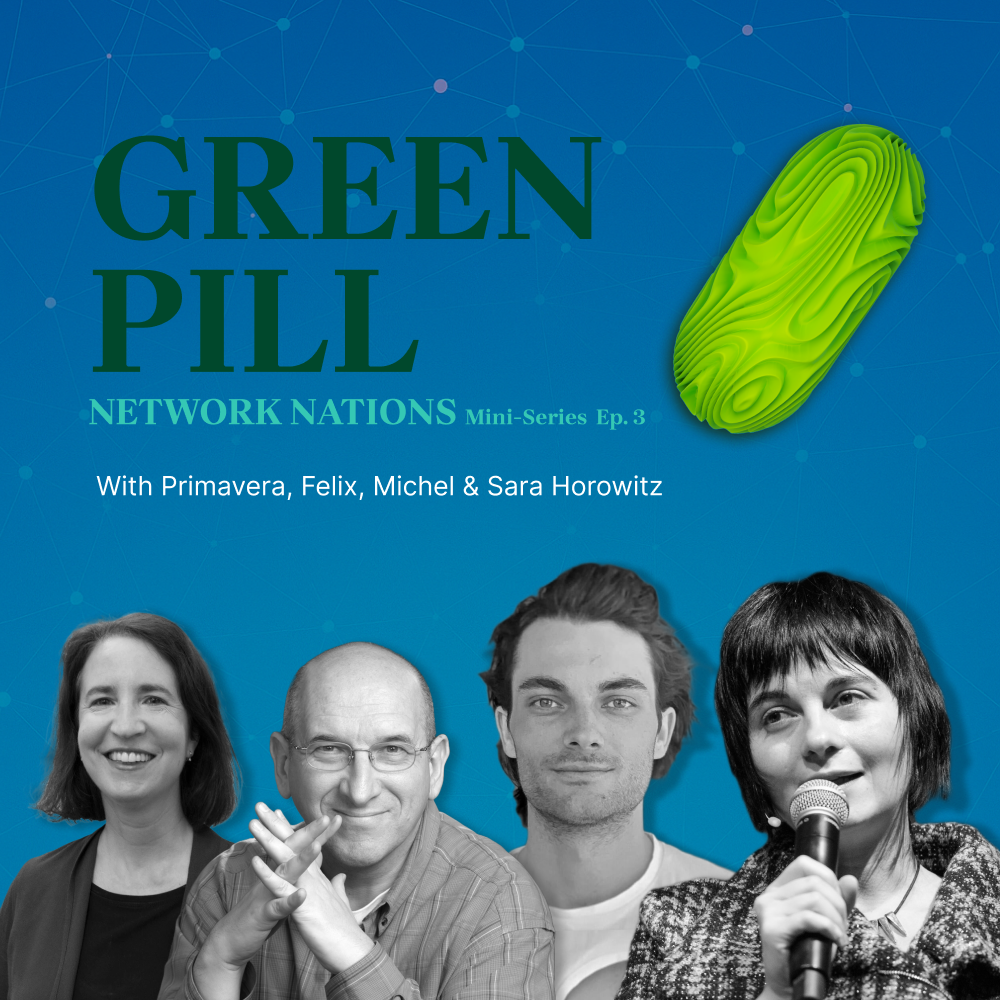
Hosted by Primavera De Filippi & Felix Beer, this episode of the Network Nations mini-series explores how commons, mutualism, and entanglement form the backbone of resilient, self-organizing communities.
Joined by Sara Horowitz (founder of the Mutualist Society & Freelancers Union) and Michel Bauwens (founder of the P2P Foundation), they discuss how collective ownership, cooperative economies, and peer-to-peer networks can transform civil society into interconnected network nations.
Together, they unpack the difference between commoning and mutualism, the importance of trust and solidarity, and how local cooperation can scale into a global fabric of shared governance.
🎧 Learn more → networknations.network
🌐 greenpill.network
Mutualistsociety.net
https://p2pfoundation.net/
https://4thgenerationcivilization.substack.com/
🐦 @owocki
@Sara_Horowitz
@mbauwens
| @greenpillnet |
🌐 Timestamps
00:00 – Welcome to the Network Nations mini-series with Primavera De Filippi & Felix Beer
01:30 – Introducing guests: Sarah Horowitz (Mutualist Society) & Michel Bauwens (P2P Foundation)
03:30 – What are the commons and how communities organize through shared resources
05:30 – Michel on the evolution from free software to Web3 and local commons
07:40 – How open collaboration shifted toward community self-reliance
09:30 – From cooperation to solidarity: why communities need mutual care
10:40 – When institutions fail, communities must organize for themselves
12:00 – Sarah's work with freelancers and the rise of mutualist organizing
13:40 – The three principles of mutualism: solidarity, economic mechanism, and longevity
15:00 – How commoning and mutualism interconnect historically
17:00 – The role of capital and appropriate funding for mutualist systems
18:40 – Scaling solidarity: from patchworks of local groups to federated networks
20:20 – Michel on cosmopolies and non-territorial governance throughout history
22:00 – The blockchain paradox: ideology as glue for coordination
23:30 – Why transcendent values or shared myths matter for collaboration
25:00 – Defining entanglement the bonds between communities and shared kinship
27:40 – Michel's "archipelago of regenerative villages" model
30:00 – How regenerative projects can attract capital and resilience
31:30 – Bioregional and cosmolocal models of solidarity
33:00 – Sarah on federations, unions, and historical models of coordination
35:00 – Rethinking "exit": from isolation to interdependence
37:20 – Why interdependence is strength, not weakness
38:30 – The lost baton of institutional knowledge in Web3 governance
39:50 – Delegation, iteration, and the relearning of organizational design
42:00 – Network Nations as additive systems, not exit systems
43:20 – Building power through the commons and mutualism
45:30 – From individual sovereignty to collective agency
47:10 – Building mutualist tech infrastructure for self-financing communities
49:20 – The disconnect between coders and communities — and how to bridge it
51:10 – Learning from what works: local experiments that can scale
53:00 – The role of "deep dives" in connecting commons, co-ops, and Web3 builders
55:00 – Why sensemaking and learning infrastructures are key for coordination
56:30 – Sarah on the "pods" model — ecosystems for mutual learning
57:40 – Network Nations as a convergence point for adjacent movements
59:10 – Building open, kind, and politically diverse collaboration cultures
01:01:20 – Avoiding the tragedy of the commons through entanglement and shared trust
01:05:00 – The SMART Co-op model for freelancers as a transnational example
01:07:00 – Low-hanging fruit: building local capital pools for community resilience
01:08:40 – Closing thoughts and invitations to join the movement
Hosts & Guests


No transcript available for this episode.