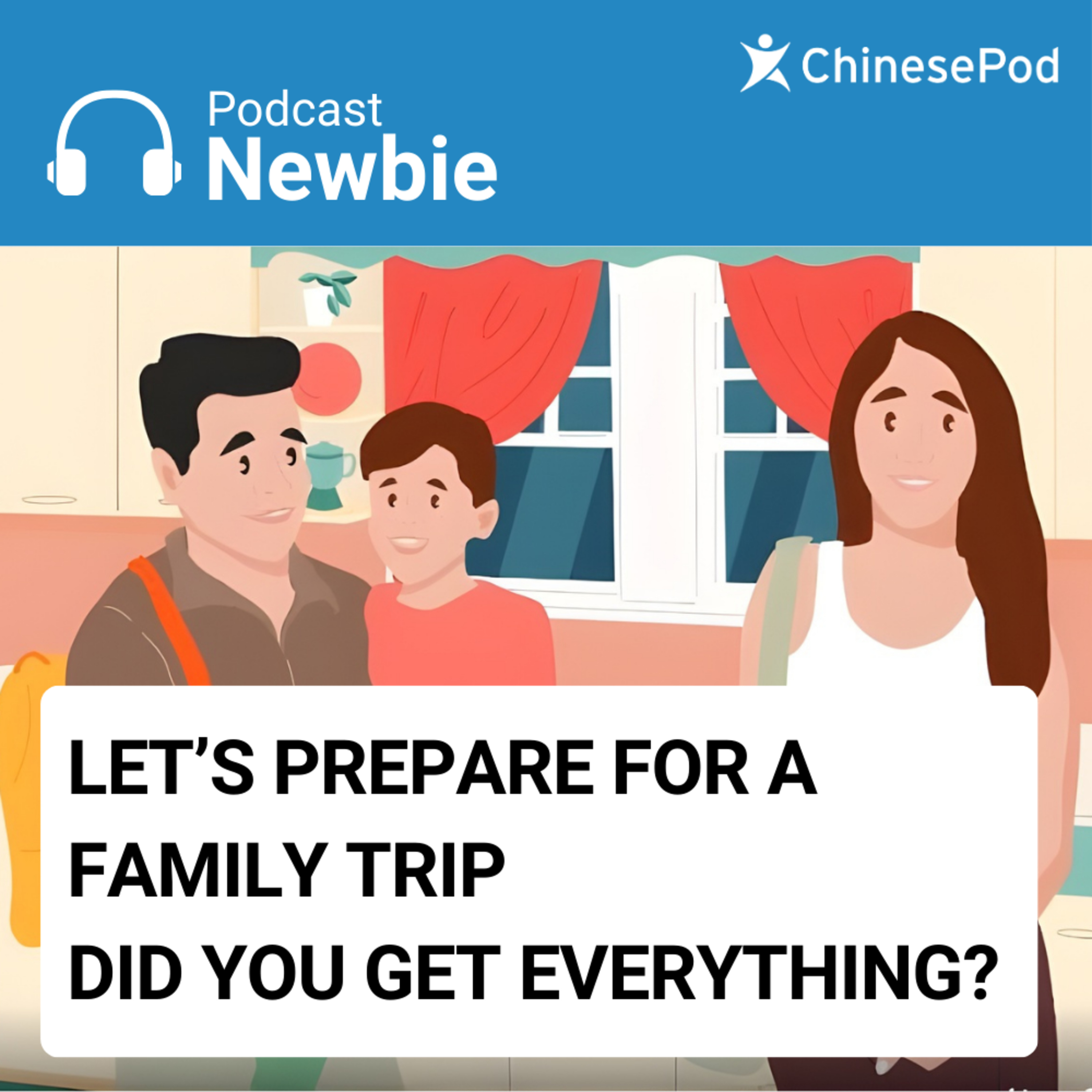
About this episode
Well, if you are a forgetful person, you must hear this dialogue pretty often. "Did you bring this? What about that?" So, today we are going to learn how to ask these questions and how to answer them in Chinese in this lesson. Let's get started! Episode link: https://www.chinesepod.com/4369
Get every episode summarized
Each time ChinesePod - Beginner publishes, we email you a written briefing from the transcript — the topics, who appeared, and any specific claims, with the ad reads skipped.
Email me new episodesFree for 3 shows. No card needed.
Hosts & guests
Transcript ready
300 searchable segments. Every word is indexed and playable.
Full transcript
ChinesePod - Beginner — Newbie | Did You Get Everything?. Machine-transcribed; use the interactive transcript above to jump the player to any line.
给你 seed Master 大家好,大家好 我是盛春icki 大家好,欢迎来到中文播课 我们期待 我认为是庆利 Today's lesson we are going on a small family trip And especially we will talk about the things that you will have to remember taking when you go on such an outing So what would be things that you take when you go out with your family? 嗯 衣服 衣服, like maybe for the kids or when it gets too cold 零食 snacks 水壺 And a water bottle or more than one Okay, and some of those you will find in our dialogue as well So let's check it out
小朋友的零食呢 带了 水壺呢 带了 你放心 出门吧 Before discussing the dialogue in detail Let's break it down line by line 小朋友的零食呢 What about the small friend's零食呢 What about the small friend's零食呢 What about the small friend's零食呢 What about the small friend's零食呢 What about the snacks for the kids? 小朋友的零食呢 What about the snacks for the kids? 小朋友的零食呢 带了 Got it 带了 Got it 带了 Got it 带了 水壺呢 And the water bottle 水壺呢 And the water bottle 水壺呢 带了 你放心 出门吧
Got it Don't worry Let's go 带了 你放心 出门吧 Got it Don't worry Let's go 带了 你放心 出门吧 So you have a couple talking about having a trip and what to bring And what do you think where do they go 公圆吧 Or maybe to the park or maybe even an extended weekend trip Who knows However they are talking about what to bring for the trip And the first question is what about the snacks for the kids? 小朋友的零食呢 So you have some words that we should talk about first The first one is kid 小朋友 小朋友 So this can be the kid or kids And what's cute about this word is you maybe know the parts inside that mean friend already 朋友 And here we have a little friend And this little friend then becomes a kid So a little friend Kid
小朋友 And then in the sentence we have another word that means snacks 零食 零食 And零食 Actually it means fragment or something But it's often used to represent zero as well So it's actually zero and then plus which is food So it's zero food Maybe that's because snacks have like next to zero nutritional value So that's like zero food 零食 And in between those two words kids and snacks we have a particle This particle is used as a possessive particle And we use that to say things like My, your, his or anything of somebody Okay maybe let's practice this a little bit How would I say my? 我的零食 Okay so my snacks So my would actually just be i and this possessive particle And then it's the thing of me
And this is my 你的钱 So now it's 你 plus this der So this makes you to your And you said money, your money 他的衣服 I know that example So ta means he And this plus der is his So now it's his clothes 他的衣服 And in our example we had it's the snacks of the kids 小朋友的零食 So we have the der here to indicate that this this thing is of the kids But of course in a more natural translation this maybe becomes the snacks for the kids Because it's things we are taking for them to eat We have another small word in the end of the first sentence What is that? This is a question particle that is used to ask questions like What about something? So you have what about this next for the kids? 小朋友的零食 And of course we can use other questions with this
So I could ask What about his clothes? 他的衣服 Okay so this no is what about Sometimes depending on context It changes its meaning a little bit But what about is a very good translation to remember in general But for instance it could be What about his clothes? Where are they? Or what about his clothes? Have you thought of them? Like depending on context there's a little bit more to it So what about this next for the kids? 大了 Oh he brought them So here we have the verb to bring 大 And this is paired up with yet another particle It indicates the completion of an action So this look in the end makes To bring into broad 大了 So he brought this next for the kids Let's say he forgot it What would he have said if he said Oh I didn't bring it 美大 Okay so this may is not And then together with bring again
So it would be not bring and say I didn't bring it What is the next thing the wife then thinks about? 水湖 水湖 So this is a water bottle And here she uses the particle again And then she asks what about the water bottle or water bottles 水湖呢 So here we are talking probably again about the water bottles of the kids But she just leaves this off the kids out of the equation Because we know the context already But if we wanted to say the whole sentence, how would we say that? 小朋友的水湖呢 And did he bring the water bottles? 带了 Of course he did And now this guy may think that his wife is a little bit annoying Right? And then he goes on and tells her Don't worry 你放心 And just let's go 出門吧 So let's talk about the vocabulary here We have the first which is don't worry
放心 放心 And this is a cute little word or an interesting word Because when you look at the words inside, the characters inside You have the word for to put down something 放心 And the word for heart 放心 And this is like to put down your heart, put your heart at rest 放心 Don't worry And then we have this other word which is to leave 出門 And this is to go out 出門 And the door 門 And this together then becomes to leave the door, go out of the door, leave the house 出門 出門 And here we have yet this particle ba again in the end to make a suggestion And we could probably hear some other things instead of 出門 as well, right? 嗯 可以說出發吧 出發 That would be departure
So similar meaning What else? 走吧 走 is to walk So let's go So now let's check out the dialogue again 小朋友的零食呢 戴了 水湖呢 戴了 你放心 出門吧 greetings everyone and welcome to Chinese pod trivia Our first question is How long will it take you to become an intermediate Chinese speaker using the Chinese pod app? Is it A, the rest of your life? B, you should already be an intermediate speaker? C, three months? Or D, Chinese pod has an app? You should already be Ooh, that is incorrect The correct answer is C, three months That's right Head over to ChinesePod.com now
to register for your access to over 4,000 lessons Get the Chinese pod app now on Google Play or the app 小朋友的零食呢 戴了 水湖呢 戴了 你放心 出門吧 Today's lesson and our small family outing We have learned how you can talk about things that you have brought or have not brought 戴了 没戴 And we have used the possessive particle D to say In today's lesson and our small family outing We have learned how you can talk about things that you have brought or have not brought 戴了 没戴 And we have used the possessive particle D to say things like the snacks of the children 小朋友的零食 Additionally, we have used the particle D to ask questions like
What about his clothes? 他的衣服呢 So we have figured out that this has been in our dialogue is maybe a little bit forgetful, right? 对 So let's spin the situation a little bit further and maybe let's assume we are in the park now What do you think would happen? 零食呢 The woman would definitely start to check again So this next 戴了 水湖呢 Water bottles?戴了 尿布呢 diapers? 没戴 Okay, I have to go home now and get those diapers quickly And if you guys have any questions in today's content, you can leave us a comment below My name is Jo 我是庆林 See you next time Bye-bye Now, here's a vocabulary recap 小朋友 Kid or kids? 零食
戴 水湖 Water bottle 放心 Don't worry 出門 Now let's start the lesson number 4369 So just go to www.ChinesePod.com slash 4369 And you will find a transcript of a vocabulary and much more The link again www.ChinesePod.com slash 4369
More episodes
More from ChinesePod - Beginner

Elementary | Boxing Day
ChinesePod - Beginner

Elementary | Getting an Official Receipt
ChinesePod - Beginner

Elementary | Choosing a Room
ChinesePod - Beginner

Elementary | The Better Man
ChinesePod - Beginner