Loading...
news
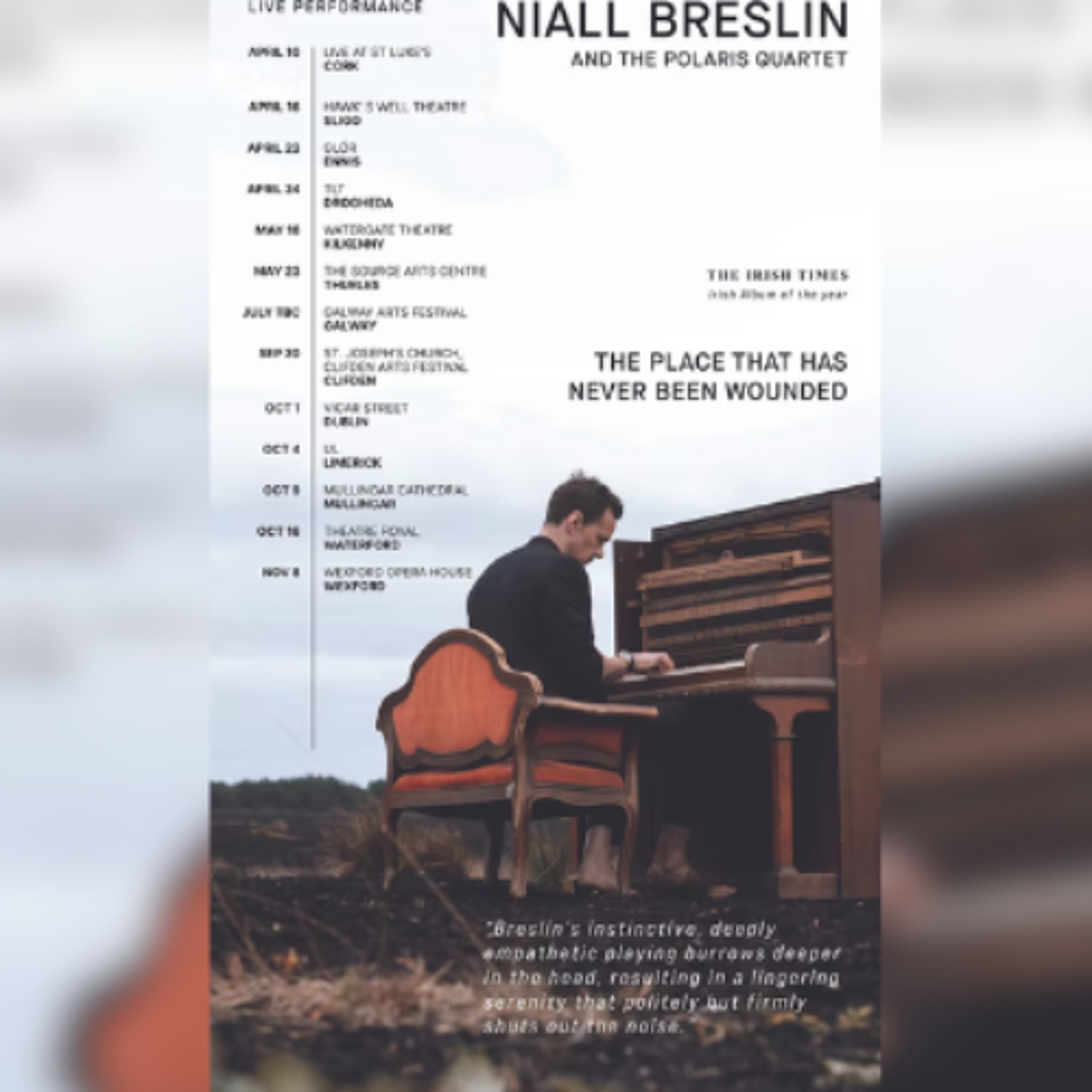
Niall Breslin With The Polaris Quartet: The Place That Has Never Been Wounded
About this Episode
Niall Breslin, best known to many as Bressie, is back with a brand-new album.
Called The Place That Has Never Been Wounded, it is being described as spacious, introspective, and deeply personal.
He is set to bring this new record into a live setting, with a show at Glór next month on Thursday 23rd April from 8pm.
To find put more, Alan Morrissey was joined by Bressie on Tuesday's Morning Focus.
Photo (c) niallbreslin.com
Hosts & Guests
Transcript
Niall Brezzlin, obviously best known to many as Brezzi, who is promoting his latest record,
called The Place that has never been wounded, it's been described as spacious, introspective,
and deeply personal, and he'll be bringing it into a live setting, but a show at Glornex Month,
on the 23rd of April, to be precise, and as I say to light, to be joined by Brezzi,
how are things, are you? I'm very good, how are you?
Very well, thanks for having a chat with us, and the new record, it's quite a departure from
what people would best know, you're for a very kind of stripped-back atmospheric piano-led record.
What inspired that shift?
That's kind of where I came from. My mother's a kind of classically trained pianist and
violin teacher, and when I was younger, when my grandfather died, he gave me his piano in as well,
if he must have seen something in me when I was a kid, and that was where I learned everything
about music, my entire education was on a piano, and over the years, I suppose I would have
rode a lot of my music on the piano, even though it was guitar music, and then I kind of,
I wanted to come back to it, I suppose I was a little bit insecure about coming back to it,
because then the artist that I love, the max rickers, and the, you know,
over for animals, people like that, I was like, can I do this? And over kind of COVID, I just
started to write, and yeah, I was like, I want to put a record out, and come back to what I know,
I suppose. Yeah, and that actually max rickter was, when I heard the record, it was the first name
that popped into my head. It's definitely within that realm. As you said there, that, you know,
you know, you think you had that kind of thought of, I should, is this, should I be going in this
direction? But is it very satisfying to have done it and kind of come up with your own version of
that unique sound? And you also did it quite quickly as well. You know, some albums can take weeks,
for some bands even years to record. This was done over just five days.
Yeah, my overthinking day is hopefully when it comes to music or I'm moving on. I think when you're
younger and you're in a band, you keep trying to second guess everything and, you know,
are the label going to like us? Are the audience going to like us? And you spend most your time
worrying about that stuff rather than just, you know, creating something that you like, and that
means something to you. And that's the one learning I got, being in this industry 25 years,
and you can, you can bend to other people's perceptions or you can actually create something
that you believe in. And that's what I did. And that's why it took very little time. We just
went in. I mean, you exactly what we wanted to do. And even from that, like I've already started
working on new material and stuff. And that's the approach I take. If it's right, it's right. And
you know, for somebody who's, can be immensely critical on himself and overanalyze everything,
clear everything every thought I've ever had. Sometimes getting out your own way is the single
best thing you can do for creativity. And in terms of the speed of creating the records,
Brazil, I mean, how much of the material did you have kernels of going in or fully completed or
was the whole thing? Was it an experiment all written within the written and recorded within
the studio in that tight time frame? No, I kind of had the ideas. I had the concept and I had
the tracks to a point. But then I didn't, you know, you always have to give the people your work
on with space to bring something to the table as well. Like, really, they're like, what are you here
in here? What's this making you feel like? And the thing about the music is it comes to one thing
and one thing only we said, does it make you feel something? And if it doesn't, then we didn't,
we moved on from it. And that was the approach. And even now the approach I'm taking is that it's
and it doesn't have to be necessarily a positive emotion. It can be a difficult one. Whatever it is,
the full spectrum of emotions, human steel with every single day, like it is, that's the idea
with the album. And even the concept of the album, I think so much in the wellness space is about
what we don't have and what we need to be more of and what we need to do more of. And I think
to myself, like, how much more can we all do? You know, maybe we should recognize the part of us
that holds a study when the world is shaken. And the world has been shaken pretty hard for the
last several years. So I think that's what this album is about. It's that tribute to that part
of us, rather than a part that, you know, people keep telling us we need to do more on. And
in the words of Elton John, as I said, if you're still standing after the chaos, we've been served
maybe you're a little tougher than you think here. You've described the record, you know,
obviously, instrumentals as exploring things you can put into words. And I suppose with
instruments, you know, sometimes artists can struggle with a particular song coming up on
an appropriate theme for lyrics or it saves that problem. But then I guess it puts on the flip side
it puts the focus on to the music carrying the emotion or the feeling as opposed to either the
music and the lyrics or predominantly the lyrics doing that. How not having the lyrics, having
the lyrics side of it removed, did that place extra important to your extra pressure or emphasis
on ensuring the music carried what it is you wanted the listener to feel or to take from it?
Well, it's a concept album. So I didn't, I wasn't massively worried about lyrics. I think the
concept was each track over the 14 tracks guides you to that place within yourself that's never
been wounded. That's the kind of the idea with the titles. And the really important thing with music
as well is people will take what they need from us. You know, when you over tell people what this
is about, it doesn't need much space for them to decide this is what I feel when I listen to this.
And that's what I wanted to do with this. It's what does it release in you or, you know,
and that's the general theme you get from the live shows is people come up to us and say,
it released something that I didn't realize I was holding onto. And they might not be in heavy,
it just might have been that, you know, I often joke. I sometimes say to people, there's
anyone who knows what it feels like to be calm anymore. You know, that's the modern culture we've
created. This hyper vigilant, you know, front row seat of genocides and moors and all the stuff
that comes with that. And, you know, in the midst of it, one of the quotes that I used in the album
was this Krishna Morty quote, it's no measure or sanity to be well adjusted to an insane world.
And when people come to the shows, it's just it's 90 minutes of not that. It's the opposite
of that. It's an escape. And it's an acknowledgement that if you are feeling a little overwhelmed
by the world, good you should be. It's all my, but this space is a space to get away from that
for a period of time. Has this whole process been immensely satisfying for you creating and
pulling out the place that has never been wounded, and playing, performing it in a live setting,
having the audiences respond positively to the shows, to the record, and just pulling off
something that perhaps people didn't expect from you and, you know, proven you can't be pigeonholed.
Yeah, I know everyone will leave up without albums and they put out new material to say this is
the thing I'm most proud of. It's definitely the thing that's challenged me the most. It's that,
you know, I've been in bands for years and I've really sold up music for years. And I love that
and I love being part of a band, but I think this for me was a, it's not even that it's that
the deeply personal element of it. And some of the pieces that are immensely personal. And, but,
you know, I think it is, it is what I've created is something that I was so nervous about doing for
so many years because I was like, this could be a disaster. Like, and if you put it out and people
are like, what's this guy doing? And these are the things a lot of creatives actually deal with.
And most people deal with it if they're honest. It's not even an imposter syndrome. It's just
there's an insecurity to it. And like in the past, I wouldn't know when near that. I would have just
went, I'm not going to challenge this. And that's not what I do anymore. I just go over. And
I don't know if that's age. I'm 45 now. Like when I was in my 20s, I wasn't thinking like that. So
there's probably a bit of age to it. But this type of music is, is designed. It is genuinely
designed to make people realize that there is a part of them. And I believe it's in every single
person on this planet. There is a part of them that knows exactly what to do. And, you know, when we
keep going on our TikTok and Instagram and we see got some guy telling us he's done three days
work before 8 AM in the morning and now he's gone to the gym 40 times today. And if you're not doing it,
you're not hustling enough. That mentality is making us feel lonely and deeply individualistic.
And one thing I've learned with this type of music, it brings people together. And that's what's
missing. I think is community connection, collectivism. And not this, you know, every person for themselves
agenda individualism that we see so much in social media. Yeah, certainly. I haven't listened
to it. I can bring that sense of camp to what is a chaotic, noisy world that we live in these days.
The album is called The Place That Has Never Been Wounded. You can see, Bresy, at Glor on Thursday,
the 23rd of April. Bresy, thanks for having a child. It's congratulations on the record.
We're going to play the Creedence frequency now. Thanks for being with us.
Thanks so much, Bresy. Thanks for the support. That's Bresy there. And from the place that has never
been wounded, this is the Creedence frequency.