About this episode
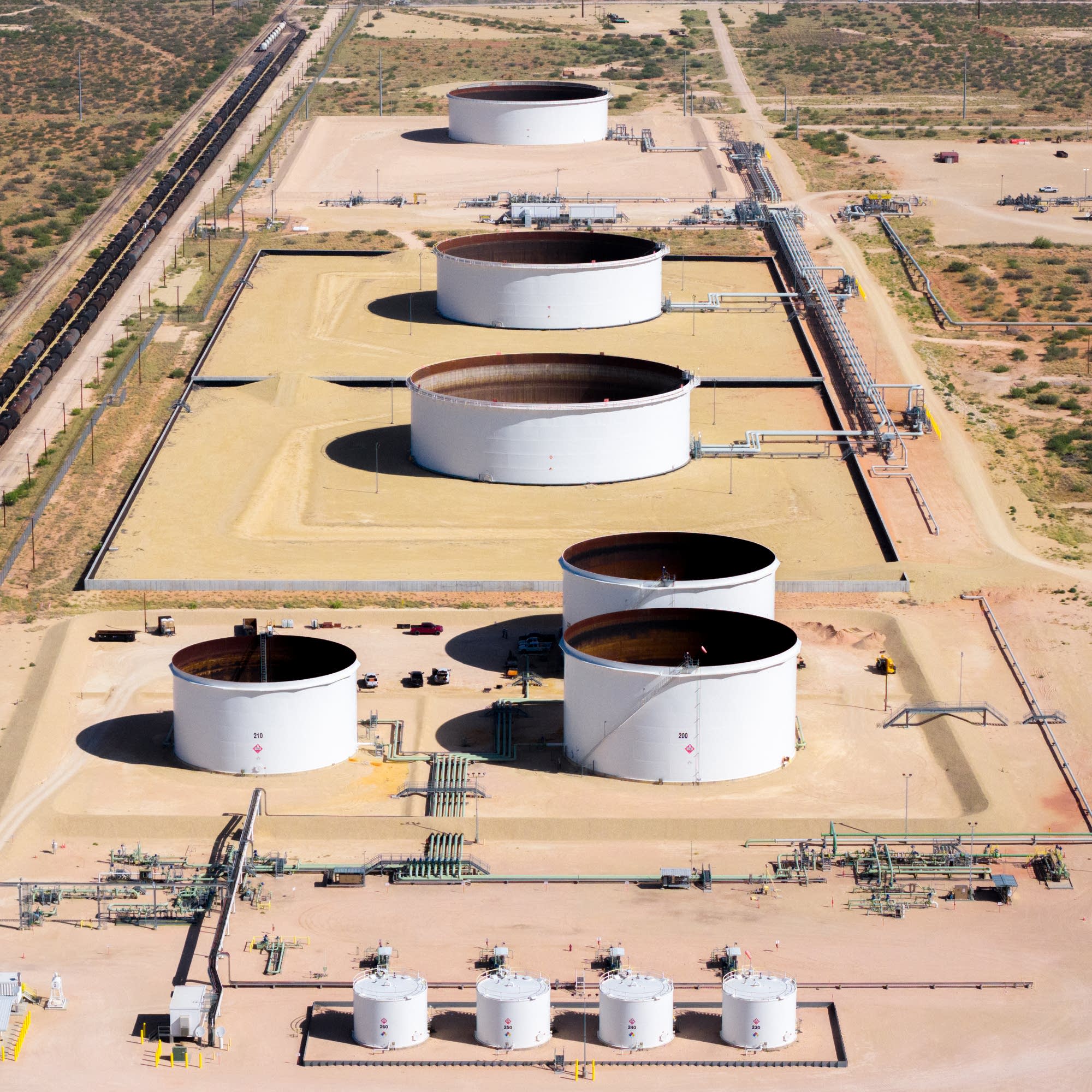
In Texas oil country, September usually marks the beginning of maintenance season. But with refineries running at near-100% capacity to meet increased demand, this fall might look a bit different. In this episode, can the global oil market weather an even tighter supply squeeze? Plus: Fed watchers expect an interest rate hike in September despite Trump’s opposition, U.S. consumers keep up spending in the face of mediocre jobs data, and ski resorts hoard snow for the warmish winter.
Every story has an economic angle. Want some in your inbox? Subscribe to our daily or weekly newsletter.
Marketplace is more than a radio show. Check out our original reporting and financial literacy content at marketplace.org — and consider making an investment in our future.
Read the stories in today’s episode:
- Why interest rate expectations are pointing north
- The 'meh' job market hasn't slowed consumer spending much
- Inside the business of selling people their own family photo albums
- After a disastrous foray into real estate, this first-time buyer didn't let fear hold her back
- Can U.S. refineries afford to slow down for maintenance season?
- Ski resorts keep some snow in the bank this summer
Get every episode summarized
Each time Marketplace publishes, we email you a written briefing from the transcript — the topics, who appeared, and any specific claims, with the ad reads skipped.
Email me new episodesFree for 3 shows. No card needed.
Hosts & guests

Transcript ready
415 searchable segments. Every word is indexed and playable.
Full transcript
Marketplace — Oil markets brace for maintenance season. Machine-transcribed; use the interactive transcript above to jump the player to any line.
Today on the program catching up on where things stand. From American public media, this is Marketplace. In Los Angeles, I'm Kai Rizdal Monday. Today August 31st, as it always is, to have you along, everybody. So I was off last week, did a mostly good job of staying away from the news, except for one thing. Kevin Worsh's big speech at Jackson Hole on Friday couldn't really not tune into that. You have by now seen and heard plenty about what the Fedger and I had to say underlying inflation trends have not. He said meaningfully improved and the central bank has, and this is a quote, work to do. In the days since, market expectations have taken the chairman's words to heart with ever higher odds that the federal open market committee is going to raise rates by a quarter
of a percentage point and its next meeting. That's in September. And it is roughly even money that there will be another quarter point bump in December. You put all that together and try to figure out what it means. What do you got? Well, we've got marketplace's Mitchell Harman. Inflation hawks like Dan Norrith at Credit and Sure, Oliance Trade think the futures market has it exactly right about the Fed's next interest rate move. There's been no progress on inflation. We're right back to where we were before the war started. He points out the PCE price index is nowhere near the Fed's 2% target. Without an interest rate hike, you're going to have a hard time reaching that you were still quite a waste from it. And it's been very, very sticky. An interest rate hike is certainly warranted. And the Dovish camp is Jay Hatfield at Infrastructure Capital Advisors. He argues the government has been overestimating headline inflation and the core measures will come down soon even if oil prices stay elevated.
We think it would be ill advised to raise rates at this juncture. But we do acknowledge that the majority of the FOMC, which is what matters, absolutely does want to raise rates. Apparently because Warshen, his fellow Fed governors, want to demonstrate their political independence from President Trump, who wants lower rates to stimulate the economy. Economist Erasmus Kirsting at Villanova sees Chairman Warshen playing a careful game. Not painting himself into a corner and having to raise rates. But at the same time, he is willing to take that step if necessary. The data is not screaming for a move in one direction or another. Warshen is not a crisis. But what if the Fed does hike rate soon? Would that be a crisis? Well, it surely wouldn't help, says Guy Sakala at Inside Mortgage Finance. He points out that mortgage rates are already approaching 7%. Just a deal killer. I don't think there are any indications rates are going to come down.
US debt level and deficit, an ongoing war, gas prices, nothing. It boots well for the mortgage market. The consumer economy, already showing signs of inflation fatigue, might slide more, says Jeff Klingelhofer at Aristotle Pacific Capital. We are all having to adapt to a world of higher interest rates. Every consumer is feeling that pinch, is feeling that pressure. As borrowing costs go up, while inflation eats away virtually all of our wage gains at work. I'm Mitchell Hartman for Marketplace. At Propob, nothing other than a changing of the guard at a company worth $4.6 trillion today's Tim Cox last day running Apple. He will become the executive chairman. John Ternis, who's in charge of hardware engineering, takes over tomorrow. Elsewhere in American market capitalism, starting the week and ending the month of stocks were down. Oil was up, see also the renewed shooting in the Middle East. Details numbers when we get there.
It was a toss up for us in our news meeting today. Do we start with the bond market and rates or do we go with jobs? You know how that turned out, but it was close because this is a big week in this economy. Jobs wise. Tomorrow is going to bring us the latest job openings and labor turnover survey. A report basically on what demand there is for labor right now and how much labor market churn there is Friday. Of course, is the biggie, the August jobs report will get the number of new jobs, the unemployment rate and wages to do not sleep on wages. Expectations to be totally honest are for more of the same, the low fire, low higher labor market we have had for months now. But here's the thing. Our demand has a huge effect on this economy.
Marketplaces Justin Ho is on that one. Even though jobs numbers are some of the most important economic indicators, they don't really guide people's decisions every day. So long as you're employed, it's not something that you think about every morning as to whether or not the overall labor market in the US is expanding or contracting. That's Peter Erasm, an economics professor at Iowa State University. He says people are certainly aware of what's happening in the jobs market, say what's going on in their own industries or how easy it is to get a raise. But he says in order to actually change someone's behavior, that takes something big, like being laid off, for instance. And right now, we simply don't have that many people looking for work. And so that by itself is going to mean that fewer people are really feeling any pinch of the slow growth in the labor market. That's one of the reasons why consumer behavior hasn't really changed much. Sarah House is a senior economist with Wells Fargo. She says even though people's wages have not been keeping up with inflation for most of this year, you still see consumer spending hold up over that same period.
But House says a lot of people have been spending by dipping into their savings. When we look ahead, I think there's some concern about, well, you can only drive the saving rate so low for so long. And so that does suggest an caution in terms of consumer spending in the back part of the year. The weaker labor market is also having an outsized impact on lower income households. Kathy Bosschansik, chief economist at Nationwide says they are having the shift their spending behavior. And they are probably substituting for less expensive goods and maybe curtailing services in order to make ends meet. But either way, Bosschansik says people are still spending. For the lower income households and lower middle income, they just have no choice right now. They have a certain level of spending. They have to maintain. And as long as people have jobs, Bosschansik says they will keep spending. I'm Justin Howe from Marketplace.
This economy, as we've talked about a time or two, I do believe, is actually made up of a million different micro economies, including to be completely honest, some I've never heard of even after all these years. That's the entry into this next interview, a conversation with David Poe about an experience he wrote about from New York magazine. He's also, by the way, a correspondent at CBS Sunday Morning. David, welcome to the program. Thank you. Tell me about this email that your sister got. It came out of the blue. It was from a total stranger and it sounded like a scam. It said, I have come into possession of a photo album belonging to your grandmother. It's over 100 years old. And for 150 bucks, I'll sell it to you. Totally a scam. Come on. Totally a scam. But at the same time, the email had a couple of details in it like where my grandmother grew
up and when she graduated from high school, that were correct. So I wrote the guy back and this time he responded with photos of said photo album, which none of us knew existed. And just spectacular. I mean, handwritten captions by my grandmother, pictures of her as a college woman, as a high schooler, as a baby. And so we went for it. We sent him 150 bucks. So as they say in the art street, I imagine, tell me the provenance of this thing. How did he come to have it? So it turns out it's this guy in Ohio who's got a side gig of buying old albums from flea markets and online stores like eBay, researching who's in the pictures, and then researching who those people's descendants are, and then selling the albums back to us. So he got it from an eBay vendor, who got it from another eBay vendor, who got it from
another eBay vendor. And then the origin story is really weird. My uncle died in 2018 and it turns out when we went to sell the house he had lived in, he was a hoarder. It was just crammed to the ceiling with junk. So we hired of all people Matt Paxton. That's the guy from the hoarders TV show. We hired him to clean it out. And the deal is he throws away everything that's obviously trash and anything that might have value to us. He lays out for us in this immense warehouse in Richmond, Virginia. So my entire family flew down there, spent two days looking through all this crap. And you know, it's possible that this photo album was actually there. And surrounded by boxes and boxes and boxes of junk, we actually left it behind on purpose. And so it comes full circle, right? Exactly. So somebody probably sold what was left into this online economy of memorabilia traders.
That's the thing. There is this entire ecosystem because it's not just this one guy who found your grandma's album, right? There's a whole like industry full of people who do this. I mean, hundreds of thousands of sales by these people. And some of them specialize in weird photographic categories. Like one just does bathing beauties from the 20s. One does military, one collects what they call camera shy shots, which are all photos of someone blocking their face with their hand. It's I had no idea that this existed. And I actually tracked it from vendor to vendor to vendor, the price going up a little bit each time. Yeah. Until it came back to us. Right. Right. Right. So you're getting now with your family and flipping through this album. You know, we only knew Mary Ellen when she was really old. Mary Ellen your grandma. Mary Ellen your grandma. My Mary Ellen my grandma. Yeah. Yeah. We only knew her as an old lady. And this album, I mean, these pictures are spectacular.
It's her with her friends, you know, 12 people cramming into a model T as a joke. And, you know, she was accomplished. She was a newspaper columnist before she was even out of college. She was a prominent violinist. So it really made the century between us kind of disappear. David Pogue you can see him on CBS Sunday mornings. You can read him also this crazy, crazy story in New York magazine. David, thanks a lot for your time. My pleasure. Buying a house can be a smooth process. Often though, it's not offers fall through. You get out bid sellers, take it off the market.
Any number of unfortunate things can happen in the complicated dance that is buying a home. But it can be worth it sometimes too. It's a setup for today's installment of our series adventures in housing. My name is Ash Sheep and Sunny. I'm a 29 year old first time homeowner in Bartlett, Illinois. Back in November, I almost had a house. I put in an offer. It went to inspection. And basically, it failed the inspection. We didn't even get through the whole inspection. There was weeks and potential asbestos and problems with the sighting and there were these, like, just one thing after another. And as a first time homeowner, it was too much for me to handle. People that work were like, oh my gosh, how do you feel? Every day, I want to throw up. I want to throw up. Like ultimately, at the end of the day, I wanted a house where I wasn't going to have to pay another house worth of money to make it livable. And with this one, I still wanted to throw up, but not as badly.
I had my heart destroyed by that first house. And I could not let myself love something until it was mine. So when we went to go look at this house, my dad and my mom both did not like it from the listing. But we walk in the front door. This sounds so dumb. But the refrigerator, I told my boyfriend a couple months ago, that's the refrigerator I want in my house one day. And then I was FaceTiming my mom so she could see the house. And there was a painting on the wall, and she goes, granny has that painting. And like, mind you, my grandparents are the most important people in my life. So I didn't fall in love with the house when I walked in. I had signs telling me, this is your house. I put in an offer three days later we had the inspection and I closed within a month, so it was meant to be.
When I was looking, everybody kept going, oh, starter home, starter home. And I was like, no, I don't want to do this again. It was so stressful. I remember we pulled up to the final walkthrough and I just started crying. And my realtor, she's like, are you okay? I'm like, you know, I'm fine. Just give me a minute. Because it was scary. Because like, you go from this dream and this, this is going to be yours and you're going to do this to, oh my gosh, who let me buy a house? But I don't regret it. And if I spend the next 30 years here, I'd be happy. It's a good story, huh? Ashley Pinsenty, first time homeowner, Bartlett, Illinois. You know, this series does not happen without you. So whether you nailed it on the first go round or you needed a couple of tries to find the right place or maybe you're still looking, tell us about it, marketplace.org slash adventures in housing. Coming up.
We all watched the pile. Is it getting smaller? I think it's getting smaller. Like watching paint dry, you might say. So let's do the numbers. Dow and dust rolls off 374 points today. 7th 10th percent, 53,185 for the blue chips. The NASDAQ subtracted 31 points, about a 10th percent, 26,370. S&P 500 down, 25 points, a third of 1 percent, 7686 there. The shooting has, as I said a minute ago, picked up again in the Middle East and so has the price of oil. Brent crude bubbled up to and 7th 10th of 1 percent. West Texas Intermediate rose just over 3 percent. And thus Chevron pocketed to 2 and a 10th percent. Exxon mobile holdings found to 2 and 7th 10th percent in the couch cushions. While the fire liability reform bill introduced in the California Senate would not prevent insurers from recovering wildfire related claims from utilities, that hit this state's electricity providers.
But in the petroleum economy, September is the month when refineries typically start doing their fall maintenance routine most years, which this year is definitely not thanks mostly to the president's war with Iran. U.S. refineries are already running almost full throttle, 97 percent of capacity in case you're curious. And refineries around the world have been taken out of action, squeezing the global market for refined products and as supply and demand dictates pushing up prices. So run of the mill maintenance into the mix. Well, you see where this is going, right? Marketplaces Elizabeth Trova can too. It's not like U.S. refineries want to shut down parts of their refineries. They are raking in high margins right now for every barrel they make. You're going to do everything you can to keep that refinery running. Tom saying is with Texas Christian University. We're not talking band aids. You're going to do the required maintenance at a minimum. That's the U.S. Companies have been running their refineries to make as much gasoline, diesel and jet fuel
as possible. Saying says at some point their equipment will need some work. You can't be run in 97 percent continually for months and not have something break. These maintenance shutdowns for refineries are called turnarounds. And anytime U.S. refineries go offline this fall for turnarounds will lower what they can produce. So, we're going to do a little oil analyst Tom Close up says that's happening as we're getting into harvest season for farmers. Which sees a boost in diesel use and then there's the heating season and God only knows we hope we don't have a cold winter in the U.S. store at the east or in Europe this year because we don't have the hydrocarbons to sort of have the the wherewithal to pay for it. Joe Delora with Robo Bank is also concerned about where that leaves the market for diesel this fall. Why just have nothing positive to say other than that diesel prices are going to go up and diesel in stores are likely to continue trapping and this is a global problem.
He says demand for diesel is less elastic than demand for gasoline. You can't just stop using it. If you stop using it it means you're not doing the thing right you means you're not literally harvesting crops right or you're not shipping things. And so companies will usually tend to just continue to use it and they'll just pay up for it and try to pass the cost along to the consumer. He says as diesel prices climb even higher we'll see inflationary hits about two months after. I'm Elizabeth Trowwald from Marketplace. We are technically a bit past the dog days of summer.
Early July through mid August is when they run so says the old farmer's almond ag. It's an astronomical thing. It turns out that happens to align with the hottest, humidest, sometimes grossest days of the year before global warming I suppose. But I digress because while yes the thermostat is still registering in the 80s and 90s in much of the country we are here to talk to you right now about snow. Your thoughts might not have turned to winter but you know who's have ski resorts. Marketplace of Katelyn Tann has our story of how some of those resorts are putting snow in the bank. If you visit the cross country ski area in Utah's Wasatch mountains about now you'd see lots of dry grass and sagebrush. You could hike the trails or hop on your mountain bike and you might also catch a glimpse of a football field sized mound. We now pull you come here and you go that way and we pull it here. Listening to a video from Soldier Hollow Nordic Center back in March. The mound is covered in mats, blankets and tarps.
What's underneath? No. And now comes the mats. The snow storage technology is from Finland. The insulated snow pile sits through the scorching summer heat and somehow mostly survives. I recently called up Soldier Hollow's manager Luke Bodensdiner to check on the pile. It was 85 degrees that day. I'm looking at it right now. It's still there. It's still close to 25 feet deep to be honest. A few months from now the cover will come off and the giant snow bank will be spread out with a snow groomer. I think we'll probably be able to open about two weeks earlier than we normally have. For ski resorts opening early can be the difference between prosperity and just eking along. It'll be pretty limited terrain but skiers will be skiing. Last year Soldier Hollow opened two weeks late because snow was nowhere to be found. And that's not something Bodensdiner is willing to risk in the future. We are preparing to host the Olympics and Paralympics in 2034.
Cross country skiing, biathlon and the Nordic combined. Hard to do a global winter sports competition without something to compete on. And snow storage will almost certainly figure into our preparations for that event. Just a guarantee that we can produce the Olympics in any kind of weather. Stored snow is like an insurance policy. Quite a few ski resorts in Europe are already doing it. But it's still catching on in the states. All of our guests in the summer don't know what it is. When we tell them it's snow under there, they don't believe us. It's Nate Shake. He's the mountain operator at Bogus Basin, a downhill ski resort near Boise, Idaho. And they've stored snow the last two summers. When it's 100 plus degrees, his crew turns anxious. Hi everybody. We all watch the pile. Is it getting smaller? I think it's getting smaller. A little, but not much. They invested $120,000 in insulation materials.
And Shake says it's worth it to have the guarantee of even a little snow. I mean, you can get open. You can get your lifts spinning. You can start selling lift tickets. Shake says Bogus Basin rakes in about 30% of its annual profits during the winter holidays. And last year it would have missed out. There wasn't any snow and it was too warm for the manmade kind. But the big pile from the previous winter bought them time. We were able to open one of our conveyor lifts and have a train park and a skiing lane on the storage snow. And if lift tickets are selling, people are likely spending money in town. That's something Paul Bierman is seeing in Northern Vermont. He's an environmental scientist at the University of Vermont. And he says snow storage has helped revive the local Nordic ski area. It's allowed general stores to thrive. It's allowed Airbnb's to thrive. It's allowed cabins and lodging to come back that had closed because there weren't enough clientele. The resort now stores snow in a pond basin covered in wood chips.
A technique Bierman helped with. It just gives them the ability to function through an increasingly erratic and warming climate in Vermont. But Bierman calls snow storage a bandaid for ski resorts. At some point the winters are going to get warm enough that that snow you spread in November is not going to stick around. It's going to melt. It says figuring out how to slow or stop warming winters is the only foolproof business plan for guaranteeing skiing. I'm Caitlin Tan from Marketplace. The final note on the way out today in which artificial intelligence ain't all that. The US division of Ernst & Young, the big accountant, seeing consulting company, is putting $100 million in employee rewards and incentives on the line.
This is the quote from the Wall Street Journal which had the story. They want to recognize people who show skills like adaptability and innovation and judgment as well as experimentation with AI. I'm pleased to be able to report that there is hope for humanity yet. I'm here by way Caitlin Ash, John Gordon Neukekar, Steve Mullison, Stephanie Seek, are the Marketplace editing staff Kelly Svera, is the news director. And I'm Kyle Rizdal, we will see you tomorrow everybody. This is APM. College sports are a multi-billion dollar industry. How much of that money should go to the players? I'm Alice Wilder, and this week on This Is Uncomfortable, we're talking about how new policies on name, image, and likeness, or NIL, are changing the game for student efforts. They're wearing a lot of different hats at a very young age.
They're a student, they're an athlete, they're potentially an influencer. It's a lot happening at once. I'm joined by Charlotte Wilder and Madeline Hill from the Sports Gossip Show. Listen wherever you get your podcasts.
More episodes


