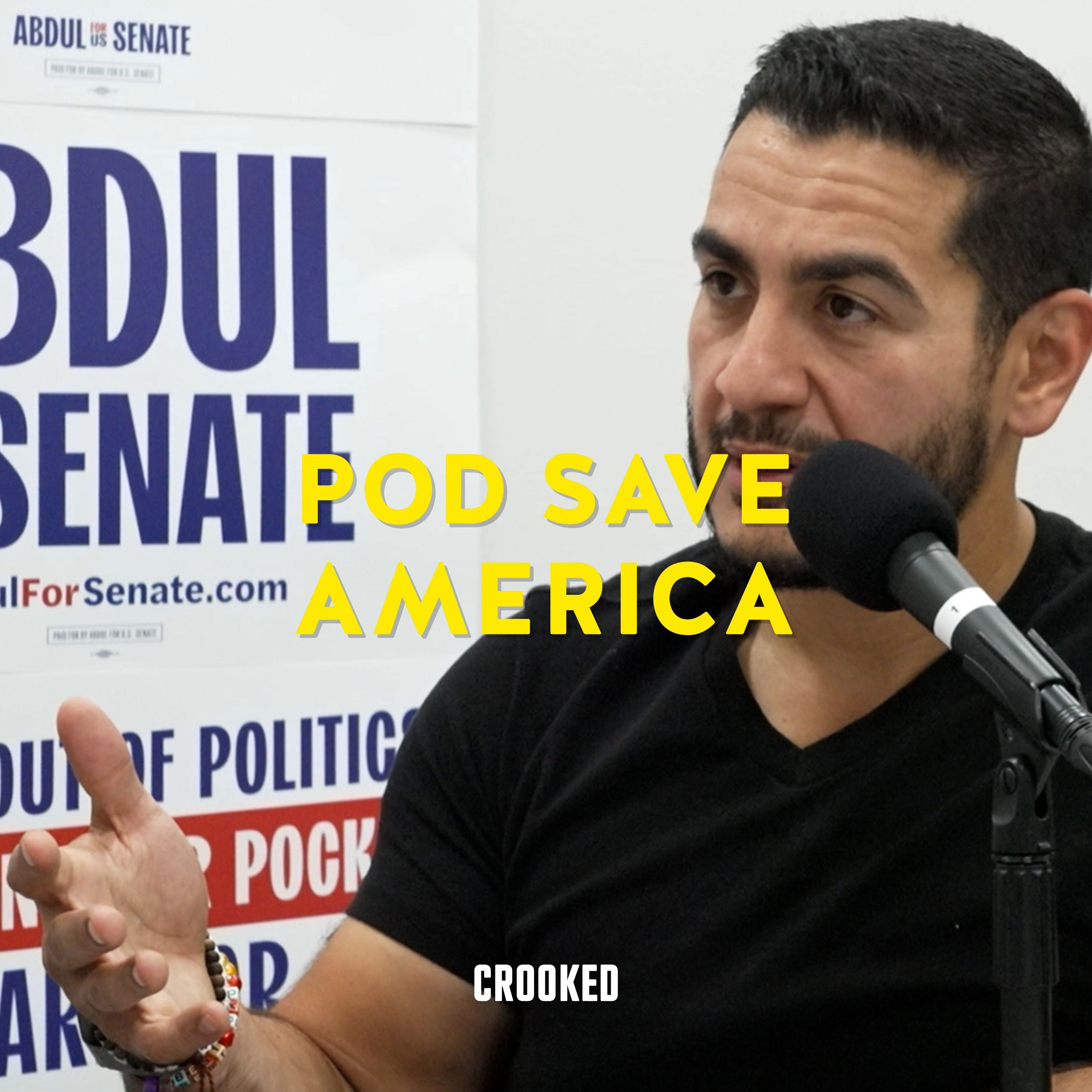
About this episode
Pod Save America is made possible by:
Tommy flies out to Detroit to talk to Michigan Democratic Senate nominee Abdul El-Sayed, asking him about his masculinity-forward campaign, the electorate's appetite for candidates who fight back, and how to restore trust in the American healthcare system. But first, Tommy sits down with Jon to talk about the energy he saw on the ground in Michigan, what he heard from voters, and what it'll take for Abdul to win come November.
Hate listening to ads? Become a Friends of the Pod subscriber for ad-free episodes of Pod Save America, Pod Save the World, Lovett or Leave It, Runaway Country, Offline with Jon Favreau, and more—plus exclusive content, including bonus episodes of Pod Save America. Subscribe now at crooked.com/friends, on Apple Podcasts, or through the Pod Save America YouTube channel.
You can request a transcript by emailing [email protected]. Include the podcast name, episode title, and air date. Please allow 48 hours for delivery.
Get every episode summarized
Each time Pod Save America publishes, we email you a written briefing from the transcript — the topics, who appeared, and any specific claims, with the ad reads skipped.
Email me new episodesFree for 3 shows. No card needed.
Hosts & guests

Transcript ready
1,049 searchable segments. Every word is indexed and playable.
Full transcript
Pod Save America — On the Ground in Michigan with Abdul El-Sayed. Machine-transcribed; use the interactive transcript above to jump the player to any line.
[♪ OUTRO MUSIC PLAYING [♪ Welcome to Plot's Ave America, I'm John Favreau. And I'm Tommy Vittor, hello from Detroit, Michigan. How you doing? Hello! How's it going there? What are you doing there? It's going great. I came out to see Michigan Senate candidate Abdul Al-Sade on the campaign trail interviewed him last night in Detroit after a town hall event. As you guys know, as the listers know, this is one of the most hotly contested Senate races in the country. The Democrats just had a bruising primary that pitted progressives against the establishment, A-PAC in Israel versus, you know, with the left position, on a bunch of foreign policy issues. And now Republicans are propping up mic Rogers who is, you know, the conservative,
you know, national security official from a different era of Republican politics. And this is going to be a knife fight between now and election day. So I want to get out here, get on the ground and see what it looked like. Nice. How was it? How was, uh, what we can get to have deal with? Like, how was, what did you see on the ground? It was a very quick trip. In the, in the Tommy's fantasy version of this trip, I went to Detroit last night and then event in Lansing today and then tailgated with Abdul and, uh, before the Michigan football game. Oh, that was fun. I know, but you'll be surprised to learn that didn't fly with Hannah. The three year old and the two year old at home. Yeah, a little bit going on. So it was a quick trip. flew out, um, 6am, Thursday landed in Detroit. Then we went to Wayne County Community College where Abdul is holding this town hall meeting. So we interviewed a bunch of voters coming in, um, got to hang out with Abdul for a bit off the record before the event. watched him speak, uh, and did, he did a Q&A, a gaggle with press, and then he sat down with us for an interview before he then did a CNN hit.
So it was a very long day for him. So here's a quick taste of what we heard, what we saw, what the ground was like, uh, what Abdul's events, what the interview was like. Watch this and then John and I are going to talk about impressions from the event, the stakes in the election, kind of the issues that are getting fought, and what the path looks like going forward for Abdul. We are at the Wayne County Community College in Detroit, Michigan. We're here to see Abdul El Sayed, he's doing a, it shouldn't be this hard town hall meeting tour. The democracy is supposed to be about sharing in a conversation about two days. Who are we and who do we want to be? Part of my job is not just to be like, all right, here's what's popular to pull. It's not just to do what's popular, it's to make popular what's right. At the end of the day, people are good, really. I think sometimes we're afraid of our own shadow. We assume that people are going to like it. We shouldn't be talking about it, we're going to be like, yes, we should. What are you afraid of? Oh, wow. What did, uh, what some of the voters say? But you said, um, the voters, well, let me tell you guys first about,
let me preview the Abdul piece of this, just so folks know, and I'll talk about the voters. In the interview, Abdul and I talk about, you know, the difference between the questions he got from voters in the town hall and then the media, um, you'll be surprised to learn that the voters were not asking about Twitch streamers, but the press corps was, um, and Hassan Piker. We talked about what Mike Rogers and Ted Cruz had just said about Abdul in Dallas. I'm sure some person-screened shoot-em will play those comments for you guys in a bit. I asked him about kind of like his reflections on 9-11 because we're talking on the 10th, and not just kind of like the fear of that day, but being a Muslim in America in that period after. And then I asked him about his image because you and I know him is like our really smart doctor buddy. Yeah. And kind of a nerd. And now like, there's a lot more bro coming out of that campaign. So I asked him about how we thought about that. The kind of him kind of getting the Tucker Carlson endorsement. We talked about public health. This is about 20 minutes and in a worthier time.
Most of the voters we talked to were big Abdul fans. Not a lot of undecided, so we're turning out at this event. But two people that really stand out to me, one was a woman who you'll hear from in the episode who actually knew Adi Barkin. That was a friend of ours. It's unbelievably brave healthcare activist. And she talked about getting arrested with Adi and how Abdul's commitment to Medicare for all in healthcare was what inspired her to be a part of the campaign. And then I talked to this older gentleman. He's 82 years old and had worked on RFK, the good ones campaign. Wow. How cool is that? I know. That's very cool. It was awesome. The best campaign ever. And he was the last most inspiring campaign. Yeah. I know before the new generation of RFKs, kind of the team version that we got now. But you know, he talked about Abdul being a breath of fresh air and whatever. So here are some conversations I had with voters on the ground in Michigan about the election and about Abdul. Can you tell us your name?
My name is Jane. I'm Zach Ferrell. Edan Norris Howard. Christine Engels. Othanali. Marvin Crawford. Eileen McDonald. How did you know Abdul? Abdul was in my advanced placement calculus class. So you taught Abdul AP calculus? I did. I really did. And he was the most brilliant student. I mean, I know offense to rest my students. Come on. Nobody's got to calculus. He was brilliant at that. He won the math award. He also won the English award when he graduated, which was pretty a pastown. I like what he has to say in the manner in which he says it. It's his fresh air. It's fresh air. And we need fresh voices. I'm 82 years old. My last campaign I worked for was Bobby Kennedy, 1968. I feel like him, Bernie, the whole progressive movement, were putting us in the right direction. Fortunately, what happened with establishment the last few years kind of pushed people away
from the Democrats. And now people like Abdul are here to save the Democrats again. And Bernie and all those progressives. Why do you think, well, why do you like Abdul? Is it a message, a policy area, policy, money out of politics, Medicare for all, and all the policies he's pushing for? I think the message is clear. His fans are big fans of him. But I think the biggest thing is that when people finally hear him speak, there's a clarity of message. And I think also they like that. He's kind of not punking out, so to speak. You know, he's very verbose. He's very gregarious, but at the same time he's kind of a bulldog when he wants to be. I love that he's Medicare for all or healthcare for all. And I love that he wants to stop sending money to Israel. That is one of my biggest things that I love about him. He's one of the first politicians to actually do that. Personally, it's the healthcare for all. It says stance against Iran.
Money out of politics is probably the biggest thing. Money out of politics is definitely one of the biggest things. And I appreciate the campaign for all Americans, not just a specific group. I have six grandkids, two great grandkids. I worry about him every single day. The kids are starting to age are the 26-year-old health cares. And it's not looking too good for a couple of them. And we shouldn't be like this. This should not be this hard. Every country in the world has healthcare. We're the only ones that go bankrupt. We're the only ones that have that ration medications. It's not right. And it's not the way it should be. The young people need something to look forward to in terms of politics. And some of the people right now in Washington should go home. They've made a contribution. It's time to go home. And let the younger folks, you know,
when you were working for Obama, that's how I got connected with you. Amazing. You're amazing. Yes. Yes. Oh my god. I saw it. That's amazing. That's you. When you walked there, I thought, oh my god, I know who that is. It's incredible. Oh my god. What a small world. Yes indeed. Oh my god. You were saying you know some people that are very conservative in your life. And, you know, the classic Republican message of why are we giving stuff to them when I'm getting left behind kind of works. Do you feel like when you send those people an Abdul Clip, is he able to break through? Do they hear him? I think it takes a lot more nuance than sending them a clip because they are very used to just seeing a propagandized message and being like, oh, that's just the Democrats doing their thing. I think it's going to take a lot of things like this, seeing people talking and seeing actual conversations being had with people to realize and understand that it is a message for everybody. And it is for people like my dad who is,
didn't go to college and one of the hardest workers I know have the utmost respect for him. And it is important that he sees that. And I don't know that the, like you were talking about the love island clip, that's obviously not going to reach him. And I think something like this is important to see him actually talking to constituents and realizing that this is Michigan first, America first kind of movement as opposed to a specific group of people that the Republican Party has who convinced that they're the enemy. And this is something that he can see. My dad's like more of a moderate Democrat. And it's like a little convincing for him to get behind Abdul. But his biggest thing was getting money out of politics. So he has a sign out there. So that broke through? Oh yeah, absolutely. That's amazing. I'm hopeful. I'm hopeful that this, that this is the start of something new in this state in Michigan. Because there has been a dumbing down, a dumbing down of intellect,
a dumbing down and it's down, dumbing down. It can't continue. We can't continue this. We can't continue this. Agreed. You can't get much dumber. That's a good news. We're pretty dumb right now. Yeah, and it's it's it's it's it's sickening. It's spiritually sickening. It's emotionally sickening. It's intellectual sickening. And we we've got to get it's sad. I mean, here we are, the United States of America. And here we are. And this this uh, uh, filth that is stinch. That is over the whole country. I mean, I mean, I mean, I mean, I mean, I'm, I'm 82. I want to see see something refreshing before my last days. I want to see us, um, evolve, become, um, enlightened. Yeah.
You know, you know, I'm politically enlightened. And it's it uh, well, I just know. No, I'd like to listen. I really, really appreciate it. So it's great to see you. Thank you so much for talking with us. Well, you, I, I'm so glad to meet you, man. I'm listening. Thank you very much. It's amazing. Appreciate it. Appreciate it. Thank you for, uh, thank you for caring enough to turn out. No, God, yeah, talk to these guys. Yes indeed. And by the way, if you like seeing us getting out of the office, going out on the ground on these reporting trips, please consider becoming a friend of the pod subscriber. You get ad free episodes, you get bonus content, and you also help us grow our progressive independent media company. And just do more stuff like this. Cover more issues. Get out into the world. So crooked dot com slash friends, uh, check it out. I'll tell you all the ways you become a paid subscriber to quick and media crooked dot com slash friends.
Pots of America is brought to you by the NPR politics podcast. If you are listening to the show, we don't have to tell you that the midterms are coming up quick. And there's a lot to keep track of. Here's a cheat code I used to help. The NPR politics podcast. There are a daily political podcasts where you can catch up on the biggest political news of the moment in 15 minutes or less every weekday. Right now, NPR politics has its eye on the issues that actually affect your life, the high cost of housing, healthcare, ice and immigration, America's role in the world, and the growing debt, plus how all of them might impact the coming elections. No doom scrolling to stay clear focus summary for you to declutter the chaos. It's a team of really experienced political journalists who talk like your smart friends give you calm, straight news instead of hyperbole. They offer clarity without judgment, offering a better understanding of how the balance of power might shift without stressing you out. I'm a huge fan of the NPR politics podcast. I have been for a long time. I've I'm fans of the journalists there. I've known a lot of them personally. They are smart. They are diligent. They're really thoughtful. There's trusted people who do great reporting and provide really smart and sharp analysis.
So we highly recommend it. Listen now to the NPR politics podcast in the NPR app or wherever you get your podcasts. Pots of America is brought to you by stamps.com. We could all use a few more hours, even minutes in the day for ourselves. Skip your trip to the post office and stop letting mail steal your precious little time. With stamps.com, you can print postage and shipping labels from your computer or phone 24 seven with up to 90% off UPS, USPS, FedEx and more. No lines, no trips, no waiting. Get everything done in minutes and even schedule free pickups. So carriers come right to you. Whether you're sending letters, contracts, important legal documents or packages. Stamps.com can make mailing simple for businesses of all sizes, including multi location offices. You can even send certified mail with proof of delivery right from your desk. We've used stamps.com here at Crooked, especially when we're mailing out Merch and Makes Life so much easier saves you a bunch of time. If mailing is taking more time and more money than it should, try stamps.com free for four weeks and get a welcome kit. Go to stamps.com slash PSA to get this offer today. That's STAMPS.com slash PSA.
Stamps.com slash PSA. Taxis and fees apply. It was great to get out here. And it's fun to watch these guys on YouTube and see the events, but I think being there in person just kind of gives you a different sense. And being there in a period of you can see the campaign going from primary to general election mode in that step up in size and intensity. And kind of watching a dual guy go from a guy who was a little bit known in Michigan political circles to totally losing his anonymity. It is just it is gone now. It is not quite the AOC experience because for her like winning the primary was winning the general. So she's a national figure right away. But Abdul is close and also you know, unfortunately for him it's back by $70 million in attack ads that were kind of part of that process. Yeah. Seeing him deal with that was really interesting. I've been wondering about that because and he like he ran for statewide office before, but that was just a totally different level of like faint.
And people know who he is. I watched the preparing for this. I watched the event that you went to and I watched his speech and his and all the quiet and listen all the questions to he's it's just I'm sure you will talk about this and and and felt this as well. But man is it different watching an event and watching the speech versus like what you see in here from the internet and the media about the race. Yes, yes, I think look we are a dual fans. He's been a friend for a long time. Both of us have donated to the campaign. So we are bias. But I came away just being like, okay, this guy is so talented. He's a talented communicator. He's a great speaker. And he just kind of he seems like a fighter, which I think is the thing we've all been talking about that voters want for this moment. But John the thing that he has done that I think every campaign consultant would dream of is he has landed on a clear succinct message, which is money out of politics, money in your pockets and Medicare for all to the point
where when we are interviewing voters about why they liked a dual, they were repeating it back to us. And he's the dream. He starts the event by saying that and then everyone repeats it back to him like it's a whole. Yep. I look like I also think for everyone's like, well, he's got to I mean, and we've done this analysis too on this show. Like he's got to talk about this and he's got to link Mike Rogers to Trump and he's got to be talking about economic stuff and not Gaza and Israel the whole time. And like he was so on message during that event, including the questions he was getting. It is like I would encourage anyone who is doubtful about the race and doesn't isn't sure like just just watch an event. Because he and the comfort that he has and the confidence, which I think is so huge into candidate. Like this is not someone who seems like he, I mean, first of all, he's memorized just out, but he is, you can tell it's just, it feels conversational. It feels relevant to people. He's not like talking down to folks. He's not like doing like here's my line on this.
And I actually think he even comes off better in person or at these events than he does. Sometimes like on social media or the interviews. Oh, definitely. The goofiness and the sense of humor comes through. Like so, you know, you've written a million stump speeches. But like politicians don't need your stump speech to be a thing you read verbatim every day. In fact, that's bad. What Abdul did very well last night was kind of work topical things into his remarks and make it new and new. But in the frame, so we talked about the Trump kind of $5,000 dividend proposal from Dallas. And he's like, hey, you're paying like on average 5600 for Trump's vanity trade war with Canada. You know, he's having an Episcopal contest with the Prime Minister of Canada. You pay for it and then he comes back and tries to bribe you for a vote for a little less back. And he's talked about how this is the third time you've been offered a check. He said, remember the Doge dividend Elon Musk got the Doge dividend the rest of us are still paying for it. And then he mentioned like the lettuce and the Listeria outbreak. And he said, you're paying for it on the toilet too. So it was like this funny thing. You talked about the Michigan Western Michigan game. The tour is called the it shouldn't be this hard tour.
Yeah. He talked about this football game that ended where everyone thinks that Western Michigan got robbed. And he was like, man, you can imagine Western people at Western being like, it shouldn't be this hard. It's funny. It's funny. It'll be funny. The jokes were funny. He also look again. I asked him about it at the interview. But he's grown out hard on the stump there. He threatened challenge Mike Rogers to a no-pads Oklahoma drill. So. But even I noticed that. And like even when he did that, it didn't come off. It was like, hey, dude, like it was it was joking. Yeah, it was joking. You know, like it's on the town a little bit. Yeah, you can tell. And even the I don't do that cheerleader riff. Like Mike Rogers is a cheerleader. But the way he did it was like tongue in cheek. And he, you know, it didn't sound like a politician's riff where you're like, and now applaud. Right. Like I just thought he was comfortable. Yeah, it's so Abdul's opponent, like Rogers, he was not a Michigan this week. He was in Dallas, Texas for the Trump of Belusa, where he was given a full six minutes and 48 seconds to speak. The guy left the state, a swing state in the middle of a campaign to go do that.
Rogers delivered kind of a classic paint by numbers, bio speech, about his story and himself. John, this line made me laugh really hard. He was kind of trying to tell like up from your own bootstraps product of the American Dream story, which is great. But the way he phrased it was that the American Dream quote took me, the son of a Michigan shop teacher, all the way to be the chairman of the House Intelligence Committee. Dude, that is the American Dream. I watched the speech again this morning. I was like, buy myself in my house and I, and he did that line and I laughed out loud to myself. It's that exact line. I was like, where's he going to take this and then he's like to the House Intelligence Committee? Share the factory floor to the chairman of the deep state. That is the American Dream. Look, what are you talking about? That speech was, I mean, we can talk about the attacks on a dual in that speech. But the fact that he has nothing to say, you get six minutes in front of generous to say a national audience because I'm sure not many people were watching at all.
Only 2.5 million watch Trump the first night total. That's the normal Fox audience at night. So Trump didn't even break that. So I'm sure no one was watching. But you have six minutes in a big speech like this. Nothing about costs in Michigan, tariffs, the economy, what to do for people. It was literally like he did the 9-11 commemoration. And all he talked about was terrorism. It was as if he was giving the speech in the 2002 Senate race. John, I literally wrote down, I feel like I'm watching the RNC in New York in 2004. It was Bush era post-election measure. Let's roll a clip of Rogers, folks can see what we're talking about. I know what they're capable of. And I know what happens when America becomes afraid to call evil by its name. September 11th isn't something that we deserved no matter what Abdul's buddies say. Abdul's is funding his campaign with money from terrorist groups like the Muslim Brotherhood.
He wants to represent Palestine. I want to represent Michigan. Maybe that'll work. It tells you where the campaign's going, which is all fear mongering Islamophobia stuff. Yeah, but like the whole the way he talked about 9-11, it's like, hey, microgers. And then what happened? Do you have any do you have an apology to all the men and women in this country who lost loved ones in the Iraq war and in Afghanistan and in all the years that we have fucked up the Middle East and the world by just doing the wrong thing, reacting the wrong way after 9-11. Yeah. Did those wars go well, Mike? Yeah, how did that go? Well, like how was your time on the Intel committee? How was your time like, did you like the Patriot Act? Was that that go well too? Do you think people are happy about that? Is that surveillance state? Yeah, it seems like Republicans are a little worried about these days. Yeah, Ted Cruz did something similar. So Ted Cruz also hopped into his time machine and went back to 2002, did some post 9-11 fear mongering. John, let me tell me if you can figure out what the two Democrats named checked by Cruz in this clip,
have in common. Let's watch. When Mandami says he wants to seize the means of production, he means it. When Abdul Al Sayed says he has a quote obligation to comply with Sharia law, he means it. Very subtle to link Kuzoran and Abdul with nothing in common. Also, John, Ted Cruz on the anniversary of Charlie Kirk's assassination says nothing in response to two calls to shoot Democrats. I feel like that tells you everything you need to know about his sincerity as a human being and also the Republican Party's commitment to rooting out political violence. Yeah, you could tell that the first one, I thought they weren't maybe even three in the longer clip, but you can tell that maybe he doesn't hear the first couple. He definitely hears the last one. There's almost a pause and he just decides, I can't call that. I couldn't say don't say that because that would be showing some kind of moniker of courage.
Yeah, decency. Yeah, I mean, look, the Mombani stuff is crazy and just blatantly Islamophobia and racism because Mombani's not running in the midterms. He's not on the ticket anywhere. So bringing him up over and over again is just a way to write up the base. It's just Fox News brain. I mean, we have Fox on in our office. They've been talking about some 9-11 families not wanting Zoran to go to ground zero to go to the commemoration event. Obviously, those families can feel however they want, but they're also putting on just like hardcore right wing Republican politicians who are just being Islamophobic disc races. By the way, Zoran Mombani is a Shia Muslim. So bin Laden would call him an infidel and want to kill him to just for the record, but those facts don't matter. Sure, that distinction matters. They're going to listen to me on this one. Let's just talk a big picture on the race. I like we were saying this is what the rest of the race is going to be. It's just going to be naked Islamophobia. Republicans think this stuff is effective. I don't know. Abdul is trying to
counter it by showing other sides of his personality. We've talked about the goofy, like blues, clues, video. I asked him about that. He's talking about sports. A lot of it is guilt by association stuff with Hassan Piker, but really those guilt by association attacks are just Islamophobia. It's basically they're saying two Muslims are too much. If JD Vance really cared about Hassan Piker's views on Israel, then he would also denounce and cut ties with Tucker Carlson, but he doesn't give a shit. This is just politics. I think ultimately where Abdul is on this is he thinks we need to be able to agree disagreeably on foreign policy, including Israel. He disagreed with some of the stuff Hassan said in the past, but he's not going to cut ties with the guy, like who is a friend for that. He's just going to tell him I disagree. I think what's hard here is a lot of Democrats are following Republicans down this path of only focusing on guilt by association, and there's just no other conversation about this race because obviously Hassan said some stupid shit. He apologized, but
Abdul didn't say it. Meanwhile, we have this really dynamic, exciting candidate that is inspiring people. You have the conversation online and then the media just gets wrapped around the axle on this one issue over and over and over again. You can tell it's just driving Abdul crazy because he's like, I want to talk about health care and grocery prices and all the shit that I hear about on the campaign trail, not this stuff. Yeah, I mean, a few things about this stipulated, I think if if Abdul had to do it over again, it would not have had Hassan come to Michigan and campaign, right? I think that there is a difference between, and I still believe we've had Hassan Pecker on the show and even politicians who go on Hassan's stream, like I will still defend that, right? Because you're reaching an audience, whatever else, like the campaigning made it tougher, right? Now, that said, the guilt by association that they're trying to do is guilt by association with someone who has apologized for comments, he said, were a joke about 9-11, and someone who,
you know, they're like, oh, it's Abdul's best friend and his running mate, something like that. It's like, no, Abdul's had a million people campaign with them and Hassan was there like twice, right? And that's it. I also don't think people, normal people give a shit about this. I really don't. I do think that, I mean, I'm curious what Abdul's told you or like what their polling shows, whatever, like I think his, to the extent he has a challenge and he does have a challenge, it is do do people think that he is too extreme or too progressive or too liberal? I have dual, right? Like do they think his positions are too far to the left? Do they think he is too, is out of the mainstream? And my view on this is like watching that event that he did, if he could, if he could meet everyone in Michigan, everyone who sees him campaign, everyone who gets contact by the campaign, contact by Abdul, like has that kind of experience, I think he'll be fine. And I think people are going to come away with the view that like, yeah, he's progressive in all the right ways. And like his slogans, right? Money in your pocket,
money out of politics, Medicare for all, very popular. And so my concern, I think, is probably the campaign's concern, their challenge is, you're not going to be able to reach everyone in a big state like Michigan. And for the people who are just tuning in at the end and are going to vote, which image of Abdul, are they going to get? Are they going to get, are they going to see him as this extreme out of step guy with a funny name? Or are they going to see the Abdul that we all see? And so that I imagine that's probably their big challenge. Yeah, I mean, just on these real stuff, like I think the vast majority of voters don't vote based on foreign policy, it's economic issues, it's rage at the establishment. Now that doesn't mean there aren't real concerns within parts of the Michigan Jewish community about Hasopiker, past comments, etc. So actually, I called Andy Levin to talk about all this. He's a former member of Congress. He's from the Levin family, which is like a deep political history in Michigan. He's also Jewish. He was a president of his synagogue. He tangled with APAC back in the day because he was too progressive. His view was
that this is a tempest in the T-Pot. There was this, you know, in the, in the gaggle of Abdul did, he was asked about a letter from 400 Jewish Democrats who now support Mike Rogers. But Andy Levin was saying that he thinks a lot of them are actually Republicans or support of Mitt Romney in 2012 because Obama was too, you know, dangerous on Israel or whatever. So, you know, we'll see. He said to me, ultimately 1.3% of Michiganers are Jewish. If there's high turnout, that's like 1.8% of the electorate. But he also thinks that when you combine Muslim and Arab American voters, that's like 3 to 4% of the electorate. So politically speaking, it could offset, but also Andy's like, again, my slack, I have tons of Jewish voters who are just really pumped about the guy. So, you know, maybe Abdul doesn't get 70%, but he gets 40 or 50 or 60, something like that. Potayf America is brought to you by Joly. If you struggle with chronic skin conditions like dryness, sensitivity, breakouts, or scalp issues, you've probably tried a lot of products with
ingredients that promise to address them. But what about the ingredients with which your skin comes into most frequent contact, your home's water? Water quality majorly affects your skin and your hair. So, give both the best chance by switching to a Joly shower filter. If you have hard water like most of us do here in LA, Joly is the solution to filter out chlorine, heavy metals, and everything else you don't want in your water that can damage your skin and your hair. The Joly shower head installs in minutes, fits all showers, delivers amazing pressure and elevates any space. This small package can make a significant difference in how your skin and hair feel all year long. Plus, the sleek aesthetic of the Joly shower head means your bathroom instantly feel more chic. The thing about Joly shower heads is they're very easy to install. There's a lot of the filtered shower heads affect the water flow and make it just, you know, make it so it's hard to get the shampoo out of your hair. That is not the case with the Joly. The water pressure is excellent. And best of all, you will notice a difference in your skin and your hair. Try Joly risk-free for 60 days by going to jolyskinco.com slash crooked.
That's jolyskinco.com slash crooked. Joly is also available on Amazon and Costco, both online and in store. I think the bigger problem is what you're talking about, which is this effort to make a dual radical. When you talk to his team, the traditional DSCC strategy would be a dual hangs back, make Rodgers the main character. His association with Donald Trump is way more harmful than a dual's association with anyone else and just roll with that. But the challenge they're having is a dual is too interesting and too different of a story politically for that to work because the media doesn't give a fuck about my Rodgers because he just hides in Florida all the time. So they're like trying to get the establishment on board while letting a dual be himself and not play into this lie that he's a super radical because he's not. But in some markets right now, they're getting outspent four to one with all the outside money and they're worried about Elon Musk cutting a
hundred million dollar check at any time and dumping even more ads on their heads. So they're just like, you know, that's the challenge right now. Yeah, this is why I, and I think he's an excellent reporter and I agree with him a lot. But when Jonathan Martin has been saying recently, like, oh, why is a dual making this about himself? Why doesn't Democrats just make him, like you said, hang back and make it all about Rodgers and the, you know, the call's going to come in from the DSCC to like knock it off and just do less and all that kind of stuff. It's like, I get that if a dual is Troy Jackson or Bill Smith. But yeah, right. Maybe not to her Jackson because people don't know who Troy Jackson is because he just jumped in. But someone like that, right? He doesn't have an option of hanging back. He just doesn't. And he's got to do a whole bunch of reassurance for voters that he is an acceptable alternative to the guy they want to vote against who is Mike Rogers because he's too tied to Trump. So you have to do both. You just cannot make it all about Rodgers
when all this money is going to be spent making a dual into this monster. Like he's got to push back on that and he's got to push back on it by just revealing his actual personality. Yes, yes, it's funny. When I asked about that question about kind of the 2018 campaign between now, he was like, look, in 2018, I was 32. I'd never run for office before I had no business running. So I decided like go big or go home and then I went home. He's like a funny line in the stomach. But he was like, look, I ran thinking like, okay, these are the things that a politician should be. It's like the serious guy, the doctor, the nerd. And he's like, I am all these things. But like, I'm also like, this is me too. And this is my personality. And I'm just trying to be myself. And like the cornea shit ever in campaigns is like, let Obama be Obama or let Trump be Trump. But I do think there's an element of truth there that the kind of more layered version of a dual we're seeing that includes being the brod out, you know, lacrosse captain or whatever is more true to himself. And I think they also think that that kind of message or like the cringy cheesy shit, the love
island video, the blues clues video is a way to get attention and then offset this claim that he's too radical. I also asked Andy Levin about the concern that a lot of the folks should listen to still counting are amazing new polling and data show with Nate Silver and Claire Malone and Galen Drewke. You do them as 538 now that they're still counting, get it on your podcast video because they talked about the kind of concerns about a duals candidacy in a really interesting and compelling way. But Andy Levin wanted to kind of push me on why the traditional approach of moderation is wrong and that progressives are how the way to go in this cycle is he was just pointing out that progressives have been winning up and down the ballot in Michigan primaries. It's where all of the energy is. It's where, you know, the only way you will turn out more people and be authentic to yourself if you're a dual. And he also thinks that this like kind of traditional measurement of extreme versus moderate moderate, it's kind of ridiculous in a moment where like democracies hang in by a thread
and wear a trayboard with Canada that is really hurting Michigan and diesels over $6. So, you know, maybe he's right, maybe he's wrong. He's like my hope him comes from being a union organizer. We are always going against the boss. You should never win. But what we did there is, you know, we rank all our supporters from one to five, like one as a yes, firm yes, five as a no. And then you count the ones and you subtract 10% and that's your real level of support. And he's like, that's how I'm approaching every poll going forward because I'm skeptical and concerned as you are, but we just got out hustle. Yeah. And it's also this is all about how you define progressive and no one is just a progressive on everything or not or like voters are more open to a more progressive position on healthcare. They just are. They are less open to a progressive positions on crime. Also, just the truth. And you could go through every issue like that. And so the challenge is to Andy Levin's question, like, first of all, you can't completely just reinvent yourself as someone new in a general election.
You have your past positions. Right. And running away from all those positions is arguably more damaging than keeping them and explaining why you feel the way you do. Right. So that's like number one. And been number two, like the everlasting challenge for Democrats is all of the energy and excitement in terms of what kind of candidates and like how they inspire and how they talk about politics is on the left. And I might be more in more agreement with a lot of center left politicians on a host of issues. Some are more progressive, but like their challenges, they're not if you just give the stump speech and read the stage of directions and are boring. It could work. It has worked in a ton of places, right. But like, I don't know if you're trying to capture voters in a primary, like you've just got to be, you've got to have something to say real about the problems that people are facing and not just sound like you're reading it from a fucking poll. And for people who are like really concerned about money and politics and really concerned about health care and haven't seen
in like affordable care act past and they're still having trouble with costs, health care costs, they want to hear something. What you're going to do about that. And like that's, I think that's that's why you're seeing all this energy. Yeah, listen, I don't know if this progressive case is the right one or if it means he's more likely to win, but just to articulate it more, I think you said it well, like voters have never hated the establishment more. They have never had less trust in their government. So if you sell them the same old shit, the same old talking points, they're not going to believe you. If you at least come off as a fighter, if you least come off like you care and you understand the issues and you're not 150 years old, they like that. One thing I didn't get to ask Abdul about John was kind of how his Medicare for all position has evolved. You dug into this in some death. Can you just like give voters kind of a sense of how he's gotten seemingly more flexible on this? Yeah, so the big challenge with Medicare for all is it pulls well. And then with the, you know, progressives will say it pulls well. It's great. Everyone, you know, what's the problem from the centrist and all that. And as we all sound, we have to live
through 20 fucking primary debates about this where everyone litigated the Medicare for all positions in the presidential primary in 2020. Once you tell people that it means getting rid of private insurance, the support goes down. Once you tell people the cost and that you cannot pay for Medicare for all a real single pair system by just raising taxes on wealthy support goes down. And you know, the Medicare for all supporters will say, well, yes, maybe middle class folks will have to pay a little bit higher taxes, but you're paying so much less in premiums and deductibles that it wall works out. Sure. Absolutely. But these are the attacks that the Medicare for all is been explaining. And one thing in the Democratic primary in 2020 that candidates like Pete Buttigieg did is they tried to split the difference. And basically, uh, Pete's plan was Medicare for all who want it, meaning, um, everyone can enroll in Medicare tomorrow after the plan passes. Um, but if you really, really like your private health insurance, you can keep your private health insurance.
And you do not have to go into Medicare for all. Uh, now even Bernie's plan, right, on Medicare for all plan did eliminate private insurance, uh, completely. But even that plan did it over a set of years, right? So it wasn't all once because if you eliminate private insurance tomorrow after a plan passed, bad things would happen. I will get to the economy. Yeah. Right. It's a rough transition to do it right away. So even Bernie knew that it was like a four year window or whatever it was. So Abdul, um, during the course of this primary, he, he basically, his plan is more like Pete's plan was in the 2020 primary. I think that is a great thing because I think it also sends a signal for 2028 in the primary that we are not going to do another primary in 2028 where if you don't have Bernie's exact Medicare for all plan that you are, you know, an apostate and you like it and like you, you shouldn't be listened to when you're just a neolibshell. Like, right. I think if the goal is, yes, we want every single American to have insurance and every
single American, uh, not to go bankrupt and to pay just only what they can, uh, to see a doctor and when they get sick, then there's a whole bunch of different ways to get there and Abdul has one way and he's showing flexibility. And I think that is great. And he's, if he wins the election, Donald Trump is going to be president for two and more years at least. Right. And then even then with a Democrat in 2028, we'll still have to build support for Medicare for all. So we should not attack him for a lack of purity between now and then we got to build support for this. Um, the other thing I wanted to ask him about but didn't get a chance to was artificial intelligence, but someone in the audience asked about it and he gave a very thoughtful answer that I'm going to we're actually going to put into the episode because, uh, it was just worth hearing. It was nice hearing someone who was young and thoughtful. And again, it was like the example of his political skill, because he was able to explain the hugging face attack with open AI in a way that was really short and sweet and had people in the audience gasping because they had never heard it before, but um, it wasn't too confusing for them. The question of AI is the existential
question of our time. And it's not the technology per se. It's the incentives driving the technology which are exceedingly dangerous because right now it's all being driven by a few billionaires out in Silicon Valley. AI should not be used to do certain things like take your job or provide you health care or deny your health care or fire a weapon. We need an international treaty that governs the use of compute so that we understand how these these things are being used. If you're going to build a data center, the following things have to be true. Number one, all union labor. Number two, that you cannot touch our water. Number three, that you cannot raise our electricity rates. Number four, that you need to improve our electricity reliability. Not just keep it where it is. Number five, there needs to be a very clearly defined community benefits agreement that's negotiated in good faith in public, not behind an NDA until we get that terms of engagement at
the federal level. I think there need to be state and local moratorium on data center construction. We need regulation. We needed it yesterday. So the best we might be able to get is tomorrow, but we need regulation. We need it now. When I heard him give that answer and this goes back to what you were saying a couple of minutes ago about like why people like progressives and younger people and anti-establishment candidates. So I interviewed Steph Molten right before that primary. And he was hitting Markey on AI because Markey was like, I don't know whatever apps are on my phone. So then I dug in with Seth on what would you do with the regulations be? And look, I don't want to criticize him too much for this because it was a short interview and we couldn't go on forever and we could have talked for an hour about it. But he didn't give much on the details of how to safeguard it, what to do, all this. It was like pretty top line. And I was like, yeah, okay, well I thought you were supposed to be like the younger I know more about this kind of stuff guy. And maybe he
does again, but we didn't get it in the interview. Abdul, who is supposed to be the like, you know, oh, he's a crazy progressive and he just has slogans like Medicare for all. He gave one of the most thoughtful answers about AI that I have heard. And he didn't just say like, ban it, done, paused. He was like, or like band data centers forever. He he talked about all the dangers, all the problems out there. And then he was like, we would build data centers if these conditions are met. AI, it's not the technology. It's the people controlling the technology. I thought I thought it was just great. And he sounded thoughtful. He didn't sound it to to extreme. It was just you could tell he studied the issues and care about it. Yeah, someone smarter than me could tell me if it was bad policy or a bad answer substantively, but it was clear that he had thought deeply about it and he had something to say. And it wasn't just kind of whatever, you know, the latest polling memo said was the most potent attack against the data center industry or whatever. It was like a real plan. So look, going forward on the campaign, I tried to ask his team like, what's it look like, you know, from now until election day, they don't know really like, I think they changed the location
of the town hall in Detroit like a couple days before, right? So they're just kind of flying by the seat of their pants. They said they're just kind of outwork Rodgers. That will probably mean tons of town halls, but it also means there's also a diminishing return to events at this point in the campaign because you get your supporters and you don't get undecided. So they're trying to figure out like media places to go on to reach different voters, but they really, I think just need money and they need the progressives and the establishment to just get on board with this campaign and go all in because like we don't just have an opportunity to like hold a seat in Michigan here. We have an opportunity to elect someone who is young and exciting and a great communicator and is brilliant like a literal road scholar with big ideas who cares deeply about the issues. And I think we should just everyone just be excited about that. Stop letting Fox News kind of drive the conversation about this election. That is the Republican propaganda wing of the party. Fuck them. Let's all like let's be a little more hopeful optimistic here about what the future
could look like. And again, I don't want to like tell people what to do, but if you are still doubting a duel or you're not sure about the race or you're sort of rolling your eyes about all this or you are on the other side of the primary, like just watch an event. Watch the event that you went to last night and see what you think. And like I feel pretty confident that people who listen to this show and a lot of other people will find it maybe surprising, compelling, all of the above. And yeah, it's I'm I'm I was wondering about the money thing. I'm sure they I'm sure they're going to get outspent and need money. It was and if you watch him and you in you don't and his interviews on foreign policy or Israel or about his on Piker are bridge too far for you. That's totally fine. Don't endorse. Don't support him. That's okay. I'm just like what I want from people is to do what you said, which is watch a full event. Like let's let this election be about something more than just a controversy that Fox News is doing everything they can to keep in the news because they think it's politically potent. Let's talk about the things that we really care about in the
bigger picture in this election. Okay. So with that, here's my conversation with Michigan Santa candidate Abdul Alsaid. And me I use it. I like it. It helps because hair health isn't one size fits all. NutriFull offers different formulas for both men and women at any age or stage of life. And now NutriFull Women's formula has been upgraded to its most advanced version yet. It's a 100% vegan, biotin-free and comes in a smaller capsule size to make your daily routine easier. NutriFull hair growth supplements are peer reviewed NSF certified for sport and clinically tested. Adding NutriFull to your daily routine is easy. Order online. No prescription needed with automatic
deliveries and free shipping to keep you on track. Plus with the NutriFull subscription, you can save up to 20% and get added parts like a free headspace membership to support your hair health journey. See thicker, stronger, faster growing hair with less shedding in just three to six months. Right now, NutriFull is offering our listeners $10 off your first month subscription and free shipping when you visit NutriFull.com and enter promo code crooked. That's NutriFull.com spelled N-U-T-R-A-F-O-L.com promo code crooked. Abdul, great to see you. Great to see you. Thanks for coming to Detroit. It's great to be here. I mean, you're in Detroit in microadgers in Dallas. Who would have thought? So it's 820. It's probably your 13th hour of a very long day. Yes, that's actually the tracks. We're at the sprints part that's also at the end of a marathon of a campaign. That's right. So the primary is a marathon and then you're like, you won. Okay, go sprint five miles. So as fast as you can. It's going to be exponentially worse. So you just did a town hall meeting here in Detroit. You had asked about food inspections, like Listeria outbreaks, Doge, whether Democrats are going to actually fight for stuff
artificial intelligence and public safety and then the work you did to keep Wayne County prison open during COVID, they needed to press a veil and it was very different. It was like Israel, you know, Twitch streamers, etc. Like those are the town hall questions. Are they representative of what you're hearing at town hall events? It felt very different than a kind of national media narrative. That is very well put because when I travel to stay and you know, we don't just stick around here in Detroit. We go all of the states a big state. You can be in Detroit. You can be in Eskinawa and people literally use the same words in asking the same question. And it's almost always about something having to do with affordability, something having to do with government not working for them, something having to do with the existential dread of a data center or AI or healthcare. Those are all the issues you get. And then, you know, you go on to some media platform hoping to communicate about the issues of the day and you get some question about
a Twitch streamer in California. It's not to say that people who make media in California are doing anything wrong. But that is to say that they are not the subject of a race for senate here in Michigan. Well, that was the thing that I was you to drive Obama crazy because when you are campaigning, you're having like daily focus groups at all times and you have like this, this real sense of what voters actually care about. And then you do the media scrum and it's just so divorced from it. It can be frustrating. You know, maybe it's just because I was famously hosted a podcast and sure did. And a lot of what I tried to talk about on the podcast were the issues of the moment having to do with this issue of health. And of course, that was a subject of the podcast. But I actually believe that the media is important. I believe that the work that you all do that the press does that CNN and MS now do maybe Fox News sometimes that it serves a critical role in our democracy. And what frustrates me is that maybe like I'm a romantic about how this is supposed to work. But I'm like, guys, do the job. And you wonder why a lot of these
traditional media outlets are hemorrhaging viewers or readers as because people don't see themselves reflected in the conversation that's being had. And so in some respects, I remember this moment where there's a crossover between a very famous political reporter and the Super Bowl. And I was like, Oh, wait, it's because the medium with which we consume politics has become the medium in which we consume support, which means that the political conversation has been moved out of a way of actually informing people about what's happening in our civics into coverage for people who have the time and space to think about politics like it's a sport. But here's the problem. In politics, winners and losers really matter. It's not that team versus this team or this issue of the day that keeps you clicking when people like microaggers or Donald Trump win, like the people lose. And if you're not actually talking about it at that level, what's the point of doing this? And
I just kind of want the media to be better. Yeah. No, I hear you. Your opponent was in Dallas, Texas. Tonight, speaking of like this Trump of Poulisa thing, he said a bunch of stuff. I mean, it wasn't a very long speech. He seemed like he went there for like five minutes maybe. Well, the more important reason he went there happened behind closed doors to talk to daddy Trump. He said, you want to represent Palestine. He said, I want to represent Michigan. You know, he said, you sanitize extremism. He called you a con man. He said, I'm a law man. But I mean, I'm waiting here with the law man as to say about, I guess when Ted Cruz was speaking about you, someone in the audience screamed shoot him or kill him. Something to that effect. Like what do you think it says about our politics? The Republican party that that kind of thing is happening in such a public venue. And by the way, Ted Cruz is kind of like chortling about it, right? And he's not like condemning it from stage. You know, it kind of goes back to that point we just talked about that this is real life. And we are real people and all of us want to get home safely. And when you think about politics as
being more about beating the other guy, it's easy to cross that line rather than thinking about politics about actually delivering for people. And you know, if Ted Cruz was out there or microchairs out there or Donald Trump was out there having a conversation about like, here's the very serious things that we need to do to actually try to bring down the price of groceries for people or try to bring down the price of gas for people or trying to make sure that people can see a doctor without losing their livelihood on top of possibly losing their life. I think you'd have a very different conversation. But that's not how they do politics. It's like this winner take all culture war through politics. And it's very easy once you start to demonize somebody to the level at which you literally call them evil, which is what JD Vance called me what two weeks ago. That you then get from there to a permission structure that allows you to call for violence against somebody. And politics democracy is supposed to be the process by which we solve our disagreements peacefully. And it's been very clear they've been running against democracy for
a very long time. And this becomes a logical outcome. And this also happened on the day that the anniversary of Charlie Kirkheading is fascinated, which was a horrible thing that everyone condemned and right and should continue to condemn. But if someone's saying shoot them or kill them from state, you know, when you're on stage, you should condemn it in real time. You and I are talking on September 10th tomorrow is the 25th anniversary of the 9-11 attacks. You and I are both old enough to remember how terrifying that day was. How you know, the country was gripped by fear for not just days and weeks, but years afterwards. But you had to experience that period as a guy named Abdul Al-Sahed. And all the Islamophobia and suspicion that went along with it. When I think about that day, in some ways it feels like a lifetime ago. But then I look at our political debates and the way that Republicans are talking about you and fear mongering about you and your religion. And it makes me wonder if we've really moved on at all from the kind of post-9-11 politics of fear. I'm just
wondering like what that period of time was like for you and how you think about it. I remember I was a junior in high school sitting in my chemistry classroom and I remember watching the second plane hit the towers and thinking about what happened. You know, the victims of the terrorist attack that day were the 3,000 people who lost their lives. The first responders whose lives were irreparably harmed. The families who have a hole in their families that's been there for 25 years now. The attack on our country, the attack on the ideals of our country. But there were huge ripple effects that happened. And one of the questions our country I think constantly has to ask is who are we and who do we want to be. And in the aftermath of tragedies like this, terrorist attacks, attacks on our homeland, we get to decide how we show up. And you know, for me obviously I went from being a brown-key with a funny name to being a very particular kind of brown-key with a very
particular kind of funny name. And I remember a kind of a set of words that I'd never heard before being hurled at me literally every time I'd ever step on a playing field. I was just what came with it. And I also know that my classmates, my teammates, whether it was football, wrestling, world across, they voted me captain of the football team, wrestling team, lacrosse team. And they saw past the attempt by a few people to weaponize that attack to try to make America smaller. And by and large, we have seen in the past 25 years an attempt by a few people who want to gain power to constantly define out of the American norm certain groups of people. And I think what made you know the political rise and presidency of President Obama, who was the president of my 20s, so meaningful and powerful to a lot of folks was that he was the image of an America big enough
for everybody. And we find ourselves in a moment like that now. But you're reflecting on 25 years, right? But we've been having this debate for 250 years, you know, who gets to be included. Yeah. And a lot of folks ask me, well what does it mean to be you, I've only ever been me. I don't I don't know how to be anybody else. I've never lived outside of this experience set. But being me has also allowed me to see how people engage and interact with me. And yeah, there are the microaggers and JD Vance and the Donald Trumps of the world who see in me an attempt or an opportunity to define America as smaller than. But I also get to interact with rooms full of people who are open-minded and big-hearted and are less interested in how you pray than what you pray for and are excited about the idea of an America that is bigger, more inclusive, more empowering. That does the things that America always should have done. And I hope that in this race is less about me and my identity and more about America and our identity. And there's something
exciting about the idea that Michiganders can prove Donald Trump wrong that they can prove JD Vance wrong that they can go back and improve the folks who wanted to persist in a Jim Crow era or perpetrated in eras of slavery or destroyed native people. They can prove all of them wrong again. And that's the story of this place. So, you know, yeah, we're talking about 9-11 on the 25th anniversary because it's important for us to memorialize the people who are lost on that day. But it's also important for us to memorialize that they didn't tear us apart. They didn't take away that idea of an America that's big enough for everybody. And America decided to be that place that elected a guy like Barack Obama that demonstrated how big it can be. And I think here in Michigan, Michiganders are going to prove that out too. You mentioned sort of questions of identity in who you are and you know, who you've always been. When I think of you, I think of my really smart doctor friend, the guy I would call if I was trying to figure out like, what is this new pandemic that I'm hearing
about or, hey man, like help me understand this wonky health care policy. But then, you know, a lot of the clips and the ads I see out of your campaign, there's like a love island spoof. You just, you've been calling like Rodgers of Beta. You just challenged him to an Oklahoma drill. And it's a little, you know, it's more bro than nerd. And I'm just curious like, what's the image or message or story you're trying to tell about yourself? Like tell me about the two sides and kind of what you want voter to know about you in a couple of way with. So the thing about politics is always collapses people. Right. And I ran once before in 2018. And I had never run before I was 32 years old. There were all these open questions about, well, you know, I had to say my identity then too. And I realized I'd like kind of flatten my personality in that race because I was like, well, this is how a politician is. Right. And this time around, I was like, you know what, I'm just going to be who I am. I was authentically the kid in, you know, AP classes and also, I just made your calculus teacher. You meant my calculus teacher. We interviewed her authentically. Also, the kid who
too often, you know, would be scrapping at recess. I was both those kids. And part of it goes back to the fact that like, you know, I never walked into a classroom where I was, quote, unquote, normal. Right. And if there was a bully in that classroom, you better believe that bully was coming for me. So I learned pretty early that if you let a bully take a lunch, you're not going to eat lunch. I like to eat. So at some point, I was like, okay, you know, I know what to do with bullies. And my whole life, like I, I am the kind of person that if you're somebody who is struggling and don't have what you need, I will go to the ends of the earth to try to provide those things. And if you're a bully who's taking those things away, I will pull the fuck out of you. Because at the end of the day, like, I don't want a world where people like that get to decide who gets and who doesn't get. So what you're seeing out of me is, yeah, like, I write policy books. I wrote the book on Medicare for All. I'm proud of that book. I like to sit down and research questions and think about health policy and I enjoy studying. And I also know that we live in a time where the capacity to actually get good policy sits at the edge of defeating a set of bullies
who've tried to dominate our politics away from that. And right now, we need folks who are willing both to think critically about big problems that we have. And also, willing to step up to the bully. And the thing about bullies is they don't respond to reason. The reason they bully you is not because they've made a logical calculation about how best to engage in the world is because they're usually broken people and their approach to being broken is to try to break other people. And the only way you take on bullies is to take on bullies. So yeah, like, they want to hit me. I'm going to hit them right back. They want to pretend like somehow people should fear how strong they are. I'm going to show them what strength actually looks like so that we can get to a world where that's not what runs this. I mean, there's going to be an after-Trump. And I'm excited about that. So while we got Trump in our presidency, while we've got the many wannabe Trumps, at some point you got to stand up to them. And too often, I think as Democrats, it's like, I remember the kids in my advanced classes. Anytime there'd be this bullying, they'd just kind of
be like, well, what are we going to do? I'm like, stand up. Bye-bye. So right now is the time to stand up. Bye-bye. I also would imagine like, look, I believe you that this is who you are having known you for like a decade now. But also, I wonder if there is political value here, right? In that, you know, Republicans are trying to call you radical and extreme. And then they see you in a blues-close video. And you're like, okay, I kind of look like a goofball, right? This doesn't look like a radical. A lot of young men in particular don't like the Democratic Party because they don't think it's masculine. We can talk about all the ways that masculinity can be defined in bad ways and can be toxic in our culture. But it is like a thing you see in polling. And then you know that Trump's demeanor and the way he is persona and the way acts in the world appeal to a lot of young men. And I'm just wondering, you know, when you talk about lifting and football, I'm not kind of stuff like, do you think it is appealing to young men? Do you think that helps you break through? You know, I played sports my whole life. It was a huge part of my childhood. Like chances are,
if you met me when I was 8, 9, 10, I would be outside playing some sport with all the neighborhood kids. And so, you know, I spent a lot of my time in a lot of those locker rooms listening to those conversations being had. And there's this game that people play around masculinity, where they try to make it very hierarchical. And I was always taught that any strength you have over somebody should be used to uplift that somebody. The version of masculinity they like to present is one in which the only way you ever punch is down. And you're always kissing up. I was always taught that if you're going to punch, you punch up and that you protect it down. And I think it's important for people to realize you could be strong and you can be masculine and not be an asshole. So, if the adjective we always hear in front of the word masculinity is toxic,
what does like benevolent masculinity look like? What does it look like to actually be strong and use that effort to try to make yourself better in whatever way as a disciplining feature, but also a disciplining feature that is about how you promote others, how you become an integrator in your community, how you empower folks, and how you demonstrate that ability to discipline yourself. They want to masculinity is about trying to achieve power over other people. I always taught that it was about achieving discipline over yourself. And I think there's a way forward here which is not trying to pretend to be them, but to show an alternative to what that is, because it doesn't feel good to be an asshole. It doesn't feel good to show up and just like tell people off or be always feel bad about it. You know, not only do people a whole, it's a cycle, right? And then you're always watching out for somebody else to do it to you. So, what does it look like to come out and be like, yes, out of your masculinity, you're going to be a positive
force in society. You're going to uplift people. You're going to fight for more justice, more rights. Right? And yeah, when it comes to standing up the bullies, stand up, flex, but understand what you're doing it for. It's not about the power differential. It's not about the power matchup. It's about trying to make a world that's better for everybody. And I think we have to be able to embrace that and embrace it in a way that is consistent with our values. Yeah, speaking of a kind of crossover appeal. Former Fox News host, Zucker Carlson was talking about your opponent, Mike Rogers recently. And he said, quote, I wouldn't vote for Mike Rogers at gunpoint. What'd you make of that? And is that an endorsement of you? Are we going to do a Tucker event, maybe, Detroit? Sometimes in unlikely. Would buy unlikely. I mean, no. I'm just imagining all the opposite. Wait, wait, so there's a possibility. Wait a minute, Tucker, you see this week. But look, I mean, I think what you get in Tucker's call is into somebody who's seen up close.
A lot of the corruption inside mega. And when I think he sees in Mike Rogers is what all of us see in Mike Rogers, somebody whose only interest is power and the money he can make off of power. And so when he says that, it's because he knew Mike Rogers back when Mike Rogers was in Congress, and he was supporting things like TPP and NAFTA. And now pretends like he somehow somehow the guy who wants to stand up for workers against free trade. The Mike Rogers, he knew was the Mike Rogers who took us all to all those wars in Iraq, extended the war in Afghanistan, who never saw a war he didn't like. And now Mike Rogers pretending he's against war until Donald Trump does war. In which case, he's crazy. Now we're loving around. And he understands that Mike Rogers is the guy who's never seen a corporate contribution he didn't like. So at least say what you will about Tucker, there are a lot of things that Tucker and I are going to disagree with. But he can see the corruption and the cowardice in the man. And it's just so off-putting when you actually have
to look at in the eye. Yeah. There were a couple people in the crowd tonight who worked with you when you were in charge of public health. As you know, like faith in public health and institutions took a huge hit. It was also good. It took a significant hit during COVID. But then if you look at polling, it kind of fell off a cliff when Robert F. Kennedy took over at HHS. And there's a lot of his biggest Democrats no longer trust, you know, the CDC or Kennedy to do their job. How do you think that the federal government can rebuild that trust and better communicate about public health knowing that often, if you're talking about a novel coronavirus, right, like you're not going to know all the facts, right? It's going to be an iterative process. You know what's on me? I think the foundational issue is that people had lost public trust in public health and healthcare well before COVID. And it's because there's a lot of amazing science out there. But it always sits behind a paywall. And a lot of people can scale that paywall. And so when you have a Charlotte to Newcomes in and says, well, I have this all their alternative
and they're just trying to make money off of you, it's not that far of a leap to go from. They make things I need, but they make them too expensive. So I don't trust them to, I don't even need the things that they make. I will remember talking to a gentleman in the midst of the pandemic about the vaccine. He said, you know, I'm going to take the vaccine. I trust you. But how come y'all out here trying to get me to take a vaccine that didn't exist a year ago for a disease that didn't exist a year ago? I don't even have. When I've been diabetic my whole life, and insulin, been around for a hundred years. How come y'all out here trying to give me for insulin? It's like, good point. Yep. So one of the big reasons as a public health official, I'm so passionate about Medicare for all is because if we want people to trust health and healthcare, it can't feel like they're getting their pocket picked every day. And if we want to restore trust, the things that are out there need to be available for people without having to worry about falling into debt without having to worry about choosing between seeing a doctor
and paying your rent next month. Buddy, thanks for the time. I think you got to go sit in a van and talk to CNN. So we'll let you go. This is my life now, man. This is my life. Anyway, we're in an event in Detroit. I appreciate you. I appreciate you being out here. It's going to be a welcome anytime to all the folks out there who are listening. I hope you'll support us at AbuelforCenter.com. Get involved in this campaign. We are building a movement. We took 70 million dollars on in the primary and still long got spent 11 to one because we built a movement to get money out of politics for money in our pocket pass Medicare for all. That movement continues. I'm up against literally the poster child of the worst features of American politics. A guy who is never going to see an order from Trump. He doesn't like has never seen a corporate contribution. He didn't like. We've got an opportunity to win an opportunity to win on our values and start redefining what the Senate can be. I'm so grateful for you guys honored to have this conversation and looking forward to the next one. Also, like the vibes are good out here. It seems fun. You got a fun team. People are cool in the town also. Come out. Volunteer. We'd love to see out here. It's a lot of fun. Michigan in the fall. Unbeatable. All right, John. That's it from Michigan. I'm a
new shut down my laptop. Upload some files and run to the airport. So see you guys soon. All right. We'll see you. We'll see you soon and we will have a new episode in your feed on Tuesday. Paws in America is a crooked media production. Our show is produced by Austin Fisher, Saul Rubin, McKenna Roberts, and Ferris Safari with Reed Charlene, Elijah Cohn, and Adrian Hill. Our team includes Matt DeGroat, Ben Heffko, Jordan Cantor, Charlotte Landis, David Tolls, Mia Kelman, Ryan Young, and Naomi Single. Our staff is probably unionized with the writer's Guild of America East.
More episodes
More from Pod Save America

Dallas Bribers Club
Pod Save America

Will Trump's Postal Service Seize This Mail Bag?
Pod Save America
Poll Me Twice, Shame On Me
Pod Save America

Republicans Suddenly Have Plans Next Week
Pod Save America