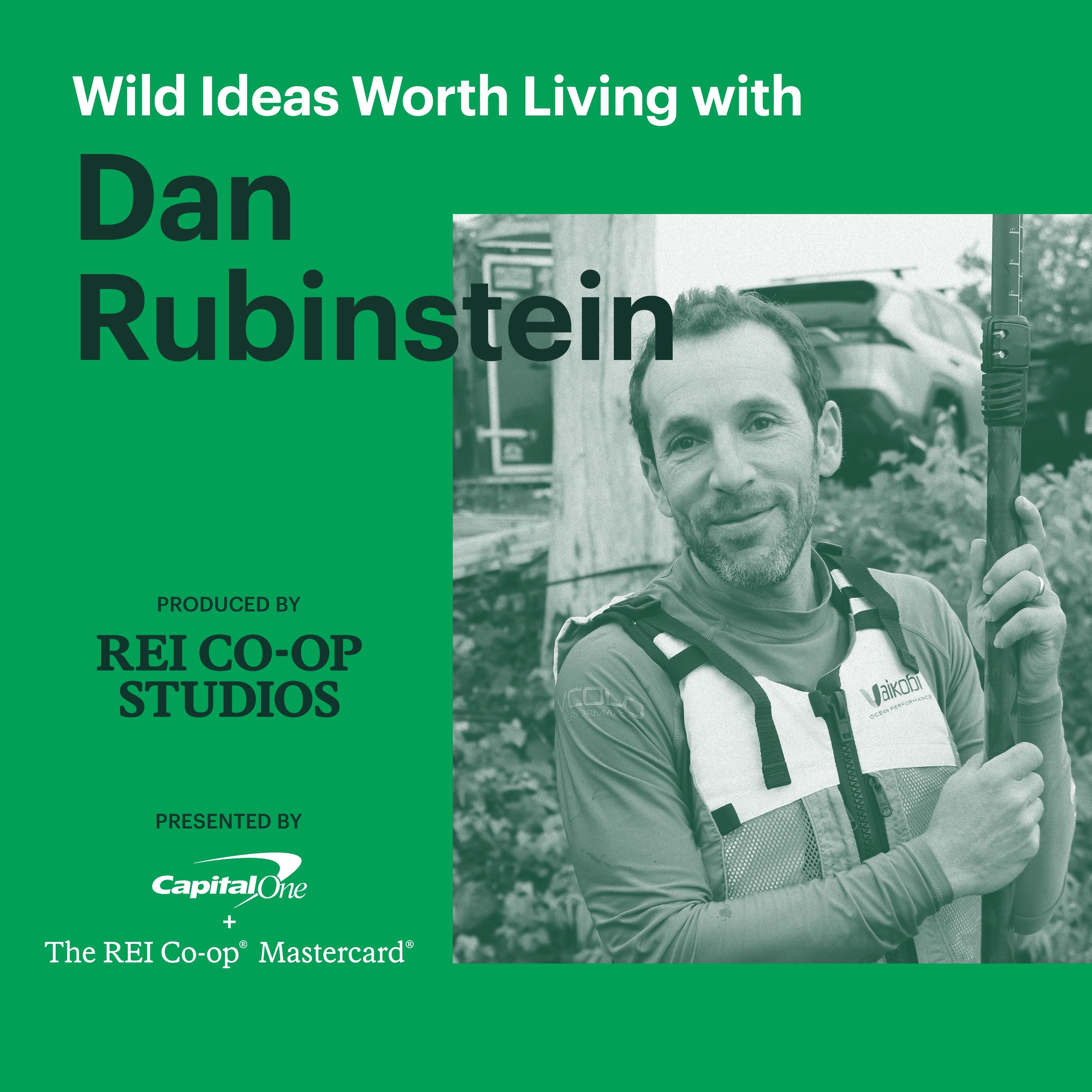
Paddling 1,200 Miles from Ottawa to New York with Dan Rubinstein
About this episode
In 2023, Dan Rubinstein completed a 1,200 mile stand up paddleboarding journey from Ottawa to New York City and back. His expedition followed rivers and waterways, turning a long distance paddle into a rare blue space adventure.
Connect with Dan:
- Website
- Purchase Dan's book, Water Borne
Explore the REI and Intrepid Travel collections
Thank you to our sponsors:
- Capital One and the REI Co-op® Mastercard®
- Ocean Bottle
Hosted by Simplecast, an AdsWizz company. See pcm.adswizz.com for information about our collection and use of personal data for advertising.
Get every episode summarized
Each time Wild Ideas Worth Living publishes, we email you a written briefing from the transcript — the topics, who appeared, and any specific claims, with the ad reads skipped.
Email me new episodesFree for 3 shows. No card needed.
Hosts & guests

Transcript ready
386 searchable segments. Every word is indexed and playable.
Full transcript
Wild Ideas Worth Living — Paddling 1,200 Miles from Ottawa to New York with Dan Rubinstein. Machine-transcribed; use the interactive transcript above to jump the player to any line.
A moment that I talk about a fair bit is we're paddling hard head down, there's a camp round, an actual campground where I was going to spend the night and I just kind of wanted to get there, set up my tent, go to sleep. And I heard somebody yell, take a break, have a beer, and I looked over my shoulder and there was a marina and there was a group of people on the back of their boat hanging out. And my first thought was, I'm just going to keep going and give my wave, but I was like, yeah, why not, why not take a break, have a beer, I'm only a mile from where I want to be. And they went over and they helped me up into the boat and we just had this amazing conversation. They were so joyful and supportive of somebody who was doing something weird just because he kind of wanted to do it. Dan Rubenstein is a journalist from Ottawa, Canada who spent years exploring how he connect with the natural world. Back in 2015, he wrote a book called Born to Walk, all about the science of walking outside.
But after that project was done, Dan's curiosity began to shift from land to blue spaces, like rivers, lakes, oceans, and other waterways. He loved stand-up paddleboarding and would head out on the Ottawa River whenever he could. Before long he started to wonder, what does being near water actually do for our brains and bodies? With that question in the back of his mind, Dan came up with a wild idea. In 2023, he set out to stand up paddle 1200 miles from Ottawa all the way to New York City and back. Along the way, he met with experts who helped him understand the physical, mental, and social impacts of spending time in blue spaces. He later wrote about his experiences and findings in his book Waterborne. I'm Shelby Stanger and this is Wild Ideas Worth Living, an REI Co-op Studios production presented by Capital One and the REI Co-op Mastercard.
Dan Rubenstein, welcome to Wild Ideas Worth Living. I want to start with your really wild idea. How did you come up with a wild idea to stand up paddle 1200 miles from Ottawa to Montreal, New York City, Buffalo, Toronto, and back to Ottawa for 10 weeks? There's a long answer and a condensed answer to that question and the kind of short answer is that I love stand up paddleboarding. I had been doing it for about 10, 12 years before my trip in 2023 and it was kind of taking over my life. And at the same time as a journalist, I was really getting into exploring the idea of blue space of what happens to our bodies and minds when we spend time in or around water. And I wanted to kind of combine my love for paddleboarding and my journalistic exploration of blue space into a book project. And I had some ideas, you know, there's a lot of people I wanted to interview and a
writer friend of mine said, you need to wrap this around a journey of some kind. So I started thinking about roots I could do and this trip took shape and once I realized it was kind of feasible, it was all systems go. How did you even get into stand up paddleboarding in like Ottawa? I don't know anything about what it's like to paddle around there. Yeah, so this is going back to like 2014, 2015 thereabouts and I had just finished writing a book about walking, which was coming out and I don't know if I was consciously looking for a new pastime or passion, but my wife and I had seen people on subs in and around the city. But one main river, the Ottawa River, a couple smaller rivers, the Rideau and the Gattano rivers and a big canal that runs right through the city, the Rideau Canal. So I started to see people on paddle boards and it looked kind of ridiculous. We're a country of canoers and kayakers and subs were relatively new and it looked inefficient and just kind of weird. But something made me really want to try it. So we were camping at a park not too far outside the city with some friends and some folks
in a group wanted to rent canoes and you could rent paddle boards there. So I rented a stop and it was kind of love at first paddle. It felt right from the start, you know, the balance wasn't too difficult. You could move around on the board so you didn't, I didn't feel confined like I sometimes do sitting in a canoe. It was easy on my back, easy on my knees, but the very best thing which to me I think is still my favorite thing about paddle boarding is when it's hot, you can just step off the board and swim and you can't do that when you're in a canoe or kayak as easily. And it just felt like a really kind of intimate way to engage with water. Standup paddle boarding made Dan feel relaxed and more clear headed. He wondered if there was a scientific explanation behind the way humans are impacted by water. After looking into the literature on blue spaces, Dan was inspired to do some research of his own. He hatched a wild idea to stand up paddle a 1200 mile loop from his home in Ottawa all
the way to the Atlantic Ocean and back. Starting in the Ottawa River, he'd head east to Montreal, then south in New York City. From there, Dan would head north to Toronto via the Erie Canal, Niagara River and Lake Ontario. Finally, he'd return to Ottawa via the Rideau Canal. So talk to me about the paddle, like where did you start, where did you go, where did you stop, and how did you even plan this route, how did you train, tell me about all that. I didn't really embark on a formal training routine, I'm pretty active in decent shape. I kind of amp things up in the months leading up to my trip. I run, I do some weights, I cross-country ski a lot. So I did my first week as a bit of a proving ground. So I paddled from Ottawa to Montreal over the course of about five or six days. Just to see, can I do 30 miles a day for a few days steady and camp and do the journalism I wanted to do and continue that kind of day after day and yeah, it kind of worked.
So when I began, I just kind of set out and I had a bit of a schedule because I set up interviews along the route. So I had people I wanted to meet and I kind of would give people windows, I'll be in Beacon, New York, within these two or three days, can you meet me there? And then if I would get closer to a place, I would be in touch with folks and kind of agree on a day and a time and a place to meet. So I did have a bit of a schedule to keep. So my one kind of regret is that maybe if things were more open, I could have had bigger days, smaller days, kind of followed more serendipitous opportunities along the way. But I wanted to do the journalism and as I write in the book, normal people up schedules to keep. So I couldn't keep people waiting. But yeah, I just kind of went and you know, tried to stick more or less to my schedule. There were a lot of surprises and changes along the way, but it more or less worked. And June 2023, Dan set out on a stand up paddle expedition. After the first week on the water, he realized he could tackle more than 20 miles a day and
still have time to interview people and take notes. But in order to cover that much distance, Dan had to fill up on calories, travel as light as he could and use the wind to his advantage. How many miles did you actually paddle a day? Probably average 20, 25 miles a day. I think my biggest day was about 40 miles with a bit of help from Title Current on the Hudson. That was a long day, but because you're standing, because you can shift around, because the majority of the movement relies on your core or on the bigger, strong muscles, it's sustainable, right? I could not canoe for 10, 12, 14 hours, but I can and have paddleboarded for 10, 12, 14 hours. What did you do for food? Where did you put your, did you take a computer with you? Like how did you? No, laptop, just a phone and I was schooled, notepads. So a lot of notepads and then I would mail them home when I had filled, filled a bunch of them up. You trusted the mail to like keep your notes?
Yeah, I know. That is crazy. Yeah. I actually, and I mailed home like extra clothes and stuff because I realized it was hot. I did not need long underwear, you know, in July, in New York State. So I ended up mailing stuff home as well. I brought freeze-dried meals. So I had something no matter where I ended up as long as I had water. I brought a lot of energy bars and shakes. But as you know from paddleboarding, you burn a lot of calories. So I was hungry all the time. And because it was so hot and because the temperature inside a dry bag is roasting, even the stuff that I would take on a hiking trip like dried sausage or hard cheese, I didn't want to risk it melting and going rancid in the sauna in my dry bag. But because my route goes through really populated places, there were cities and towns everywhere. So there was restaurants, there were supermarkets. And if I was staying in their nearer town, you know, depending on the night, I might eat my freeze-dried meal or I might walk to a restaurant. And I would just, I'm 5'5", I'm a small guy.
But I would order the biggest thing on the menu and eat all of it and then like go to the gas station next door and buy half a dozen donuts and a couple ice cream sandwiches and eat that too. And I would still be hungry when I went to bed. So I was just eating all the time, everything, everywhere. Where would you sleep? Did you sleep at a tent on the side of the shore? Would you find a hotel? Mostly tenting. So I like to wait tent. But you were in cities. So like how did you just pull up on the shore and camp? And some of the water is like the Erie Canal, at lock stations, paddlers and cyclists are allowed to camp and they have drinking water and bathroom. So that's all I need. Because I was doing journalism, I talked to folks in advance about potential places to stay. And you know, if you call up a marina or a maritime museum or a nonprofit and say, hey, I'm paddling through, I want to talk to somebody from your organization about how you relate to and connect with water or their egg and agree to an interview most likely. And then if I say, you know where I can camp, often they would say, well, you can camp
on our lawn or you can camp here. So I counted a lot of marinas, which are really accommodating and have showers, which is really, really nice. But I would talk to people. There was always somebody walking their dog or fishing. I would say, hey, I'm paddling through and a long trip. I need some of the camp. You think I'll have any trouble camping here. And usually people said, yeah, you should be fine. Every year, Capital One and the REI Co-op MasterCard program proudly donate $2 million to the REI Co-operative Action Fund. The fund supports hundreds of nonprofit partners that are creating a more equitable outdoors for everyone. You've even heard of some of their stories on the podcast. In addition to supporting the REI Co-operative Action Fund, Capital One and REI have partnered on the REI Co-op MasterCard, bringing card members, excellent card benefits that inspire
more outdoor adventures. Find out if you're pre-approved for the REI Co-op MasterCard with no risk to your credit score. Go to REI.com-mastercard-podcast to learn more. If you spend a lot of time in the ocean, surfing, swimming, or just sitting and watching the waves, you probably want to protect it as much as I do. That's why I want to tell you about Ocean Bottle. Ocean Bottle is made for people who care about the ocean, about good design, and about leaving things better than we found them. Every bottle they sell funds the removal of 1000 plastic bottles before they hit the ocean. That work is part of a mission to stop 10 billion plastic bottles from polluting our oceans by 2030. If you're looking for a simple way to make an impact, Ocean Bottle recently launched
their peak range. It's slimmer, stronger, 100% leak proof, and designed to keep your drinks at the right temperature longer. Check out Ocean Bottle at your local REI or at REI.com. You know that feeling when the trail turns a corner and boom, in front of you is a massive mountain or jaw-dropping canyon vista. Now imagine that view is in Peru, Alaska, or Morocco. REI.com is teaming up with a globe charting experts at Intrepid Travel to bring you a curated mix of global and domestic trips that are outside the ordinary, with bucket list destinations, small groups, and local leaders who actually know the place you're exploring. The best news is that members save more with exclusive member pricing. Starting March 15th through the end of April, REI.com members get an additional $100 off
all REI and Intrepid trips over $1,000, and that's on top of existing member travel benefits. The only question is, where will you go? Explore the REI and Intrepid Travel Collections at REI.com slash travel. That's REI.com slash travel, Terms Apply. In June 2023, Journalist Dan Rubenstein strapped 50 pounds of camping gear to a stand-up paddleboard and pushed off from shore and Ottawa, Canada. Stand-up paddleboarding is a very exposed sport. If it rains, there's nowhere to hide, and if there's lightning, you're a target. The tiniest bit of wind can make a big difference in how quickly you move. Not to mention, conditions can change in an instant. So what was the biggest day you did, like mileage-wise?
It was July 4th. I was at a hotel in Troy, New York, and I just stopped myself at the breakfast buffet, and then hit the Hudson River at dawn. And I had a couple of marinas where I could have spent that night, but I was enjoying the ride. Sun came out, got really hot, the water was clean, so I swam every 20 minutes, and I just kind of kept going and going and going, and stopped in a town, got a burger at like, supper time, and realized that I could probably get to Catskill, New York, to another marina where the owner had said, yeah, you can stay here, no problem. So it was probably like eight, nine o'clock, it was getting dark, there were fireworks, you know, in towns on the shore. And then I realized that some of what I thought were fireworks was actually lightning, and there was a big thunderstorm kind of bearing down on me from the north. And I had to really bust it the last mile or so, and got to this marina and got to a dock. You used my leash to tie the board up, and I left all my gear on it, because I thought it could blow away if I stripped it down, and ran into the nearest building,
and it turned out it was the bar. It was closing the bartender's side, but I saw a few folks still finishing their drink, so she gave me a beer, and I chatted with a few of the locals until the storm blew through, and then set up my tent and had a very good sleep. Those unexpected moments were some of the best parts of Dan's trip. He enjoyed the interviews he'd scheduled with researchers and conservationists, but he ended up being more moved by the chance encounters. It was always fascinating to discover what was around the next bend. A moment that I write about and talk about a fair bit is where paddling hard head down, there was a campground, an actual campground where I was going to spend the night, and I just wanted to get there, set up my tent, take a shower, have some food, go to sleep, and I heard somebody yell, take a break, have a beer, and I looked over my shoulder, and there was a marina, and there was a group of people on the back of their boat hanging out.
And my first thought was, I'm just going to keep going and get my wave, but I was like, no, why not? Why not? Take a break, have a beer. I'm only a mile from where I want to be. And they went over, and there was a guy named Matt Donahue, and his wife and son, and some friends of theirs from the UK, and they helped me up into the boat. And we just had this amazing, amazing conversation, and they asked me so many questions about my trip. They were so curious. They were so joyful and supportive of somebody who was doing something weird, just because he wanted to do it. And then they told me about their lives and their community, and the two anecdotes that I really love from that encounter was Matt told me that I was about halfway through the area at that point. So I had another 175 miles to go, and he kind of, I think he sensed that I was tired and looking kind of weary and disheveled, and he told me that he used to be a member of the U.S. Navy CBs, and the CBs are this elite kind of construction battalion that will go and build bridges and buildings and roads and do things that have to be done in difficult situations.
And he said their motto is the difficult takes time, the impossible, a little longer. And that kind of became a bit of a mantra for me paddling into the wind, into the current. If it's difficult, it's going to take time. But if it's impossible, it's going to take a little bit longer. And then when I was leaving, I was happy down on my board. He gave me a beer for the road, and then Matt and I hugged. And it wasn't just, you know, this is two middle-aged men who have been talking for like maybe an hour and a half at most, and it wasn't kind of awkward, one arm back padding. It was a real emotional hug. And the thing that sticks in my mind from that experience is like, where else the two middle-aged dudes have just met hugged like that, right? And we're going to happen in different places, different ways, but there was something about meeting him in that context that led to a connection. And I don't know if he feels the same way at this point two years later, but it felt really real. I really love this conversation, because my best friends I've met through surfing, I had to go to the ER last week. My mom had pneumonia, and she's a little older, and when I got there,
I knew the ER nurse because we had paddle battled for a wave and then like made fast friends. I was like, okay, I'm not going to be this guy's enemy. He can surf really well. I'll make him my friend, found out he was an ER nurse, and he was the first guy I saw on the ER. And it's really interesting. I know you got to meet with some really cool Indigenous communities on your paddle. Can you tell me about that? Yeah, so towards the end of the first leg of my journey, just before I paddled into downtown Montreal, I crossed the St. Lawrence River on a calm day to a Mohawk community called Ghanawage. And Ghanawage, the name means by the rapids. It's always been there on the water. And in the 1950s, when the St. Lawrence Seaway was built to facilitate shipping from the ocean to the Great Lakes, it basically was bulldozed through Ghanawage front yard, disturbing their connection to the river. And I spent time with a few folks there, and it was just really inspiring. One were people at a local paddling club, and they were kind of asserting their right to be on the water or something their ancestors had always done. So it struck me how beautiful and important it is for a community and for kids
to have an opportunity to do things like that. And then the other guy spent a lot of time with was he worked for the local environmental department. And when the Seaway was built, a lot of the rocks and rubble from excavation were basically dumped onto a few little islands to make one big island. This kind of arid, dry place, and the community has restored it and re-naturalized it. And they're just kind of putting the finishing touches on this major multi-year project. And it now has habitat for native flora and fauna. There's beaches for swimming, there's boat launches, there's a bike path, there's benches, and they've taken this colonial imposition and turned it around into this beautiful, healthy place. And I really love that idea of something you've been dealt with, this kind of raw hand you've been dealt, and turning it around and turning it into a positive thing. What about the statue of liberty when you paddled on that? That must have been pretty wild. Yeah, I mean, that's the money shot, right?
Like you're going to New York City, you gotta go to the statue of liberty. I got really lucky on my way into New York where I had been in contact with a paddle-border, this guy named Paris Montoya, who had, he had paddled from Buffalo to New York City, where he lives, and he gave me some advice. He introduced me to a boat club on the lower Hudson in Manhattan, where I could leave my board in gear, which was really helpful. But the day after I got to New York, I went out with Paris, his partner, and a friend of theirs, and we circumnavigated his statue of liberty. And the New York Harbor is bonkers, right? Because there's tour boats, there's fairies, there's water taxis, there's police boats, there's barges, everything is flying around really fast, there's big waves, there's wake, the water is bouncing around, and you know, I've paddled in a lot of cities, but never in a place as active as that. So the group I was with, they knew the water, two of them were licensed guides, they had radios, they were communicating with the fairy captains. But we went out, and then we, yeah, we got to the statue, and circumnavigated it pretty quickly,
and you know, I wanted to kind of linger and reflect on the immigrant experience, because that's my family story in North America, my parents met New York, got married there, before moving to Canada, and I wanted to kind of have this emotional moment. But Paris said, we gotta go, there's boats coming. Paddling around the statue of liberty was exhilarating, but the next day was even more special. Dan went across the Hudson to Hoboken, New Jersey, where he visited the exact place where his parents met. He ended up stumbling right into a local community celebration of water sports and activities. It was a perfect full circle moment. By the time Dan left New York, the trip was only half over. He spent the rest of the summer paddling about 700 miles back to Ottawa, before finally finishing in September. He'd pulled off the physical aspect of this challenge, but the real work was just beginning.
I'm curious how long it took to finish this whole journey. The paddling or the writing, because the paddling was hard, but the writing was harder. Writing sucks. Yeah, I hate it. So talk to me about first the stand-up paddle journey. How long did that take? Yeah, the paddling was about 10 or 11 weeks. I did take two breaks, so I did after Montreal came home for about 10 days, and then after I got to Toronto, which is where I born and raised. I left all my stuff at one of my brother's house and came back to Ottawa for a little bit. I had to kind of deal with real life and drive one of my daughters to university and catch up on domestic things, and then I went back to Toronto and resumed the trip a little bit later, so I did take two breaks. So when you came back, did you have like the post-adventure blues, or were you like, no, because you actually had a book to write about it, so you got to relive it? Yeah, there was a tough couple of months. I did not have a book contract yet. So you got to sell it after you got back? Yeah, I have an agent, and I had talked to her early, and before the trip, and she was optimistic and confident, so I wasn't worried, but then
that writer's neuroses. Like, where are the offers? Are we going to do this? And, you know, I wasn't a happy person, but I think it was just before Christmas where the book deal came through. So things worked out, but yeah, there was a bit of a downtime, and then you just have to jump into the writing. And I think this one was a little easier, it was easier than the first book, because I had done one, and because it was an expedition, because there was a chronological element to it. But yeah, so probably like January 2024 was the beginning, and it was done within the year. Okay, so give us a little taste of your book. What did your trip teach you about being around blue spaces? Yeah, I mean, research shows that water mixes feel good. It's good for bodies, it's good for minds, that's been shown, and it also slows us down. So sure, some boats go really fast, but generally when you're in a blue space, your pace has diminished a little bit. People spend more time playing when they're at the beach than they do in green space. Something about the water, you know, they lose track of time. So water mixes feel good, it slows us down, and there's an
element of danger around water too. And my theory, and this isn't born out by research yet, is that people kind of look out for one another around water more than in other places. We're interested in one another around water. We see this elemental connection. So because it makes us feel good, because it flows us down, because it kind of sparks this human connection, it has capacity to build community in ways that other natural places might not. And I had a writer, I know, kind of refute my thesis and say that she had made some of the best friends and had some of the best moments serendipitous while hiking. And she kind of listed a few examples, but the examples are all hiking beside rivers or lakes or oceans. So like, yeah, you're hiking, but you're hiking overlooking the Pacific, you're hiking beside this white water, right? So you're you're in blue space, right? So yeah, I think it does have this capacity. It's the most elemental thing about us. It's the majority of our bodies. It's the majority of our planet. And as an indigenous writer, Leanne Betosama-Sake Simpson writes in a recent book called Theory of Water,
when you breathe out, there's water droplets in your exhaust. And I'm breathing them in. And maybe not you now, because you're in San Diego and I'm in Ottawa, but if we're in the same space, we're literally sharing the same water, right? So it's this thing that connects us all, and every single plant and animal needs it to live, right? So it's this essential thing that connects us kind of makes sense that it would facilitate community in one way or another. If you want to learn more about Dan, his journey, and his scientific findings, be sure to check out his book Waterborne. That's Waterborne spelled B-O-R-N-E. You can find it wherever you buy books. To connect with Dan directly, follow him on Instagram at DanRubinsteinSupp. That's D-A-N-R-U-B-I-N-S-T-E-I-N-S-U-P. You can also check out his website at www.waterborne.ca. Wild ideas worth living is part of the REI podcast network. It's hosted by me, Shelby Stanger,
produced by Annie Fastler, Sylvia Thomas, and Sam Pierce-Nitzberg of Puddle Creative. Our senior producer is Jenny Barber. Our executive producers are Paolo Motila and Joe Crosby. Thanks again to our partner, Capital One, and the REI co-op Mastercard. As always, we love it when you follow the show, take time to rate it, and write a review wherever you listen. And remember, some of the best adventures happen when you follow your wildest ideas. And remember, some of the best adventures happen when you follow the show, take time to rate it, and write a review wherever you listen.
More episodes
More from Wild Ideas Worth Living

Expanding Access to the Outdoors with Alison Mariella Désir
Wild Ideas Worth Living

The First Person to Complete the Double Seven with Rob Lea
Wild Ideas Worth Living

Why Bike Commuting Makes Us Happier with Jenn Dice
Wild Ideas Worth Living

Walking Barefoot Across the US with Anton Nootenboom
Wild Ideas Worth Living