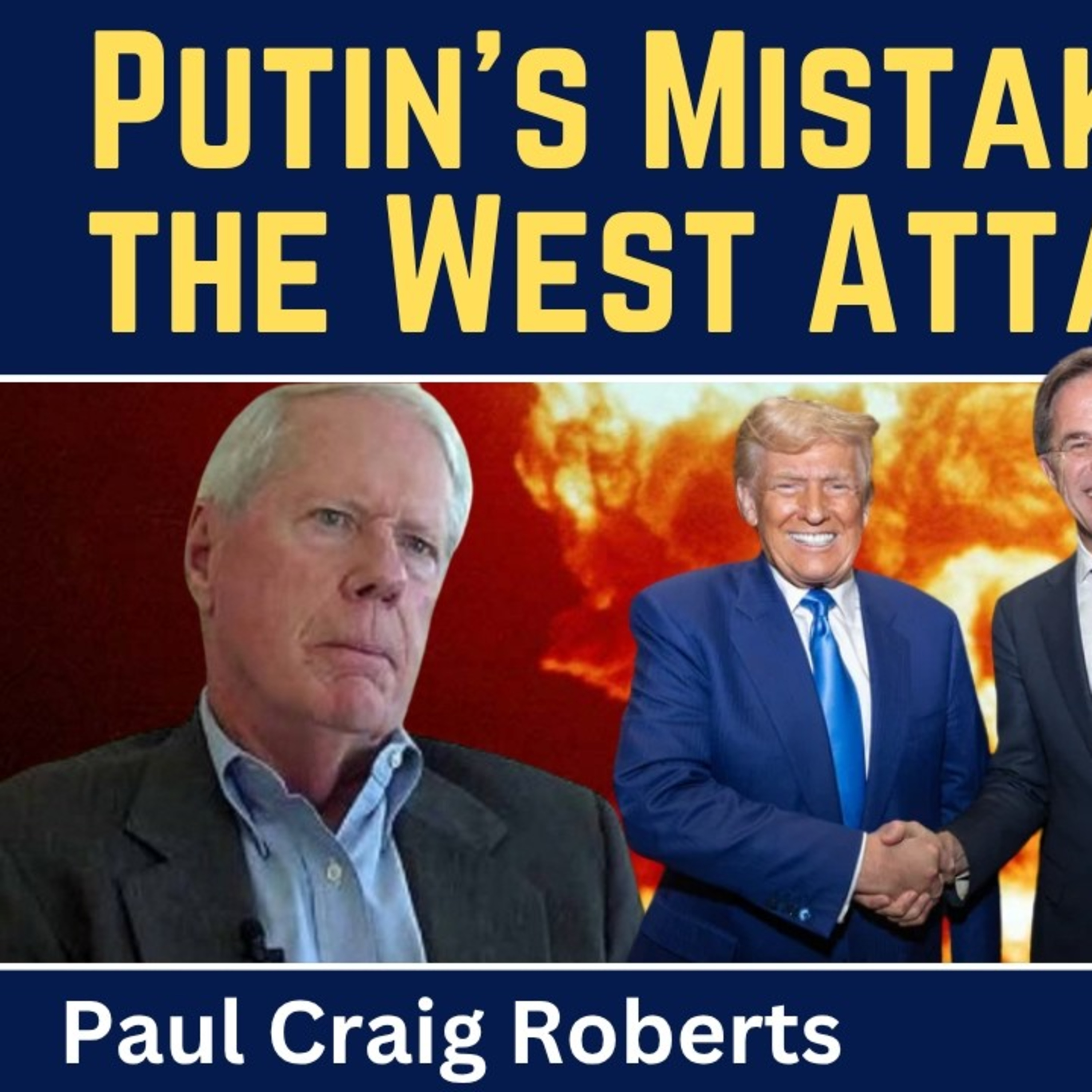
Paul Craig Roberts: Putin's Mistake - Letting the West Attack Russia
About this episode
Paul Craig Roberts is an economist and former United States Assistant Secretary of the Treasury for Economic Policy. Roberts argues the US is in rapid decline economically and it is defeated in Iran. Roberts expresses concerns that a great power like Russia allowed the West to become comfortable with attacking Russia, which suggests that much instability is coming.Follow Prof. Glenn Diesen: Substack: https://glenndiesen.substack.com/ X/Twitter: https://x.com/Glenn_DiesenPatreon: https://www.patreon.com/glenndiesen Support the research by Prof. Glenn Diesen: PayPal: https://www.paypal.com/paypalme/glenndiesenBuy me a Coffee: buymeacoffee.com/gdiesengGo Fund Me: https://gofund.me/09ea012fBuy Diesen merchandise: https://diesen-shop.fourthwall.com/en-nok Books by Prof. Glenn Diesen: https://www.amazon.com/stores/author/B09FPQ4MDL
Get every episode summarized
Each time Glenn Diesen - Greater Eurasia Podcast publishes, we email you a written briefing from the transcript — the topics, who appeared, and any specific claims, with the ad reads skipped.
Email me new episodesFree for 3 shows. No card needed.
Hosts & guests

Transcript ready
338 searchable segments. Every word is indexed and playable.
Full transcript
Glenn Diesen - Greater Eurasia Podcast — Paul Craig Roberts: Putin's Mistake - Letting the West Attack Russia. Machine-transcribed; use the interactive transcript above to jump the player to any line.
Welcome back. We are joined today by Paul Craig Roberts, an economist, author and former US Assistant Secretary of the Treasury for Economic Policies. Thank you for coming on the program. Thank you, I'm pleased to be with you. We see that the Trump administration, it had some very ambitious goals. It wanted to re-industrialize and all this waste, get the debt under control, restore US economic primacy. A lot of this appears to have failed now and also the extent to which the US uses economic warfare, it appears to only grow towards pursuing these former goals. But this is happening at the same time as we see all these new economic alternatives are emerging. So I wanted to get your perspective on this, how you see the current policies of the United States. If I'm reading the intentions correct here at least.
Well, I think one thing is clear and that is that Trump has been diverted by Neton Haayuf. Who is using the United States or attempting to use the United States against Iran in the interest of the Zionist agenda of greater Israel. A lot of people still don't realize that the American wars in the Middle East doing this first quarter of the 21st century were wars for greater Israel. Americans would tell that it was the war on terror. But it was the war against Iraq, Libya, Syria, who were obstacles to greater Israel.
And we know that greater Israel is not a conspiracy theory because of a variety of Israeli prime ministers and other ministers in the government have held up maps of greater Israel. They acknowledge it. They don't deny it. And the recent maps now claim from the Nile to Pakistan. So it doesn't leave anything for the Muslims. So I think this diversion has lost a Trump, his opportunity to be a president who managed to restore some aspects of the American existence. I think it goes now. He's in a predicament. He phased his elections. The war is not popular at home.
Israel is less and less popular in the United States among both Republicans and Democrats, but especially among the Democrats who are becoming somewhat radicalized. If you look at the candidates they have been running in the primaries for the House and Senate elections this fall, these are not the normal type of establishment Democrats. So with all of this brewing up he finds himself in a war. I thought that he had found his exit strategy when he announced that he wasn't any longer pursuing the war in a military fashion, but was going to use economic means sanctions
to bring Iran to its knees. So I thought that was his exit. That's the way he gets out of an unpopular military situation which seems to be hurting the United States presence in the Middle East, the bases and so forth. Much more than it's harming a rig. But no sooner were these words out of his mouth, then that now you have some back attacking Iran. I think there were three or four days in a row. So he wasn't allowed to exit. So he's stuck with this and it takes a lot of resources. It produces bad publicity. We seem to kill most civilians, that military targets.
The damage to the American naval base and the Persian Gulf, the fact that it's no longer accessible to American ships is caused supply problems on the Navy ships. We had the embarrassment of the aircraft carrier with the sailors in near revolt and the complaints of their families about the poor quality of the food and so on and so on. This is not working to make Americans feel good about Trump and the Republicans and the upcoming election. And of course, if the Democrats win the House of Senate, that's effectively the end of the Trump administration. It actually may face again, impeachment attempts. So that's what's happened.
Now, the economy itself will, his choice of tariffs as a way of bringing Johnson was foolish. The development of this AI technology promises massive layoffs of working people. And these layoffs come on top of the previous massive layoffs of a manufacturing force that resulted from the offshoring of American production to Asia and Mexico. For example, the products of Apple, they made in China and brought in to the United States to be sold. When they come in, they expand the trade deficit. They're treated as imports.
So this is an economic problem. We also have the economic problem. I'm winding this down. Of the impact of the American sanctions on the attitude of foreign central banks to whole US treasury debt as the reserves and the central banks. The reason the vast American national debt has never been a problem is that when the treasury's debt expands, so do the reserves of foreign central banks. So they can lend more. It's been an arrangement that works. But once you start freezing or confiscating people's central bank reserves, as they did with the Russians, Venezuelans, they've seized some Iranians,
you make other countries say, well, you know if we do something that displeases Trump and he's volatile, there go our central bank reserves. And so we are experiencing a decline in the willingness of foreign central banks to whole US treasury debt as the central banks reserves. Well, if this goes too far, then there's a serious consequence for the US dollar. And if in the meantime Trump has kept the turmoil going in the Persian Gulf, or I should say if Israel using Trump has kept the turmoil going, then you can see the dollar under pressure with an addition to rising fuel costs which inflate the price very thing
and a great deal of economic hardship in the United States. A large percentage of the population really doesn't have any discretionary income. The whole income is exhausted paying their rent or their mortgage payment, their car payment, their utility bill. And so if these things start rising on them, they're hard pressed to survive, to keep the homes. So you can see with all of this that Trump has created problems that may devour him. These are problems of his own creation or of his willingness to act for Israel. And of the agendas of his advisors, this has created problems and these problems may
destroy Trump. So that's my view of the waterfront. Well, I didn't want to ask about that though. The wider development we're seeing. Because if we take a step back, it doesn't seem like it's only the problem with debt or losing this war. It's wider, the US-led world order it feels because the US for a long time as a holding a hegemonic position, it organized functions that previously belonged to individual states. That is the US managed security for other states through military alliances. It wrote a lot of the trade rules through this international trade organizations. They organized their financial dealings through US development banks through the Swiss payment system by using the US dollar. The US has been setting the technological standards for countries. It again had a big role in all kind of commerce through multinational corporations. It also for many countries managed
their civil society of these countries through these NGOs financed by the US government. I'm just seems like all of this is cracking to some extent all at the same time. I was wondering how how are you seeing this because this is quite a unique development. Yes, it is. And we've seen more evidence of it recently. The two principal foreign policy organizations in the United States, the Council on Foreign Relations, which produces the the journal Foreign Affairs and the Atlantic Council. Recently, representatives of both of these organizations have had articles in Foreign Affairs that say straight out, the United States has been defeated in Iran.
And it's time for us to withdraw and to retreat from the notion that we can control the world. Well, this is the first time I've seen major or important members of the foreign policy community. In the main foreign policy journal, disassociate themselves with the Wolfowitz doctrine of American and Germany. So that illustrates or suggests that suggests that the new conservative hold on the American foreign policy, which has been in place firmly since the George W. Bush regime, that it's cracking. We now have people who are not afraid to go against the narrative.
As these two authors, it's unusual to go against the narrative because it can marginalize or you get left out, you know, get a published disease, lean on, bad to pace attention to you because you don't fit any longer. So the fact that this has happened indicates that what you said, that this whole Higgemonic attitude is fracturing. I don't know how much are bad, but it's enough that we found two people willing to speak against it or to say we got to admit defeat and we know, ball in the least. There were unusual statements to hear from the American foreign policy establishment or members of this establishment. So I think your conclusions right and I just added some more evidence for it.
The question is, it doesn't suit the Israel lobby, it doesn't suit Trump's ego, but it's not clear what Trump can do about it. It's always a danger that he becomes so frustrated and he can't accept defeat. That he lashes out and does something stupid like used nuclear weapons or gives some kind of green life for Israel because otherwise I don't see how they can bring around down. They can't defeat the Iranians and if they can't defeat them, then the Israeli agenda, the Israeli Israel, is up against a block that they can't get around. And if Trump somehow is able to get free of the whole that the Israel lobby has
on the United States, you could see some sort of change in Israel's politics. You could see a situation where not all of them are Zionist to the like of Netanyahu or his coalition. So they could reach a conclusion that we better stop provoking these people because it's too much for us. We can't handle it. And this means this expansionist agenda we have has to somehow be modified or put in cold storage. I saw some hope in the announcement of that mecca alliance.
I said, you know, if Iran were to be included, you would have territory running from Turkey, which is the edge of Europe, into Pakistan and Central Asia. You would have 458 million people with conventional military capability, control over the world's oil. Since the airport is strategic waterways, which oil flows and they would be protected by the Pakistani nuclear weapons. So that would neutralize the use of nuclear weapons by Israel or the US against Iran. And I said that this is an opportunity to end the violence in the Middle East by making
clear that Israel can't continue its expansion. As it is done for 79 years, it's absorbed all the Palestine. And now it's trying to absorb ports of southern Lebanon. And it's there's it's not leaving the parks of Syria that it's occupied. Well, this is this source of aggression is the source of the problem. And if if that kind of aggression, that kind of expansion, that kind of agenda is implausible because it's up against 450 million people with nuclear weapons, a control of oil in the waterways, it would cause the Israeli people to have a sober moment. You see one of the reasons this Zionist agenda has been able to go on is it's never cost
Israel anything. The United States paid the cost of getting rid of Iraq, Syria, Libya. And Israel is using nine states against Iran. So Israel is succeeded in having the United States, it's proxy to fight Iran for Israel. And so who suffers the destruction? The United States, the Iran, they're not Israel. It's the same thing that we that the United States has done in Ukraine. We have the Russians fighting the American proxy, Ukraine. So all the damages of this experience by Russia and Ukraine and I'm by the Americans. So that's the sort of way that this works for Israel. The cost will come home to them. And somebody else bears the burden.
Well, if the sort of alliance that I said would be an opportunity, if that was real, it would, I think, make it clear that the Israeli expansion had no further to go. Now, since pointing out this opportunity, I've kind of kind of a collusion that's not real. It's an illusion because if it was real, when the alliance was announced, Iran would already have been a member. Because it would show that the Sunnis, because the three original countries or Sunni Iran's Shia, it would show immersion. And it would send the message that the Middle East now was taking charge of its own affairs. And there would be no further outside interference.
That would be a hopeful, peaceful side. But I think it's an illusion. And I, I mean, it's an abstract opportunity. But I think in reality, it's an illusion because we see already the Saudis again attacking Yemen. So again, the Americans and the Israelis have the Arabs fighting each other. So I don't know what's going to happen, but this tit for tat war that young states Iran, it's like the tit for tat between Putin and Ukraine. It can go all forever. But one of us is US stand to Lusto in the Middle East because I, even if Iran wouldn't join this,
this, you know, mecha, the defense alliance, it nonetheless gives this country's more autonomy, allows them to, if not the couple, at least reduce their dependence. And I'm just wondering how does it affect, for example, the petrodollar system? Because a lot of the, you know, the US offering security to the states is also a key reason why they would sell all the oil in dollars or invest it in the United States. And again, all of this seems, the US seems to have a lot to lose from, from seeing the defeat now. Yes, if the alliance is real, but I've been thinking about and I've kind of come to the conclusion that each of the three countries that formed their lots joined for their own reasons. The Turks have their own reasons. The Saudis have their own
reasons. The backsthenes have their reasons, which is probably to get money from the Saudis. And they didn't join it for their mutual defense. So it's not a real allows. They've got each of the countries has its own interests and is using it for it. And that means there's not a real unity. That's the theory I'm operating on at the moment. Now, so if it's not that real, it won't have that much effect on the United States. As for the petrodollar, the Saudis already announced they'll take payment in other currencies. It's not really, the petrodollar is not as important as the
willingness to foreign central banks to hold US Treasury debt as reserves. So you could not have a petrodollar. But if all the countries are still going to use whatever their source of revenue is to purchase US Treasury to hold as reserves of their central banks, then it doesn't hurt. The dollar doesn't hurt the ability of the United States government to roll on its debt and to increase its debt. Because as I said earlier, and I'll talk, the increase in US national debt means that increase in the reserves of the World Banking System, which people favor. But it is true that a long time goal of one of the goals of American policy in Middle East
is to control the oil flows. I can remember this from the 70s when I was in the staff of the United States Congress. They got upset about OPEC and things like that because this order is some possible challenge to the ability the United States control oil flows. That's important. It's still important. I think it kind of lost its importance. I see we've been in war for Israel in the Middle East for 25 years. Now some people say longer, but I'm talking about the war terror. This was a propaganda gas for a war for a great Israel. That sort of overshadowed the traditional
policy of being the Middle East to control the oil flows. That's my opinion. It may be wrong. I don't claim to be right about everything I say. It's just thoughts. I think we need different thoughts. I think your program does a good job of finding different thoughts to present. That's about all I'm doing. I'm not laying down the truth of anything. I was going to ask what you said before about the US and also allies fighting with proxies. You mentioned also the Russian case that is that NATO that were fighting with Ukrainians to weaken Russia. When Trump came to power, he ran on this platform that it would be better to
put an end to this. Again, he communicated some strategic reasons behind this. If you're going to have the mergers of a multiple order with China at other side, it would be pretty much in our interest to get Russia on our side of the ledger. It seemed credible for a while that he wanted to put a quick end to this war and patch things up with the Russians. But we're seeing something very different instead. The war is continuing. They see how he's still managing a lot of this. How do you see that Trump's, I guess, reversal or willingness to continue this war against the Russians? He ran up against the power of the military security complex. They need a Russian enemy. It builds their budgets, it justifies the power. They're unanswerable.
If the Russian enemy disappears, what happens to the defense spending, all the armaments companies. They're so wired in. They've been so long wired in. If you remember what you may know, as long ago as 1961, President Dwight Eisenhower, in his last public address, warned the American people that the military security complex was a danger to democracy because for the first time, we came out of war without dismantling the military security complex. It was in place everywhere. Every state, this military base, this armist-factors, the power of this huge enterprise to
fund the campaigns for the House of Representatives, the Senate. Eisenhower warned us that this was a threat to the control of government. What was 1961? How long ago was that? Well, imagine what's happened since. It's ever more entrenched, every more powerful. Look at the budget. The budget exceeds the national income in most countries. Look at the power. So if you don't have an enemy that justifies this need, so I think that's what happened to Trump. He just ran up to too much opposition and hadn't any way of dealing with it.
People often overestimate the power of a president. It's easy to do to overestimate it. Myself having been in administration as a presidential appointee who was trying to help the president. I can attest that there are very few people in any administration who are there to help the president. They're there to help the career. They're looking for some powerful interests to serve who will take care of them or the nice position afterwards. The notion of a cohesive administration was not my experience. I'm talking about the Reagan administration. The Reagan administration was not all that
support he affords the Reagan. I know that from experience. I was assigned the job to get his supply side program out of the administration so that the Congress could vote on it. My opposition was not the Democrats. Trump is always thought that the president is in charge and everybody has to do it. That's the way he ran his business. He was in charge. He gets into the office. He finds out he's not in charge. I think that's why he looks increasingly out of control. He's frustrated. He makes all these untrue statements and in contradictory statements. I think he's very frustrated. He's found that
things don't work like he thought. That's my insight into it. I'm sure it's not the whole story. It is a danger because he gets too frustrated and he can't accept the fee. There's a danger there. I think that now you know it. I wouldn't be surprised if there's some kind of an event orchestrated that has the purpose of making the market people accept the use of nuclear weapons against Iran. It wouldn't surprise me. I'm not predicting it. I'm not saying it. I don't know. If you understand that Netanyahu is committed to great Israel, this is his chance.
Is he going to let it pass? These are questions I would like to see openly discuss because it would be a constraint on such a development. If people are talking about it, this will less likely to happen because it's harder to hide. We've been talking about, oh you did it. I like to see these things talked about just as a protective measure against them happening. You mentioned this in fighting in the US administration. Everyone is competing for their own policy. At least they're not taking all the orders directly from the president as he would expect their
business to be run. But there's this interesting interview with President Putin where he argues that every time he meets with a newly elected US president, they tell him about how they want to change. Then he makes the point that the men in dark suits come in and tell him how it actually has to be. This little window of opportunity to change policies goes away. The status asserts itself. But given the way they now interpret probably the Trump administration, what do you expect to see from the Russians? Are they shutting the door now on the diplomacy or peace or negotiations? My impression is that they also look towards Iran. The back and forth between making deals and breaking deals. It doesn't seem genuine, though.
Well, I've long been a critic of Putin for the way he's permitted this war to go on and on and widen and widen and widen. By refusing to use the force, sufficient force, to make it impossible for Zalisk to continue the war. I don't mean nuclear weapons, but the Russians have plenty of conventional force and could have stopped Ukraine's ability to continue the war long ago. And he hasn't done it. And so he has been in a situation where the war has consistently widened. You might remember first the battle front was Donbass. And there was discussion.
I would, the West sent tanks. Oh, no, we'll never send tanks. Well, they sent the F-15s. Oh, no, never. But they all got sent. Well, they sent missiles. Oh, never. Oh, but they got sent. And now we have it openly admitted, British government, the German government, that they're supplying Ukraine with thousands of long-range drones. The battlefield has moved from Donbass to inside Russia. Oil production facilities are destroyed, refineries, oil storage depots, airports are disrupted, civilians are killed in residential housing, people killed on vacation. And schools are hit. And what is Putin? He says, this isn't war. That's terrorism. That's terror
instructions, because he doesn't want to have to do anything about it. So he won't even admit that this is war. He keeps talking about the war in Donbass. And the Russian media keeps going on about, they've taken another settlement. It's been nobody there for years. And so now we have a situation where not only is it obvious that the Germans and the British are direct participants in the war, but also the Americans and the British are providing the targeting information for the missiles, so they're heading way inside Russia. And Putin won't acknowledge it. Even when the Russia Strategic Bombing Force was attacked, he said, the Russian war doctrine required a really strong response. He said,
well, no, it's not war, it's a terrorist act. When his home was attacked, it was a terrorist act. So he has redefined the real war that's about to enlarge if we can believe Zalinsky who said that he's going to make all the airspace in Russia unsafe for commercial flights. Well, this goes beyond a terrorist act. This is closing down a concert. It's something that Putin steadfastly has refused to do to Ukraine, but Zalinsky's going to do it with a German and British equipment and American targeting. And now we see also knowing that there are more NATO
countries, two more countries, joint-natured NATO, after Putin gave a demonstration that Russia is not a threat to anybody. No red line ever enforced. Lots of words, lots of warnings. People learn they don't mean anything. Nothing happens. So I think that what Putin has done, he's made Europe comfortable in being an antagonistic position toward Russia. We have Europeans, countries, tiny ones, even insignificance, who are willing to stop in board and even seize Russian oil tankers. I mean, as an incomprehensible imagine somebody boarding and seizing a Soviet oil tanker, they would have been thought to be
totally insane. And now Latvia is willing to do it, or Estonia, or some of these tiny little countries that don't have enough people to feel an army. So this is what I think is the consequence of Putin. And I'm a little bit worried that the Iranians are going to make the same mistake and they're going to fight the proxy, which is the US and their enemy, which is Israel, doesn't pay the cost. So certainly the people who are equipping the ability of Russia to be attacked deep inside Russia are paying no cost. Nothing happens to them. So what the West is learning is, we can carry on war against Russia and they'll fight the proxy. Well, that's not
that's not a good position because at some point it'll go too far that Putin or his successor or somebody won't have any alternative, but to use the heavy stuff. And that's been my concern from the beginning that Putin made me trying to minimize war, but he's actually maximizing it because it's expanded. And the more it expands at some point, the Russians have to do something. And what will they have left to do that anyone will believe? And of course, the Iran could end up in the same position. That's the trouble with Tid for Tad. That's the trouble with fighting the proxies and not the enemy. And I don't think good intentions, Putin's good intentions or
can justify that because it's too dangerous for all the humanity. So that's my spiel. That's been my position since really since 2014 when he did nothing to stop the American takeover of Ukraine. Does this last question? Do you see any shifts though in Russia on this? Because their position is hardened, but it's hardening against Ukraine. That is their public Ukraine. That is the proxy. But do you see any, well, I know that there is going deep concern in Moscow that they allow their deterrence to slip. And also, as you said, how comfortable do Europeans are now in terms of attacking Russia, seizing its ships? I mean, the way they talk openly about the need to do deep strikes in Russia, all of this, as you said, the tax on this nuclear deterrent. I mean, this will be unthinkable during the Cold War. And yet here we are. So they do recognize
that this is a problem. But do you see any indications that they're preparing to change this or not yet? You know, our friend, Dr. Role, I thought he perceived finally pressure on Putin to cause them to shut down Ukraine. I think what's called that thing, Dr. Role came to that conclusion because of the attacks on Odessa closing down the sea routes to Ukraine. But they've done nothing to shut the land routes in the railroads, the bridges. And Putin keeps suspending the operations. Like he, when the European delegation went to Kiev, he stopped, Putin stopped all the attacks so they could be there safely. And then when Whitcalf and Kushner
went, he stopped all the attacks again. So it doesn't look like a decision has been made by Putin that I've put, I've allowed this to go into long. I'm closing down their ability to conduct war. Now, he could have done that long ago. And all the casualties and all of the expansion of this conflict would never happen. So it may, I don't know, we'll see what could and what could cause some change in Putin's way of approaching the conflict. It could be the upcoming elections. If the party that supports Putin loses, this could be the necessary pressure that he says I
got to get this war over with. You know, a lot of the Russians, especially the older ones, whenever their experiences, in terms of life under the Soviet Union, at least they knew that people were afraid of the Soviet Union. And the sort of things that Putin's Russia has to suffer would never have even been mentioned when there was the Soviet Union. Nobody would have dare do the things that Putin's accepted. So they kind of feel like they've come down in the world. If there's no respect, no fear, no respect, what are they going to do to us?
And I'd, you know, it would be a shock, I think, if the communist were to do better than Putin's, then the party that supports Putin, there would be one hell of shock and would cause some kind of internal change and some adjustment to how they conduct war. If you think about it, this conflict with U-Crom that Putin has been conducting has gone on now about twice as long as it took the Red Army to clear the very mark out of Russia, Eastern Europe, and arrive in Berlin. Now think about that. We talk about thousands of some miles of kilometers that the Red Army cleared out in half the time that Putin's been fighting
for Donbass a few kilometers. Well, this has to make an impression on nationalistic Russians, Russians who have a national consciousness. I mean, it has to make some sort of impression. They have to be in some way uncomfortable about it. And as you probably know, our friend Dr. O. Thrall was listening to the leading news programs, discussion programs, and they were getting tougher and tougher against Putin. And all of a sudden, one of them got shut down for four days and the tune changed. So Dr. O saw that as evidence that there was discontent and it was drawing with the way that Putin conducts the conflict. And
this election coming up may give us some indication of whether that's real. Well, thank you so much for sharing your thoughts on this. I do think that this is a dangerous, yeah, this allowing a superpower like Russia to have its deterrence weakened. I think many people in the West see it as a success, but I think this is extremely dangerous because at some point, all of this has to be reset and it can't be done anymore in organized way. I think this is going to be very, very messy at the end of the day. So it's never good when the countries with Russia United States, China, if they feel there's a deterrence doesn't work in them, but then they're really dangerous ground and that appears to be there. Any final thoughts? I certainly agree with that. Also would simply add, I think the reset has to be sooner rather than later because the later it
goes harder it is to reset. People get accustomed to the way Russia based and then if they try to reset it, there's more opposition. So I hope the reset occurs soon otherwise it just continues to get worse. Well, thank you for having me on and tolerating all the time I took. Thank you very much. Thank you.
More episodes
More from Glenn Diesen - Greater Eurasia Podcast

Steve Jermy: End of U.S. Military Primacy - New Strategic Thinking Requried
Glenn Diesen - Greater Eurasia Podcast

Trita Parsi: Massive Houthi Victory Transforms U.S.-Iran War
Glenn Diesen - Greater Eurasia Podcast

Peter Schiff: Economic Armageddon - Bonds & Dollar in Crisis
Glenn Diesen - Greater Eurasia Podcast

Sean Foo: U.S. Allies Dumping Bonds - Is the Dollar Next?
Glenn Diesen - Greater Eurasia Podcast