Plato and St. Augustine with Dr. Chad Pecknold
About this episode
How did Plato influence St. Augustine? Today on Ascend: The Great Books Podcast, Dcn. Harrison Garlick and Dr. Chad Pecknold of the Catholic University of America discuss Plato's influence on St. Augustine.
Check out our account on X for daily postings on the great books!
Check out our library of written guides to the great books!
Check out FIRE ON THE ALTAR by Dr. Chad Pecknold.
The discussion begins with the historical evolution of Platonism—from the original Academy of Socrates and Plato, through Middle Platonism (with figures like Plutarch and Apuleius), to the late or Neoplatonism of Plotinus and others—showing how it became increasingly religious, mystical, and hierarchical in the Roman Empire, complete with daemons (intermediary spiritual beings) and a strong emphasis on the soul's ascent to the divine.
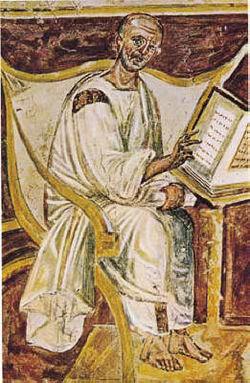
St. Augustine, after years as a Manichaean and skeptic, encountered Platonic texts (likely including Plotinus) in Milan around 385–386 AD through Christian Platonists like Bishop Ambrose and Simplicianus. These writings played a crucial role in his intellectual conversion: they revealed a transcendent, immaterial God as Being itself, the eternal Word/Logos, and the soul's capacity for contemplative ascent beyond the material world—ideas strikingly parallel to the prologue of John's Gospel.
Yet St. Augustine recognized Platonism's crucial limitation: it allowed him to "catch the fragrance" of God but not to "feast" through union, because it lacked the Word made flesh—the incarnate Christ as the true mediator who bridges the gap between the divine and humanity, solving the problem of mediation and purification that Platonism itself raised but could not resolve.
Ultimately, Pecknold presents Platonism as a providential praeparatio evangelica—a promise that raises the restless heart's longing for God, truth, beauty, and eternal happiness—but one fulfilled only in Christianity. St. Augustine adopts and transforms Platonic elements (such as the ideas/forms residing in the divine mind, now identified with the Logos/Christ, and the soul's ascent through purification) while critiquing its errors, especially its inadequate mediators and inability to address incarnation, bodily resurrection, and grace. In this way, St. Augustine shows that Plato comes closest among philosophers to Christianity, yet only the Word made flesh satisfies the hunger Plato so powerfully articulated.
Plato on St. Boethius is up next week!
Get every episode summarized
Each time Ascend - The Great Books Podcast publishes, we email you a written briefing from the transcript — the topics, who appeared, and any specific claims, with the ad reads skipped.
Email me new episodesFree for 3 shows. No card needed.
Hosts & guests
No transcript yet
This episode has not been transcribed. Request it and it moves to the front of the queue.
More episodes
More from Ascend - The Great Books Podcast
Red Shadows: A Savage Tale of Solomon Kane with Alberto Fernandez
Ascend - The Great Books Podcast
Enduring Chill by Flannery O'Connor with Dr. Joseph Boyne
Ascend - The Great Books Podcast
Plato's Ion with Erik Rostad, Dr. Grabowski, and More
Ascend - The Great Books Podcast
Hippias Minor (On the Lie) with Dr. Grabowski and Friends
Ascend - The Great Books Podcast