Loading...
historysocietyculture
Portland lost world’s biggest log cabin in 1964 fire
About this Episode
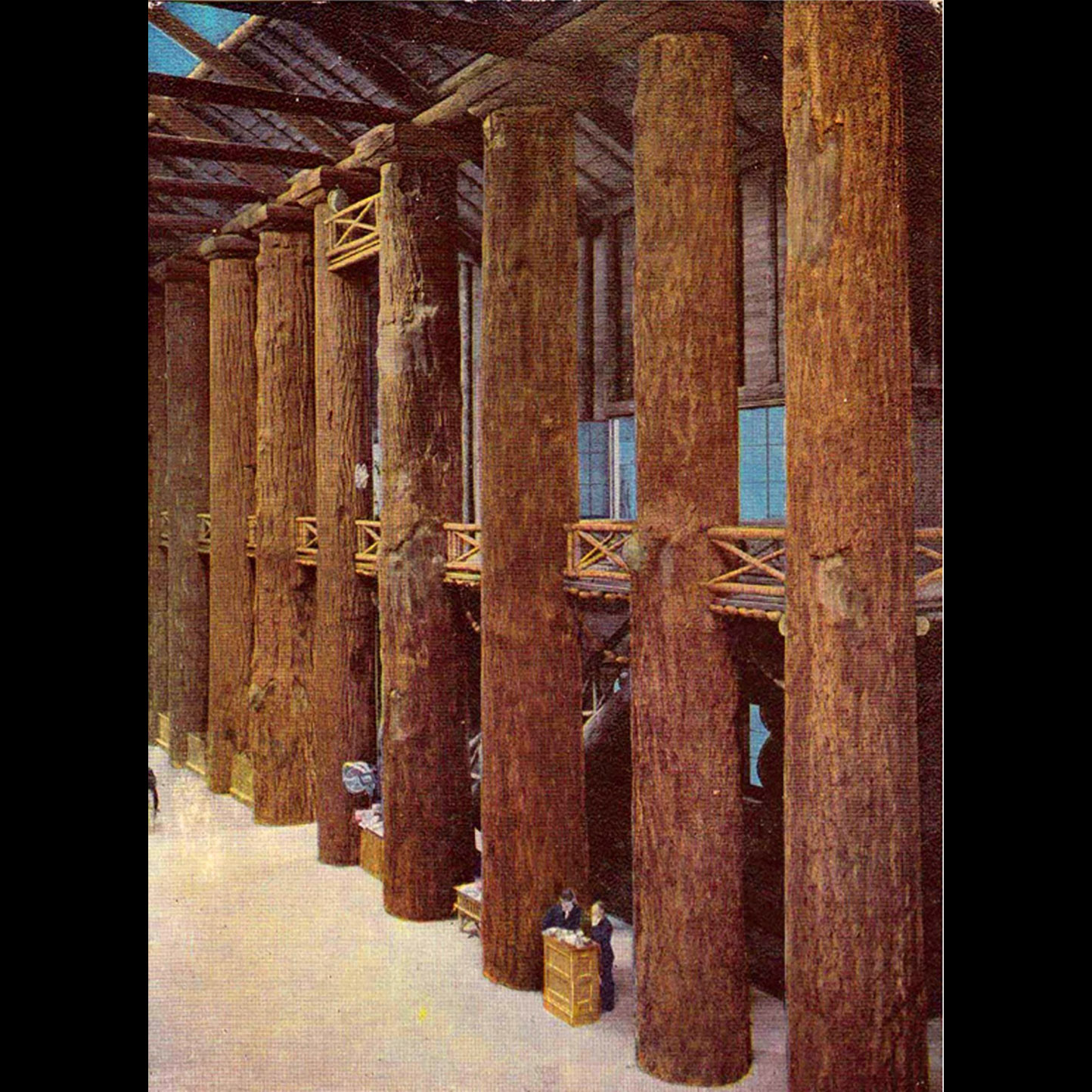
Ancient electrical wiring ignited Portland's legendary Forestry Building, a structure made of massive, flawless old-growth logs that had been built for the Lewis and Clark Exposition in 1905. (Portland, Multnomah County; 1960s) (For text and pictures, see https://offbeatoregon.com/1206c-forestry-building-biggest-log-cabin-burned.html)
Hosts & Guests
Transcript
Good morning, Oregon. I'm Finn J.D. John F.J. at OffbeatOrgan.com, and this is the Daily
Offbeat Oregon History Podcast. Thanks for tuning in, and I hope you enjoy it.
This story was first published on June 17th of 2012 under the headline,
P-Town Lost World's Biggest Log Cabin in a 1964 fire. Here we go. When the Sun
came up on the morning of August 17th, 1964, Oregon was home of the world's
largest log cabin. When the Sun went down that evening, it wasn't, and firefighters
were still battling a blaze that sent flames 10 stories into the air and rained
burning embers the size of apples down on neighboring houses roofs. It was the
granddaddy of all fires in this historic area of Portland, local photographer and
graphic designer Grant Keltner later wrote,
I don't think I'll ever see anything like it again. The cabin was one of the
last two surviving buildings from the 1905 Lewis and Clark Exposition in
Portland, and it sat across the road from Montgomery Park in the Northwest
section of town. It was an enormous structure measuring 206 by 102 feet, just shy
of half an acre, a million-board feet of lumber went into it. By the way, another
building that was part of the Expo, the National Cash Register Company
Exhibition Building, survives to this day. It now houses the St. John's Theatre
and Pub, part of the Minimums Group, back to our story. Portland Timber magnates
Simon Benson, a fella who installed the famous Benson bubbler drinking
fountains in downtown Portland, supplied most of the logs for the structure,
and they were hand-picked old-growth monsters from Columbia County. There
was a great colon aid down the middle of the building made of 52 unpeeled six-foot
thick tree trunks, hand-matched like a string of pearls. They'd had to be
handled specially when they were cut and hauled to preserve their bark. After
the 1905 Exposition, the building was purchased by the City of Portland, which
for many years led it decline in decay. It was nearly lost to fire several times
when embers fell on the roof, either from nearby building fires or wood stove
embers, but quick responses by the fire department kept it going. In the 1940s,
there was talk of actually demolishing the building, which by then had turned
into a safety hazard. The balconies had been built with whole logs, which
had warped, making them dangerous. The whole building was like a banquet hall for
wood-destroying organisms like bark beetles and termites. Finally, in the
1950s, the Chamber of Commerce took up a collection to restore the place.
By this time people were starting to realize it was completely irreplaceable.
Old-growth timber like what had gone into its construction could still be
found, but it was deeper in the forest and less uniform. Finding 52 matching
trees would be prohibitively expensive if not impossible to do, and since the
logs would have to be trucked to the site rather than just floated up the river,
log-handling systems would have to be engineered to prevent the bark from being
scarred by logging equipment. By the time of the state's centennial
celebration in 1959, the building was mostly restored to its former glory.
It now boasted a priceless collection of logging and lumbering exhibits, both antique and
modern, according to an Oregonian report. Also on display was another bit of history.
The first sheet of commercially-produced Douglas Ferpli would ever made, a product of the
Watson family's Portland Manufacturing Company, produced in 1904. All of it went up in flames
on what was surely the biggest and most spectacular single-building structure fire in Portland
history, and until the 1992 burning of the blimp hanger until a mook in Oregon history as well.
On August 17, 1964, the forestry building's caretaker locked up for the night at around 5.30 pm.
Within 45 minutes, neighbors were noticing that something was wrong. Specifically,
the place was on fire, and when the fire crews arrived around 6.15, it was clear that nothing
short of direct divine intervention was going to put it out. There was never a hope of saving
the building, the Oregonian reported the next day. Nothing was saved from the inside.
It turned out that the fire had been started by some bad vintage 195 electrical wiring.
Had it broken out an hour earlier, the caretaker might have seen it in time to raise the alarm
and possibly save the building, but that's not what happened. The fire rapidly grew to spectacular
proportions and people flocked to the scene from all over Portland. Grant Kelton was a boy at the
time living about four blocks from the building. The flames were almost 10 stories high. The fire
eliminated the sky from miles, though the neighborhood was an orange glow, he wrote on his website.
The windows on the entire south side of the Montgomery Park building were blown out.
The heat was so intense that the windows were popping out. Glass was falling down into the streets
below. Ashes, the size of large snowflakes fell to the ground within a mile of the structure.
It was surreal, an amazing sight. Some of the spectators, the Oregonian reported were in tears.
Afterward, the city pulled itself together as best it could. Citizens and civic leaders
got together with timber industry leaders to create the Western Forestry Institute to fill the void.
The new institute soon had a new building roughly the same size as the old one in Washington Park.
Generations of Northwest Oregon's school children remember it from field trips to the zoo,
Amzean Forestry Center. Before Amze, the Oregon Museum of Science and Industry moved to its present
location. So the mission of the forestry building lives on, but as for the building itself,
it was an artifact of a time that is gone and is not coming back. The great heyday of old
growth logging in Oregon. Key sources in this story have included works by Mark Moore at pdxorigan.com,
Grant Keltner at worldforestry.org, and James Andrew Long, author of Oregon Firsts Past and
Present, a book published in 1994.
That's our show for today. Thanks again for listening. This podcast is part of Offbeat Oregon
History, a public history resource for the state we love. Say are you an audiobook listener?
And do you enjoy old pre-war pulp stories like Tarzan of the Apes and Conan the Barbarian and
the Call of Cthulhu and stuff like that? Or do you like early Victorian penny dreadful fiction,
like Sweeney Todd and Varney the Vampire and Highwayman Dick Turpin? If so, you might enjoy the
audiobooks I have out there in the world. The easiest way to find them is for the search for my name
on audible.com. My few music is by the Atlas String Band and was written by Carmen Ficcara.
Listen and download more at AtlasStringBand.com. Episodes of Offbeat Oregon History are uploaded
around 6 a.m. every weekday, so the next one will be on your device and ready to go before you know it.
Until then, go out and fill up the rest of the day with good stuff. Bye now!


